
Research date: July 2, 2026 | OSINT market research on Qualcomm Inc (QCOM, Nasdaq), the mobile chip and patent-licensing franchise betting its next decade on automotive and data-center silicon
Important disclaimer. This is independent OSINT (open-source intelligence) research compiled for educational and informational purposes only. It is not investment advice, not a recommendation or solicitation to buy, sell, or hold any security, and not a statement that any security is suitable for you. The author is not a financial advisor and has no fiduciary relationship with any reader. The rules-based rating below is a research signal, not a directive. All figures are point-in-time (as of July 2, 2026 unless otherwise stamped), press-reported where noted, and move fast. Semiconductor stocks in particular carry cyclical, geopolitical, and customer-concentration risk beyond what any single article can capture. Any bull / base / bear scenarios and the multi-year illustrative valuations are analytical framings and arithmetic on stated assumptions, not price targets, predictions, or guarantees. Do your own due diligence and consult a licensed professional before making any financial decision.
Where this stock could be in 6 months, 1 year, 3 years, and 5 years
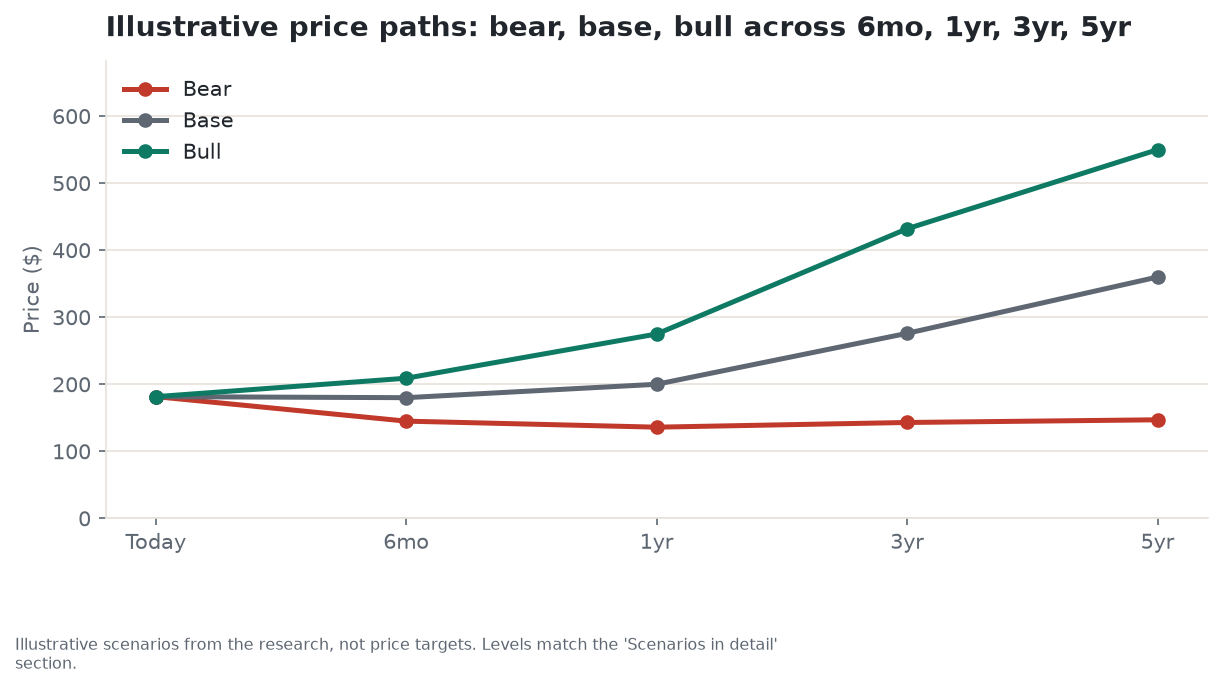
Qualcomm is running two clocks at once, and the ranges below exist because a reader needs to know which clock matters at which horizon. One clock counts down to the day Apple stops buying Qualcomm modems. The other counts up toward whatever automotive, data-center, and IoT revenue arrives to replace it. Every number that follows is arithmetic on stated assumptions, not a prediction.
6 months. The next two datable events are the Q3 and Q4 fiscal 2026 earnings prints, and specifically whether Qualcomm’s own guidance that Chinese handset customer revenue “bottoms” in the third quarter and bounces in the fourth actually happens. Automotive is guided to accelerate to roughly 50 percent year-over-year growth in the same window, a genuine, checkable data point. If the China bounce shows up and automotive keeps compounding, the stock likely treads water near current levels, a base case around $180. If the bounce fails to arrive and Apple’s C2 in-house modem rollout headlines intensify around the iPhone 18 launch, the stock likely re-tests $145 to $155 as the market prices a nearer, steeper earnings cliff. A bull case near $209 needs a clean beat plus a credible data-center proof point at a conference or on the earnings call, something more concrete than a slide. The single thing most likely to flip this window: what Qualcomm’s November guidance implies for fiscal 2027 handset revenue.
1 year. This is the year the Apple modem exit actually shows up in reported numbers rather than in press coverage, so it is the widest range of the four. A base case near $200 assumes the handset decline is managed, roughly 15 percent, with automotive running at a $7-8 billion annualized pace and data center contributing a token $1-2 billion, producing fiscal 2027 non-GAAP earnings per share near $10.50 at a market multiple around 19 times. The bear case near $136 assumes the Apple hole is deeper than modeled (handset revenue down 25 percent or more) with automotive growth decelerating at the same time, pushing earnings toward $8.50 at a compressed 16 times. The bull case near $275 assumes Apple’s exit is slower than feared, because the C3 modem still cannot close the mmWave gap in US iPhones, while automotive and an early data-center contribution lift earnings toward $12.50 at 22 times. The flip: whether the first two quarters of fiscal 2027 show handset revenue declining by $1-2 billion a quarter (manageable) or $2-3 billion a quarter (a genuine cliff).
3 years. By July 2029, Qualcomm’s own investor targets come due, so the structural drivers dominate. A base case near $276 assumes the company delivers roughly two-thirds of its Investor Day targets: data center at $5-8 billion instead of the guided $15 billion-plus, automotive at $8-9 billion instead of $10 billion, IoT near $10 billion. That mix produces earnings near $14.50 at a 19 times multiple, in line with Qualcomm’s own five-year average. The bull case near $432 has the company landing at or near its own targets, with earnings near $18 re-rated to 24 times as the market starts pricing a diversified compute platform rather than a phone chipmaker. The bear case near $143 has data center stuck below $3 billion, automotive undershooting at $6-7 billion, and earnings near $9.50 priced at a 15-times hardware discount, essentially flat from today. The flip: whether a second and third hyperscaler customer follows Meta into Qualcomm’s data-center roadmap by 2028.
5 years. The far horizon is a single question: does the mix shift actually complete? A base case near $360 has Qualcomm as a genuinely diversified compute company, handsets down to roughly a third of chip revenue and automotive, data center, and IoT the other two-thirds, earning around $18 at a 20-times multiple, roughly double today’s price. The bull case near $550 has data center scaling to $15-20 billion and the market re-rating Qualcomm alongside Broadcom as an AI-compute franchise, earnings near $22 at 25 times. The bear case near $147 has the diversification stall out, a smaller handset base after the Apple exit, and a mid-growth hardware multiple of 14 times on earnings near $10.50. The single number to track across the whole period: data-center revenue as a share of the total. Above 15 percent of revenue by fiscal 2030 and the bull is winning; below 5 percent and the bear is.
Where the read lands today. On balance the read holds at Hold. Qualcomm’s licensing moat and its automotive momentum are real and already showing up in the numbers, but the confirmed Apple modem loss and an unproven data-center bet against an entrenched Broadcom and Marvell duopoly keep the risk picture heavier than the valuation discount compensates for. The single thing most likely to flip that read: a real, reported data-center revenue number, even a modest one, arriving well ahead of the 2028 Meta production date the company has guided to.
Companion tool
Jump to the interactive dashboard to sort and filter every company in the piece, or download the Excel model to flex the scenarios yourself.
TL;DR
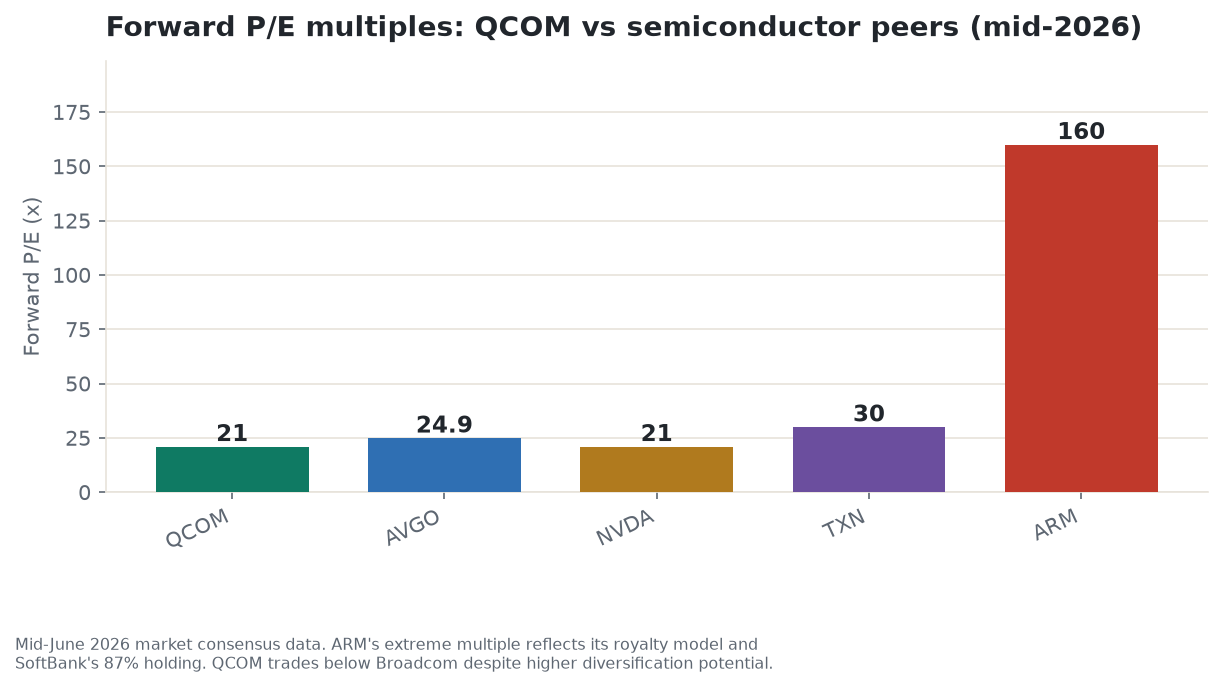
Qualcomm makes money two structurally different ways, and understanding which one is under threat is the whole story. QCT, the chip-design business, sold $9.08 billion of Snapdragon silicon in the March quarter, split between a shrinking handset line ($6.02 billion, down year over year as Apple builds its own modems) and a fast-growing automotive and IoT line ($1.33 billion and $1.73 billion, the former up 38 percent). QTL, the patent-licensing business, collected $1.38 billion at a 72 percent pre-tax margin, a toll it charges on nearly every cellular device sold globally regardless of whose chip is inside, including phones Qualcomm never touched. The bear case is concrete and dated: Apple’s in-house C2 modem ships in most international iPhone 18 models this year, with a full replacement targeted for 2027, an analyst-estimated $7.3-7.8 billion annual revenue hole once complete. The bull case is that automotive (a $65 billion design-win pipeline, guided to grow roughly 50 percent next quarter) and a brand-new, Meta-anchored data-center push (near zero revenue today, an investor-day target above $15 billion by fiscal 2029) arrive in time to fill it. The stock trades around 21 times forward earnings, a discount to Broadcom’s 25 times and roughly in line with Nvidia, because the market is assigning close to zero value to the data-center bet succeeding. The single biggest risk is that the math does not line up in time: Apple’s exit is a 2027-2028 event, automotive design wins take two to four years to become revenue, and Qualcomm’s last attempt at a data-center chip, in 2017, failed and was shut down within two years.
Explore it yourself: the interactive dashboard
Open the dashboard in a full screen
What Qualcomm actually does
Every company sells something. Qualcomm sells two different things that happen to share a logo, and the confusion between them is where most of the disagreement about this stock lives.
The first business is ordinary, in the sense that any chip company would recognize it: Qualcomm designs semiconductors, has another company manufacture them, and sells the finished part to a phone-maker, an automaker, or a PC brand. This is QCT, for Qualcomm CDMA Technologies, and it is roughly 87 percent of the company’s revenue. It behaves like a normal, competitive hardware business: margins depend on winning design slots against rivals, prices get squeezed at the low end, and a customer that decides to build its own chip can simply walk away.
The second business has no real analogue in most industries. Qualcomm holds foundational patents on the cellular standards, 3G, 4G, and 5G, that essentially every phone on earth uses to connect to a network. Because those patents are “standard-essential,” meaning you cannot build a legally compliant cellular device without infringing them, Qualcomm collects a royalty on nearly every cellular phone sold globally, whether or not that phone contains a single Qualcomm chip. This is QTL, for Qualcomm Technology Licensing, and it posted a 71.9 percent pre-tax margin on $1.38 billion of revenue in the March 2026 quarter, versus 27.2 percent for QCT on $9.08 billion. Think of it as the difference between running a toll road and running a trucking company: the trucking company competes on price and service every single day; the toll road just collects, rain or shine, from every truck that uses the road, including trucks it does not own.
That structural difference explains almost everything else in this article. QCT’s fortunes rise and fall with the smartphone cycle, with Apple’s decisions, and with how good MediaTek’s chips are this year. QTL’s fortunes rise and fall with how enforceable the patents remain and how many cellular devices exist in the world, a number that only grows. Qualcomm’s stock price is, in effect, the market’s best guess at how those two very different engines net out, plus, as of mid-2026, a small and contested amount of credit for whether a third engine, data-center silicon, will exist at all in three years.
How the money flows
flowchart TD
    TOP["End consumers: phones, cars, PCs, IoT devices<br/>China ~46% of QCOM FY2025 revenue"]
    TOP --> OEM["OEMs: Samsung / Xiaomi / Oppo-Vivo<br/>Mercedes / BMW / GM (each 10%+ concentration risk)"]
    OEM --> QCT["Qualcomm QCT: Snapdragon chip design<br/>Q2 FY26 rev $9.08B, EBT margin 27.2%"]
    OEM --> QTL["Qualcomm QTL: cellular patent licensing<br/>Q2 FY26 rev $1.38B, EBT margin 71.9% (toll booth)"]
    QTL -.->|"royalty owed regardless of chip supplier"| MTK["MediaTek / Apple in-house / HiSilicon chips"]
    QCT --> ARMB["Arm: architecture license (v9 ISA)<br/>Qualcomm won the 2024-2025 licensing dispute"]
    QCT --> TSMC["TSMC: sole leading-edge fab (3nm/4nm/5nm)<br/>Top-10 customer, squeezed by AI/data-center demand for capacity"]
    TSMC --> OSAT["OSAT packaging/test: Amkor / ASE / JCET<br/>over 60% of global OSAT revenue, Asia-concentrated"]
    OSAT --> OEM
    QCT -.->|"competes with"| RIVALS["MediaTek 32% share / Samsung Exynos / Apple silicon"]
    TOP -.->|"policy overlay"| POLICY["US Section 232 tariff (25%, narrow scope, Jan 2026)<br/>Huawei export license revoked May 2024"]
Read this top to bottom, because the shape of it is the investing point. Money starts with an end consumer buying a device, a phone, a car, a laptop, a factory sensor, and that spend flows first to an original equipment manufacturer: Samsung, Xiaomi, the Oppo-Vivo-OnePlus family on the phone side, or Mercedes-Benz, BMW, and General Motors on the automotive side. In fiscal 2025, Apple, Samsung, and Xiaomi each individually accounted for 10 percent or more of Qualcomm’s consolidated revenue, which means a small handful of very large device brands function as gatekeepers for the biggest single line item in the business, handset chips.
Roughly two-thirds of what an OEM spends on Qualcomm content lands in QCT, the chip-design business, in exchange for a Snapdragon mobile processor, a Snapdragon Digital Chassis automotive platform, or a Snapdragon X PC chip. QCT does not own a factory. Every Snapdragon die is fabricated by TSMC in Taiwan, using Arm’s licensed instruction-set architecture as the CPU blueprint, then shipped to an outsourced assembly and test house, historically Amkor for RF and packaging work, before final device assembly at the OEM. Qualcomm is a meaningful TSMC customer, but industry reporting places it as a top-10 account rather than in TSMC’s highest-priority anchor tier alongside Apple and Nvidia, and as AI and data-center customers increasingly compete for the same advanced-node wafers, Qualcomm and MediaTek are the ones reporting tighter allocation, not the ones setting the terms.
The second flow runs in parallel and does not care which chip ended up in the phone. QTL collects a royalty, published at 2.275 percent of wholesale price for 5G-only devices and 3.25 percent for multimode 3G/4G/5G devices (capped at a $500 wholesale price, so roughly $16.25 is the most Qualcomm can collect on any single handset), from essentially every OEM selling a cellular device anywhere in the world. That includes phones running MediaTek chips, phones running Samsung’s own Exynos silicon, and historically, phones running Huawei’s HiSilicon chips. It is the closest thing to a pure toll in the semiconductor industry, and it is why Qualcomm is never valued as a plain commodity chipmaker even when QCT’s competitive position looks shaky.
Geography stacks risk at both ends of this chain. Roughly 46 percent of Qualcomm’s fiscal 2025 total revenue traces to China and Hong Kong customers, and effectively all of its leading-edge chip fabrication runs through TSMC in Taiwan. A narrowly-scoped 25 percent Section 232 tariff on certain advanced logic semiconductors took effect in mid-January 2026, and while it currently appears to spare most mainstream Qualcomm mobile chips, the administration explicitly reserved the authority to broaden it. A single strait, a single fab customer, and a handful of phone brands sit in the middle of nearly every dollar this company earns.
The Snapdragon lineup: a field guide
Qualcomm’s product line has grown well past “the chip in your Android phone.” Here is what each piece actually is.
Snapdragon 8 Elite (flagship mobile). The top-tier mobile platform: the highest-performance modem, CPU, GPU, and on-device AI accelerator Qualcomm builds, priced at roughly $100-200 or more per unit to the OEM. This is where Qualcomm’s pricing power is strongest, because Samsung, Xiaomi, and Oppo have limited alternatives for a premium Android chip with best-in-class 5G modem performance. The Snapdragon 8 Elite Gen 6, moving to a 2-nanometer TSMC process alongside Apple’s next chip and MediaTek’s Dimensity 9600, is press-reported to launch in the second half of 2026 as a genuine technology race, not a Qualcomm-specific edge.
Snapdragon mid-range and entry (7-series, 4-series). Priced roughly $15-30 for entry parts up to around $50-80 for upper mid-range, this tier is where Qualcomm competes least comfortably. MediaTek’s Dimensity line offers comparable performance at a lower price, and the gap has widened: Qualcomm’s global smartphone chipset shipment share fell to 23 percent in the first quarter of 2026 from 27 percent a year earlier, per Counterpoint Research, while MediaTek held the top spot at 32 percent, down from 38 percent. Both companies lost share in unit terms because a DRAM and NAND memory-cost shock raised device bills of materials and hit entry and mid-tier volumes hardest, a demand shock that started two supply-chain stages away from Qualcomm’s own chip business and still suppressed its shipments.
Snapdragon Digital Chassis (automotive). A bundled platform covering cockpit infotainment, connectivity, and increasingly ADAS (advanced driver-assistance systems), sold to automakers at a far higher price point than mobile, an estimated $500 to $2,000-plus per vehicle depending on the bundle. Design wins across more than 40 automakers, including Mercedes-Benz, BMW, General Motors, Stellantis, Hyundai, Volvo, Nio, Li Auto, and Xpeng, add up to a cumulative pipeline Qualcomm put at $65 billion at its June 2026 Investor Day. The catch is time: automotive design-in to production cycles typically run two to four years, so today’s pipeline converts to revenue on a multi-year lag, not the next quarter.
Snapdragon X (PC, Windows on Arm). Qualcomm’s attempt to put a mobile-derived chip into laptops, competing against Intel and AMD’s x86 architecture. The company’s own claim, roughly 10 percent of United States premium ($800-plus) Windows retail laptop sales, and an IDC-sourced figure of about 0.65 percent of global commercial PC unit shipments, are both accurate for their own definitions. They describe very different markets (a narrow, high-end US retail slice versus the entire worldwide commercial fleet), and the honest takeaway is that Snapdragon X remains a real niche rather than a mainstream PC platform, limited mostly by how much enterprise software still assumes x86 compatibility.
AI200, AI250, and the Dragonfly C1000 CPU (data center, the newest and least-proven line). Announced in October 2025, the AI200 and AI250 are inference accelerators aimed at AI data centers, pitched on power efficiency rather than raw throughput. At its June 2026 Investor Day, Qualcomm added a server CPU (Dragonfly C1000), an AI300 accelerator, and a “High-Bandwidth Computing” architecture, anchored by a multi-generation partnership with Meta for data-center CPUs with production slated for 2028, and the roughly $3.92 billion, all-stock announced acquisition of AI software company Modular, intended to build a software layer that could compete with Nvidia’s CUDA ecosystem. None of this has produced meaningful revenue yet.

Who wins where
Group the competitive landscape by what kind of economics each player actually captures, because “chip company” is too blunt a label to be useful here.
The toll-takers. QTL is Qualcomm’s own toll booth, collecting on cellular devices regardless of chip supplier. Above Qualcomm in its own supply chain sits Arm, which licenses the instruction-set architecture nearly every Qualcomm CPU core is built on and functions as an upstream chokepoint in its own right; Qualcomm won a Delaware court fight over the scope of its Arm license in late 2024 and 2025 after Arm attempted to force a richer, device-price-based royalty and briefly moved to cancel Qualcomm’s license outright, per Qualcomm’s own investor-relations statement describing the outcome as a complete win, though a separate countersuit Qualcomm brought against Arm was still headed to trial as of early 2026 and its outcome had not been reported as of this writing.
The premium-tier leaders. Qualcomm holds the performance edge in flagship Android modems and integrated SoCs (system-on-chip designs combining CPU, GPU, modem, and AI accelerator on one die), the reason Samsung and Chinese OEMs still pay up for Snapdragon at the top of the range even as MediaTek closes the gap lower down. Apple sits in its own category, the only major phone brand vertically integrating its silicon entirely in-house, and is in the process of doing to Qualcomm’s modem business exactly what it already did to Intel’s.
The volume and value competitors. MediaTek is the shipment-share leader by unit volume and increasingly credible at the flagship tier, but it lacks Qualcomm’s licensing moat and carries even higher China customer concentration. Samsung’s own Exynos chips and China’s Unisoc and HiSilicon lines compete at the commodity end, where Qualcomm is a price-taker rather than a price-setter.
The data-center incumbents Qualcomm must dislodge. Nvidia dominates AI training and much of inference through its CUDA software ecosystem. Broadcom and Marvell together hold roughly 95 percent of the custom AI ASIC co-design market, the very market Qualcomm’s Dragonfly, AI200/AI250, and Meta partnership are trying to enter. This is an entrenched duopoly, and Qualcomm’s history here is not blank: it tried a data-center CPU once before, the Centriq 2400 in 2017, and shut the entire server-chip division down within about eighteen months after failing to gain traction against Intel’s then-dominant share.
The regulatory and geographic risk names. Intel is both a competitor (in automotive ADAS through Mobileye, and in PC chips) and, separately, a reminder of how fast an incumbent’s position can erode. HiSilicon and Unisoc represent a genuinely different risk category: Chinese industrial policy actively favors domestic silicon substitution, and neither company licenses Qualcomm’s cellular patents the way a Western OEM’s chip supplier would, meaning both the QCT sale and, potentially, the QTL royalty are at risk on any device that migrates to them. Texas Instruments sits adjacent as an analog and embedded-processor leader in the same automotive and industrial end markets Qualcomm is chasing, though on different silicon.
Company by company: who’s who
Qualcomm Inc (QCOM, Nasdaq, market cap approximately $192 billion as of July 2, 2026). The only company that both designs competitive 5G modems and collects royalties on nearly every 3G/4G/5G device sold globally. Q2 fiscal 2026 revenue was $10.6 billion, with automotive up 38 percent year over year to a record $1.33 billion and the June 2026 Investor Day raising the fiscal 2029 non-handset revenue target to $40 billion. Bull: Automotive’s $65 billion design-win pipeline, a new Meta data-center partnership, and on-device AI inference diversify the company away from phones before the Apple modem loss fully lands, at a discount valuation to semiconductor peers. Bear: The confirmed Apple modem exit, a smartphone SoC share that has fallen from 27 percent to 23 percent in a year, 46 percent revenue concentration in China, and a data-center push that is unproven against an entrenched duopoly.
Broadcom (AVGO, Nasdaq, market cap approximately $1.8 trillion). The benchmark for what a successful pivot to custom AI silicon looks like, pairing a dominant custom-ASIC co-design business with a high-margin VMware software annuity. Bull: Hyperscaler wallet share is expanding as Google, Meta, and ByteDance in-source GPU alternatives, and the software business is a recurring, roughly 79 percent-margin annuity. Bear: Customer concentration sits in three or four hyperscalers, and design wins are lumpy.
Marvell Technology (MRVL, Nasdaq, market cap approximately $215 billion). The number-two custom-silicon designer behind Broadcom, with data center representing 82 percent of its revenue and a March 2026 $2.0 billion preferred-stock investment from Nvidia adding credibility to its position in the XPU ecosystem. Bull: Nvidia’s endorsement plus an accelerating hyperscaler design-win pipeline make Marvell the cleanest pure-play on custom AI silicon after Broadcom. Bear: Roughly 82 percent of revenue concentrated in its top ten customers, with customer in-sourcing disclosed as a rising risk, at a valuation (about 81 times non-GAAP earnings) that prices the entire data-center thesis as close to certain.
Intel (INTC, Nasdaq, market cap approximately $340 billion). A mid-turnaround x86 and foundry business betting its next process node, 14A, on winning external customers. Bull: The only US-owned leading-edge foundry with government and strategic-investor backing, positioned for a potential re-rating if a marquee external 14A customer signs. Bear: The foundry business is losing roughly $10 billion a year, server CPU share continues eroding to AMD, and the stock has run well ahead of the sell-side consensus target on a thesis that has not yet converted into a signed external customer.
MediaTek (MDTKF, OTC / 2454.TW primary, market cap approximately $150 billion). The global smartphone chipset shipment leader by volume, dominant in mid-range Android and pushing harder into the premium tier and automotive. Bull: Volume leadership, an aggressive premium-tier push with the Dimensity 9400/9600 series, and diversification into automotive and AI edge silicon, all at a cheaper valuation than Qualcomm. Bear: Concentrated in mid-range Android exactly where entry-level demand has been softest, without Qualcomm’s licensing moat, and with even higher China customer concentration.
Arm Holdings (ARM, Nasdaq, market cap approximately $370 billion). The near-universal CPU instruction-set architecture licensor for mobile and embedded chips, and increasingly for data-center CPUs. Bull: An essentially irreplaceable architecture toll on billions of cumulative chips, mixing into higher-royalty Armv9 licenses and expanding into data-center CPU designs. Bear: At roughly 160 times forward earnings, the valuation embeds very little room for error; royalty revenue growth has decelerated, SoftBank’s 87 percent ownership stake limits the public float, and the 2024-2025 Qualcomm litigation showed courts will push back on Arm’s pricing ambitions.
Nvidia (NVDA, Nasdaq, market cap approximately $4.6 trillion). The dominant AI compute platform and the incumbent Qualcomm’s data-center ambitions must eventually contend with. Bull: A near-monopoly in AI training compute with a deeply entrenched CUDA software moat and expanding inference share. Bear: Custom ASICs from Broadcom and Marvell are eating share at the margin, and any pause in AI infrastructure spending would hit a valuation priced for continued acceleration.
Texas Instruments (TXN, Nasdaq, market cap approximately $273 billion). The largest analog semiconductor maker globally, serving the same automotive and industrial end markets Qualcomm is chasing, with a structural 300-millimeter wafer cost advantage. Bull: The strongest analog franchise in the industry, approaching a free-cash-flow inflection as its capital-spending cycle steps down, with more than two decades of dividend growth. Bear: The richest peer multiple in this comparison set at roughly 30 times forward earnings, roughly half its ship-to revenue tied to China, and a cycle recovery that is still early rather than confirmed.
What the filings say
Qualcomm reports three segments: QCT (chips), QTL (licensing), and QSI (strategic investments, minor), plus a small non-reportable Data Center line that does not yet move the total.
Revenue and segment mix. Total revenue in the quarter ended March 29, 2026 was $10,599 million. Within QCT’s $9,076 million, handsets were $6,024 million, down from $6,929 million a year earlier, automotive was $1,326 million, up 38.3 percent from $959 million, and IoT was $1,726 million, up 9.2 percent from $1,581 million. QTL added $1,382 million. For the full fiscal year 2025, company-reported revenue was $44.3 billion, with a gross margin around 55.4 percent and a GAAP operating margin around 27.9 percent.
Margins tell the segment story on their own. QCT’s pre-tax margin was 27.2 percent in the March quarter; QTL’s was 71.9 percent. The gap is structural, not cyclical: QTL is essentially a legal and licensing operation with minimal incremental cost, while QCT carries the full weight of TSMC wafer costs, R&D, and competitive pricing pressure. QTL’s dollar revenue has held roughly flat at $5.3-5.6 billion a year for three straight fiscal years even as it shrinks as a share of the total (from about 14.8 percent of revenue in fiscal 2023 to about 12.7 percent in fiscal 2025), a byproduct of QCT’s automotive and IoT growth outpacing it, per a third-party tally of the company’s own segment filings.
Reported earnings need a footnote. GAAP diluted earnings per share for the March quarter were $6.88, but that figure is inflated by a one-time $5,138 million income tax benefit and is not a useful run-rate number; non-GAAP EPS around $2.60 for the quarter is the comparable figure.
R&D intensity is genuinely high. Research and development spending was $2,463 million in the quarter, about 23 percent of revenue, funding next-generation Snapdragon, automotive platforms, and the new AI inference and data-center lines. This level of R&D spend is itself part of the moat: staying ahead in modem and SoC intellectual property requires it every generation.
Cash flow and capital returns are aggressive. Free cash flow for fiscal 2025 ran approximately $12.8 billion, per third-party data aggregation of the company’s cash-flow statements. Qualcomm bought back $5.4 billion of stock in the first half of fiscal 2026 alone and announced a new $20 billion repurchase authorization alongside its March-quarter results. The quarterly dividend stands at $0.92 per share ($3.68 annualized, a yield around 2.0-2.1 percent as of July 2, 2026), extending a 21-year streak of consecutive annual increases at a payout ratio around 35-40 percent of non-GAAP earnings, comfortably covered.
The balance sheet is investment grade. Cash, equivalents, and marketable securities stood at $9,799 million as of the March quarter, down from $12,478 million at fiscal year-end 2025, partly a mechanical effect of releasing restricted cash tied to the Alphawave acquisition. Total debt was $15,270 million, for net debt around $5.5 billion, against a Moody’s A2 rating.
M&A has been busy and, in one case, dilutive. Qualcomm completed its roughly $2.4 billion acquisition of connectivity-IP company Alphawave Semi in December 2025, ahead of schedule. In June 2026, alongside the Investor Day, it announced an agreement to acquire AI software infrastructure company Modular for approximately $3.92 billion, to be funded through a private placement of up to 19.2 million new Qualcomm shares, roughly 1.8 percent of shares outstanding, a real dilution consideration press coverage flagged as one reason the stock’s post-announcement pop did not hold.
Ownership and customer concentration. Institutional ownership runs around 77.9 percent, insiders around 2.6 percent, and retail around 19.5 percent, per third-party ownership data. In its fiscal 2025 10-K, Qualcomm disclosed that Apple, Samsung, and Xiaomi each individually accounted for 10 percent or more of consolidated revenue, the standard customer-concentration language, and the one most consequential given Apple’s active modem-replacement program. On the insider side, chief financial officer Akash Palkhiwala sold 2,500 shares on June 11, 2026 across a pre-arranged trading plan, a transaction size press coverage noted was roughly four times his typical trade, worth about $493,000; it was executed under a Rule 10b5-1 plan adopted in December 2025, a standard pre-scheduled selling arrangement, though the size and timing near the stock’s local high is worth flagging rather than dismissing.
Guidance and disclosed risk factors. Q3 fiscal 2026 guidance calls for total revenue of $9.2-10.0 billion, QCT revenue of $7.9-8.5 billion (handset around $4.9 billion, automotive growth around 50 percent year over year, IoT growing high-single digits), QTL of $1.15-1.35 billion, and non-GAAP diluted earnings per share of $2.10-2.30. The 10-K and 10-Q explicitly disclose, in the company’s own words, vertical integration by Apple and Samsung as an ongoing risk to QCT revenue, the expired and unrenewed Huawei licensing agreement (no further Huawei revenue is assumed in guidance, following the US Commerce Department’s May 2024 revocation of Qualcomm’s export license), China revenue concentration, TSMC sole-source fabrication dependency, competition from MediaTek and the long-term prospect of RISC-V as an alternative to Arm-based designs, tariff and export-control exposure, and the dilution from the pending Modular transaction.
What the market is paying
As of July 2, 2026, Qualcomm traded around $181.53 a share, with the 52-week range spanning $121.99 to $259.92 (the quote above this article is current and self-updates; treat any specific price cited here as a dated snapshot). The stock is down somewhere in the 26-30 percent range from its 2026 intraday high, a figure that has moved as the stock has kept drifting since a mid-June tally put it at 26 percent; the wider figure reflects the additional decline into early July.
Performance has been a story of two very different windows. Over the trailing year, QCOM is up roughly 49 percent from a July 2025 base near $122, comfortably ahead of the S&P 500’s roughly 21 percent gain over the same period. But the more recent windows tell the opposite story: the stock is down an estimated 5-8 percent over the trailing month and 15-20 percent over the trailing three months, as the market gave back the early-2026 rally and then erased most of the June 24 Investor Day pop. Multi-year return figures vary meaningfully by data source and start date (one tally puts the five-year total return near 109 percent, another closer to 30 percent), a genuine discrepancy in dividend-reinvestment assumptions and start-date conventions rather than a single clean number, so it is fairer to describe the five-year path as choppy and cycle-driven than to cite one precise figure.
Valuation sits at a discount to the names benefiting most from AI infrastructure spending. Qualcomm’s forward price-to-earnings ratio was around 20.9 times as of early July 2026, per stockanalysis.com, modestly above its own five-year average of 18.6 times but well below Broadcom’s roughly 25 times, in line with Nvidia’s roughly 21 times (on a revenue base several times larger), and far below Arm’s roughly 160 times. Price-to-free-cash-flow runs around 15 times on fiscal 2025 free cash flow of roughly $12.8 billion, an attractive multiple for a business generating that much cash. The clearest way to read this: the market is pricing Qualcomm as if its data-center ambitions are worth close to nothing today, which means any credible proof of execution has real room to re-rate the multiple, while any confirmation that the Apple hole is worse than modeled has room to compress it further.
Liquidity and positioning are unremarkable in a way that matters. Average daily volume runs an estimated 8-12 million shares, and short interest sits around 4.24 percent of float with roughly two days to cover, a modest short position rather than a crowded one, per Finviz data. Analyst sentiment has been cautiously repositioning: TipRanks tallies a consensus Hold rating from roughly 32 analysts (about 10 buy, 19 hold, 3 sell), with average 12-month price targets clustering somewhere in the $182-220 range depending on the aggregator and individual targets spanning as wide as $100 to $300, a dispersion that reflects genuine, unresolved disagreement about how much of the Apple hole gets offset rather than any calculation error. Morgan Stanley’s June 25 upgrade from Underweight to Equal-weight, with its price target moving from $146 to $231, is the most visible single data point in that repositioning, though even that upgrade came paired with a caveat that the fiscal 2029 data-center target reads as more aspirational than achievable.
What the crowd is saying
The retail and news narrative around Qualcomm in mid-2026 has been genuinely split between two stories running at the same time, and reading only one of them will mislead you.
The dominant story through May and early June was the Apple modem cliff. Analyst downgrade notes circulated, framing a multi-billion-dollar annual revenue exposure once Apple’s in-house modem fully replaces Qualcomm’s, and by some measures the stock had its worst month in seven years. Then the June 24 Investor Day flipped the narrative hard, at least briefly: the $15 billion-plus fiscal 2029 data-center target, the doubled $40 billion non-handset revenue goal, the Meta partnership, and the Modular acquisition sent the stock up as much as 15 percent in after-hours trading, and retail message volume on StockTwits surged an estimated 550 percent in the 30 days leading into the event, a genuine and datable attention spike even if the exact sentiment shift it represents is softer to quantify. The enthusiasm did not last: by June 26 the stock had given back roughly 5 percent, as sell-side commentary (including from Morgan Stanley, in the same note that upgraded the stock) flagged the data-center targets as more aspirational than proven, and the broader semiconductor sector cooled. On July 1, a rumor that SpaceX was building an AI phone using Snapdragon chips, which Elon Musk publicly and explicitly denied, briefly moved the stock before reversing into a fourth consecutive down day, a reminder that retail positioning here is currently reactive rather than convinced, held lightly enough to swing on a celebrity denial of a rumor that had nothing to do with Qualcomm’s actual business.
The most useful thing in the sentiment data is where the crowd’s framing diverges from the filings. Retail and headline coverage treats the Apple exit as an immediate, existential event; the actual timeline, per the company’s own guidance and press reporting of management commentary, is a 2027-2028 transition, not a 2026 one, and Qualcomm’s automotive business is already compounding in the reported numbers rather than sitting as a slide-deck promise. At the same time, the crowd has arguably not fully absorbed how much of the fiscal 2029 diversification target is genuinely unproven: data center is going from roughly zero revenue today to a $15 billion-plus goal in three years, a scale of ramp Qualcomm has not achieved in any adjacent category before, and its own prior attempt at a data-center chip, the Centriq line, was shut down within about eighteen months of launch in 2017-2018. Employee sentiment on Glassdoor (3.8 out of 5 stars across nearly 11,000 reviews, with 73 percent willing to recommend the company but recent reviews citing layoffs and stalled advancement) reads as organizational cost-cutting stress rather than growth euphoria, a soft but consistent signal that this transition is not costless internally either.
Manipulation and hygiene checks came back clean. There is no evidence of coordinated pump activity, thin-float hype, or paid amplification around either the Investor Day rally or its reversal; the pattern is consistent with genuine, if headline-reactive, retail interest followed by ordinary sell-side skepticism. The one real hygiene flag is how easily the stock moves on pure noise, the July 1 SpaceX denial being the clearest example, which says less about Qualcomm’s fundamentals and more about how lightly the current shareholder base is holding its position.
Can the diversification outrun the Apple cliff?
Strip away the noise and the durability question comes down to a race with a visible finish line and a visible clock.
The structural case for Qualcomm surviving the transition is genuinely strong. QTL’s patent moat does not depend on Qualcomm winning any particular design slot; it collects regardless. Automotive content per vehicle is rising sharply and structurally, as cars shift from a $50-100 infotainment chip to a $500-2,000-plus ADAS and cockpit platform, and that shift does not reverse even if a particular quarter’s vehicle sales soften. The design-win pipeline (over 40 automakers, $65 billion cumulative) suggests the demand side of that bet is largely settled; what remains uncertain is conversion timing and rate, not whether the market exists. On the data-center side, the opportunity is real in the sense that inference workloads are growing and power efficiency genuinely matters at scale, and a named anchor customer (Meta) is a meaningfully stronger starting position than a pure R&D bet with no committed buyer.
The cyclical and structural bear case is just as real, and it has a specific trigger and timing. Apple’s C2 modem ships in most international iPhone 18 models in 2026, and the C3 modem targeted for 2027 is aimed at closing the last technical gap (millimeter-wave support) that currently keeps a Qualcomm modem in US iPhone models. Analyst estimates, not company-disclosed figures, put the full annual exposure once that transition completes at $7.3-7.8 billion of modem and RF revenue, materializing across fiscal 2027 and 2028. That timing lands squarely inside the same window automotive’s design-in cycle needs to convert its pipeline and data center needs to move from roughly zero revenue to something material. If the conversion is slow, and automotive design cycles have historically run two to four years for a reason (automakers do not compress vehicle development timelines to help a chip supplier’s narrative), there is a real, dateable window, roughly mid-2027 through 2028, where Apple’s revenue is largely gone and the replacement businesses have not yet scaled to cover it. Layer on top of that a genuinely competitive threat at the premium Android tier too: Samsung has reportedly begun putting its own Exynos 2600 chip into 25-30 percent of Galaxy S26 units, a direct share loss at Qualcomm’s most important remaining Android customer, and China’s Unisoc and HiSilicon continue improving domestically.
The most likely outcome, on the evidence assembled here, is a genuine squeeze rather than a clean win or a collapse. Automotive probably delivers real, growing revenue, but likely below the guided $10 billion fiscal 2029 target rather than at or above it, because design-win pipelines convert at less than 100 percent and automakers routinely delay platform launches. Data center probably ships some revenue by 2028 as Meta’s production ramps, but a first-generation product against an entrenched Broadcom and Marvell duopoly is unlikely to hit the guided $15 billion run rate on the guided timeline. QTL almost certainly holds its dollar revenue roughly flat, the closest thing to a sure thing in this analysis, because the legal moat does not depend on execution the way the growth businesses do. The net effect is a company that is diversifying in the right direction but on a slower and lumpier timeline than its own Investor Day slides suggest, which is precisely why the current discount valuation, rather than a premium one, is the more defensible starting point for a reader weighing this stock today.
The scenarios in detail
The driver tree
Four variables decide where Qualcomm lands over the next five years; the horizon paths above are just different settings of these same four dials.
-
Apple modem offset rate. Apple’s C2 modem ships in most international iPhone 18 markets in 2026, with C3 aiming for a full Qualcomm replacement by 2027. Analyst estimates put the annual revenue exposure at $7.3-7.8 billion (modem plus RF), not a company-disclosed figure. How fast this cliff arrives, and how much Qualcomm replaces through other channels, is the single most consequential variable.
-
Automotive ramp execution. Automotive revenue was $1.33 billion in the March 2026 quarter, up 38 percent year over year, guided to accelerate to roughly 50 percent growth the following quarter. The design-win pipeline stands at $65 billion, against a fiscal 2029 company target of $10 billion in revenue. Because design-in to production cycles run two to four years, pipeline-to-revenue conversion is the key uncertainty, not whether underlying demand exists.
-
Data-center entry success. Qualcomm has near-zero data-center revenue today. The fiscal 2029 target is above $15 billion, anchored by the multi-generation Meta partnership (production slated for 2028) and the Modular acquisition. Broadcom and Marvell together hold an estimated 95 percent of the custom AI ASIC co-design market. This is the highest-upside, highest-risk variable, and the one with the least precedent, given Qualcomm’s own failed 2017-2018 attempt at a data-center CPU.
-
China trade policy trajectory. China and Hong Kong made up 46 percent of fiscal 2025 revenue. Further export controls, a broadened tariff (Section 232 is narrowly scoped today), or accelerated domestic-substitution mandates would each hit Qualcomm at a different point in the same chain. QTL provides partial insulation because it collects regardless of chip supplier, but QCT’s China revenue is directly exposed.
Bull case (estimate)
Apple’s modem transition runs slower than feared, with US iPhone models retaining a Qualcomm modem through 2027 because of the mmWave gap, keeping the net revenue cliff closer to $5 billion than $7-8 billion, while QTL keeps collecting royalties on all Apple devices regardless. Automotive converts its $65 billion pipeline faster than guided, reaching $10 billion-plus by fiscal 2029 and $15 billion by fiscal 2031. Data center executes: Meta production starts on schedule in 2028, two or three additional hyperscaler customers sign on, Modular’s software layer becomes a credible inference alternative, and data-center revenue reaches $12-15 billion by fiscal 2029 and $20 billion-plus by fiscal 2031. China stabilizes, with the Section 232 tariff staying narrowly scoped and Chinese OEMs continuing to use Snapdragon at the premium tier where no domestic alternative matches its performance. Under these assumptions, fiscal 2027 revenue reaches roughly $47 billion with earnings near $12.50; fiscal 2029 revenue reaches $65-70 billion with earnings near $18, hitting the company’s own Investor Day target; fiscal 2031 revenue reaches $80-90 billion with earnings near $22. Applying a 24-times multiple at fiscal 2029 (reflecting a partial re-rating toward data-center peer multiples) implies roughly $432; a 25-times multiple at fiscal 2031 implies roughly $550. What has to be true: data center actually ships revenue, not just press releases, Meta’s 2028 production start holds, at least one more hyperscaler validates the platform, and Apple’s C3 modem underperforms on mmWave for long enough to keep Qualcomm inside US iPhones through 2028. The single thing most likely to break it: a hyperscaler cancels or delays its CPU program after initial samples underperform Nvidia or Broadcom alternatives, since Qualcomm has no fallback customer base in this market yet.
Base case (estimate)
Apple’s transition plays out roughly as guided, with $6-7 billion of annual revenue lost across fiscal 2027-2028, partially offset because QTL royalties from Apple devices (an estimated $1-1.5 billion annually) continue regardless, for a net Apple headwind of roughly $5-6 billion fully absorbed by fiscal 2028. Automotive delivers about two-thirds of the Investor Day target, reaching $8-9 billion by fiscal 2029 and $12-13 billion by fiscal 2031, as some pipeline conversion runs slower than guided and cyclicality creates at least one soft quarter along the way. Data center reaches a meaningful but sub-target level, $5-8 billion by fiscal 2029 and $10-15 billion by fiscal 2031, with Meta shipping on schedule but additional hyperscaler wins closing more slowly, making Qualcomm a credible third or fourth player in data-center inference rather than a top-two name. China erodes gradually as Unisoc and HiSilicon improve, with QCT’s China handset share declining two to three points a year while QTL’s China royalties hold on enforceability, taking China from 46 percent of revenue toward 38-40 percent by fiscal 2029. Under these assumptions, fiscal 2027 revenue lands near $42-44 billion with earnings near $10.50; fiscal 2029 revenue near $52-56 billion with earnings near $14.50; fiscal 2031 revenue near $62-68 billion with earnings near $18. Applying a 19-times multiple (in line with Qualcomm’s own historical average, reflecting partial diversification credit) implies roughly $276 at fiscal 2029 and, at 20 times, roughly $360 at fiscal 2031. What has to be true: automotive pipeline conversion proceeds at a reasonable clip (above 60 percent of the $65 billion converting by fiscal 2031), data center generates real revenue rather than just design wins, and QTL remains legally enforceable globally. The single thing most likely to break it: a QTL licensing dispute with a major Chinese OEM, or a regulatory challenge to the royalty structure in a major jurisdiction, that threatens the roughly $5.5 billion annual QTL stream; QTL is the margin floor the whole model rests on, and without it the base case becomes the bear case.
Bear case (estimate, anchored on the skeptic’s strongest arguments)
Apple’s transition is swift and complete: the C3 modem closes the mmWave gap on schedule, Qualcomm loses essentially all Apple modem and RF revenue by the end of fiscal 2028, and some Apple QTL royalties get renegotiated downward at the next agreement renewal. Automotive undershoots as two-to-four-year design-in cycles stretch to three-to-five years amid EV-adoption headwinds (higher rates, reduced subsidies in some markets), reaching only $6-7 billion by fiscal 2029, well below the $10 billion target. Data center fails to scale: the Dragonfly CPU underperforms Nvidia and Broadcom alternatives in production, Meta shifts meaningful volume to in-house or Broadcom silicon, the Modular acquisition’s dilutive equity turns out to have bought little, and data-center revenue stays below $3 billion through fiscal 2031. China deteriorates as a broadened Section 232 tariff or new export controls hit QCT’s China revenue directly, Chinese OEMs accelerate adoption of Unisoc and HiSilicon at the premium tier, and China’s share of revenue drops from 46 percent to below 35 percent by fiscal 2029, with dollar declines, not just share dilution. Under these assumptions, fiscal 2027 revenue lands near $38-40 billion with earnings near $8.50; fiscal 2029 revenue near $40-44 billion with earnings near $9.50; fiscal 2031 revenue near $42-46 billion with earnings near $10.50. Applying a 15-times hardware-discount multiple (no data-center premium) implies roughly $143 at fiscal 2029, and 14 times implies roughly $147 at fiscal 2031, essentially the current price, five years from now, with no growth credited. What has to be true: Apple’s C3 modem closes the mmWave gap on schedule, at least one of the three new growth verticals materially underdelivers, and China policy worsens or domestic substitution accelerates. The single thing most likely to disprove this case: if Qualcomm reports $3 billion or more of data-center revenue in any single quarter before fiscal 2029, the market would likely re-rate immediately, because the entire bear case depends on data center staying vaporware.
A closely related, and arguably more probable, failure mode described by the skeptic case deserves its own mention because it is not a single dramatic event but a slow squeeze. Apple modem revenue could fall by $4 billion or more in fiscal 2027 alone as C3 eliminates the last Qualcomm modems from iPhones, while Samsung simultaneously expands Exynos usage from an estimated 25 percent to 40-50 percent of Galaxy shipments by 2027-2028, removing another $1-2 billion from QCT’s handset line, and Chinese OEM demand continues its structural decline as Unisoc and HiSilicon improve. In this scenario the roughly $28 billion-plus handset business shrinks to $20-22 billion while automotive is still only a $6-7 billion business (not the guided $10 billion) because pipeline conversion runs at 60-70 percent rather than 100 percent, data center ships first-generation product to Meta in 2028 but contributes less than $2 billion, not the $5 billion-plus run rate needed to stay on the guided fiscal 2029 trajectory, and margins compress as Qualcomm prices aggressively to win share in both automotive and data center. Total revenue effectively flatlines near $42-44 billion through fiscal 2028 instead of growing toward the $55-60 billion-plus the Investor Day targets imply, non-GAAP earnings land near $10-11 rather than above $18, and the market re-rates the stock from a diversification-premium multiple toward a declining-phone-chipmaker discount, roughly 14-16 times, implying a price in the $140-175 range. This is not a crash scenario. It is the slower grind of a company spending heavily on research and acquisitions while its legacy business shrinks faster than its new ones grow.
Catalysts and timeline
Near term. Q3 fiscal 2026 earnings (late July 2026) will show whether the China handset “bottoming” narrative holds and whether automotive hits its roughly 50 percent guided growth. The iPhone 18 launch (September 2026) provides the first hard data on how much modem revenue Qualcomm retains through the transition year. Q4 fiscal 2026 earnings (November 2026) will carry the 2H flagship refresh cycle (Snapdragon 8 Elite Gen 6 on 2nm) and, most importantly, will include the first official company guidance for fiscal 2027, the Apple-transition year and the single most consequential near-term catalyst. The Modular acquisition’s close, expected in the second half of fiscal 2026 or early fiscal 2027, is worth watching for integration difficulty or further dilution.
Multi-year inflections. Meta’s Dragonfly CPU production start in 2028 is the first verifiable proof point for the entire data-center thesis; a delay or cancellation would effectively end it. Apple’s C3 modem in 2027 is the technical event that decides whether Qualcomm keeps any iPhone modem revenue past that year. The fiscal 2029 Investor Day scorecard, the explicit $40 billion non-handset, $15 billion data-center, $10 billion automotive, $14 billion IoT, and $18 non-GAAP EPS targets, is the make-or-break year for the whole diversification story. QTL license renewals and any challenge to the royalty structure, particularly from Chinese licensees or regulators, remain a persistent tail risk to the margin floor. A decision to broaden the Section 232 tariff beyond its current narrow scope would be a direct hit to Qualcomm’s TSMC-fabricated, Asia-packaged cost structure.
Leading indicators to watch
- Quarterly automotive revenue growth. Sustained 30 percent-plus year-over-year growth through fiscal 2027, reaching a $7 billion-plus annualized run rate, keeps the offset narrative credible; deceleration below 20 percent signals slower pipeline conversion than guided.
- Data-center revenue, whenever it first appears in earnings. Currently near zero; any single quarter showing $500 million or more would be the earliest real validation.
- Handset revenue trajectory. A managed decline of 10-15 percent a year is the base case; a cliff of 25 percent or more in any quarter signals the Apple loss is worse than expected.
- QTL dollar revenue stability. Roughly flat at $5.3-5.6 billion for three years; a drop below $5 billion a year would signal a licensing enforcement problem.
- China’s share of total revenue. Currently 46 percent; a gradual decline toward 40 percent over three years is the base case, while a sudden drop below 38 percent in any fiscal year signals policy-driven disruption.
- Sell-side consensus fiscal 2027 EPS revisions. Drifting below $8.50 favors the bear; stabilizing above $10 favors the base.
- Automotive design-win pipeline updates. A growing $65 billion figure at future investor events is a strong structural signal; a quietly de-emphasized figure would be a warning sign.
Companies to watch (bull / base / bear)
Qualcomm (QCOM) - the name itself. Bull: data center ships real revenue years ahead of the 2028 target, automotive crosses $8 billion annualized before fiscal 2028. Base: automotive and IoT grow steadily while handsets decline in a managed way and data center stays a modest contributor. Bear: Apple’s exit lands harder and faster than guided while automotive and data center both underdeliver on their own timelines. Watch: Q3/Q4 fiscal 2026 guidance for fiscal 2027 handset revenue.
Broadcom (AVGO) - the benchmark for what a completed custom-silicon pivot looks like, and the multiple Qualcomm’s bull case implicitly aspires toward. Watch: whether Broadcom’s own customer concentration in three or four hyperscalers becomes a cautionary tale or stays a durable moat, since Qualcomm is trying to enter the same market from far behind.
Marvell (MRVL) - the number-two custom-silicon player Qualcomm’s data-center bet must eventually unseat or coexist with. Watch: whether Marvell’s Nvidia-backed credibility translates into design wins that could otherwise have gone to Qualcomm.
Apple (AAPL) - not a peer, but the single company whose decisions matter most to Qualcomm’s next two fiscal years. Watch: the iPhone 18 and 19 modem split between US and international markets, and any reported quality issues with Apple’s in-house modem that could extend Qualcomm’s supply agreement.
MediaTek (MDTKF) - the shipment-volume leader and the valuation Qualcomm risks converging toward if diversification stalls. Watch: MediaTek’s premium-tier design wins at Xiaomi, Oppo, and Vivo, which double as a read on whether Qualcomm’s flagship pricing power is eroding.
Arm (ARM) - the upstream licensor whose terms shape Qualcomm’s chip economics from underneath. Watch: the outcome of Qualcomm’s own countersuit against Arm, still pending as of this writing, and any future licensing-rate dispute given how RISC-V is being explored across the industry as a royalty-free alternative.
Risk controls
Qualcomm’s risk profile is unusually stacked for a company this size, and a reader positioning around this stock should size for the combination, not any single item in isolation. The confirmed risk is customer concentration: Apple, Samsung, and Xiaomi each represent 10 percent or more of revenue, and the largest of the three is actively replacing Qualcomm’s chips with its own. The geographic risk is concentration in China at 46 percent of revenue, layered under a US policy environment that has already shown it will cut off a customer relationship (Huawei) or tax the product (Section 232) with a single administrative action, with no fast way for Qualcomm to route around either. The supply-chain risk is single-source dependency on TSMC for all leading-edge fabrication, with no meaningful second source since Samsung Foundry lost the flagship Snapdragon business after 2022 yield problems. The execution risk is unproven diversification: automotive design wins are non-binding estimates with multi-year conversion lags, and data center is a second attempt at a strategy Qualcomm already tried and abandoned once. The valuation risk cuts both ways: the stock is not expensive against its own history, but it is also not priced for the diversification story to fail outright, so a confirmed, faster-than-modeled Apple decline would likely compress the multiple further even from a discount starting point. The dilution risk is real but modest: the Modular acquisition adds up to 19.2 million shares, roughly 1.8 percent of the share count, on top of ordinary stock-based compensation that already runs an estimated $2.4-2.8 billion a year. What would change the thesis for the better: a real, reported data-center revenue number arriving well ahead of schedule, or Apple’s in-house modem running into persistent technical problems that extend the current supply agreement. What would change it for the worse: a Meta program delay or cancellation, a successful legal challenge to QTL’s royalty structure in a major jurisdiction, or a broadened Section 232 tariff that catches mainstream Qualcomm mobile chips.
Methodology, sourcing, and data-quality flags
This article draws on Qualcomm’s SEC filings (the fiscal 2025 10-K and the fiscal 2026 second-quarter 10-Q, both primary sources), the company’s own earnings releases and June 24, 2026 Investor Day materials, analyst research (Counterpoint Research for smartphone chipset share, Futurum Group for Apple modem exposure estimates), reputable trade and financial press (CNBC, Tom’s Hardware, MacRumors, TipRanks, stockanalysis.com, Finviz, macrotrends.net, and others cited inline), and clearly labeled sentiment and social-attention data (StockTwits message volume, Glassdoor reviews). Every figure in this piece traces to a claim recorded with a source, an as-of date, and a verification tier; company-disclosed figures from filings and press releases are treated as the most reliable tier, followed by named analyst estimates, followed by general press reporting, with sentiment and social data always flagged as signal rather than fact.
On the five factors behind the overall read. Valuation nets modestly favorable: a forward price-to-earnings ratio near 21 times sits a touch above Qualcomm’s own five-year average of 18.6 times but well below Broadcom’s 25 times or Arm’s roughly 160 times, and the price-to-free-cash-flow ratio near 15 times is attractive for the amount of cash the business throws off; the key nuance is that this multiple embeds essentially zero credit for the data-center bet succeeding, so the valuation has real room to move in either direction depending on execution. Growth is genuinely mixed: automotive compounding at 38-50 percent and IoT growing high single digits are real, positive data points, but they sit alongside a confirmed handset headwind as smartphone SoC share slides and Apple exits, with data center the wild card that could swing this factor sharply positive if it materializes. Quality is Qualcomm’s clearest strength: the QTL licensing business’s 72 percent pre-tax margin and its structural independence from any single chip design win, an investment-grade balance sheet, roughly $12.8 billion of annual free cash flow, a 21-year dividend-increase streak at a well-covered payout ratio, and R&D intensity near 23 percent of revenue sustaining the intellectual-property lead all point the same direction. Risk is elevated and stacked rather than singular: the confirmed Apple modem loss, the highest China revenue concentration among major US-listed semiconductor names, sole-source dependency on TSMC, an unproven data-center thesis against an entrenched duopoly, and share dilution from the Modular deal all sit on the same side of the ledger at once. Momentum reads negative across essentially every dimension available: the stock trades below its 200-day moving average, down meaningfully from its 2026 high, the June Investor Day rally fully reversed within days, the chief financial officer sold shares at several times his typical size in June, and retail attention that spiked around the Investor Day has already faded. Taken together, the read that emerges from those five factors lands at Hold: a genuinely high-quality licensing franchise and a real automotive growth engine, weighed down by confirmed near-term risk and momentum that has not yet turned, with the data-center bet as the clearest single catalyst that could move the read in either direction from here.
Data-quality flags:
- Apple’s modem transition timeline and the $7.3-7.8 billion annual revenue exposure are analyst estimates (Futurum Group, corroborated by an independent Seeking Alpha estimate in a similar range) attributed to reported comments from Qualcomm’s own chief executive, not a figure Qualcomm has disclosed directly in a filing; treat both the percentage timeline and the dollar range as estimates, not company-confirmed facts.
- The Modular acquisition is announced (June 24, 2026) and its terms are corroborated across CNBC, Yahoo Finance, and other outlets, but this article could not independently confirm the transaction had closed as of the July 2, 2026 research date; treat it as pending until closure is separately verified.
- Qualcomm’s fiscal 2029 Investor Day targets (a $40 billion non-handset revenue goal, $15 billion-plus data center, $10 billion automotive, $14 billion-plus IoT, and non-GAAP earnings above $18) are company-disclosed goals, not forecasts or commitments, and at least one major sell-side analyst (Morgan Stanley) has publicly characterized the data-center portion as more aspirational than achievable; every reference to these figures in this article should be read with that caveat attached.
- Analyst consensus ratings and price targets vary meaningfully by aggregator: this article uses TipRanks’ tally (roughly 10 buy, 19 hold, 3 sell of 32 analysts, average targets clustering $182-220 with a $100-300 range), but other data providers report materially different buy/hold/sell counts for the same underlying analyst universe; the dispersion itself, not any single average, is the honest takeaway.
- The 2024-2025 Arm versus Qualcomm/Nuvia litigation outcome is corroborated by Qualcomm’s own investor-relations statement describing a complete win alongside independent press coverage (The Register, Engadget, PCWorld, EE Times), but a separate countersuit Qualcomm brought against Arm remained pending as of this research date with no confirmed trial outcome; this article does not characterize that countersuit’s result, only the resolved dispute.
- Qualcomm’s position within TSMC’s customer-priority tiers is disputed across sources: one industry-analysis source described Qualcomm as sitting in TSMC’s top anchor tier alongside Apple and Nvidia, but independent 2026 reporting on TSMC capacity allocation places Qualcomm and MediaTek in a lower-priority group being squeezed by AI and data-center demand for leading-edge wafers; this article uses the latter, better-corroborated framing.
- Smartphone chipset share (Counterpoint Research), the Broadcom-and-Marvell custom-ASIC market-share estimate (Tom’s Hardware, corroborated directionally by a separate Bloomberg Intelligence-cited breakdown), the China revenue share, ownership splits, and short-interest figures are all sourced to named third parties and dated; treat all of them as point-in-time snapshots that will move.
- Five-year total stock return figures disagree materially by source (roughly 30 percent versus roughly 109 percent depending on provider and start date); this article describes the path qualitatively rather than asserting a single precise number.
- Sentiment figures, including the StockTwits message-volume spike and Glassdoor ratings, are explicitly signal rather than fact, self-selected or attention-proxy data that should never be read as a fundamental catalyst on their own.
Key sources: Qualcomm 10-K (fiscal 2025) and 10-Q (Q2 fiscal 2026), sec.gov; Qualcomm Q2 FY2026 earnings release and press releases, qualcomm.com; Qualcomm June 24, 2026 Investor Day materials via BusinessWire and CNBC; Counterpoint Research smartphone SoC market share; Futurum Group analyst estimates on the Apple modem transition; TipRanks, stockanalysis.com, Finviz, macrotrends.net, and WallStreetZen for market and ownership data; Tom’s Hardware and Network World on the custom AI ASIC market and Qualcomm’s prior Centriq data-center attempt; MacRumors and corroborating outlets on the Apple C2/C3 modem timeline; Qualcomm investor relations on the Arm litigation outcome.
Prepared July 2, 2026. Figures are point-in-time and will change. This is research and analysis for educational purposes, not investment advice, not a recommendation, and not a solicitation. Semiconductor stocks carry cyclical, customer-concentration, and geopolitical risk beyond what any single article can capture. Verify all figures independently and consult a licensed financial advisor before making any decision.