
Research date: June 22, 2026 | OSINT market research on Broadcom Inc. (AVGO, Nasdaq), the custom-AI-silicon and infrastructure-software franchise
Important disclaimer. This is independent OSINT (open-source intelligence) research compiled for educational and informational purposes only. It is not investment advice, not a recommendation or solicitation to buy, sell, or hold any security, and not a statement that any security is suitable for you. The author is not a financial advisor and has no fiduciary relationship with any reader. The rules-based rating below is a research signal, not a directive. All figures are point-in-time (intraday on June 22, 2026 unless otherwise stamped) and move fast - prices, market caps, multiples, and legal status may be stale by the time you read this. Any bull / base / bear scenarios and the five-year illustrative valuations are analytical framings and arithmetic on stated assumptions, not price targets, predictions, or guarantees. Do your own due diligence and consult a licensed professional before making any financial decision.
Where this stock could be in 6 months, 1 year, 3 years, and 5 years
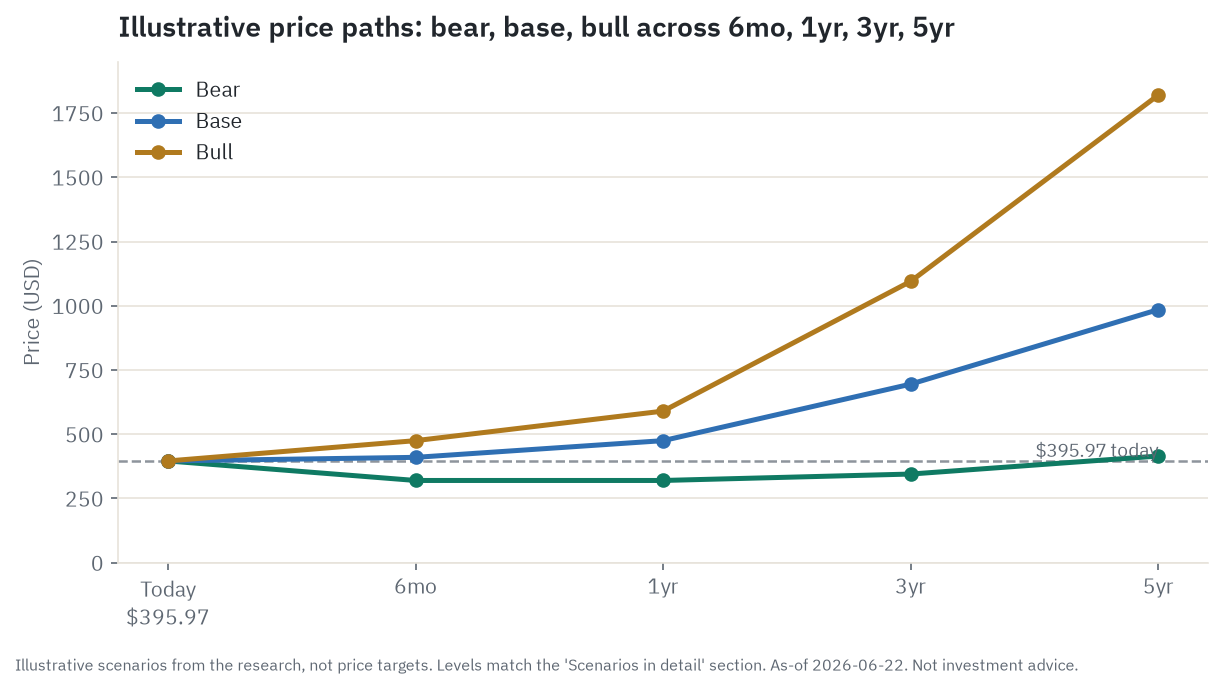
The stock closed at $395.97 on June 22, 2026, off its early-June all-time high near $495 after a sharp post-earnings selloff. The ranges below are arithmetic on stated assumptions, not predictions. They are here because they are the answer to the question most readers arrive with.
6 months. This window belongs to two earnings prints: Q3 FY2026 (the quarter ended in early August, reported around September) and Q4/full-year FY2026 (reported December). The bar is high - the stock fell about 12.6 percent in a single session after the June 3 report, erasing roughly $280 billion in market value, because AI guidance of $16 billion for Q3 landed below the most aggressive buy-side numbers and management did not raise the $100 billion-plus FY2027 target. Base case is the stock chopping in the $400s as it digests that move (around $410), bear around $320 toward the 200-day moving-average zone, bull around $475 back toward the highs. The single thing most likely to flip this window: whether AI revenue beats the $16 billion Q3 guide cleanly and the roughly 74 percent gross-margin step lands as guided rather than worse.
1 year. The dominant variable becomes the credibility of the FY2027 AI target - raised, reiterated, or quietly trimmed. The base case around $475 assumes the target holds and non-GAAP earnings compound about 25 percent, a modest re-rate toward where the sell-side average already sits. Bull around $590 needs the target actually raised, proving orders are run-rate and not pulled forward. Bear around $320 is a derating toward roughly 18 times earnings if book-to-bill rolls back toward 1x and Google’s supplier diversification starts showing up in revenue per program. The flip: the FY2027 guide, and any disclosed change in customer count or concentration.
3 years. Structural drivers start to dominate. Base case around $695 has the $100 billion-plus AI base compounding into the mid-$100-billions while networking and software anchor margin, valued at a fair multiple near 24 times. Bull around $1,095 is the full AI-silicon-franchise re-rate as custom ASIC (an application-specific chip built for one job) keeps taking share from merchant GPU. Bear around $345 is the skeptic’s scenario: capex digests, Google compresses revenue per TPU, the $128 billion purchase-commitment tail turns into a working-capital drag, VMware net ARR slips below double digits, and the multiple compresses to about 18 times on a business that is still growing. The flip: whether customers four through six become real, named, shipping revenue, and whether VMware churn stays contained through the 2027-2029 migration window.
5 years. Pure durability. Base case around $985 assumes a durable AI-plus-software compounder at a fair 24 times with non-GAAP earnings compounding about 22 percent a year. Bull around $1,820 assumes the XPU plus networking business matured into a dominant, defensible custom-silicon franchise re-rated toward 30 times. Bear around $415 (roughly flat from today over five years) assumes the AI cycle digested and the premium evaporated, leaving only the software and networking floor holding value - a derating, not an impairment. The flip: whether custom ASIC stayed a structural share-gainer against merchant GPU, or commoditized.
Where the read lands today. On balance the read holds at Buy. Broadcom is the number-two AI-silicon franchise bolted to a roughly 93-percent-gross-margin software annuity, compounding AI revenue toward a $100 billion-plus FY2027 target while throwing off about $10 billion a quarter of free cash flow, and the valuation the Street uses is only modestly above the stock’s own history. The single thing most likely to flip that read is the one moving the wrong way already: customer concentration is rising, not falling, and the largest customer is inserting rivals into part of its program.
Companion tool
Jump to the interactive dashboard to sort and filter every company in the piece, or download the Excel model to flex the scenarios yourself.
TL;DR
The money starts as hyperscaler AI capital spending - Google, Meta, Amazon, and Microsoft guided a combined $660-725 billion for 2026 (press-reported, up roughly 55-77 percent) - and Broadcom intercepts it at two tollbooths before it reaches the foundry. The first is custom AI accelerators, or XPUs, which Broadcom co-designs with each hyperscaler and sells per chip shipped; the second is merchant Ethernet networking silicon (Tomahawk switches, Jericho routers, Thor NICs) that ties the accelerators into clusters. Together that AI semiconductor business ran $10.8 billion in Q2 FY2026, up 143 percent year over year, and management guides $56 billion for FY2026 and targets over $100 billion for FY2027 (guidance, not fact). Underneath sits a second engine: roughly $27 billion of high-margin VMware-led infrastructure software that funds about $10 billion of free cash flow a quarter. The bull case is steady compounding as the AI build earns out. The single biggest risk is that the AI ramp is concentrating the business rather than diversifying it: one distributor now routes about 42 percent of revenue (up from 29 percent a year earlier), and the largest end customer is reportedly bringing Marvell and MediaTek into part of the work. At about 26 times forward non-GAAP earnings the stock is not priced for failure, but it is priced for the good case to keep arriving on schedule.
Explore it yourself: the interactive dashboard
Open the dashboard in a full screen
The two engines: what Broadcom actually is
Most people file Broadcom under “AI chip stock” and stop there. That misses half the company.
Think of Broadcom as a tollbooth operator who also owns a utility. The tollbooth sits on the busiest road in technology - the flow of hyperscaler capital into AI data centers - and collects a fee on every custom accelerator and every networking chip that passes through. The utility is the VMware software business: a slow, boring, very high-margin annuity that bills the world’s largest enterprises every year whether or not the AI road is busy. The tollbooth is where the growth and the excitement live. The utility is where the cash comes from when growth gets choppy.
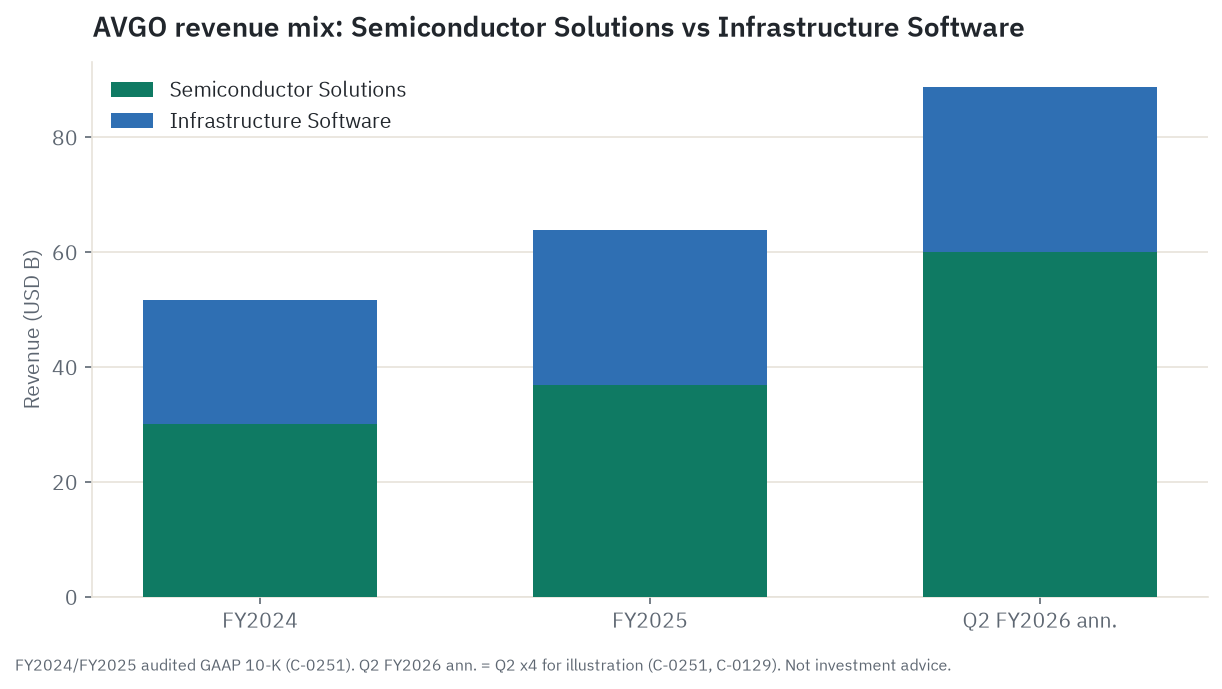
In FY2025 (the year ended November 2, 2025) the two engines split the business almost evenly: Semiconductor Solutions was $36.9 billion of $63.9 billion in total revenue, Infrastructure Software the other $27.0 billion. By Q2 FY2026 the semiconductor engine had pulled ahead on the AI ramp - $15.0 billion of the $22.2 billion quarter - but the software engine still produced about $5.6 billion in segment operating income on $7.2 billion of revenue, nearly matching the semiconductor segment’s $9.3 billion on more than twice the revenue base. That is the dual identity. Hold it in mind through everything that follows, because the bull case and the bear case live in different engines.
How the money flows
flowchart TD
    HC["Hyperscaler AI capex\n$660-725B guided CY2026\n(Google, Meta, Amazon, Microsoft)"]
    AI_CUST["AI frontier customers\n(Anthropic, OpenAI + 2 unnamed)\n~$6B in Q2 FY2026 bookings"]
    ENT["Enterprise IT budgets\n~300K VMware accounts\nfocused on top 10K"]

    HC --> AVGO_XPU["Broadcom XPU co-design\n~60-70% custom ASIC mkt share\n$6.5B XPU rev Q2 FY2026"]
    HC --> AVGO_NET["Broadcom AI networking\nTomahawk 6, Jericho4, Thor Ultra\n~$4.3B net rev Q2 FY2026"]
    AI_CUST --> AVGO_XPU
    ENT --> AVGO_SW["Broadcom Infrastructure SW\nVMware VCF + CA + Symantec\n$7.2B rev Q2 FY2026, 93% GM"]

    AVGO_XPU --> TSMC["TSMC (foundry + CoWoS)\n3nm today, 2nm targeted 2027\nCapacity secured through 2028"]
    AVGO_NET --> TSMC

    TSMC --> EDA["EDA tools\nSynopsys / Cadence duopoly"]
    TSMC --> HBM["HBM memory\nSK Hynix, Samsung, Micron"]
    TSMC --> PKG["Advanced packaging materials\nsubstrates, copper bonding"]

    AVGO_NET --> ARISTA["Arista Networks\nDistributes Tomahawk silicon\n$2.7B Q1 2026 rev (+35% YoY)"]
    ARISTA --> HC

    AVGO_SW --> NTNX["Nutanix (displacer)\n$2.43B ARR +15% YoY"]

    AVGO_XPU --> DIST["Single unnamed distributor\n42% of Broadcom net rev Q2 FY2026"]
    DIST --> HC
Read the diagram top to bottom. At the top is the demand source: four hyperscalers guiding a combined $660-725 billion of capital spending for 2026 (press-reported), roughly three-quarters of it AI-directed, plus a set of frontier-model buyers (Anthropic, OpenAI, and two unnamed accounts) that booked about $6 billion of orders disclosed on the Q2 call. That spend splits into two demand pools that feed Broadcom.
The first pool is custom AI silicon. The hyperscaler defines the workload and the chip architecture; Broadcom co-designs the implementation - the silicon layout, the high-speed SerDes interconnects (serializer/deserializer IP, the signaling that moves data fast between chips), the power delivery, and the advanced-packaging integration that bonds multiple chiplets and HBM (high-bandwidth memory, the stacked DRAM that feeds an accelerator, itself supply-constrained across SK Hynix, Samsung, and Micron) into one package - and sells the finished chip per unit shipped. That is product revenue, not a royalty. The same data-center build pulls Broadcom’s merchant Ethernet networking silicon to wire the accelerators together. In Q2 FY2026 that AI pool generated $10.8 billion, about 49 percent of total revenue, split roughly 60 percent XPU and 40 percent networking.
The second pool is software. Once a data center exists, it runs virtualized workloads on VMware Cloud Foundation. Roughly 10,000 large enterprise accounts pay annual subscriptions, and because the marginal cost of another software license is near zero, the segment runs at about a 93 percent gross margin.
Now the chokepoints, because the shape is the investing point. Broadcom owns no fabs; TSMC makes every wafer, on 3nm today and 2nm targeted for late 2027, and TSMC’s CoWoS-L process does the advanced packaging. CoWoS (chip-on-wafer-on-substrate) is TSMC’s technique for stacking the logic die and the HBM stacks into one module, and it is the single packaging chokepoint the entire AI-chip industry competes for the same scarce capacity on, so it cannot simply be scaled up on demand. That single foundry relationship is both the biggest cost line and the most critical supplier dependency in the chain, and there is no credible leading-edge alternative. Broadcom earns its margin on IP and design, not on fab capacity, which is what makes the model capital-light. The other chokepoint is the one at the bottom of the diagram: a single unnamed distributor routed about 42 percent of Broadcom’s net revenue in Q2 FY2026, believed to route primarily to one end customer. The tollbooth is lucrative, but most of the traffic comes from one road.
Field guide: the segments and products
Plain-language tour of what Broadcom sells, grouped by engine.
Semiconductor Solutions - the AI silicon and the legacy base.
- Custom AI accelerators (XPUs). Application-specific chips co-designed for one hyperscaler’s workload. Broadcom owns roughly 60-70 percent of the custom-ASIC co-design market by analyst estimate; Marvell holds most of the rest. XPUs are the largest piece of the AI revenue line and the lower-margin one, because the customer absorbs much of the wafer cost.
- AI networking silicon. Merchant Ethernet chips that build the cluster fabric. The flagship Tomahawk 6 switch chip moves 102.4 terabits per second, the first to clear 100, and began shipping in March 2026. Jericho4 is the fabric router for connecting data centers (shipping since August 2025); Thor Ultra is the 800-gigabit network interface card that attaches each accelerator. By analyst estimate Broadcom holds roughly 80 percent or more of high-end merchant switch silicon. Networking carries richer margins than XPUs.
- Legacy non-AI semiconductors. Broadband (DOCSIS 4.0 upgrades are a near-term catalyst), wireless RF (Broadcom is Apple’s primary Wi-Fi and 5G front-end supplier, highly seasonal), server storage, enterprise networking, and industrial. This base ran about $4.2 billion in Q2 FY2026, up 6 percent, in a slow U-shaped recovery from the 2022-2023 inventory correction.
Infrastructure Software - the cash annuity.
- VMware Cloud Foundation (VCF). The private-cloud stack: compute (vSphere), networking (NSX), storage (vSAN), and increasingly AI inferencing. Broadcom collapsed hundreds of VMware SKUs into four bundles, ended perpetual licenses, and pushed everyone to subscription. This is the engine behind the segment’s roughly 79 percent operating margin.
- CA Technologies and Symantec. Mainframe software (CA, acquired 2018) and enterprise security (Symantec, acquired 2019). Both are captive, sticky, slowly declining, and very profitable. Broadcom does not break them out separately; they sit inside Infrastructure Software.
The AI engine: custom silicon, customers, and the ramp
This is the core of the bull case, so it is worth getting the mechanism right.
A merchant GPU, the kind Nvidia sells, is a general-purpose chip that runs any AI workload. A custom XPU is the opposite: a chip stripped down to do one class of workload extremely well. The hyperscaler that runs that workload at enormous scale - billions of inference queries a day - can justify spending two to four years and several billion dollars co-designing a chip that drops the features it does not need. The payoff is lower cost per token and better performance per watt for that specific job. By analyst estimate (SemiAnalysis and Bernstein figures, not company disclosures), custom ASICs carry a 30-65 percent total-cost-of-ownership advantage over merchant GPUs for high-volume, multi-year inference. That is why the build is happening.
Why does Broadcom keep the economics rather than the hyperscaler doing it alone? Because designing a chip that works in a lab is very different from producing a hundred thousand-plus of them at usable yields. Broadcom brings the SerDes interconnect IP, the power and I/O design, and the advanced-packaging expertise - the 3.5D XDSiP stacking that bonds four compute chiplets, an I/O die, and six HBM modules into one package, which began production shipments in February 2026. That XDSiP architecture is Broadcom’s own in-house packaging IP, and it is a large part of why a hyperscaler cannot cheaply swap design partners: the integration is co-developed, not off the shelf. Switching design partners means a full architecture rebuild taking three to five years, and Broadcom has reserved TSMC capacity through 2028. That is the moat.
The ramp. The numbers are point-in-time and the forward ones are management guidance, not fact, but the trajectory is the story:
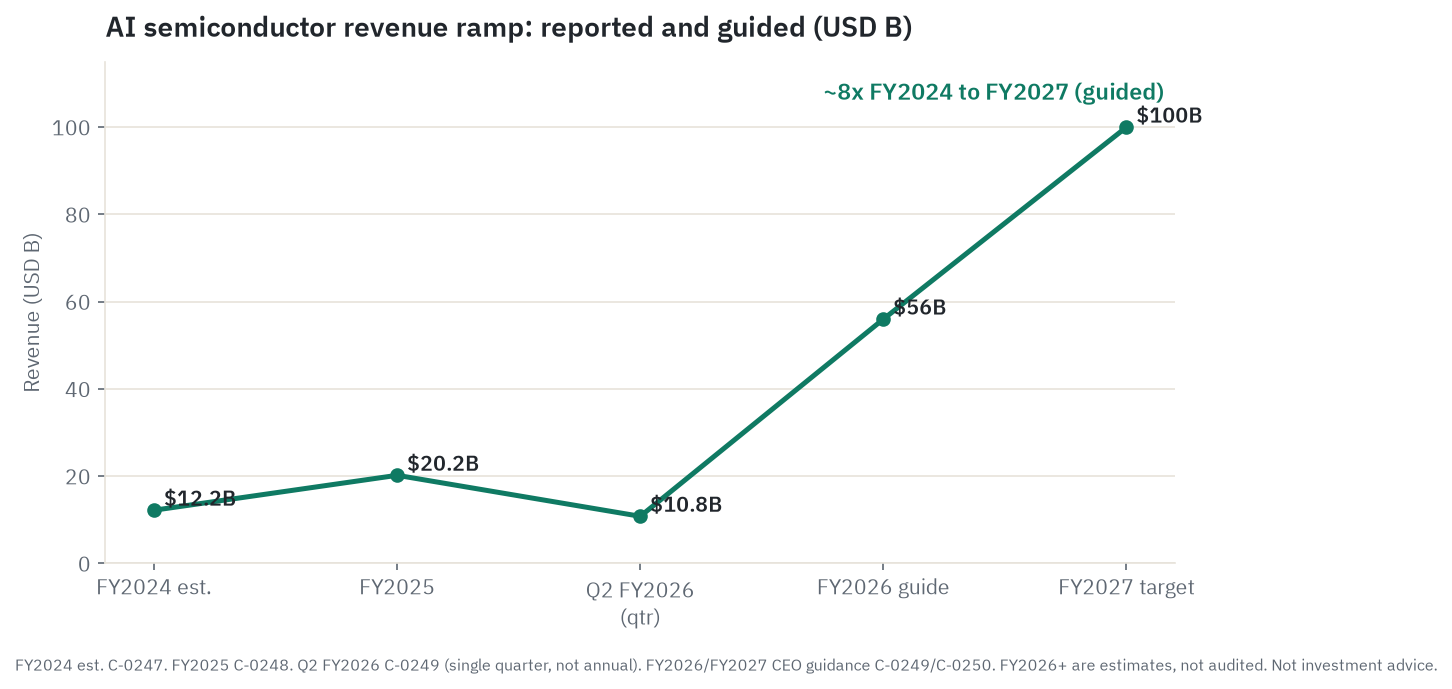
- FY2024 AI revenue about $12.2 billion (primary, from an 8-K).
- FY2025 about $20.2 billion - this full-year figure is derived from four quarterly reports rather than read from a single primary filing, so treat it as an estimate.
- Q2 FY2026 $10.8 billion in a single quarter, up 143 percent year over year (primary).
- Q3 FY2026 guided to $16.0 billion, over 200 percent growth (primary guidance).
- FY2026 guided to $56 billion, roughly 180 percent growth (guidance).
- FY2027 target “in excess of $100 billion” (management target, reiterated June 3, not raised).
The jump that makes a reader squint is the one from about $20 billion in FY2025 to a guided $56 billion in FY2026. The bridge is not a new tollbooth; it is the existing XPU programs inflecting from pilot and qualification volume into full production at the same time, with new programs (the Anthropic and OpenAI ramps, and the new unnamed accelerator contract signed in Q2) entering volume alongside them. That is why the same business that ran $10.8 billion in a single quarter can plausibly nearly triple its full-year AI line in a year - the orders are already booked, not hoped for, which is what the backlog signals below are measuring.
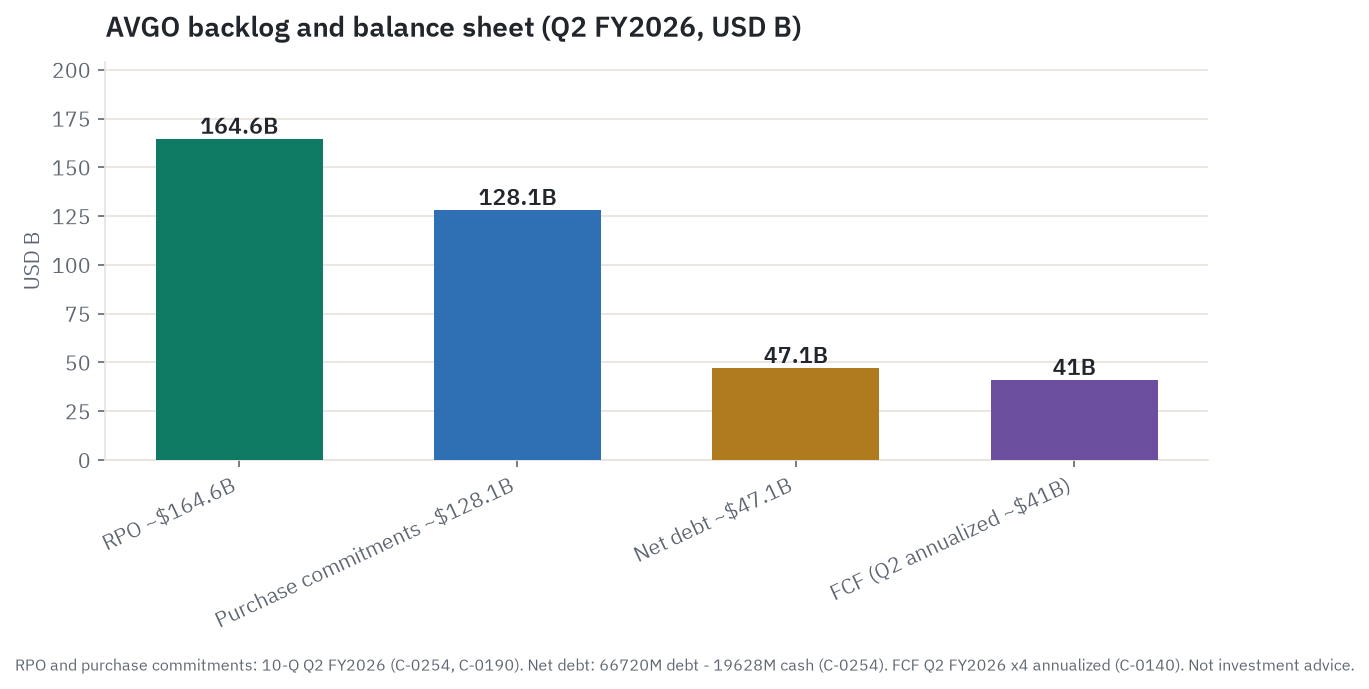
Two more demand signals matter. Bookings in Q2 exceeded $30 billion against $10.8 billion shipped, a book-to-bill near 2.8x (orders booked divided by product billed and shipped, so anything above 1x means the backlog is building faster than the company can ship it), and management said visibility runs to 2028. And firm-committed remaining performance obligations, or RPO - the dollar value of signed contracts the customer cannot terminate that has not yet been recognized as revenue - stood at about $164.6 billion as of May 3, 2026, including a new long-term custom-accelerator contract signed that quarter. Roughly 30 percent of the RPO is expected to convert to revenue over the next 12 months.
The customers. Broadcom discloses XPU customers by count, not by name, in its filings. On the Q2 call it named four: Google (TPU), Meta (MTIA), Anthropic, and OpenAI, plus two unnamed accounts that together booked about $6 billion of orders. Where press reports go further, hedge accordingly:
- Google is the largest and longest-running, partnering since 2016, now on its seventh TPU generation (Ironwood). The two firms reportedly signed a long-term supply agreement in April 2026 running through 2031, though terms are undisclosed and the report is press-tier. Google is also reportedly developing a cheaper inference TPU variant with MediaTek and is in talks with Marvell - more on that risk below.
- Meta committed (per CNBC) to 1 gigawatt of MTIA custom chips starting in the second half of 2027, plus 3 gigawatts through end-2028. Meta also runs AMD GPUs, a rare dual-vendor approach.
- Anthropic has 1 gigawatt of compute in 2026 with another 5 gigawatts of next-generation compute beginning 2027 (primary, from the call).
- OpenAI is a confirmed design-win, but the reported deal economics (an $18 billion first phase, a condition that Microsoft commit to buying about 40 percent of the chips, and a May 2026 financing snag) are press-reported and unconfirmed by either company. The customer relationship is confirmed; the terms are not.
- Customers five and six are unnamed. Press speculation includes Apple (a reported server chip codenamed “Baltra”) and xAI, but Broadcom has not named Apple as an XPU customer, and any bull line leaning on Apple or xAI XPU revenue is unverified.
- ByteDance was previously a top-three customer; its 5nm program was cancelled in March 2025 under tightened US export controls, an estimated $2-3 billion revenue loss (press-reported).
The honest read on the customer story: four confirmed, two unnamed, and the bull case quietly leans on the unnamed two becoming real, named, shipping revenue. They are not yet.
Networking silicon: the second AI toll booth
The networking business gets less attention than XPUs and is arguably the more durable franchise.
Every AI cluster needs a fabric to connect its accelerators, and that fabric is increasingly Ethernet rather than Nvidia’s proprietary InfiniBand or NVLink. Broadcom builds the merchant silicon for that Ethernet fabric: Tomahawk 6 for within-cluster switching, Jericho4 for connecting data centers up to 100 kilometers apart, Thor Ultra for the network interface on each accelerator. Tomahawk 6 shipped in March 2026 at 102.4 terabits per second, roughly a generation ahead of Nvidia’s competing Spectrum-X1600, which is expected in the second half of 2026.
The structural argument for durability has two parts. First, open standards. Broadcom is a founding member of the Ultra Ethernet Consortium, whose UEC 1.0 spec (released June 2025) rebuilds the network stack to hit InfiniBand-like performance on open Ethernet. Any hyperscaler that wants to avoid locking its networking to Nvidia’s GPUs - which is every non-Nvidia-centric hyperscaler - has a structural incentive to pull Broadcom silicon, often through OEMs like Arista. Second, switch ASICs are hard to in-source. Hyperscalers have built their own accelerators with Broadcom’s help, but high-bandwidth switch silicon, with its annual generational cadence and co-packaged-optics integration, has not seen the same in-sourcing pressure. No hyperscaler has publicly announced an in-house switch program.
The real competitive threat is Nvidia at the system level, not the chip level. Nvidia’s Spectrum-X reached about $2.1 billion in Q1 2026 and topped the data-center Ethernet switch market by revenue, because Nvidia bundles networking with GPU cluster sales. If you buy Nvidia GPUs, you tend to buy Nvidia networking by default. Broadcom’s counter is that hyperscalers building on diverse XPU architectures have every reason to keep networking standards-based and merchant.
One caveat the company itself flagged: networking was about 40 percent of AI revenue in Q2, which Hock Tan called a “stars aligned” quarter, and management expects it to normalize toward 30 percent as XPU volumes ramp. The percentage compresses, but the absolute dollars can still grow.
The software engine: VMware integration, subscription conversion, margins
The VMware story is where the cash comes from and where the slow-burn risk lives.
Broadcom bought VMware in November 2023 for roughly $69 billion in cash and stock, financed largely with debt. The playbook since has been the same one Broadcom ran on CA and Symantec: end perpetual licenses, force everyone to subscription, collapse the SKUs (hundreds down to four bundles), raise the minimum core requirement (from 16 to 72 cores per CPU, effective April 2025), focus on the largest accounts, and accept churn in the small tail. As of mid-2025 management reported that over 90 percent of the top 10,000 VMware customers had converted to VCF subscriptions, though press coverage notes that figure reflects licenses sold, not deployments operationalized.
It is working on the income statement. The segment ran $27.0 billion in FY2025, up 26 percent on the first full year of VMware; gross margin sits at 93 percent and operating margin reached 79 percent in Q2 FY2026, up from a roughly 59 percent operating margin before the acquisition. ARR grew 17 percent year over year in Q2 (Broadcom discloses the growth rate, not the absolute dollar figure). Q3 software revenue is guided to about $8.9 billion, up 31 percent, a sharp acceleration management attributes to the VCF 9.1 release and server demand.
Now the bear case, which is structural rather than cosmetic. The annuity is being built by renewing only a fraction of each customer’s prior estate at a much higher price. An analyst estimate (Naveen Chhabra, cited in Network World) puts the average converted customer at renewing roughly 25 percent of its prior VMware footprint, at 1.3x to 5x the prior cost. Per-unit price up, footprint down. Customer surveys, which are self-selected and should be read as directional rather than precise, paint a restless base: a Rimini Street survey of 111 customers found 98 percent using, planning, or considering alternatives and 36 percent already switched; a CloudBolt survey found 87 percent reducing their footprint. Nutanix, the main displacer, reported its strongest new-logo quarter in eight years off VMware migration, with ARR of $2.43 billion, up 15 percent. Ingram Micro, a top-tier distributor, terminated its Broadcom relationship.
On pricing magnitudes, the reported ranges are customer and trade-group accounts, not Broadcom disclosures: typical renewal increases around 150 percent on average, with smaller accounts reporting 350-1,000 percent and some European trade-group members citing 800-1,500 percent. Broadcom has disputed the magnitude of increases and made some concessions under pressure without reversing the core strategy.
On regulation, the careful framing matters. The EU cloud trade body CISPE is seeking annulment of the original merger clearance at the EU General Court (Case T-503/25, filed July 2025, ongoing), and the German IT association VOICE has filed a complaint alleging abuse of market power. These are pending complaints and allegations, not findings. No regulator had announced a finding of wrongdoing as of the research date, and nothing here characterizes Broadcom’s VMware pricing as unlawful. A separate AT&T lawsuit alleging a large price increase was reportedly settled on undisclosed terms in November 2024; a settlement is not an admission.
The honest tension: the filings show software revenue growing and renewals holding, while the customer-satisfaction signal deteriorates. Forced subscription conversions can inflate near-term revenue while building churn risk that does not show up in the numbers for one to two more years, exactly when the bull case needs the software engine to keep compounding through the 2027-2029 migration window. The narrative is running ahead of the numbers on the bear side. That does not make it wrong; it makes it unmeasured.
Who wins where: the competitive map
- Custom-ASIC co-design. Broadcom (roughly 60-70 percent share, analyst estimate) and Marvell (roughly 20-25 percent) together account for most of the market. Alchip and GUC are lower-cost Taiwan-based design houses for less complex sockets. Broadcom’s edge is depth of IP and the Google 2031 lock; Marvell is structurally closer to a contract design house and lacks an equivalent multi-year anchor, though it is now also the rival being inserted into Google’s program.
- Merchant GPU. Nvidia holds roughly 80 percent of AI accelerator revenue; AMD has 5-7 percent. This is a parallel market to custom ASIC, not the same one. The relevant fact for Broadcom is that custom ASICs are growing faster than merchant GPUs for the first time in 2026 (TrendForce: ASIC shipments up 44.6 percent versus GPU up 16.1 percent), and inference, where ASICs are strongest, is the fastest-growing slice of compute.
- Networking. Broadcom leads merchant Ethernet switch silicon; Nvidia competes at the system level via Spectrum-X bundles; Cisco and others trail. Arista, which runs Broadcom silicon in most of its switches, is both a customer and a demand signal.
- Software. VMware leads private-cloud virtualization by a wide margin; Nutanix, Red Hat, Proxmox, and public-cloud migration are the alternatives gaining ground on the back of pricing backlash.
Company by company: who’s who
The primary name.
Broadcom Inc. (AVGO). Fabless designer of custom AI XPUs, Ethernet switch silicon, DSPs, and wireless RF, plus infrastructure software (VMware/VCF, CA mainframe, Symantec). Q2 FY2026 revenue $22.2 billion (up 48 percent), AI semiconductor revenue $10.8 billion (up 143 percent), 67 percent non-GAAP operating margin, $10.3 billion free cash flow; Q3 guided to $29.4 billion total and $16.0 billion AI. Market cap about $1.88 trillion on June 22, 2026. Bull: the custom-ASIC and merchant-Ethernet position is durable near-term, the software annuity funds about $10 billion a quarter of free cash flow, and the AI runway is exceptional even after hedging the forward numbers. Bear: at $1.88 trillion and about 26 times forward non-GAAP earnings the valuation assumes the AI capex build keeps arriving on schedule, while concentration is rising (one distributor about 42 percent of revenue, top-five end customers about 45 percent) and the largest customer is reportedly diversifying part of its program.
Merchant GPU peers.
NVIDIA (NVDA). The dominant merchant AI GPU vendor and the largest company by market cap (about $5.05 trillion on June 22, 2026; vendor figures drift, one source showed $5.14 trillion). FY2026 revenue $215.9 billion, up 65 percent. See the full picture in the NVIDIA deep dive. Bull: CUDA lock-in and the Blackwell/Rubin cadence make it the default for nearly every AI workload. Bear: custom ASICs are growing roughly three times faster in 2026 and hyperscalers are deliberately reducing Nvidia dependency - the same trend that helps Broadcom.
Advanced Micro Devices (AMD). Number-two merchant GPU and the server-CPU leader versus Intel. Market cap about $876 billion. Q1 2026 revenue $10.3 billion (up 38 percent); Meta committed up to 6 gigawatts of Instinct MI450 GPUs. Bull: EPYC dominance in cloud plus a credible CUDA alternative gaining real traction. Bear: roughly 5-7 percent AI GPU share at about 62 times forward earnings already prices in closing most of the gap.
Custom-ASIC peer.
Marvell Technology (MRVL). Number-two custom-ASIC house (roughly 20-25 percent share); primary ASIC partner for AWS Trainium and Microsoft Maia. Market cap about $267 billion, up roughly 260 percent in 2026. Closed a $2 billion Nvidia strategic investment and an NVLink Fusion partnership in March 2026. Bull: AWS and Microsoft ramps entering volume, plus a new XPU-on-Nvidia-fabric channel. Bear: roughly 100 times EV/EBITDA and 163 times price-to-free-cash-flow on a ramp not yet delivered at scale, with no equivalent to Broadcom’s Google lock - and Marvell is now the threat to Broadcom’s Google socket.
Hyperscaler customers (context, not the trade).
Alphabet (GOOGL). Broadcom’s largest XPU customer; reportedly committed through 2031. Google Cloud Q1 2026 revenue $20.0 billion (up 63 percent); 2026 capex guided $180-190 billion. See the Alphabet deep dive. Bull: a $180-190 billion capex budget and 63 percent cloud growth directly drive Broadcom TPU and networking demand. Bear: Google’s diversification to MediaTek (inference) and Marvell is the clearest path to compressing Broadcom’s revenue per TPU generation over 2027-2031.
Meta Platforms (META). Second-largest disclosed XPU customer by committed volume (4 gigawatts through 2028). Market cap about $1.47 trillion; 2026 capex guided $125-145 billion. Also a large AMD GPU customer. Bull: multi-gigawatt MTIA commitments are contracted, not market-dependent, through 2028. Bear: the dual-vendor approach caps Broadcom’s per-workload exposure, and a maturing MTIA program raises long-run in-sourcing risk.
Amazon sits one step away: AWS Trainium is Marvell’s and Alchip’s turf, not Broadcom’s, but AWS’s hyperscaler capex still pulls Broadcom networking silicon. See the Amazon deep dive for the AWS custom-silicon and capex picture.
What the filings say
Everything here is from Broadcom’s 10-K (FY2025, filed December 18, 2025), 10-Q (Q2 FY2026, filed June 9, 2026), and Q2 earnings release, each verified against the filing on EDGAR.
Revenue and mix. FY2025 total net revenue was $63,887 million, up 24 percent: Semiconductor Solutions $36,858 million (58 percent), Infrastructure Software $27,029 million (42 percent). Q2 FY2026 revenue was $22,187 million, up 48 percent, with semiconductors at $15,009 million and software at $7,178 million. China (including Hong Kong) was 17 percent of FY2025 revenue, down from 20 percent. Revenue is recognized largely at point of shipment in Asia Pacific (about 66 percent of the Q2 figure), so the geographic split reflects shipment location, not end-use.
Margins. FY2025 GAAP gross margin was 68 percent and GAAP operating margin 40 percent. The non-GAAP picture is higher and is what the Street uses: Q2 FY2026 non-GAAP gross margin was 77 percent and non-GAAP operating margin 67 percent, versus GAAP gross margin of 69 percent and GAAP operating margin of 49 percent. The gap is large and worth understanding: the quarterly bridge adds back about $2.0 billion of amortization of acquired intangibles and about $2.1 billion of stock-based compensation. The amortization will burn off as VMware intangibles age (down from about $39 billion at FY2024 end to about $28 billion by May 2026); the stock comp is recurring and ran about 10 percent of first-half revenue.
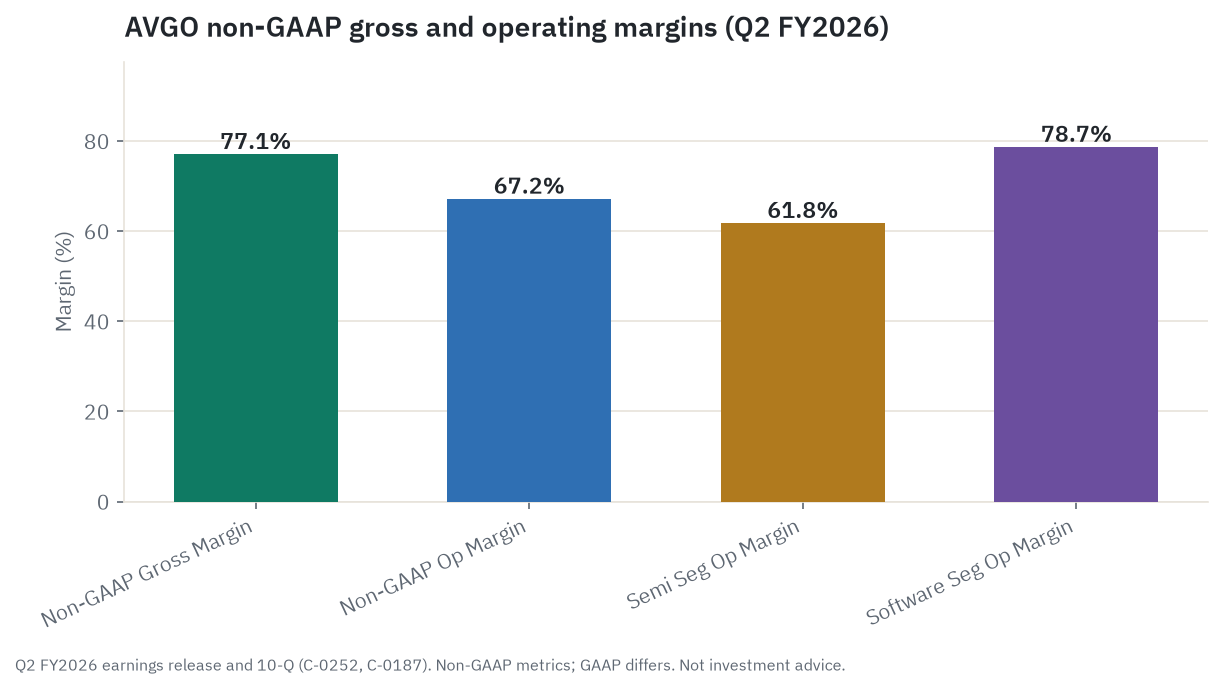
A point the bears press: Q3 FY2026 consolidated gross margin is guided to about 74 percent, down from 77.1 percent non-GAAP, as faster-growing lower-margin AI semis (XPUs are lower-margin than networking) grow as a share of mix. The CFO explicitly rejected calling this a structural change in semiconductor margin, saying it reflects product mix and that segment margins are stable. The honest framing is mix, not erosion - but mix that grows as the bull case “works.”
Cash flow and the balance sheet. FY2025 operating cash flow was $27,537 million against just $623 million of capex (this is a fabless, capital-light business), for free cash flow around $26.9 billion, a roughly 42 percent margin. Q2 FY2026 free cash flow was $10,262 million, a 46 percent margin. Cash stood at $19,628 million against total debt principal of $66,720 million, so net debt was about $47.1 billion - down from roughly $60 billion at the VMware close and falling. The revolver was undrawn.
Capital returns and dilution. Broadcom pays a growing dividend, $0.65 a quarter ($2.60 annualized), with $11,142 million paid in FY2025. Buyback authorizations total over $20 billion across 2025-2026 programs; the company repurchased $8.45 billion of stock in the first half of FY2026. Against that, share count has risen post-VMware (about 544 million shares issued in the merger) and stock comp continues to dilute, with total SBC of $7,568 million in FY2025.
Guidance. Q3 FY2026: revenue about $29.4 billion (up 84 percent), non-GAAP operating margin stable at about 67 percent, AI semiconductor revenue $16.0 billion (over 200 percent growth). The FY2027 AI target of “in excess of $100 billion” was reiterated, not raised.
The risk factors the company itself discloses. The 10-K and 10-Q are unusually direct:
- Customer concentration, the largest disclosed risk. One distributor accounted for 32 percent of FY2025 revenue (28 percent in FY2024), and the top-five end customers about 40 percent in each of FY2025 and FY2024. The Q2 10-Q shows the single-distributor figure rising toward 42 percent in H1 FY2026. The filing states the loss of any top-five customer “could have a material adverse effect.”
- Novel financing structures. The Q2 10-Q discloses that customers increasingly want to lease XPUs or full AI racks rather than buy them outright, and Broadcom entered a backstop guarantee of up to $29 billion on AI-rack leases. The mechanism is worth understanding because it is why a fabless chip designer is suddenly carrying rack-financing risk. To make the lease model work, Broadcom arranged for an investor partner to buy the AI racks and lease them to the customer; Broadcom stands behind that arrangement with a guarantee capped at $29 billion. If the lessee stops paying or the racks are worth less than expected at the end of the lease, Broadcom is on the hook for the shortfall up to that cap rather than the investor partner. So a financing structure designed to help customers buy more chips quietly converts a chunk of customer credit and equipment-residual risk into Broadcom’s own balance-sheet exposure, and it does so right as customer concentration is rising. The filing itself warns that these arrangements may not generate the revenue, free cash flow, or profitability that the company or investors expect. The guarantee is sized for the bull-case ramp; in a digestion scenario it is a free-cash-flow risk, not a revenue helper.
- The purchase-commitment tail. Non-cancellable purchase commitments totaled $128.1 billion ($55.2 billion in FY2027, $72.9 billion in FY2028), primarily AI accelerator inventory. The scale signals confidence; it also creates downside if demand softens.
- VMware tax exposure. If VMware’s 2021 spin-off from Dell is ever found not to have been tax-free, Broadcom could owe a portion of the tax. The company also expects a material impact from the Corporate Alternative Minimum Tax in FY2026.
- Export controls. China at 17 percent of revenue sits inside a shifting US export-control and tariff regime; AI silicon is in the highest-restriction tier.
Leadership. Kirsten Spears, CFO for over a decade, departed June 12, 2026, replaced by Amie Thuener, a former Alphabet executive. CFO turnover arrives at a moment of unusual accounting complexity (lease and backstop structures, the $128 billion commitment, RPO mechanics), which is a yellow flag worth watching rather than a verdict.
Insider and institutional signal. Recent Form 4 activity is routine RSU tax-withholding sales, not discretionary selling; no unusual insider selling around the all-time high was identified. On the ownership side, no current 13F filing-by-filing analysis was performed for this run, so the precise holder list is a gap. The directional picture is not, though: with roughly 4.75 billion shares outstanding and a market cap near $1.9 trillion, AVGO sits among the very largest US equities, which means the float is overwhelmingly institutionally held and heavily index-driven (the big passive complexes own it by definition of its index weight), with a correspondingly small discretionary insider stake. Read the ownership leg as megacap-typical and passively anchored rather than founder- or insider-controlled; a precise 13F breakdown by holder is the piece this run did not pull.
What the market is paying
All figures point-in-time as of June 22, 2026, from market-data vendors, and they move fast. Note the 10-for-1 stock split on July 15, 2024: every price and share figure here is post-split, so a share that cost above $1,700 pre-split trades as ten shares near $396.
Price and performance. The stock closed at $395.97, down 3.74 percent on the day (the June 22 ex-dividend date mechanically clipped it). The 52-week range is $246.46 to $495.00, with the all-time intraday high of $495 set June 3, 2026. Total return over one year is +58.76 percent, three years +400.33 percent, five years +789.98 percent - but year-to-date 2026 is only +14.67 percent. Market cap is about $1.88 trillion, the one market figure cross-checked to a second source for the date.
Relative strength. Here is the surprise: over three and five years AVGO crushed the semiconductor index (the SOX), but in 2026 it has badly lagged it. Year-to-date the SOX is up about 105 percent and AVGO about 15 percent, a roughly 91-point underperformance; over one year the gap is about 121 points. The 2026 chip rally has rewarded purer, faster AI-silicon stories (Marvell up roughly 260 percent, AMD up sharply) more than Broadcom’s larger, software-heavy mix.
Valuation. This is the crux, and the forward multiple needs care.
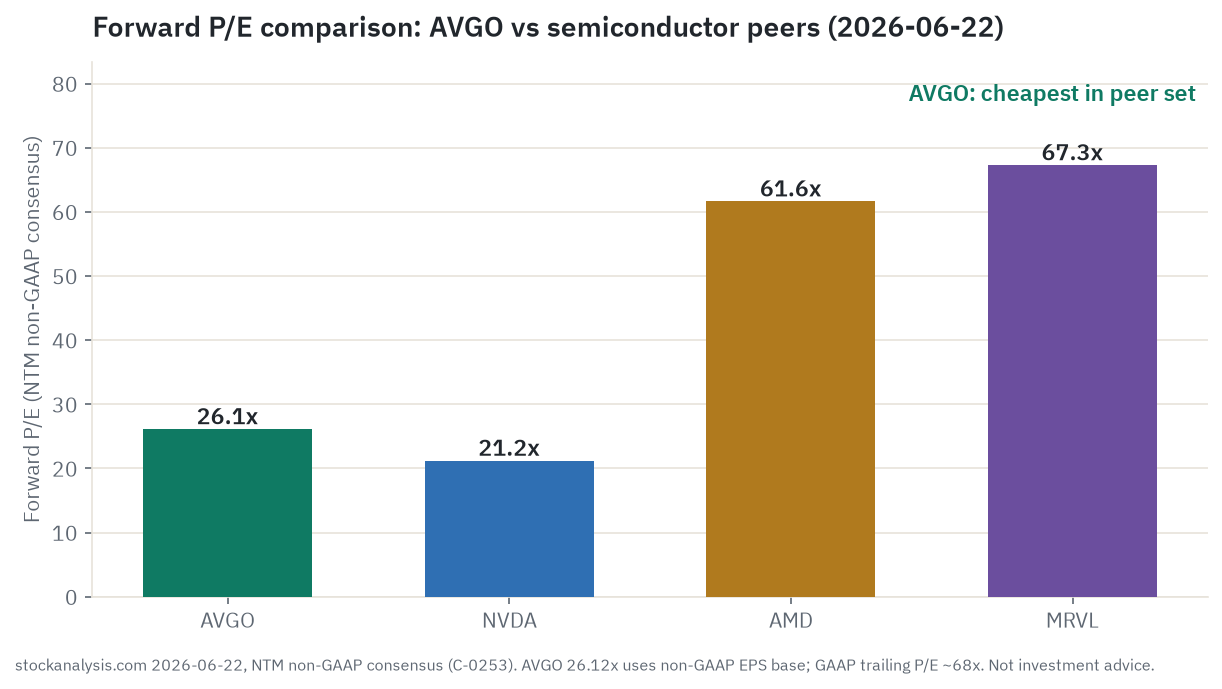
AVGO’s forward P/E is best stated as a range with the basis named: about 26 times forward earnings on non-GAAP consensus (the basis the sell-side uses), versus about 68 times trailing GAAP earnings. The GAAP figure is suppressed by VMware amortization; a third vendor showed roughly 33 times on a different EPS base. They are not contradictory, just different denominators. On the non-GAAP forward basis, 26 times sits only modestly above AVGO’s own roughly 22 times five-year forward average, is in line with or slightly richer than Nvidia (about 21 times), and is meaningfully cheaper than AMD (about 62 times) and Marvell (about 67 times). On price-to-free-cash-flow the stock looks dearer, about 57 times, a thin roughly 1.7 percent free-cash-flow yield.
The core valuation tension is a sum-of-parts problem. The market pays a chip multiple for the AI/networking segment, discounts the VMware cash flows for integration and churn uncertainty, and values the legacy semis on an industrial multiple. Depending on assumptions, a sum-of-parts can land both above and below the current price. The most defensible single read: net mildly cheap on the earnings metric the Street uses, dearer on cash.
Liquidity and short interest. About 32-37 million shares trade daily, roughly $12-15 billion of notional, among the most liquid names in the market. Short interest is very low - about 1.26 percent of float, days-to-cover near 2.9 - so bears are not pressing a large bet. The stock sits above its 200-day and 100-day moving averages but below its 50-day and 20-day, with RSI near 47 (neutral), the picture of a stock in price discovery after a vertical run and a sharp pullback.
Sell-side consensus (opinion, not fact). The Street is unanimously bullish: across vendor sets, zero Sell ratings, with average targets ranging from about $490 (33 analysts, Marketbeat) to about $524 (48 analysts, StockAnalysis), implying roughly 24-32 percent upside from the research-date price. These are third-party views, not the author’s targets, and notably the targets have not followed the stock down since the June selloff.
What the crowd is saying
Sentiment is signal, not fact, and the data here is soft. Read it for direction, not precision.
The dominant June 2026 story is a narrative rupture. Broadcom reported record Q2 revenue and 143 percent AI growth on June 3, then fell about 12.6 percent the next session - one of the larger single-day megacap wipeouts on record - because the Q3 AI guide came in below the most aggressive buy-side numbers and management did not raise the FY2027 target. At peak optimism, beating reality but missing expectations reads as a miss. A second storyline reinforced it: Macquarie cut the stock to Neutral, citing reports of Google’s talks with Marvell and analyst models showing Google’s share of Broadcom’s TPU work falling from roughly 95 percent in 2026 to 65 percent by 2028. Those share figures are analyst models, not Google disclosures - the narrative is running ahead of the primary data. Against the bears, JPMorgan reiterated an Overweight with a $580 target and called the stock an aggressive buy.
Retail attention is the blue-chip-AI kind, not the meme kind: AVGO is discussed respectfully on the investing forums rather than hyped, with no evidence of coordinated promotion or pump activity - the float is too large and the price too high. The cleanest social data point is StockTwits message volume surging over 700 percent before earnings with sentiment classified “extremely bullish,” then flipping to “bearish” within two weeks of the drop. The 700 percent figure is a single-platform reading, uncorroborated, but the direction of the reversal tracks price and news.
The most useful part is where narrative and fundamentals diverge. On VMware, the crowd fears the pricing strategy is destroying the customer base while the filings show revenue growing - both can be true if forced conversions inflate near-term revenue and seed churn that surfaces in 2027-2029. On AI, the divergence runs the other way: the fundamentals are exceptional and the price still fell, because expectations had outrun even an extraordinary reality. On Google concentration, the crowd has treated analyst models as confirmed risk; they are directionally plausible but not yet measurable in revenue.
Durability: structural case versus the cyclical bear case
The right way to read Broadcom is to separate the two demand pools, because they have very different durability.
The structural case. The AI pool is funded by the most cash-generative companies on earth, spending from operating earnings rather than debt, under a competitive logic where no hyperscaler can afford to fall behind. That is close to a self-sustaining demand loop. Broadcom’s specific position adds lock-in: custom-ASIC engagements run two to four years of co-design and multi-year supply agreements (the reported Google 2031 deal is the clearest example), switch silicon resists in-sourcing, and the VMware annuity throws off cash regardless of the chip cycle. Sovereign AI - Europe’s gigafactory plans, France’s stated investment, India’s data-center commitments - is a plausible second demand wave on a later, government budget clock.
The cyclical bear case, and it is real. The most credible bear is not a collapse but a digestion pause. Hyperscaler capex growth is forecast to decelerate from roughly 51 percent in 2026 to 13-22 percent in 2027 and lower after (analyst forecasts, not fact). Cloud providers are spending hundreds of billions on AI infrastructure against only $20-30 billion of enterprise AI revenue, the financing has gotten circular, and a 2.8x book-to-bill is exactly what double-ordering looks like at a cycle top. If two or three hyperscalers conclude their compute is running ahead of monetizable workloads and slow orders 20-30 percent for a few quarters - the 2014-2016 server-cycle analog - the $128 billion of non-cancellable commitments turns from a confidence signal into an inventory drag, and a stock that fell 12.6 percent on a 200 percent guide re-rates lower.
The most likely outcome is a split. The AI silicon is durable and growing through at least FY2027 on contracted backlog, with genuine digestion risk in 2028. The non-AI semis recover modestly. The software annuity throws off cash for 24-36 months with a growing churn tail beyond. The balance sheet deleverages fast, possibly toward 0.5x net leverage by end-FY2027, turning a risk factor into a return-of-capital story. Net leverage just means net debt (debt minus cash, about $47 billion here) divided by annual EBITDA (roughly $60 billion on the recent quarterly run-rate of about $15 billion), which puts the company near 0.8x today; getting to 0.5x means EBITDA grows and debt shrinks until net debt is half of one year’s EBITDA, a level at which the leverage barely registers as a constraint and free cash flow can swing fully to buybacks and dividends. The clean binary - supercycle forever versus telecom-overbuild bust - is almost certainly wrong in both directions.
Why 2028 is the year to circle. Three separate risks that the rest of this piece treats individually happen to converge on the same window, and that convergence is the real bear case rather than any one of them alone. First, the capex curve: hyperscaler AI spending growth is forecast to slow from roughly 51 percent in 2026 to 13-22 percent in 2027 and toward the mid-single digits by 2028 (analyst forecasts, not fact), so 2028 is roughly when the demand tailwind that funds everything is expected to be at its weakest. Second, the commitment tail: of the $128.1 billion in non-cancellable purchase commitments, the single largest slug, about $72.9 billion, comes due in FY2028 - meaning Broadcom is contractually obligated to buy the most inventory in the same year demand growth is forecast to be softest, which is exactly how a demand wobble becomes a working-capital and free-cash-flow event. Third, the software clock: the VMware forced-subscription conversions of 2024-2025 come up for their first big renewal-and-migration decisions across the 2027-2029 window, so any churn that the price increases seeded shows up in net ARR right around then too. None of the three is fatal by itself. The thing to watch is whether they land together: a capex digestion, a $72.9 billion inventory bill, and a VMware renewal cliff arriving in one year is the scenario the bear case is really pricing, and it is why the leading indicators below matter most as 2027 turns into 2028.
The scenarios in detail
The deep version of the lede chart. Four variables decide the next five years; the three scenarios are just different settings of those dials.
The driver tree.
- AI revenue trajectory - the swing factor. Does the $100 billion-plus FY2027 target get reached and then compound, or is it pulled-forward orders that fade as capex decelerates?
- Customer concentration and revenue per program. One distributor about 42 percent of revenue, up from 29 percent; the ramp is concentrating, not diversifying. Does Google’s revenue-per-TPU erode faster than new named customers fill in?
- Blended margin under the XPU mix shift. Gross margin steps to about 74 percent on mix. Do networking (about 80 percent switch share) and software (about 93 percent gross margin) grow fast enough to anchor quality as XPU scales?
- The VMware annuity and the capital tail. Software at roughly 79 percent segment operating margin funds the cash; against it sit $128.1 billion of purchase commitments and the $29 billion lease backstop, both sized for the bull case.
The horizon levels below are derived mechanically from a market-consistent next-twelve-months non-GAAP EPS anchor of about $15.16 (which is $395.97 divided by the 26.12x forward consensus), grown at each scenario’s EPS growth rate and valued at a stated exit multiple, then rounded. Every level is an estimate stamped June 22, 2026, never a price target. The bull/base/bear levels here match the lede chart exactly.
Bull (estimate). AI revenue clears $100 billion-plus in FY2027 and compounds toward $150-200 billion-plus by about FY2030 as custom ASIC keeps taking share; customers four through six become real, named, shipping revenue so concentration stops rising; networking holds and software net ARR stays double-digit through the migration window; non-GAAP EPS compounds about 32 percent. Illustrative valuation: EPS of about $15 compounding to about $61 at a roughly 30 times exit multiple, around $1,820 at five years (about $1,095 at three years, about $590 at one year). What has to be true: concentration stops rising, the FY2027 target is raised, VMware churn stays contained. What most likely breaks it: capex decelerates on schedule and the $100 billion proves pulled-forward.
Base (estimate). FY2027 of about $100 billion is met, not dramatically raised, then compounds at a maturing rate into the mid-$100-billions; concentration stays elevated but does not blow up; gross margin grinds to the low 70s while networking and software hold blended quality; software net ARR decelerates toward high-single or low-double digits but does not crack; non-GAAP EPS compounds about 22 percent. Illustrative valuation: EPS of about $15 to about $41 at about 24 times, around $985 at five years (about $695 at three years, about $475 at one year - the one-year base and bull straddle the Street’s average targets, a sanity check, not an endorsement). What has to be true: the build digests rather than collapses, and the annuity flattens slowly. What most likely breaks it: Google revenue-per-program erodes faster than new customers fill in.
Bear (estimate), anchored on the skeptic’s strongest case. AI capex growth decelerates 51 to 13 to about 5 percent into 2027-2028; one or two hyperscaler orders get pushed on power or ROI discipline; book-to-bill falls toward 1x and the backlog stops growing. Google’s diversification visibly compresses revenue per TPU (analyst models: roughly 95 to 65 percent of TPU work 2026-2028). XPU mix grinds gross margin toward the low 70s; the $128 billion of commitments becomes an inventory drag; VMware POCs convert to migrations and net ARR slips below double digits. None catastrophic alone; together, “beat-and-raise” becomes “beat-and-hold” and the multiple re-rates from about 26 toward about 18 times, a 25-35 percent drawdown with the business still growing. EPS compounds about 10 percent. Illustrative valuation: EPS of about $15 to about $24 at about 17 times, around $415 at five years (about $345 at three years, about $320 at one year). What has to be true: capex digestion, revenue-per-program erosion, and the VMware migration all land in the same window with no named new customers to offset. What most likely saves the bull: customers four through six ship real revenue and the FY2027 target is raised.
Catalyst timeline. Near term: Q3 FY2026 earnings (around September) test the $16 billion AI guide and the 74 percent margin step; Q4/full-year FY2026 (around December) shows whether FY2026 AI lands at or above $56 billion and whether the FY2027 target is raised, reiterated, or trimmed; VMware renewal-cohort progress through 2026; CISPE procedural steps; the new CFO’s first prints. Multi-year: the FY2027 target itself (the single most important datable test), the hyperscaler capex deceleration curve, Google’s TPU v8/v9 program timing and Broadcom’s share per generation, the $128 billion of commitments coming due, the 2027-2029 VMware migration window, and the sovereign-AI wave.
Leading indicators to watch in real time. AI revenue against the $56 billion/$100 billion path (the master gauge); book-to-bill and RPO direction (currently about 2.8x, RPO about $164.6 billion); the single-distributor concentration percentage and any move to named customers four through six; consolidated gross margin (holding low-70s-plus is mix as advertised, sliding toward high-60s is the bear’s erosion read); VMware net ARR; hyperscaler capex commentary; and the inventory balance against the $128 billion commitments.
Companies to watch (bull / base / bear)
Broadcom (AVGO) - the primary name; AI-silicon toll-taker plus software annuity.
- Bull: customers four through six become named and shipping, the FY2027 target is raised, networking and software hold margin quality.
- Base: steady compounding as the AI build earns out; concentration elevated but stable; margin grinds to the low 70s without cracking.
- Bear: capex digests, Google compresses revenue per TPU, the $128 billion commitment becomes a drag, the multiple re-rates toward 18 times.
- Watch: the single-distributor percentage, book-to-bill, consolidated gross margin, VMware net ARR.
NVIDIA (NVDA) - merchant-GPU incumbent and the mirror of the ASIC trade.
- Bull: CUDA lock-in and the upgrade cadence keep it the default.
- Bear: custom ASIC grows about three times faster and hyperscalers cut dependency - the same trend that helps Broadcom.
- Watch: the ASIC-versus-GPU growth spread and hyperscaler in-house chip progress.
Marvell (MRVL) - number-two ASIC house and now the threat to Broadcom’s Google socket.
- Bull: AWS and Microsoft ramps plus the NVLink Fusion channel.
- Bear: about 100 times EV/EBITDA on a ramp not yet delivered, no Broadcom-style multi-year anchor.
- Watch: whether the Google inference/memory talks convert to revenue.
AMD - number-two merchant GPU; the Meta 6-gigawatt MI450 commitment is the proof point.
- Bull: a credible CUDA alternative with real traction.
- Bear: roughly 5-7 percent share at about 62 times forward earnings.
- Watch: Instinct production ramp and gross-margin trajectory.
Alphabet (GOOGL) and Meta (META) - the customers whose capex and diversification choices set Broadcom’s revenue per program.
- Watch: capex revisions, and any disclosure on MediaTek/Marvell insertion (Google) or MTIA in-sourcing (Meta).
One unbacked bull line to flag: the “Apple as next Broadcom XPU customer” thread (the reported “Baltra” chip) is press speculation, not confirmed. Any bull case leaning on Apple or xAI XPU revenue is unverified.
Risk controls
The honest risk paragraph. Customer concentration is the disclosed number-one risk and it is moving the wrong way - one distributor about 42 percent of revenue (up from 29 percent), top-five end customers about 45 percent, and the largest customer reportedly inserting rivals. The AI build is cyclical, however structural it looks; a 20-30 percent order pause from two or three hyperscalers would cascade through a 2.8x book-to-bill and the $128 billion of non-cancellable commitments. The margin dilutes as the bull case works - more XPU volume means lower blended gross margin against a premium multiple. The balance sheet carries about $47 billion of net debt plus a $29 billion lease backstop, manageable against $10 billion of quarterly free cash flow but real. The GAAP-versus-non-GAAP gap is wide (about $4 billion a quarter of add-backs), and stock comp is recurring dilution. The valuation followed a big run, leaving a thin disappointment cushion - the 12.6 percent drop on a 200 percent AI guide is the proof. China at 17 percent of revenue sits in a shifting export regime. What would flip the thesis to negative: any two of book-to-bill toward 1x, rising concentration with visible Google revenue-per-program compression, gross margin sliding below about 72 percent, or VMware net ARR dropping below double digits as migrations land. What would flip it more positive: named, shipping customers four through six and a raised FY2027 target.
Methodology, sourcing, and data-quality flags
This piece drew on parallel research streams: the value chain and money flow, the SEC filings (10-K, 10-Q, earnings releases, Form 4s, all checked on EDGAR), market action and valuation from data vendors, social and news sentiment, the macro and micro economics, custom-silicon and networking and software product deep-dives, the competitive set, and a five-year forward outlook. A thesis-skeptic attacked the bull case and a compliance pass enforced the disclaimers and the attribution of legally sensitive claims. Of the load-bearing claims, 129 were independently verified to primary or named-analyst tier, four were disputed and resolved with the safe framing used above, and 73 (mostly press and analyst figures) remain unverified and appear here only as attributed estimates with the uncertainty stated. The source hierarchy was primary filings first, then named analyst houses, then reputable trade press, then labeled estimates.
The full five-factor read, in plain prose:
Valuation - mildly cheap on the metric the Street uses, dearer on cash. About 26 times forward non-GAAP earnings sits only modestly above AVGO’s own roughly 22 times five-year forward average and is cheaper than AMD (about 62 times) and Marvell (about 67 times), though richer than Nvidia (about 21 times). Trailing GAAP P/E of about 68 times is VMware-amortization-suppressed; price-to-free-cash-flow is about 57 times with a thin roughly 1.7 percent free-cash-flow yield. The sum-of-parts cuts both ways. Net a touch undervalued on earnings.
Growth - best-in-class. AI semi up 143 percent year over year to $10.8 billion, FY2026 guided to $56 billion, the FY2027 target over $100 billion, RPO about $164.6 billion, Q3 guided up 84 percent total and over 200 percent in AI, plus a roughly $27 billion recurring software base. The runway is exceptional even after hedging the forward numbers as guidance.
Quality - high. About 67 percent non-GAAP operating margin, a roughly 93 percent-gross-margin software core, a 42-46 percent free-cash-flow margin, over $27 billion of FY2025 operating cash flow, manageable net debt of about $47 billion against roughly $10 billion of quarterly free cash flow, and a growing dividend. The blemish is XPU mix diluting blended gross margin as it scales.
Risk - elevated and pointed the wrong way. Customer concentration is rising (one distributor about 42 percent, top-five about 45 percent); the largest customer is reportedly inserting Marvell and MediaTek; $128.1 billion of non-cancellable purchase commitments plus a $29 billion lease backstop are sized for the bull case; the VMware churn and EU overhang persist; the CFO transition arrives at peak accounting complexity; China is 17 percent of revenue into a shifting regime. This is the factor the skeptic is right about.
Momentum and sentiment (soft, low weight) - mixed. Up about 59 percent over the trailing year but a roughly 120-point underperformance of the SOX in 2026 and a 12.6 percent post-Q2 single-session drop; price below the 50- and 20-day moving averages, above the 200-day; RSI near 47; a unanimously bullish Street whose targets have not followed the stock down (a stale-bull divergence, not confirmation); social sentiment flipped from extremely bullish to bearish in two weeks. Net neutral.
Overall lean: the growth and quality are top-tier and the valuation is fair on the Street’s basis, but the risk factor is genuinely deteriorating, so the read lands as a moderate, hedged positive - Buy, as a labeled research signal, not advice. The label would move up if concentration reverses (named new customers) or the FY2027 target is raised; it would move down if growth disappoints (book-to-bill toward 1x, the target trimmed) or the stock re-rates richer without earnings following.
Data-quality flags:
- Stored dollar values in the raw ledger were leading-digit-truncated (a storage artifact). The underlying figures were each verified intact against EDGAR; the corrected full figures are used throughout (FY2025 revenue $63.9 billion, Q2 FY2026 $22.2 billion, AI $10.8 billion, net debt about $47 billion, RPO about $164.6 billion).
- “AI semiconductor revenue” is a management non-GAAP disclosure, not an audited GAAP segment line. The $10.8 billion, $56 billion, and $100 billion-plus figures are CEO disclosures and guidance; all forward numbers are framed as such. The FY2025 full-year AI figure (about $20.2 billion) is derived from four quarterly reports, not read from a single primary filing, and is treated as an estimate.
- XPU customer identities are press and analyst attributions. Broadcom discloses by count, not name; Google, Meta, Anthropic, and OpenAI were named on the Q2 call, and Apple was not named as an XPU customer. No identity beyond those four is stated as a Broadcom-confirmed fact.
- Market shares (roughly 60-70 percent ASIC co-design, roughly 80 percent merchant switch silicon) are analyst estimates that bounce by house and quarter; they are presented as attributed ranges.
- Market caps, prices, and multiples are point-in-time as of June 22, 2026, and definition-sensitive (trailing GAAP P/E about 68 times versus forward non-GAAP about 26 times). AVGO’s own market cap was cross-checked to a second source; most other market figures are single-vendor.
- Legally sensitive items are hedged. The EU CISPE matter (Case T-503/25) and the VOICE complaint are pending complaints and allegations, not findings; no finding of wrongdoing had been announced as of the research date, and nothing here characterizes VMware pricing as unlawful. The AT&T matter reportedly settled on undisclosed terms; a settlement is not an admission. Google’s TPU share-decline trajectory and the MediaTek/Marvell insertion are analyst estimates and press reports, not confirmed fact. The reported China VMware phase-out directive is attributed as reported, not confirmed.
- Sentiment data is soft. The StockTwits 700 percent volume surge is a single-platform, uncorroborated reading; survey figures (Rimini Street, CloudBolt) are self-selected samples and are flagged as such.
Key sources: Broadcom 10-K FY2025 and 10-Q Q2 FY2026 (EDGAR); Q2 FY2026 earnings release and call transcript; market-data vendors (stockanalysis.com, barchart.com, marketbeat) as of June 22, 2026; TrendForce, SemiAnalysis/Bernstein, Hashrate Index, Mizuho (analyst estimates); CNBC, Reuters, The Register, Network World, CISPE/VOICE filings (press and trade); peer filings for NVDA, MRVL, AMD, GOOGL, META, Nutanix, Arista.
This document is OSINT research for educational purposes only and is not investment advice, not a recommendation, and not a solicitation. The author is not a financial advisor. All data is point-in-time as of June 22, 2026 and may be outdated; nothing here is guaranteed. The five-year scenarios and illustrative valuations are arithmetic on stated assumptions, not price targets. Forward-looking statements are estimates or attributed third-party views, not promises. Do your own due diligence and consult a licensed financial advisor before making any decision.