
Research date: July 2, 2026 | OSINT research on Marvell Technology, Inc. (Nasdaq: MRVL), a fabless chipmaker that designs the custom AI accelerators (“XPUs”) a handful of hyperscale cloud providers use instead of buying a general-purpose GPU, plus the networking and optical interconnect silicon that ties those accelerators together. It covers the filings, the market action, the sentiment, and a peer set (Broadcom, NVIDIA, AMD, Intel, Super Micro Computer) it gets measured against. Live prices, stamped hard.
Important disclaimer. This is OSINT (open-source intelligence) research published for educational and informational purposes only. It is not investment advice, not a recommendation to buy, sell, or hold any security, and not a solicitation. I am not a financial advisor. Marvell is a high-beta semiconductor stock levered to a narrow, concentrated set of hyperscaler customers and to the broader AI-infrastructure capital-spending cycle, so its figures can move faster and further than a typical stock. All figures here are point-in-time as of the stated research date (July 2, 2026) and move fast: prices, market caps, share counts, and customer relationships will be stale by the time you read this. Any bull, base, or bear scenarios below are illustrative arithmetic on stated assumptions, not price targets. Do your own due diligence and consult a licensed financial advisor before making any decision.
Where this stock could be in 6 months, 1 year, 3 years, and 5 years
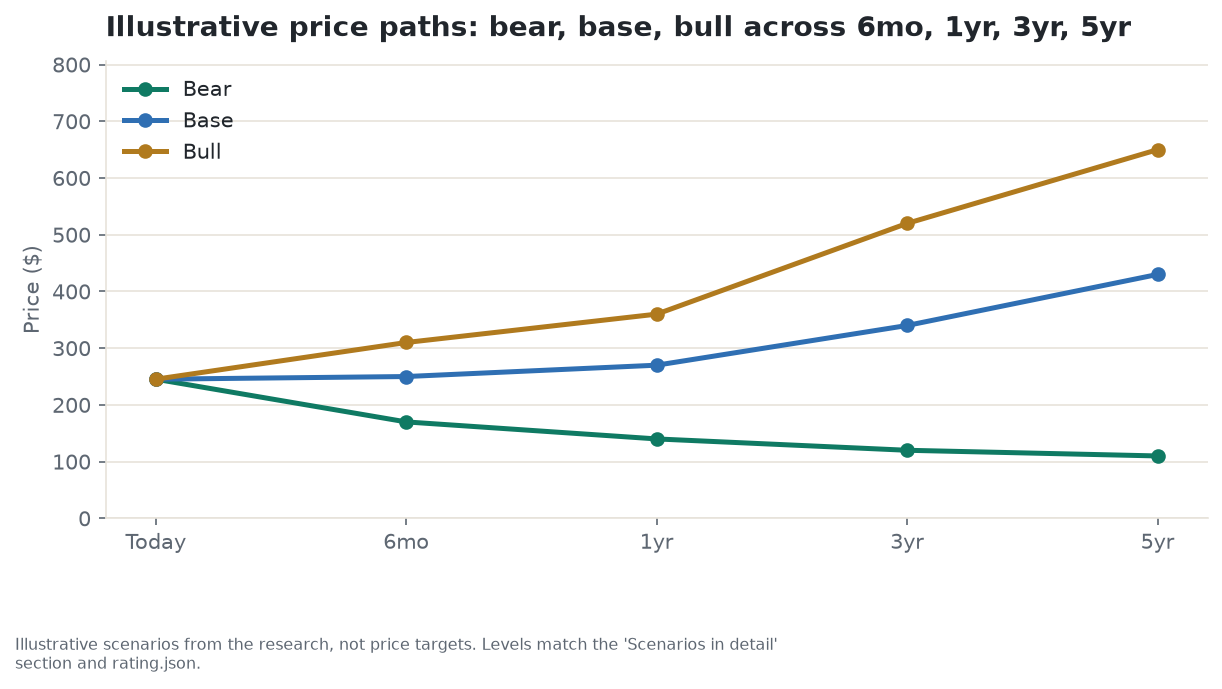
Six months. This window is dominated by two datable events: the Q2 fiscal 2027 earnings report expected around late August 2026, and whether management keeps raising guidance the way it did between its last two reports. Marvell just guided Q2 revenue to $2.70 billion at the midpoint, about 35 percent above the year-ago quarter and an acceleration from the 28 percent growth it just posted, an unusual thing to see this deep into an up-cycle. The base case is around $250, roughly flat from here, because a great deal of that good news is already in the price. The bull case is about $310 on another beat-and-raise alongside continuing news on the new NVIDIA partnership. The bear case is about $170, essentially a repeat of the kind of sharp, sector-wide reset that knocked the stock down almost 10 percent in a single session on the day this piece was researched. The single thing most likely to flip this window is the specificity of what management says about data center bookings on the August call.
One year. The dominant twelve-month question is whether growth holds anywhere near the 28 to 35 percent range Marvell has been posting and guiding, or reverts toward the kind of near-stall the company itself lived through as recently as fiscal 2025, when full-year revenue grew just 5 percent. Base case is around $270. Bull case is about $360, if growth keeps accelerating and Marvell discloses a customer relationship beyond the small handful it depends on today. Bear case is about $140, if growth disappoints and the market’s rich multiple compresses at the same time, a classic double-hit for an expensive growth stock. The clearest signal to watch either way is whether Marvell names a new hyperscaler-scale customer (the strongest possible evidence against concentration risk) or discloses any pullback from an existing one.
Three years. By this point the structural questions take over from the quarterly noise: has Marvell kept or grown its share of custom AI silicon against Broadcom, the larger and longer-established incumbent in this exact business, and against hyperscalers simply building the next chip generation themselves rather than paying Marvell to do it. Base case sits around $340. Bull case is about $520, if Marvell has genuinely broadened its customer base while holding today’s margins. Bear case is about $120, if one of its two or three largest relationships is lost, reduced, or brought in-house, echoing a risk the company discloses in its own regulatory filings, not one this research invented. Five years. This is the durability question in its purest form: does custom AI silicon prove out as a lasting, multi-customer franchise the way some of Marvell’s older product lines did, or does it turn out to be a phase hyperscalers eventually design their way out of once they have learned enough. Base case is around $430. Bull case is about $650. Bear case is about $110, essentially where the stock traded a little over a year before this research date. The single most important thing to watch across this whole horizon is customer count: two or three big relationships is a bet, six or eight is a franchise.
Where the read lands today. On balance, the five-factor read holds at Hold: the growth is real and the NVIDIA relationship is a genuine strategic validation, but the price already assumes a great deal of that strength keeps compounding without a stumble on concentration, competition, or the cycle, and the thing most likely to flip this read either way is a single disclosed customer event, not another quarter of the current growth rate.
Companion tool
Jump to the interactive dashboard to sort and filter Marvell against its peer set, or download the Excel model to flex the scenarios yourself.
TL;DR
Marvell makes the custom chips a small number of hyperscale cloud providers use instead of buying a general-purpose AI accelerator, plus the switches and optical links that move data between those chips inside a data center. Data center revenue grew from 40 percent of the business three years ago to 74 percent today, and the growth rate has gone from a near-stall (5 percent) two years ago to an accelerating 28 to 35 percent now, which is the entire bull case in one sentence. NVIDIA just backed that story with a real $2 billion equity investment and a partnership to connect Marvell’s chips to its own AI ecosystem, a genuine validation rather than the usual “GPUs replace custom chips” competitive framing. The catch is concentration and price: ten customers are 82 percent of revenue, one distributor alone is 37 percent, and Marvell’s own filings state plainly that customers sometimes bring chip design in-house instead of continuing to pay Marvell for it. At roughly 25 times trailing revenue and roughly 81 times trailing adjusted earnings, the stock is priced as though none of that risk shows up for years, and the company’s own history (a near-stall just twelve months before this rebound) argues that outcome is not guaranteed.
Explore it yourself: the interactive dashboard
Open the dashboard in a full screen
The chip that gets built once, for one customer
Most semiconductor companies design a chip and sell the identical part to dozens of customers, the way a factory that makes one style of door hinge sells that same hinge to every furniture maker who wants it. Marvell’s fastest-growing business does something different: it designs a chip to one customer’s exact specification, then builds it for that customer and essentially nobody else, the way a custom furniture shop builds one cabinet to fit one specific kitchen. That is what a custom Application-Specific Integrated Circuit, or ASIC, is in this context, and when the customer is a hyperscale cloud provider building its own AI accelerator instead of buying one from NVIDIA, the industry calls the resulting chip an “XPU.”
The commercial logic is straightforward once you see the scale involved. A cloud provider running artificial intelligence workloads across data centers that draw hundreds of megawatts of power can save real money per unit of computing power by paying a design house like Marvell to strip a chip down to exactly what that provider needs, rather than paying for a general-purpose chip built to serve every customer’s needs at once. That trade only pencils out at very large scale, tens or hundreds of billions of dollars of lifetime chip spend, which is exactly why the list of companies who can be a Marvell “XPU” customer is short by definition. Amazon, Google, Microsoft, and Meta between them run most of the world’s hyperscale AI infrastructure, and that handful of names is effectively the entire addressable customer list for this business. That is simultaneously the opportunity, since each design win is worth billions of dollars over several years, and the risk, since there is no long tail of smaller customers to fall back on if even one of those relationships sours.
How the money flows
flowchart TD
    A[Hyperscaler AI capex budget<br/>Amazon / Google / Microsoft / Meta] --> B[Custom XPU design win<br/>Marvell or Broadcom ASIC program]
    A --> C[Networking & optics budget<br/>switches, 800G/1.6T optics, DCI]
    B --> D[Marvell chip design & IP integration<br/>compute, SerDes, security firmware]
    C --> D
    D --> E[Third-party foundry<br/>advanced-node manufacturing]
    E --> F[Packaging, assembly, test<br/>often Asia-based contract manufacturers]
    F --> G[Distributor A<br/>37% of FY2026 revenue]
    F --> H[Direct customers<br/>57% of FY2026 revenue]
    G --> I[Hyperscaler data center deployment<br/>74% of revenue: Data Center segment]
    H --> I
    H --> J[Enterprise / carrier / other<br/>26% of revenue: Communications and other]
    K[NVIDIA: $2.0B preferred equity + partnership<br/>connects Marvell XPUs to NVIDIA ecosystem] --> D
    I --> L[Revenue back to Marvell]
    J --> L
    L --> M[R&D reinvestment ~25% of revenue]
    L --> N[Buybacks + dividend]
    L --> O[M&A: Celestial AI, XConn]
Money starts as a hyperscaler’s annual AI infrastructure budget, splits between a custom chip commitment (design partnership with Marvell or, more often industry-wide, Broadcom) and a separate networking and optics budget that gets spent regardless of whose compute chip sits in the middle of the rack. Marvell’s design and engineering work turns a specification into a chip; the actual manufacturing is outsourced entirely to third-party foundries, since Marvell owns no factories of its own. From there the finished chips are packaged and assembled, largely by contract manufacturers based in Asia, which is why 77 percent of Marvell’s revenue by shipment destination flows through Asian operations even though the end customer is very often a US hyperscaler. A large share of that revenue, 37 percent in the most recent fiscal year, is routed through a single distributor rather than billed directly, which in this industry usually means a small number of very large end customers wearing a different label, not genuine diversification.
The shape worth noticing is how short the chain is and how concentrated every stage after Marvell’s own design work happens to be. Manufacturing is a single outsourced chokepoint (the foundry layer). Demand is concentrated in a handful of buyers who hold real negotiating leverage precisely because there are so few of them. Marvell’s own toll sits entirely in the design and intellectual-property layer in the middle, which is genuinely valuable while a customer keeps choosing Marvell for its next chip generation, and genuinely fragile the moment that customer decides to design the next generation itself instead.
Company by company: who’s who
Marvell Technology, Inc. (MRVL), market cap approximately $214.6 billion as of July 2, 2026. The subject of this piece: a fabless designer of custom AI accelerators, data-center networking silicon, and optical interconnect. Q1 fiscal 2027 revenue was a record $2.418 billion, up 28 percent year over year, though GAAP net income of just $34.5 million (diluted EPS $0.04) was held down by a disclosed, non-cash accounting charge explained in the filings section below; non-GAAP net income was $718.0 million (diluted EPS $0.80). Bull: custom-XPU and AI-networking demand is accelerating, not decelerating, and NVIDIA’s own equity stake validates rather than threatens Marvell’s role in the AI ecosystem. Bear: 82 percent of revenue comes from the ten largest customers, one distributor alone is 37 percent, and the stock trades at roughly 25 times trailing revenue while the company’s own 10-K discloses that customers sometimes bring chip design in-house.
Broadcom Inc. (AVGO), market cap approximately $1.71 trillion. The much larger, longer-established incumbent in exactly the same custom-AI-silicon business, diversified further by a large enterprise-software arm (VMware). Fiscal Q2 2026 revenue was $22.187 billion. Bull: the largest and most established custom-silicon franchise in AI, with earnings-mix diversification competitors lack. Bear: its sheer size means any single new design win moves its overall growth far less than the same win would move a smaller name like Marvell, and its own rich multiple already assumes continued dominance.
NVIDIA Corporation (NVDA), market cap approximately $4.71 trillion, the world’s largest company. Designs the GPUs and AI-accelerator systems that are the dominant alternative to a hyperscaler building its own custom XPU, and, since March 2026, a $2.0 billion strategic equity investor in Marvell. Fiscal Q1 2027 revenue was $81.615 billion with net income of $58.321 billion, an extraordinary roughly 71 percent net margin. Bull: still the default choice for AI compute at almost any scale, and now holds a strategic stake across the custom-silicon ecosystem it might otherwise be disintermediated by. Bear: a broad hyperscaler shift toward custom XPUs, Marvell’s and Broadcom’s core business, is the single biggest structural risk to NVIDIA’s own share of AI compute spending.
Advanced Micro Devices, Inc. (AMD), market cap approximately $844.4 billion. The number-two merchant GPU vendor behind NVIDIA, with a smaller custom-silicon business competing for some of the same design wins as Marvell and Broadcom. Q1 2026 revenue was $10.253 billion, net income $1.383 billion. Bull: a credible alternative supplier on two fronts (merchant GPUs and select custom-silicon programs) benefits from any diversification away from a single AI-compute vendor. Bear: still behind NVIDIA in AI-accelerator share and behind Broadcom and Marvell in the custom-ASIC design-win pool, competing on two fronts at once with thinner margins than either specialist.
Intel Corporation (INTC), market cap approximately $604.9 billion. The only name in this peer set that both designs chips and owns its own manufacturing (a foundry), now seeking outside customers for that foundry business. Q1 2026 revenue was $13.577 billion, but the company posted a GAAP net loss of $3.728 billion. Bull: a successful foundry turnaround would make Intel a rare vertically-integrated alternative to the fabless model every other name here depends on. Bear: continued losses show that turnaround is not yet proven, and Intel has comparatively little of Marvell’s or Broadcom’s hyperscaler custom-AI-silicon traction today.
Super Micro Computer, Inc. (SMCI), market cap approximately $16.4 billion. A downstream systems assembler that builds complete AI server racks using chips from Marvell and its peers, rather than a chip designer itself, so it is more a proxy for the overall pace of AI data-center building than for who wins any specific silicon design. Fiscal Q3 2026 revenue was $10.243 billion with net income of just $483.4 million, a roughly 4.7 percent margin typical of a low-margin systems-integration business. Bull: rides the same AI data-center buildout as Marvell from the assembly side, with revenue that can scale quickly when capital spending accelerates. Bear: thin margins, high revenue volatility, and limited differentiation versus other contract assemblers.
What the filings say
Marvell’s revenue went from $5.51 billion (fiscal 2024) to $5.77 billion (fiscal 2025, up just 5 percent) to $8.19 billion (fiscal 2026, up 42 percent). That is not a smooth compounding line, it is a business that nearly stalled and then re-accelerated hard, and nearly all of the re-acceleration sits in one place: data center revenue grew from $2.22 billion (40 percent of the total, fiscal 2024) to $4.16 billion (72 percent, fiscal 2025) to $6.10 billion (74 percent, fiscal 2026), a 46 percent year-over-year gain in the most recent year. The smaller “communications and other” bucket, folding in enterprise networking, carrier infrastructure, consumer, and automotive/industrial products, grew 31 percent to $2.09 billion.
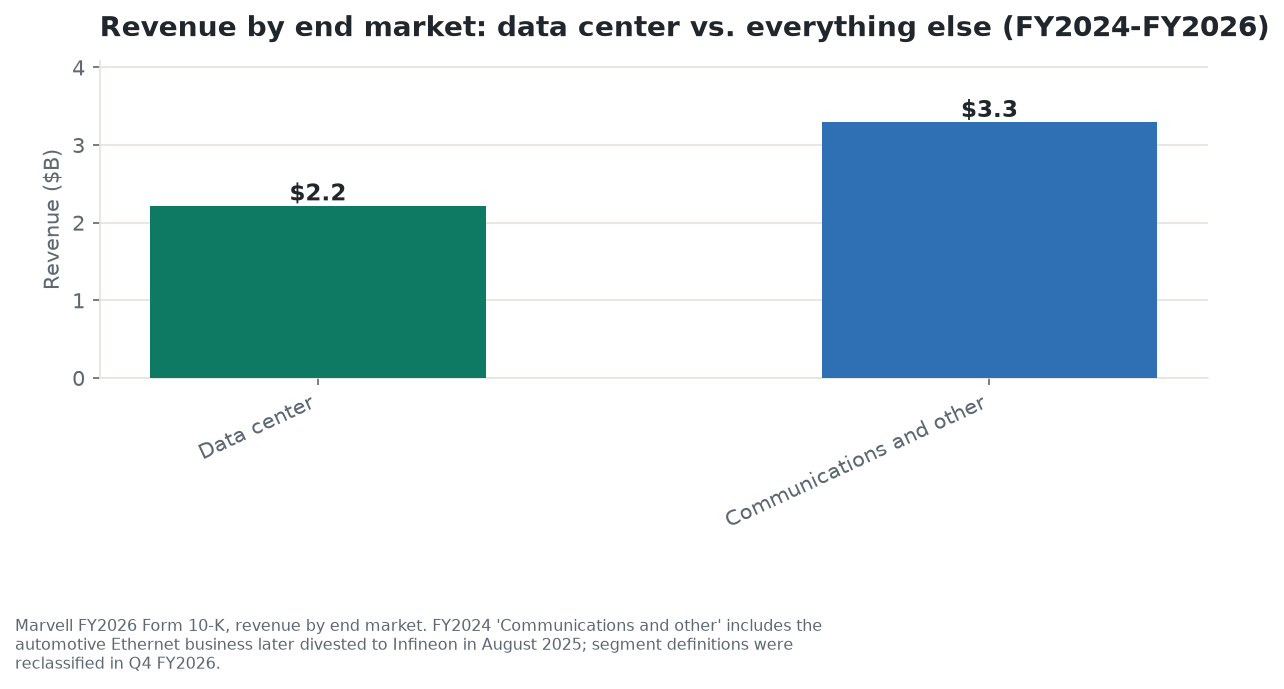
The most recent quarter confirms the trend is still building. Q1 fiscal 2027 (ended May 2, 2026) revenue was $2.418 billion, a quarterly record, up 28 percent year over year and 9 percent sequentially, with data center at $1.83 billion, 76 percent of the total. Guidance for the following quarter calls for $2.70 billion at the midpoint, about 35 percent year-over-year growth, an acceleration in the guided rate rather than a deceleration, which is the single most important number in this entire piece: this deep into an up-cycle, guided growth rates typically flatten or slow, not speed up.
Margins tell a genuinely encouraging story, with one important asterisk. GAAP gross margin expanded from 41.3 percent (fiscal 2025) to 51.0 percent (fiscal 2026), and GAAP operating income swung from a $720.3 million loss to a $1.32 billion profit over the same period. Some of that improvement is a one-time comparison effect: fiscal 2025’s margin had been depressed by $357.9 million of restructuring-related impairment charges that did not repeat. But R&D spending also grew only 6.4 percent while revenue grew 42 percent, and SG&A fell in absolute dollars even as revenue surged, both signs of real operating leverage as the custom-silicon business scales, not just a one-time comparison flattering the numbers.
Where the picture gets genuinely messy is GAAP net income and earnings per share, and understanding why matters more than the headline figures themselves. Fiscal 2026 GAAP net income was $2.67 billion, or $3.07 per diluted share, an enormous swing from the prior year’s $885.0 million loss. Almost none of that swing came from operations: Marvell completed the sale of its automotive Ethernet business to Infineon Technologies for $2.5 billion cash in August 2025 and booked a $1.83 billion pre-tax gain on that sale in the third quarter, a one-time item that inflates the headline net income and, by extension, any trailing price-to-earnings ratio computed on it.
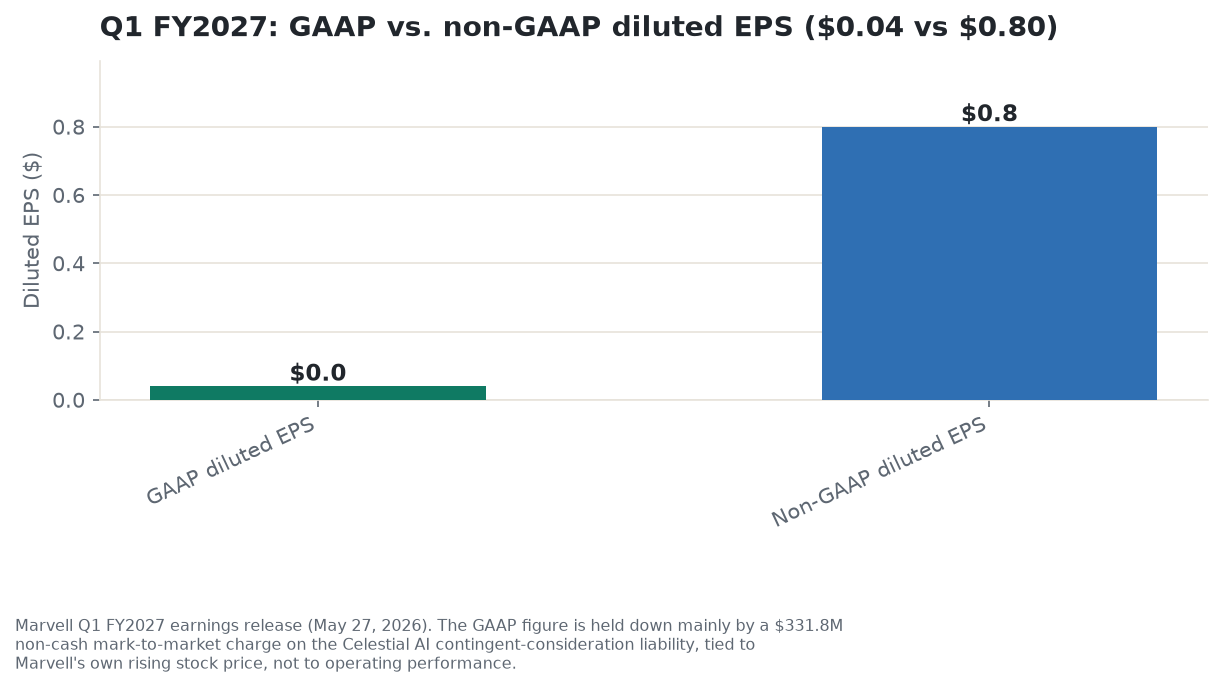
The most recent quarter shows a related but different version of the same lesson. Q1 fiscal 2027 GAAP diluted EPS was just $0.04, against $0.80 on a non-GAAP basis, an unusually wide gap that a casual reader could easily mistake for a bad quarter. It is not: the gap is almost entirely a single, disclosed, non-cash item. Marvell’s February 2026 acquisition of Celestial AI included an earnout, additional cash and stock owed to Celestial’s former owners if future revenue milestones are hit, and part of that earnout’s value is contractually tied to Marvell’s own stock price. When MRVL’s stock rose during the quarter, accounting rules required Marvell to record the resulting increase in the earnout’s estimated value as a current expense, $331.8 million of it, even though no cash actually changed hands and even though a rising stock price is, if anything, good news for shareholders. Think of it like a homeowner who promised a contractor a bonus tied to the house’s resale value: if the neighborhood gets more expensive, the homeowner has to book a bigger expected bonus payment on paper immediately, even before the house sells and even though rising home values are the opposite of bad news for the homeowner. That is mechanically what happened to Marvell’s GAAP earnings this quarter.
Marvell’s balance sheet also changed sharply in a single quarter. Between the fiscal 2026 year-end (January 31, 2026) and the end of Q1 fiscal 2027 (May 2, 2026), goodwill rose by roughly $2.8 billion on the Celestial AI and XConn acquisitions, long-term debt rose from $3.97 billion to $4.96 billion, and Marvell issued an entirely new $2.0 billion Series A Convertible Preferred Stock to NVIDIA, all while still completing $200 million of buybacks and paying its regular dividend in the same period. That is a great deal of simultaneous capital-allocation activity: two acquisitions integrating, new debt, a new class of preferred equity, and ongoing shareholder returns, all at once, right as a new Chief Financial Officer, Daniel Durn, took the seat on June 15, 2026 after the prior CFO’s orderly, stated-as-amicable departure. Durn previously served as CFO of Adobe, Applied Materials, and NXP Semiconductors, a strong resume for the role, but the sheer amount of financial-reporting complexity landing in his first quarters is worth tracking regardless of how well-qualified he is.
The single most consequential disclosure in this year’s filings, though, is the NVIDIA relationship itself. During the first quarter of fiscal 2027, Marvell and NVIDIA announced a strategic partnership “to connect Marvell’s custom XPUs and compatible scale-up networking with NVIDIA’s AI infrastructure ecosystem,” and on March 31, 2026, NVIDIA backed that partnership with cash: Marvell issued 2,000,000 shares of a new Series A Convertible Preferred Stock to NVIDIA for $2.0 billion, convertible at roughly $91.84 per share into about 21.8 million common shares. This is a genuine reversal of the simplistic “NVIDIA’s GPUs replace custom ASICs” framing that has hung over the whole custom-silicon industry: the world’s largest AI-compute company is now also a disclosed, paying strategic investor in one of the two leading independent custom-XPU houses. Marvell’s own risk-factor language is careful to note the other side of that coin too: the arrangement concentrates influence with a single large holder and could be dilutive on conversion, so this should be read as both a real strategic endorsement and a real governance and dilution consideration, not a one-sided positive.
Finally, the concentration numbers, straight from the filing, deserve to be stated plainly rather than softened. The ten largest customers (distributor and direct combined) were 82 percent of fiscal 2026 revenue. A single distributor, not separately named in the filing, was 37 percent of revenue, up from 34 percent the year before and 24 percent the year before that. A single direct customer was 14 percent, up from 13 percent. Direct customers overall were 57 percent of revenue, distributors 43 percent. And the filing states, in the company’s own words, that “some of our customers have chosen to develop certain semiconductor products internally and this trend may continue to proliferate.” That sentence, more than any chart in this piece, is the honest bear case in miniature.
What the market is paying
MRVL closed at $245.29 on July 2, 2026, down 9.84 percent on the day, against a 52-week range of $61.44 to $329.88. Computed from a market-data vendor’s daily closing price series, the stock is up roughly 12 percent over the trailing month, roughly 189 percent over six months, somewhere around 221 to 226 percent over the trailing year, and more than 300 percent over three years. Over that same trailing year, the PHLX Semiconductor Index (the SOX, a broad basket of chip stocks) returned about 19 percent and the S&P 500 returned about 19 percent as well by comparison, meaning MRVL has outrun even a very strong semiconductor sector by more than five times. Whatever multiple this stock carries today is a multiple assigned to a name that has already re-rated enormously, not a starting point.
Trailing one-year daily beta, a measure of how much a stock moves relative to the broader market, runs around 2.9 versus the S&P 500 and around 1.3 versus the semiconductor index specifically, with annualized realized volatility near 74 percent. In plain terms, this stock moves roughly three times as hard as the market as a whole, and meaningfully harder even than its own high-volatility sector peer group. The July 2 close is a live example: a nearly 10 percent single-session decline, on the same day the company reported record revenue alongside the GAAP-versus-non-GAAP earnings gap explained above.
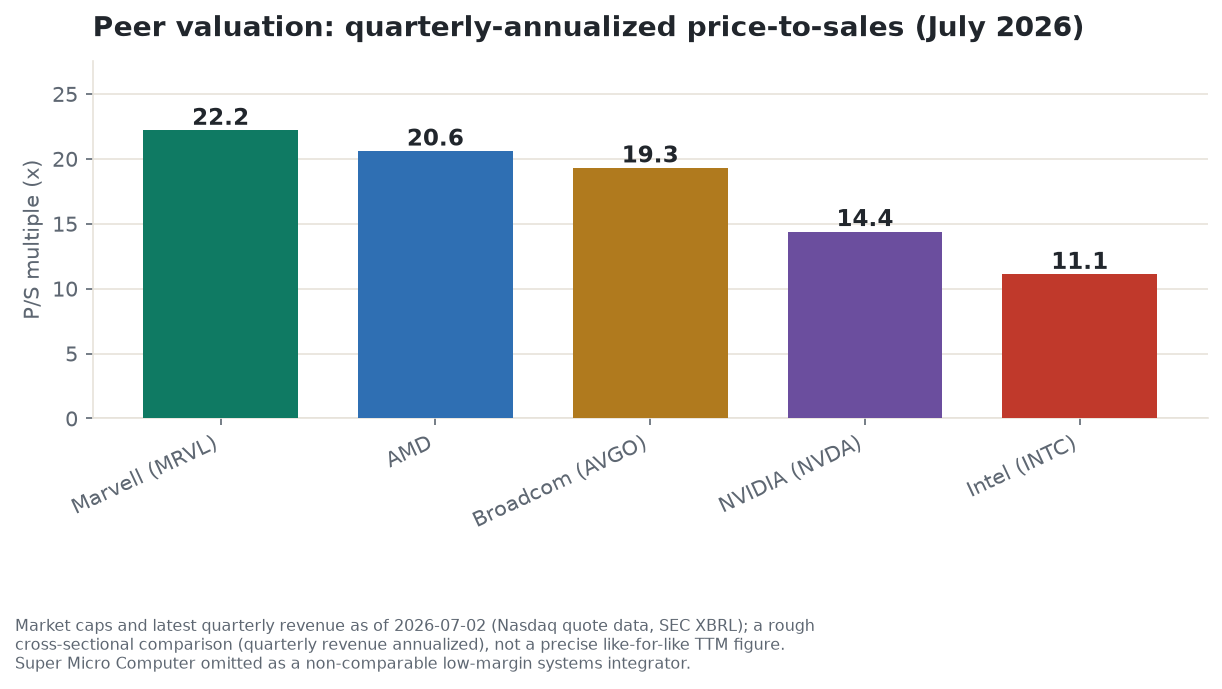
On valuation, market cap on common shares alone was approximately $214.6 billion, using 874.8 million shares outstanding as of the most recent 10-Q cover page (this excludes the roughly 21.8 million shares NVIDIA’s preferred stake would convert into). Against trailing-twelve-month revenue of $8.72 billion, that works out to roughly 24.6 times sales. Against trailing-twelve-month non-GAAP net income of $2.64 billion, that is roughly 81 times earnings, one of the richest multiples in the semiconductor sector on either measure. A rough, quarterly-annualized revenue multiple comparison across the peer set puts Marvell around 22 times, AMD around 21 times, Broadcom around 19 times, and NVIDIA around 14 times, so Marvell is not obviously the most expensive name in the group on a revenue basis, but its non-GAAP earnings multiple stands out as notably higher than NVIDIA’s, reflecting how much smaller Marvell’s absolute profit base still is relative to its market cap.
Short interest was 39.3 million shares as of the June 15, 2026 settlement date, about 4.5 percent of shares outstanding, with a days-to-cover ratio near 1.0, an unremarkable, non-crowded level of bearish positioning given how volatile the stock has been recently. A Nasdaq data-provider aggregation showed a one-year price target of $250.00 for MRVL as of July 2, 2026, sitting almost exactly at the current price, which suggests that particular vendor’s blended sell-side view is, on balance, that the stock is roughly fairly priced from here, though individual analysts clearly disagree in both directions: financial media reported Bank of America raising its own price target to $365 in late June (reported by a secondary aggregator, not independently confirmed against the primary analyst note), a target well above both the current price and that vendor consensus. Marvell was also added to the S&P 500 index in June 2026, alongside Flex Ltd, after clearing the index’s profitability screen on the back of its AI-driven earnings recovery, a mechanical demand event (index funds must buy the stock to track the benchmark) that plausibly contributed to some of the stock’s extraordinary price action in the weeks around the announcement, independent of the underlying business.
What the crowd is saying
Financial media coverage of MRVL through June and early July 2026 was unusually heavy, with a steady stream of same-day “why is Marvell stock up or down today” articles, the mark of a name that has become a genuine retail and institutional focal point rather than a quiet mid-cap story. The dominant thread across outlets has been speculative framing of Marvell as a future “trillion-dollar company,” repeatedly tied to a paraphrased remark attributed to NVIDIA’s chief executive calling Marvell “the next trillion-dollar company.” This research could not independently retrieve a primary transcript of that remark; it is widely repeated across outlets but sourced here only to secondary media aggregation, and it should be treated as a circulating narrative element rather than a confirmed executive statement, separate from the real, filed $2 billion NVIDIA investment described above, which stands on its own regardless of whether the quote is accurate.
A competing narrative, repeated across at least two separate dates in June 2026, argues that Broadcom’s larger, longer-established custom-AI-silicon franchise structurally outcompetes Marvell’s smaller, more richly valued equivalent. That is a legitimate framing worth taking seriously, and this piece’s own bear case, built independently from the filed customer-concentration numbers and Marvell’s own risk-factor language rather than from media commentary, stands regardless of how any single outlet frames the Broadcom comparison. Separately, multiple outlets reported in late June that Amazon was exploring selling its own Trainium AI chips to customers outside its cloud division, framed by some commentators as a read-through for Marvell given its role in Amazon’s custom-silicon program. This is speculative, sourced only to press reporting rather than a disclosure from either company, and cuts both ways if true: a bigger Trainium program could mean more design and manufacturing work for whichever partners support it, or it could simply reflect Amazon investing further in owning its own chip roadmap end to end. It belongs on a watch list, not in anyone’s thesis yet.
On the July 2 sell-off specifically, press coverage pointed to a mix of a broader “Korean chip rout” and a narrowing AI-sector valuation premium industry-wide, alongside the same-day earnings release. No single, confirmed cause for the entire move was identified in this pass. The more honest read is that a stock already up well over 100 percent in the prior six months, trading at a rich multiple, with elevated volatility, is mechanically primed for an outsized reaction to almost any incremental piece of news, and this looks like exactly that kind of reaction rather than one clean, identifiable trigger. Taken together, the fundamentals genuinely support a growth story (accelerating revenue, expanding non-GAAP margins, a real strategic relationship with NVIDIA), but the narrative running ahead of it, especially the round-number “trillion-dollar” framing, and the stock’s own recent stretch of double-digit single-day moves in both directions, are themselves evidence that the market’s read on this name is genuinely unsettled right now, not converging cleanly on either the bull or the bear case.
Durability: what has to keep being true
Marvell’s growth is tied overwhelmingly to one cycle: how much hyperscale cloud providers choose to spend building AI infrastructure in a given year, and how much of that spend flows to custom silicon and networking rather than to general-purpose GPUs. That is a real structural tailwind, evidenced across the sector broadly, but it is also a genuine cyclicality risk in its own right, and Marvell’s own recent history proves the point better than any hypothetical could: fiscal 2025 revenue grew just 5 percent, a near-stall, before the current re-acceleration. A cycle that has already turned down once inside the past three years can turn down again, and this time the stock would be falling from a far richer starting multiple than it carried during the last slowdown.
The structural bull case is that custom silicon, once won, behaves like an annuity rather than a one-time sale: an 18-to-24-month design cycle means a hyperscaler that commits engineering resources and roadmap to Marvell’s chips is expensive and slow to switch away from mid-cycle, and the deep intellectual-property and system-integration work Marvell brings (compute cores, high-speed signaling, security firmware, all stitched into one working chip) is not trivially replicated by a customer overnight. NVIDIA’s own decision to invest $2 billion and build a formal partnership around connecting Marvell’s chips to its ecosystem is real evidence that a very well-informed industry player believes the custom-XPU category is durable enough to be worth aligning with commercially, rather than something to simply out-compete.
The honest cyclical and structural bear case, though, is not a hypothetical either: it is Marvell’s own words. The company’s 10-K states plainly that customers bringing chip design in-house “may continue to proliferate,” and names an unusually long list of direct competitors, from Broadcom, the largest and most established rival in this exact business, down to smaller specialists like Alchip and Global Unichip who compete for the same design-win pool from an even closer position to the foundry. With 82 percent of revenue from ten customers and 37 percent from a single distributor, there is no long tail of smaller relationships to smooth the loss, reduction, or in-sourcing of even one large one. The most likely outcome, on the evidence gathered here, sits between these two extremes: Marvell’s core custom-silicon relationships probably hold for the next design cycle or two given how switching-cost-heavy the model is, and the near-term growth numbers likely stay strong, but the valuation already assumes that outcome plus meaningful diversification beyond it, and the company’s own disclosed risk factors, not media hype, are the reason that assumption deserves real scrutiny rather than blind acceptance.
The scenarios in detail
Four variables decide where this stock goes from here: whether Marvell adds genuinely new hyperscaler customers rather than compounding within its current concentrated base; how much of the incremental AI custom-silicon and networking spend flows to Marvell versus Broadcom or in-house design efforts; whether non-GAAP gross margin (58.9 percent in the most recent quarter) holds or expands; and how rich a multiple the market keeps paying for that growth, since at roughly 81 times trailing non-GAAP earnings, a large share of the near-term stock outcome depends on sentiment about the multiple as much as on the business itself.
Bull. Revenue growth stays in the 25 to 35 percent range for several more years before moderating, Marvell adds at least one genuinely new large custom-silicon or AI-networking customer beyond its current concentrated base, the NVIDIA partnership converts into meaningful, disclosed commercial volume rather than remaining mostly a validating headline, non-GAAP gross margin holds near 58 to 60 percent, and the market continues paying a premium AI-infrastructure multiple. Under those assumptions, non-GAAP diluted earnings per share, built from today’s roughly $3 trailing run-rate, could plausibly compound toward the mid-teens dollars within five years at an assumed exit multiple that stays elevated even as it moderates somewhat, an illustrative path toward roughly $650 [estimate]. What breaks this case: the loss, reduction, or in-sourcing of any of the top two or three customer relationships, or a broad pause in hyperscaler AI infrastructure spending across the board.
Base. Growth decelerates gradually from today’s 28 to 35 percent toward a mid-teens percentage rate within five years as the business matures and laps larger comparisons, Marvell retains its current relationships without major new diversification, margins hold roughly flat to modestly improved, and the market’s multiple normalizes gradually from today’s rich level toward a more ordinary, still-respectable growth-semiconductor multiple. That path implies non-GAAP diluted earnings per share reaching roughly $12 to $13 within five years at a multiple closer to the mid-30s, an illustrative level near $430 [estimate]. A single disclosed new customer win, or a single customer loss, would each be a large enough event on its own to move the stock off this base case in either direction.
Bear, anchored on the same customer-concentration risk Marvell itself discloses. One or more of Marvell’s two or three largest custom-silicon relationships is lost, reduced, or brought in-house; Broadcom’s larger, more established franchise takes the next generation of design wins Marvell was counting on; growth decelerates sharply, echoing the fiscal 2025 near-stall; and the market re-rates the stock toward a normal, mature semiconductor multiple in the mid-teens once the growth story cools. Under those assumptions, non-GAAP earnings per share growth stalls in the mid-single digits to flat for a period, reaching only roughly $7 within five years instead of compounding toward the base case, an illustrative level near $110 [estimate], not far from where the stock traded a little over a year before this research date.
Near-term catalysts to watch: the Q2 fiscal 2027 earnings report around late August 2026 and whether guidance is raised again; further disclosure on the NVIDIA partnership’s commercial specifics, beyond the equity investment alone; any update on the Amazon Trainium external-sales reporting; and the new CFO’s first full quarters setting the tone after an unusually complex period of simultaneous M&A, new debt, and new preferred equity. Multi-year inflections to watch: whether Marvell discloses any genuinely new large custom-silicon customer, the clearest possible evidence against concentration risk; the next design-win cycle with its existing top customers, given design cycles typically run 18 to 24 months; and the broader hyperscaler AI-capex cycle’s next inflection, whether it keeps accelerating or pauses the way it has before, including within Marvell’s own recent history.
Companies to watch (bull / base / bear)
Marvell (MRVL): the subject of this piece. Bull: new customer diversification plus sustained margin expansion. Base: current relationships hold, growth moderates gradually. Bear: a top customer relationship is lost or in-sourced. Watch: the top-10 and single-distributor concentration percentages in each future filing.
Broadcom (AVGO): the larger incumbent Marvell is most often compared against. Bull: continues winning the majority of new hyperscaler custom-silicon design cycles given its scale and tenure. Base: the two companies roughly split incremental design wins. Bear: loses share to Marvell or to in-house hyperscaler efforts even from its larger base. Watch: any disclosed new custom-silicon customer win at either company, since it is a relative, zero-sum-ish signal between the two.
NVIDIA (NVDA): both the biggest competitive threat to custom silicon broadly and now a strategic investor in Marvell specifically. Bull: the AI compute market grows large enough that both merchant GPUs and custom XPUs expand together rather than at each other’s expense. Base: a gradual, ongoing mix shift toward more custom silicon at the margin, which NVIDIA’s investment in Marvell suggests it is positioning for rather than fighting. Bear: a hard shift toward custom XPUs materially dents NVIDIA’s own growth trajectory. Watch: commercial specifics disclosed under the Marvell-NVIDIA partnership, beyond the equity stake alone.
AMD (AMD): a smaller custom-silicon competitor and the number-two merchant GPU vendor. Watch: whether AMD’s custom-silicon design wins grow meaningfully, which would signal the design-win pool is genuinely widening rather than staying a two-horse Marvell-versus-Broadcom race.
Intel (INTC): a foundry, not primarily a custom-silicon design competitor today. Watch: whether Intel’s foundry business wins external custom-silicon manufacturing customers, which would be a structural change to who controls the manufacturing chokepoint every fabless designer, including Marvell, currently depends on outside foundries for.
Super Micro Computer (SMCI): a systems-assembly proxy for overall AI data-center build volume. Watch: SMCI’s own revenue trend as a rough read on whether the broader AI-infrastructure buildout, the tide that lifts or lowers every name in this piece, is still rising.
Risk controls
The single largest risk in this name is customer concentration, not cyclicality or competition in the abstract: 82 percent of revenue from ten customers and 37 percent from one distributor means there is no diversification to fall back on if even one relationship weakens, and Marvell’s own filing states that customers bringing chip design in-house is an active, ongoing trend, not a hypothetical. The second-largest risk is valuation: at roughly 81 times trailing non-GAAP earnings, this stock is priced for years of continued strong growth, and its own recent history (a near-stall in fiscal 2025) shows that outcome is not guaranteed, so a growth disappointment here would likely combine with multiple compression rather than one offsetting the other. The third risk is volatility itself: a beta near 2.9 versus the broad market and annualized volatility near 74 percent mean this stock can move violently on relatively routine news, as it did on the day this research was conducted, and position sizing should reflect that reality regardless of one’s view on the underlying business. A reasonable risk control here is treating any position as a smaller allocation sized for a name that can plausibly move 10 percent or more in a single session, watching the customer-concentration disclosures in each future filing as the single most important recurring data point, and being honest that the bull case requires several things (customer retention, competitive share versus Broadcom, sustained margins, and a market willing to keep paying a rich multiple) to all go right at once, not just one of them.
Methodology, sourcing, and data-quality flags
This piece draws on Marvell’s fiscal 2026 Form 10-K, its Q1 fiscal 2027 Form 10-Q, the associated quarterly earnings-release exhibits, a June 2026 Form 8-K on the CFO transition, live market data from Nasdaq’s quote and short-interest feeds and a market-data vendor’s daily price series, and a scan of recent financial media coverage treated explicitly as narrative signal rather than fact. Every figure traces to a claim recorded with its source, tier, and as-of date; 69 load-bearing claims were recorded for this piece, 46 from primary filings, 16 from analyst-tier market-data sources, and 7 from press-tier news coverage, of which 62 were independently confirmed and the remaining 7 (all narrative or single-vendor consensus items) are explicitly hedged in the text above rather than stated as fact.
On the five-factor research read behind the rating: valuation shows one of the richest multiples in the semiconductor sector, roughly 24.6 times trailing revenue and roughly 81 times trailing non-GAAP earnings, against a peer set that includes far larger, more diversified names trading at lower earnings multiples, which reads as stretched even for a fast-growing business. Growth is unambiguously strong: revenue accelerated from 5 percent to 42 percent year-over-year growth across the last two fiscal years, the most recent quarter grew 28 percent, and management’s own guidance calls for further acceleration toward 35 percent next quarter, an unusually strong signal this deep into a cycle. Quality is mixed: non-GAAP gross and operating margins are excellent and expanding, and operating cash flow just set a quarterly record, but customer concentration is severe and rising, GAAP earnings quality has been volatile due to real but non-operating items, and the balance sheet took on meaningful new complexity in a single quarter alongside a CFO transition. Risk points firmly negative: the company’s own filings disclose customer in-sourcing as an active, rising risk, competition from the larger incumbent Broadcom is real, beta and realized volatility both run roughly three times the broad market, and the rich valuation leaves little room for a stumble. Momentum has been extraordinary on a one-year view (roughly 221 to 226 percent, more than five times the semiconductor index) and includes a real S&P 500 inclusion and NVIDIA strategic investment, but the very recent price action has been sharply two-sided and a single vendor’s aggregated price target sits almost exactly at today’s price. On balance, the five-factor read lands at Hold: a company whose growth and strategic positioning are genuinely strong, inside a stock whose price already assumes a great deal of that strength keeps compounding without a stumble.
Data-quality flags:
- GAAP net income and earnings per share for fiscal 2026 and the trailing twelve months are inflated by a one-time, non-recurring $1.83 billion gain on the automotive-Ethernet divestiture; any GAAP price-to-earnings ratio computed on that trailing figure understates the true multiple relative to the underlying run-rate business.
- Q1 fiscal 2027 GAAP earnings per share ($0.04) is depressed by a disclosed, non-cash, stock-price-linked mark-to-market charge tied to the Celestial AI acquisition’s earnout structure, not by weak operations; non-GAAP earnings per share ($0.80) is the cleaner read on the quarter’s operating performance, though non-GAAP measures by definition exclude real costs and should not be treated as a full substitute for GAAP.
- “Distributor A,” representing 37 percent of fiscal 2026 revenue, is not separately named in the filing; industry convention suggests this figure likely represents a small number of large end customers routed through a distribution intermediary rather than genuine diversification, but this is an informed inference by this researcher, not a disclosed fact.
- Sell-side consensus price-target figures cited here are a single vendor’s aggregation, not independently cross-checked against a second consensus provider, and one specific analyst price-target report (Bank of America) is sourced only to secondary aggregator coverage, not the primary analyst note.
- The widely repeated “next trillion-dollar company” remark attributed to NVIDIA’s chief executive could not be traced to a primary transcript in this pass and is presented only as reported commentary, never as a confirmed quotation.
- The exact cause of the July 2, 2026 intraday decline is not singularly attributable; press coverage cites a mix of a broader sector-wide “Korean chip rout” and the same-day earnings release, and this piece presents that as an open, hedged attribution rather than picking one cause.
- A specific, attributable third-party total-addressable-market figure for AI custom silicon was sought but could not be independently verified in this pass, so this piece relies on management’s own verified guidance and demand commentary rather than an unverified market-size number.
Key sources: Marvell Technology Form 10-K (fiscal year ended January 31, 2026, filed March 11, 2026); Form 10-Q (quarter ended May 2, 2026, filed May 28, 2026); Q1 FY2027, Q3 FY2026, and Q2 FY2026 earnings-release exhibits; Form 8-K on the CFO transition (filed June 11, 2026); Nasdaq quote, summary, and short-interest data (accessed July 2, 2026); a market-data vendor’s daily price series for MRVL, the S&P 500, and the PHLX Semiconductor Index; Reuters coverage of the S&P 500 index-inclusion announcement; and a scan of aggregated financial media coverage from June and early July 2026.
Structured data for search and rich results
{
  "@context": "https://schema.org",
  "@type": "Article",
  "headline": "Marvell (MRVL) stock: NVIDIA's $2B bet vs a rich AI-chip price",
  "description": "MRVL stock forecast: Hold, Overvalued. Bull/base/bear across 6mo-5yr on a custom-AI-silicon supplier at ~81x non-GAAP earnings, 82% customer concentration, and NVIDIA's new $2B stake.",
  "author": {
    "@type": "Organization",
    "name": "Deep Market Research"
  },
  "datePublished": "2026-07-02",
  "dateModified": "2026-07-02",
  "image": "/og/mrvl.png",
  "url": "/posts/mrvl/"
}
{
  "@context": "https://schema.org",
  "@type": "FAQPage",
  "mainEntity": [
    {
      "@type": "Question",
      "name": "What is the Marvell (MRVL) stock price forecast for 6 months?",
      "acceptedAnswer": {
        "@type": "Answer",
        "text": "Base case around $250, roughly flat, since a lot of good news is already priced in. Bull case around $310 on another beat-and-raise quarter. Bear case around $170 on a guidance miss or a continuation of sector-wide de-rating like the July 2, 2026 sell-off."
      }
    },
    {
      "@type": "Question",
      "name": "What is the Marvell (MRVL) stock outlook for 1 year?",
      "acceptedAnswer": {
        "@type": "Answer",
        "text": "Base case around $270 as growth moderates gradually. Bull case around $360 if growth stays near 30%+ and a new customer relationship is disclosed. Bear case around $140 if growth disappoints the way it did in fiscal 2025 and the multiple compresses at the same time."
      }
    },
    {
      "@type": "Question",
      "name": "What is the Marvell (MRVL) stock forecast for 3 years?",
      "acceptedAnswer": {
        "@type": "Answer",
        "text": "Base case around $340 on steady, more moderate compounding. Bull case around $520 if Marvell visibly broadens beyond its concentrated customer base while holding margins. Bear case around $120 if a top customer relationship is lost, reduced, or brought in-house."
      }
    },
    {
      "@type": "Question",
      "name": "What is the Marvell (MRVL) stock price target for 5 years?",
      "acceptedAnswer": {
        "@type": "Answer",
        "text": "Base case around $430 as growth matures toward a mid-teens rate. Bull case around $650 if custom AI silicon proves a durable, diversified, multi-decade franchise. Bear case around $110 if competitive share loss and in-sourcing compound with ordinary semiconductor cyclicality."
      }
    }
  ]
}
Prepared July 2, 2026. Figures are point-in-time and will change. This is research and analysis for educational purposes, not investment advice, not a recommendation, and not a solicitation. Marvell is a high-beta semiconductor stock levered to a concentrated customer base and a fast-moving AI-infrastructure spending cycle, so its figures can move faster and further than a typical stock. Verify all figures independently and consult a licensed financial advisor before making any decision.