
Research date: June 22, 2026 | OSINT market research on Advanced Micro Devices, Inc. (AMD, Nasdaq), the AI-accelerator challenger and server-CPU share-taker
Important disclaimer. This is independent OSINT (open-source intelligence) research compiled for educational and informational purposes only. It is not investment advice, not a recommendation or solicitation to buy, sell, or hold any security, and not a statement that any security is suitable for you. The author is not a financial advisor and has no fiduciary relationship with any reader. Semiconductors are deeply cyclical, AMD’s growth is concentrated in a handful of AI-capex customers, and the company depends on a single foundry (TSMC) and on China-export policy that can change without warning, so the risk here is real and two-sided. The rules-based rating below is a research signal, not a directive. All figures are point-in-time (intraday on June 22, 2026 unless otherwise stamped) and move fast - prices, market caps, multiples, market-share figures, and legal status may be stale by the time you read this. Any bull / base / bear scenarios and the illustrative valuations are analytical framings and arithmetic on stated assumptions, not price targets, predictions, or guarantees. Do your own due diligence and consult a licensed professional before making any financial decision.
Where this stock could be in 6 months, 1 year, 3 years, and 5 years
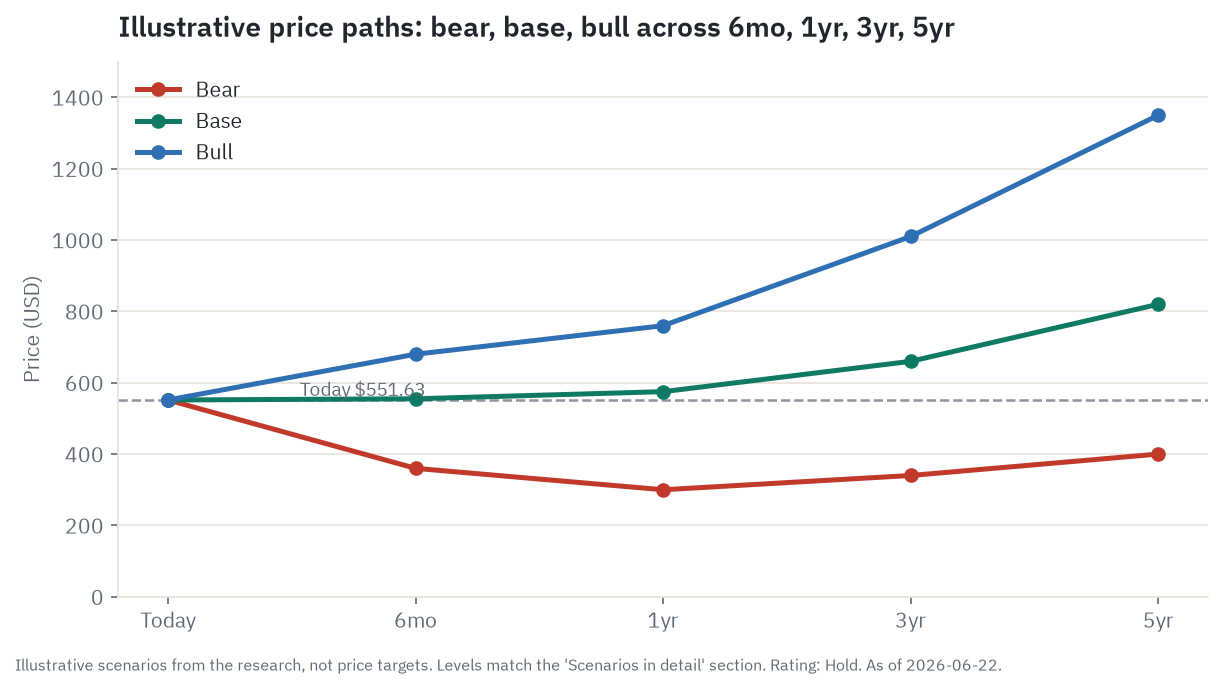
AMD closed at $551.63 on June 22, 2026, after touching an all-time high of $562.99 intraday the same session. The stock is up about 158 percent year to date and roughly 330 percent over the trailing year. The ranges below are arithmetic on stated assumptions, not predictions. They are here first because they are the answer to the question most readers arrive with.
6 months. This window belongs to datable events, not to the long-run story. Q2 2026 earnings land in late July or early August (AMD guided about $11.2 billion in revenue, plus or minus $300 million, at roughly 56 percent non-GAAP gross margin), and the first batches of the new MI450 AI GPU ship to OpenAI and Meta in the second half of 2026. That same shipment is when the warrant “contra-revenue” charge (more on that below) first shows up in the GAAP numbers. Base case is roughly flat near the high, around $555, as the market digests the run. Bull around $680 if the MI450 ramp prints cleanly and the stock pushes toward the $600 level that triggers the final warrant tranche. Bear around $360 if the soft-Q2 warning that circulated in mid-June proves real and the first GAAP gross-margin print on warrant-bearing revenue surprises a Street that has been anchoring to the friendlier non-GAAP number. The single thing most likely to flip the window: whether that first GAAP gross-margin print is a non-event or a shock.
1 year. The dominant variable becomes the cadence of the MI450 deployment through the back half of 2026 against NVIDIA’s next-generation Vera Rubin, plus where the multiple settles. Base case around $575 is a mid-single-digit total return as earnings grow into a still-rich but fading multiple. Bull around $760 if deployments beat, hyperscalers keep wanting a second source to NVIDIA, and EPYC server share keeps climbing. Bear around $300, approaching the Street’s lowest published target of $225, if the ramp is lumpy and a stock already sitting above its own average analyst target re-rates down toward the multiple a proven peer like Broadcom carries. The flip: does reported Data Center revenue validate the “tens of billions” framing that justifies a 63x multiple, or fall short of it.
3 years. Structure starts to dominate. By 2028 and 2029 the market can see whether Instinct GPU revenue actually compounded, whether its gross margin rose toward the mid-50s, and whether EPYC held more than half of server-CPU revenue through Intel’s delayed Diamond Rapids counter. Base case around $660 puts roughly $11 to $12 of non-GAAP earnings per share against a normalized 30 to 35 times multiple. Bull around $1,010 has Instinct revenue and margin both proving out on AMD’s own aspirational earnings path at a sustained premium. Bear around $340 is the AI premium gone, leaving the company worth its EPYC plus Embedded earnings power at a market multiple. The flip: proof of durable Instinct margin, not just Instinct revenue.
5 years. Pure durability. Did AMD’s inference foothold survive the custom-chip substitution coming from below, and did its ROCm software narrow the gap to NVIDIA’s CUDA enough to lift Instinct margins while memory costs climbed? Base case around $820 puts roughly $16 to $18 of earnings per share at a mature 28 to 32 times, partly diluted for the warrants. Bull around $1,350 if Instinct matured into a second high-return franchise near AMD’s stated ambition of more than $20 in earnings power. Bear around $400 if AI compute stayed a capital-hungry, margin-thin, custom-chip-eroded commodity and only the EPYC and Embedded businesses held value. That bear is a derating, not an impairment - the company stays healthy throughout. The flip: whether merchant GPUs are still a real market for inference in 2031, or whether the hyperscalers built around them.
Where the read lands today. On balance the read lands at Hold. AMD is a genuinely fast-growing, net-cash chip franchise where EPYC server CPUs are the real profit engine and the Instinct AI ramp - underwritten by back-to-back 6-gigawatt deals with OpenAI and Meta - is the upside call option. The catch is the price: the stock trades at roughly 63 times forward earnings, above the Street’s own average target, carries close to 20 percent potential dilution from the customer warrants, and runs a gross-margin gap to NVIDIA of about 20 points. So the business can grow, but the stock can grow into that valuation only slowly. The single thing most likely to flip the read is the first clean look at warrant-bearing GAAP revenue in the second half of 2026.
Companion tool
Jump to the interactive dashboard to sort and filter every company in the piece, or download the Excel model to flex the scenarios yourself.
TL;DR
The money starts as AI-capital spending by a handful of the most profitable companies on earth - Amazon, Microsoft, Alphabet, Meta, and Oracle guided a combined roughly $725 billion of 2026 capex, around three-quarters of it aimed at AI infrastructure (analyst-aggregated, press-reported) - and AMD intercepts it through two products. The first is EPYC, its server CPU (central processing unit, the general-purpose brain of a server), which reached a record 46.2 percent of x86 server-CPU revenue and is the steady cash engine. The second is Instinct, its AI GPU (graphics processing unit, the parallel-math chip that trains and runs AI models), where AMD is the credible number two behind NVIDIA. Total revenue grew 34 percent in 2025 to $34.6 billion and 38 percent in the first quarter of 2026, with the Data Center segment up 57 percent and now the primary driver. The bull case is that the dual 6-gigawatt OpenAI and Meta mandates carry Instinct toward tens of billions in revenue while EPYC holds share. The single biggest risk is the price colliding with the structure: a 63x forward multiple (about three times NVIDIA’s) on AI earnings that have not fully arrived, roughly 20 percent share dilution that AMD handed customers to win the deals, NVIDIA’s CUDA software moat on training, and custom hyperscaler chips eating the inference work AMD is counting on. The growth is real. The stock is priced for that growth to keep arriving close to flawlessly.
Explore it yourself: the interactive dashboard
Open the dashboard in a full screen
The setup: AMD’s bid to be the credible number two in AI compute
For most of its life AMD was the cheaper alternative. It made decent processors that undercut Intel, it sold the chips inside game consoles, and for long stretches its stock traded like an option on Intel stumbling. That AMD is gone. The company that sits in front of investors in mid-2026 is the only firm besides NVIDIA that hyperscalers will seriously consider for AI accelerators, and it has the back-to-back signatures of OpenAI and Meta to prove buyers want a second source.
Here is the core question the rest of this piece interrogates. Is AMD a structural number two in AI accelerators and a profitable share-taker from Intel in server CPUs - two real franchises that justify a premium - or is it a cyclical chip company priced for an AI outcome that has not arrived and may arrive smaller than the price implies?
A useful way to hold both at once: think of the AI-compute market as a single toll road being built at full speed. NVIDIA owns the main road and the toll software, and it collects on nearly every car. AMD is building a parallel lane. The lane is real, cars are starting to use it, and two very large fleet operators have signed up to drive on it. But the lane opened years later, it does not yet run the same software the drivers already know, and a third group of operators is quietly paving private side roads of their own for exactly the trips AMD’s lane was built to capture. The lane will carry traffic. The argument is about how much, at what toll, and whether the price of the company already assumes the road is fuller than it will be.
How the money flows
flowchart TD
    HYPER["Hyperscalers + AI Labs\nOpenAI 6GW deal, Meta 6GW, Oracle 50K GPUs\n~$11.2B AMD Q2 2026 guide driven by DC"]
    CLOUD["Cloud + Enterprise Servers\nAWS, Azure, GCP, OCI buy EPYC\n46.2% x86 server CPU revenue (Q1 2026)"]
    OEMS["PC OEMs\nDell, HP, Lenovo buy Ryzen\n$10.6B Client revenue FY2025"]
    CONSOLE["Console + Embedded\nSony PS5, Xbox SoC, Xilinx FPGA OEMs\n$3.5B Embedded 36% op margin"]

    AMD["AMD - Fabless Designer\nFY2025 revenue $34.6B, FCF ~$5.5B\n4 segments: DC, Client+Gaming, Embedded"]

    HYPER --> AMD
    CLOUD --> AMD
    OEMS --> AMD
    CONSOLE --> AMD

    ODM["ODM/System Integrators\nHPE Helios rack, Dell, Supermicro\ncapture server system margin"]
    HYPER --> ODM
    ODM --> AMD

    TSMC_PKG["TSMC CoWoS Packaging\nSole advanced packaging for Instinct GPUs\nAMD gets ~11%, NVIDIA gets ~60% of capacity"]
    TSMC_FAB["TSMC Wafer Fabs (Taiwan + AZ)\nSole N3/N2/N4/N5 source for AMD\nN2 Venice in prod May 2026"]
    HBM["HBM Memory\nSK Hynix (dominant) + Micron\n2026 capacity fully booked; +15-20% pricing"]
    GF["GlobalFoundries\nMature nodes >7nm\nRyzen embedded cores, chipset dies"]
    SUB["Substrates/OSAT\nIbiden, Shinko, Amkor AZ"]

    AMD --> TSMC_PKG
    AMD --> TSMC_FAB
    AMD --> HBM
    AMD --> GF
    AMD --> SUB

    CUDA["NVIDIA CUDA Ecosystem\nToll-taker above AMD for training workloads\n15-yr head start, TensorRT-LLM, NVLink 900GB/s"]

    CUDA -. "Software moat constrains AMD\ntraining cluster wins" .-> AMD
Read the diagram top to bottom and the investing point falls out of the shape. Demand enters from four pools at the top. The fast, high-margin pool is the hyperscalers and AI labs buying Instinct GPUs and EPYC CPUs - OpenAI and Meta on 6-gigawatt deals, Oracle on a 50,000-GPU cluster. Below that sit the steady pools: cloud and enterprise buyers of EPYC server CPUs, PC makers buying Ryzen consumer chips, and console and industrial buyers of semi-custom and Xilinx products. AMD is the company in the middle. The word that matters there is fabless: AMD designs the chips and owns the customer relationships and the software, but it owns no factories.
That is why the bottom half of the diagram is where the danger lives. Every leading-edge chip AMD sells is made by TSMC, the Taiwanese foundry, and there is no second source at the advanced process nodes AMD needs. The memory that gives an AI GPU its capacity - HBM, or high-bandwidth memory, stacked DRAM bonded right next to the compute die - comes mostly from SK Hynix and Micron, and that supply is fully booked for 2026 with prices up high-teens to low-20s percent. The packaging step that physically bonds the HBM to the GPU is TSMC’s CoWoS (chip-on-wafer-on-substrate), and AMD gets an estimated 11 percent of that capacity against NVIDIA’s roughly 60 percent (an analyst estimate the source itself calls contested, so read it as direction, not precision). AMD does not own a single one of those chokepoints. It rents access and competes for allocation against NVIDIA and Apple.
There is one more toll-taker, and it sits outside the physical chain entirely. NVIDIA’s CUDA software ecosystem - 15 years of libraries, tools, and trained developers - is the default platform for AI training, and AMD cannot out-manufacture it. AMD competes around it by aiming at inference (running models, the cheaper and more repetitive half of AI work) and at buyers motivated to qualify a second source. Where does AMD’s own profit concentrate? In Data Center (21.7 percent operating margin in 2025, rising to 27.7 percent in the first quarter of 2026) and in Embedded, which carries the highest segment margin at about 36 percent. The shape of this chain is the whole thesis: AMD captures fast-growing demand but sits beneath suppliers it does not control and beside a software moat it did not build.
Field guide: the four segments
AMD reports three segments after a 2025 reorganization that merged Client and Gaming, but it is clearest to walk all four product lines. The 2025 revenue split is on the chart below.
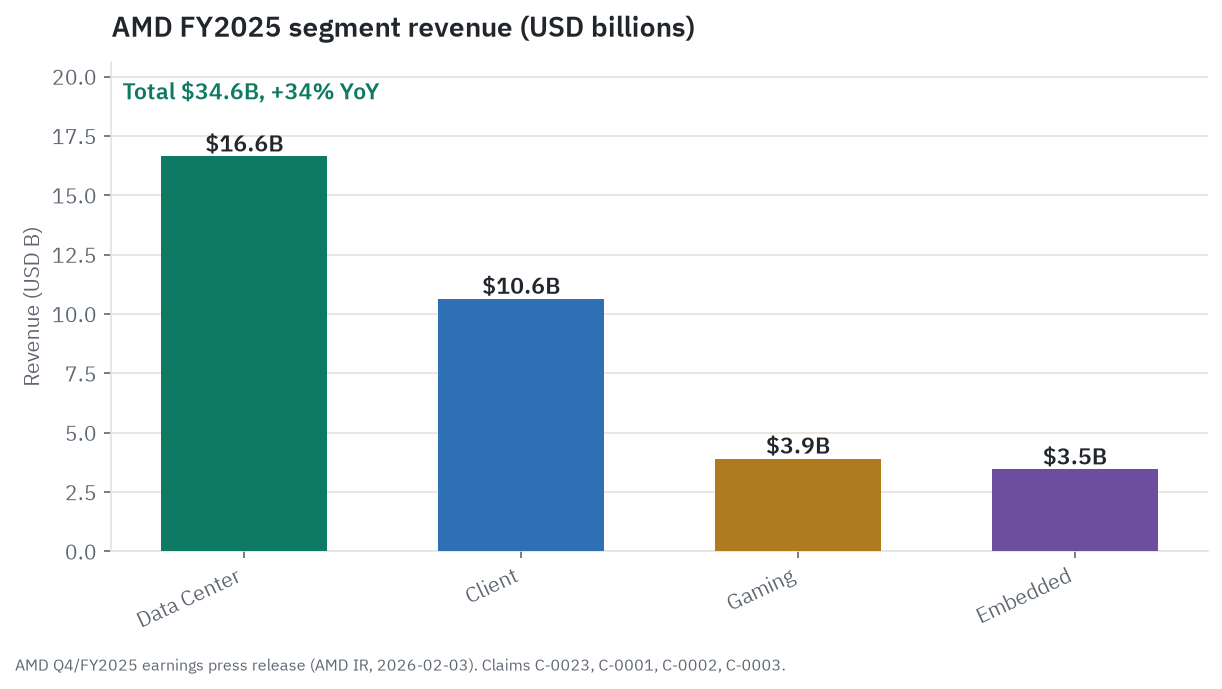
Data Center ($16.6 billion in 2025, up 32 percent; 48 percent of total). This is the engine and the story. It holds two products: EPYC, AMD’s server CPU line, and Instinct, its AI GPU accelerator line. AMD does not break out the split between them, which matters more than it sounds and comes up repeatedly below. Data Center grew 57 percent year over year in the first quarter of 2026 to $5.78 billion and is now 56 percent of company revenue, up from 49 percent a year earlier.
Client ($10.6 billion in 2025, up 51 percent; 31 percent of total). This is Ryzen, AMD’s PC processor for desktops and laptops sold through makers like Dell, HP, and Lenovo. AMD set records here: 42.6 percent of desktop CPU revenue in late 2025 and a best-ever 28.3 percent unit share in mobile in the first quarter of 2026. It is winning the high end while Intel still ships more total units. The AI-PC angle (Ryzen AI chips with an NPU, a neural processing unit for on-device AI) is an ASP story more than a volume story, with PC unit volumes expected to fall about 10 percent in 2026.
Gaming ($3.9 billion in 2025, up 51 percent; 11 percent of total). Two things live here: semi-custom SoCs (system-on-chip, the single chip that powers a console) for Sony’s PlayStation and Microsoft’s Xbox, and Radeon discrete graphics cards. The console business is in year seven of its cycle and declining, with AMD guiding gaming revenue down about 20 percent in the second half of 2026 on higher memory costs. Radeon is a footnote at roughly 5 to 8 percent of the discrete-GPU market against NVIDIA’s 90 percent. The optionality is the next console cycle: a next-gen Xbox is on track for 2027, with a PS6 likely 2027 or 2028, both AMD-designed.
Embedded ($3.5 billion in 2025, down 3 percent; 10 percent of total). This is the Xilinx business AMD bought for $49 billion in 2022: FPGAs (field-programmable gate arrays, reconfigurable chips for industrial, aerospace, communications, and automotive systems) and adaptive SoCs. It is small and was in a multi-year downturn as customers worked off inventory, but it matters for two reasons. It carries AMD’s richest margin (about 36 percent operating margin, with Xilinx’s standalone gross margin historically around 73 percent), and it returned to year-over-year growth in late 2025 for the first time in eight quarters. Embedded is the high-margin ballast.
The takeaway from the field guide: more than half of AMD’s revenue is still not the AI story. Client, Gaming, and Embedded together were 52 percent of 2025 revenue. AMD is an AI accelerator company at the margin and on the multiple, but a diversified chip company on the base.
The AI accelerator story: Instinct, ROCm, and the named deals
This is the heart of the bull case, so it deserves the most space - and the bear lives in the same section, because the two are inseparable.
The hardware roadmap. AMD has shipped an annual Instinct cadence since 2023: MI300X (2023, the chip that put AMD on the AI map thanks to a large memory capacity), MI325X (late 2024, a memory bump), the MI350 series (late 2025, on TSMC’s 3-nanometer process, AMD’s inference flagship with 288GB of HBM3E memory), and now the MI400 series including the MI450 (second half of 2026, the first GPUs on TSMC’s 2-nanometer node, with up to 432GB of HBM4). The MI450 ships inside a rack-scale system AMD calls Helios. On raw specifications the gap to NVIDIA has genuinely narrowed: the MI350X offers competitive peak compute and more memory per GPU than NVIDIA’s B200, and at MLPerf Inference 6.0 in April 2026 the MI355X landed within single-digit percentage points of the B200. AMD does not claim to beat NVIDIA’s newest part on peak performance. Its pitch is total cost of ownership and second-source necessity.
The revenue trajectory, and the disclosure problem. AMD does not report Instinct revenue as a separate line. Everything public is the combined Data Center figure (EPYC plus Instinct). The quarterly Data Center path tells a real re-acceleration story: $3.7 billion, then $3.2 billion (dented by an $800 million China charge), then $4.3 billion, $5.4 billion, and $5.78 billion. The chart below shows the annual ramp and the EPYC share point.
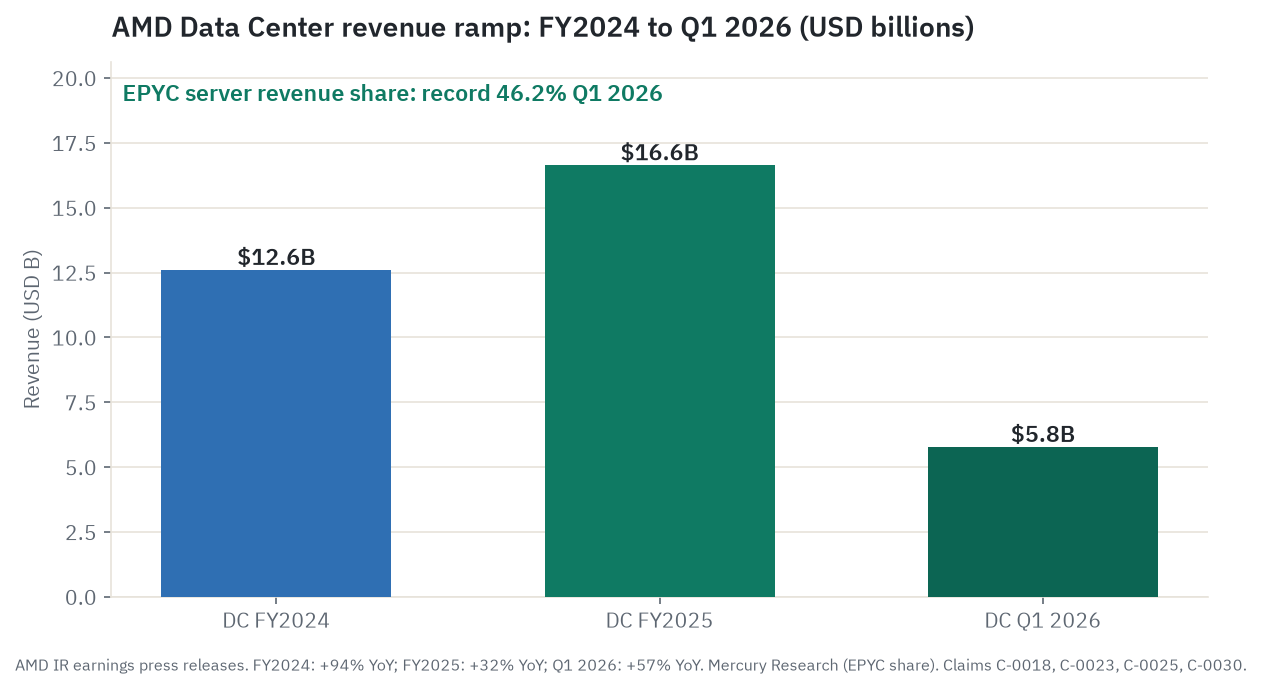
Because AMD does not split EPYC from Instinct, every Instinct-only revenue figure you see is an analyst estimate. The widely-cited range is roughly $6 to $10 billion of Instinct revenue in 2025, and it bounces by research house and by quarter. Treat it as an estimate with a wide band, never as a fact, and never trust a precise EPYC-versus-Instinct split - AMD has not disclosed one and has not said it will. AMD’s own three-to-five-year targets, set at its November 2025 analyst day, are more than 60 percent Data Center revenue growth annually, more than 80 percent AI Data Center growth, server-CPU share above 50 percent, and non-GAAP earnings above $20 per share. Those are company aspirations, not results. Independent analysts size the 2030 merchant-GPU market at roughly $200 to $300 billion rather than the $1 trillion total-compute figure AMD cites, which implies AMD’s realistic ambition is tens of billions of GPU revenue, not the whole market.
The software gap, which is the real moat. Hardware is not where AMD is behind. Software is. NVIDIA’s CUDA platform has a roughly 15-year head start, and the training stack at every major hyperscaler is written in CUDA-native code. AMD’s answer is ROCm, its open software platform, and it competes against CUDA the way a capable second operating system competes against the one every developer already knows. ROCm has genuinely caught up in places: PyTorch supports it as a first-class backend, ROCm 7 added Windows support and day-zero framework integration, and inference on supported hardware is production-ready for many teams. But the gaps that remain are exactly the ones that decide big deployments. There is still no ROCm equivalent of TensorRT-LLM (NVIDIA’s production inference optimizer) or FlashAttention 3 (the standard attention kernel for the newest NVIDIA chips). Independent benchmarks put ROCm 10 to 25 percent slower than CUDA on equivalent silicon. And the interconnect gap is large: AMD’s chip-to-chip Infinity Fabric runs around 128 GB/s versus NVIDIA’s NVLink at 900 GB/s on Blackwell and an announced 3,600 GB/s on Vera Rubin. For training, where every GPU must talk to every other GPU constantly, that bandwidth gap is the difference between near-linear and sublinear scaling. In MLPerf Training 6.0, an NVIDIA GB200 NVL72 cluster trained a reference model in 3.1 minutes; an 8-GPU MI350X node took about 4.8. The honest read: AMD’s realistic opening is inference and second-source procurement, not frontier training, and it knows it - the Helios pitch is about inference throughput and cost, not training at scale.
The named deals, as filed. Two deals reframed AMD in late 2025 and early 2026, and their terms are verified from the SEC filings. In October 2025 AMD and OpenAI announced a multi-year agreement for OpenAI to deploy up to 6 gigawatts of Instinct GPUs through 2030, starting with 1 gigawatt of MI450 in the second half of 2026. In February 2026 AMD and Meta announced a parallel agreement: up to 6 gigawatts, also starting with 1 gigawatt of a custom MI450 in the second half of 2026. AMD described the OpenAI deal as expected to deliver “tens of billions of dollars in revenue” and to be accretive to non-GAAP earnings per share. Analyst estimates of the revenue vary widely and are not apples-to-apples - J.P. Morgan put it around $30 to $35 billion per year at full scale; Jon Peddie Research described the Meta deal as roughly $60 billion over five years; Morningstar lifted its 2029 AMD revenue estimate to $42.2 billion. Oracle separately committed to deploy 50,000 MI450 GPUs starting in the third quarter of 2026, with no equity component. The named-customer concentration is extreme, and AMD’s own filings flag it: a small number of customers will account for a substantial part of revenue.
The warrants, which are where the bull and bear collide. To win OpenAI and Meta, AMD issued each customer a warrant - a right to buy stock at a fixed price - for up to 160 million shares at one cent each. That is 320 million shares combined, about 19.6 percent of AMD’s roughly 1.63 billion shares. The chart below shows the overlay.
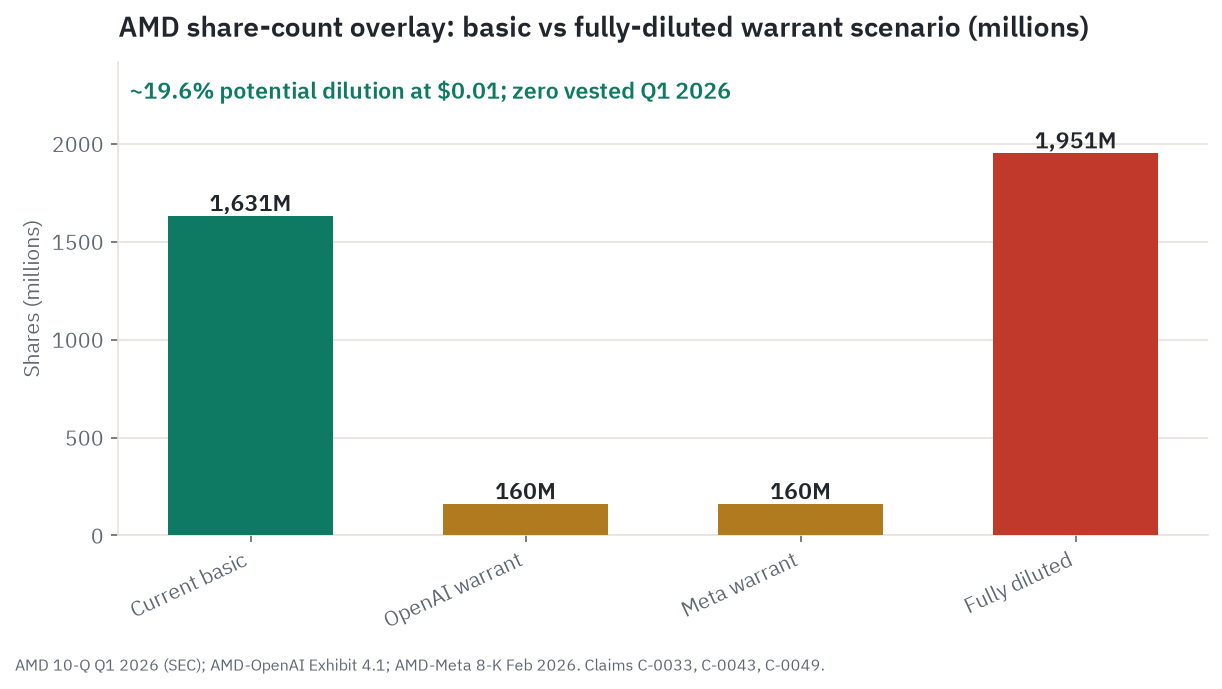
The terms, from the filings: the warrants vest in tranches tied to gigawatts of GPU purchased and to escalating stock-price milestones, with the final tranche of each vesting only if AMD’s stock reaches $600 (about 9 percent above the June 22 close). The OpenAI warrant expires in October 2030, Meta’s in February 2031. Both are classified as liabilities, and crucially, the grant-date fair value is recognized as contra-revenue - a reduction of reported GAAP revenue - when the related GPU sales are booked, not as a separate expense. As of the first quarter of 2026, zero had vested and they had no financial-statement impact yet. They start to bite when the first MI450 ships in the second half of 2026.
Now the bear, stated as an attributed argument rather than a fact, because that is what it is. Critics - a widely-shared Substack analysis, with the concern acknowledged (though not endorsed as a sell call) by BofA’s Vivek Arya - argue the structure is a form of vendor financing: AMD is offering equity to capital-hungry customers as a demand-pull mechanism, and those customers could vest and sell AMD shares to fund further GPU purchases. The signal, the critics say, is that AMD did it twice in four months, which suggests a structural need rather than a one-off masterstroke; NVIDIA secures orders without equity sweeteners. There is a self-cannibalizing wrinkle: the dilution accelerates exactly as the stock rallies toward the $600 trigger. No warrants have vested, so none of this is demonstrated. But the contra-revenue charge is mechanical and arriving, analysts model a 200-to-400 basis point gross-margin hit on affected Instinct revenue (the dollar magnitude is undisclosed and first appears in the second-half 2026 statements), and the bull needs the deals to be large enough that earnings are accretive despite the dilution while the GAAP haircut stays immaterial. Both are unproven until the prints land.
NVIDIA, the leader AMD is chasing, gets its own deep treatment in our NVIDIA research; the AI-capex customers underwriting all of this are covered in our pieces on Meta and Amazon.
EPYC and the server-CPU share war with Intel
If the Instinct story is the call option, EPYC is the business that pays for the option. It is the most underappreciated part of the AMD story and the most durable.
The headline. EPYC reached a record 46.2 percent of x86 server-CPU revenue in the first quarter of 2026 (Mercury Research), up almost 5 points in a single quarter and roughly 7 points year over year. Intel holds the rest at about 54 percent. Two years ago the gap was more than 20 points; now it is about 8.
Read the revenue-versus-unit gap carefully, because it is the whole point. EPYC’s 46.2 percent is revenue share. Its server unit share is about 27.4 percent (Mercury Research). That nearly 19-point gap is not noise - it is pure ASP (average selling price) premium. AMD is winning the high-end, high-core-count sockets that hyperscalers and AI servers want, while Intel still ships more total units into low-end commodity workloads. One caution worth flagging because secondary write-ups get it wrong: the 27.4 percent is the server unit figure; a 33.2 percent number that circulates is AMD’s desktop unit share, a different market. Do not conflate them.
Why it is durable. AMD has an architectural lead and a clear window. EPYC Turin (the current Zen 5 generation) drove the share gains, and EPYC Venice (Zen 6, up to 256 cores on TSMC’s 2-nanometer node, with a claimed 70 percent performance gain) entered production in May 2026 for a second-half launch. Intel’s direct high-end answer, Diamond Rapids, slipped to mid-2027, and Intel’s next P-core server chip after that is not expected until 2028. Intel’s 2026 server part, Clearwater Forest, drops simultaneous multithreading, which hurts it on per-core-licensed enterprise software like databases - AMD says that choice will help it gain even more share. That leaves EPYC roughly 12 to 18 months without a comparable Intel response.
Why CPUs are back. The counterintuitive tailwind is that AI raises CPU demand, not just GPU demand. Agentic AI - models that orchestrate tools, manage state, and chain calls - shifts the CPU-to-GPU ratio in servers up from roughly 1-to-8 toward 1-to-2. AMD doubled its estimate of the server-CPU market to more than $120 billion by 2030 on that thesis (AMD’s own forecast, not an independent one). EPYC carries no HBM cost, no CoWoS packaging constraint, and no warrant. It generates the free cash flow that funds the Instinct bet, and if the AI premium ever deflates, EPYC plus Embedded are what hold the floor. The closest thing AMD has to a sure thing is this CPU share war, not the GPU story that drives the multiple.
Client, Gaming, Embedded: the rest of the book
These segments do not move the multiple, but they shape the blended margin and the cycle read, so they are worth a paragraph each.
Client (Ryzen). First-quarter 2026 revenue was $2.885 billion, up 26 percent, with commercial Ryzen PRO sell-through up more than 50 percent year over year. AMD keeps setting desktop and mobile share records. The risk is that PC units overall are expected to fall about 10 percent in 2026, so Client is an ASP-and-mix story riding the AI-PC refresh and the Windows 10 end-of-support cycle, not a volume story. It is a healthy, share-gaining business with a cyclical ceiling.
Gaming. First-quarter revenue was $720 million, up 11 percent, but the segment is structurally shrinking inside AMD as Data Center grows. Console semi-custom revenue is in late-cycle decline, and AMD guided gaming down about 20 percent in the second half of 2026 on memory and component costs. Radeon discrete graphics remain a distant third behind NVIDIA. The real value here is forward optionality: the next-gen Xbox is on track for 2027 and a PS6 is expected 2027 or 2028, both AMD silicon, which would restart the semi-custom revenue cycle.
Embedded (Xilinx). First-quarter revenue was $873 million, up 6 percent - the early innings of recovery after a long inventory-driven trough. It is small, but it is AMD’s margin ballast at roughly 36 percent operating margin, and the FPGA market it serves is growing at a mid-teens annual rate. Aerospace and defense are recovering first; industrial is still working off inventory. The Xilinx deal also created the single biggest accounting wrinkle in AMD’s financials, which the next section unpacks.
What the filings say
Now the numbers from the 10-K and 10-Q, all primary-tier and dated. The story the filings tell is of a business that got dramatically healthier between 2023 and 2026, with two real complications: an accounting drag from Xilinx and a coming GAAP haircut from the warrants.
Revenue and growth. Total revenue was $34.639 billion in fiscal 2025, up 34 percent, after $25.785 billion in 2024 and $22.680 billion in 2023. The first quarter of 2026 was $10.253 billion, up 38 percent, and AMD guided the second quarter to about $11.2 billion, plus or minus $300 million, implying roughly 46 percent year-over-year growth. This is genuine, broad-based acceleration, led by Data Center.
Margins, and the Xilinx drag. GAAP gross margin was 50 percent in 2025, rising to 53 percent in the first quarter of 2026. Non-GAAP gross margin was 52 percent in 2025 and 55 percent in the first quarter, with second-quarter guidance around 56 percent. The gap between the two is mostly acquisition-related amortization - the accounting write-down of the intangible assets AMD booked when it bought Xilinx, which runs through the cost lines and depresses GAAP profit without being a cash cost. That amortization was $2.254 billion in 2025 and is declining at roughly 6 percent a year as the Xilinx intangibles wind down, but substantial charges continue for years. GAAP operating margin was 11 percent in 2025; non-GAAP was 22 percent. The 11-point gap is the amortization plus stock-based compensation.
Earnings. GAAP net income was $4.335 billion in 2025 (diluted EPS $2.65); non-GAAP net income was $6.831 billion (diluted EPS $4.17). The first quarter of 2026 delivered $1.383 billion GAAP net income ($0.84 diluted) and $2.3 billion non-GAAP ($1.37 diluted).
Segments. Data Center was $16.635 billion (up 32 percent, 21.7 percent operating margin); Client and Gaming combined was $14.55 billion (up 51 percent); Embedded was $3.454 billion (down 3 percent but the highest margin at 36 percent). In the first quarter of 2026, Data Center jumped to $5.775 billion (up 57 percent) at a 27.7 percent segment operating margin, a clear sign of operating leverage as the segment scales.
Cash and balance sheet. This is a strong balance sheet. AMD generated about $5.5 billion of free cash flow in 2025 (operating cash flow of $6.493 billion less $974 million of capex) and a record $2.566 billion in the first quarter of 2026 alone, an annualized rate above $10 billion. It held $12.347 billion of cash and short-term investments against about $3.224 billion of total debt as of the first quarter, a net cash position around $9.1 billion. In May 2026 it replaced its revolving credit line with a new, undrawn $5 billion facility. AMD pays no dividend. The one stretch on the balance sheet is the legacy of Xilinx: goodwill and intangibles together are about 54 percent of total assets.
Capital returns and dilution. AMD has a $14 billion buyback authorization with $9.4 billion remaining, and it repurchased modestly in 2025. But the dilution story that matters is the warrants. Share count has been roughly flat year over year as buybacks offset stock comp, but the OpenAI and Meta warrants represent up to 320 million additional shares (about 20 percent) that begin vesting on GPU deployment. AMD will account for the vested tranches as contra-revenue. Investors who anchor on non-GAAP earnings per share without adjusting for that dilution trajectory are underpricing the warrant cost.
Guidance and disclosed risks. Management’s own risk factors are the right place to end. AMD names three that genuinely matter. First, US export controls: AMD states it relies on customer demand, China import rules, and its ability to get licenses, and that its MI308 product already took an approximately $800 million inventory charge in 2025 (about $440 million net after a partial reversal). Second, single-source foundry: AMD relies on TSMC for all wafers at 7-nanometer and smaller, meaning any disruption directly halts its most profitable products. Third, customer and cyclicality concentration: AMD warns that the loss of a significant customer would have a material adverse effect and that the semiconductor industry is highly cyclical. These are not boilerplate. They are the bear case in the company’s own words.
What the market is paying
Everything here is point-in-time as of June 22, 2026, and moves fast. Analyst targets are opinions, not facts, and they are visibly lagging the tape.
Performance and relative strength. AMD has been the market’s favorite name in this group. It is up about 158 percent year to date, against roughly 107 percent for the SOX semiconductor index, about 18 percent for the Nasdaq-100, and about 5 percent for NVIDIA. Over one year it is up about 330 percent. Over three years NVIDIA’s roughly 700 percent still dwarfs AMD’s 384 percent - the AI cycle started earlier and bigger for NVIDIA - so AMD’s recent dominance reflects a specific catalyst set (the deals plus a first-quarter earnings beat) and a rotation, not a reversal of NVIDIA’s structural lead. The stock closed at 97.7 percent of its 52-week high. This is also a violent stock: beta is 2.49, the highest in the peer set, and recent single-session earnings moves were plus 18.6 percent (May 2026) and minus 17.3 percent (February 2026).
Valuation, the crux. The chart below is the center of the whole read.
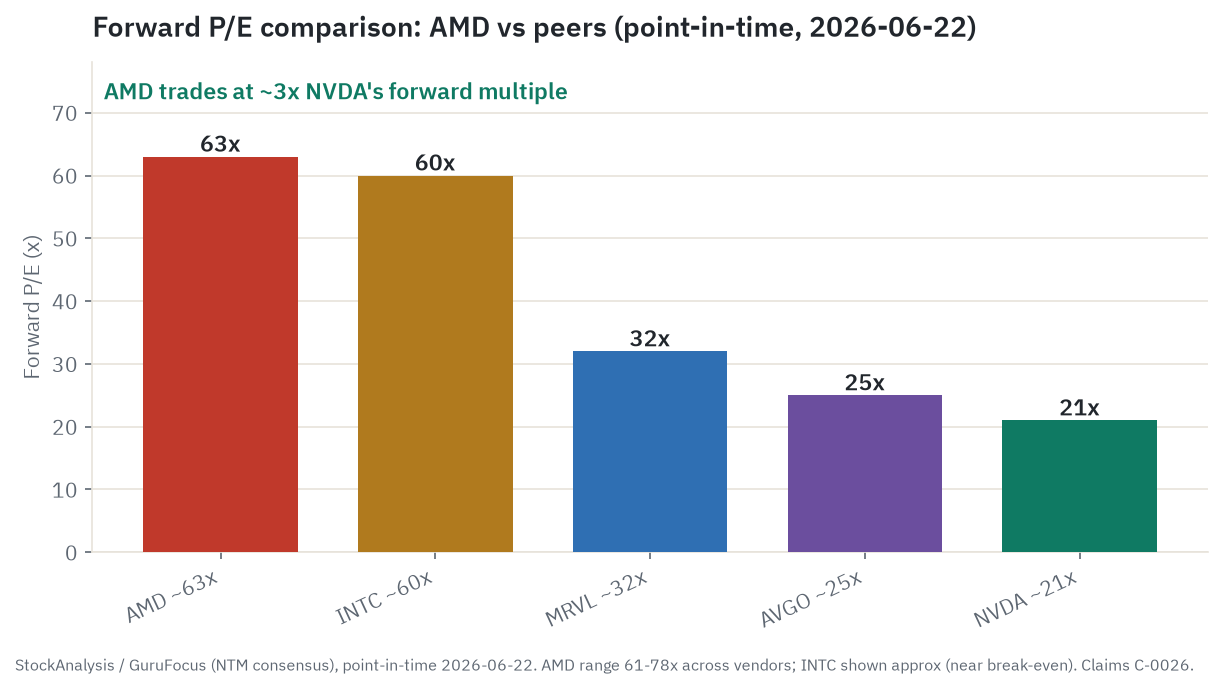
AMD trades at roughly 63 times forward earnings. That figure is disputed across data vendors (GuruFocus around 61, StockAnalysis around 63, Yahoo around 79, because each uses a different forward-earnings estimate), so read it as “about 63 times, in a 61-to-78 range,” not as a single point. On other measures it is about 184 times trailing earnings, about 24 times sales, and about 120 times trailing EV/EBITDA (a single-vendor figure, so hedge it). The comparison that does the work: AMD’s roughly 63 times forward is about three times NVIDIA’s roughly 21 times and about 2.5 times Broadcom’s roughly 25 times. The number-two player, with AI earnings that have not fully arrived, trades at a multiple of the number one that already prints those earnings. And every one of those multiples is on a basic share count; fully diluted for the warrants, they are materially higher.
The two-sided read matters here. The bull explanation is that NVIDIA’s cheaper multiple reflects that its AI earnings already exist while AMD is valued on a future path, and that a sub-2 PEG ratio (about 1.1 to 1.3) means consensus growth partly defends the multiple. The bear explanation is that paying a 2.5-to-3x premium to proven peers for an unproven ramp is the least defensible figure in the entire analysis, and the warrant overlay makes the per-share math even more demanding than the headline.
The Street is below the price. Here is the unusual configuration. The consensus rating is Strong Buy (51 analysts, 37 of them Strong Buy, zero Sell). But the average price target is about $487.90 - roughly 12 percent below the $551.63 close. The stock has run through the Street’s own average target. Three major shops raised targets within two weeks of the research date (Bernstein to $600, Citi to $575, BofA to $560), and the mean is still below the price. (Note that one widely-quoted BofA figure of $280 is stale; the current BofA target is $560. Morningstar’s fair value moved from $300 after the Meta deal to about $332. Attribute targets to a house and a date or omit the number.) The targets are chasing the tape, not leading it. That is the textbook signature of a stock priced for perfection.
Liquidity and short interest. AMD is one of the most liquid stocks in the market, so access is no constraint. Short interest is only about 2.7 percent of float and falling - low by semiconductor standards. That cuts both ways: there is no crowded bear position, but there is also no short-squeeze fuel under the price if it falls.
What the crowd is saying
Sentiment is signal, not fact, and this data is soft - treat it as impressions, clearly labeled.
The dominant narrative is AMD as the credible number-two AI accelerator, validated by the OpenAI and Meta deals. Coverage through May and into June was euphoric, with headlines calling AMD a “new AI king.” That tone is cooling at the margin. A mid-June alternative-data report from M Science (a secondary report of a subscription note, which could not be independently re-confirmed, so weight it accordingly) warned that AMD’s second-quarter GPU deployments had “materially worsened” and that Data Center revenue would miss - it triggered a roughly 7.3 percent single-session drop on June 17. The stock then bounced on a smaller deal and analyst upgrades, which tells you the euphoric bid returns quickly on any positive headline. Coverage is bifurcating: bulls focus on the multi-year 12-gigawatt pipeline and EPYC share, skeptics on near-term execution, the multiple, and warrant dilution.
The most useful part is where the crowd’s story diverges from the filings and the tape. First, retail commentary largely treats the warrants as validation of AMD’s credibility; the actual dilution math (about 20 percent of the float, contra-revenue starting in the second half of 2026) is mostly discussed by institutional analysts and short-sellers. Second, the “12 gigawatts committed” narrative sits in direct tension with the near-term execution worry - the crowd is pricing the pipeline while the filings show a business still executing quarter by quarter. Third, AMD trades above the sell-side’s own average target while about 82 percent of analysts rate it Buy or better, the classic “everyone loves it, nobody can quite justify the price” setup.
On disclosed activity, two data points belong here strictly as disclosed activity, not as signals. ARK Invest sold AMD on several occasions in June 2026 (around $146 million trimmed, per ARK’s daily disclosures, while it still holds the name). And CEO Lisa Su and CTO Mark Papermaster sold a combined $60 million-plus in June under pre-scheduled 10b5-1 plans, which are routine and not discretionary calls. Neither is a vote of no confidence; both are noted for completeness because they sit on the opposite side of rising retail enthusiasm at an all-time high.
Durability: the structural case against the cycle
This is the synthesis of the macro and micro work. The question is whether the demand driving AMD is structural or a bubble, and what most likely breaks it.
The structural case is real. The AI-capex surge funding AMD is not venture money or speculation. It is the free cash flow of five of the most profitable companies on earth: Amazon, Microsoft, Alphabet, Meta, and Oracle guided a combined roughly $725 billion of 2026 capex (analyst-aggregated), about three-quarters aimed at AI infrastructure. And this is not 2000. In 2001 the data-center vacancy rate exceeded 20 percent as capacity was built ahead of any buyer; in 2026 it is about 1.4 percent. Hyperscalers contract for power, land, and hardware before breaking ground, GPU orders are placed 12 to 18 months ahead, and CoWoS packaging is fully booked. This is a supply-constrained market, not a speculative glut. AMD’s specific advantage is that hyperscalers want a second source to NVIDIA for supply security and pricing power, and AMD has qualified at Microsoft, Meta, and Oracle. The EPYC franchise adds a second, more durable driver that does not ride the GPU cycle.
The cyclical bear is also real, and it has a clock. Cyclicality is never repealed. The most quantifiable risk is the gap between roughly $725 billion of 2026 capex and roughly $150 billion of annualized AI cloud revenue - the spend is far ahead of the revenue it must eventually earn. Allianz Research modeled capex growth decelerating from 51 percent in 2026 to 13 percent in 2027 and roughly 5 percent in 2028. That is not a crash; it is a step-down sharp enough to be felt by a supplier priced at 63 times forward earnings. The triggers, in rough order of probability: a hyperscaler capex digestion phase in 2027 (watch for CoWoS lead times falling from 52-to-78 weeks toward 30); power and grid constraints delaying deployments (transformer lead times run 2 to 4 years); an export-control tightening that re-imposes a freeze on China revenue; and the slow-moving risk that ROCm never closes the CUDA gap for customers without dedicated engineering teams.
The most likely outcome is a split. The honest base case is neither pure bull nor pure bear. Through 2026 the story is execution-defined: if the first MI450 deployments ship cleanly and the GAAP contra-revenue haircut is contained, the structural case holds. In 2027 comes the digestion fork - AMD likely gets 2 to 3 gigawatts of follow-on deployments confirmed, enough to sustain but not to re-accelerate, and the multiple de-rates from its peak even without a demand collapse. Throughout, EPYC anchors the floor: a highly profitable, growing server-CPU business at 46 percent revenue share, with an option on Instinct on top. China policy is the binary swing factor that no fundamental analysis can predict.
The scenarios in detail
Four variables decide AMD’s next five years. The three scenarios are just different settings of these four dials.
-
Instinct revenue scale and its gross margin. The swing factor. The bull needs Instinct to compound toward tens of billions on the dual 6-gigawatt mandates and gross margin to climb from a structurally lower base toward the mid-50s. Those pull against each other, because incremental GPU revenue carries lower margin than incremental EPYC. NVIDIA’s blended gross margin is about 74.9 percent versus AMD’s roughly 53 percent GAAP, a gap of about 20 points driven by HBM cost at lower ASP, no software pricing power, and the warrant contra-revenue unique to Instinct.
-
EPYC server share and ASP premium. The real profit engine. Record 46.2 percent revenue share on 27.4 percent units, a 12-to-18-month window before Intel’s high-end answer arrives, and no HBM, CoWoS, or warrant attached. This is the durable part.
-
Warrant dilution and the contra-revenue charge. Up to 320 million shares, about 19.6 percent, with the final tranches vesting at $600. When the first MI450 ships in the second half of 2026, the vested fair value lowers GAAP revenue and gross margin. The structure is self-cannibalizing: dilution accelerates as the stock rallies.
-
The competitive and regulatory shift: CUDA, custom chips, allocation, China. CUDA and interconnect lock training to NVIDIA. Custom ASICs (application-specific chips built for one job) grow about 44.6 percent annually versus about 16.1 percent for merchant GPUs and target exactly AMD’s inference foothold. AMD holds about 11 percent of CoWoS allocation against NVIDIA’s 60 percent. China is about 22 percent of revenue and policy-switchable.
Bull - the credible number two compounds into a second franchise. Instinct ramps from roughly $6 to $8 billion (2025 estimate) toward $40 to $60 billion-plus by 2030 as the full 12 gigawatts deploy and Oracle, neocloud (specialist GPU-cloud providers like CoreWeave that rent AI compute capacity to enterprises and AI developers), and sovereign AI (government-funded national AI compute programs, often aimed at reducing dependence on US hyperscalers) demand pull; Instinct margin climbs toward the low-to-mid 50s as ROCm matures; EPYC holds above 50 percent share; the multiple stays premium near 35 to 40 times because the market treats AI earnings as durable. Illustrative arithmetic: roughly $18 to $20 of non-GAAP earnings at a 35-to-40-times multiple, less about 20 percent dilution, lands in a $1,300-to-$1,400 area at year five (the $1,350 bull on the chart). What breaks it: hyperscaler custom chips claim the inference foothold from below faster than AMD wins enterprise and neocloud buyers. Estimate, not a target.
Base - real growth, but the multiple normalizes faster than earnings rise. Instinct compounds but to roughly $25 to $40 billion by 2030, not the full deal math, as custom chips take a slice and the ramp is lumpy; margin improves only gradually while contra-revenue clips the GAAP line for years; EPYC holds 45 to 50 percent share. Company revenue compounds about 20 to 25 percent a year; non-GAAP earnings reach roughly $11 to $12 by 2028 and $16 to $18 by 2030. The 63x multiple compresses toward 30 to 35 times as earnings arrive, so the stock rises far slower than earnings: about $660 at year three, about $820 at year five (matching the chart). What breaks it: the multiple compresses faster than modeled - it is already above consensus - turning a good business into a flat stock for years even as fundamentals grow.
Bear - an expectations derating, anchored on the skeptic’s strongest case. In the second half of 2026, three things land at once. GAAP revenue and margin disappoint as the contra-revenue charge bites for the first time into a Street anchored on non-GAAP. The 1-gigawatt ramp is lumpy (the M Science warning proves real). And NVIDIA’s Vera Rubin ships in volume the same half at 3,600 GB/s, softening the second-source urgency that gave AMD pricing power, just as custom chips scale for the same inference work. Instinct margin stays about 20 points below NVIDIA, ROCm does not close the gap, and the $600 tranches do not vest - so the dilution overhang stays alive without the revenue arriving. Earnings still grow via EPYC and Embedded; this is a derating, not a solvency event. The multiple compresses from 63x toward the 20-to-30 times proven peers carry. The skeptic’s $225 sell-side low (down 59 percent) is the floor of the one-year bear; year five recovers only modestly to about $400 as EPYC and Embedded earnings reassert at a market multiple. What turns it back: one clean second-half-2026 print with an immaterial GAAP haircut would invalidate the bear’s central mechanism.
Catalyst timeline. Near term: second-quarter 2026 earnings in late July or early August (where the soft-Q2 warning gets tested); the first 1-gigawatt MI450 shipments in the second half (the first appearance of warrant contra-revenue); NVIDIA Vera Rubin volume the same half; Oracle’s 50,000-GPU cluster targeted for the third quarter; any China license decisions; and the stock crossing $600 (which vests the final tranches). Multi-year: Helios mass production and Venice server ramp in 2027; Intel’s Diamond Rapids in mid-2027 (the first real test of the server-share window); a likely 2027 capex deceleration; the next console cycle in 2027-2028; and the 2030 completion of the OpenAI and Meta deployments. Leading indicators to watch, in order: Data Center segment growth and any GPU color, the GAAP-versus-non-GAAP gross-margin gap, EPYC quarterly share from Mercury Research, warrant-vesting disclosures and the $600 level, TSMC CoWoS lead times, and hyperscaler AI cloud revenue growth versus capex.
Companies to watch (bull / base / bear)
AMD first, then the supporting cast. Each one-liner pairs the bull and the bear with equal weight, because the bear is the point.
Advanced Micro Devices (AMD). The subject. Bull: dual 6-gigawatt OpenAI and Meta mandates plus record EPYC share underwrite a path to tens of billions in Data Center revenue the price only partly captures. Bear: the stock sits above its own consensus target at about 63 times forward and 120 times EV/EBITDA, with about 20 percent warrant dilution, a 20-point gross-margin gap, CUDA lock-in on training, and custom-chip erosion of the inference foothold. Watch: the first warrant-bearing GAAP print in the second half of 2026.
NVIDIA (NVDA). The leader and the rival, at roughly a $5.1 trillion cap. Bull: CUDA, NVLink, annual cadence, and a $500 billion-plus capex pipeline cement a near-monopoly. Bear: at $5 trillion the market already prices sustained monopoly earnings; any capex pause, custom-chip substitution, or export tightening hits a stock with little room for disappointment. See our NVIDIA deep dive.
Intel (INTC). The CPU incumbent in retreat, about $708 billion cap. Bull: the 18A process node and an Apple foundry partnership could rehabilitate Intel Foundry as a TSMC second-source. Bear: the foundry still loses about $2.4 billion a quarter, Gaudi (Intel’s AI accelerator line, which has failed to gain meaningful share against either NVIDIA or AMD) has no AI traction, and EPYC keeps taking server revenue. Note the Intel bull is itself speculative (paying 100-times-plus forward earnings for a business with negative free cash flow), and it does not imply the server-share pressure on AMD is easing - the share war still favors AMD.
Broadcom (AVGO). Both a supplier of competitive context and, more importantly, the custom-chip substitution threat to AMD’s inference market, about $1.9 trillion cap (point-in-time, it has moved). Bull: a more-than-$100 billion fiscal-2027 AI revenue target and record operating margins. Bear: it fell sharply after a quarter when it did not raise that target - priced for perfection - and any hyperscaler program delay dents it. The key AMD angle is that Broadcom’s custom XPUs are built for exactly the inference work AMD is counting on. See our Broadcom research.
Marvell (MRVL). The other custom-chip threat, about $270 billion cap, with 20-plus design wins entering production in 2028-2029. Bull: multi-year revenue visibility from locked-in wins. Bear: a steep multiple on chips not yet shipped. Belongs in the substitution paragraph alongside Broadcom.
TSMC (TSM). The foundry chokepoint, about $2.5 trillion cap. Bull: the sole-source toll-taker on advanced nodes and CoWoS, durable regardless of which GPU brand wins. Bear: Taiwan-strait risk and Apple concentration. The specific AMD angle: TSMC’s CoWoS allocation favoring NVIDIA is AMD’s supply ceiling. Our Micron research covers the HBM supplier on the same chain.
Oracle (ORCL). A demand customer, about $504 billion cap, deploying 50,000 MI450 GPUs and holding a $638 billion remaining-performance-obligation backlog. Bull: multi-year locked-in cloud revenue. Bear: more than half of that backlog is concentrated in OpenAI, a single-counterparty risk. Note the circularity worth flagging: OpenAI prepays Oracle, Oracle buys AMD GPUs, and AMD gave OpenAI warrants - the AI-infrastructure financing loop runs through all three.
Risk controls
The honest risk paragraph, with no soft-pedaling. AMD carries several large, real risks that are mostly two-sided but genuinely capable of breaking the thesis.
Semiconductor cyclicality is never repealed, and AMD’s beta of 2.49 with a demonstrated 17 percent single-session drop means this stock moves violently on disappointment. AI-capex concentration is the macro risk: a 2027 hyperscaler digestion phase that slows new orders would compress a 63x multiple even without a revenue decline. Customer concentration is acute: OpenAI, Meta, and Oracle account for the bulk of disclosed Instinct commitments, and AMD’s own filings warn that losing a significant customer would be material. Valuation is the most immediate risk: the stock already trades above its own average analyst target with only 2.7 percent short interest, so there is no valuation cushion and no squeeze floor if execution disappoints. The warrant dilution of about 20 percent accelerates as the stock rallies toward $600, an unusual structure where success on the stock price brings dilution forward. Single-foundry dependence on TSMC and tight HBM and CoWoS supply mean AMD’s ramp is gated by capacity it does not own and that favors NVIDIA. China is about 22 percent of revenue and policy-switchable; a freeze already happened once in April 2025, and the MI325X license status is unconfirmed. And the CUDA software moat caps how much of the training market AMD can ever address.
What would change the read for the better: a clean second-half-2026 MI450 print with an immaterial GAAP haircut, sequential Instinct acceleration, and EPYC share still climbing would let the premium multiple persist on arriving earnings. What would change it for the worse: a lumpy ramp plus a visible contra-revenue hit the Street had not modeled, with the $600 tranches staying unvested, would justify the multiple compressing toward the range proven peers carry.
Methodology, sourcing, and data-quality flags
This piece is built from parallel research streams: the SEC filings (10-K, 10-Q, 8-K, proxy), the market action and valuation, the AI-accelerator and ROCm-versus-CUDA technical picture, the EPYC server-CPU share data, the OpenAI and Meta deal structures, the China-export and TSMC supply chain, the competitive map, the macro AI-capex demand, the sentiment and OSINT signal, and a forward bull/base/bear outlook. Every load-bearing number traces to a claim with a source and a tier (primary filings and standards, then analyst houses like Mercury Research and TrendForce, then reputable trade press, then explicit estimates). Where sources disagree or a figure is unconfirmed, it is flagged below and hedged in the text rather than stated as fact.
The five-factor read, in plain prose. Valuation is the hardest factor to defend on the bull side: about 63 times forward earnings (range 61 to 78 across vendors), about 120 times trailing EV/EBITDA, and about 24 times sales - roughly three times NVIDIA’s forward multiple and 2.5 times Broadcom’s, for the number two with unproven AI earnings versus the number one that already prints them, with the stock closing about 12 percent above its own consensus mean target and the multiple sitting on a basic share count. Valuation reads as overvalued, at the extreme end. Growth is the strongest factor: 34 percent revenue growth in 2025, 38 percent in the first quarter of 2026 with Data Center up 57 percent, a record 46.2 percent EPYC server revenue share, and the dual 6-gigawatt mandates underwriting a multi-year ramp - growth is strong and real. Quality is mildly positive: about $9 billion net cash, about $10 billion annualized free cash flow, Embedded at 36 percent operating margin, and genuine EPYC pricing power, offset by the roughly 20-point gross-margin gap to NVIDIA that widens as Instinct mixes up, the warrant overhang, and a heavy Xilinx intangible load (about 54 percent of assets). Risk is the other extreme-negative factor: about 20 percent potential dilution that accelerates as the stock rallies, China at 22 percent of revenue and policy-switchable, 100 percent TSMC dependence with only about 11 percent of CoWoS allocation, the CUDA moat on training, custom-chip erosion of the inference foothold, and a beta of 2.49. Momentum and sentiment (soft, low weight) net mildly positive but conflicted: up 330 percent over a year and 158 percent year to date at a fresh high above every major moving average with a Strong Buy consensus, offset by smart-money trimming, a consensus target below the price, and no short-squeeze floor. On balance the read lands at Hold: a high-growth, solidly-financed franchise whose AI optionality is real but whose valuation already prices near-flawless execution while carrying genuine dilution and a software moat against it. Extreme valuation and risk cancel strong growth and mild quality and momentum. This is a labeled research signal, not advice.
Data-quality flags:
- Source ledger figures required correction. A tooling bug truncated some dollar values in the raw claims ledger; every figure in this article was sourced from the verified research files, which carry the correct un-truncated numbers and matched independent sources on cross-check. This is a tooling issue, not a research error.
- Forward P/E is a range, not a point. Vendors compute 61 to 78 times depending on the forward-earnings estimate used; the best-corroborated figure is about 63 times, point-in-time. All the headline multiples are on a basic share count and would be materially higher fully diluted for the warrants.
- EPYC unit-share ambiguity. The 27.4 percent is server unit share; a 33.2 percent figure that circulates is desktop unit share. The robust, widely-corroborated figure is the 46.2 percent server revenue share.
- Analyst price targets move weekly and lag the tape. The current BofA target is $560 (an earlier $280 figure is stale); Morningstar’s fair value moved to about $332. Targets are attributed to a house and a date here, or omitted.
- Consensus sits below the price. The roughly $488 mean target is below the $551.63 close; some aggregators show lower means. The “trades above consensus” observation is directionally robust.
- Instinct GPU revenue and AI-accelerator market share are estimates. AMD does not break out GPU-only revenue, so all Instinct revenue figures (roughly $6 to $10 billion in 2025) and share percentages (low-to-high single digits) are analyst estimates that bounce by house and quarter. The EPYC-versus-Instinct split is never presented as fact.
- Forward growth targets are AMD’s own. The more-than-60-percent Data Center CAGR, more-than-50-percent server share, and more-than-$20 earnings-per-share figures are AMD’s stated three-to-five-year aspirations from its November 2025 analyst day, not results.
- The warrant “circular financing” critique is attributed opinion. The warrant terms (160 million shares each at one cent, the $600 final tranche, contra-revenue treatment, zero vested as of the first quarter of 2026) are verified primary-tier; the “vendor financing” framing is a critic’s argument, not a finding.
- China export controls are stated as filed. The roughly $800 million MI308 charge, the 15 percent revenue-remittance arrangement (a reported government expectation, not yet codified as regulation), and the unconfirmed MI325X license status are reported as filed or as attributed, without editorializing.
- Insider and ARK selling are disclosed activity, not signals. The 10b5-1 insider sales and ARK’s daily-disclosure trims are noted as disclosed activity, not as a company view or a bearish call.
- All prices, caps, multiples, returns, short interest, and volume are point-in-time (June 22, 2026) and move fast. Peer market caps moved even between research and verification.
Key sources: AMD 10-K (fiscal 2025) and 10-Q (first quarter 2026) on SEC EDGAR; AMD investor-relations earnings releases and the November 2025 Financial Analyst Day; the AMD-OpenAI SEC Exhibit 4.1 warrant and the AMD-Meta 8-K; Mercury Research server and client CPU share data (via Tom’s Hardware, TweakTown, WccfTech); TrendForce, Omdia, and Yole market sizing; SemiAnalysis benchmark research on ROCm versus CUDA; StockAnalysis, GuruFocus, and Yahoo Finance for point-in-time market data; Morgan Lewis and Cleary Gottlieb analysis of the BIS export rules; and Allianz Research and CreditSights for hyperscaler-capex aggregation.
This is OSINT research, not investment advice. Figures are point-in-time as of June 22, 2026 and change quickly. Nothing here is a recommendation to buy or sell any security. Semiconductors are cyclical, AMD’s growth is concentrated in a few AI-capex customers, and it depends on a single foundry and on reversible China-export policy. Verify all figures independently and consult a licensed financial advisor before making any decision.