
Research date: July 1, 2026 | OSINT market research on Palantir Technologies Inc. (Nasdaq: PLTR): the Gotham/Foundry/AIP platform and the two customer budgets it lives on, the government moat that Salesforce just breached, the stock-based-compensation dilution behind the margin story, the valuation debate splitting Wall Street, and the company-by-company peer set across government services, data platforms, and AI-era software. Prices and multiples stamped hard.
Important disclaimer. This is OSINT-based research and educational analysis, not investment advice. I am not a financial advisor. Nothing here is a recommendation to buy or sell any security, and the scenarios below are illustrative, not price targets. Palantir sells software into two very different budgets, US and allied government appropriations and corporate enterprise IT spending, so its results are exposed to both federal budget politics and enterprise AI adoption cycles, and its stock trades at a growth-software valuation that is unusually sensitive to any change in the pace of that growth. Market caps, prices, valuation multiples, and market-share figures are point-in-time as of July 1, 2026, press-reported where noted, and move fast. Do your own due diligence and consult a licensed advisor.
Where this stock could be in 6 months, 1 year, 3 years, and 5 years
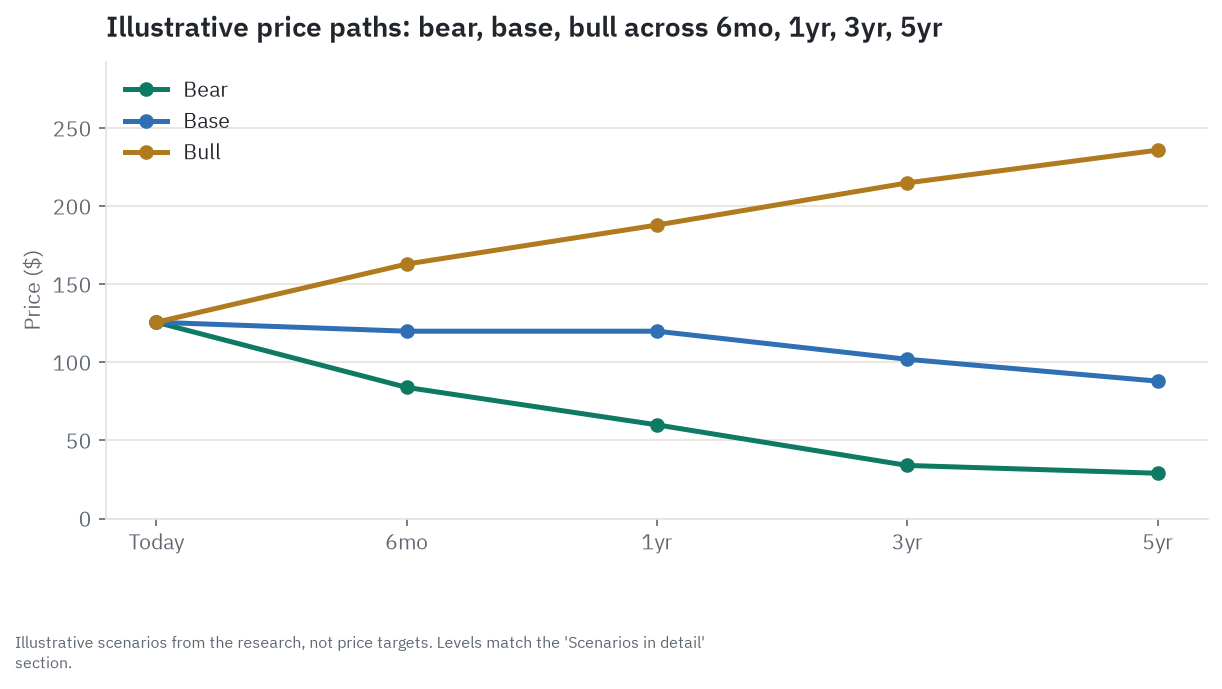
Palantir closed at $125.73 on July 1, 2026 (the live header above carries the current quote). At that price the stock trades near the bottom fifth of its own 52-week range of $106.37 to $207.52, roughly 39 percent below the November 2025 all-time high and about 19 percent above a 52-week low set only a week before this research was compiled. The gap between that price action and the business underneath it is the entire story: Palantir just posted its fastest quarterly growth since its 2020 direct listing, and the stock is still down roughly a quarter for the year. Every dollar level below is an estimate built on stated growth and multiple assumptions, never a price target.
Six months. This window is decided by two datable events: Q2 2026 earnings (expected early August, guided to $1.797 billion to $1.801 billion in revenue) and the Federal Reserve’s July 28-29 meeting, with Q3 earnings following in early November. In the base case, Palantir delivers roughly in line with its raised guidance and the stock consolidates near $120 as the valuation debate keeps a ceiling on the multiple even as the business executes. The bull case reaches $163 if the beat-and-raise cadence continues alongside a neutral Fed and steady AI sentiment, recovering toward the lower end of Wall Street’s price-target cluster. The bear case falls to $84 if a hawkish Fed surprise, a government funding disruption, or a guidance miss triggers a broader rotation out of high-multiple growth stocks, retesting or breaking the recent $106 low. The single thing most likely to flip this window: whether the next guidance print accelerates further or shows the first sign of deceleration.
One year. By mid-2027 the market has full-year 2026 results and, more importantly, the first look at 2027 guidance, the first hard data point on how fast the growth rate is decelerating from its current pace. The base case holds the stock near $120: earnings keep growing at a rate most software companies would envy, but the market normalizes the forward multiple down from around 80 times toward roughly 60 times as the deceleration narrative takes hold, and the two effects roughly cancel. The bull case reaches $188 if 2026 finishes above the raised guide and 2027 guidance comes in above 60 percent growth, which would be a historically unusual third straight year of triple-digit-adjacent growth at this revenue scale. The bear case falls to $60, a Snowflake-style de-rating in which growth confirms its deceleration, the multiple compresses from roughly 80 times to roughly 40 times, and the stock loses more than half its value from here. What flips it: whether US commercial revenue growth holds above 100 percent through the next several quarters or breaks meaningfully below it.
Three years. By mid-2029 the structural drivers, not the quarterly cadence, start to dominate. The base case puts the stock near $102: revenue has grown to roughly the high teens of billions with growth decelerated to around 20 percent, margins are strong but no longer expanding, and the market pays about 35 times forward earnings, a reasonable multiple for a high-quality but no-longer-hypergrowth software company. The bull case reaches $215 if the AIP platform proves durable, revenue approaches the low $20-billions still growing above 30 percent, and the market still pays a 50-times premium. The bear case falls to $34 if Salesforce, Microsoft, and the foundation-model labs have meaningfully eroded both the government and commercial moats, growth has stalled into the single digits, and the multiple has been cut to roughly 22 times, the kind of re-rating that hit many 2020-2021 hypergrowth names once their curves inflected. What flips it: whether net dollar retention, the clearest read on whether existing customers keep expanding, stays above 130 percent or falls below 120 percent.
Five years. By mid-2031 the full driver tree is visible. In the base case ($88), Palantir has become a durable, roughly $22 billion-revenue enterprise software franchise growing in the mid-teens with GAAP operating margins in the high 30s, generating billions in annual net income by any conventional measure a clear success, and the stock is still down about 30 percent from today’s entry price, because the starting valuation of roughly 80 times forward earnings was simply too rich for even strong execution to outrun: earnings more than double over five years while the multiple compresses by roughly two-thirds, and the arithmetic nets negative. The bull case reaches $236 if revenue climbs toward $35 billion, still growing around 20 percent, and the market still pays 40 times for that combination, a legitimate outcome if AIP becomes something close to the default enterprise AI operating system, but one that demands close to flawless execution for half a decade. The bear case falls to $29, the scenario in which growth has decelerated into the single digits and the multiple has fully re-rated to roughly 18 times, on the view that the $301 billion market cap Palantir carries today marked a once-in-a-cycle peak. What flips it: whether Palantir’s government moat survives the next defense-budget cycle and the political transitions that come with it.
Where the read lands today. On balance the five-factor read holds at Hold: this is an exceptional business, growth and quality both score at the top of the range, but the price already assumes the bull case is the baseline, and the base-case math points to flat-to-negative five-year returns from here. The single thing most likely to move that read: a real pullback in the share price toward the multiple the base case would support, or two more quarters of growth reacceleration that would justify paying up further.
Companion tool
Jump to the interactive dashboard to sort and filter every company in this piece, or download the Excel model to flex the scenarios yourself.
TL;DR
Palantir is not one business, it is two budgets riding the same software platform. Roughly 54 percent of FY2025 revenue came from US and allied government appropriations, defense, intelligence, and homeland-security spending flowing through contracts like the Army’s up-to-$10 billion Enterprise Service Agreement. The other 46 percent, and the faster-growing half, is corporate enterprise AI spending, where the AIP “bootcamp” sales motion lets a prospective customer see a working AI application on their own data within days rather than months, and where US commercial revenue grew 133 percent year over year in the most recent quarter. The financial trajectory is genuinely rare: revenue growth has accelerated for three straight years to 85 percent in the latest quarter, GAAP operating margin moved from 5 percent to 32 percent to 46 percent across FY2023, FY2024, and the most recent quarter, the balance sheet carries zero debt against $8.0 billion in cash and short-term Treasuries, and the improvement is a stock-based-compensation story as much as a revenue story: SBC held roughly flat in dollars while revenue nearly doubled, so it fell from 24 percent of revenue to 12 percent in a year. None of that is in dispute. What is in dispute is the price: at roughly 80 times forward earnings, nearly 58 times trailing sales, and over 135 times EV/EBITDA, Palantir trades above every large-cap software peer, including other richly-valued names like CrowdStrike and Snowflake, and the multiple already prices in years of growth that has to outrun the mathematically inevitable slowdown that comes as any company’s revenue base gets larger. The government moat that anchors half the bull case is also no longer uncontested: Salesforce won a comparable-scale $5.6 billion Army contract six months after Palantir’s own $10 billion award, and a UK National Health Service deployment is headed toward a break-clause decision after one major sub-national customer already walked away for a Microsoft alternative. The single biggest risk is not a business failure, it is the ordinary math of deceleration meeting a multiple built on acceleration.
Explore it yourself: the interactive dashboard
Open the dashboard in a full screen
What Palantir actually sells
Most software companies sell a subscription to a tool. Palantir sells something closer to a permanent, on-site translator. Its core insight, wrapped into a concept the company calls the Ontology, is that most large organizations do not actually have a shared, computable map of their own data, decisions, and actions: the warehouse system speaks one dialect, the finance system another, the field-operations logs a third, and nobody has ever built the dictionary that lets a piece of software reason across all three at once. Palantir builds that dictionary, customer by customer, using teams of “forward-deployed engineers” (FDEs) who embed inside a client’s operations, and once it is built and load-bearing to how the organization actually runs, replacing it is a multi-year undertaking, not a software swap.
Four platforms sit on top of that shared Ontology layer. Gotham is the original product, built for defense and intelligence customers to fuse classified and sensitive data sources into a single operational picture. Foundry is the commercial and civilian-government equivalent, a general-purpose data-integration and operations platform that the company describes as becoming a central operating system for entire industries. Apollo is the plumbing underneath both, a continuous-delivery layer that patches and upgrades Palantir’s software in virtually any environment, including fully air-gapped, classified networks where a normal cloud update pipeline cannot reach. AIP, launched in 2023, is the newest and fastest-growing layer: it connects large language models to a customer’s live operational data inside the Ontology, so an AI agent’s outputs are grounded in the same governed, auditable data the rest of the organization already trusts, rather than a chatbot guessing at answers with no connection to the customer’s actual systems.
The government side of the business is protected by a genuine regulatory moat: Palantir holds FedRAMP High Baseline Authorization (granted December 2024) plus prior FedRAMP Moderate and DoD Impact Level 5/6 authorizations, multi-year, expensive-to-replicate certifications that gate which vendors can even bid on classified or sensitive federal workloads. The company has gone a step further and started renting that accreditation out: its FedStart program lets other software vendors deploy inside Palantir’s own accredited government cloud environment, direct evidence that Palantir itself treats the accreditation as a distinct, monetizable asset rather than simply a cost of doing business.
The commercial side runs on a different mechanic: the “AIP bootcamp,” a short, hands-on session where a prospective customer builds a working AI application against their own data within days. That compresses a traditional enterprise-software sales cycle, historically 12 to 18 months of trust-building and pilots, down to a live demonstration the customer has already seen work. It is the single biggest reason the commercial book has overtaken the government book as the growth engine: management said plainly on the Q1 2026 earnings call that “our biggest problem currently in the U.S. is that we just cannot meet demand.”
How the money flows
flowchart TD
    TOP["FY2025 revenue $4.5B: 54% govt / 46% commercial"]
    TOP --> GOVT["Govt budgets: US DoD/IC/DHS + allied (mainly UK)"]
    TOP --> COMM["Commercial IT/AI budgets: US enterprise, 137% YoY Q4"]

    GOVT --> ARMY["US Army Enterprise Agreement: up to $10B, 10yr"]
    GOVT --> OTHERAGENCY["Air Force, IC, ICE, DHS, IRS"]
    COMM --> ENT["Industrials, healthcare, energy, finance"]

    ARMY --> PROC["Procurement: prime vehicles, GSA/DoD schedules"]
    OTHERAGENCY --> PROC
    ENT --> DIRECT["Direct enterprise sales, no reseller layer"]

    PROC --> CERT["Chokepoint: FedRAMP High + DoD IL5/IL6 (granted Dec 2024)"]
    CERT --> DELIVER["Forward-deployed engineers build customer ontology"]
    DIRECT --> DELIVER

    DELIVER --> CLOUD["Input: AWS/Azure/GCP/OCI hyperscaler compute"]
    DELIVER --> CLEARED["Input: cleared engineering workforce (scarce, slow)"]

    DELIVER --> LOCKIN["Toll-taker: ontology + FDE integration = switching cost"]
    LOCKIN --> OUTCOME["Mission/operating outcome for the customer"]

    RIVALGOV["Rivals: Booz Allen, Leidos $17.2B rev, CACI, SAIC, Anduril"] -.-> PROC
    RIVALCOMM["Rivals: C3.ai, Databricks, Snowflake"] -.-> DIRECT
Read the diagram top to bottom. Money enters Palantir’s business from two structurally different places. The larger, at 54 percent of FY2025 revenue (roughly $2.43 billion), is government appropriations: US Congress and Department of Defense and intelligence-community budget owners, plus a smaller slice of allied-government spend led by the UK. That money flows through prime contract vehicles, the Army’s up-to-$10-billion, 10-year Enterprise Service Agreement being the largest single example, and through legacy programs like Project Maven, whose software-license ceiling the Pentagon raised from $480 million to roughly $1.3 billion in a single year. The second river, 46 percent of FY2025 revenue (about $2.07 billion) and the faster-growing one, is corporate IT and digital-transformation budgets, funded out of ordinary operating cash flow rather than an appropriations bill.
Both rivers converge on the same chokepoint before Palantir can deliver anything: security and compliance certification for the government side, and direct enterprise sales (Palantir runs almost no reseller channel) for the commercial side. Past that gate, the actual delivery work is forward-deployed engineers building the customer-specific Ontology, the mapping of data, logic, and action described above, using cloud compute rented from AWS, Azure, Google Cloud, or Oracle as an input, alongside a scarce and slow-to-produce input of its own: engineers who hold US security clearances, since background investigations for classified work take months to complete. That clearance pipeline, not customer appetite, is the practical speed limit on how fast government revenue can scale.
The shape of this chain is the investing point. Palantir does not own the compute layer (the hyperscalers do, and Palantir pays them for it) and does not build the foundation models it orchestrates (OpenAI, Anthropic, and open-source labs do that). It sits specifically at the layer where an AI model’s raw output gets turned into something an organization can actually trust and act on, and it captures the toll there because the Ontology and the FDE integration effort become the customer’s own switching cost once they are load-bearing. That is also exactly the layer every large hyperscaler and several government IT primes are now trying to build toward, which is the central competitive question the rest of this piece works through.
Government and commercial: the same platform, two very different economics
Palantir does not report separate product-line revenue for Gotham, Foundry, AIP, and Apollo; internally it tracks two segments, government and commercial, on a “contribution margin” basis (revenue less segment cost of revenue and sales and marketing, excluding stock compensation and unallocated corporate costs). In FY2025, government revenue was $2,402.3 million, up 53 percent year over year, and commercial revenue was $2,073.2 million, up 60 percent, with both segments now running at an identical 66 percent contribution margin. That parity is a change from FY2023, when government carried a 59 percent margin against 52 percent for commercial, and it means the two halves of the business are now equally profitable on a unit-economics basis even though government remains the larger dollar contributor.
Geographically, the United States accounted for 74 percent of FY2025 revenue, up from 66 percent in FY2024 and 62 percent in FY2023, with the UK at roughly 10 percent and the rest of the world splitting the remainder. Within the US, the divergence between the two segments has widened sharply: US commercial revenue grew 109 percent to $1.5 billion in FY2025 while US government grew more modestly (but off a larger base) to $1.9 billion, and in the first quarter of 2026 the split moved further still, with US commercial up 133 percent year over year to $595 million against US government up 84 percent to $687 million. The US commercial ramp is the single biggest driver of every recent guidance raise.
The unit economics behind that growth are best read at the account level rather than per-transaction, since Palantir sells platform deployments, not metered seats. Two figures matter most. First, net dollar retention, the measure of how much existing customers are spending compared with a year earlier, reached 150 percent in the first quarter of 2026, up roughly 1,100 basis points sequentially; this is a company-reported, non-audited metric, so treat the precision as approximate, but multiple independent outlets cite the same underlying investor materials. Second, and independently confirmable from the filings themselves, average revenue among Palantir’s top 20 customers on a trailing-twelve-month basis climbed from $64.6 million in FY2024 to $93.9 million in FY2025 to $108 million through the first quarter of 2026, a 55 percent year-over-year increase on the latest reading. Existing accounts, in other words, are expanding faster than new logos are being added, the classic signature of a land-and-expand motion that is actually working rather than just being claimed.
Palantir closed 206 deals of at least $1 million in total contract value in the first quarter of 2026 alone, 72 of at least $5 million and 47 of at least $10 million, for $2.41 billion in closed total contract value, up 61 percent year over year, alongside total customer count of 1,007 (up 31 percent) including 615 US commercial customers (up 42 percent). Forward pipeline looks even stronger than realized revenue: total remaining deal value reached $11.2 billion at the end of FY2025 ($6.8 billion commercial, $4.4 billion government), though it is worth separating that figure from the more conservative Remaining Performance Obligation of $4.5 billion at the end of the first quarter of 2026, of which only about 39 percent is expected to convert to revenue within the next 12 months. Remaining deal value assumes contract options are exercised and nothing is terminated; RPO is the non-cancelable floor. Treat the larger figure as a ceiling on optimism and the smaller one as closer to a floor.
The cost structure explains why margins have expanded so fast without a comparable jump in gross margin. Cost of revenue was 18 percent of revenue in FY2025, covering hosting and cloud costs plus the direct cost of forward-deployed engineers, so gross margin has been stable in the low 80s (82 percent GAAP in FY2025, 84 percent excluding stock compensation) rather than the source of the profitability story. Because Palantir’s version of cost of goods sold is mostly people and rented compute rather than owned, depreciating hardware, its margin structure is far less sensitive to a demand air pocket than an infrastructure-heavy business: there is no half-empty data center sitting idle if a contract pauses. Revenue per employee is the cleanest proxy available for how differently Palantir’s economics behave from a traditional government IT contractor: with 4,429 full-time employees generating $4.475 billion of FY2025 revenue, Palantir runs at roughly $1.01 million of revenue per employee, several multiples above the $150,000 to $300,000 typical for staff-augmentation-heavy primes like Booz Allen or SAIC, whose revenue model is built on billing hours rather than licensing software.
Who wins where: the competitive map
Palantir’s own 10-K names its competitors only in general terms, “large enterprise software companies, government contractors, and system integrators,” without naming Salesforce, Snowflake, or Databricks directly; those names come from analyst and press commentary, not company disclosure. On the ground, three distinct competitive fronts matter.
The government-services incumbents that Palantir’s software model is displacing. Traditional prime contractors like Booz Allen Hamilton, Leidos, SAIC, CACI, and ManTech historically won government IT work by billing hours; Palantir’s licensed-software approach captures more of the economics per contract, evidenced by its roughly $1 million of revenue per employee against those primes’ $150,000 to $300,000. But this is not a one-way street: Palantir still competes for the same contract vehicles, and in January 2026 the Army awarded Salesforce, through its Computable Insights LLC subsidiary, a $5.6 billion, 10-year IDIQ contract for cloud infrastructure, unified data, and AI-enabled workflows covering recruiting, personnel, training, and logistics, a directly comparable-scale vehicle to Palantir’s own $10 billion Army Enterprise Service Agreement signed just six months earlier. Salesforce CEO Marc Benioff had publicly called Palantir’s pricing “the most expensive enterprise software I’ve ever seen” at a Goldman Sachs conference in September 2025; the Army contract turned that rhetoric into a booked, comparable-scale competitive loss for the incumbency thesis. The Army itself described the structure as the first of several planned enterprise agreements with multiple vendors, explicitly signaling a multi-vendor future rather than sole-source dependence on any one company.
The hyperscalers and foundation-model labs building toward the same orchestration layer. Microsoft’s Azure AI Foundry, Amazon’s AWS Bedrock Agents, and Google’s Vertex AI Agent Builder are all building toward the same “operationalize AI on your own data” layer Palantir occupies, bundled with cloud infrastructure enterprises already buy. This is the most structurally credible long-run threat, because a hyperscaler does not need Palantir’s margin on the orchestration layer; it profits primarily on the underlying compute (the same AWS and Google Cloud capacity Palantir itself rents to run customer deployments, detailed in the money-flow section above) and could underprice a standalone platform to protect that larger business. The counterweight, at least for now, is that hyperscaler tools are generally not accredited to the same government classification levels and require the customer to do integration work Palantir’s forward-deployed engineers currently do directly, but Microsoft Azure Government already holds FedRAMP High and DoD Impact Level 5 authorizations and is actively expanding toward Impact Level 6, narrowing that gap over time. OpenAI and Anthropic have also both moved toward direct enterprise and government offerings, a nearer-term threat to simpler use cases than to Palantir’s large, complex, multi-system deployments, where integration and governance, not raw model access, is the product being sold.
The commercial data-platform peers. Databricks (private, reportedly valued around $134 billion after a December 2025 funding round and in talks for $165 billion to $175 billion as of June 2026) and Snowflake are the analyst-favored comparison set on scale and growth rate in the enterprise AI-data fight; Databricks is the more commonly cited direct rival, running at roughly $5.4 billion of annualized revenue and growing 65 percent as of February 2026, though it has no public shares and cannot be independently invested in today. C3.ai occupies the other end of the spectrum, a smaller, publicly listed enterprise-AI name whose FY2026 revenue actually fell to $250.3 million with subscription revenue down 31 percent, a cautionary counter-example on how quickly the enterprise-AI hype cycle can turn for a company without Palantir’s government moat or commercial momentum.
The clearest evidence the moat is not absolute sits outside the US: Palantir’s roughly £330 million ceiling contract with the UK’s National Health Service Federated Data Platform is under formal UK government review ahead of a break-clause decision point in the first quarter of 2027, and Greater Manchester’s Integrated Care Board has already rejected the platform in favor of a Microsoft Azure-based alternative. UK members of Parliament have publicly called on the government to exercise the break clause, and an advocacy group published a formal briefing raising data-privacy concerns about the deployment. That is a live, public, named example of a major public-sector customer walking away from an embedded Palantir platform, not a hypothetical risk.
Company by company: who’s who
Palantir Technologies (PLTR, Nasdaq, subject company). The near-monopoly incumbent for classified US government and defense data integration, and a fast-emerging leader in commercial enterprise AI through the AIP bootcamp-to-deployment motion. Q1 2026 revenue was $1.6 billion, up 85 percent year over year, with US revenue up 104 percent and US commercial up 133 percent; adjusted operating margin reached 60 percent and FY2026 revenue guidance now stands at $7.650 billion to $7.662 billion, up 71 percent. Bull: the bootcamp-to-production motion is compounding US commercial revenue at triple-digit rates on top of a sticky, expanding government book. Bear: the stock trades at a multiple that assumes years of near-flawless execution, and government-revenue concentration exposes it to budget and political risk that the filings themselves flag as real.
Snowflake (SNOW, NYSE, ~$90.5 billion market cap). The closest structural analog for Palantir’s valuation risk, and a partial competitor in enterprise data and AI workloads. Product revenue reached $1.33 billion in the quarter ended April 2026, up 34 percent, its strongest sequential dollar growth on record, alongside a new five-year, $6 billion AWS spend commitment. Bull: the consumption-based AI Data Cloud is reaccelerating as enterprises layer Cortex AI onto governed data, with room to expand further inside existing large accounts. Bear: Snowflake’s own price-to-sales multiple compressed from roughly 95 times to roughly 15 times when its growth decelerated from over 100 percent to the 30 to 35 percent range, the specific historical template this piece uses to size Palantir’s own deceleration risk; cloud infrastructure costs and Databricks’ lakehouse competition still pressure margins.
Databricks (private, ~$134 billion valuation as of a December 2025 funding round, reportedly in talks for $165 billion to $175 billion as of June 2026). The largest well-funded private data and AI infrastructure company and the analyst-favored direct competitor to both Snowflake and Palantir’s Foundry in the lakehouse and AI-data category. Annualized revenue run-rate reached roughly $5.4 billion in February 2026, up 65 percent, reportedly free-cash-flow positive. Bull: the fastest-growing large-scale data and AI platform, heading toward a possible 2026-2027 IPO. Bear: not tradable on any public exchange today; retail investors have no direct access, and the eventual IPO pricing and lockup dynamics are unknowable in advance.
C3.ai (AI, NYSE, ~$1.47 billion market cap). The cautionary counter-example on the enterprise-AI hype cycle rather than a scaled Palantir competitor. FY2026 revenue fell to $250.3 million, subscription revenue down 31 percent and services down 62 percent, with a $470.4 million net loss; founder Thomas Siebel resumed the CEO role in May 2026 amid a restructuring targeting roughly $135 million in annualized savings. Bull: a deep bench of AI and machine-learning intellectual property and long-standing federal relationships could still find traction under a refocused go-to-market. Bear: shrinking revenue, heavy cash burn relative to market cap, and repeated strategy resets have eroded credibility with the market.
Booz Allen Hamilton (BAH, NYSE, ~$7.2 billion market cap). One of the largest pure-play federal consulting and IT contractors, a labor-driven competitor and sometime channel partner to Palantir on government AI deployments. FY2026 revenue fell 6.4 percent year over year to $11.22 billion as federal contract cuts bit into the book, and the stock is down roughly 35 percent over the trailing 52 weeks; the US Treasury also terminated roughly $21 million of remaining Booz Allen obligations across 31 contracts in January 2026 over a data-security failure, followed by roughly 2,500 layoffs. Bull: deep incumbency across defense and intelligence agencies positions it to resell AI-enabled services once federal spending stabilizes. Bear: its margin-light, headcount-billed model is more exposed to government cost-cutting than a software-margin peer like Palantir, and there is no clear evidence federal spending is stabilizing yet.
Leidos (LDOS, NYSE, ~$13.0 billion market cap). A larger, more diversified federal IT integrator than Booz Allen or SAIC and a direct competitor to Palantir on some government data and software programs. Q1 2026 revenue was $4.40 billion, up 4 percent, and FY2026 guidance was raised to $18.00 billion to $18.40 billion, but the stock fell sharply in mid-June 2026 after the Defense Health Agency signaled it would move away from Leidos as lead systems integrator for its electronic health record program, prompting Jefferies to cut its price target from $185 to $140 and BofA from $200 to $125. Bull: an $18 billion-plus revenue base and $48.4 billion backlog cushion the impact of any single contract loss. Bear: losing a marquee integration role shows how quickly a single agency decision can re-rate a low-margin services contractor, and the same defense-budget uncertainty that hit Leidos applies across the sector.
SAIC (Science Applications International Corp, Nasdaq, ~$4.46 billion market cap). A smaller pure-play federal IT integrator than Booz Allen or Leidos, and a mid-cap proxy for the same government-services-versus-software-platform question Palantir’s own model raises. FY2026 annual earnings were roughly flat year over year at $358.0 million, though the most recent quarter beat estimates. Bull: disciplined earnings execution and a Fortune 500-scale mission-integrator footprint give it a defensible federal-services niche. Bear: the same federal-budget exposure as Booz Allen and Leidos, with less scale to absorb a lost recompete.
Datadog (DDOG, Nasdaq, ~$94.1 billion market cap). The category leader in cloud observability and security, benefiting as an infrastructure-layer toll-taker on enterprise cloud and AI adoption rather than competing directly with Palantir’s application layer. Q1 2026 revenue crossed $1 billion for the first time, up 32 percent and accelerating, with roughly 4,550 customers spending at least $100,000 annually, up 21 percent. Bull: observability spend rides along with cloud and AI workload growth, giving Datadog a durable, high-margin toll on enterprise IT expansion. Bear: priced for continued acceleration at a rich sales multiple, and hyperscaler-native and open-source observability tools chip away at the edges.
CrowdStrike (CRWD, Nasdaq, ~$196.7 billion market cap). The category leader in cloud-native endpoint security, and the software name most frequently cited alongside Palantir as a high-multiple, AI-adjacent platform stock. FY2026 ending annual recurring revenue reached $5.25 billion, up 24 percent, the first year exceeding $1 billion of net-new ARR, with the company fully recovered from its 2024 Falcon-outage reputational hit. Bull: platform consolidation, Falcon modules replacing point security tools, plus AI-driven detection keeps net-new ARR accelerating with best-in-class free-cash-flow margins. Bear: the valuation already assumes years of flawless execution, and any repeat of a Falcon-style outage would be a second strike on customer trust; its trajectory (growth slowing from over 40 percent to 24 percent while the stock roughly held its value as margins expanded and the multiple gradually compressed) is also the template for what a successful, non-catastrophic deceleration looks like, which matters directly to how PLTR’s own base case is framed above.
What the filings say
All figures below are GAAP unless marked adjusted or non-GAAP, sourced to Palantir’s FY2025 10-K (filed February 17, 2026), Q1 2026 10-Q (filed May 5, 2026), the Q1 2026 and Q4/FY2025 earnings-release 8-Ks, and the DEF 14A proxy (filed April 24, 2026, record date April 6, 2026).
Income statement. FY2025 revenue was $4,475.4 million, up 56 percent year over year (FY2024: $2,865.5 million; FY2023: $2,225.0 million), and the growth rate itself has accelerated in each of the last several years rather than decelerating, unusual for a company at this scale. Gross margin expanded to 82 percent in FY2025 from 80 percent in FY2024. GAAP operating margin jumped to 32 percent ($1,414.0 million) from 11 percent in FY2024 and 5 percent in FY2023, driven by sales and marketing falling from 31 percent to 23 percent of revenue and general and administrative costs from 20 percent to 15 percent, even as R&D held roughly flat as a share of revenue. Net margin attributable to common stockholders reached 36 percent in FY2025 ($1,625.0 million) versus 16 percent in FY2024. That trajectory continued into the first quarter of 2026: revenue was $1,632.6 million, up 85 percent year over year, the company’s highest quarterly growth rate on record, with GAAP operating margin of 46 percent and net margin of 53 percent. Guidance for the second quarter of 2026 points to $1.797 billion to $1.801 billion in revenue.
Cash flow and balance sheet. FY2025 operating cash flow was $2,134.5 million (48 percent margin) versus $1,153.9 million in FY2024, and FY2025 adjusted free cash flow was $2,270.4 million (51 percent margin). The first quarter of 2026 alone generated $899.2 million of operating cash flow (55 percent margin) and $924.6 million of adjusted free cash flow (57 percent margin). As of March 31, 2026, the company held $8.0 billion in cash, cash equivalents, and short-term US Treasury securities, up from $7.2 billion at the end of 2025. Palantir carries no outstanding debt and has an additional $500.0 million undrawn revolving credit facility; there is no maturity wall or covenant risk to flag. Total FY2025 contractual obligations, mostly noncancelable cloud-hosting commitments and operating leases, were $1,980.0 million, spread through 2030 and beyond and immaterial relative to the balance sheet.
Capital returns and dilution. Palantir pays no dividend. The board authorized a $1.0 billion share buyback in August 2023, but the company used it sparingly, repurchasing only $75.0 million (0.6 million shares) during all of FY2025, and terminated the program entirely in January 2026. That means there is no active buyback offsetting dilution today, and management’s own decision not to keep buying, after using less than 8 percent of its authorization, is a signal worth sitting with, either capital discipline or an implicit view that the stock is not attractively priced for repurchases; the filings themselves do not say which. Total shares outstanding grew from 2,338.8 million at the end of 2024 to 2,391.2 million at the end of 2025, up 2.2 percent, and diluted weighted-average share count rose from 2,450.8 million in FY2024 to 2,565.2 million in FY2025, up from 2,297.9 million in FY2023, a cumulative increase of roughly 12 percent in diluted shares over the two most recent fiscal years, primarily from RSU vesting and option and SAR exercises. Think of it like a bakery giving away slices of a growing pie to the people who baked it: the pie itself is getting much bigger, so each individual slice given away has, so far, mattered less to the shareholders who bought in at the counter, but it is still a real slice, not free dough. The offsetting positive is that total stock-based compensation expense held almost flat in dollar terms, $684.0 million in FY2025 versus $691.6 million in FY2024, down 1 percent, even as revenue nearly doubled, which pulled SBC down from 24.1 percent of revenue in FY2024 to 15.3 percent in FY2025 and to 12.3 percent in the first quarter of 2026 ($201.6 million, up 30 percent in dollar terms but down sharply as a share of a much larger revenue base). Unrecognized stock compensation as of March 31, 2026 was roughly $383 million in options, $146 million in SARs, and $817 million in RSUs, spread over multi-year vesting, meaning dilution pressure continues even with the buyback shut off, though it is shrinking as a share of the growing revenue base for now. That last clause matters: the entire mechanism depends on revenue continuing to outgrow a roughly fixed compensation pool, and if growth slows meaningfully while Palantir has to raise pay to retain engineering talent in a competitive AI labor market, the dilution math (and the margin story tied to it) works in reverse.
Guidance. Management has raised full-year guidance at every recent print. With Q4/FY2025 results on February 2, 2026, Palantir guided FY2026 revenue to $7.182 billion to $7.198 billion (about 61 percent growth). With Q1 2026 results on May 4, 2026, it raised that guidance to $7.650 billion to $7.662 billion (about 71 percent growth, which CEO Alex Karp described as “10 points ahead of our guidance from last quarter”), raised US commercial guidance to at least $3.224 billion (at least 120 percent growth), and raised adjusted operating income guidance to $4.440 billion to $4.452 billion. Management states it continues to expect GAAP operating income and net income in every quarter of 2026, a specific, checkable commitment. Karp’s shareholder letter also cited a self-reported “Rule of 40 score” of 145 percent (revenue growth plus adjusted operating margin) and compared the company to “NVIDIA, Micron and SK hynix” as the only other companies matching that combined metric; this is a company-defined, non-GAAP figure, not an independently audited one, and should be read as management’s framing rather than a hard fact.
Disclosed risks, in the company’s own words. The 10-K flags four items worth taking seriously rather than treating as boilerplate. First, customer concentration and public-sector contract terms: the top three customers together accounted for 16 percent and 17 percent of revenue in FY2025 and FY2024, and many government contracts carry termination-for-convenience clauses, while “the U.S. federal government is prohibited from exercising contract options more than one year in advance,” meaning the $11.2 billion in disclosed remaining deal value is not a guarantee of future revenue. Second, quarterly volatility: the company itself states results “are likely to fluctuate significantly on a quarterly basis,” with sales cycles that “often last six to nine months but can extend to a year or more” and a large share of deals closing in the final weeks of a quarter, plus structural seasonality tied to the US government’s September 30 fiscal year-end. Third, founder control: the risk-factor summary names it directly, “the multi-class structure of our common stock, the Founder Voting Trust Agreement, and the Founder Voting Agreement concentrate voting power with certain stockholders, in particular, Stephen Cohen, Alexander Karp, and Peter Thiel,” describing the arrangement as “novel or otherwise not common among other corporations with multiple class structures.” Fourth, and smaller in dollar terms but worth flagging: Palantir discloses “Strategic Commercial Contracts” with companies in which it holds an equity or investment stake, a related-revenue structure that drew “circular revenue” criticism in the past. As of March 31, 2026 the cumulative value of these contracts was $326 million against $4.475 billion of FY2025 revenue, small in scale, but the filing itself notes “some of our early-stage Investee customers filed for bankruptcy or terminated their contracts with us,” worth knowing even though it is not currently material.
Recent material events. No fraud, restatement, or executive departure appeared in the filings reviewed. The June 3, 2026 annual meeting was routine: all seven director nominees, including Karp, Cohen, and Thiel, were re-elected, auditor Ernst & Young was ratified, executive compensation was approved on an advisory basis, and three stockholder proposals (an independent due-diligence report, a human-rights impact assessment, and political-spending disclosure) were all voted down by wide margins. Separately, a consolidated securities class action (Cupat v. Palantir Technologies Inc., filed in Colorado federal court, originally lodged in 2022) was dismissed with prejudice on April 4, 2025; plaintiffs filed a notice of appeal to the 10th Circuit on May 2, 2025, and as of the FY2025 10-K the company states it is not aware of pending matters expected to have a material adverse effect.
Insider and institutional signal. As of the proxy’s April 6, 2026 record date, the three founders’ beneficial ownership was: Alexander Karp with 6.4 million Class A shares, 86.9 million Class B shares (64.0 percent of Class B), and 335,000 Class F shares, representing 11.4 percent of total voting power; Stephen Cohen with minimal Class A shares, 36.0 million Class B shares (29.4 percent), and 335,000 Class F shares, representing 3.0 percent of voting power; and Peter Thiel with 68.9 million Class A shares (3.0 percent of Class A), 29.1 million Class B shares (29.1 percent), and 335,000 Class F shares, representing 7.9 percent of voting power. Collectively, the founders control roughly half of total voting power through the Class F and Founder Voting Trust structure, well above their combined economic ownership. On the selling side, all three founders execute regular, disclosed Rule 10b5-1 plan sales rather than one-off discretionary trades: Karp sold 397,744 Class A shares on May 20, 2026 at weighted-average prices of roughly $132.95 to $136.61, tied to RSU vesting and automatic tax-withholding; Cohen sold 319,934 shares the same day at the same price range under the identical vesting-driven pattern; and Thiel, through STS Holdings II LLC, sold 2,000,000 shares on March 2, 2026 at weighted-average prices of roughly $140.97 to $146.80 (about $286 million gross) under a plan adopted November 14, 2025. These filings recur roughly quarterly, coinciding with equity vesting dates, consistent with pre-scheduled selling rather than opportunistic trading, though the sheer size (Thiel’s single filing alone was roughly $286 million) is still a data point worth weighing rather than dismissing. On the institutional side, the only disclosed holder above 5 percent is BlackRock, Inc., with 158,217,849 Class A shares (6.9 percent of Class A, 3.5 percent of total voting power) as of the proxy date; no fresher Schedule 13D/13G has been filed disclosing a changed major holder since November 2024, and current-quarter 13F positions for Vanguard, State Street, and other large managers were not part of this research pass, a genuine gap in the institutional-ownership picture.
What the market is paying
Palantir’s last close was $125.73 on July 1, 2026, up 7.77 percent (plus $9.06) on the day, with after-hours trading essentially flat. The 52-week range is $106.37 to $207.52 (one vendor shows the high at $207.18, an immaterial discrepancy). At $125.73 the stock sits roughly 19 percent above its 52-week low and about 39 percent below its 52-week high, the bottom fifth of its own one-year range. Both the $207 high and the $106 low were set within the last eight months, the high on November 3, 2025 and the low around June 24, 2026, a peak-to-trough drawdown of roughly 49 percent.
Returns. Year-to-date performance through July 1, 2026 is roughly negative 24 to 25 percent depending on the vendor. The one-year total return figure is genuinely disputed across data sources, with readings ranging from negative 3.79 percent to negative 13.48 percent to a clear outlier of positive 15.82 percent that appears mismatched to a different measurement window; none of the three is treated as a reliable standalone figure here. Multi-year total returns are directionally consistent with the well-known move from roughly $12 to $15 in mid-2023 to $125.73 today, a multiple-hundred-percent gain over three years, but the precise three-year and five-year percentages come from a single vendor and could not be cross-verified against a second source, so they are not stated as precise facts here.
Volatility. Beta (five-year monthly) is 1.56, confirmed by two independent sources, a high-beta, genuinely violent stock rather than a calm one: a 49 percent peak-to-trough drawdown over the past year and a single-day move of plus 7.77 percent on July 1 alone (on 58.6 million shares traded versus a 42.5 million 20-day average) illustrate the swings a holder has to sit through. The S&P 500 was up 8.1 percent year-to-date and the Nasdaq up 9.2 percent as of late June 2026, so Palantir has underperformed the broad market by roughly 32 to 33 percentage points over the same stretch, a sharp reversal for a name that dramatically outperformed over the prior three to five years. Part of that violence traces to a mechanism worth naming plainly, since it explains why a Fed meeting appears in this stock’s catalyst list even though the company itself owes nobody a dollar of interest: Palantir carries no debt and $8.0 billion of cash, so a rate move does not touch its own borrowing cost, but it does touch the arithmetic behind an 80-times forward multiple. Think of that multiple like a bond with an unusually long maturity: most of the value the market is paying for today sits many years out in future earnings, so raising the rate used to discount those distant dollars back to the present shrinks the stock’s fair value more than it would for a company priced mostly on this year’s results. That is the channel through which the Federal Reserve’s decisions move a debt-free software company’s share price.
Valuation. PLTR trades at a trailing P/E of roughly 141 and a forward P/E of roughly 80 (confirmed closely by two independent vendors), about 350 percent above the software industry’s median forward P/E of roughly 17.65. On EV/EBITDA, vendors disagree on the exact figure (readings from roughly 135 to 153 times depending on the source and date), but every reading places the stock in the same extreme zone. Price-to-sales is 57.7 times and price-to-free-cash-flow is roughly 112 times (both single-sourced and not independently cross-checked here); price-to-book is roughly 35.7 times. There is no dividend. The more interesting comparison is against Palantir’s own trading history: the current price-to-sales of 57.7 times is roughly in line with its own five-year average of 58.4 times, and actually below its own three-year average of 67.5 times. By its own recent history, in other words, this is not an unusually rich moment for the stock; it is only extreme in absolute terms and relative to peers, not relative to where it has traded for most of the last three years.
Against high-growth software and security peers, Palantir’s roughly 80-times forward P/E and roughly 145-times EV/EBITDA sit above CrowdStrike (forward P/E around 142 times, forward EV/EBITDA around 98 times), Datadog (forward EV/EBITDA around 74 times), Palo Alto Networks (forward EV/EBITDA around 54 times), and Snowflake (forward P/E 123.56 times, price-to-sales 17.99 times). The broader software peer set’s median forward EV/EBITDA is closer to 11 times, meaning Palantir trades at roughly 13 times that median. Against the government-services contractors it is often compared to on the public-sector side of its business, Booz Allen Hamilton (forward P/E roughly 10 to 12.5 times) and Leidos (roughly 8.5 to 10.5 times), Palantir trades at roughly 6 to 8 times their forward earnings multiple. On any peer basis, this is a rich stock; measured against its own trading history, it is roughly mid-range.
Liquidity and short interest. The stock is highly liquid, with a 20-day average volume of 42.5 million shares, 58.6 million traded on July 1 alone, 2.40 billion shares outstanding, and a market cap of roughly $301.3 billion to $301.4 billion. Short interest is low and consistent across sources at roughly 3.2 to 3.3 percent of float, with about 1.44 days to cover, meaning the violent price swings in this name come from long and short positioning turnover and momentum flow rather than a crowded short base being squeezed.
Sell-side. Consensus is “Buy” or “Moderate Buy,” though the exact analyst count and price targets vary meaningfully by data vendor, one tracker counts 21 analysts (13 buy, 6 hold, 2 sell), another counts 32, a third counts 34. Price targets cluster with a high estimate of $230 to $260, a mean or average of $181 to $190 depending on vendor, and a low estimate of $70, a clear outlier well below the average cluster (Jefferies analyst Brent Thill’s Street-low target, tied to a Sell rating and a stated view that the stock “remains vulnerable to any moderation in AI enthusiasm or even modest headline deceleration”). HSBC downgraded the stock to Hold-equivalent in May 2026, citing intensifying competition from OpenAI and Anthropic. The $70-to-$260 spread on a single large-cap stock is itself a signal that the Street is deeply divided on what Palantir’s government and commercial AI businesses are actually worth.
Technicals. Moving averages disagree by vendor (readings for the 50-day range from roughly $116 to $135, and the 200-day from roughly $132 to $158), but every source agrees the stock currently trades below its 200-day moving average, meaning the longer-term trend line sits above the current price regardless of the exact number used. The obvious levels to watch: the 52-week low of $106.37 as the nearest tested support, a congestion zone around $150 to $160 from June’s trading range as first resistance, and the $207.52 all-time high as the level that would need to be reclaimed to fully retrace the 2026 drawdown. This is offered as where buyers and sellers have clustered historically, not as a prediction.
| Metric | PLTR | CrowdStrike | Snowflake | Software peer median | Booz Allen | Leidos |
|---|---|---|---|---|---|---|
| Forward P/E | ~80x | ~142x | 123.6x | n/a | ~10-12.5x | ~8.5-10.5x |
| Forward EV/EBITDA | ~145x | ~98x | n/a | ~11x | n/a | n/a |
| Price-to-sales (trailing) | 57.7x | n/a | 17.99x | n/a | n/a | n/a |
All multiples approximate and vendor-dependent as of late June/early July 2026; see the methodology section for dispute framing.
What the crowd is saying
Two narratives dominate the news flow, and they are pulling in opposite directions. The first, and the more recent, is a catalyst story: in the days around this research date, Palantir announced a partnership with NVIDIA to deploy sovereign AI models built on NVIDIA’s open Nemotron models for US government agencies (the stock jumped roughly 9 percent cumulatively on the news, with reports of the day-of and two-day moves varying by source), and the US Army selected Palantir Foundry as the cloud data layer for its NGC2 modernization program, adding a further 3 to 7 percent depending on the source. Coverage frames the sovereign-AI opportunity as large, citing a McKinsey estimate (via press paraphrase, not the underlying report directly) that the sovereign-AI market could reach $600 billion by 2030. The second, and the more persistent, narrative since early 2026 has been the valuation-disconnect story: outlets including 24/7 Wall St., Investing.com, and Yahoo Finance have repeatedly framed “Palantir crushed guidance with 85 percent growth and is still down a quarter for the year” as proof that the real fight over this stock is about price, not growth.
Retail and social sentiment leans strongly and consistently bullish, with genuine cult-stock dynamics. Reddit mention volume spiked roughly 336 percent in the 24 hours around the early-July NVIDIA and Army announcements, a datable, news-driven spike rather than a promotional one. The community around the stock, centered on the roughly 50,000-member r/PLTR subreddit and a broader presence on r/WallStreetBets, has developed an unusually personal identification with CEO Alex Karp (referred to affectionately as “Papa Karp”), self-identifying language (“Palantards”), and a “hold to Valhalla” ethos around long-term conviction. Recent tracking cited roughly 86 percent positive comments against 14 percent negative on PLTR-focused Reddit threads, though sentiment on the broader r/WallStreetBets swung more bearish in mid-May before recovering around the July catalysts; treat those specific percentages as impressionistic color from secondary aggregators, not independently re-checkable facts, since they are not sourced from a single auditable dataset. No credible evidence of coordinated pump-and-dump manipulation surfaced in this research, but the underlying structural fact, an unusually large share of the float held by tribal, emotionally invested retail holders, cuts both ways: the same conviction that has provided price support during past drawdowns could accelerate a sell-off if the narrative genuinely breaks, since coordinated retail exits move faster than institutional rebalancing.
Employee and customer signal offer a third, quieter read. On Glassdoor, Palantir carries a 3.7-out-of-5 overall rating from over 1,000 reviews, with 66 percent of employees willing to recommend the company to a friend and 76 percent expressing a positive outlook on the business, but work-life balance rates a notably weaker 2.9 out of 5, with common complaints citing 50-plus-hour weeks and light mentorship past the first few years, evidence that rapid scaling is outpacing internal infrastructure even as belief in the mission stays high. On the customer side, Palantir’s self-reported Net Promoter Score is 31, a middling figure (53 percent promoters, 25 percent passive, 22 percent detractors), with Gartner Peer Insights showing four of five recent reviews positive; customers consistently praise security, ease of use, and support quality while flagging high cost and a steep learning curve as the recurring friction points. Together these two employee-and-customer reads describe a company whose product genuinely works and whose employees genuinely believe in it, but one whose growth is outrunning both its own operational comfort and, for some customers, their patience with the price tag.
The central divergence worth naming explicitly: the retail and social narrative holds that 85 percent revenue growth, 120 percent-plus US commercial guidance, and a self-reported Rule of 40 score of 145 percent justify a premium valuation and long-term conviction regardless of the entry price. The market’s actual pricing behavior, a stock down roughly a quarter for the year despite the best quarter in company history, says the opposite: that the crowd believes in the growth story while the market has already begun pricing in the deceleration risk that growth story cannot outrun forever. A stock priced this close to perfection has, almost by definition, more room to disappoint than to surprise.
Durability: what has to keep being true
Palantir’s demand base is unusually bifurcated, and that bifurcation is both its structural strength and its structural risk. The government book is funded by discretionary appropriations rather than end-consumer spending, which insulates it from an ordinary consumer recession but exposes it directly to congressional dysfunction; the 10-K itself specifically cites “the federal government’s shutdown in the third quarter of 2025” as a realized event that delayed revenue recognition, not a hypothetical risk. Against that friction, the funding tailwind is currently unusually large: the White House’s FY2027 defense budget request totals $1.5 trillion, roughly 44 percent above the FY2026 topline and the largest nominal defense increase since the Korean War (though it still needs congressional passage), while NATO members committed at the 2025 Hague summit to lift defense-related spending to 5 percent of GDP by 2035, with combined NATO spending already crossing $1.5 trillion in 2026 for the first time. Named contract evidence that this is converting into bookings, not just headlines, includes the Maven Smart System ceiling rising from $480 million to roughly $1.3 billion and the Army’s up-to-$10-billion Enterprise Service Agreement.
The commercial book is a different animal entirely: funded by ordinary corporate discretionary IT budgets, a CFO can pause an AIP rollout in a way a federal agency generally cannot cancel an appropriated contract mid-year. Its durability rests on a specific, testable premise, that the AIP bootcamp motion keeps converting pilots into durable, expanding contracts, and the evidence so far, 150 percent net dollar retention and 55 percent year-over-year growth in top-20 customer spend, is strong but only two to three years old at real scale. It has not yet been tested through a genuine enterprise IT spending downturn of the kind that hit SaaS broadly in 2022 and 2023.
Unlike a hardware or infrastructure business, Palantir’s margin expansion is not a cyclical, commodity-price phenomenon that could reverse on its own; it is a software operating-leverage story built on stock-based compensation shrinking as a share of a fast-growing revenue base. That means the margin story does not “revert” the way a chip or mining company’s margins might, but it is directly coupled to the growth rate: if revenue growth decelerates sharply while SBC dollars have to rise again to retain engineering talent against hyperscaler and foundation-model-lab competition for the same people, the operating-leverage tailwind weakens mechanically. The bear case for margins, in other words, is not a separate risk from the bear case for growth; it is the same risk wearing a different hat.
Three specific, historically grounded mechanisms could end the current growth phase. A broad corporate earnings slowdown that trims enterprise software and AI-pilot budgets, the same dynamic that hit SaaS spending in 2022 and 2023, and one Palantir’s commercial book has never been tested against at its current scale. A shift in the government AI-adoption narrative, whether through a change in political leadership less committed to defense-AI modernization or a high-profile controversy involving AI in a sensitive government use case, given Palantir’s history with ICE, immigration-enforcement data systems, and military targeting software, sits closer to this kind of tail risk than almost any other public software company; such an event would show up first in procurement hesitancy and public pressure, not immediately in the financial statements. And multiple compression independent of fundamentals: even a modest, ordinary deceleration in the reported growth rate, exactly what sell-side models already expect for 2027, could trigger a valuation reset that has nothing to do with the underlying business getting worse, purely because the multiple was built on the assumption of continued acceleration.
The most likely path, on the evidence gathered here, is not a clean continuation of 70-to-85 percent growth nor a hard stop, but a deceleration toward still-exceptional 30-to-60 percent growth as the law of large numbers takes hold, with government revenue proving stickier but slower-growing than commercial, which stays the more volatile but faster driver. The single most probable trigger for real downside is not a business failure at all: it is growth decelerating in an entirely ordinary way while it happens to hit a multiple that was built on the assumption it never would.
The scenarios in detail
Four variables decide where Palantir’s stock lands over the next five years, and everything else, individual catalysts, sentiment, technical levels, flows through them. Each price level below is an estimate, derived from projected next-twelve-month adjusted earnings per share multiplied by a forward P/E appropriate to the growth rate assumed at that horizon, divided by projected diluted share count. None of these is a price target.
Revenue growth trajectory. Current growth is 85 percent year over year (Q1 2026), with 71 percent guided for full-year 2026. At $7.65 billion of guided FY2026 revenue, Palantir is already one of the fastest-growing large-scale software companies in history, and the law of large numbers says this rate cannot persist indefinitely. Put in dollars rather than percentages: once revenue reaches the $14 billion to $18 billion range the base and bull scenarios both project for FY2028, holding even a 30 percent growth rate means finding $4 billion to $5 billion of entirely new revenue in a single year, an estimate built on those same scenario assumptions. That is roughly Palantir’s entire FY2025 revenue base, repeated from scratch, every year, just to keep the growth rate from slipping further. Whether the compound annual growth rate from FY2025 to FY2030 lands near 45 percent (bull), 35 percent (base), or 23 percent (bear) is the single biggest determinant of the outcome, and the US commercial book, growing 133 percent year over year, is the swing variable: it is the source of the recent acceleration, the least tested through a downturn, and the most exposed to competitive substitution.
Operating margin and dilution path. Current GAAP operating margin is 46 percent (Q1 2026), 60 percent adjusted, and the gap between the two is stock-based compensation. SBC has fallen from 24.1 percent of revenue in FY2024 to 12.3 percent in Q1 2026 as revenue outgrew a roughly flat SBC dollar base, the primary mechanism behind the margin inflection described earlier. Diluted shares are still up 12 percent cumulatively over two years, and the $1 billion buyback was terminated in January 2026. If revenue growth slows, SBC stops falling as a share of revenue and the margin-expansion story stalls.
Competitive moat durability. Current strength is real: FedRAMP High and DoD Impact Level 5/6 accreditation plus embedded ontology lock-in. But Salesforce won a $5.6 billion Army IDIQ contract in January 2026 for overlapping capabilities, Microsoft Azure Government already holds FedRAMP High and DoD Impact Level 5, and the UK NHS is actively reviewing its Palantir contract ahead of a break-clause decision point in the first quarter of 2027. The moat is real today; the open question is whether it depreciates over five years as hyperscalers and foundation-model labs build toward the same orchestration layer with far larger research budgets.
Valuation multiple path. Current pricing is roughly 80 times forward earnings, 57.7 times trailing sales, and roughly 135 to 153 times EV/EBITDA, the richest multiples in enterprise software by a wide margin. The multiple the market assigns five years from now depends almost entirely on where growth has landed by then: a company still growing above 20 percent with 40-percent-plus margins commands 35 to 40 times earnings; one growing around 12 percent commands roughly 25 times; one growing in the single digits gets roughly 18 to 20 times. The starting multiple today is so high that even a modest compression overwhelms earnings growth in the base case.
| Horizon | Bear | Base | Bull | Dominant driver of the window |
|---|---|---|---|---|
| Today | $125.73 | $125.73 | $125.73 | reference price, verified close, July 1, 2026 |
| 6 months | $84 | $120 | $163 | Q2/Q3 earnings execution, the Fed’s rate path, AI sentiment |
| 1 year | $60 | $120 | $188 | full-year 2026 results plus first 2027 guidance |
| 3 years | $34 | $102 | $215 | AIP platform durability, government moat, margin trajectory |
| 5 years | $29 | $88 | $236 | structural growth rate plus terminal multiple, the full driver tree |
Bull case: “AIP becomes the enterprise AI operating system.” Revenue reaches roughly $7.8 billion in FY2026 (slightly above guide), then compounds through the high-teens billions by FY2028 and the low-to-mid $30-billions by FY2031 as AIP’s commercial deployments compound and government contracts (Maven, the Army’s Enterprise Service Agreement, a Golden Dome allocation) ramp, a five-year compound annual growth rate near 45 percent. Adjusted operating margin holds at 57 to 60 percent through FY2030 as SBC intensity keeps falling against a much larger revenue base, and the market pays roughly 40 times forward adjusted earnings for a company still growing around 20 percent at that scale, a premium to the broader software sector but justified by a Rule of 40 score still comfortably above 60. Net dollar retention stays above 140 percent. What has to be true: US commercial revenue growth sustains above 50 percent through FY2028, meaning the bootcamp-to-production flywheel keeps compounding at enterprise scale without meaningful hyperscaler displacement, and government contract ceilings (Maven’s $1.3 billion, the Army’s $10 billion, the UK’s roughly £1.5 billion) convert to actual spend near their ceilings. What breaks it: a genuine enterprise AI spending slowdown analogous to the 2022-2023 SaaS deceleration, or a specific competitive displacement, if Azure Government or AWS GovCloud achieves Impact Level 6-equivalent accreditation at scale and bundles orchestration as a loss leader.
Base case: “great business, fully priced.” Revenue is delivered in line with the FY2026 guide at roughly $7.65 billion, then decelerates steadily toward the low $20-billions by FY2031, a five-year compound annual growth rate near 35 percent. Adjusted operating margin drifts from 58 percent in FY2026 toward roughly 52 percent by FY2030 as growth slows and competitive spending on research and sales rises modestly; SBC declines to roughly 9 percent of revenue. The market pays roughly 25 times forward adjusted earnings for a company of that size growing in the low teens with strong but no longer expanding margins, a modest premium to the software sector consistent with high-quality but decelerating growth. What has to be true: the company keeps executing at rates that would be exceptional for almost any other software company, but the starting valuation of roughly 80 times forward earnings is simply too rich for that realized growth to outrun; earnings roughly double over five years while the multiple compresses by roughly two-thirds, and the net effect on the share price is negative. What breaks it to the upside: if the 65-to-85-percent growth rate persists through FY2028 rather than decelerating as expected, because AIP unlocks entirely new categories of spend. What breaks it to the downside: a government funding disruption coinciding with a corporate earnings slowdown that pauses enterprise AI pilot budgets at the same time, compressing two currently uncorrelated demand streams into one correlated air pocket.
Bear case: “priced for perfection, delivered excellence, lost money.” Revenue growth slips slightly below guide in FY2026 to roughly $7.3 billion as a government funding disruption delays recognition in the second half, then decelerates more sharply as the commercial book’s first real slowdown lands, reaching roughly $13 billion by FY2031, a five-year compound annual growth rate near 23 percent. Adjusted operating margin compresses from 58 percent to roughly 42 percent by FY2030 as stock compensation dollars rise to retain talent against hyperscaler and model-lab competition, sales and marketing spend rises to defend commercial logos against Azure AI Foundry and AWS Bedrock, and the operating leverage that came from rapid growth against a fixed cost base reverses. The market pays roughly 18 times forward adjusted earnings for a roughly $13-billion-revenue company growing in the low single digits, the Snowflake analog: Snowflake’s own price-to-sales multiple collapsed from roughly 95 times to roughly 15 times when its product revenue growth decelerated from over 100 percent to 30-to-35 percent, and Palantir’s terminal multiple lands slightly lower here because government-services comparables like Booz Allen and Leidos trade at 10-to-12-times forward earnings, and a slower-growing Palantir gets measured increasingly against that comp set rather than against high-growth software. Even in this scenario, the resulting company, roughly $85 billion in market value on $13 billion of revenue with 42 percent adjusted operating margins and $5 billion-plus of adjusted operating income, is not a failed business; it is a good business that was priced as if it were the greatest business in history. What has to be true: growth decelerates sharply from the current 71-to-85-percent rate and the market re-rates accordingly, which does not require a business failure, a contract loss, or a scandal, only the mathematical inevitability that a $7.6-billion-revenue company cannot grow at 85 percent forever. The 2022-2023 SaaS compression, in which the median high-growth software EV/Revenue multiple fell roughly 65 percent on rate hikes and sentiment rotation alone, not business deterioration, is the template. What breaks it to the upside: if growth does not decelerate, if the commercial book sustains 80-percent-plus growth through FY2028 in a way no enterprise software company at this revenue scale has ever done, the bear case was simply wrong about the single most important variable, and the leading indicator to watch is whether US commercial revenue growth accelerates above 133 percent or begins to fall.
Catalyst timeline. Near term: Q2 2026 earnings, expected early August, guided to $1.797 billion to $1.801 billion in revenue; the July 28-29, 2026 FOMC meeting, with the Fed holding at 3.50 to 3.75 percent after four consecutive holds; Q3 2026 earnings, expected early November, which typically benefits from the government’s September 30 fiscal year-end contracting rush; the UK NHS Federated Data Platform break-clause decision point in the first quarter of 2027; and continued deliverables from the June 2026 NVIDIA sovereign AI partnership. Multi-year inflections: FY2027 guidance, expected early February 2027, the first hard data on the deceleration curve (sell-side already models growth slowing to roughly 44 to 50 percent); Golden Dome program appropriation and Phase 1 milestones through 2027-2029, where the company-specific dollar allocation within the $185 billion program remains undisclosed and depends on multi-year congressional appropriation, a speculative option rather than a booked catalyst; the pace at which Maven and Army Enterprise Service Agreement ceilings convert to actual spend through 2027-2030; and the timeline for hyperscaler Impact Level 6-equivalent accreditation, which would narrow Palantir’s regulatory moat if it arrives.
Leading indicators to watch, in order of signal strength: US commercial revenue growth rate each quarter (above 100 percent reads bull, decelerating from 133 percent toward 70-to-80 percent reads base, below 50 percent reads bear); net dollar retention (above 140 percent bull, 120-to-140 percent base, below 120 percent bear); whether full-year guidance keeps getting raised or is merely reiterated for the first time; government contract ceiling expansions on Maven and the Army Enterprise Service Agreement; SBC as a percentage of revenue, watching specifically for dollar SBC growth exceeding revenue growth in any single quarter; the forward P/E multiple, watching for compression below roughly 50 times on a non-crisis basis; and any additional large-scale government or commercial contract wins by competitors against Palantir, following the template Salesforce’s Army IDIQ set in January 2026.
Companies to watch (bull / base / bear)
Palantir (PLTR). Bull: the bootcamp-to-production commercial flywheel keeps compounding at triple-digit rates on top of a sticky, expanding government book, and the market eventually pays up for a genuinely rare growth-and-margin combination. Base: the company executes at a level that would be exceptional almost anywhere else, but the starting multiple was too rich for that execution to fully outrun over five years. Bear: growth decelerates in the ordinary, mathematically inevitable way any large company’s growth rate eventually does, and a multiple built on acceleration reprices sharply, independent of any business failure. Watch: US commercial growth rate, net dollar retention, and whether guidance keeps getting raised.
Snowflake (SNOW). Bull: Cortex AI reaccelerates consumption growth inside already-large accounts. Base: steady 30-percent-ish growth at a moderated multiple, the template Palantir’s own base case borrows from. Bear: the $6 billion AWS spend commitment becomes a fixed-cost drag if consumption growth slows further. Watch: product revenue growth rate and the pace toward durable GAAP profitability.
Databricks (private). Bull: the fastest-growing large-scale data and AI platform heads toward a 2026-2027 IPO at a premium valuation. Base: stays private longer than expected as management weighs a crowded 2026 IPO calendar. Bear: private-round pricing does not survive a public-market test. Watch: any confirmed S-1 filing or IPO timeline announcement.
C3.ai (AI). Bull: a refocused go-to-market under a returning founder-CEO finds traction on existing federal relationships. Base: revenue stabilizes but does not meaningfully re-accelerate. Bear: the shrinking-revenue trend continues and cash burn forces further strategic resets. Watch: whether subscription revenue stops declining.
Booz Allen Hamilton (BAH) and Leidos (LDOS). Bull: federal spending stabilizes and both resell AI-enabled services on top of deep agency incumbency. Base: revenue stays roughly flat as government cost-cutting offsets AI-driven modernization spend. Bear: more marquee contract losses, following Leidos’s Defense Health Agency shock and the Treasury’s Booz Allen contract terminations, confirm software-licensed platforms are structurally displacing headcount-billed services. Watch: any additional large contract recompete outcomes.
Datadog (DDOG) and CrowdStrike (CRWD). Bull: both keep compounding as AI-workload observability and security spend rides along with broader enterprise cloud and AI adoption. Base: growth decelerates gradually (CrowdStrike’s own path from over 40 percent to 24 percent growth while the stock roughly held its value) rather than sharply, the template for a successful deceleration Palantir’s own base case would need to follow. Bear: a rich sales multiple meets any sentiment-driven rotation out of AI-adjacent software, independent of fundamentals. Watch: net-new ARR trends and, for CrowdStrike specifically, any recurrence of a platform-reliability incident.
Risk controls
Position sizing should reflect that PLTR is a high-beta (1.56), high-multiple stock that has already drawn down roughly 49 percent peak to trough within the past year on no business deterioration, purely on valuation sentiment; a holder needs to be able to sit through moves of that size without being forced to sell at the bottom. Concentration risk runs in two directions at once: within the company, 54 percent of revenue is government-linked and the top three customers alone represent 16 to 17 percent of revenue, while a single unnamed government counterparty represented 31 percent of accounts receivable at the end of the first quarter of 2026, a collections concentration distinct from revenue concentration. Governance risk is structural and does not change with the share price: the Class F and Founder Voting Trust arrangement gives Karp, Cohen, and Thiel roughly half of total voting power regardless of how much stock they personally sell, a structure the company’s own filings describe as “novel or otherwise not common,” and minority shareholders have essentially no path to influence board composition or major corporate decisions, evidenced by all three independent shareholder proposals at the June 2026 annual meeting being voted down by wide margins.
The valuation itself is the primary risk control question: at roughly 80 times forward earnings, there is very little room in the price for anything short of continued exceptional execution, and the scenario math above shows that even a good, non-catastrophic outcome (the base case) implies negative returns from today’s price over five years. A reasonable discipline is to track the leading indicators named in the scenarios section, especially US commercial growth and net dollar retention, each quarter rather than reacting to headline price moves, since the stock’s own behavior in 2026 (a record quarter met with a double-digit-percentage stock decline) shows that execution alone has not been sufficient to move the multiple. What would most plausibly change this thesis for the better: a genuine pullback in share price toward a level where the base case supports positive returns, or two more quarters of commercial growth reacceleration. What would most plausibly change it for the worse: a confirmed FY2027 guidance print below roughly 40 percent growth, a second large-scale competitive contract loss following Salesforce’s Army IDIQ, or SBC dollar growth outpacing revenue growth for two consecutive quarters, which would break the margin-expansion mechanism directly.
Methodology, sourcing, and data-quality flags
This research draws on Palantir’s FY2025 10-K, Q1 2026 10-Q, the Q1 2026 and Q4/FY2025 earnings-release 8-Ks, the DEF 14A proxy statement, and Form 4 insider filings as primary sources, supplemented by market-data vendors (stockanalysis.com, investing.com, GuruFocus, YCharts, Barchart, and others) for pricing and multiples, and press and analyst coverage (Reuters, CNBC, DefenseScoop, The Register, and named sell-side analysts) for government contracts, competitive developments, and sentiment. Every figure in this piece traces to a claim recorded in the run’s claims ledger with a source and an as-of date; figures without a verifiable source were cut or hedged rather than presented as fact.
Where the five-factor read lands. On valuation, Palantir trades at the richest multiples in enterprise software, roughly 80 times forward earnings, 57.7 times trailing sales, and roughly 135 to 153 times EV/EBITDA, well above the software industry median and 6 to 8 times above the government-services contractors it is sometimes compared against, though measured against its own five-year trading history the current price-to-sales sits roughly at its own average, not at an extreme. The read on valuation is that the stock is overextended relative to peers and to what even the base-case scenario math supports, though the exceptional growth rate makes the overvaluation less extreme than a static multiple comparison alone would suggest. On growth, revenue grew 85 percent year over year in the most recent quarter, the fastest since the company’s 2020 direct listing, with US commercial revenue up 133 percent, net dollar retention at 150 percent, and full-year guidance raised twice; this growth profile is among the best in the public software universe at any scale, verified directly from SEC filings. On quality, GAAP operating margin expanded from 5 percent in FY2023 to 32 percent in FY2025 to 46 percent in the most recent quarter, one of the more dramatic margin inflections in software history, the balance sheet carries $8.0 billion in cash and short-term Treasuries against zero debt, and adjusted free cash flow margin reached 57 percent; the one quality detractor is SBC-driven dilution, diluted shares up roughly 12 percent cumulatively over two years, with the buyback program terminated after using less than 8 percent of its authorization. On risk, government revenue is 54 percent of the total with termination-for-convenience exposure, customer concentration sits at 16 to 17 percent for the top three accounts, the Class F and Founder Voting Trust structure hands the founders roughly half of total voting power regardless of economic stake, and the government moat has already shown one confirmed breach (Salesforce’s $5.6 billion Army IDIQ) and one live counter-example of switching costs failing to hold (the UK NHS review); these risks are partially offset by the debt-free balance sheet and a diversifying customer base. On momentum, the stock is down roughly 24 to 25 percent year-to-date despite the best quarterly growth in company history, trades below its 200-day moving average, and sits roughly 39 percent below its November 2025 all-time high, though a recent NVIDIA partnership and Army NGC2 selection catalyzed a bounce; sell-side consensus leans “Moderate Buy” with a mean target near $183, but the $70-to-$260 spread is among the widest for any large-cap stock, and retail sentiment stays strongly bullish even as the broader multi-month trend has been negative. Taken together, the overall lean, as a labeled research signal rather than a recommendation, holds at Hold: the business is exceptional on growth and quality, but the price already assumes the bull case as its baseline, and the risk profile, government concentration, governance structure, and a now-contested competitive moat, is non-trivial enough that the balance of evidence does not clear the bar for a more constructive rating at this price.
Data-quality flags:
- Shell-corruption artifact, corrected in-run. A batch of the earliest figures recorded for this run had their dollar signs mangled by a data-entry error at ingestion (for example, “$1.633 billion” briefly became “.633 billion”). All were re-entered correctly and independently re-verified before this article was written; only the corrected figures appear above.
- Company-disclosed, non-GAAP metrics carry no independent audit. Net dollar retention (150 percent), the self-reported Rule of 40 score (145 percent), and the remaining-deal-value and total-contract-value bookings figures are all metrics Palantir defines and reports itself. Verification here means confirming multiple independent outlets cite the same official investor materials, not that a third party independently recalculated the figure; these are presented as company-reported throughout.
- Market-action figures are vendor- and definition-dependent and move daily. Market cap, price, P/E, EV/EBITDA, moving averages, year-to-date and one-year returns, and analyst price targets all differ by a few points to double digits depending on the data vendor and exact timestamp. Every figure above carries an as-of date, and the underlying figures should be treated as point-in-time snapshots, not live data, since they will be stale by the time this is read; the site’s live price header carries the current quote.
- The one-year total return figure is unresolved across three vendors (readings from negative 3.79 percent to negative 13.48 percent to a clearly stale-looking positive 15.82 percent) and is not used as a standalone fact anywhere in this piece; the year-to-date figure (roughly negative 24 to 25 percent) is better corroborated and used instead.
- The UK NHS break-clause date is hedged. Some outlets report February 2027 and others the end of an initial three-year contract term in March 2027; this piece uses the safer framing, “a break-clause decision point in the first quarter of 2027.”
- Institutional 13F ownership beyond BlackRock’s 6.9 percent Class A stake was not part of this research pass. A fuller picture of Vanguard’s, State Street’s, and other large managers’ current positions would require a separate pull of recent 13F filings.
- Insider selling is framed as filed, plan-based transactions. All three founders’ recent sales were executed under disclosed Rule 10b5-1 plans rather than as opportunistic, discretionary trades; Karp’s and Cohen’s sales in particular are tied to routine RSU-vesting tax withholding. This piece presents them as filed transactions with that context, not as a standalone “insiders are bailing” signal.
- Golden Dome and Maven figures are program-level totals, not Palantir-specific contract awards. The $185 billion Golden Dome Phase 1 figure and the roughly $1.3 billion Maven ceiling describe the scale of multi-vendor government programs, not a guaranteed dollar amount flowing to Palantir alone; this piece treats both as context for the addressable opportunity, not as booked revenue.
Key sources: Palantir Technologies FY2025 Form 10-K (filed February 17, 2026) and Q1 2026 Form 10-Q (filed May 5, 2026), SEC EDGAR; Q1 2026 and Q4/FY2025 earnings-release 8-Ks (Exhibit 99.1), SEC EDGAR; DEF 14A proxy statement (filed April 24, 2026); Form 4 filings for Alexander Karp, Stephen Cohen, and Peter Thiel; US Army official press release on the Enterprise Service Agreement; Salesforce press release on the Army IDIQ contract; stockanalysis.com, investing.com, GuruFocus, YCharts, and Barchart for market data; The Register and UK Parliament coverage on the NHS Federated Data Platform review; and sell-side commentary from Jefferies, HSBC, and other covering analysts as attributed above.
Prepared July 1, 2026. Figures are point-in-time and will change. This is research and analysis for educational purposes, not investment advice, not a recommendation, and not a solicitation. Palantir’s revenue depends on both government appropriations and corporate discretionary AI budgets, and its valuation multiple is unusually sensitive to any change in its growth rate, so this name carries risks that differ meaningfully from a typical software or defense-services stock. Verify all figures independently and consult a licensed financial advisor before making any decision.