
Research date: July 2, 2026 | OSINT research on Palo Alto Networks (Nasdaq: PANW), the largest pure-play cybersecurity platform, how it turns network, cloud, security-operations, and now identity-security products into a recurring-revenue platform, the $25 billion CyberArk acquisition sitting on top of this quarter’s numbers, and the cybersecurity peers it is measured against. Live prices, stamped hard.
Important disclaimer. This is OSINT (open-source intelligence) research published for educational and informational purposes only. It is not investment advice, not a recommendation to buy, sell, or hold any security, and not a solicitation. I am not a financial advisor. Cybersecurity software stocks carry high growth expectations baked into the price, so a change in the growth story can move the stock faster and further than a typical company. All figures here are point-in-time as of the stated research date (July 2, 2026) and move fast: prices, market caps, share counts, and guidance will be stale by the time you read this. Any bull, base, or bear scenarios are illustrative arithmetic on stated assumptions, not price targets. Do your own due diligence and consult a licensed financial advisor before making any decision.
Where this stock could be in 6 months, 1 year, 3 years, and 5 years
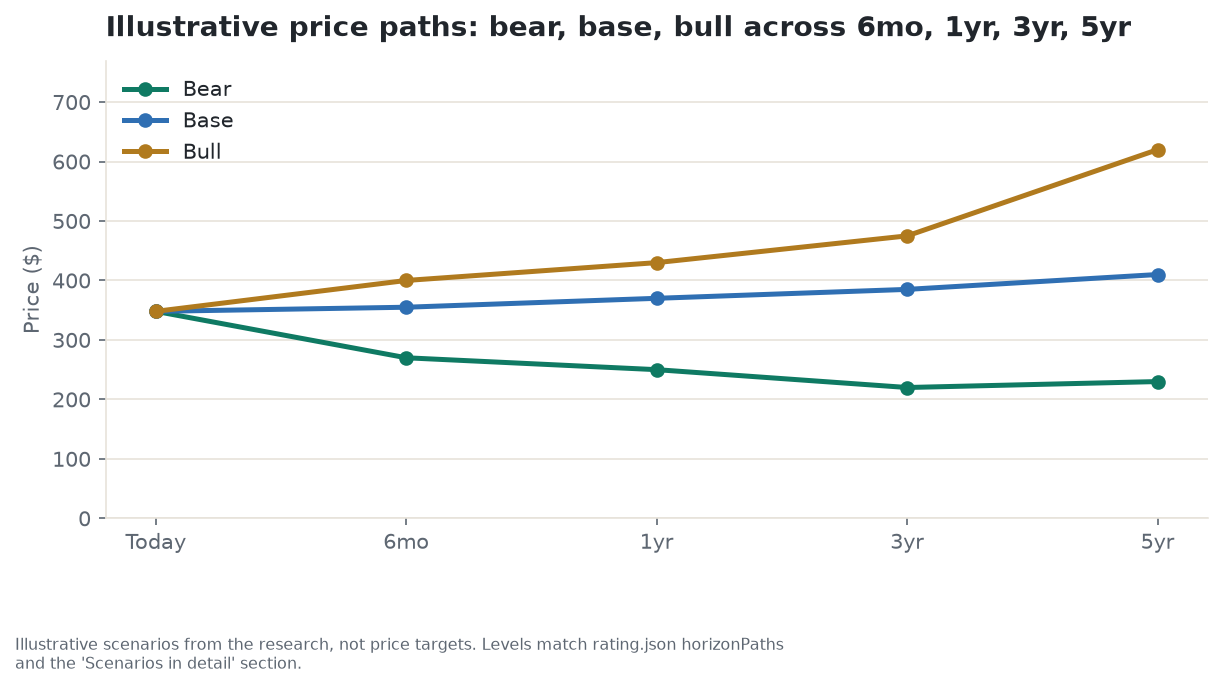
Palo Alto Networks closed around $348 when this was written (the quote above the article is current), a level that puts the stock at roughly 92 times the non-GAAP earnings management has guided for this fiscal year and roughly 25 times guided forward revenue. Both multiples sit well above every cybersecurity peer covered in this piece. That gap between price and every other company in its own category is the whole story here. The underlying business is real and growing: recurring bookings (Next-Generation Security ARR, or NGS ARR) are up 60 percent from a year ago. But strip out the revenue PANW just bought when it closed its roughly $25 billion acquisition of CyberArk in February 2026, and the growth rate the company was generating on its own is closer to 14 percent, basically a continuation of a multi-year slowdown rather than the acceleration the headline number implies. Every dollar level below is an estimate built on stated assumptions, never a price target.
Six months. This window turns on the next print. PANW reports its fiscal fourth quarter in mid-to-late August 2026 and gives its opening guide for fiscal 2027 in the same call, the first real look at whether CyberArk integration costs have peaked and whether NGS ARR is tracking the guided $8.90 to $8.95 billion. The base case is a modest grind to about $355 as the multiple holds roughly where it is. The bull case is about $400 if the beat-and-raise pattern that has defined the last several quarters continues and the stock pushes to a new high. The bear case is about $270 if the opening fiscal 2027 guide disappoints, or if the GAAP-loss headline from this past quarter repeats and the market starts pricing the multiple down. The single thing most likely to flip this window is that opening fiscal 2027 guide.
One year. Over twelve months the deciding variable is whether fiscal 2027 non-GAAP earnings per share actually lands near $4.50 to $4.60, and whether CyberArk’s identity-security products are visibly showing up as new bookings sold into PANW’s existing base of more than 70,000 customers, not just sitting on the books as acquired revenue. The base case is about $370, the guide delivered and the multiple normalizing slightly as the market gets a full year of clean comparisons. The bull case is about $430 if synergy capture from the CyberArk deal runs ahead of plan. The bear case is about $250 if organic growth decelerates further and the stock’s multiple falls back toward where its peers trade. The flip here is the pace of CyberArk cross-selling, the first hard evidence either way on whether the acquisition thesis is working.
Three years. By this point the acquisition-year noise should be fully out of the year-over-year comparisons, and the question becomes whether organic growth has stabilized in the high teens, which is what the platform-consolidation strategy is supposed to deliver, or kept sliding toward the low teens, which is what a maturing company facing tougher competition would look like instead. The base case is about $385, continued earnings growth against a multiple that keeps normalizing down from today’s rich starting point. The bull case is about $475 if 20-percent-plus growth holds and the market keeps paying a premium for platform leadership. The bear case is about $220 if CrowdStrike, Fortinet, and the big cloud platforms have visibly taken share and the multiple has fully reverted toward the level its peers already trade at. The flip is the clean, multi-year organic growth rate, finally observable without the acquisition distorting it.
Five years. This is the durability question in its purest form: does the platform-consolidation bet compound into a larger, more profitable company, or does it plateau into a good-but-no-longer-premium security vendor. The base case is about $410, a modest total return from today’s price, because a rich entry multiple absorbs a lot of what would otherwise be strong earnings growth. The bull case is about $620 if the identity-and-AI-security platform story fully plays out and a premium multiple holds through the period. The bear case is about $230, roughly flat to down from today, if competitive and pricing pressure compresses both growth and the multiple over the full five years. The flip is whether PANW keeps taking share across five product categories at once, or whether best-of-breed specialists and bundling cloud platforms erode the platform premium one category at a time.
Where the read lands today. On balance the read holds at Hold. This is a genuine platform-security leader whose recurring bookings are compounding at a healthy double-digit rate even after the acquisition math is stripped out, but the stock is priced as if the optimistic version of the CyberArk story is already delivered, GAAP profitability just swung negative on real integration costs, and every peer in this piece trades at a fraction of PANW’s multiple. The single thing most likely to move that read is whether NGS ARR growth, measured without the acquisitions, holds steady or starts sliding further.
Companion tool
Jump to the interactive dashboard to sort and filter PANW against its cybersecurity peers, or download the Excel model to flex the scenarios yourself.
TL;DR
Palo Alto Networks is the largest pure-play cybersecurity company, and its whole strategy for the last several years has been “platformization”: instead of selling a firewall to one team, a cloud-security tool to another, and a security-operations tool to a third, it bundles all of it, sometimes at a discount or an initial low-cost period, into a single enterprise agreement, betting that the switching costs of an integrated platform make a customer far stickier and far more monetizable over time than a single-product buyer would be. That bet just got a fifth leg: in February 2026, PANW closed its acquisition of CyberArk, the identity-security leader, for roughly $25 billion in cash and stock, adding privileged-access-management as a new platform alongside network, cloud, and security-operations. The results this past quarter show exactly what a deal like that looks like in the numbers: revenue grew 31 percent, but $388 million of that was CyberArk and Chronosphere revenue landing on the books at close, and organic growth was closer to 14 percent. NGS ARR, the recurring-bookings metric management wants investors to watch, grew 60 percent to $8.1 billion, and remaining performance obligations grew 36 percent to $18.4 billion, both figures that include a large acquired chunk but also show genuine double-digit organic growth underneath. GAAP operating income swung to a $183 million loss and GAAP net income to a $177 million loss, driven by real but partly non-cash and acquisition-specific charges: stock compensation, acquisition costs, and the amortization of CyberArk’s acquired intangibles. Free cash flow, which strips those non-cash items out, tells a cleaner story: a trailing 38.5 percent margin, up more than four points from a year ago. The catch is the price. After a run of more than 70 percent over the past year, PANW trades around 92 times guided non-GAAP earnings and 25 times guided forward revenue, both multiples well above CrowdStrike, Fortinet, and Zscaler, even though those peers are growing organically at similar or faster rates. The honest read is Hold, Overvalued on valuation: a real growth business, priced for a lot of things to keep going right.
Explore it yourself: the interactive dashboard
Open the dashboard in a full screen
The dashboard holds PANW and the four cybersecurity peers covered in this piece, sortable by market cap, by growth rate, and by the valuation multiple that carries most of the debate here. It also lays out the rating, the factor-by-factor read behind it, and the full bull, base, and bear horizon table. Use it to check any single name as you read.
Prefer a spreadsheet? Download the Excel model with the company summary, the scenario math behind the horizon chart, and the peer comparison table. The scenario levels in that file are illustrative arithmetic, not targets.
The moat that is also a bet
Think of enterprise security spending as a household’s separate insurance policies: one for the car, one for the house, one for health, each bought from a different company, each with its own paperwork, its own renewal date, and its own customer-service line to call when something goes wrong. For years, that was how large companies bought security software, one point product per problem, from whichever vendor was best at that one thing. Palo Alto Networks’ entire strategy is to be the one insurer that sells you all four policies bundled into a single relationship, arguing that a single integrated platform catches things a pile of disconnected tools misses, and that a customer who is fully on the platform is much harder to peel away, product by product, than a customer who bought each piece from a different vendor.
That is a real, defensible strategic logic, and it shows up in the numbers as “platformization deals”: bundled agreements, sometimes discounted or offered at no cost for an initial period to get a customer fully onto the platform, with the expectation that the customer expands its spending across more of the platform over the life of the relationship. It is also, mechanically, a bet that gives up near-term revenue and gross margin for a promise of a stickier, larger long-term relationship. Whether that promise pays off is not visible in a single quarter. It shows up over years, in whether NGS ARR keeps compounding faster than a simple sum of PANW’s individual product lines would. This piece works through both the bull and the bear on that bet, because the entire CyberArk acquisition, the biggest single event in PANW’s recent history, is the same bet made at a much larger scale: a fifth platform, identity security, bought rather than built, on the same logic that a fuller platform beats a better single product.
How the money flows
flowchart TD
    CUST["Enterprise and Government Customers - 70,000+ accounts"]
    DEAL["Platformization Deals - bundled, sometimes low-cost land"]
    STRATA["Strata: NGFW + Prisma SASE - Network Security"]
    CORTEXCLOUD["Cortex Cloud - CNAPP + CDR"]
    SECOPS["Cortex XSIAM/XDR/XSOAR - Security Operations"]
    IDENTITY["Identity Security - CyberArk PAM, closed Feb 2026"]
    ARR["NGS ARR $8.1B - +60% YoY"]
    RPO["Remaining Performance Obligations $18.4B"]
    REV["Total Revenue $3.0B per qtr - +31% YoY, incl M&A"]
    COGS["Cost of Revenue - incl $280M/qtr acquired-intangible amortization"]
    OPEX["R&D + S&M + G&A - incl $517M/qtr stock comp"]
    GAAP["GAAP Operating Loss $183M this qtr"]
    NONGAAP["Non-GAAP Operating Income $814M this qtr"]
    FCF["Adjusted Free Cash Flow - 38.5% TTM margin"]
    CUST --> DEAL
    DEAL --> STRATA
    DEAL --> CORTEXCLOUD
    DEAL --> SECOPS
    DEAL --> IDENTITY
    STRATA --> ARR
    CORTEXCLOUD --> ARR
    SECOPS --> ARR
    IDENTITY --> ARR
    ARR --> RPO
    RPO --> REV
    REV --> COGS
    REV --> OPEX
    COGS --> GAAP
    OPEX --> GAAP
    GAAP --> NONGAAP
    NONGAAP --> FCF
Read the diagram top to bottom and it is the whole business. Customers sign platformization deals, sometimes bundled at a discount, across four platforms (soon to include the fifth, identity security, via CyberArk). Those deals build NGS ARR, the recurring-bookings figure PANW steers investors toward, which in turn builds remaining performance obligations, the contractually committed backlog that has not yet been recognized as revenue. Revenue itself lags NGS ARR because of how subscription accounting recognizes revenue over the life of a contract rather than all at once. From there, cost of revenue and operating expenses take their share, and right now those costs include a large, temporary layer of acquisition-specific charges: intangible amortization from the CyberArk purchase, integration costs, and heavy stock compensation. That layer is exactly why GAAP operating income went negative this quarter even as non-GAAP operating income and free cash flow both grew. The investing point is the gap between the two bottom lines: GAAP profitability is currently telling a worse story than cash generation is, and figuring out which one is the truer read on the business is most of what this piece is about.
Field guide: the four platforms and the fifth
Strata (Network Security) is the original business and still the anchor. It covers next-generation firewalls, sold as hardware appliances for on-premises networks and as software for cloud environments, plus Prisma Access, PANW’s Secure Access Service Edge (SASE) offering that secures remote workers and branch offices from the cloud rather than a physical box. A growing suite of cloud-delivered add-ons rides alongside it: threat prevention, DNS security, IoT and operational-technology security, and AI-specific access controls.
Cortex Cloud (Cloud Security) protects applications and infrastructure running in public and hybrid clouds, combining a Cloud Native Application Protection Platform, which secures code and configurations before and after they are deployed, with cloud detection and response, which watches for active threats once something is running. It is built to secure the same generative-AI workloads that are driving new cloud spending across the industry.
Cortex (Security Operations) is where a security team actually watches for and responds to attacks. Cortex XSIAM is PANW’s newer, AI-powered replacement for the traditional Security Information and Event Management (SIEM) system, the software that ingests logs from every other tool and flags anomalies. Cortex XDR handles detection and response on endpoints and across the network, Cortex XSOAR automates the repetitive parts of incident response, and Cortex Xpanse maps an organization’s external attack surface, the systems visible to an attacker from outside.
Identity Security, the newest platform, arrived through the CyberArk acquisition. CyberArk was the established leader in privileged access management, the discipline of controlling and monitoring the most powerful credentials in an organization, the ones that can access anything. PANW’s pitch for combining the two is that the rise of AI agents, software that can act autonomously inside a company’s systems, creates an explosion of new “machine identities” that all need the same kind of privilege controls a human administrator’s credentials would get, and that this moment is the right time to enter the category before it matures.
Two smaller, more recent additions round out the picture: Chronosphere, an observability company (the tools that monitor whether software systems are healthy and performing) that closed in January 2026, and Koi Security, folded into the same wave of dealmaking. Neither is individually broken out in the numbers, but both show up in the acquisition-related costs discussed below.
Who wins where
The competitive map splits into three groups. The first is best-of-breed specialists that compete category by category: CrowdStrike in endpoint detection and identity, Zscaler in SASE, and, until it was acquired, CyberArk itself in privileged access. These companies win by being deeper and more focused in a single category than a broad platform can be, and they generally price aggressively to land new customers away from incumbents. The second group is large, horizontal technology platforms that bundle basic security into products companies already buy: Microsoft folds security features into Windows, Azure, and Microsoft 365; Alphabet’s Google Cloud acquired Wiz, a cloud-security company, to do something similar; and Cisco has long bundled security into its networking hardware. These companies do not need security to be a standalone profit center, so they can price it as a feature rather than a product, a pricing dynamic no pure-play security vendor can fully match. The third group is Fortinet, which sits in an unusual middle position: an independent security vendor like CrowdStrike or Zscaler, but with real scale and, according to press coverage, gaining ground against PANW specifically in the SASE category, PANW’s own network-security turf. Cisco belongs in this same bundling group: it has folded security features into its networking hardware for years, and its own Splunk acquisition gives it a security-operations foothold that overlaps directly with PANW’s Cortex line. For a look at how that name is positioning security and AI-networking together, see the Cisco (CSCO) deep dive.
PANW’s answer to all three groups is breadth: the argument that no single specialist covers as much ground, and that Microsoft’s bundled security is generally regarded across the industry as good enough rather than best of breed, leaving room for a premium platform vendor that covers everything a large enterprise needs from one relationship. That argument is testable over time in a simple way: it wins if PANW’s NGS ARR keeps compounding faster than the specialists’ combined growth, and it loses if CrowdStrike, Fortinet, and the bundling cloud platforms keep taking individual categories away from PANW’s own platform, one at a time.
Company by company: who’s who
Palo Alto Networks (PANW). The largest pure-play cybersecurity company by platform breadth, at roughly $283.7 billion in market capitalization. NGS ARR grew 60 percent to $8.1 billion and remaining performance obligations grew 36 percent to $18.4 billion, both figures inflated by the CyberArk and Chronosphere acquisitions but still showing healthy double-digit organic growth underneath.
- Bull: a genuinely expanding recurring-revenue base and a real, sourced strategic argument for entering identity security at what management calls an inflection point for AI-agent security.
- Bear: organic growth is closer to 14 percent once the acquisitions are stripped out, GAAP profitability just turned negative on integration costs, and the stock’s roughly 92 times forward non-GAAP earnings multiple leaves very little room for a stumble.
CrowdStrike (CRWD). PANW’s closest best-of-breed competitor, built around a cloud-native endpoint agent that has expanded into identity and cloud security, with about $49.4 billion in market capitalization. Latest-quarter revenue grew 25.6 percent year over year, the fastest organic pace in this peer set.
- Bull: already GAAP-net-income-positive with a lightweight, single-agent architecture that is simpler to deploy than a multi-platform bundle, and its own expansion into identity and cloud puts it in direct competition with PANW’s newest platform.
- Bear: GAAP operating income is still slightly negative on a heavy stock-compensation load, and it is not immune to the same platform-versus- point-product argument PANW makes against everyone else.
Fortinet (FTNT). PANW’s most direct competitor in firewalls and SASE, the categories that anchor PANW’s own Strata platform, with about $114.5 billion in market capitalization. Latest-quarter revenue grew 20.1 percent, the slowest pace here, but GAAP operating income was a solidly profitable $580.0 million.
- Bull: the only large peer in this piece that is comfortably GAAP-profitable at scale, and press coverage specifically credits it with taking share from PANW in SASE.
- Bear: its historical strength in appliance-based hardware is a structurally slower-growing category than cloud-delivered security, which shows up in its growth rate lagging the rest of the group.
Zscaler (ZS). A cloud-native, zero-trust specialist and the pure-play competitor to PANW’s Prisma Access business, with about $23.8 billion in market capitalization. Latest-quarter revenue grew 25.4 percent, essentially matching CrowdStrike’s pace, on an organic-only business with no large recent acquisition distorting its own numbers.
- Bull: a clean read on genuine zero-trust demand, growing about as fast as CrowdStrike without any acquisition noise in the numbers.
- Bear: still GAAP-loss-making with no scale advantage over PANW or CrowdStrike, and it competes for the exact same SASE budget Fortinet is also pressing.
SentinelOne (S). The smallest, most growth-stage name in the group, an AI-driven endpoint and cloud-security vendor, with about $5.9 billion in market capitalization. Latest-quarter revenue grew 20.8 percent off a much smaller base.
- Bull: still growing at a healthy clip with room to take share as an independent alternative to the two platform giants above it.
- Bear: the widest GAAP loss in the group relative to its revenue base, the clearest case in this piece of a subscale company squeezed between larger platforms on both sides.
What the filings say
Full fiscal-year revenue (PANW’s fiscal year ends July 31) shows a clean, multi-year deceleration that predates any of the recent acquisitions: $4.26 billion in fiscal 2021, growing 29.3 percent to $5.50 billion in fiscal 2022, 25.3 percent to $6.89 billion in fiscal 2023, 16.5 percent to $8.03 billion in fiscal 2024, and 14.9 percent to $9.22 billion in fiscal 2025.
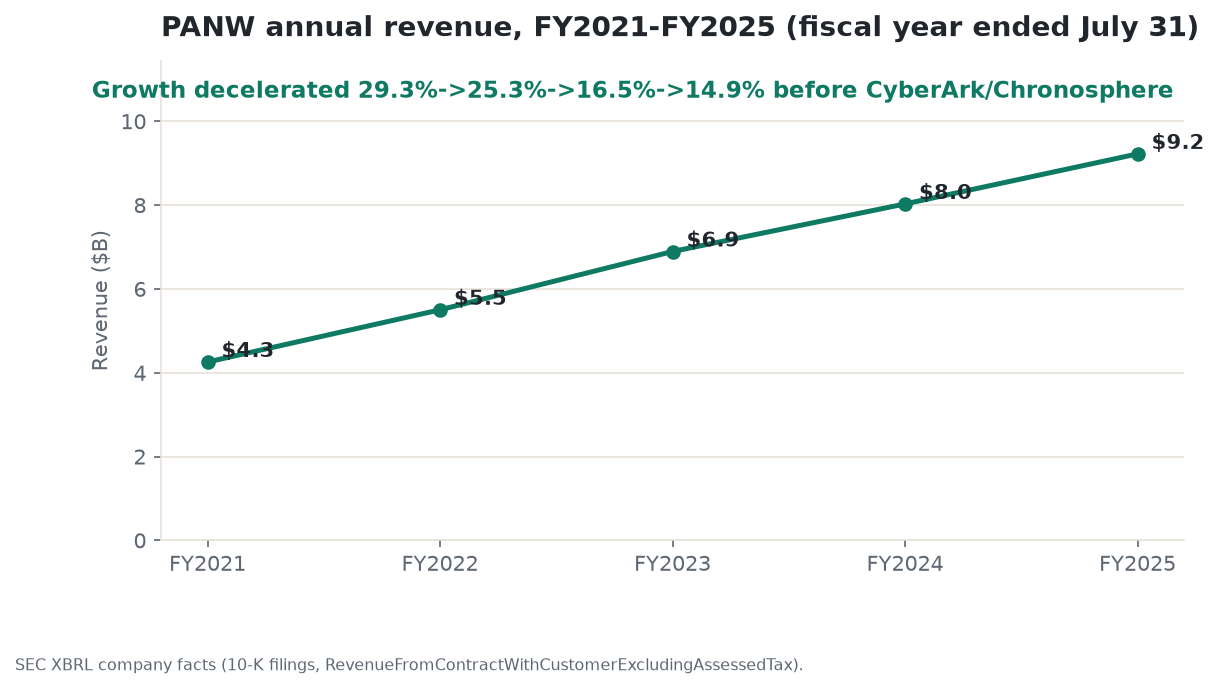
That deceleration is the backdrop against which the most recent quarter has to be read. In the quarter ended April 30, 2026 (PANW’s fiscal third quarter of 2026), total revenue was $3.00 billion, up 31 percent from $2.29 billion a year earlier. But $388 million of that revenue came from CyberArk and Chronosphere, which closed during the quarter and the prior one. Strip that out and revenue was about $2.61 billion against $2.29 billion a year ago, an organic growth rate of roughly 14.2 percent (a figure computed for this piece, not one PANW discloses directly), which is essentially the fiscal 2025 pace continuing rather than the acceleration the 31 percent headline suggests. Nine-month fiscal 2026 revenue was $8.07 billion versus $6.69 billion, up 21 percent. Revenue mix in the quarter was 19.8 percent product and 80.2 percent subscription and support, the recurring-revenue-heavy mix typical of a mature platform vendor.
The two metrics PANW and the sell-side actually watch closest are NGS ARR and remaining performance obligations, because platformization deals often start as discounted or no-cost trials that convert to real recurring revenue only later, which can make GAAP revenue lag the true health of the business in either direction.
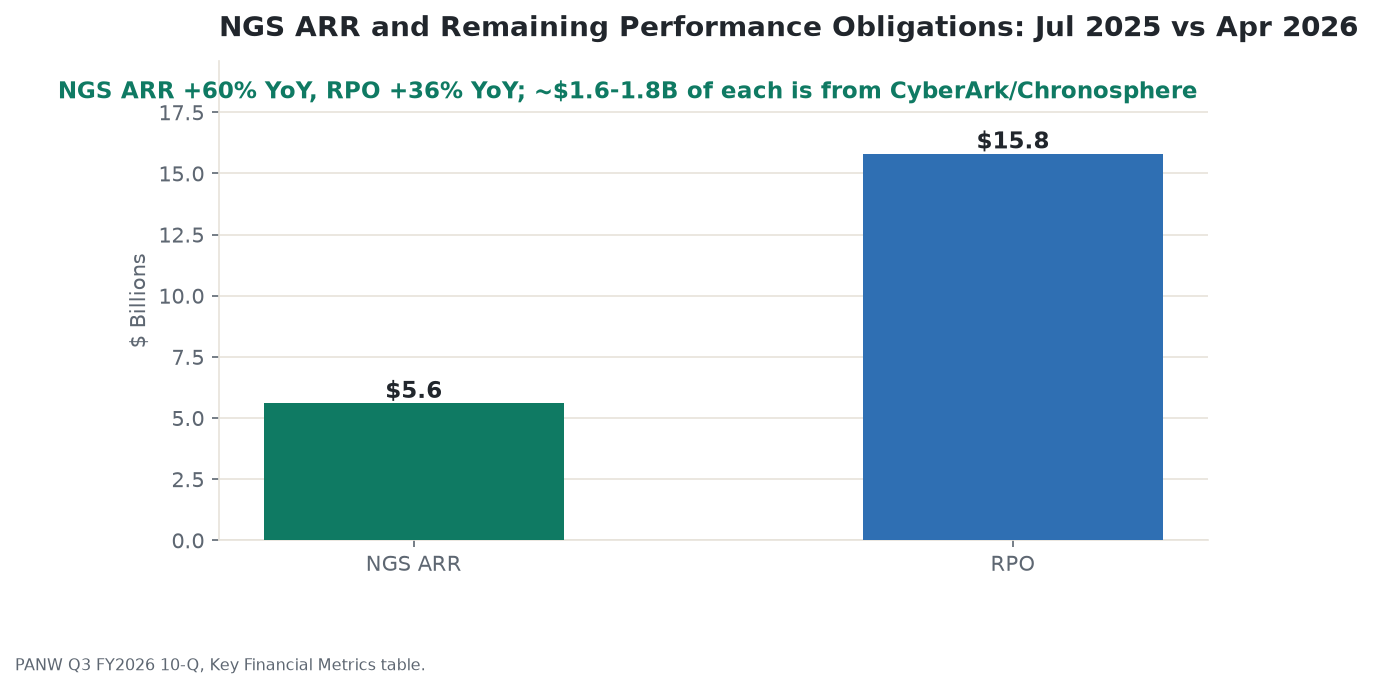
NGS ARR reached $8.1 billion as of April 30, 2026, up 60 percent from $5.6 billion a year earlier, including $1.6 billion contributed directly by CyberArk and Chronosphere. Remaining performance obligations reached $18.4 billion, up 36 percent from $15.8 billion, including $1.8 billion from the same two deals. Both metrics carry the identical caveat as revenue: a meaningful share of the increase is acquired backlog landing on the balance sheet at the moment of close, not new organic bookings, though both also show real double-digit organic growth once that is accounted for.
Margins tell the most important story in this print. Gross margin compressed to 67.6 percent from 72.9 percent a year earlier, a drop of about 530 basis points, driven largely by acquisition-related cost of revenue, chiefly the amortization of CyberArk’s acquired intangible assets. GAAP operating income swung to a loss of $183 million (a negative 6.1 percent margin) from operating income of $219 million (9.6 percent margin) a year earlier, and GAAP net income swung to a loss of $177 million, or a negative $0.22 per diluted share, from net income of $262 million, or $0.37 per diluted share.
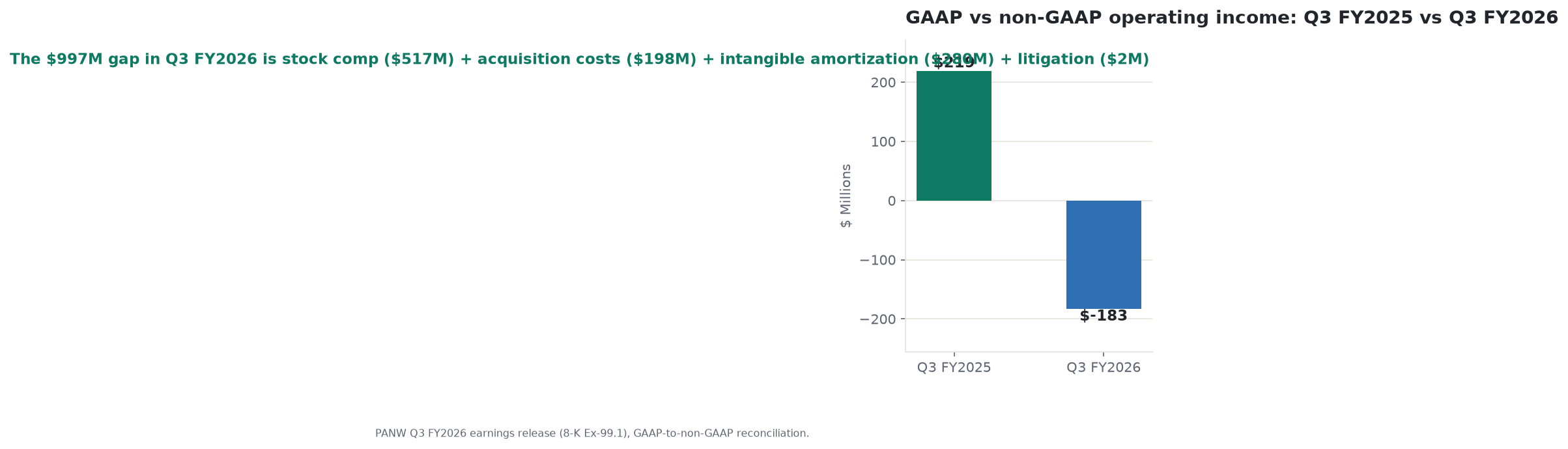
Here is where the two accounting views genuinely diverge rather than telling the same story two ways. Non-GAAP operating income, which adds back stock compensation ($517 million), acquisition-related costs ($198 million, including CyberArk integration), amortization of acquired intangibles ($280 million), and a small litigation charge ($2 million), was $814 million, up from $627 million a year earlier, a roughly flat margin near 27 percent either way you cut it. Non-GAAP net income was $684 million, or $0.85 per diluted share, up from $561 million, or $0.80 per diluted share. None of those add-back items is fabricated. Stock compensation is a real cost to shareholders even though it is non-cash, and intangible amortization is a real accounting consequence of paying $25 billion for a company, spread over years. The honest reading is that GAAP and non-GAAP are not lying to each other; they are answering two different questions. GAAP asks what happened to shareholders’ claim on the business, dilution and amortization included. Non-GAAP asks what the underlying, ongoing operations generated, treating the acquisition costs as a temporary, non-repeating layer. Both are true at once, and a reader who only sees one side misses half the picture.
Cash flow is where the “temporary layer” argument gets its strongest support. Operating cash flow was $871 million in the quarter versus $628 million a year earlier, and adjusted free cash flow was $910 million versus $578 million. Trailing-12-month adjusted free cash flow margin was 38.5 percent, up 430 basis points year over year, a genuine, cash-based improvement that does not depend on which set of accounting add-backs you trust. CFO Dipak Golechha said the company remains “firmly on track to achieve 40% adjusted free cash flow margin in FY28,” a management target, not a fact, two full fiscal years away from being tested.
The balance sheet changed more than any single income-statement line, because of the CyberArk deal’s size relative to PANW itself. Total assets nearly doubled to $46.27 billion from $23.58 billion. Goodwill grew to $21.90 billion from $4.57 billion, and intangible assets, net, grew to $7.28 billion from $763 million, almost entirely the purchase-accounting step-up from the acquisition, the premium paid over CyberArk’s identifiable net assets plus the technology and customer-relationship value now amortizing through cost of revenue, which is exactly what is compressing gross margin above. Cash and investments totaled roughly $7.0 billion across cash, short-term, and long-term investments. The balance sheet now also carries $1.35 billion of convertible senior notes assumed from CyberArk, none of which existed a year ago. Stockholders’ equity nearly quadrupled to $27.67 billion from $7.82 billion, mechanically reflecting the roughly $19.3 billion of PANW stock issued as deal consideration. Deferred revenue, the contractually billed but not-yet-recognized backlog, grew to $13.61 billion from $12.75 billion.
The single most consequential fact in this section is the dilution. Diluted weighted-average shares were 801 million in the quarter, up from 707 million a year earlier, about 13 percent, and the 10-Q cover page showed 815 million shares outstanding as of late May 2026 versus 668.9 million a year earlier on the prior 10-K cover, a roughly 22 percent increase concentrated around the February 2026 closing. Every non-GAAP per-share figure above already reflects that larger share count; the growth in the underlying dollars has to outrun a meaningfully larger denominator for per-share value to actually compound.
Management’s own risk factors, disclosed in the FY2025 10-K before the deal closed, are worth reading in their own words rather than paraphrased: PANW “may in the future acquire other businesses… which could subject us to adverse claims or liabilities, require significant management attention, disrupt our business, adversely affect our operating results, may not result in the expected benefits of such acquisitions, and may dilute stockholder value.” That sentence, written about the exact deal now sitting on the balance sheet, is management’s own bear case, not one invented for this piece.
What the market is paying
PANW’s price action has been extraordinary. The stock is up about 72.5 percent over the trailing year, from around $202 a year ago to around $348 today (a snapshot as of the research date; the quote above the article is current), trading within about 3 percent of its 52-week high of $358.10 and well above both its 50-day moving average (around $251) and its 200-day moving average (around $201), the technical signature of a strong, extended uptrend. The stock pays no dividend, so that entire return is price appreciation.
The harder question is what that price is buying. GAAP earnings are not a useful valuation anchor right now, since trailing GAAP earnings per share are negative because of the CyberArk-related net loss this quarter, so a traditional GAAP price-to-earnings ratio is not meaningful. Two forward multiples do the real work instead. Against the fiscal 2026 guided revenue midpoint of about $11.42 billion, PANW’s roughly $283.7 billion market capitalization implies a forward price-to-sales multiple around 24.8 times. Against the fiscal 2026 guided non-GAAP diluted earnings-per-share midpoint of about $3.78, the roughly $348 price implies a forward non-GAAP price-to- earnings ratio around 92 times.
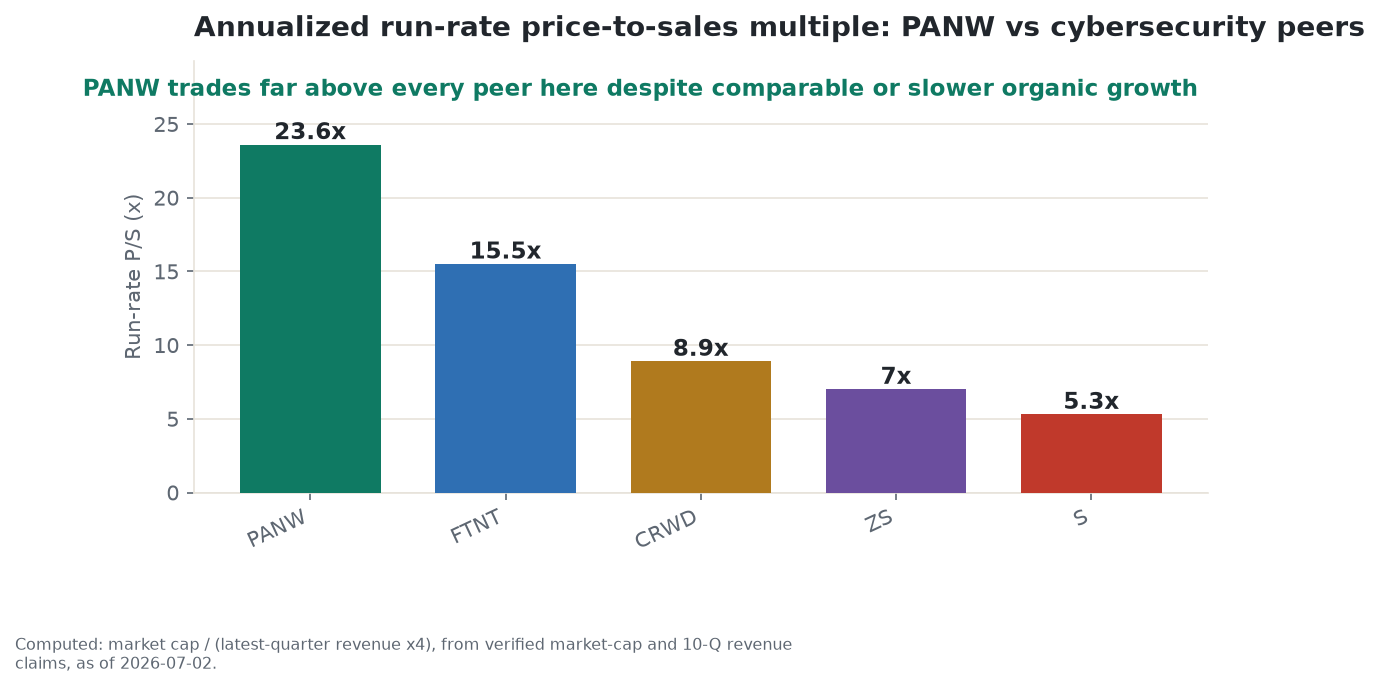
Both readings sit far above the peer group in this piece. Using each company’s latest quarterly revenue annualized (multiplied by four) as a run-rate proxy, PANW trades around 23.6 times run-rate sales, versus about 15.5 times for Fortinet, 8.9 times for CrowdStrike, 7.0 times for Zscaler, and 5.3 times for SentinelOne. The gap is not explained by growth: CrowdStrike (25.6 percent) and Zscaler (25.4 percent) are both growing organically at rates comparable to or faster than PANW’s own 14.2 percent organic pace, yet both trade at a fraction of PANW’s multiple. The market is paying a substantial premium for PANW’s platform breadth and its identity-security land-grab specifically, a premium the acquisition math itself has not yet proven out.
News-flow around and after the Q3 fiscal 2026 print on June 2, 2026, was mixed in tone even though the headline numbers beat expectations. Aggregated coverage reported the stock up roughly 12.9 percent the day after results on the NGS ARR and RPO beat and the raised guide, even as GAAP profit swung to a loss, and multiple outlets reported upward sell-side price-target revisions, including a target raise from Wedbush. Later coverage in June described the stock giving back part of a roughly 57 percent one-month run into the print, a sign that a great deal of optimism had already been priced in quickly. This is market-mood signal, not fact about the business, and is treated as such throughout this piece.
What the crowd is saying
The dominant narrative in the weeks around the print is “AI-fueled beat, GAAP profit turns to loss.” CEO Nikesh Arora framed the quarter around “accelerating organic bookings” as “customers turn to us to secure their AI deployments at scale,” and argued that AI has broadly “increased the level of urgency around cybersecurity” and “redefined the shape of the industry for the coming years.” The market’s initial reaction, a roughly 12.9 percent pop the next session, shows investors rewarded the NGS ARR and RPO beat and the raised guide more than they punished the GAAP loss, which management framed entirely in acquisition-accounting terms.
That initial framing is exactly where the narrative and the filings diverge. The 31 percent headline revenue growth and 60 percent NGS ARR growth are the numbers driving the bullish coverage, but a meaningful share of both is CyberArk and Chronosphere landing on the books at close, not organic acceleration. The crowd’s initial read, that AI demand is re-accelerating growth, and the filings’ more sober read, that a large acquisition is consolidating into the numbers, are both defensible takes on the same print. A fair version holds both at once: the underlying franchise is not obviously re-accelerating on its own, but the company is also not manufacturing growth from nothing, since organic NGS ARR and RPO growth are still healthy double-digit numbers on their own.
Coverage later in June described the stock giving back part of its post-earnings spike, consistent with a market that priced in a lot of good news fast and then took a more mixed second look, particularly once analysts worked through the optics of the GAAP loss and the scale of the dilution from the CyberArk deal’s stock-and-cash structure. Sell-side price targets stayed net positive through that pullback, which suggests the multi-year thesis remains intact among covering analysts even as short-term positioning got choppy. A recurring, more skeptical thread in the coverage questions whether a stock already trading around 25 times forward revenue and roughly 92 times forward non-GAAP earnings has room left to re-rate further, and at least one piece specifically flagged Fortinet gaining ground in SASE, a direct challenge to one of PANW’s own core platforms.
The useful takeaway is where the crowd’s story and the filings genuinely diverge, not which one is simply right. The crowd’s growth framing overstates the organic acceleration. The harsher bear framing that dismisses the entire quarter as “just M&A” understates that NGS ARR and RPO both grew at healthy double-digit organic rates too, and that the identity-security-for-AI-agents rationale is a coherent, sourced strategic argument, not an invented one, even though its payoff is unproven. The valuation skepticism showing up consistently across independent coverage is the more durable signal here, because it lines up with the hard multiples computed above, which is exactly the kind of alignment between narrative and fundamentals that deserves more weight than any single day’s price reaction.
Does the platform bet earn its premium?
This is where the evidence gets weighed against the question the whole piece is built on: does PANW’s platform breadth, and the CyberArk bet specifically, justify a valuation multiple several times higher than every peer it competes against? The structural case for the bull is real. Enterprise security budgets are historically one of the stickier lines in corporate technology spending, cut later and restored sooner than general IT budgets in a downturn, because breaches are visible, costly, and reputationally damaging. Platformization deals genuinely do consolidate vendor relationships in a way that raises switching costs once a customer is fully bundled in, and management’s own timing argument, that identity security for AI agents is at an inflection point similar to where SASE and cloud security once were, is a coherent, sourced strategic thesis rather than marketing filler.
The real cyclical case, and its timing, is just as concrete. The trigger is not a single bad quarter; it is a slow bleed. If organic NGS ARR growth, measured cleanly once the acquisition comparisons wash out around late fiscal 2027, comes in below the high-teens level the platform thesis implies, while GAAP losses persist because integration costs do not fade on the schedule management expects, the market has every reason to re-rate PANW’s multiple down toward where CrowdStrike, Fortinet, and Zscaler already trade. That would not require the business to break. It would only require the premium the market is currently paying to prove unearned, which is a much lower bar for a bear thesis to clear than an actual deterioration in the underlying franchise.
The most likely outcome, on the evidence gathered here, sits between the two: a real, growing platform business that has bought itself a fifth category at a large price, still working through the integration costs of that purchase, trading at a multiple that already assumes the purchase pays off on schedule. That is a fine business and a demanding stock at the same time, which is exactly why this piece lands at Hold rather than a stronger conviction in either direction.
The scenarios in detail
Four variables decide where PANW lands over the next five years. The first is organic NGS ARR growth once the CyberArk and Chronosphere consolidation effect washes out of the comparisons, currently around 14 percent against a 60 percent headline. The second is integration execution: whether cross-selling identity security into PANW’s existing base of more than 70,000 customers, plus cost synergies, grows faster than the acquired-intangible amortization and stock-compensation load currently suppressing GAAP margins. The third is the forward multiple itself, currently about 92 times guided non-GAAP earnings and about 25 times guided forward revenue, both well above the peer set, which means how much of the growth story is already paid for is the central valuation question. The fourth is competitive share across CrowdStrike’s push into identity and cloud, Fortinet’s press-reported SASE gains, and the bundling threat from Microsoft and Google’s Wiz.
The dollar levels below use the same method as the lede chart: each path multiplies a projected non-GAAP diluted earnings-per-share figure by a projected forward multiple. The base case starts from the guided fiscal 2026 non-GAAP EPS of $3.78 and compounds it at a decelerating rate as CyberArk synergies phase in and organic growth normalizes, roughly 20 percent annually in fiscal 2027 and 2028, slowing to the low-to-mid teens by fiscal 2031, while the forward multiple compresses from today’s roughly 90 times toward a mature premium-platform multiple in the 45 to 50 times range by year five, since a 92 times entry multiple already prices in a great deal of optimism. The bull case assumes faster earnings compounding, low-20-percent growth sustained longer, and a multiple holding in the 55 to 65 times range because the identity-and-AI- security thesis proves out. The bear case assumes earnings compounding slows to single digits or low teens as competitive share loss and integration drag bite, and the multiple de-rates toward 30 to 40 times, roughly where mature large-cap software peers trade once a growth premium fades.
Bull, the platform-consolidation and identity-AI thesis fully plays out. NGS ARR compounds at 20 percent or more annually as CyberArk cross-sell and the AI-agent identity-security category both scale faster than expected, non-GAAP operating margin expands past the 40 percent fiscal 2028 free-cash-flow-margin target as integration costs fade, and the forward multiple holds in the 55 to 65 times range because growth stays durably premium. On illustrative arithmetic [estimate], that is about $400 at six months, $430 at one year, $475 at three years, and about $620 by year five. What breaks it: a large competitor, whether CrowdStrike or a hyperscaler, proves cheaper and good enough across enough categories that platformization deals stop expanding.
Base, organic growth normalizes and the CyberArk bet pays for itself slowly. Organic NGS ARR growth settles in the high teens once the acquisition effect washes out, non-GAAP margins keep expanding toward the 40 percent fiscal 2028 target but on a longer timetable than the bull case, and the forward multiple normalizes from about 90 times toward the 45 to 50 times range as growth decelerates from today’s inorganic-boosted headline rate. On illustrative arithmetic [estimate], that is about $355 at six months, $370 at one year, $385 at three years, and about $410 by year five, a modest total return reflecting how much of the good news the current price already contains. What breaks it: either a faster multiple de-rate, the bear case, or a durable premium holding, the bull case.
Bear, integration drag and share loss outrun growth. CyberArk integration costs and complexity persist longer than guided, organic growth decelerates into the low teens as CrowdStrike, Fortinet, and bundling hyperscalers take share in the categories PANW is trying to consolidate, and the market re-rates the stock toward a mature large-cap software multiple in the 30 to 40 times range once the growth premium is no longer credible. On illustrative arithmetic [estimate], that is about $270 at six months, $250 at one year, $220 at three years, and about $230 by year five, a lost half-decade rather than a collapse, since the underlying business does not need to break for this scenario, the premium just needs to be given back. What defuses it: NGS ARR and RPO continuing to compound at a healthy double-digit organic rate even after the acquisition effect is isolated out.
The catalysts that decide which path wins are datable. Near term: the fiscal fourth-quarter print and fiscal 2027 opening guide in mid-to-late August 2026, and continued quarterly disclosure of CyberArk integration costs, watching whether they are peaking or still building. Multi-year: the point in roughly late fiscal 2027 when year-over-year comparisons no longer include the CyberArk and Chronosphere consolidation effect, finally revealing a clean organic growth rate; progress against the 40 percent fiscal 2028 adjusted-free-cash-flow-margin target; and the multi-year competitive contest with CrowdStrike, Fortinet, and Microsoft or Google’s Wiz for share in each platform. The leading indicators worth watching in real time are NGS ARR and RPO growth with the acquisition contribution isolated out, the gross-margin and non-GAAP operating-margin trend quarter to quarter, whether GAAP operating income ever returns positive, the adjusted free cash flow margin against its 37.5 percent fiscal 2026 guide, and the pace of further share-count growth.
Companies to watch (bull / base / bear)
Palo Alto Networks (PANW). The name this piece is built on.
- Bull: organic NGS ARR growth (ex-acquisitions) re-accelerates rather than merely holding steady, and the CyberArk cross-sell shows up clearly in the numbers within a few quarters.
- Base: organic growth holds around its current mid-teens pace while integration costs gradually fade on roughly the guided schedule.
- Bear: GAAP losses persist past the next few quarters, organic growth slips further, or CrowdStrike and Fortinet’s press-reported share gains show up directly in PANW’s own NGS ARR growth rate.
- Watch: the fiscal fourth-quarter print and fiscal 2027 opening guide in mid-to-late August 2026.
CrowdStrike (CRWD).
- Bull: its identity and cloud-security expansion keeps taking share directly from PANW’s newest platform while staying GAAP-profitable.
- Base: continues growing in the mid-20-percent range as a best-of-breed alternative without materially disrupting PANW’s platform customers.
- Bear: its own stock-compensation load keeps GAAP operating income negative even as growth decelerates industry-wide.
Fortinet (FTNT).
- Bull: its press-reported SASE gains against PANW continue and its GAAP-profitable scale lets it price more aggressively than smaller peers.
- Base: keeps growing in the low-20-percent range on its hardware and SASE mix without a major share shift either way.
- Bear: its appliance-heavy legacy keeps its growth rate the slowest in the group as cloud-delivered security keeps taking wallet share.
Zscaler (ZS).
- Bull: its clean, organic-only 25-percent-plus growth continues, proving zero-trust demand does not require an acquisition to sustain.
- Base: keeps pace with CrowdStrike’s growth rate without closing its GAAP loss.
- Bear: gets squeezed between Fortinet’s SASE push and PANW’s platform bundling, with no scale advantage of its own.
SentinelOne (S).
- Bull: keeps growing at a healthy clip and proves an independent alternative to the two platform giants can still take share.
- Base: continues at its current roughly 20-percent pace, the smallest but steady grower in the group.
- Bear: its GAAP losses, the widest in the group relative to its revenue base, force a difficult capital-raising or takeover conversation.
Risk controls
The honest risk paragraph. Palo Alto Networks carries three layers of risk stacked on top of each other, and they rank in that order. The largest is integration risk on a large, complex, recently closed acquisition: CyberArk closed only in February 2026, its convertible notes and purchase-accounting intangibles are now on PANW’s balance sheet, and management’s own risk factors explicitly warn that an acquisition “may not result in the expected benefits… and may dilute stockholder value,” a sentence written about exactly this deal. Second is the valuation itself: at roughly 92 times guided non-GAAP earnings and 25 times guided forward revenue, after a stock up more than 70 percent in a year and sitting within about 3 percent of its 52-week high, there is very little margin of safety, and a de-rating toward where CrowdStrike or Zscaler already trade would be a meaningful move on its own even if the business does nothing wrong. Third is competitive intensity that is already visible in the press, not theoretical: Fortinet reportedly gaining ground in SASE, CrowdStrike pushing directly into identity and cloud security, and Microsoft and Google’s Wiz able to bundle security into products companies already buy at a price no pure-play vendor can fully match.
What would change the read for the better: organic NGS ARR growth, cleanly measured without the acquisitions, holding steady or re-accelerating for several consecutive quarters, or gross margin recovering toward its pre-acquisition levels faster than the amortization schedule alone would suggest, which would indicate real revenue synergy rather than just accounting consolidation. What would change it for the worse: GAAP losses persisting well past the near-term integration window with no visible path to breakeven, or organic growth decelerating further rather than stabilizing, either of which would suggest the platform premium is not earning its keep.
Methodology, sourcing, and data-quality flags
This piece was built from a single research pass across primary SEC filings (the FY2025 10-K, the Q3 FY2026 10-Q, the CyberArk acquisition and closing 8-K exhibits, and SEC XBRL company facts for PANW and its four covered peers), market data (Yahoo Finance price series, cross-checked against SEC cover-page share counts), and aggregated news coverage for the sentiment read, followed by a self-verification pass, a skeptic pass arguing the bear case, and a compliance review of the disclaimer posture. Of 54 recorded claims, 50 are load-bearing, none are disputed, and none are unverified: every load-bearing figure traces to a primary filing or exhibit, or to an explicitly labeled press-tier source.
A note on the read itself, factor by factor, in plain terms rather than as scores. On valuation, the evidence reads rich: around 92 times guided non-GAAP earnings and around 25 times guided forward revenue, both well above every peer covered here, after a stock up more than 70 percent over the past year and sitting near its 52-week high. This is the clearest weak point in the case. On growth, the read is strong on the metrics management wants followed (NGS ARR up 60 percent, remaining performance obligations up 36 percent, guided fiscal 2026 revenue up 24 percent) but considerably more modest once the CyberArk and Chronosphere consolidation effect is stripped out, leaving organic growth around 14 percent, a continuation of a multi-year deceleration rather than a re-acceleration; net, still a genuine growth business, just not growing as fast as the headline suggests. On quality, the read is mixed: cash generation is unambiguously strong and improving, a 38.5 percent trailing free-cash-flow margin, up more than four points year over year, even as GAAP operating income and net income both swung negative this quarter on real, if partly non-cash and acquisition-specific, charges, and the balance sheet now carries meaningfully more goodwill, intangibles, and assumed convertible debt than a year ago. On risk, the read is net negative for now: integration risk on a complex, recently closed roughly $25 billion acquisition, heavy dilution with shares outstanding up about 22 percent year over year, and genuine competitive pressure from CrowdStrike, Fortinet, and the bundling hyperscalers in every category PANW competes in, all sitting under a valuation that leaves little room for a stumble. On momentum, the read is on balance positive: the stock trades well above both its 50-day and 200-day moving averages after a more than 70 percent one-year run and a beat-and-raise quarter management itself frames as an AI-driven demand inflection, tempered by a choppier, partly-given-back reaction in the weeks after the print and a press narrative that is turning more valuation-skeptical. Netting it out, this is a genuine platform-security leader executing a real, if partly acquired, growth story, priced at a level that already assumes most of that story goes right, and the read lands at Hold.
Data-quality flags:
- Point-in-time figures move fast. Every price, market cap, moving average, peer comparison, and valuation multiple is stamped July 2, 2026, and will drift. The site renders a live price and market cap above this article, so the current quote there supersedes the roughly $348 figure used in the text.
- Organic growth is computed, not disclosed. PANW does not itself publish an organic (ex-CyberArk/Chronosphere) growth rate. The roughly 14.2 percent figure used throughout this piece is computed by subtracting the disclosed $388 million of acquired revenue from total Q3 FY2026 revenue and comparing the remainder to the prior-year quarter; it is a reasonable approximation, not a company-reported number.
- Non-GAAP figures are real add-backs, not fabricated ones, but they exclude real costs. Stock compensation, acquisition costs, and intangible amortization are genuine economic costs to shareholders even where they are non-cash or acquisition-specific; this piece presents both the GAAP and non-GAAP views rather than treating either as the single truth.
- PANW’s fiscal year ends July 31. “Fiscal 2026” spans August 2025 through July 2026; the most recent quarter discussed throughout is fiscal Q3 2026, the calendar quarter ended April 30, 2026.
- Peer comparisons are computed run-rate multiples, not standardized reporting-period multiples. The price-to-sales figures for PANW and its four peers are each computed as market capitalization divided by the most recent quarterly revenue multiplied by four, a same-methodology, point-in- time approximation rather than each company’s own guided forward-revenue multiple, since forward guidance was not independently verified for every peer in this research pass.
- SentinelOne’s share count is a proxy. SentinelOne does not disclose a cover-page share count in the same field used for the other three peers; its market-cap figure uses the latest weighted-average basic share count from its income statement as the closest verifiable proxy.
- Sentiment figures are aggregated headlines, not primary reporting. The stock-reaction percentages and narrative descriptions in the sentiment section are drawn from aggregated news coverage (Google News/Yahoo Finance), reported as directional market-mood signal, never as precise, audited figures.
- Scenarios are arithmetic, not forecasts. The bull, base, and bear dollar levels are illustrative arithmetic on stated non-GAAP-earnings-growth and forward-multiple assumptions. They are not price targets and not forecasts.
Key sources: Palo Alto Networks FY2025 Form 10-K (filed 2025-08-29) and Q3 FY2026 Form 10-Q (filed 2026-06-03); the Q3 FY2026 earnings release (8-K exhibit 99.1, 2026-06-02); the CyberArk acquisition announcement (8-K exhibit 99.2, 2025-07-30) and closing 8-K (2026-02-11); SEC XBRL company facts for PANW, CrowdStrike, Fortinet, Zscaler, and SentinelOne; Yahoo Finance price and market data; and aggregated Google News/Yahoo Finance coverage for the sentiment read. Figures are point-in-time as of July 2, 2026.
This article is OSINT research for educational purposes only and is not investment advice. I am not a financial advisor, and nothing here is a recommendation to buy, sell, or hold any security. Cybersecurity software stocks carry high growth expectations baked into the price, so a change in the growth story can move results faster and further than a typical company. Figures are point-in-time as of July 2, 2026 and will change. Do your own due diligence and consult a licensed financial advisor before making any decision.