
Research date: July 2, 2026 | OSINT research on International Business Machines Corp. (NYSE: IBM): how a company once shorthand for slow, managed decline rebuilt itself around Red Hat’s hybrid cloud, the watsonx AI platform, and a hot IBM z17 mainframe cycle, what that reboot is actually worth next to Oracle, Microsoft, Accenture, Salesforce, and Hewlett Packard Enterprise, and where the Consulting segment and a rising debt load still drag on the story. Live prices, stamped hard.
Important disclaimer. This is OSINT (open-source intelligence) research published for educational and informational purposes only. It is not investment advice, not a recommendation to buy, sell, or hold any security, and not a solicitation. I am not a financial advisor. IBM is a large, diversified enterprise-technology company, but its Infrastructure segment is genuinely cyclical around mainframe product launches and its Software segment competes in a fast-moving AI and cloud market, so growth rates and sentiment here can shift faster than the headline numbers suggest. All figures are point-in-time as of the stated research date (July 2, 2026) and move fast: prices, market caps, segment growth rates, and guidance will be stale by the time you read this. Any bull, base, or bear scenarios below are illustrative arithmetic on stated assumptions, not price targets. Do your own due diligence and consult a licensed financial advisor before making any decision.
Where this stock could be in 6 months, 1 year, 3 years, and 5 years
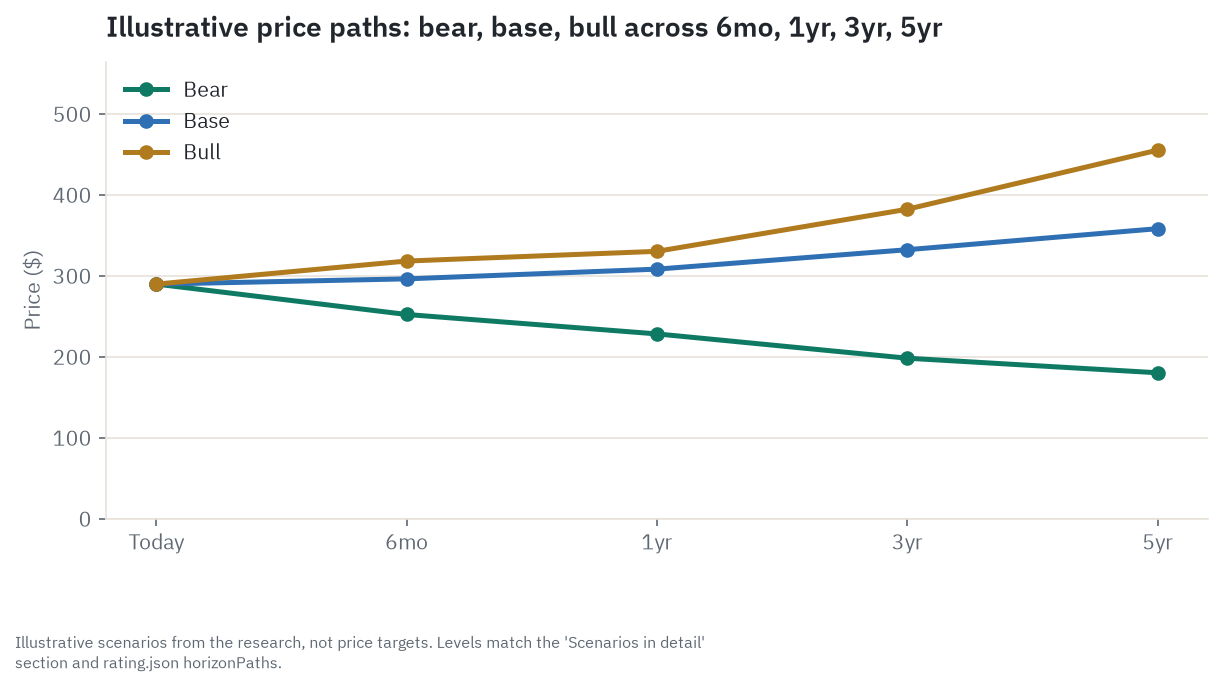
IBM’s stock (the quote above is live) trades at roughly 23.7 times trailing earnings, a multiple that now sits in the same band as Microsoft and Oracle rather than the discount the market once demanded from a company written off as a legacy mainframe-and-outsourcing vendor. That re-rating is not an accident: Software, the segment built around Red Hat’s hybrid cloud and the watsonx AI platform, grew revenue 10.6 percent in 2025 at an 83.5 percent gross margin, a combination that looks far more like a modern cloud business than the IBM of a decade ago. Layered on top of that genuine shift is a second, more temporary tailwind: the new IBM z17 mainframe, launched in June 2025, which pushed Infrastructure segment revenue up 12.1 percent for the year and an even faster 15.2 percent in the first quarter of 2026. Mainframe cycles like this one have a history of fading two to four years after launch, so a meaningful share of IBM’s current growth rate is a cycle running its course, not a permanent step change. The question this whole piece works through is how much of the “IBM is back” story is Software’s durable reinvention, and how much is a mainframe upgrade wave and a soft dollar doing the heavy lifting.
Six months. The next one or two quarterly earnings reports, tested against the guidance management reaffirmed on the first-quarter 2026 call, more than 5 percent constant-currency revenue growth and roughly a billion dollars of additional free cash flow for the full year, dominate this window. The base case sits around $296, close to today’s level, since a guidance-consistent quarter mostly confirms the story rather than re-rating it. The bull case is about $318, close to retesting the stock’s 52-week high near $332, if Software growth holds in the low double digits and the z17 order book stays hot. The bear case is about $252, a pullback toward support, if a single quarter shows Software decelerating or if a broader rate scare hits growth-priced technology names generally. The single thing most likely to flip this window is whether Software’s growth rate holds above 10 percent for another quarter or slips toward high single digits.
One year. The dominant twelve-month variable is whether the full-year 2026 guidance is actually delivered, not just repeated on an earnings call. Base case is about $308, modest earnings growth with the multiple roughly steady near today’s level. Bull case is about $330, guidance beaten rather than merely met, with the market rewarding that beat with a small further re-rating toward the multiple Oracle and Microsoft command. Bear case is about $228, a guidance miss serious enough that the market starts questioning whether the Software reacceleration is durable, pulling the multiple back toward where IBM traded before the Red Hat and watsonx story took hold. The flip signal to watch is the actual full-year 2026 revenue and free-cash-flow print against that specific guided range.
Three years. This window is long enough that the current z17 mainframe cycle should be maturing, the way every prior IBM Z cycle has within two to four years of launch. Base case is about $332, assuming Software growth moderates from its current pace to a still-solid high-single-digit rate as the mainframe tailwind fades and the Consulting segment stays roughly flat. Bull case is about $382, if watsonx and Automation (the HashiCorp-anchored piece of Software) keep compounding at a double-digit pace even without the mainframe boost. Bear case is about $198, if the mainframe cycle rolls over on schedule at the same time Consulting continues to lag under the same AI-driven fee-compression pressure showing up at Accenture. The variable that decides which path plays out is whether Consulting, nearly a third of revenue, stabilizes or keeps dragging on the blended growth rate.
Five years. At this horizon, the structural question is whether IBM has durably repositioned as a software-led hybrid cloud and enterprise AI platform company, or whether the current re-rating turns out to have been a temporary reward for a mainframe cycle and a weak dollar. Base case is about $358, moderating but still-real Software-led growth without either extreme playing out. Bull case is about $455, if Software sustains double-digit growth for years running and the market keeps paying a cloud-peer multiple for it. Bear case is about $180, if blended growth reverts toward the low-single-digit rates that defined much of IBM’s 2010s and the multiple de-rates back toward its own pre-reboot history. The variable to track over this stretch is whether Software’s growth rate proves structural, or was itself partly a one-time step-up from folding in the HashiCorp and Confluent acquisitions that fades once those deals lap their first anniversaries.
Where the read lands today. On balance the read holds at Hold. IBM has genuinely rebuilt its growth and margin profile around Red Hat and watsonx, and the cash flow and dividend track record back that up. But the stock now trades at a multiple that already prices in a fair share of that turnaround, sitting alongside much larger, faster-diversifying cloud names, while nearly a third of revenue still sits in a Consulting business facing the same AI-driven margin pressure as its closest peer. The single thing most likely to flip the read either way is whether Software’s double-digit growth holds up once the current mainframe cycle and the recent acquisitions stop doing part of the work.
Companion tool
Jump to the interactive dashboard to sort and filter every company in this piece, or download the Excel model to flex the scenarios yourself.
TL;DR
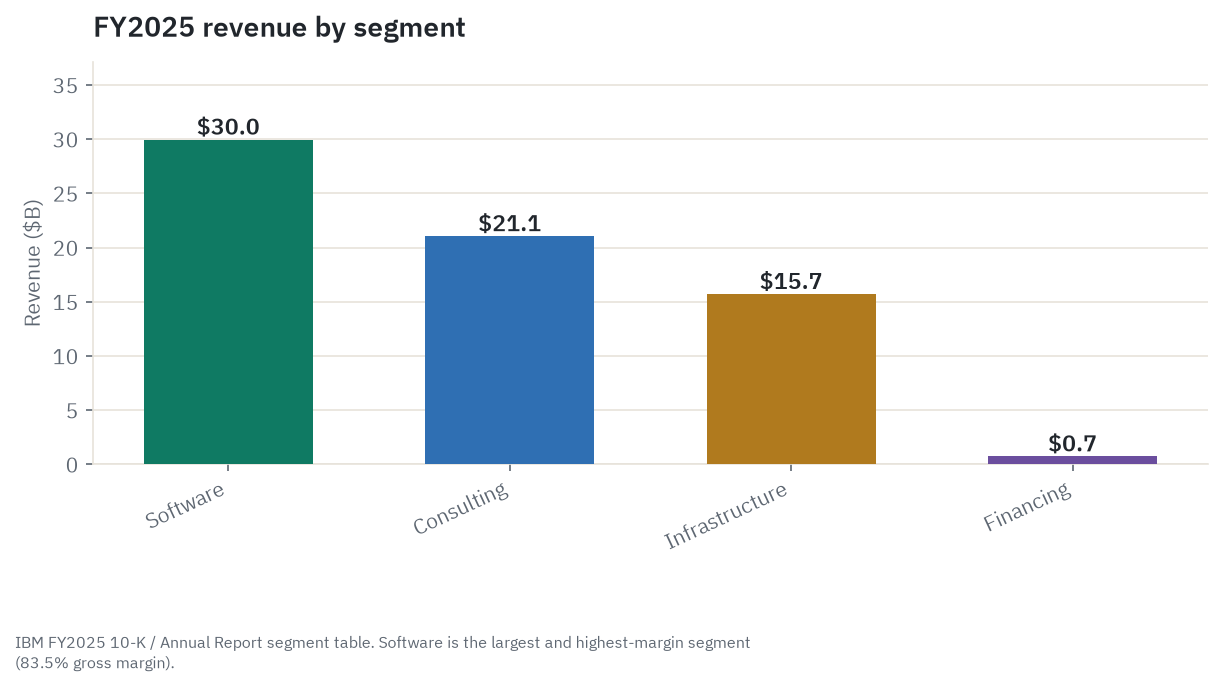
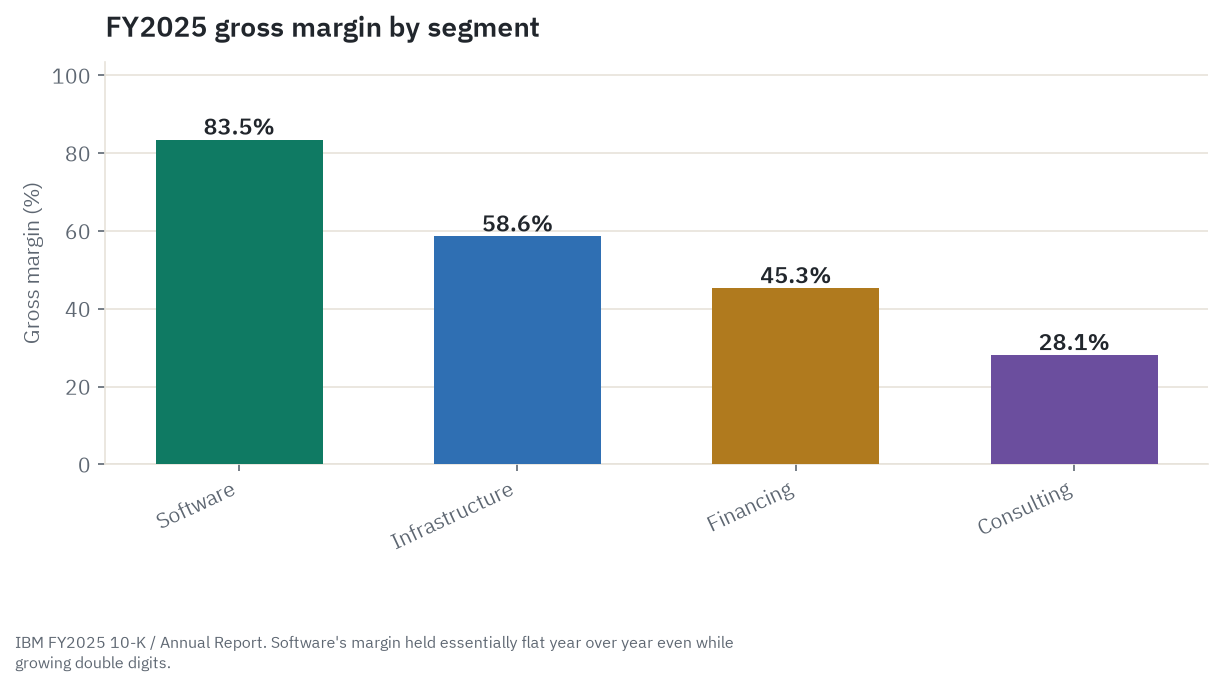
IBM sells four things: high-margin enterprise software built around Red Hat’s hybrid cloud and the watsonx AI platform (Software, 44 percent of 2025 revenue, 83.5 percent gross margin, growing 10.6 percent), labor-intensive strategy and implementation work (Consulting, 31 percent, 28.1 percent gross margin, growing just 1.8 percent), mainframe and server hardware (Infrastructure, 23 percent, 58.6 percent gross margin, growing 12.1 percent on the new z17 cycle), and a small equipment-financing book. That mix produced $67.5 billion of 2025 revenue, up 7.6 percent, the fastest growth in years, and $14.7 billion of free cash flow, funding a dividend that has grown for decades and two straight years of debt-funded bolt-on acquisitions, HashiCorp in 2025 and Confluent in 2026. The market has rewarded the shift by pushing IBM’s trailing earnings multiple to about 23.7 times, roughly matching Microsoft and Oracle rather than the discount IBM used to trade at as a slow-growth legacy name, and a 26-analyst “Strong Buy” consensus carries only about 6 percent average implied upside from here, a sign much of the good news is already in the price. The catch is that a meaningful share of the current growth rate rides two things that will not last forever: a mainframe upgrade cycle that historically fades within a few years of launch, and a currency tailwind that added one and a half to three points to recent reported growth. Strip those out and Consulting, nearly a third of the company, is barely growing at all, facing the same AI-driven fee-compression pressure visible in Accenture’s steeply discounted multiple. The honest read is Hold, Overvalued: a genuinely improved business, priced as if the improvement is fully durable rather than partly cyclical.
Explore it yourself: the interactive dashboard
Open the dashboard in a full screen
The dashboard holds IBM and the peer set covered in this piece, sortable by market cap and by trailing valuation multiple, and carries the full rating, the factor read behind it, and the bull, base, and bear horizon table.
Prefer a spreadsheet? Download the Excel model with the segment build, the peer valuation table, and the scenario math behind the horizon chart. The scenario levels in that file are illustrative arithmetic, not targets.
From mainframe decline to hybrid-cloud reboot
For most of the 2010s, the dominant story about IBM was managed decline: a company losing share to cloud-native competitors, propped up by a shrinking mainframe base and a dividend. The 2019 acquisition of Red Hat for roughly $34 billion, IBM’s largest deal ever, was the pivot point, betting that enterprises which would not or could not move everything to a public hyperscaler cloud would pay for software that let them run consistent, portable workloads across their own data centers, private clouds, and public clouds at once. Think of it the way a universal power adapter works for a traveler: the value is not any single wall socket, it is the ability to plug the same device into whichever socket you find yourself facing. Red Hat’s OpenShift and Linux platform is that adapter for enterprise workloads, and watsonx, IBM’s AI platform, extends the same idea to AI models and agents, letting a bank or an insurer govern where and how an AI model runs rather than depending entirely on a single hyperscaler’s AI stack. That positioning matters most to exactly the customers IBM has always served best: banks, insurers, governments, and other regulated institutions that care as much about data sovereignty and governance as about raw AI capability.
How the money flows
flowchart TD
    CUST["Enterprise & government customers (175+ countries)"]

    CUST --> INFRA["Infrastructure: $15.72B FY25 (IBM Z, Power)"]
    CUST --> SW["Software: $29.96B FY25 (Red Hat, watsonx, Automation, Data)"]
    CUST --> CONS["Consulting: $21.06B FY25 (Strategy/Tech, Intelligent Ops)"]
    CUST --> FIN["Financing: $0.74B FY25"]

    INFRA --> Z17["z17 mainframe cycle (launched Jun 2025)"]
    Z17 --> INFRAMARGIN["Infrastructure gross margin: 58.6%"]

    SW --> REDHAT["Hybrid Cloud (Red Hat): OpenShift, RHEL, Ansible"]
    SW --> WATSONX["Data: watsonx AI platform"]
    SW --> AUTO["Automation: HashiCorp, Apptio"]
    SW --> TXN["Transaction Processing: IBM Z software"]
    REDHAT --> SWMARGIN["Software gross margin: 83.5%"]
    WATSONX --> SWMARGIN
    AUTO --> SWMARGIN
    TXN --> SWMARGIN

    CONS --> STRATTEC["Strategy & Technology"]
    CONS --> INTOPS["Intelligent Operations"]
    STRATTEC --> CONSMARGIN["Consulting gross margin: 28.1%"]
    INTOPS --> CONSMARGIN

    INFRAMARGIN --> GROSS["Total gross profit: $39.30B (58.2% margin)"]
    SWMARGIN --> GROSS
    CONSMARGIN --> GROSS
    FIN --> GROSS

    GROSS --> RND["R&D: $8.32B"]
    GROSS --> OPCF["Operating cash flow: $13.19B"]
    OPCF --> FCF["Free cash flow: $14.7B"]

    FCF --> DIV["Dividends: $6.26B"]
    FCF --> MNA["Bolt-on M&A: HashiCorp (2025), Confluent (2026)"]
    FCF --> DEBT["Debt service: $61.3B total debt"]
Money enters IBM from enterprise and government customers spread across more than 175 countries, and it splits four ways depending on what the customer is actually buying. Hardware spend flows into Infrastructure, where IBM’s own manufacturing partner (a shift made in the second quarter of 2025 to an external strategic partner) builds the mainframes and Power servers, and where a single big buying wave around a new z-series launch, like the June 2025 z17, drives a temporary surge that fades as customers finish their upgrade cycle. Software spend is the toll booth in this chain: once a customer has built production workloads on Red Hat OpenShift, or wired watsonx governance into an AI pipeline, switching away is expensive enough that IBM keeps collecting at an 83.5 percent gross margin whether or not that customer ever buys another mainframe. Consulting spend is different again, it pays for IBM’s own people to design and implement the Red Hat, watsonx, and mainframe deployments the other two segments sell, which is why its economics look like a staffing business rather than a software business, revenue scales with billable headcount, not with a product’s near-zero marginal cost. All four streams combine into $39.3 billion of gross profit, which funds $8.3 billion of research and development to keep the Red Hat and watsonx pipeline moving, and generates $14.7 billion of free cash flow that in turn funds a multi-decade dividend-growth streak and a run of bolt-on acquisitions, HashiCorp for infrastructure automation in 2025, Confluent for data streaming in 2026, layered onto a debt load that grew to $61.3 billion in the process. The shape of this chain is the whole investing question: Software is the highest-margin, most durable layer, Infrastructure is the highest-margin cyclical layer, and Consulting is the largest-by-headcount, lowest-margin layer, and the blended growth rate the market sees every quarter is just the weighted average of those three very different businesses.
The four businesses in plain terms
Software (44 percent of 2025 revenue, $29.96 billion, 83.5 percent gross margin, up 10.6 percent). This is IBM’s highest-margin and fastest-growing segment, and it is built from four pieces. Hybrid Cloud is essentially Red Hat: Red Hat Enterprise Linux (RHEL), the OpenShift container platform, and Ansible automation, the tools that let a company run the same software stack whether it sits in its own data center or in a public cloud. Automation includes HashiCorp’s Terraform (infrastructure-as-code tooling acquired in the 2025 deal) and Apptio, which helps companies track and control cloud spending. Data is where watsonx lives, IBM’s platform for building, deploying, and governing AI models and AI agents, plus the databases and data-integration tools that feed them; IBM added Confluent’s data-streaming technology to this group in the first quarter of 2026. Transaction Processing is the software counterpart to the mainframe hardware below it, the layer that actually runs a bank’s core transaction systems on IBM Z.
Consulting (31 percent, $21.06 billion, 28.1 percent gross margin, up 1.8 percent). This is IBM’s people business: Strategy and Technology consultants who design and build client solutions (often implementations of IBM’s own Red Hat and watsonx products, and increasingly using an internal AI delivery platform called IBM Consulting Advantage), plus Intelligent Operations, a managed-services line that runs client processes on an ongoing basis rather than project by project. Growth here has been essentially flat, and margin actually improved slightly even as revenue barely grew, a sign of cost discipline and mix shift toward the managed Intelligent Operations line rather than of pricing power.
Infrastructure (23 percent, $15.72 billion, 58.6 percent gross margin, up 12.1 percent). IBM Z mainframes and Power servers, the hardware layer, running mission-critical transaction processing for banks, insurers, airlines, and governments that will not put those workloads on public cloud. The June 2025 launch of the IBM z17, with added AI-inference acceleration, and the July 2025 launch of Power11 both drove this segment’s acceleration; mainframe launch cycles like this one have historically produced a multi-quarter surge followed by a multi-year fade as the initial replacement wave completes.
Financing (1 percent, $0.74 billion, 45.3 percent gross margin, up 3.3 percent). A small book of lease and loan financing that lets customers spread out the cost of IBM hardware and software rather than paying up front, earning a financing spread in the process.
Who wins where
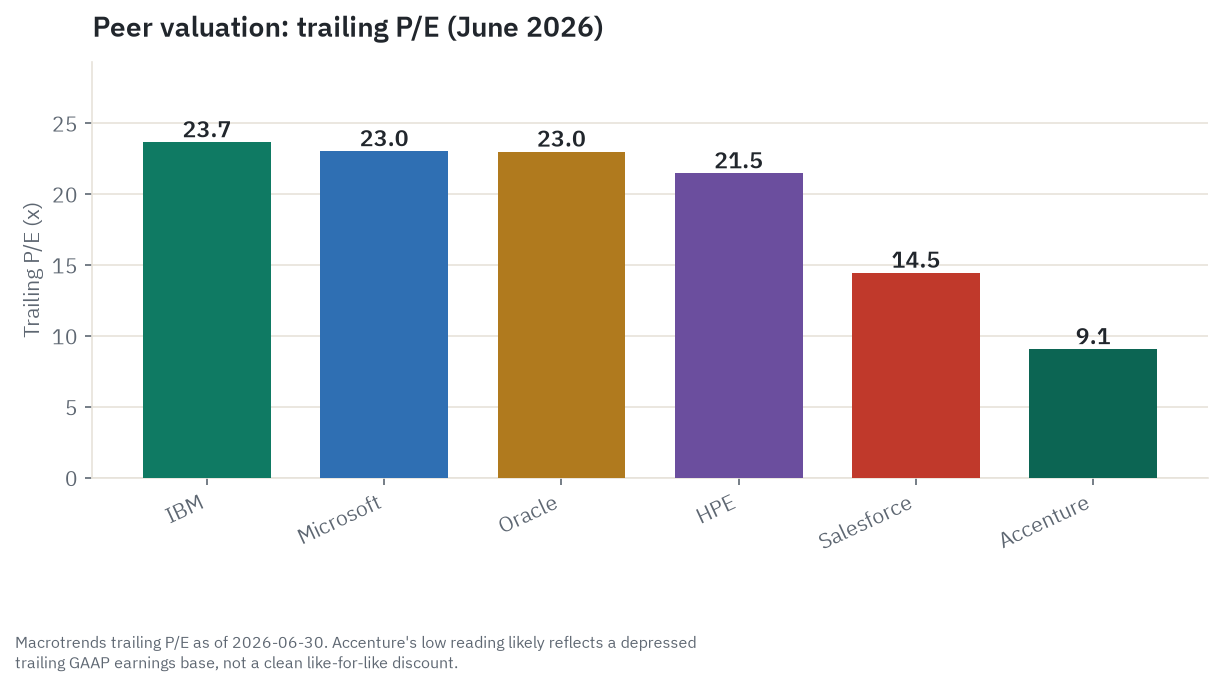
IBM’s genuine competitive advantage is owning technology across the entire hybrid-cloud stack that a large regulated enterprise needs at once: the mainframe transaction-processing hardware, the Red Hat middleware that lets workloads move between on-premises and cloud, the watsonx AI-governance layer sitting on top, and the Consulting labor to implement all of it. Most competitors own one or two of those layers, not all four. Microsoft (Azure, Copilot) and Oracle (OCI, Fusion applications) compete hardest for enterprise cloud and AI budget and have far larger cloud infrastructure businesses, but neither has IBM’s mainframe transaction-processing installed base, the specific reason many of IBM’s most regulated customers stay in the fold. Both trade at a trailing multiple close to IBM’s own (Microsoft around 23.0 times, Oracle around 23.0 times, versus IBM’s 23.7 times), despite being vastly larger, roughly 10.5 times and 1.6 times IBM’s market capitalization respectively, which says the market currently prices IBM’s quality and growth profile in the same neighborhood as these two much bigger cloud players. A third hyperscaler, Amazon’s AWS, is not a direct peer covered in depth in this piece, but it is the pure-public-cloud alternative IBM’s hybrid pitch is implicitly measured against: a customer choosing full migration to AWS instead of a hybrid Red Hat deployment is the clearest form of the substitution risk this piece keeps coming back to. Accenture is the direct comparable for IBM Consulting, competing for the same systems-integration and AI-advisory work, and it trades at a far cheaper roughly 9.1 times trailing earnings, a discount that most likely reflects the same worry hanging over IBM’s own Consulting segment: that AI-assisted delivery tools compress the billable-hours economics the whole industry runs on. Salesforce competes for enterprise AI-agent budget specifically, its Agentforce product against IBM’s watsonx Orchestrate, at a mid-teens multiple reflecting decelerating core subscription growth across the sector. Hewlett Packard Enterprise is the closest pure hardware comparable to IBM’s Infrastructure segment, at roughly a quarter of IBM’s market cap and a similar low-20s multiple, but without IBM’s mainframe franchise or software annuity to lean on.
Company by company: who’s who
International Business Machines (IBM, NYSE). Market capitalization approximately $264.3 billion as of June 30, 2026 (approximately $272.1 billion computed from the 939.9 million shares outstanding disclosed on the Q1 2026 10-Q against the July 2, 2026 closing price). Enterprise hybrid-cloud and AI platform company across Software, Consulting, Infrastructure, and Financing. Bull: Red Hat and watsonx are converting hybrid cloud and AI demand into durable, high-margin software revenue, the z17 mainframe cycle is running hot, and free cash flow keeps funding the dividend and bolt-on M&A. Bear: blended growth is still mid-single digit once the mainframe cycle and software step-up are averaged with a slow Consulting book, and the stock already prices in a lot of the AI optimism at around 24 times trailing earnings.
Oracle Corp. (ORCL, NYSE). Market capitalization approximately $422.1 billion as of June 30, 2026, trailing P/E approximately 23.0 times. Database, enterprise applications, and rapidly scaling cloud infrastructure (OCI). Bull: OCI’s AI-infrastructure backlog gives Oracle a rare hyperscaler-like growth path bolted onto a cash-generative applications and database base. Bear: the AI-capacity buildout requires heavy, debt-funded capex, a far more capital-intensive model than IBM’s asset-lighter software mix.
Microsoft Corp. (MSFT, NASDAQ). Market capitalization approximately $2,771.0 billion as of June 30, 2026, trailing P/E approximately 23.0 times. Azure cloud, Microsoft 365, GitHub, and Copilot AI products. Bull: Azure and Copilot give Microsoft first claim on enterprise AI budgets at a scale no single competitor, IBM included, can match. Bear: the sheer AI-infrastructure capex load raises the bar for return on invested capital and makes the stock sensitive to any AI-monetization slowdown.
Accenture plc (ACN, NYSE). Market capitalization approximately $83.1 billion as of June 30, 2026, trailing P/E approximately 9.1 times (a figure that most likely reflects a depressed trailing GAAP earnings base rather than a clean valuation discount, a caveat worth reading carefully rather than taking at face value). The world’s largest pure-play technology and management consultancy, the direct comparable to IBM Consulting. Bull: scale and delivery capacity give Accenture first call on enterprise AI-transformation advisory budgets. Bear: consulting is the most commoditized, lowest-margin part of the enterprise technology chain, the same segment IBM itself is trying to diversify away from.
Salesforce, Inc. (CRM, NYSE). Market capitalization approximately $128.3 billion as of June 30, 2026, trailing P/E approximately 14.5 times. The largest CRM software vendor, competing with IBM’s Software segment on enterprise AI agents (Agentforce versus watsonx Orchestrate). Bull: Agentforce and Data Cloud give Salesforce a credible AI-agent upsell path across its large installed CRM base. Bear: core subscription growth has slowed into the high single digits, and it faces the same AI-agent competitive intensity IBM and Microsoft do.
Hewlett Packard Enterprise Co. (HPE, NYSE). Market capitalization approximately $59.7 billion as of June 30, 2026, trailing P/E approximately 21.5 times. Enterprise servers, storage, and networking, post-Juniper acquisition. Bull: the Juniper networking deal and AI-server demand give HPE a second growth leg beyond commodity servers. Bear: HPE lacks IBM’s high-margin mainframe franchise and software annuity, leaving earnings more exposed to hardware-cycle and component-cost swings.
What the filings say
IBM’s 2025 revenue reached $67.535 billion, up 7.6 percent reported (6.1 percent at constant currency) from $62.753 billion in 2024 and $61.860 billion in 2023, the fastest reported growth of the three years. Net income was $10.593 billion in 2025 versus just $6.023 billion in 2024 and $7.502 billion in 2023, a swing that looks alarming until you find the cause: 2024’s dip was not an operating problem, it was a one-time $3.1 billion pretax ($2.4 billion after tax) charge from transferring US and non-US pension obligations to insurers, a non-cash, non-operating item that alone cut 2024 diluted earnings per share by about $2.56. Strip that distortion out and the underlying trend is straightforwardly improving: diluted earnings per share was $11.17 in 2025 (up 73.7 percent from the depressed 2024 base), and on IBM’s own operating, non-GAAP basis, 2025 operating earnings per share was $11.59.
The segment detail explains where that growth came from. Software revenue of $29.962 billion grew 10.6 percent reported at an 83.5 percent gross margin that barely moved from 83.7 percent the year before, a sign IBM is not discounting to win share. Infrastructure revenue of $15.718 billion grew 12.1 percent, explicitly attributed by the company to strength in the new IBM z17, at a 58.6 percent gross margin, up nearly 3 points as the mix shifted toward higher-value new systems. Consulting revenue of $21.055 billion grew just 1.8 percent at a 28.1 percent gross margin. Total gross margin expanded 1.5 points to 58.2 percent (59.5 percent operating, non-GAAP), driven by portfolio mix shift toward Software and productivity actions rather than any single cost-cutting program. That pattern continued into the first quarter of 2026: total revenue of $15.917 billion, up 9 percent reported (6 percent constant currency), with Software up 11.3 percent, Consulting up 4.0 percent, and Infrastructure up 15.2 percent, still riding the z17 launch cycle.
Cash generation has kept pace with earnings. Operating cash flow was $13.193 billion in 2025 (versus $13.445 billion in 2024), and free cash flow, IBM’s own non-GAAP measure, rose to $14.7 billion, up $2.0 billion, even as capital expenditure stayed modest at $1.091 billion, consistent with an asset-light software and services mix rather than the heavy AI-data-center capex programs running at Oracle and the hyperscalers. Research and development spending rose to $8.316 billion in 2025 from $7.479 billion in 2024 and $6.775 billion in 2023, funding continued Red Hat, watsonx, and z-series development.
The balance sheet tells the other half of the story. Total assets grew $14.7 billion to $151.880 billion at the end of 2025, primarily on higher goodwill and intangible assets from the HashiCorp acquisition, which closed in the first quarter of 2025. Goodwill alone rose to $67.717 billion from $60.706 billion the year before. Total debt reached $61.3 billion at year-end 2025, up $6.3 billion in a single year, while total stockholders’ equity was just $32.648 billion, up $5.3 billion on net income and stock issuance, partially offset by dividends. IBM followed the HashiCorp deal with an acquisition of Confluent, a data-streaming software company, in the first quarter of 2026, funded out of the same free cash flow and debt capacity.
Capital returns remain a defining feature of the IBM story: dividends paid rose from $6.040 billion in 2023 to $6.147 billion in 2024 to $6.255 billion in 2025, a multi-decade track record of increases that has made IBM a byword for dividend reliability, with a trailing yield around 2.4 percent as of July 1, 2026, higher than the typical mega-cap software peer. On guidance, chief executive Arvind Krishna reaffirmed on the first-quarter 2026 earnings call that IBM continues to expect “more than 5 percent constant currency revenue growth and an increase of about $1 billion in year-over-year free cash flow in 2026,” implying free cash flow trending toward roughly $15.7 billion for the year if delivered. That is management’s own forward guidance, not an independently verified fact about the future.
On disclosed risks, the filings flag currency exposure (a large, only partly hedged share of revenue is earned outside the US), a shift of Distributed Infrastructure manufacturing to an external strategic partner beginning in the second quarter of 2025, and ongoing legally mandated pension contributions expected near $1.4 billion across all plans in 2026. Nothing in the filings reviewed for this piece disclosed a pending fraud, insolvency, or adverse litigation matter material to the investment case.
What the market is paying
IBM closed at $289.52 on July 2, 2026, inside a 52-week range of $212.34 to $332.46, meaning the stock sits roughly 13 percent below its 52-week high and about 36 percent above its 52-week low, a wide range that reflects both the AI-narrative re-rating IBM has ridden over the past year and the give-back periods when that narrative has cooled. Trailing earnings multiple was 23.67 times as of June 30, 2026, essentially matching Microsoft’s roughly 23.0 times and Oracle’s roughly 23.0 times, sitting modestly above Hewlett Packard Enterprise’s roughly 21.5 times, and at a large premium to Salesforce’s roughly 14.5 times and Accenture’s roughly 9.1 times (a figure this piece treats cautiously, since it most likely reflects a depressed trailing GAAP earnings base at Accenture rather than a clean like-for-like discount). On a trailing twelve months basis through March 31, 2026, IBM’s revenue was $68.91 billion and net income $10.75 billion, a 15.61 percent net margin, consistent with the annual figures in the filings.
Twenty-six analysts carry a consensus “Strong Buy” rating on IBM, with an average twelve-month price target of $306.76 (ranging from $231.00 to $375.00), roughly 6 percent above the reference price used on that page. A “Strong Buy” consensus paired with only modest average implied upside is a familiar pattern for a stock that has already re-rated: sell-side sentiment stays positive, but the price has moved far enough that the average target no longer implies a large gap. This is a labeled research signal about what covering analysts currently think, not a prediction.
At roughly 23 to 24 times trailing earnings with management’s own guidance of “more than 5 percent” constant-currency growth, IBM’s multiple looks like the market giving real credit for the profitability and growth-rate improvement in Software, rather than pricing IBM the way it often was priced in the years before the Red Hat integration matured, as a legacy, low-growth hardware-and-services company. Whether that credit is fully earned, given the mainframe-cycle and currency contributions layered on top of the durable Software story, is exactly the tension worked through in the scenarios below.
What the crowd is saying
The financial-media narrative around IBM has shifted meaningfully over the past several years, from “legacy tech company in slow, managed decline” to “underappreciated AI and hybrid-cloud play.” Both stories describe the same underlying business; the shift is in emphasis rather than in a new data point. The current sell-side consensus, a “Strong Buy” rating from 26 analysts with only about 6 percent average implied upside, reads as broadly constructive but not euphoric, consistent with a stock that has already captured a meaningful re-rating rather than one still waiting to be discovered.
The most important narrative-versus-fundamentals gap this research turned up: popular coverage often talks about “IBM’s AI business” as if it were a single, precisely quantified line item, but the 2025 annual report and first-quarter 2026 filing do not disclose a standalone watsonx revenue figure or a “generative AI book of business” metric the way some AI-forward vendors do. Software’s growth is real and verified, driven collectively by Red Hat, Automation, Data, and Transaction Processing, but any specific dollar figure attached to “IBM’s AI revenue” that a reader encounters in the press should be treated as a company-sourced marketing metric unless it is traceable to the audited segment disclosures.
The z17 launch has produced a wave of commentary reframing the mainframe not as a legacy holdover, but as an AI-inference and high-security transaction engine for regulated industries wary of moving core workloads to public cloud, a genuine change in tone from a decade ago. The risk in taking that framing at face value is that mainframe revenue is inherently cyclical around new model launches, so a strong post-launch quarter or two should not be mistaken for a permanent change in the segment’s underlying growth rate. Separately, the same “AI could compress consulting labor economics” worry attached to Accenture applies to IBM Consulting too, since both companies sell essentially the same billable-hours-based work into the same client base.
Durability: what has to stay true
The structural case for IBM rests on Software’s mix shift continuing: as long as Red Hat, watsonx, Automation, and Data keep growing faster than Consulting and Infrastructure, the consolidated gross margin keeps expanding almost mechanically, and the durable part of the growth story, the part not dependent on a mainframe cycle or currency, gets a little more evidence behind it every quarter. The cyclical case, and the real trigger to watch, is the IBM z17 replacement wave completing on the same two-to-four-year timeline every prior mainframe cycle has followed, most plausibly sometime between 2027 and 2029, which would remove roughly a third of the current segment growth story overnight and force the blended growth rate to lean entirely on Software and a stabilized (or still-shrinking) Consulting book. The most likely outcome, on the evidence gathered here, is a split one: Software very likely keeps growing at a solid, if probably moderating, pace, while Infrastructure fades back toward its historical norm on the timeline mainframe cycles usually follow, and Consulting is the genuine swing factor, since nearly a third of revenue sits in a segment that has been flat for two years running and faces the same fee-compression risk as its closest peer.
The scenarios in detail
The driver tree
Four variables decide where IBM lands over the next five years: (1) whether Software’s mix shift and its double-digit growth rate prove structural or partly a temporary step-up from the HashiCorp and Confluent deals; (2) whether the IBM z17 mainframe cycle proves a multi-year plateau or the usual post-launch spike-then-fade; (3) whether Consulting stabilizes, reaccelerates on AI-delivery tooling, or keeps shrinking under the same fee-compression pressure hitting Accenture; and (4) whether the rising $61.3 billion debt load, built from two acquisitions in two years, stays a manageable, free-cash-flow-funded growth engine or becomes a constraint if free cash flow disappoints relative to the guided roughly $1 billion 2026 increase.
Bull
Software sustains double-digit growth as watsonx and Red Hat OpenShift become the default enterprise hybrid-cloud and AI-governance layer for regulated industries; HashiCorp and Confluent integrate cleanly and add to, rather than distract from, organic growth; the z17 cycle extends longer than prior cycles as AI-inference workloads give customers a new reason to stay on IBM Z; Consulting stabilizes rather than shrinking. Under these assumptions, blended revenue growth holds near or above the guided “more than 5 percent” floor for multiple years running, gross margin keeps expanding on mix shift, and operating earnings per share compounds near 12 percent a year, an illustrative five-year value of roughly $455 (operating earnings per share near $20.43 at a sustained roughly 22 times multiple, estimate, not a target). What has to be true: enterprise customers keep choosing governed, hybrid AI deployment over pure-hyperscaler alternatives. What breaks it: a hyperscaler closing the governance and hybrid gap well enough that enterprises no longer need IBM’s middle layer.
Base
Software growth moderates from the current 10 to 11 percent pace toward a still-solid high-single-digit rate as the HashiCorp and Confluent step-up laps; the z17 cycle fades toward flat-to-modest Infrastructure growth over the next two to three years, consistent with prior mainframe cycles; Consulting stays roughly flat. Blended revenue growth settles near the guided “more than 5 percent” floor rather than accelerating further, and operating earnings per share compounds near 8 percent a year, an illustrative five-year value of roughly $358 (operating earnings per share near $17.03 at a roughly 21 times multiple, estimate). What has to be true: no segment materially deteriorates even as the mainframe-cycle tailwind fades. What breaks it: either a faster-than-expected mainframe-cycle rollover, or a genuine Software acceleration that pushes the outcome toward the bull case instead.
Bear (anchored on the skeptic’s strongest case)
The z17 cycle rolls over within the next one to two years, the way every prior IBM Z cycle has; Consulting continues to lag as AI-assisted delivery tools compress the billable-hours model industry-wide, the same pressure visible in Accenture’s discounted multiple; Software growth decelerates toward mid-single digits as HashiCorp and Confluent integration proves harder than guided and hyperscaler AI tools erode watsonx’s governance-layer differentiation. Blended revenue growth falls back toward low-single digits, margin expansion stalls, and the elevated debt load becomes a real constraint on further M&A or buybacks, an illustrative five-year value of roughly $180 (operating earnings per share compounding near 2 percent a year to about $12.80, at a de-rated roughly 14 times multiple, estimate). What has to be true: the AI and hybrid-cloud narrative that re-rated IBM’s multiple over the past several years proves to have run ahead of the underlying growth reality. What would falsify this case: Software sustaining double-digit growth for several more years running.
Catalysts and the timeline
Near term, watch each quarterly earnings print against the reaffirmed 2026 guidance of more than 5 percent constant-currency growth and roughly a billion dollars of additional free cash flow, along with any commentary on HashiCorp and Confluent integration progress and continued z17 order and deployment trends. Further out, the point at which the z17 replacement wave completes and Infrastructure growth normalizes, plausibly 2027 through 2029 based on prior cycle lengths, is the multi-year inflection to watch, alongside whether a next-generation z-series or Power launch resets the cycle again, and whether Consulting stabilizes, reaccelerates, or keeps lagging.
Leading indicators to watch
Software segment revenue growth (currently 10 to 11 percent) is the single most important number, since deceleration toward mid-single digits would be the clearest sign the bull case is fading. Consulting segment revenue growth and gross margin matter almost as much, since a return to shrinkage or margin compression would confirm the fee-compression bear case is playing out. Infrastructure segment growth against the pattern of prior mainframe cycles’ fade, free cash flow against the guided roughly $1 billion 2026 increase and total debt against that free cash flow, and the gap between IBM’s trailing multiple and its own longer-run historical average round out the list.
Companies to watch (bull / base / bear)
IBM (IBM). Role: the primary name, a re-rating hybrid-cloud and AI turnaround story built on top of a legacy mainframe and services base. Bull: Software sustains double-digit growth and the z17 cycle extends. Base: growth moderates toward high single digits as the mainframe tailwind fades and Consulting stays flat. Bear: the mainframe cycle rolls over on schedule while Consulting keeps lagging, and the multiple de-rates back toward IBM’s pre-reboot history. Watch: Software segment growth rate, Consulting segment growth and margin, and total debt versus free cash flow.
Oracle (ORCL). Role: the cloud-infrastructure-scale comparable. Bull: OCI’s AI-capacity backlog keeps converting into revenue faster than the capex it requires. Base: steady database and applications growth with OCI scaling in line with guidance. Bear: AI-capacity capex outruns realized cloud revenue, pressuring returns on that investment. Watch: OCI revenue growth and capital expenditure trajectory.
Microsoft (MSFT). Role: the dominant scale comparable for enterprise cloud and AI budget. Bull: Azure and Copilot keep taking first claim on enterprise AI spend. Base: steady Azure growth with Copilot monetization building gradually. Bear: AI-infrastructure capex intensity outpaces monetization, pressuring margins. Watch: Azure growth rate and AI capex-to-revenue trends.
Accenture (ACN). Role: the direct consulting-segment comparable and read-through for IBM Consulting. Bull: scale and an early generative-AI advisory book let Accenture defend share as AI reshapes delivery. Base: revenue growth stays muted as clients delay large transformation programs. Bear: AI-assisted delivery genuinely compresses the billable-hours model across the industry, IBM Consulting included. Watch: Accenture bookings growth and headcount trends, a leading indicator for the same pressure on IBM Consulting.
Salesforce (CRM). Role: the enterprise AI-agent competitor to watsonx Orchestrate. Bull: Agentforce adoption accelerates across Salesforce’s large CRM installed base. Base: steady but decelerating core subscription growth. Bear: AI-agent competition from Microsoft, IBM, and others compresses Salesforce’s own pricing power. Watch: Agentforce-attributed revenue disclosure, if and when Salesforce breaks it out.
Hewlett Packard Enterprise (HPE). Role: the closest pure hardware comparable to IBM Infrastructure. Bull: Juniper networking integration and AI-server demand drive a second growth leg. Base: steady server and networking demand without major share shifts. Bear: commodity server pricing and component costs compress margin. Watch: AI-server order backlog and Juniper integration progress.
Risk controls
IBM’s Infrastructure segment is genuinely cyclical: a mainframe upgrade wave like the current z17 cycle produces a multi-quarter surge that has historically faded within two to four years, and treating the current growth rate as a new steady state would be a mistake based on the company’s own multi-decade pattern. Consulting, nearly a third of revenue, carries real concentration risk to a single macro theme, AI-driven pressure on billable-hours economics, that this research cannot yet confirm or rule out; a reader underwriting the Software growth story should watch Consulting’s trend as a genuine offsetting risk rather than a rounding error. The balance sheet has grown more leveraged in a short window, two acquisitions and $6.3 billion of new debt inside about a year, and while free cash flow currently covers the dividend and debt service comfortably, that cushion would shrink quickly if either free cash flow growth disappoints relative to guidance or integration costs from HashiCorp and Confluent run higher than expected. On valuation, a stock trading near cloud-peer multiples after a multi-year re-rating leaves less room for a disappointing quarter than a stock still priced at a discount, since expectations are already elevated. IBM’s NYSE listing is highly liquid, so access and execution are not meaningful constraints for most investors; the risks here are business-model and valuation risks, not liquidity risks. What would change this thesis: two or more consecutive quarters of Software growth decelerating below high single digits, or clear evidence the HashiCorp and Confluent integrations are dilutive rather than accretive, would be the clearest signal the bull case is fading; conversely, Consulting stabilizing or reaccelerating, or Software demonstrating durable double-digit growth for years beyond the current acquisition-driven step-up, would be the clearest evidence against the bear case.
Methodology, sourcing, and data-quality flags
This research drew on IBM’s fiscal-year 2025 Form 10-K (filed February 24, 2026, incorporating the 2025 Annual Report to Stockholders by reference), the first-quarter 2026 Form 10-Q (filed April 23, 2026), the first-quarter 2026 earnings release furnished as an 8-K exhibit (filed April 22, 2026), SEC XBRL company-facts data, and third-party market-data aggregators (Yahoo Finance, Macrotrends, MarketBeat) for live pricing, valuation multiples, and sell-side consensus. Every load-bearing figure in this piece traces to one of 55 recorded claims, all marked verified at the time of recording rather than recorded first and checked later: 36 are primary-tier (SEC filings and XBRL data) and 19 are analyst-tier (third-party market-data aggregators, stamped point-in-time). None was left unverified, so no claim needed to be cut, hedged, or gated in this run.
On valuation, IBM’s roughly 23.7 times trailing earnings multiple sits in the same band as much larger, faster-diversifying cloud peers Microsoft and Oracle, and a “Strong Buy” sell-side consensus carries only about 6 percent average implied upside, both consistent with a stock that has already captured a meaningful re-rating rather than one still cheap for its growth. On growth, 2025’s 7.6 percent revenue growth was the best in years and the first quarter of 2026 held at 9 percent, with full-year 2026 guidance reaffirmed at more than 5 percent constant-currency growth, but a real share of that acceleration rides Software’s double-digit run and a cyclical mainframe boost rather than a uniformly accelerating business, since Consulting, nearly a third of revenue, grew just 1.8 percent. On quality, gross margin expanded to 58.2 percent (59.5 percent operating) and free cash flow rose to $14.7 billion, a genuinely improving profitability and cash-generation profile, tempered by a debt load that grew $6.3 billion in a single year funding two acquisitions in two years. On risk, the concentration in a lumpy, cyclical mainframe upgrade wave, the fee-compression pressure facing Consulting, ongoing acquisition-integration risk, and disclosed currency and pension-funding exposure are all live, disclosed risks rather than theoretical ones. On momentum, the stock has climbed roughly 36 percent off its 52-week low over the past year even as it sits about 13 percent below its 52-week high, and the sell-side stance remains constructive, a positive but not euphoric signal consistent with a name that has already re-rated. Taken together, this five-factor read lands as a research signal in the Hold range: a genuinely improving business trading at a multiple that already reflects a fair amount of that improvement.
Two data-quality gaps are worth naming rather than papering over. First, neither the 2025 10-K and Annual Report nor the first-quarter 2026 10-Q discloses a standalone watsonx revenue figure or a “generative AI book of business” metric, so any specific dollar figure attached to “IBM’s AI business” that a reader sees elsewhere should be treated as a company-sourced marketing metric rather than an audited disclosure until traced to the segment data. Second, no verifiable, specific third-party total-addressable-market figure for enterprise hybrid cloud or enterprise AI spend was sourced with enough precision to cite as fact, so this piece describes the opportunity qualitatively rather than attaching an invented market-size number to it.
Data-quality flags:
- No standalone watsonx or generative-AI revenue figure is disclosed in the FY2025 10-K/Annual Report or Q1 2026 10-Q reviewed; treat any such figure seen elsewhere as a marketing metric, not an audited fact.
- Accenture’s roughly 9.1 times trailing P/E most likely reflects a depressed trailing GAAP earnings base rather than a clean valuation discount versus IBM; the two are not a perfect like-for-like comparison without normalizing both companies’ trailing earnings.
- Market cap is presented two ways in this piece: approximately $264.3 billion per Macrotrends as of June 30, 2026, and approximately $272.1 billion computed from the verified share count (939.9 million as of March 31, 2026) times the July 2, 2026 closing price; the difference is the few trading days between the two price dates, not a data conflict.
- No verifiable, sourced total-addressable-market figure for enterprise hybrid cloud or AI spend was found; this piece does not attach an invented market-size number to the opportunity.
- No specific social-media or search-attention sentiment metric is cited as fact anywhere in this piece; where such a figure might ordinarily appear, it has been omitted for lack of a verifiable source.
Key sources: IBM FY2025 Form 10-K and Annual Report to Stockholders (SEC EDGAR, filed 2/24/2026); IBM Q1 2026 Form 10-Q (SEC EDGAR, filed 4/23/2026); IBM Q1 2026 earnings release, Form 8-K Exhibit 99.1 (SEC EDGAR, filed 4/22/2026); SEC XBRL company-facts API; Macrotrends (market cap, P/E, dividend yield, TTM margin, peer valuation); Yahoo Finance (live price and 52-week range); MarketBeat (sell-side consensus rating and price targets).
Prepared July 2, 2026. Figures are point-in-time and will change. This is research and analysis for educational purposes, not investment advice, not a recommendation, and not a solicitation. IBM’s Infrastructure segment is cyclical around mainframe product launches and its Software segment competes in a fast-moving AI and cloud market, so sentiment and growth rates here can shift faster than the headline numbers suggest. Verify all figures independently and consult a licensed financial advisor before making any decision.