
Research date: July 1, 2026 | OSINT research on Kioxia Holdings Corporation (Tokyo: 285A; US OTC ADR: KXIAY), a NAND flash memory maker riding the sharpest pricing upswing in its history, the unsponsored ADR structure US investors actually trade, and the bull, base, and bear paths from here through 2031. Live prices, stamped hard.
Important disclaimer. This is OSINT (open-source intelligence) research published for educational and informational purposes only. It is not investment advice, not a recommendation to buy, sell, or hold any security, and not a solicitation. I am not a financial advisor. Kioxia is a single-product commodity-memory manufacturer whose operating margin has swung from a 24 percent loss to a 74 percent guided profit inside three fiscal years, so the figures here move faster and further than in a typical stock. KXIAY carries risks beyond the operating business: it is an unsponsored, Level-1 OTC ADR on the Pink Limited tier, thinly traded relative to the Tokyo listing, with no arbitrage mechanism keeping its price tight to the underlying shares, and it layers yen-to-dollar currency conversion risk on top of the NAND cycle itself. All figures are point-in-time as of the stated research date (July 1, 2026) and were captured in the middle of a sharp, sector-wide selloff; prices, market caps, and analyst estimates will be stale by the time you read this. Every bull, base, and bear figure below is illustrative scenario arithmetic on stated assumptions, not a price target and not sourced consensus. Do your own due diligence and consult a licensed financial advisor before making any decision.
Where this stock could be in 6 months, 1 year, 3 years, and 5 years
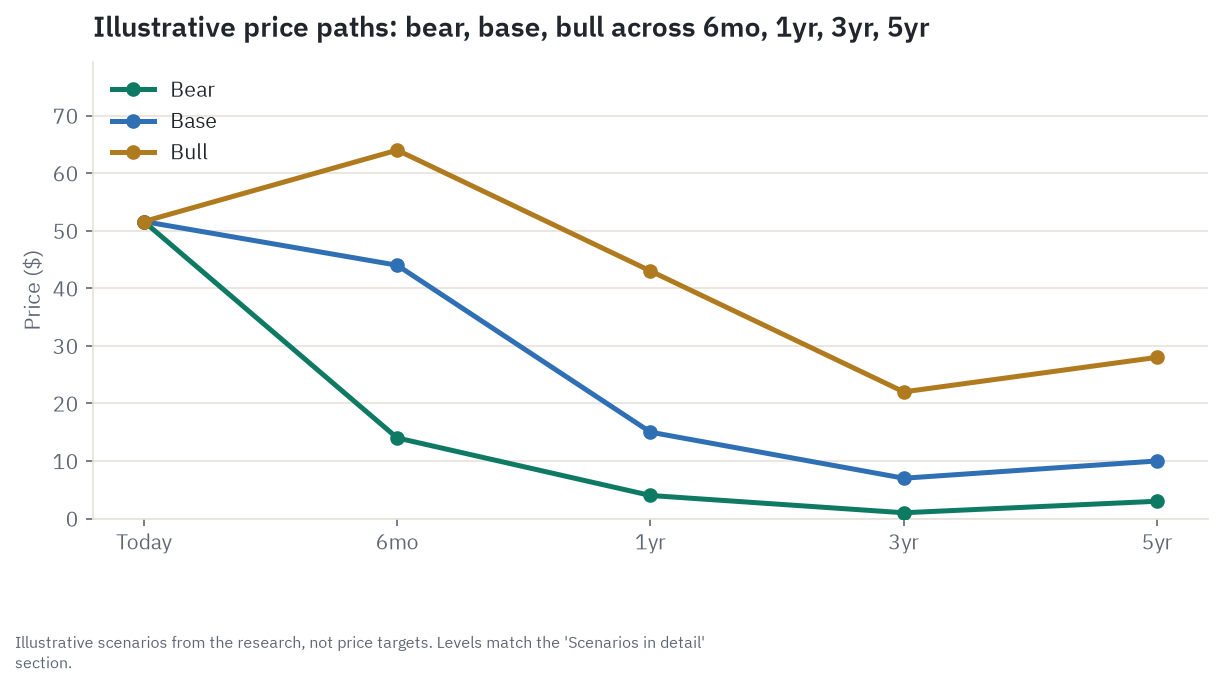
Kioxia’s stock (the quote above is live) is a NAND flash memory maker that went from a fiscal-year operating loss of 24 percent of revenue to a guided operating margin of 74 percent in three years, and the market has re-rated the shares roughly fiftyfold from their December 2024 Tokyo listing price to match. Every scenario below is built the same way: a forecast earnings-per-share number times a price-to-earnings multiple appropriate to where the NAND cycle sits at that horizon, converted from the primary Tokyo listing (285A) into the OTC ADR (KXIAY) at the observed 1-ADR-to-0.1-share ratio. None of it is a price target. What the arithmetic shows, mechanically, is that once you price a cyclical commodity-memory business on anything other than this quarter’s shortage earnings, almost every horizon beyond six months lands well below where the stock trades today.
Six months (by roughly January 2027). This window is dominated by one datable event: Kioxia’s Q1 fiscal-2027 earnings, expected around August 2026, against company guidance for revenue of 1.75 trillion yen and operating profit of 1.298 trillion yen, an implied 74 percent operating margin for the quarter. That guidance is for a quarter Kioxia has already said is sold out, so it is likely to print close to plan. The base case assumes it does, and that NAND contract prices plateau rather than keep accelerating, putting the stock at $44, a level still 15 percent below today’s close as the market digests the idea that pricing power near its peak. The bull case, a beat on guidance plus continued momentum, revisits the June 2026 high near $64. The bear case, a demand scare (a hyperscaler capex pause, a large Bain Capital share sale, or an early crack in NAND pricing), sends the stock to $14. The single thing most likely to flip this window: a sequential decline in NAND contract prices before year-end 2026, ahead of when any current scenario expects it.
One year (mid-2027). By then the market is pricing fiscal-2028 forward earnings, and the question shifts from “how high is the peak” to “how fast does it come down.” The base case assumes NAND prices peak in the first half of 2027 and begin moderating as the current wave of industry capacity commitments starts to land, an orderly derating to $15. The bull case, extended shortage conditions plus the added institutional demand a planned sponsored US listing (targeted spring 2027, not yet confirmed) might bring, holds the stock near $43. The bear case, a sharp downturn arriving earlier than expected, sends the stock toward $4, close to where it traded not long after its Tokyo debut. The flip signal here: whether BiCS10, Kioxia’s next NAND generation, reaches mass production on the schedule the company has guided, and whether the new listing actually happens on time.
Three years (mid-2029). This horizon sits inside what is very likely a NAND downturn or an early recovery from one, in every scenario. The bull case assumes a shallow trough, operating margin bottoming near 15 percent rather than the negative 24 percent Kioxia posted in fiscal 2023, because enterprise SSD qualification cycles genuinely provide a pricing floor: $22. The base case assumes a standard cycle with deep margin compression to 5 to 10 percent: $7. The bear case assumes a repeat of fiscal 2023, with YMTC, the Chinese state-backed NAND maker, aggressively taking share into the weakness: $1, near book value. The thing that would flip this read: evidence, from an actual reported quarter, that Kioxia’s trough-year revenue holds up better than in prior cycles.
Five years (mid-2031). The structural question at this horizon is whether AI-driven datacenter demand has permanently lifted NAND’s earnings floor, or whether this is the same three-decade commodity cycle wearing a bigger peak. The bull case has Kioxia exiting the downturn with a larger revenue base and a US listing supporting a premium multiple: $28, still roughly 46 percent below today’s price. The base case, a well-run commodity semiconductor company in mid-cycle recovery: $10, about 80 percent below today. The bear case, share loss to YMTC and no demonstrated structural moat: $3, a 94 percent decline. The single thing most likely to flip this horizon: whether YMTC reaches 20 percent or more of global NAND share and proves willing to compete on price outside China.
Where the read lands today. On balance the read holds at Hold, with a valuation flag that leans firmly negative. Kioxia is a genuinely well-run company that pulled off one of the fastest balance-sheet turnarounds in memory-chip history, from near-insolvency to an investment-grade credit rating in about two years. But at today’s price, the market is paying for a level of earnings that no NAND manufacturer, including this one, has ever sustained for more than a few quarters. The bull case requires this cycle to be different from every one before it; the base case, built on nothing more exotic than the historical pattern repeating on a slightly longer clock, already implies most of today’s price is peak-cycle enthusiasm. The single thing most likely to flip the read: two or three consecutive quarters of stable-to-declining NAND contract prices, the earliest, most concrete signal a reader can track in real time.
Companion tool
Jump to the interactive dashboard to sort Kioxia against its NAND peers, or download the Excel model to flex the scenario assumptions yourself.
TL;DR
The reason Kioxia’s valuation is so contested is that its earnings today are the least representative earnings in the company’s history. NAND flash is a commodity chip business where six manufacturers, effectively an oligopoly, add capacity in large discrete steps every few years while demand grows more smoothly, so price is the pressure valve that swings the whole industry from loss to windfall and back. Kioxia posted a 252.7 billion yen operating loss (a negative 24 percent margin) in the fiscal year ended March 2024, needed capital injections from Bain Capital, Toshiba, and Japan’s Development Bank to get through it, and then rode an AI-datacenter-driven NAND shortage to 870.4 billion yen of operating profit (a 37.2 percent margin) in the fiscal year ended March 2026, with guidance for the June 2026 quarter alone implying a 74 percent operating margin, a level no commodity-memory manufacturer has ever held for more than a few quarters. That whipsaw is the entire story: forward price-to-earnings on Kioxia looks like roughly 9 times, genuinely cheap on its face, but the denominator is the highest margin this industry has ever printed, and on a mid-cycle margin assumption of 18 to 22 percent, the same math implies something closer to 60 to 120 times normalized earnings, among the richest readings in global semiconductors. Layered on top of the cyclical question are three structural ones the research keeps surfacing: nearly 40 percent of the stock sits with Bain Capital and Toshiba, both financial and strategic sellers who have already reduced their stakes; a Chinese state-backed competitor, YMTC, is closing the technology gap and targeting 15 percent of global NAND share by late 2026; and the ADR US investors actually buy, KXIAY, is an unsponsored, thinly traded Pink-tier instrument, not the liquid Tokyo line the headline numbers describe. None of that erases the real thing happening here, an AI-storage demand pulse the company says has sold out its entire 2026 production capacity. It just means the price already assumes that pulse persists for years, not quarters, and every prior NAND cycle in three decades has eventually proven that assumption wrong.
Explore it yourself: the interactive dashboard
The dashboard holds all seven names in this piece, Kioxia and its six NAND competitors, sortable by market cap, by NAND share, and by valuation multiple, alongside the same money-flow map printed below. Use it to check any single name as you read.
What Kioxia actually does
Kioxia makes NAND flash memory, the type of chip that stores data permanently even when the power is off, the way a hard drive or a USB stick does, as opposed to the DRAM chips that hold data only while a device is running. Think of a computer’s memory system as a kitchen: DRAM is the countertop, fast to reach but wiped clean the moment the restaurant closes for the night, and NAND flash is the walk-in pantry, slower to access but holding everything that needs to survive until tomorrow. Kioxia builds the pantry, not the countertop. It does not make DRAM, and it does not make the high-bandwidth memory (HBM) chips that sit inside Nvidia’s AI accelerators. It is a single-product company: NAND wafers, turned into chips, modules, and solid-state drives (SSDs).
The company traces directly back to Toshiba, which invented NAND flash in the 1980s and commercialized it in 1989, and which announced the first 3D, layered version of NAND, branded BiCS FLASH, in 2007. Kioxia is the direct successor to Toshiba’s memory division, carved out and sold to a Bain Capital-led investor consortium in 2018, renamed Kioxia in 2019, and listed on the Tokyo Stock Exchange in December 2024 under ticker 285A. Its current flagship product generation, BiCS8, stacks 218 layers of memory cells on top of each other in a single chip; the next generation, BiCS10, at 332 layers, is sampling in the summer of 2026 with mass production pulled forward to 2026 to 2027, ahead of the company’s original timeline. Kioxia sells three broad product lines: SSD and Storage (client PC drives and, increasingly, enterprise and datacenter drives), Smart Devices (the NAND chips and embedded flash modules built into smartphones, tablets, and other consumer electronics, plus a growing automotive line supplying NAND for infotainment and driver-assistance systems), and a smaller Other/Retail bucket (USB drives and SD memory cards sold under Kioxia’s own brand). SSD and Storage has become the growth and margin engine, at 58 percent of fiscal-2025 revenue, up from 991.1 billion yen to 1,362.6 billion yen year over year, and management’s own investor-day target is more than 60 percent of revenue from datacenter and enterprise storage by fiscal 2028.
Revenue durability depends heavily on who is buying. Roughly half of historical NAND demand has come from smartphones and PCs, funded by consumer discretionary spending and device-replacement cycles, cyclical and price-elastic: when NAND gets expensive, phone and laptop makers cut storage tiers rather than absorb the cost, and unit volumes soften. The newest and now largest incremental demand pool is enterprise and AI-datacenter SSDs, funded by hyperscaler capital spending on the infrastructure behind large AI models. Kioxia says its entire calendar-2026 NAND production capacity is already sold out, and management expects demand to exceed supply through the year, though that “sold out” language is a company characterization from February 2026 rather than a fixed contractual commitment, and should be read that way.
How the money flows
flowchart TD
    TOP["AI-datacenter, smartphone and PC demand<br/>Kioxia FY2025 revenue JPY2,337.6B, +37% YoY"]
    TOP --> HYPER["Hyperscalers: AWS, Microsoft, Google, Meta<br/>enterprise SSD demand, 58% of Kioxia revenue"]
    TOP --> OEM["Smartphone/PC OEMs: Apple (20.4% of revenue), Dell, HP, Lenovo<br/>legacy base, price-sensitive"]
    HYPER --> OLIGOPOLY
    OEM --> OLIGOPOLY
    OLIGOPOLY["NAND flash oligopoly: 5-6 firms hold ~all bit supply<br/>Samsung ~29-32%, SK Group ~18-22%, Kioxia ~14-15%, SanDisk, Micron, YMTC"]
    OLIGOPOLY --> KIOXIA["Kioxia Holdings (TSE: 285A, OTC: KXIAY)<br/>#3 global NAND supplier by revenue"]
    KIOXIA --> FAB["Yokkaichi & Kitakami fabs, Japan<br/>JV with SanDisk, extended through Dec 2034"]
    FAB --> WFE["Wafer fab equipment chokepoint<br/>Lam Research etch, Tokyo Electron, Applied Materials"]
    FAB --> WAFER["300mm silicon wafers<br/>Shin-Etsu + SUMCO ~50% of global capacity"]
    WFE --> REG["Japan METI export controls<br/>constrain equipment sales to China/YMTC"]
    KIOXIA --> OWN["Ownership as of Mar 31, 2026: Bain Capital 21.87%<br/>Toshiba 17.59%, SK Hynix convertible-bond stake 14.17%"]
    JAPAN["Japan government<br/>up to JPY150B fab subsidy, JPY92.9B received FY22-25"] --> FAB
    KIOXIA --> PROFIT["FY2025 op. profit JPY870.4B, 37.2% margin<br/>Q1 FY2027 guided ~74% margin"]
Money enters this chain from two very different buyer types. Historically, NAND was a smartphone-and-PC story: Apple, Dell, and other OEMs bought flash to put inside devices, and that stayed Kioxia’s steady base load. Since 2024 and 2025, the fastest-growing and now largest source of incremental demand is hyperscale datacenter buyers, the cloud and AI-infrastructure operators building storage for GPU clusters, who buy enterprise SSDs rather than loose chips. Apple Group alone was 20.4 percent of Kioxia’s fiscal-2025 revenue, up from 17.6 percent the year before, the only customer above the company’s 10 percent disclosure threshold that year; SanDisk (11.6 percent) and Dell (10.0 percent) crossed that threshold in fiscal 2024 but fell below it in fiscal 2025 as total revenue grew faster than their individual purchases.
That demand flows down to five or six NAND manufacturers who together account for essentially all global bit supply: Samsung, the largest at roughly 29 to 32 percent of quarterly revenue share depending on the quarter and the analyst house; the SK Group (SK Hynix plus its Solidigm unit), second at roughly 18 to 22 percent; Kioxia, third at roughly 14 to 15 percent; SanDisk (the former Western Digital flash business, spun off as an independent company in February 2025); Micron; and YMTC, a Chinese, state-backed maker that competes mostly domestically today but is expanding fast. Kioxia manufactures out of two joint-venture fabs in Japan, Yokkaichi and Kitakami, run in partnership with SanDisk under an agreement just extended through December 2034, with SanDisk contracted to pay Kioxia $1.165 billion for manufacturing services between 2026 and 2029. Those fabs draw on capital equipment from a small set of toolmakers, principally Lam Research (which holds close to a monopoly on the channel-hole etch step 3D NAND requires), Tokyo Electron, and Applied Materials, and on raw 300-millimeter silicon wafers where Japan’s own Shin-Etsu Chemical and SUMCO together hold roughly half of global capacity, a logistics advantage for Kioxia’s Japan-based fabs over Korean and US rivals. Japan’s government has subsidized this joint venture directly, up to 150 billion yen approved and 92.9 billion yen actually received across fiscal 2022 through 2025, part of a broader industrial-policy effort to keep advanced memory manufacturing onshore.
Sitting above the physical chain is who owns Kioxia’s equity, which does not change the manufacturing but does determine who captures the profit and who might sell into the rally. As of March 31, 2026, per the company’s own Annual Securities Report, Bain Capital-advised funds hold 21.87 percent of outstanding shares, Toshiba Corporation holds 17.59 percent, and SK Hynix, a direct NAND competitor, holds convertible bonds exchangeable into a further 14.17 percent, contractually capped below 15 percent of voting rights until 2028. Together, Bain and Toshiba directly control 39.46 percent of the company, a governance overhang worth tracking closely, since both are financial and strategic holders with every incentive to monetize a buyout-era stake that has re-rated many times over.
The competitive landscape: an oligopoly with one chokepoint above it
NAND flash is structurally a commodity with periodic pricing power, not permanent pricing power, and understanding the difference is the single most useful lens for reading this stock. Six makers effectively control global NAND supply, which is exactly why informal production discipline during a downturn, and sharp price spikes during a shortage, are both possible: there is no seventh competitor undercutting the group on price when demand outruns supply. A raw, undifferentiated NAND wafer sold to a distributor is priced off a spot or contract benchmark that all six makers are price-takers against in a normal, balanced market. But qualified enterprise and AI SSDs are a different tier entirely: hyperscalers do not casually swap vendors, qualification cycles run six to eighteen months and involve firmware, reliability, and performance validation specific to a customer’s fleet, so once Kioxia or a rival is qualified into a hyperscaler’s supply chain, real switching costs protect that relationship’s pricing even in a soft market. That qualified tier, not the raw commodity die, is where the durable economics in this business actually sit, and it is the segment Kioxia is deliberately pushing into with its own branded SSDs and a co-development partnership with Nvidia targeting a GPU-attached SSD roughly 100 times faster than current models by 2027.
Above the six NAND makers sits one genuine chokepoint: Lam Research, whose channel-hole etch tools are close to a required input for every maker adding layers to a 3D NAND chip. A channel hole is the microscopic vertical shaft that has to be bored straight down through every one of those stacked memory layers, now 218 of them in Kioxia’s current chip and headed toward 332, so that the cell material inside can be deposited and wired up; drilling that shaft precisely enough, at that depth-to-width ratio and at mass-production volume, is a narrower and harder problem than ordinary chip etching, and Lam Research is the toolmaker every 3D NAND maker in the world has ended up depending on to solve it, which is exactly why an export-control decision aimed at Lam’s tools can slow a competitor like YMTC more than almost any other single lever available to Washington or Tokyo. Below the makers sits distribution, thin and largely pass-through, capturing the least value in the chain in any environment. NAND does not require the extreme-ultraviolet lithography tools that constrain leading-edge logic chips, so the export-control exposure runs through less exotic deposition and etch equipment instead, a detail that matters for how effectively Japan’s and the US’s export controls can actually slow a competitor like YMTC. Applied Materials and Tokyo Electron are co-suppliers on deposition and other process steps.
Company by company
Kioxia Holdings Corporation (TSE: 285A / OTC: KXIAY), market cap approximately $282 billion (281.8 billion, per rating.json’s snapshot) to roughly $296 billion to $312 billion depending on the vendor and the exact moment sampled around July 1, 2026, given the stock’s own violent single-day moves, is the world’s third-largest NAND flash supplier by revenue share, at roughly 14 to 15 percent depending on the quarter and analyst house. Bull: the purest public way to own the AI-driven NAND shortage, with 2026 capacity sold out and record pricing power. Bear: the stock is up roughly 660 percent year-to-date and about fiftyfold from its December 2024 IPO price on a cyclical upswing that has cratered before, nearly 40 percent of the stock sits with two motivated sellers, and the accessible US instrument, KXIAY, is a thin, unsponsored ADR line.
Samsung Electronics (KRX: 005930), the world’s largest NAND and DRAM producer, is the scale leader across the memory industry, with roughly 29 to 32 percent of quarterly NAND revenue share, but reports memory results folded into a much larger conglomerate spanning foundry, mobile, and displays. Bull: unmatched scale across both DRAM and NAND gives Samsung the broadest set of ways to win the AI memory cycle. Bear: its P5 NAND fab expansion will not reach mass production until roughly 2029, meaning Samsung is comparatively late to add capacity into the current super-cycle, and it runs a distant second in the highest-margin HBM sub-market to SK Hynix; Samsung is also a named defendant in the DRAM price-fixing class action described below.
SK Hynix (KRX: 000660), the dominant HBM supplier to Nvidia’s AI accelerators, briefly overtook Samsung as Korea’s largest company by market capitalization in June 2026. Bull: a sold-out, industry-leading HBM franchise with an industry-record roughly 72 percent operating margin in its most recent reported quarter. Bear: that margin is as peak-cycle as Kioxia’s own, historically unsustainable for a commodity-memory business, and SK Hynix is also a named defendant in the DRAM price-fixing class action.
Micron Technology (Nasdaq: MU), the only large, US-headquartered, US-listed scaled memory maker, crossed a $1 trillion market capitalization in mid-2026 on the same AI-driven memory demand. Bull: the easiest of this peer set for a US retail investor to buy directly, with 2026 HBM capacity already sold out and a forward price-to-earnings multiple, around 7.2 times, that is the cheapest in the group. Bear: the stock has already re-rated roughly fourfold off its trough, and Micron is also a named defendant in the DRAM price-fixing class action; the company’s own history shows earnings can collapse more than 80 percent in a downturn.
SanDisk Corporation (Nasdaq: SNDK), Kioxia’s fab-sharing joint-venture partner and a direct commercial rival in branded products, spun off from Western Digital in February 2025 and has since risen roughly 4,000 percent, to a market capitalization near $310 billion. Bull: a direct NAND-boom beneficiary sharing Kioxia’s Japan fab cost base. Bear: trailing twelve-month operating income was still negative $1.4 billion at last report, meaning the entire market capitalization is a forward bet on current-quarter pricing holding, with no normalized-earnings floor yet visible in the reported financials.
Western Digital Corporation (Nasdaq: WDC), having spun off its NAND business as SanDisk, is now a pure-play hard-disk-drive company and a broader AI-storage peer rather than a direct NAND competitor to Kioxia. Bull: AI datacenters need both flash and high-capacity hard drives for cold and warm storage tiers, giving Western Digital exposure to the same buildout without NAND’s capital intensity. Bear: its forward price-to-earnings multiple is disputed across vendors by a wide margin, from roughly 33.6 times to 62.4 times, a spread itself suggesting the earnings estimates underneath are unreliable, and its market cap swung by tens of billions of dollars within a single month in mid-2026.
Seagate Technology (Nasdaq: STX), a co-leader with Western Digital in nearline enterprise hard drives, is riding the same hyperscaler AI-storage buildout with its HAMR drive technology. Bull: a technology transition finally paying off, with record recent results and a raised long-term revenue growth target of at least 20 percent annually. Bear: that growth target assumes the AI-storage buildout sustains at its current pace without a digestion phase, precisely the assumption the memory cycle has historically invalidated.
YMTC (Yangtze Memory Technologies Co., China), unlike the six names above, is not a public company and carries no ticker or market capitalization to quote, which is exactly why it does not get its own line in the market-action section further down. It is a Chinese, state-backed NAND flash maker, roughly 13 to 15 percent of global NAND revenue share in the same band as Kioxia itself, that sells mostly into China’s domestic market today. It matters to this thesis out of proportion to its public-market invisibility because it is the one competitor whose growth is not primarily disciplined by capital availability or shareholder scrutiny the way a listed rival’s is. YMTC has reached 270-layer 3D NAND capability, narrowing the technology gap with the leaders (286 layers at Samsung, 321 at SK Hynix) to roughly one generation, and it is fast-tracking a third fabrication building at its Wuhan site toward mass production in the second half of 2026, about a year ahead of its original schedule, with more than half of that new fab’s tooling reportedly sourced from Chinese equipment makers rather than the Lam Research and Tokyo Electron machines the rest of the industry depends on. That domestic-sourcing threshold makes YMTC comparatively resistant to the export controls Japan and the US use to slow other would-be entrants. Bull case for the industry, bear case for Kioxia: YMTC stays contained near its current 13 to 15 percent share by continued qualification barriers with hyperscalers outside China and by export controls that still bite on its most advanced tooling, leaving the six-player oligopoly’s pricing discipline intact. Bear case: YMTC reaches 18 to 20 percent of global share, as this piece’s own downside scenario assumes, and starts competing on price outside China, a subsidized, sanctions-resistant competitor doing to NAND what a state-backed rival has done to other commodity manufacturing industries before it, arriving at the worst possible moment if it coincides with the broader industry’s own capacity wave landing in 2027 and 2028.
Financials from the filings
Kioxia does not file with the US Securities and Exchange Commission the way a US company does. As a Japanese issuer relying on the Rule 12g3-2(b) exemption for foreign private issuers, it publishes its home-market disclosure in English instead: an Annual Securities Report (the yuho, filed with Japan’s FSA under the Financial Instruments and Exchange Act, functionally Kioxia’s 10-K equivalent) and quarterly kessan tanshin results releases via the Tokyo Stock Exchange’s TDnet system, functionally its 10-Q and 8-K equivalent. All figures are prepared under IFRS, not US GAAP, and are in Japanese yen unless converted. The figures below come from Kioxia’s own FY2025 Annual Securities Report (fiscal year ended March 31, 2026, published June 24, 2026) and the May 15, 2026 TDnet earnings release, both primary sources.
Revenue and margins. Kioxia’s income statement is the cleanest illustration in global semiconductors of which margins are cyclical peak and which are run-rate:
| Fiscal year (ended March 31) | Revenue (JPY bn) | Operating profit/(loss) (JPY bn) | Operating margin | Net profit/(loss) attributable to owners (JPY bn) | Net margin |
|---|---|---|---|---|---|
| FY2022 (ended Mar 2023) | 1,282.1 | (99.0) | (8)% | (138.1) | (11)% |
| FY2023 (ended Mar 2024) | 1,076.6 | (252.7) | (24)% | (243.7) | (23)% |
| FY2024 (ended Mar 2025) | 1,706.5 | 451.7 | 26.5% | 272.3 | 16.0% |
| FY2025 (ended Mar 2026) | 2,337.6 | 870.4 | 37.2% | 554.5 | 23.7% |
Gross profit for the year ended March 2026 was 1,012.9 billion yen on 2,337.6 billion yen of revenue, a 43.3 percent gross margin, up sharply from a 33.4 percent gross margin the prior year. Non-GAAP operating profit (excluding purchase-price-amortization from the 2018 Toshiba Memory acquisition and stock-based compensation) was 876.2 billion yen versus 453.0 billion yen the year before; basic earnings per share was 1,024.07 yen, more than double the prior year’s 519.96 yen. Management’s own words on the driver: revenue growth was “primarily due to a significant increase in ASPs [average selling prices] following strong demand from generative AI-centered data center customers, as well as an increase in bit shipment.” In plain terms: this was overwhelmingly a pricing story, not a volume story, which is exactly what makes it fast to reverse if pricing turns.
Segments and geography. Kioxia operates as a single reportable Memory segment, but discloses revenue by product application. SSD and Storage grew from 991.1 billion yen to 1,362.6 billion yen year over year (up 37.5 percent) and is now 58 percent of revenue; Smart Devices grew from 501.1 billion yen to 760.0 billion yen (up 51.6 percent), 33 percent of revenue; the retail and legacy Other bucket was roughly flat at 215.0 billion yen. Geography is only partially disclosed, by where revenue is booked rather than by end-customer location: US subsidiaries booked 1,098.8 billion yen in fiscal 2025 versus 758.7 billion yen the year before, China booked 381.9 billion yen versus 323.4 billion yen, and Taiwan booked 300.9 billion yen versus 158.1 billion yen. Manufacturing capacity remains almost entirely in Japan: 1,658.95 billion yen of a 1,667.2 billion yen total non-current-asset base. Apple Group was 20.4 percent of fiscal-2025 revenue (476.0 billion yen), up from 17.6 percent the prior year, the only customer above the 10 percent disclosure threshold that year.
Cash flow and balance sheet. Operating cash flow for fiscal 2025 was 616.5 billion yen, versus 476.4 billion yen the prior year; capital expenditure (property, plant, and equipment purchases) was 281.1 billion yen, up from 223.8 billion yen as the company accelerated capacity spending into the upcycle. Operating cash flow minus capex, a simple free-cash-flow calculation from the reported figures, works out to roughly 335.4 billion yen for the year. A separately circulated trade-press figure citing a company-communicated “free cash flow” of 395.0 billion yen for the same period does not reconcile against these primary-filing numbers, and no bridge for the higher figure was found in the Annual Securities Report; treat the 335.4 billion yen figure as the reliable, primary-sourced number and the 395.0 billion yen figure as an unreconciled, company-communicated non-GAAP claim. Total assets stood at 3,690.1 billion yen as of March 31, 2026, up 770.4 billion yen year over year, mainly on higher receivables and cash; total equity was 1,399.1 billion yen. The equity ratio, equity attributable to owners divided by total assets, jumped from 25.3 percent to 37.9 percent in a single year, a fast deleveraging funded by record retained earnings and a July 2025 capital restructuring. Net interest-bearing debt to non-GAAP EBITDA fell to a low 0.46 times, investment-grade-consistent leverage for a company that was near-insolvent five years earlier.
Debt structure and credit rating. In July 2025 Kioxia refinanced entirely: a new 447.5 billion yen syndicated bank facility maturing July 2029, plus its first-ever US-dollar bonds, $1.1 billion of five-year notes at 6.25 percent due 2030 and $1.1 billion of eight-year notes at 6.625 percent due 2033 (both swapped back to fixed yen rates). Proceeds redeemed 323.0 billion yen of non-convertible preferred shares held by Japan’s Development Bank and repaid 616.4 billion yen of buyout-era borrowings. No near-term debt maturity wall exists post-refinancing. Both S&P Global Ratings (May 22, 2026) and Fitch Ratings (May 25, 2026) upgraded Kioxia to BBB-, investment grade with a stable outlook, up from speculative-grade BB+ as recently as May 2025, citing “continued high profitability amidst strong demand in the NAND market” and “improved financial position.” This is Kioxia’s first investment-grade rating since the 2018 leveraged buyout.
Capital returns and dilution. Kioxia has paid no common-share dividend in either fiscal 2024 or fiscal 2025, and the dividend for the fiscal year ending March 2027 is explicitly “currently undecided.” There is no disclosed buyback program. Shares issued rose modestly, from 539,355,180 to 546,086,290 between March 2025 and March 2026, roughly 1.2 percent, mainly from employee stock-option and performance-linked equity plans, not a large capital raise.
Guidance. Kioxia explicitly does not provide full fiscal-year guidance, citing the industry’s characteristic volatility, and instead guides one quarter ahead. For the quarter ending June 30, 2026, issued May 15, 2026 alongside full-year results: revenue of 1,750.0 billion yen (up 74.5 percent sequentially from 1,002.9 billion yen), operating profit of 1,298.0 billion yen (up 117.5 percent sequentially), and profit attributable to owners of 869.0 billion yen (up 113.1 percent sequentially). These percentages are explicitly quarter-over-quarter per the filing’s own footnote, not year-over-year, worth flagging since a growth rate this size at first glance reads as an annualized figure. Management’s stated reasoning: “strong demand from data centers is expected to continue.” The company declined to provide guidance beyond that single quarter, citing geopolitical uncertainty.
Disclosed risk factors, in the company’s own words. From the Annual Securities Report’s Risk Factors section: cyclical, sharp memory-price swings remain the single biggest swing factor in the stock, with the 2022-2023 downcycle cited as precedent; extreme customer concentration, with Apple Group alone at 20.4 percent of revenue and “a very limited number of large customers” accounting for the majority of data-center and enterprise SSD demand; shareholder-concentration and overhang risk, since Bain Capital (21.87 percent) and Toshiba (17.59 percent) each retain enough stock to materially influence shareholder votes, and further sales by either “may affect the market trading and market price” of the shares, with SK Hynix’s convertible-bond stake layered on top creating a scenario the company itself flags where “SK Hynix Inc.’s exercise of voting rights may differ from the interests of the Company’s general shareholders”; and geographic production concentration, with all manufacturing in two adjoining Japanese prefectures and no disclosed geographic diversification.
Ownership signal. As of March 31, 2026, per the company’s own disclosure, Bain Capital-advised funds hold 21.87 percent of outstanding shares (with three Kioxia directors drawn from Bain Capital personnel), Toshiba Corporation holds 17.59 percent, and SK Hynix holds convertible bonds exchangeable into a further 14.17 percent, contractually capped below 15 percent of voting rights until 2028. Together Bain and Toshiba directly control 39.46 percent of the company. Press reporting from March 2026 (Nikkei Asia) described somewhat different percentages that do not match this audited fiscal-year-end disclosure; this piece uses the company’s own primary-filed figures rather than the press figures, treating the gap as most likely a timing or counting-basis difference rather than resolving it further. Separately, press reporting (not itself part of Kioxia’s own filed disclosure, and not independently verified against a primary transaction record in this research) describes Bain Capital selling approximately $2.1 billion of shares in November 2025 and a further $3.5 billion in February 2026, alongside a forward-sale agreement with Goldman Sachs International covering an additional 25 million shares, roughly 4.6 percent of shares outstanding. If accurate, that would mean the most informed inside shareholder has already been reducing its position steadily as the stock re-rated, a detail worth tracking through Japan’s own large-shareholding disclosure filings rather than taking as settled.
Recent material events. The leadership team is in transition: Representative Director Nobuo Hayasaka was expected to leave that role on June 25, 2026, with President and CEO Hiroo Ota expected to assume it, a succession the company itself flags given how much authority concentrates in a small group of executives. Kioxia and SanDisk extended their manufacturing joint venture through December 2034 in January 2026. Japan’s government has provided roughly 92.9 billion yen in subsidies for Yokkaichi-plant production across fiscal 2022 through 2025, with up to 150.0 billion yen more approved for Yokkaichi and Kitakami combined.
Market action and valuation
Every figure in this section was pulled in the middle of a sharp, sector-wide pullback. Kioxia and its memory peers had run up several hundred to a thousand-plus percent since early 2025 on AI-driven NAND and DRAM demand, and on July 1 and 2, 2026 the whole group, Kioxia, SK Hynix, Samsung, Micron, and Western Digital, fell double digits in a single session on profit-taking, a DRAM price-fixing litigation overhang across the sector, and a demand scare tied to reports that a major hyperscaler may be slowing its AI-compute buildout. Every price, multiple, and target below is a snapshot inside that move, not a settled level.
Two ways to hold this stock, and they are not interchangeable. The primary, liquid listing is the Tokyo Stock Exchange, ticker 285A, where Kioxia IPO’d on December 18, 2024 at 1,455 yen per share. KXIAY is an unsponsored, Level-1 OTC ADR on the Pink Limited tier, where one ADS represents 0.1 of an ordinary TSE share. Kioxia has separately announced plans, not yet confirmed and described in trade press as having “no fixed timeline,” to launch a new, presumably sponsored, US depositary-share listing in spring 2027, a tacit admission that the current unsponsored ADR is not serving US investor demand well.
Price and range. The Tokyo shares (285A) traded 76,370 to 76,890 yen intraday on July 2, 2026, down from an 88,130 yen close the prior day, roughly a 13 percent single-day move. The 52-week range is 2,260 to 112,700 yen, with the high set June 22, 2026; the low predates the AI-driven rally entirely and is not a normal trading reference point. The KXIAY ADR closed at $51.60 on July 1, 2026, down 12.76 percent on the day from a $59.15 prior close, within a 52-week range of $4.13 to $70.95.
Returns. Press estimates put the Tokyo shares up roughly 660 percent year-to-date as of early June 2026 and roughly 730 percent over the trailing twelve months as of early July, figures from different vendors and dates that disagree on magnitude but agree on direction. From the December 2024 IPO price to the June 22, 2026 high, the stock is roughly fiftyfold. No three-year or five-year return figure exists; the company has been publicly listed for barely nineteen months.
Volatility. This is a violent stock. It fell roughly 33 percent from its 112,700 yen intraday high on June 22, 2026 to around 75,000 yen by July 2, 2026, in about ten trading days, including the single-day 12 to 13 percent drop noted above. No independently sourced beta figure exists for either line; both major data providers show beta as unavailable, consistent with a listing too young for a full historical window.
Relative to the index and peers. The Nikkei 225 itself is up roughly 75 percent over the trailing year, so Kioxia’s trailing-year move is roughly nine to ten times the broader index’s own gain, a stock-specific NAND super-cycle story layered on top of an already-strong Japanese equity market. Against direct peers over a similar window, SK Hynix moved roughly 725 percent, Micron’s trailing-twelve-month total return was roughly 801 percent with a 2026 year-to-date return around 297 percent, and Western Digital’s press-reported trailing-year figure was roughly 960 percent. All four names moved together and by similar orders of magnitude, which reads as a sector re-rating rather than Kioxia-specific outperformance, even though Kioxia’s percentage move from its own IPO is the largest in absolute multiple terms because it started from the smallest base.
Valuation. Trailing price-to-earnings is disputed between data vendors, 87.33 times per one source and 76.07 times per another, both enormous but nearly meaningless here because trailing earnings still include the tail of the prior NAND downturn. Forward price-to-earnings, the more useful number, runs around 9.1 times per one vendor and 7.9 to 8.8 times per another, reflecting the earnings base that has already inflected sharply higher. Price-to-sales is 20.6 times, price-to-book 34.4 times, EV-to-EBITDA 41.4 times, and PEG a startlingly low 0.11, a set of readings that is rich on trailing and book metrics and cheap-looking on the forward-earnings view. That gap is the central valuation tension in this name: the market is pricing in that the current earnings surge is durable for years, not a peak. Against direct peers on forward price-to-earnings, the metric that travels best through a cyclical inflection, Kioxia’s roughly 9.1 times sits close to SK Hynix’s 6.6 times and Micron’s 7.2 times, and meaningfully cheaper than Western Digital, whose own forward multiple is disputed across vendors from 33.6 to 62.4 times. On EV-to-EBITDA, Kioxia’s 41.4 times is much richer than Micron’s 16.7 times, reflecting Kioxia’s smaller earnings base and higher financial leverage.
Liquidity. The Tokyo line trades roughly 29 to 38 million shares a day, genuinely liquid. The OTC ADR trades roughly 2.8 million ADS a day, but because each ADS is only 0.1 of an ordinary share, that is roughly 280,000 ordinary-share-equivalents, a small fraction of Tokyo’s turnover. A US investor using KXIAY is trading a thinner, unsponsored line layered on top of the real market, and should expect wider effective spreads than the headline volume suggests. No short-interest data could be sourced for either line; US-style short-interest reporting does not apply to an unsponsored Pink-tier ADR.
Sell-side. Coverage is unusually wide-dispersion for a large-cap name. Kioxia’s own investor relations page lists 21 covering firms as of June 30, 2026, but does not publish individual ratings or targets. Two third-party aggregators disagree materially on the underlying consensus: one shows a Buy consensus from 16 analysts with a mean target of 110,594 yen (range 40,000 to 200,000 yen); another shows 14 analysts with a tighter-looking but still wide 17,000 to 80,000 yen range. That roughly fivefold spread on the high-low range is itself the signal: professional analysts, with access to management and internal models, do not agree on whether the current earnings level is structural or a peak. Individually, Goldman Sachs raised its target from 48,000 to 93,000 yen in June 2026 (upgraded to Buy from Neutral); Morgan Stanley MUFG carried a much lower 33,000 yen target as of an unclear, likely earlier date. Every one of these figures is opinion, not fact, and the dispersion here is larger than in almost any other large-cap name.
Sentiment and narrative
News flow on Kioxia is overwhelmingly bullish and warming, dominated by the AI-driven NAND shortage and record profitability. Coverage is fact-heavy, tracking earnings, capacity updates, and technology milestones like BiCS10 sampling, rather than speculative. Retail attention, however, is split sharply by geography. In Tokyo, retail enthusiasm around 285A has been euphoric: the stock triggered “limit up” trading halts multiple times in late June 2026, a textbook sign of retail-driven momentum, and daily trading volume reached roughly 1 trillion yen during the late-June surge. Employee stock-option wealth has become its own media story, with roughly 600 Kioxia employees, not just executives but technicians and mid-level managers, reportedly holding paper gains averaging more than 1 billion yen each as of the June 22, 2026 peak, a story that generates both euphoria among option holders and a documented morale concern among base employees who have not shared in that windfall.
US retail attention to KXIAY specifically, by contrast, is close to negligible. Search interest, social-media discussion (Reddit, StockTwits), and general chatter about the ADR are all minimal; most US-based mentions of Kioxia actually reference the Tokyo listing rather than the ADR itself. That is a meaningful gap for a US reader to sit with: most of the sentiment analysis available on this name, including this section, is anchored to Tokyo, not to the instrument US investors would actually buy.
The sharpest narrative-versus-fundamentals divergence in this name is cyclicality risk being priced as if it does not apply. The dominant retail and media framing treats Kioxia as a secular AI beneficiary implying sustained high NAND prices and tight supply through 2027 and 2028. The stock, at various points, has been priced for something close to that: a trailing P/E in the high 70s to high 80s, and an analyst mean target only modestly above recent peak levels, leaving limited room for disappointment. Against that framing sit three facts the market has to be right about simultaneously: NAND is structurally cyclical, and Kioxia’s own filings say so in plain language; the company is sold out only through 2026, with new competitor capacity from Samsung, SK Hynix, and Micron not landing until late 2027 or 2028, the point at which the historical pattern is oversupply and price collapse; and the sell-side’s own roughly fivefold price-target spread is itself evidence that professional analysts, not just retail investors, have no shared view on how long the current earnings level lasts. Where the narrative and the fundamentals genuinely agree: near-term AI-datacenter demand is real, not fabricated, and Goldman Sachs’s and S&P’s more constructive recent moves are grounded in actual sold-out capacity and a genuine credit-quality improvement, not hype alone. The risk is narrower than “this is all a bubble.” It is that an 18-to-24-month demand window is being priced as if it were permanent.
No evidence of coordinated manipulation, sock-puppet campaigns, or false disclosure was found in this research. The euphoria in Tokyo appears organic to real, near-term fundamentals rather than fabricated. The unsponsored KXIAY ADR launch (March 2026, via BNY Mellon) was timed to the Tokyo rally, a natural response by financial intermediaries to US retail appetite for the story, not evidence of manipulation, though it does mean US buyers are accessing a structurally thinner instrument than the one generating the headlines.
The economics: why margins swing this hard
NAND is one of the most cyclical businesses in semiconductors because supply is lumpy, a new fab or process node adds capacity in large, discrete steps, while demand grows more smoothly, so price becomes the mechanism that reconciles the two. Kioxia’s own income statement is the cleanest possible illustration: an operating loss of roughly 99 billion yen in the fiscal year ended March 2023, a deeper loss of 252.7 billion yen the following year, then a swing to 870.4 billion yen of operating profit two years after that, with a single quarter guided to a 74 percent operating margin on top of it. The underlying cost to make a gigabyte of NAND did not change nearly that fast; the price line detached from cost because demand outran supply, and that gap, price minus a roughly stable cost curve, is currently the widest it has been in the company’s history. It is a shortage phenomenon, not a permanent improvement in unit economics.
Four demand pools feed this business, and they are not equally durable. Smartphones and PCs, roughly half of historical bit demand, are funded by consumer discretionary spending and are cyclical and price-elastic: when NAND gets expensive, device makers cut storage tiers rather than absorb the cost. Enterprise and datacenter SSDs, funded by hyperscaler capital budgets, is now the single biggest swing factor and the fastest-growing bucket. AI-datacenter storage specifically is the newest and largest incremental pool; industry commentary suggests AI server racks consume very large amounts of NAND per unit, though the specific tonnage figures circulating in trade press are back-of-envelope estimates rather than vendor-confirmed specifications, and should be read as illustrative of scale, not as a precise number. Automotive demand is smaller and growing but not currently a swing factor. Whether the AI leg is self-sustaining depends on whether hyperscaler capital spending itself keeps growing; if AI return-on-investment questions bite, or capital markets reprice the debt financing behind some AI infrastructure buildout, the newest and largest leg of NAND demand is also the most exposed to a sudden pullback, since it has never yet been tested by a full capital-spending downturn.
What ends cycles like this, historically, is a predictable mechanical sequence: manufacturers respond to shortage pricing by announcing large capacity additions, new capacity lands 18 to 24 months later, and it typically arrives just as the demand pulse that started the shortage matures or pauses. That sequence is already visibly underway. Kioxia itself guided to roughly 470 billion yen of annual capital spending for fiscal 2026 through 2028, up 66 percent from fiscal 2025, and is reportedly weighing a third building at its Kitakami site. Samsung began construction on its P5 fab in the first quarter of 2026, targeting mass production around 2029. SK Hynix’s Yongin site is targeted for construction completion in the first half of 2027 with mass production in late 2028. YMTC is reportedly fast-tracking its Wuhan Phase III fab toward the second half of 2026, roughly a year ahead of its original schedule. Every one of these commitments, taken together, represents a larger absolute-dollar capacity response than in any prior NAND cycle, because the price incentive driving them is itself larger than in any prior cycle. There is no evidence in the current data that the underlying mechanism, a supply overshoot arriving into a demand pause, has been repealed.
Where the durable economics in this business actually sit is not in raw wafer fabrication, Kioxia’s own core activity, but one layer up, in the qualified enterprise and AI SSD tier, where switching costs from hyperscaler qualification cycles provide real protection even when the broader commodity wafer market reverts to oversupply. Raw NAND die captures the most value right now precisely because the shortage is acute, but that condition has reversed sharply, and fast, in every prior cycle. Kioxia’s strategy, pushing its own branded SSDs and a co-developed, Nvidia-partnered GPU-attached SSD, is a direct bet on capturing more of that stickier, qualified tier rather than remaining purely a commodity die supplier exposed to the full amplitude of the cycle.
Durability and synthesis: what the market is paying for, and what has to be true
Put the pieces together and Kioxia’s story has a genuinely new element and an old, unrepealed mechanism sitting side by side. The genuinely new element is that AI-driven datacenter storage demand looks larger and stickier than a typical smartphone- or PC-driven upswing, and it is entirely plausible this specific cycle runs longer and peaks higher than any prior one before it eventually turns. The old, unrepealed mechanism is that every capacity response this industry has ever made to a shortage has eventually overshot, and every major NAND maker, Kioxia included, is visibly making that same response right now, on a larger absolute scale than in any prior cycle because the current price incentive is itself larger. “Longer and higher” is not the same claim as “structurally different,” and the honest synthesis is that the most probable path from here is continued margin and price strength through the back half of 2026 and into 2027 as the current shortage plays out, followed by a supply-driven correction as the 2026-through-2028 capital-spending wave lands, with the timing genuinely uncertain but the mechanism well precedented across three decades of this industry’s history.
What the current price is paying for, mechanically, is a level of earnings persistence that requires the bull case to be true, not merely possible. The stock’s forward price-to-earnings of roughly 9 times looks cheap only if the current 74 percent guided operating margin is treated as something close to a run rate; on a mid-cycle operating margin assumption of 18 to 22 percent (this research’s own estimate, anchored on the years between the last trough and this peak rather than either extreme), the same earnings power implies a P/E in the 60 to 120 times range, among the richest readings in the global semiconductor group. That gap is the single number a reader should hold onto through everything else in this piece.
The bear case, steel-manned rather than softened, rests on evidence rather than assertion: NAND flash prices collapsed roughly 50 percent peak to trough between mid-2022 and 2023, and Kioxia itself posted a 24 percent operating margin loss just two fiscal years before guiding to 74 percent; YMTC has reached 270-layer 3D NAND capability, narrowing the technology gap with the leaders to roughly one generation, is fast-tracking its Wuhan Phase III fab toward mass production in the second half of 2026, and is targeting 15 percent of global NAND production by late 2026, which would push it past SK Hynix and Micron into third place globally, a funded, operational competitive threat rather than a hypothetical one; nearly 40 percent of Kioxia’s stock sits with Bain Capital and Toshiba, both of whom have disclosed reasons to sell and, per press reporting not independently verified against a primary transaction record here, have already been reducing their stakes; the sell-side’s own roughly fivefold price-target spread signals zero professional consensus on how long current earnings persist; Apple, at 20.4 percent of revenue, has publicly signaled discomfort with rising memory costs; and a June 2026 class-action lawsuit alleges Samsung, SK Hynix, and Micron coordinated to constrain DRAM production and inflate prices, an allegation that has not been adjudicated, does not name Kioxia as a defendant, and concerns DRAM rather than NAND, but creates a live regulatory and sentiment overhang for the broader memory sector that could, if it gains traction, invite scrutiny of the same production-discipline mechanism NAND makers used to end the 2022-2023 downturn.
The bull case is not a straw man against that: it requires AI-datacenter storage demand to prove genuinely structural rather than cyclical, enterprise SSD qualification cycles to provide real pricing protection through the next downturn in a way that has never been demonstrated in this industry’s history, and YMTC to remain contained outside China by export controls and qualification barriers. None of those three conditions is impossible. All three being true simultaneously, for the multi-year duration the current price implies, is the actual bet a buyer of this stock is making.
The scenarios in detail
Four variables decide Kioxia’s outcome over the next five years, and every scenario below is a different setting of the same four dials.
- NAND contract pricing trajectory. The single largest swing factor. Kioxia’s operating margin moved from negative 24 percent to positive 37 percent to a guided positive 74 percent in three years, almost entirely on selling-price changes. Where contract prices go over the next four to eight quarters dominates every other variable near and medium term.
- Industry supply-demand balance. Kioxia, Samsung, SK Hynix, Micron, and YMTC are all raising capital spending into the current shortage. When the resulting capacity lands, typically 18 to 24 months after commitment, history says a supply overshoot colliding with a demand pause follows. Whether AI-datacenter demand breaks that pattern is the central structural question.
- Through-cycle operating margin. The real debate is whether enterprise SSD qualification cycles and long-term agreements can structurally raise Kioxia’s margin floor above its historical trough of negative 24 percent. If the floor rises to positive 15 percent, the stock deserves a fundamentally different multiple than if the cycle repeats at full amplitude.
- Ownership overhang. Bain Capital (21.87 percent) and Toshiba (17.59 percent) together hold 39.46 percent of shares as of March 31, 2026, both financial or strategic sellers. Every block sale adds technical supply and signals insider conviction, particularly into a weakening tape.
Bull scenario: AI storage demand is partly structural; the cycle is longer and shallower. Assumptions: the NAND shortage extends through the first half of 2028, with prices moderating in 2028 and 2029 but never falling below wafer cost; AI-datacenter demand absorbs most new capacity, and YMTC stays capped near 15 to 16 percent share by qualification barriers and export controls; operating margin peaks near 50 percent in fiscal 2027, bottoms near 15 percent in fiscal 2029 (versus negative 24 percent in fiscal 2023), and averages 25 to 28 percent across the cycle; Bain exits in orderly tranches, Toshiba reduces below 10 percent, and a spring-2027 US listing broadens the shareholder base. Illustrative resulting fiscal-2031 earnings per share of roughly 2,500 yen at an 18-times multiple (a peer-comparable rate for a structural-growth, US-listed semiconductor company) implies 285A at 45,000 yen, or KXIAY around $28, roughly 46 percent below today’s price even in the bull case. What has to be true: AI-datacenter storage demand is genuinely structural, enterprise SSD qualification cycles provide real pricing protection through the downturn, and YMTC does not reach tier-one competitive status outside China. What breaks it: a hyperscaler capital-spending pullback (the demand scare tied to Meta’s reported compute monetization in early July 2026 is a preview of this risk), or YMTC reaching 20 percent or more share and undercutting on price globally.
Base scenario: the standard NAND cycle plays out on a slightly extended timeline. Assumptions: NAND prices peak in the second half of 2026 or first half of 2027, moderate through 2027, and enter a downturn in late 2027 or early 2028 as new capacity from all major producers lands; YMTC reaches 16 to 18 percent share; operating margin peaks near 40 to 45 percent in fiscal 2027, troughs at 5 to 10 percent in fiscal 2029, averaging 18 to 22 percent across the cycle; Bain and Toshiba sell down to single-digit stakes by fiscal 2029, a persistent technical overhang for two to three years. Illustrative fiscal-2031 earnings per share of roughly 1,200 yen at a 14-times mid-cycle multiple implies 285A at 16,800 yen, or KXIAY around $10, roughly an 81 percent decline from today’s price over five years, though roughly double the estimated three-year trough level, consistent with a normal cyclical recovery pattern. What has to be true: the NAND cycle follows its historical pattern, with no structural break in either direction. What would move it toward the bull: a shallower-than-expected downturn with trough margin holding above 15 percent. Toward the bear: aggressive YMTC price competition outside China, or a trough as deep as fiscal 2023’s negative 24 percent margin.
Bear scenario: a classic cyclical peak priced as structural. This scenario is anchored directly on the strongest evidence in the skeptic’s case, not softened. Assumptions: NAND prices peak by late 2026 or early 2027 and enter a sharp downturn as an estimated $50 billion or more of combined industry capital spending, Kioxia’s own 470-billion-yen annual plan, Samsung’s P5, SK Hynix’s Yongin site, YMTC’s fast-tracked Wuhan Phase III, and Micron’s own expansion, lands simultaneously into a hyperscaler spending deceleration; YMTC reaches 18 to 20 percent share and competes aggressively on price in consumer and enterprise segments; operating margin peaks briefly near 40 percent in the June 2026 quarter, crashes to negative 15 to negative 20 percent in fiscal 2029, repeating fiscal 2023, and only slowly recovers to 8 to 12 percent by fiscal 2031; Bain and Toshiba accelerate selling as the stock weakens, and the thin, unsponsored KXIAY ADR gaps wider than the Tokyo listing on the way down. Illustrative fiscal-2031 earnings per share of roughly 500 yen at a 10-times trough-recovery multiple implies 285A at 5,000 yen, or KXIAY around $3, a roughly 94 percent decline from today’s price, implying a market capitalization near 2.7 trillion yen (about $17 billion), still above Kioxia’s December 2024 IPO valuation of roughly $5.2 billion but a fraction of today’s level. What has to be true: the NAND cycle reverts to its three-decade historical pattern, and YMTC becomes a genuine tier-one global competitor capable of price competition outside China. What breaks it: AI demand proving so large and durable that it absorbs essentially all new capacity and prevents the typical glut, which would push the outcome back toward the base or bull case instead.
Watch-list: leading indicators to track
- NAND contract price sequential trend, via TrendForce’s quarterly reports. The single most important indicator. A flat or declining quarter after the current run of 70-plus percent sequential increases is the earliest tell of a cycle turn.
- Hyperscaler capital spending guidance, from AWS, Microsoft, Google, and Meta’s quarterly earnings calls. Any language shift from “accelerating” to “optimizing” or “digesting” is the transmission mechanism from AI-demand deceleration to NAND pricing.
- Kioxia’s own fab utilization and inventory commentary. Utilization is currently reported near 50 percent at Yokkaichi Fab 7 and Kitakami Fab 2, meaning near-term output can grow from utilization alone without new construction; watch for this figure rising toward 80 to 90 percent, and for rising finished-goods inventory, which has historically preceded a price break by two to three quarters.
- Bain Capital and Toshiba’s selling pace, trackable through Japan’s large-shareholding disclosure filings and any secondary-offering announcements. Acceleration into a weakening tape is a negative feedback loop; orderly selling into a stable or rising stock is comparatively benign.
- YMTC’s capacity and technology milestones, particularly its Wuhan Phase III mass-production timeline, any qualification wins with major OEMs outside China, and evidence of price aggression in the enterprise SSD market.
- USD/JPY and the Bank of Japan’s policy path. The BOJ raised its policy rate to 1.0 percent in June 2026, the highest since 1995, with more hikes flagged. A strengthening yen would compress Kioxia’s reported yen margins even if underlying dollar economics hold, and mechanically reduces the KXIAY ADR price in dollar terms.
Risk controls
Cyclicality is not a footnote here, it is the whole thesis. Kioxia’s own risk-factor disclosure names memory-price cyclicality as the single biggest swing factor in the stock, and its own three-year income-statement history proves the point better than any outside commentary could. Anyone sizing a position in this name should treat the current 74 percent guided operating margin as a temporary condition, not a baseline, and should have a pre-committed view on what a normalized, mid-cycle margin looks like before buying, since the valuation case lives or dies on that single assumption.
Concentration risk is layered three ways. Customer concentration, Apple at 20.4 percent of revenue; ownership concentration, Bain and Toshiba together at 39.46 percent with SK Hynix’s convertible-bond stake layered on top; and geographic concentration, all manufacturing capacity sitting in two adjoining Japanese prefectures with no disclosed backup. Any one of these breaking, an Apple pushback on pricing, a large Bain block sale, or a disaster at Yokkaichi or Kitakami, would move the stock independently of the broader NAND cycle.
Access risk is specific to the ADR. A US investor holding KXIAY rather than the Tokyo shares is trading a thin, unsponsored, Pink-tier line with no arbitrage mechanism keeping it tight to the underlying, carries currency-conversion risk on top of the operating risk, and has no visibility into short interest or institutional positioning. The planned sponsored US listing, if it happens on the stated spring-2027 timeline, would meaningfully change this picture; until then, this structural gap between the two listings is real and should factor into position sizing, not just the operating thesis.
What would make a bull turn more cautious: a sequential decline in NAND contract prices inside the next two quarters, ahead of every scenario’s assumed timing; Apple visibly reducing its share of Kioxia purchases, either by multisourcing to YMTC for China-market devices or cutting storage tiers; or Bain Capital launching a large accelerated share sale into a weakening tape.
What would make a bear reconsider: Kioxia’s fiscal-2028 results showing an operating margin holding above 15 percent during what should be the downturn, concrete evidence that enterprise SSD qualification switching costs genuinely smooth the cycle in a way that has never happened before in this industry; or YMTC’s expansion being materially delayed by equipment-supply constraints or a Chinese policy shift, removing the most concrete near-term competitive threat.
Methodology, sourcing, and data-quality flags
This research draws on Kioxia’s own FY2025 Annual Securities Report (filed June 24, 2026, for the fiscal year ended March 31, 2026) and its May 15, 2026 TDnet kessan tanshin earnings release as primary sources for financial and ownership facts, cross-checked against TrendForce and Counterpoint Research for NAND market-share data, and against multiple market-data vendors (stockanalysis.com, Google Finance, Yahoo Finance) for point-in-time price, valuation, and consensus data. Of 74 load-bearing claims reviewed for this piece, 70 were verified, most upgraded to primary tier by reading the actual filing text; 3 remain disputed between vendors and are presented here as ranges rather than single figures; and 1 (a trade-press estimate of NAND capacity per AI GPU) was hedged explicitly as an industry estimate rather than a vendor-confirmed specification, consistent with that treatment throughout this piece.
Here is the full five-factor read behind the rating, in plain terms, since methodology is where that detail belongs rather than in the body of the piece above.
Valuation is the weakest factor by a wide margin. A forward price-to-earnings ratio near 9 times looks cheap only against peak-cycle earnings; on an 18-to-22-percent mid-cycle operating margin assumption, the same earnings power implies a P/E in the 60-to-120-times range, among the richest readings in global semiconductors. The stock trades at roughly 34 times book and 21 times trailing sales, both rich for a commodity semiconductor manufacturer, and its EV-to-EBITDA of 41.4 times is well above Micron’s 16.7 times. The PEG ratio of 0.11 is a misleading signal here because the growth rate in the denominator is a cyclical inflection, not a sustainable run rate.
Growth reads positive. Revenue grew 37 percent year over year in fiscal 2025, and Q1 fiscal-2027 guidance implies further dramatic sequential growth off an already-elevated base. AI-datacenter demand is real and near-term visible: 2026 capacity is sold out, per company characterization, and the SSD-and-storage segment already exceeds 55 percent of revenue with a management target above 60 percent by fiscal 2028. The BiCS10 technology transition offers genuine cost and performance advantages over the prior generation. The caveat is durability beyond roughly 12 to 18 months, which remains genuinely uncertain.
Quality is the strongest factor. Kioxia earned investment-grade credit ratings from both S&P and Fitch in May 2026, reflecting a rapid deleveraging: the equity ratio jumped from 25.3 percent to 37.9 percent in a single year, and net leverage fell to 0.46 times EBITDA. Operating cash flow of 616.5 billion yen and free cash flow of roughly 335.4 billion yen in fiscal 2025 are strong by any commodity-manufacturer standard. The offsetting fact is structural, not a quality flaw: this is a single-product NAND manufacturer with no demonstrated ability to sustain margins through a full cycle, having posted a negative 24 percent operating margin just two years before reporting 37 percent, then guiding to 74 percent.
Risk reads clearly negative. Extreme cyclicality is the dominant fact, operating income swung from a 253-billion-yen loss to an 870-billion-yen profit across three fiscal years. Apple accounts for 20.4 percent of revenue and has publicly signaled discomfort with rising memory costs. Nearly 40 percent of shares are held by Bain Capital and Toshiba, both actively reducing exposure per press reporting. YMTC is closing the technology gap and targeting 15 percent global share by late 2026. The OTC ADR carries structural liquidity limitations distinct from the operating business. All manufacturing sits in two Japanese sites with no geographic backup. A June 2026 DRAM price-fixing class action against Kioxia’s peers, unadjudicated and not naming Kioxia, creates a sector-wide regulatory overhang. The sell-side’s roughly fivefold price-target spread signals essentially zero professional consensus on fundamental value.
Momentum and sentiment. The stock is up roughly 660 percent year-to-date and about fiftyfold from its December 2024 IPO price, one of the largest moves in any large-cap equity globally. The recent roughly 33 percent pullback from the June 2026 high reads as a correction within a large uptrend rather than a clear reversal, and aggregated analyst consensus remains characterized as Buy. Set against that: Tokyo retail euphoria (trading halts, amplified employee-windfall stories), an unsponsored ADR created specifically to capture US retail appetite for a narrative most US investors cannot directly access, and the violent early-July sector-wide selloff together suggest momentum is fraying rather than building cleanly.
The overall lean. On balance the evidence lands at Hold, with valuation flagged Overvalued. Kioxia is a genuinely well-managed company mid-turnaround, with a real, near-term AI-storage demand tailwind and a credit profile that has improved faster than almost any peer in the sector. But the price already assumes a multi-year persistence of the highest margins this industry has ever recorded, a level history says does not hold, and the mechanism that has ended every prior NAND cycle, an industry-wide capital-spending response overshooting a demand pulse, is already visibly underway. The lean is Hold as a labeled research signal, not personalized investment advice: hold if already positioned and aware of the cyclical risk; avoid initiating new exposure at current levels without a clear, pre-committed view on where NAND pricing sits eighteen months from now.
Data-quality flags:
- Kioxia market capitalization and price figures move fast and disagree by vendor. Readings for around July 1, 2026 ranged from roughly $282 billion (this piece’s frontmatter snapshot) to roughly $296 billion to $312 billion depending on the vendor and the exact moment sampled, inside a period when the stock moved more than 12 percent in a single session. Treat every market-cap and price figure in this piece as a dated snapshot, not a current quote; the live figure at the top of this article supersedes anything stated in the body.
- The KXIAY ADR market cap and the Tokyo-implied market cap disagree by roughly 15 percent ($296.32 billion quoted directly on the OTC ADR page versus roughly $258 billion to $260 billion implied by converting the Tokyo market cap at the prevailing exchange rate), a gap that needs a primary-source reconciliation of shares outstanding and exchange-rate timing that was not available in this research pass.
- Kioxia’s trailing free cash flow is disputed between the primary filing and trade press. This piece uses the filing-derived 335.4 billion yen figure (operating cash flow minus capital expenditure) rather than a widely circulated 395.0 billion yen trade-press figure that does not reconcile against the primary filing’s own numbers.
- NAND market-share percentages bounce by analyst house and by quarter. TrendForce, Counterpoint Research, and widely circulated social-media figures agree on the ranking, Samsung first, the SK Group second, Kioxia third in a tight 13-to-15-percent band with SanDisk, Micron, and YMTC, but disagree on the exact percentage point by 1 to 4 percentage points depending on house and methodology. No single house’s decimal-point figure should be read as industry consensus.
- NAND total-addressable-market forecasts disagree by roughly a factor of two across research houses, TrendForce’s $147.3 billion 2026 figure against $58 billion to $78 billion from other analyst houses, very likely a scope difference (enterprise SSD and system revenue versus raw NAND die revenue) rather than a factual dispute, but the two ranges should never be averaged.
- Kioxia’s ownership figures used throughout this piece (Bain 21.87 percent, Toshiba 17.59 percent, SK Hynix’s 14.17 percent convertible-bond stake) come directly from the company’s own March 31, 2026 Annual Securities Report, and supersede an earlier, incorrect framing (Toshiba as largest holder at 21.9 percent, a Bain-led consortium holding a majority) that traced to a secondary source whose own cited source did not actually state that figure; readers should disregard that earlier framing wherever it appears elsewhere.
- Specific dollar figures for Bain Capital’s share sales (approximately $2.1 billion in November 2025 and $3.5 billion in February 2026) and its forward-sale agreement with Goldman Sachs International come from press reporting (Asian Morning, Seoul Economic Daily) rather than from Kioxia’s own filed disclosure, and were not independently verified against a primary transaction record in this research pass; they are presented as sourced but unverified context, not as filed fact.
- A June 2026 DRAM price-fixing class-action lawsuit against Samsung, SK Hynix, and Micron is a filed complaint, not an adjudicated finding; no defendant has been found liable, and Kioxia is not named as a defendant. It is included here only for its sector-wide regulatory-overhang implications, not as a claim about Kioxia’s own conduct.
- All figures in this piece are point-in-time as of July 1 to 2, 2026, captured during a sharp, sector-wide selloff. Kioxia’s own stock moved more than 30 percent peak to trough within roughly ten trading days around the research date; every number here should be read as a snapshot, not a current level.
- Company guidance (the Q1 fiscal-2027 figures, roughly 74 percent operating margin and a 48-fold year-over-year net profit increase) is guidance for a quarter that had not yet closed as of this research date, not a reported actual result, and reflects an unusually depressed prior-year comparison base; it should not be read as an annualized or sustainable growth rate.
This research is provided for informational and educational purposes only. It is not a recommendation, not financial advice, and not an offer or solicitation to buy or sell any security. The author is not a registered investment advisor. Kioxia’s business is a highly cyclical commodity semiconductor manufacturer, and its ADR (KXIAY) is an unsponsored, thinly traded OTC instrument carrying additional structural and currency risk beyond the operating business. Past performance is not indicative of future results. Consult a licensed advisor before making any trading or investment decision.