
Research date: July 2, 2026 | OSINT market research on Novartis AG (NYSE: NVS): how five newer growth brands are already outrunning the collapse of Entresto, why Cosentyx, the drug that just became Novartis’s biggest, is next in line for the same patent-and-pricing calendar, and the bull, base, and bear case from six months to five years. Live prices, stamped hard.
Important disclaimer. This is OSINT (open-source intelligence) research published for educational and informational purposes only. It is not investment advice, not a recommendation to buy, sell, or hold any security, and not a solicitation. I am not a financial advisor. Pharmaceutical companies carry patent-cliff, clinical-trial, and drug-pricing-regulation risk that can move results faster and further than a typical stock once a molecule’s exclusivity status changes. All figures below are point-in-time as of the stated research date (July 2, 2026) and move fast: prices, market caps, share counts, and valuation multiples will be stale by the time you read this. Any bull, base, or bear scenarios are illustrative arithmetic on stated assumptions, not price targets. Do your own due diligence and consult a licensed financial advisor before making any decision.
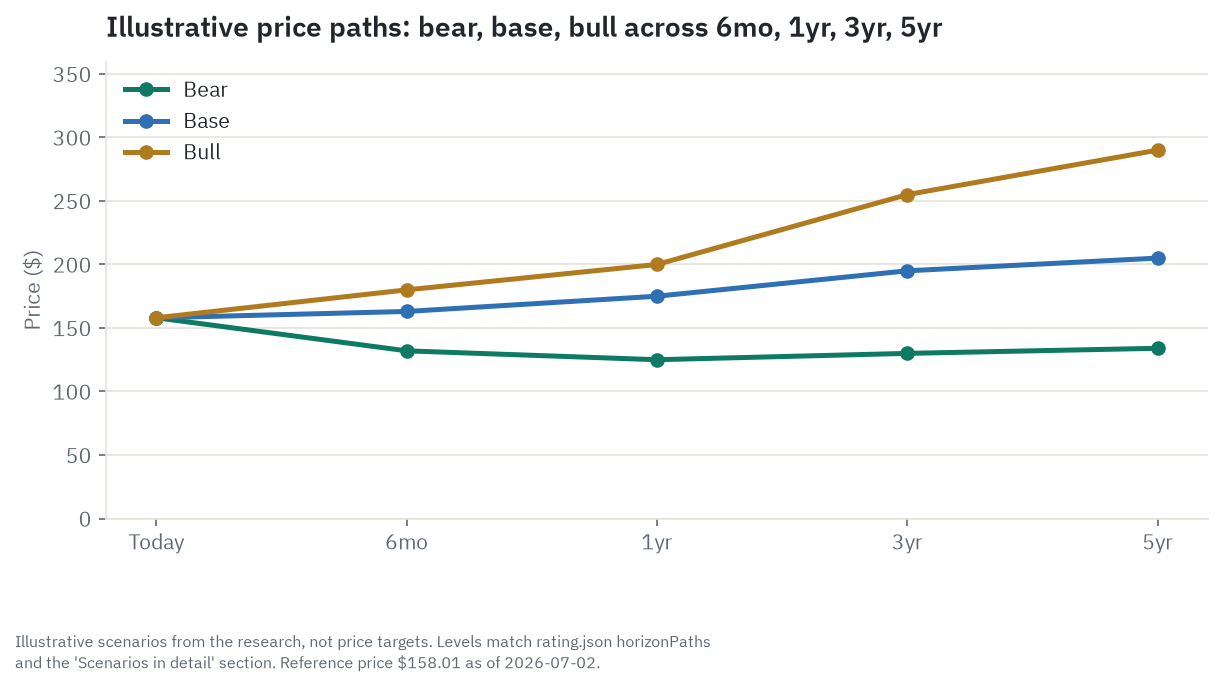
Where this stock could be in 6 months, 1 year, 3 years, and 5 years
Novartis is living through the year it told investors, more than a year in advance, would be its worst. Entresto, the heart-failure drug that was still the company’s largest product two years ago, lost US patent protection in 2025 and its sales fell 42 percent in a single quarter once generics arrived. Management’s own guidance for 2026 has the company’s core operating income declining, a rare thing for a large-cap pharma name to guide to on purpose. What makes this one different from a typical single-drug patent cliff is that Novartis did not wait for Entresto to fall before building what replaces it: five separate growth brands, spanning four different disease areas, are already generating more combined revenue than Entresto’s remaining base and are still compounding at 26 to 103 percent a quarter. Every dollar level below is an estimate built on stated assumptions, not a price target, and the read at the end is a research signal, not advice.
Six months. This window is dominated by three datable events, not by the five-year story. Novartis reports Q2 2026 earnings on July 21, the first real test of whether the guided trough is playing out on schedule or worse. Around the same time, two replicate Phase III trials read out for remibrutinib (branded Rhapsido) in relapsing multiple sclerosis, a binary result that could add a genuinely large new franchise or narrow the pipeline’s replacement capacity. And on July 31, the Section 232 pharmaceutical tariff takes effect for named companies, testing whether Novartis actually holds the preferential 15 percent Swiss rate it negotiated. The base case (around $163) has trough quarters confirming the guided decline without a fresh negative surprise. The bull case (around $180) needs Rhapsido to succeed and the tariff rate to hold cleanly. The bear case (around $132) is a Q2 or Q3 miss on top of an MS readout that disappoints. The single thing most likely to flip this window is whether the five growth brands’ combined quarterly revenue keeps growing faster than Entresto is shrinking.
One year. By mid-2027, full-year 2026 results will have confirmed how deep the trough actually was, and the first two quarters of 2027 will show whether the growth brands are reaccelerating the top line as the Entresto comparison gets easier to beat. A Pluvicto label decision for a much larger prostate-cancer population, metastatic hormone-sensitive disease rather than the currently approved later-line indication, should be in hand by then. The base case (around $175) has that reacceleration becoming visible in the reported numbers. The bear case (around $125) needs growth brands to decelerate meaningfully or IRA 2028 pricing fears to weigh harder on sentiment. The bull case (around $200) needs the 2027 growth inflection to show up clearly and the Pluvicto label expansion to land, pulling the multiple higher along with the earnings.
Three years. By around mid-2029 the structural drivers start to matter more than any single quarter. Cosentyx, now Novartis’s largest product, has US government-negotiated Medicare pricing landing in 2028 and its first biosimilar competition could be arriving anywhere in this window. The base case (around $195) has the replacement cycle broadly working, with the growth-brand cohort reaching a combined $25 to 30 billion, but the Cosentyx cliff beginning to bite and keeping the multiple contained. The bear case (around $130) has that biosimilar entry landing on the early end of estimates while the IRA cuts compress the growth brands before they have fully scaled, a second cliff arriving before the first one has finished healing. The bull case (around $255) has the pipeline outperforming, Pluvicto scaling into its larger population, and the multiple expanding toward 19 to 20 times as the market starts pricing Novartis like a faster grower rather than a patent-cliff story.
Five years. This is the full-cycle question: has Novartis proven it can run two overlapping patent-cliff replacement cycles back to back, Entresto now and Cosentyx from roughly 2029, while a third generation of pipeline assets from its recent acquisition spree scales up behind them? The base case (around $205) implies a moderate but real total return, roughly 5 percent annualized in price plus the dividend. The bull case (around $290) has the replacement cycle overshoot: a combined growth-brand cohort above $35 billion, a re-rated multiple in the high teens, and a total return closer to 13 percent annualized. The bear case (around $134) has the double-cliff dynamic plus continued government pricing pressure grinding margins and growth down together, leaving the stock roughly flat in price with the dividend doing most of the work. The single thing most likely to decide which of these three plays out is whether at least one more pipeline bet, beyond the five brands already scaled, turns into a real multi-billion-dollar franchise before Cosentyx’s own patents expire.
Where the read lands today. On balance the read holds at Buy: a company mid-transition through a well-telegraphed trough, with a replacement bench that is already larger in dollar terms than the drug it is replacing, trading at a mid-teens forward multiple that does not look like it is pricing much credit for that replacement story at all. It is not a Strong Buy, because the next cliff is already visible on the calendar and the company no longer has a captive generics arm to soften a stumble. The single thing most likely to move the read is the Rhapsido multiple sclerosis result due this summer: a clean win adds a genuine new franchise to the bench, while a miss narrows the runway right as Cosentyx’s own clock starts running.
Companion tool
Jump to the interactive dashboard to sort and filter every company in this piece, or download the Excel model to flex the scenarios yourself.
TL;DR
Novartis makes its money almost entirely from patent-protected prescription medicines across four therapeutic areas: cardiovascular/renal/metabolic, immunology, neuroscience, and oncology. Since spinning off its generics arm, Sandoz, in October 2023, it has no fallback business to soften a patent cliff the way a diversified rival can. That matters right now because Entresto, its former largest drug, lost US exclusivity in 2025 and its sales fell 42 percent reported (46 percent at constant currency) in the first quarter of 2026 alone, a collapse management itself flagged more than a year in advance as the company’s “largest patent-expiry year.” What makes this transition different from a typical single-molecule cliff is that Novartis had already built five separate growth brands, Kisqali, Kesimpta, Pluvicto, Scemblix, and Fabhalta, spanning oncology, neuroscience, and renal disease, that together generated more revenue than Entresto’s remaining base in 2025 and were still growing 26 to 103 percent a quarter as the cliff hit. Layered on top of the patent calendar is a second, faster-moving chokepoint: US government pricing. Entresto’s Medicare price was cut 53 percent under the Inflation Reduction Act effective January 2026, and Cosentyx, now Novartis’s largest product after growth-brand momentum and Entresto’s decline swapped their rank, is queued for the same negotiation in 2028, alongside Kisqali. The bull case is that Novartis is running a more diversified version of the replacement playbook AbbVie used after Humira, backed by a genuine manufacturing moat in radioligand therapy that does not depend on patent law at all. The bear case, and the reason this is a real Buy rather than a stronger conviction call, is that Cosentyx’s own patent cliff and IRA pricing date sit inside this outlook’s five-year window, and Novartis’s own recent legal track record, losing its Entresto exclusivity fight in both district and appeals court, gives little confidence that litigation buys meaningful extra time when that clock runs out too.
Explore it yourself: the interactive dashboard
Open the dashboard in a full screen
The dashboard holds Novartis’s company card, the full bull, base, and bear scenario table across all four horizons, key financial metrics (margins, free cash flow, debt), and a peer comparison table against Eli Lilly, AbbVie, AstraZeneca, Merck, Pfizer, Johnson & Johnson, and Roche. Use it to sort and check any single name while you read.
Prefer a spreadsheet? Download the Excel model with the scenario math behind the horizon chart and the peer valuation table. The levels in that file are illustrative arithmetic, not targets.
A farmer who planted five orchards before the old one died
Picture an orchard that has been fenced off for decades, protected by law so that only the farmer who planted it can pick its fruit. That fence is a patent. For years it let the farmer charge a premium for that fruit because nobody else could legally sell the same variety. Then a court orders the fence taken down. Within a single season, not years, anyone can plant the same variety and sell it for a fraction of the price, and the original farmer’s harvest from that orchard collapses. That is roughly what just happened to Entresto, Novartis’s heart-failure drug and, as recently as 2023, its single largest product. Its US patent-related exclusivity lapsed in 2025, a federal judge declined to block generic competitors from entering, and by the first quarter of 2026 Entresto’s quarterly sales had fallen 42 percent from a year earlier, a company-record patent event that management had been warning investors about for well over a year.
Most pharmaceutical companies facing a cliff like this either shrink with the drug for a few painful years or scramble to find a single successor molecule. Novartis did something more deliberate: it planted five new orchards years before the old one’s fence came down. Kisqali (breast cancer), Kesimpta (multiple sclerosis), Pluvicto (prostate cancer), Scemblix (leukemia), and Fabhalta (a rare kidney and blood disorder) were all approved and commercial well before Entresto’s cliff arrived, and by 2025 the five of them combined for more revenue than Entresto’s remaining base, still growing at rates from the high twenties to nearly 300 percent a year individually. The new orchards were already bearing fruit before the old one’s fence came down, which is the single fact that separates this story from a typical single-drug patent cliff.
The catch, as with any orchard, is that every fence eventually comes down. Cosentyx, Novartis’s immunology drug for psoriasis and related autoimmune conditions, overtook Entresto as the company’s single largest product in 2025 precisely because Entresto was shrinking. Cosentyx’s own US patent protection is estimated to run to roughly 2029, with secondary patents potentially extending it into the early 2030s, though the precise dates have not been independently confirmed against the patent register for this research and should be treated as a well-sourced analyst estimate rather than a primary fact. No biosimilar has been approved yet, but Celltrion’s CT-P55 is already in Phase 3 development. Novartis is already planting the next set of orchards, an oncology, neuroscience, and immunology pipeline built partly through more than 16 billion dollars of biotech acquisitions since late 2025, betting that the same replanting trick that worked for Entresto will still be working when Cosentyx’s own fence eventually comes down. Whether that third generation is ready in time is the whole question this article works through.
How the money flows
flowchart TD
    PAT["Patients / national payers\nCommercial insurance, Medicare, ~120 national health systems"]
    PAYER["US payers\nCommercial insurers + Medicare Part D\n~43% of NVS net sales is US-sourced"]
    PBM["PBMs (US formulary gatekeepers)\nCVS Caremark, Express Scripts, OptumRx\nExtract the rebate spread off list price"]
    EXUS["Ex-US national payers\nNHS (UK), statutory insurers (Germany/Japan), NRDL (China)\nHTA/reimbursement decision is the chokepoint"]
    GOVT["CMS IRA negotiation + MFN/TrumpRx\nEntresto MFP -53% (2026); Cosentyx/Kisqali/Xolair selected for 2028\nMayzent cut 89% via MFN"]
    NVS["Novartis net revenue\n$54.5B FY2025 net sales (+8% cc)\nCore operating margin 40.1%"]
    RLT["Radioligand therapy manufacturing (captive)\nIvrea IT, Millburn NJ, Indianapolis IN, California\n~250,000 doses/yr; isotope decay = hard chokepoint"]
    MFG["Small-molecule & biologics manufacturing\nStein CH; Ljubljana/Menges SI; CDMOs (Lonza, Samsung Biologics)"]
    WHOLE["Wholesale distribution\nMcKesson, Cencora, Cardinal Health"]
    PHARM["Pharmacy / hospital dispensing"]
    RD["R&D + bolt-on M&A\n~20.5% of sales; Avidity/Anthos/Tourmaline >$16B since late 2025"]
    CLIFF["Patent cliff / generic-biosimilar entry\nEntresto -46% cc in Q1 2026 after US generics"]

    PAT --> PAYER
    PAT --> EXUS
    PAYER --> PBM
    PBM -->|"Rebate spread"| NVS
    GOVT -->|"Government-set price overrides\nthe PBM deal on selected drugs"| NVS
    EXUS -->|"National reimbursement decision"| NVS
    NVS --> WHOLE
    WHOLE --> PHARM
    PHARM --> PAT
    MFG -->|"Supplies small-molecule & biologic product"| NVS
    RLT -->|"Supplies Pluvicto / Lutathera doses\n(capacity-constrained, not demand-constrained)"| NVS
    NVS -->|"~20.5% of revenue"| RD
    RD -->|"Funds next-gen pipeline"| NVS
    CLIFF -.->|"Reverse chokepoint: exclusivity loss\nredirects surplus to generics"| NVS

    style NVS fill:#1a6e38,color:#fff
    style PBM fill:#8b0000,color:#fff
    style GOVT fill:#8b0000,color:#fff
    style RLT fill:#1a3c6e,color:#fff
    style CLIFF fill:#8b0000,color:#fff
Follow the arrows from the top. Patients fund the system through premiums, payroll taxes, and copays, and in the US that money flows through commercial insurers and Medicare Part D to pharmacy benefit managers, PBMs, who decide which drugs sit on the preferred formulary tier and extract a rebate off list price as the toll for that placement. Outside the US, roughly 57 percent of Novartis’s revenue instead routes through national health systems and health-technology-assessment bodies, a structurally different chokepoint where a government reimbursement decision, not a PBM negotiation, determines whether and at what price a drug reaches patients at all.
Sitting above both of those is a newer, faster-moving toll: the US government itself, acting through two separate mechanisms that arrive at similar outcomes. The Inflation Reduction Act lets Medicare negotiate a compulsory price on selected drugs once a drug clears its eligibility window, and it already cut Entresto’s Medicare price 53 percent effective January 2026. Separately, a voluntary “Most Favored Nation” pricing framework struck with the Trump administration in December 2025 cut the US list price of Novartis’s multiple sclerosis drug Mayzent by 89 percent for patients buying through the new TrumpRx platform. Once either mechanism reaches a drug, Novartis has essentially no further lever on the price itself, only on timing through patent litigation, a strategy that has not worked well for the company so far: a federal court dismissed Novartis’s constitutional challenge to the IRA program in October 2024, citing the same reasoning that had already sunk similar suits from Bristol-Myers Squibb and Johnson & Johnson, and Novartis’s appeal to the Third Circuit was later turned back as well. That appeal history is a real fact worth sitting with before assuming the next drug caught in this net fares any differently.
Below Novartis in the diagram sits its own manufacturing network, and this is where the business splits into two genuinely different economics. Small-molecule and antibody-based biologic manufacturing (Stein, Switzerland; Ljubljana and Menges, Slovenia; a layer of contract manufacturers shared with the rest of big pharma) is relatively fungible, well-understood capacity. Radioligand therapy, the platform behind Pluvicto and Lutathera, is not. It requires captive access to a radioactive isotope, lutetium-177, whose short half-life means a dose has to be manufactured close to when it will be used and delivered on a tight clock, closer in logistics terms to fresh seafood than to a pill that can sit in a warehouse for two years. Roughly 20.5 percent of net sales goes back into R&D and, increasingly, bolt-on acquisitions, more than 16 billion dollars of it since late 2025 alone, which is the fuel for the next generation of drugs that eventually has to replace today’s growth brands the way today’s growth brands replaced Entresto.
A field guide to what Novartis actually sells
Entresto (sacubitril/valsartan) is an oral heart-failure drug and, until 2025, Novartis’s largest product, generating $7.7 billion in FY2025 even as its US patent-related exclusivity lapsed mid-year. Multiple generic competitors launched in the US after Novartis lost a preliminary-injunction fight to block them, and Entresto’s quarterly sales fell to $1.305 billion by Q1 2026, down 42 percent reported and 46 percent at constant currency in a single quarter. Its Medicare price was separately cut 53 percent, to $295 a month from roughly $628, effective January 2026, under the Inflation Reduction Act’s price-negotiation program. This is the completed, largely-realized part of the story rather than an emerging risk.
Cosentyx (secukinumab) is an injectable biologic that blocks interleukin-17, used across psoriasis, psoriatic arthritis, ankylosing spondylitis, and a growing list of other autoimmune indications. It generated $6.7 billion in FY2025, up 8 to 9 percent at constant currency, and became Novartis’s single largest product once Entresto’s collapse pulled the older drug down. Growth slowed sharply in the first quarter of 2026, down 2 percent reported and up only about 2 percent at constant currency, years ahead of its own estimated 2029 US patent expiry. No biosimilar is approved yet, but Celltrion’s CT-P55 is already in Phase 3, and Cosentyx has been selected alongside Kisqali and Xolair for the next round of Medicare price negotiation, effective 2028.
Kisqali (ribociclib) is an oral CDK4/6 inhibitor for breast cancer, and the fastest-growing of the five current replacement brands: $4.8 billion in FY2025, up 57 percent at constant currency, accelerating further to 55 percent constant-currency growth in the first quarter of 2026. Its growth is underpinned by the NATALEE Phase III trial, which showed that adding ribociclib to standard hormone therapy reduced the risk of tumor recurrence or death by roughly a quarter to just under a third, depending on the patient subgroup and data cut, in certain early-stage breast cancer patients, a broader label than rival Eli Lilly’s Verzenio, which was initially restricted to higher-risk patients only. That label breadth is a large part of why Kisqali is out-growing its main competitor.
Kesimpta (ofatumumab) is a self-administered, subcutaneous anti-CD20 antibody for multiple sclerosis, generating $4.4 billion in FY2025, up 36 percent at constant currency. Its main competitive edge against Roche’s infused Ocrevus is convenience: patients inject it themselves at home rather than visiting an infusion center.
Pluvicto (lutetium Lu-177 vipivotide tetraxetan) is Novartis’s flagship radioligand therapy, a targeted radioactive treatment for metastatic prostate cancer that generated $2.0 billion in FY2025, up 42 percent at constant currency, and accelerated to 70 percent constant-currency growth in the first quarter of 2026. Its growth has historically been paced by Novartis’s own manufacturing capacity rather than by patient demand, because the isotope decays on a clock most drugs never have to worry about. Novartis has filed with the FDA to expand Pluvicto’s label into metastatic hormone-sensitive prostate cancer, a much larger and earlier-line population than its current approval, the single largest near-term addressable-market expansion anywhere in the pipeline.
Scemblix (asciminib) treats chronic myeloid leukemia through a novel binding mechanism and generated $1.3 billion in FY2025, up 85 to 87 percent depending on the source, continuing at 79 percent constant-currency growth in Q1 2026.
Fabhalta (iptacopan), approved across three separate rare kidney and blood-disorder indications, is the newest and fastest-growing of the group in percentage terms: $505 million in FY2025, up 287 percent, and still growing 103 percent at constant currency in Q1 2026, though on a small enough base that the dollar contribution is still modest.
Leqvio (inclisiran), a twice-yearly injectable cholesterol-lowering drug, reached blockbuster status in FY2025 at $1.2 billion, up 59 percent.
Rhapsido (remibrutinib), an oral BTK inhibitor already approved for chronic hives, is Novartis’s nearest binary catalyst: two replicate Phase III trials in relapsing multiple sclerosis are expected to read out in summer 2026, and a positive result showing superiority to existing anti-CD20 therapy would add a materially sized new franchise to the replacement bench.
Promacta/Revolade and Tasigna, two older oncology drugs, are running through smaller versions of the same patent-cliff pattern as Entresto: Promacta fell 26 percent in FY2025 on US generic entry and Tasigna fell 34 percent, together still worth roughly $2.7 billion but in structural decline.
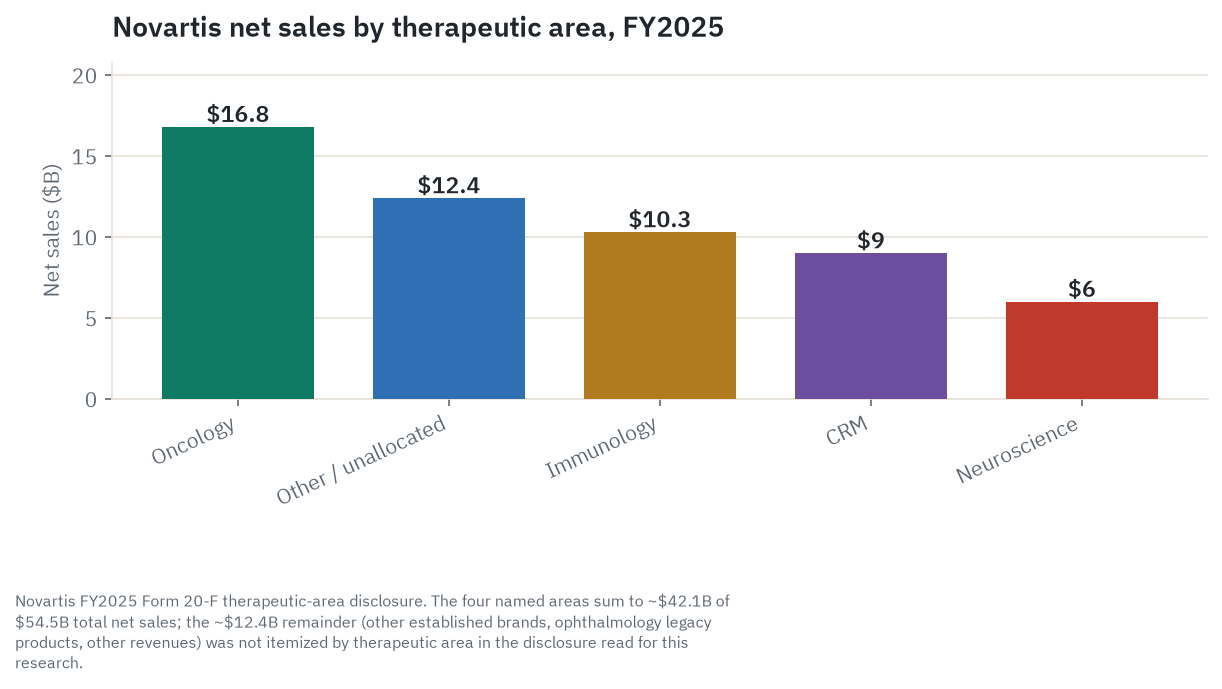
The chart above is the shape of the whole business in one picture. The four named therapeutic areas sum to roughly $42.1 billion of the $54.5 billion total, meaning close to $12.4 billion sits outside oncology, immunology, cardiovascular/renal/metabolic, and neuroscience as separately disclosed line items, a genuine reporting gap this research could not close from the narrative text of the 20-F and flags rather than estimates around.
Who wins where
Immunology biologics are a business where Novartis competes for formulary placement against a small number of well-capitalized rivals: Eli Lilly’s Taltz, UCB’s Bimzelx, and the interleukin-23 franchises from [AbbVie (ABBV)] and Johnson & Johnson all fight Cosentyx for the same preferred-tier slots, and every formulary renewal is a fresh rebate negotiation that grows the PBM’s share of the gross-to-net spread as more credible in-class competitors enter, regardless of who wins any individual prescription. Kesimpta competes similarly against Roche’s Ocrevus and a growing field of oral multiple-sclerosis therapies.
Radioligand therapy is the one place Novartis’s pricing power rests on a genuine supply-chain moat rather than a legal one. Because Pluvicto and Lutathera require captive access to a short-half-life isotope and specialized cold-chain logistics, competitors cannot simply copy the molecule in a generic lab the way they can with a small-molecule drug once its patent lapses. Eli Lilly (via its POINT Biopharma acquisition), Telix Pharmaceuticals, and Bayer are all building rival radioligand capacity, but none has yet matched Novartis’s scale, which makes this the most durable single growth driver in the current portfolio, at least for now.
The US government, through the twin mechanisms of compulsory IRA negotiation and voluntary MFN dealmaking, is now the newest and fastest-growing claimant on Novartis’s pricing power, and unlike a PBM rebate, which Novartis can partially offset through volume growth or new indications, a government-set price is a statutory or contractual ceiling that does not renegotiate upward. Wholesale distribution, handled by McKesson, Cencora, and Cardinal Health, and retail dispensing are the commodity fringe of this chain, thin and largely fixed-fee, with essentially no pricing power of their own.
Generic and biosimilar manufacturers are the group that eventually captures the value Novartis is defending, and Entresto is the completed case study: a single quarter’s worth of US generic competition redirected the bulk of that drug’s economic surplus to generic makers and, through lower net cost, to payers and patients. The same dynamic is the long-run risk sitting over Cosentyx once its own fence comes down.
Company by company: who’s who
Novartis (NVS, NYSE ADR, primary listing SIX Swiss Exchange as NOVN, market cap approximately $290 to $300 billion as of July 2, 2026) is the subject of this piece, a pure-play innovative-medicines company since spinning off its generics arm, Sandoz, in October 2023. Q1 2026 net sales were $13.1 billion, down 1 percent reported and 5 percent at constant currency, as Entresto’s 46 percent constant-currency decline outran the combined 26 to 103 percent growth of Kisqali, Kesimpta, Pluvicto, Fabhalta, and Scemblix. Bull: the replacement bench is already larger in dollar terms than the drug it is replacing and spans four separate disease areas rather than a single successor molecule. Bear: Cosentyx, the new largest product, faces its own IRA pricing date in 2028 and an estimated patent cliff around 2029, and Novartis’s litigation track record on exactly this kind of fight is a recent, clean loss.
Eli Lilly (LLY, NYSE, market cap approximately $1.0 to $1.1 trillion) is the GLP-1 and obesity-drug category leader through Mounjaro and Zepbound, with only tangential immunology overlap against Novartis via Taltz and Omvoh versus Cosentyx and Ilaris. Q1 2026 revenue reached $19.8 billion, up 56 percent year over year, on Mounjaro’s 125 percent growth. Bull: [Lilly’s (LLY)] incretin franchise alone now dwarfs Novartis’s entire net sales base in growth rate and addressable market, and the obesity category remains capacity-constrained rather than demand-constrained. Bear: the single largest valuation in pharma leaves almost no room for a stumble, a very different risk profile than Novartis’s more moderately valued, patent-cliff-driven story.
AbbVie (ABBV, NYSE, market cap approximately $448 billion) is Novartis’s most direct immunology-scale rival, having already run the exact patent-cliff replacement playbook Novartis is running now: Skyrizi and Rinvoq replaced Humira’s lost revenue and now generate more combined revenue than Humira ever did at its peak. Bull: [AbbVie’s (ABBV)] transition is a completed, audited fact rather than a thesis in progress, a useful template for how Novartis’s own transition could resolve. Bear: Skyrizi’s own patent cliff arrives around 2033 with no confirmed exclusivity extension, a reminder that the replacement cycle never actually ends, only pauses.
AstraZeneca (AZN, NYSE ADR, LSE primary, market cap approximately $285 billion) is Novartis’s closest scale peer, a similarly sized European multinational with a heavier oncology skew through Tagrisso, Imfinzi, and Enhertu, plus its own cardiovascular franchise, Farxiga, competing indirectly with Entresto and Leqvio. Q1 2026 oncology revenue reached $6.8 billion, up 16 percent. Bull: the broadest and most consistently double-digit-growing oncology portfolio of any peer in this group. Bear: AstraZeneca faces its own eventual patent-cliff wall on Tagrisso and Farxiga later this decade, the same structural clock every name here is running against.
Merck & Co. (MRK, NYSE, market cap approximately $313 billion) carries the single largest concentration risk in this peer set: Keytruda alone generated $8.0 billion in Q1 2026, more revenue in one quarter than Novartis’s entire oncology therapeutic area generates in a full year, and it is nearly half of Merck’s total sales. Bull: a subcutaneous reformulation of Keytruda extends the franchise’s exclusivity runway past the IV formulation’s roughly 2028 patent cliff, buying more time than a straight small-molecule expiry like Entresto’s allowed. Bear: no single product in Novartis’s portfolio exceeds roughly 15 percent of net sales, a far more diversified structure than Merck’s Keytruda dependence.
Pfizer (PFE, NYSE, market cap approximately $138 billion) trades at the cheapest multiple in this group, a forward P/E near 9.3 times against Novartis’s roughly 16.8 times, reflecting a still-recovering post-COVID revenue base. Bull: a high dividend yield near 6 percent and a multi-year revenue floor from the Seagen oncology portfolio and Vyndaqel. Bear: no GLP-1 franchise to ride the decade’s biggest pharma growth story, and a lower-growth, higher-yield profile than Novartis’s growth-portfolio-led story.
Johnson & Johnson (JNJ, NYSE, market cap approximately $618 billion) is the largest and most diversified name in the group, spanning Innovative Medicine (including Tremfya, a direct immunology competitor to Cosentyx) and a separate MedTech segment Novartis does not have. Q1 2026 Innovative Medicine growth ran 7.4 percent operationally, with ten brands growing at a double-digit pace. Bull: [Johnson & Johnson’s (JNJ)] diversified revenue base cushions any single franchise’s patent cliff far better than Novartis’s pharma-only model can. Bear: Tremfya is taking real immunology share from Cosentyx in the same indications, and a multibillion-dollar talc-litigation overhang remains a live wildcard on reported earnings, a legal risk Novartis does not carry.
Roche Holding (RHHBY, OTC ADR, SIX Swiss Exchange primary as ROG, market cap approximately $324 billion) is Novartis’s direct Swiss cross-town rival, and unlike Novartis, did not spin off a generics unit, instead carrying a large separate Diagnostics division alongside Pharma. Q1 2026 Pharma sales reached CHF 11.5 billion, up 7 percent at constant exchange rates. Bull: a genuinely diversified franchise, Pharma plus a leading Diagnostics business, gives Roche a second growth lever Novartis does not have. Bear: reported Swiss-franc results are being hit hard by currency, the same structural mismatch Novartis itself carries between a CHF-weighted cost base and a USD- and EUR-weighted revenue base, and RHHBY itself is a thin OTC ADR, materially less liquid than the SIX-listed primary shares.
What the filings say
Novartis is a Swiss company and files as a foreign private issuer: an annual Form 20-F rather than a 10-K, plus periodic Form 6-K furnishings for quarterly results and material announcements, rather than the quarterly 10-Q and DEF 14A proxy process a US domestic filer uses. The 20-F’s disclosure is broadly comparable to a 10-K in substance but follows IFRS accounting standards, not US GAAP, and Novartis’s own non-IFRS “core” results, which strip out amortization of intangibles, impairments, and restructuring charges, are the figures management and most sell-side analysts actually use to judge underlying performance quarter to quarter. Primary sources for this section: the FY2025 Form 20-F (filed February 4, 2026) and the Q1 2026 Form 6-K results announcement (filed April 28, 2026).
Revenue and margins. FY2025 net sales reached $54.5 billion, up 8 percent both reported and at constant currency versus $50.3 billion in FY2024, driven by 15 percentage points of volume growth partly offset by 6 points of generic competition and 1 point of pricing pressure. Gross profit was $42.975 billion, implying a gross margin near 78.8 percent, typical for a branded-pharma model where cost of goods sold is a relatively small share of revenue against R&D and sales, general, and administrative spending. GAAP operating income reached $17.644 billion, up 21 percent reported (25 percent cc), a margin of 32.4 percent of net sales. Net income reached $13.967 billion, up 17 percent, with basic EPS of $7.21, up 22 percent, helped by a falling share count from ongoing buybacks. On the core (non-IFRS) basis management actually guides to, core operating income reached $21.9 billion, up 14 percent at constant currency, at a core operating margin of 40.1 percent. The roughly 8-point gap between the 32.4 percent GAAP operating margin and the 40.1 percent core margin is almost entirely amortization of intangible assets from past acquisitions plus restructuring and impairment charges, a normal feature of a company that grows partly through M&A, worth knowing before comparing Novartis’s headline margin to a peer that reports differently.
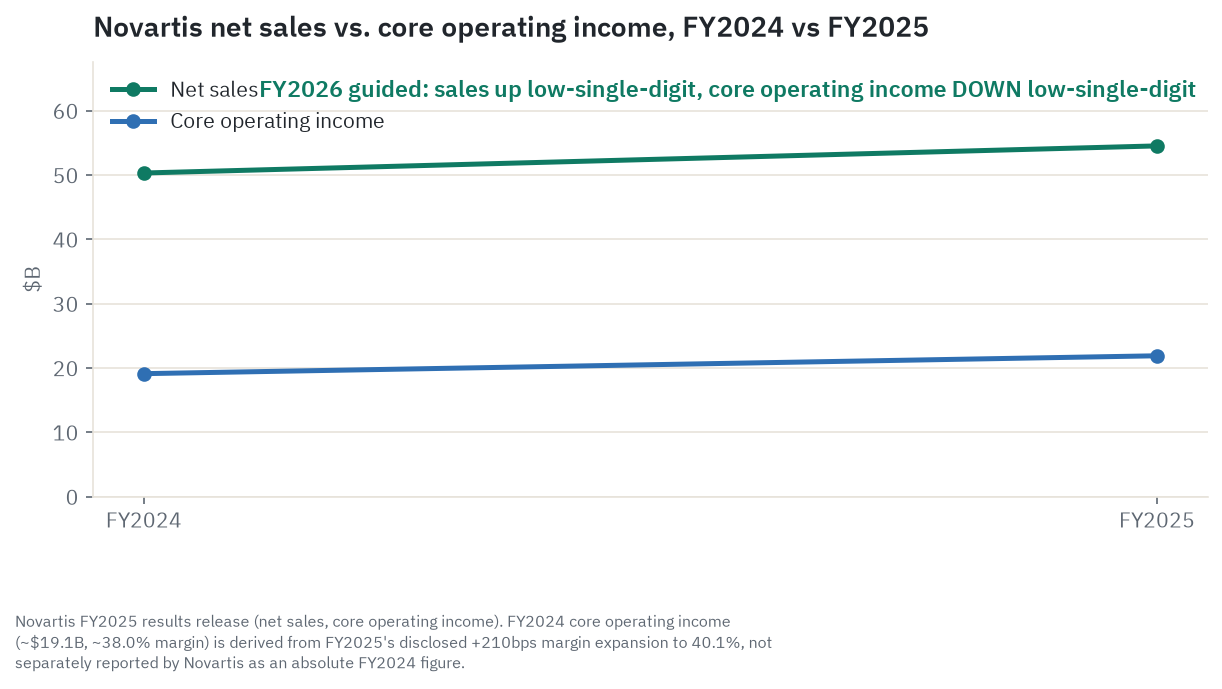
The chart above is the shape of the trough in one picture. Core operating income and margin both expanded through FY2025, but management’s own FY2026 guidance, reaffirmed at the Q1 2026 report, calls for net sales to grow low-single-digit while core operating income declines low-single-digit, an unusual thing for a company to guide to on purpose right after a year of margin expansion, and a direct acknowledgment that 2026 is the trough, not a multi-year trend. Q1 2026 already showed the early signs: net sales fell 1 percent reported and 5 percent at constant currency, core operating income fell 14 percent at constant currency to a margin of 37.3 percent, and core EPS of $1.99 missed a consensus estimate near $2.10.
Revenue by geography. US sales reached $23.3 billion (up 10 percent), Europe $16.7 billion (up 8 percent reported, 4 percent cc), and emerging growth markets $14.0 billion (up 8 percent reported, 10 percent cc), including $4.2 billion from China. The US, at roughly 43 percent of net sales, is both the single largest market and the one most directly exposed to the CMS Medicare Drug Price Negotiation Program.
Cash flow and the balance sheet. Net cash from operating activities reached $19.144 billion, up 9 percent, with free cash flow (Novartis’s own non-IFRS definition) of $17.596 billion, up 8 percent. Financing activities used $14.867 billion, driven by $9.2 billion of net treasury share buybacks, $7.8 billion of dividend payments, and $3.35 billion of bond repayments, partly offset by $6.0 billion of new bond issuance. At December 31, 2025, total assets were $110.949 billion, total equity $46.549 billion, and total liabilities $64.4 billion. Net debt (financial debts less cash, marketable securities, and derivatives) was $21.947 billion, up from $16.141 billion a year earlier, a roughly $5.8 billion increase in one year, consistent with a company that returned roughly $17 billion to shareholders through buybacks and dividends against $17.6 billion of free cash flow, then funded further bolt-on M&A partly with new debt. Novartis’s home-currency financing environment is unusually cheap: the Swiss National Bank held its policy rate at zero through mid-2026, and one of Novartis’s own outstanding bonds, a sustainability-linked note issued in 2020, carries a 0.000 percent coupon through its 2028 maturity because the company hit the patient-access targets tied to it. That near-zero financing cost is a real, if modest, tailwind for the M&A-funded replacement strategy, though rate sensitivity here shows up less in patient demand, which does not track financing costs at all, and more in the hurdle rate for the next bolt-on deal and in the equity’s own partial bond-proxy character as a steady dividend payer, where a durably higher global rate environment would compress the multiple investors are willing to pay for that yield.
Dividends and capital returns. Novartis paid or declared CHF 3.70 per share for FY2025, up 5.7 percent, the company’s 29th consecutive annual dividend increase, approved at the March 2026 annual general meeting. Management cites this as representing roughly a 3.0 percent yield in Swiss-franc terms on the Swiss-listed shares. The USD ADR yield reads meaningfully lower, closer to 2.0 percent by one aggregator, a gap this research could not fully reconcile against FX conversion and Swiss withholding-tax treatment for US ADR holders, and one separate secondary aggregator cited a still-different 3.16 percent forward yield; treat the exact USD dividend yield as genuinely disputed across sources rather than a single precise number. Alongside the dividend, Novartis ran $9.2 billion of net treasury-share purchases in FY2025, materially larger than the dividend outlay in cash terms and the primary driver of the falling share count that is boosting per-share growth figures faster than net income growth.
R&D, pipeline, and M&A. R&D spend of $11.2 billion, roughly 20.5 percent of net sales, funds both internal discovery and a slate of more than 30 disclosed late-stage development programs spanning all four therapeutic areas plus a small Global Health unit for malaria and leishmaniasis. Novartis has also been an active acquirer: it agreed in October 2025 to buy Avidity Biosciences for approximately $12 billion, closing in February 2026 and adding a late-stage RNA and antibody-oligonucleotide-conjugate platform in neuromuscular disease; it completed the roughly $1.4 billion acquisition of Tourmaline Bio (cardiovascular) in September 2025; and it agreed to acquire Excellergy (next-generation anti-IgE allergy assets) for up to $2 billion, expected to close in the second half of 2026. Combined, these deals total more than $16 billion since late 2025, and management has said the Avidity deal alone raised its own 2024 to 2029 net sales guidance from a 5 percent to a 6 percent compound annual growth rate.
Guidance. FY2026 guidance, reaffirmed as of the Q1 2026 report: net sales expected to grow low-single-digit, core operating income expected to decline low-single-digit. Investors should read this as management’s own acknowledgment that 2026 is a trough year for margin, not evidence of a multi-year deterioration.
Disclosed risk factors. The 20-F’s own risk-factor language, organized under strategic, operational, and emerging risk categories, states plainly that Novartis “must accept negotiated Medicare pricing for Entresto for 2026 to avoid fines or removal of all our products from Medicare and Medicaid,” and separately discloses that Cosentyx, Kisqali, and Xolair have been selected for the program’s 2028 pricing cycle. Other named strategic risks include competition and commercial-priorities risk, R&D failure risk, intellectual-property and patent-challenge risk, and alliance and acquisition-integration risk relevant to the recent Avidity, Anthos, and Tourmaline deals. Operational risks include cybersecurity, manufacturing concentration (relevant to the radioligand-therapy footprint), and healthcare-agency disruption risk. Emerging risks include geopolitical developments, tariffs, and climate change. None of this is unusual boilerplate for a large-cap pharma filer, but the specificity on Entresto’s compulsory Medicare pricing and the named 2028 selections for three of Novartis’s largest current products is worth reading in the company’s own words rather than taking on faith.
Ownership. Roughly 184,000 shareholders were listed in Novartis’s own Share Register as of December 31, 2025, representing about 56.0 percent of issued shares, with the remainder held through nominees and depositaries including the ADS depositary for NYSE-traded NVS. Of shares registered by name, roughly 52.2 percent were held in Switzerland and 25.7 percent in the US. Two shareholders disclosed holding more than 5 percent of share capital: BlackRock (7.3 percent) and UBS Group (7.3 percent), against 1,908,151,679 ordinary shares outstanding excluding treasury shares. Novartis states it is not directly or indirectly controlled by another corporation or government, and there are no arrangements that could result in a change of control. A secondary aggregator put institutional ownership at roughly 36 percent and insider ownership at roughly 0.1 percent, broadly consistent with, but not independently cross-checked against, the Share Register breakdown.
A hole for the reader to know about. The four disclosed therapeutic areas sum to roughly $42.1 billion of the $54.5 billion FY2025 total; the remaining roughly $12.4 billion (other established brands and other revenues such as royalties) was not itemized by therapeutic area in the narrative text read for this research. Effective tax rate for FY2025 was also not directly located in the excerpt reviewed, though income before tax of $16.352 billion against net income of $13.967 billion implies a rate in the high teens, not independently confirmed against the filing’s explicit tax-rate disclosure.
What the market is paying
Novartis last traded at $158.01 on July 2, 2026, up about 2.5 percent on the day, within a 52-week range of $112.34 to $170.46, meaningfully off its February 2026 high but well above its low. The stock is up roughly 22.4 percent year to date and roughly 53 percent over the trailing year through late June 2026, a run that has taken it back toward the top of its own range even as the Entresto cliff has been actively playing out in the reported numbers, evidence the market has largely treated the patent-cliff story as a known, guided-for event rather than a fresh surprise.
Market cap. This is one of the messier data points in this research. One major vendor’s own market-cap page showed approximately $283 billion as of July 2, but multiplying that same vendor’s stated share price by its own stated share count implies a market cap closer to $301 billion, a roughly 6 percent internal inconsistency likely tied to a stale or differently defined effective share count. A second vendor, cross-checked against the SEC-confirmed 1,908,151,679 shares outstanding from the 20-F, computed a market cap near $294 billion, and a third put the range at $294 to $302 billion. The honest read: treat Novartis’s market cap as roughly $290 billion to $300 billion in the July 2026 window, not a single precise figure, and do not lean on any one vendor’s number to the dollar.
Valuation. Trailing P/E runs 20.9 times, forward P/E 16.76 times, a lower forward than trailing multiple consistent with management’s own guidance for core operating income to grow faster once the current-year trough rolls off. Price-to-sales sits at 5.00 times, price-to-book at 7.27 times, EV/EBITDA at 14.11 times, and beta (five-year) at a notably low 0.49, consistent with Novartis’s profile as a defensive, dividend-paying pharma name rather than a high-momentum growth stock.
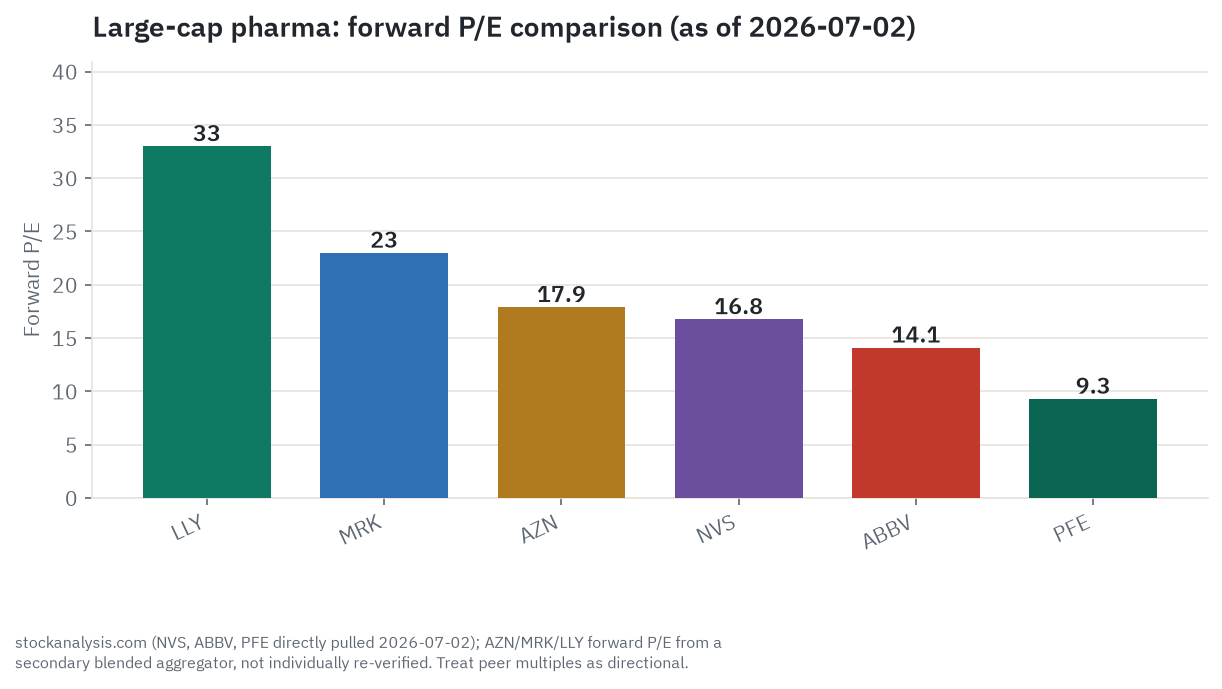
Read honestly, Novartis’s forward multiple sits roughly in the middle of this group, richer than the deeply-discounted Pfizer and AbbVie, cheaper than AstraZeneca, and far cheaper than Merck’s Keytruda-driven or Eli Lilly’s GLP-1-driven multiples. On dividend yield, Novartis’s USD ADR yield of roughly 2.0 percent is middling within this group, well below AbbVie, Merck, AstraZeneca, and Pfizer’s roughly 6 percent, though the underlying CHF-share yield closer to 3.0 percent is more competitive; the gap between the two readings is itself a genuine reconciliation question this research could not close, not a resolved fact.
Sell-side. This is genuinely divided, not a false-precision consensus. One aggregator’s rating clusters at Hold across 12 analysts, with an average price target of $154.57, roughly flat to the price at the time it was compiled, and a range of $123 to $180. A second aggregator, TipRanks, shows a “Moderate Buy” with an average target of $169.99 across 6 analysts, range $141 to $180. A separate, likely stale Benzinga snapshot showed $134.5 across 11 analysts. Morgan Stanley specifically raised its NVS target from $143 to $170 on March 26, 2026, maintaining an Overweight rating. Treat $150 to $170 as the honest range of average targets across sources as of mid-2026 rather than a single consensus number, and remember that any analyst target is opinion, typically revised after the fact rather than ahead of it.
Q1 2026 earnings context. Novartis’s Q1 2026 core EPS of $1.99 missed a consensus estimate near $2.10, and net sales of $13.11 billion missed an estimated $13.51 billion, driven by Entresto, Promacta, and Tasigna generic erosion outpacing the growth portfolio in that specific quarter. The stock’s subsequent recovery toward the top of its 52-week range suggests the market treated that miss as an already-anticipated trough rather than a thesis-changing surprise, consistent with guidance that was reaffirmed both before and after the print.
What the crowd is saying
The dominant narrative through late 2025 and the first half of 2026 has been Novartis working through a dense sequence of policy and patent events and, so far, landing on the better end of most of them. In December 2025, Novartis became one of nine major drugmakers to reach a Most-Favored-Nation pricing deal with the Trump administration. In April 2026, the Section 232 pharmaceutical tariff proclamation set a default 100 percent tariff on patented drug imports, but Switzerland secured a preferential 15 percent rate tied to a $23 billion Novartis US manufacturing commitment, a materially better outcome than the headline rate implied and one that removed a real overhang from the stock. February 2026 brought the completed $12 billion acquisition of Avidity Biosciences. Through June 2026, a steady run of positive late-stage clinical readouts continued: Rhapsido met its primary endpoints in chronic hives, Vanrafia’s Phase III data showed slower kidney-function decline in IgA nephropathy, and new Cosentyx data in polymyalgia rheumatica was published in the New England Journal of Medicine. Tone across this news flow reads net positive, driven by policy resolution and pipeline execution, with attention now shifting toward the July 21 Q2 earnings date as the next real test of whether the growth-brand cohort is offsetting Entresto’s erosion on schedule.
Retail and social chatter is thin and reactive, consistent with an ADR that skews institutional rather than retail. One low-reliability retail-sentiment aggregator characterized a majority of tracked positioning as short-leaning around the Entresto headline, a single-source, low-confidence signal not cross-checked against StockTwits or Reddit directly and flagged as such in the underlying research. This sits awkwardly against sell-side commentary describing the stock as undervalued and a run of positive clinical data, more likely a function of thin sample size and headline-reactive positioning than a considered read on the diversified growth story. Employee sentiment via Glassdoor runs a solid 4.0 out of 5 across nearly 9,000 reviews, with 79 percent of employees saying they would recommend the company to a friend, though a live cost-discipline undercurrent is visible too: Novartis is running layoffs at its East Hanover, New Jersey site and has announced plans to close its Wehr, Germany production facility by the end of 2028, both consistent with a company managing through its largest patent-expiry year rather than a distress signal on their own.
The most useful divergence in this research is between the “patent-cliff crisis” headline and what the company’s own numbers actually show. The crowd narrative, that Entresto is collapsing and 2026 is a real crisis year, is directionally accurate but incomplete in the same way the market underweighted AbbVie’s Humira transition in 2020 through 2022: the five growth brands already generate more combined revenue than Entresto’s remaining base, and the 2026 guidance itself confirms this is a real, calendared margin headwind for the specific year, not an open-ended structural decline. The divergence, if there is one, is less about whether the crisis is real and more about how quickly and completely the market expects the 2027 through 2029 reacceleration to actually play out. None of this sentiment evidence is a hard signal on its own. It should be read alongside the filings and market data above, not in place of them.
Durability, and what has to be true
Novartis sells prescription medicines for chronic and acute disease: heart failure, autoimmune conditions, cancer, and multiple sclerosis. None of this is discretionary spending. A heart-failure patient does not defer treatment because a recession hits, and an MS patient does not skip an infusion because rates rise. The funding source is almost entirely third-party, commercial insurance and Medicare in the US, government or statutory insurance systems across most of the rest of the world, which makes patient-level demand for Novartis’s chronic-disease and oncology franchises close to recession-proof. The real variable that moves Novartis’s revenue and margin year to year is not patient demand at all. It is the patent-cliff and reimbursement-policy calendar.
The structural bull case. The replacement bench is unusually diversified across therapeutic areas and mechanisms rather than concentrated in a single successor molecule the way some patent-cliff transitions are, and the radioligand-therapy platform is a genuine manufacturing moat, not just a patent moat, that outlasts any single patent term. The MFN and Section 232 deals, while genuine cost and pricing concessions, converted open-ended political risk into a bounded, known cost, and the Sandoz spin-off sharpened capital discipline, visible now in a bolt-on M&A cadence that is actively rebuilding the next-cycle pipeline years ahead of the Cosentyx cliff rather than waiting for it to arrive. Demographic demand, an aging population and rising chronic-disease prevalence, is a genuine, multi-decade tailwind that requires no assumption about GDP growth or consumer confidence.
The real cyclical bear case, and its timing. Novartis now runs this exact patent-cliff playbook with no in-house generics arm to soften the landing, having spun off Sandoz in 2023, and it has already told the market that 2026 is its largest patent-expiry year on record, with guidance for core operating income to decline even as net sales grow. That is not a hypothetical bear case. It is management’s own base case, embedded in the numbers. The next major cliff after Entresto is Cosentyx, Novartis’s largest single product, with US patent-term-extended exclusivity estimated to run to roughly 2029. If a biosimilar competitor clears regulatory approval anywhere close to that timeline, Novartis faces a second major single-product erosion event within the same five-year window this research covers, this time on a biologic where the company’s own recent legal record, losing the Entresto fight in both district and appeals court, suggests litigation is unlikely to buy meaningful extra time. What could accelerate this: faster-than-expected biosimilar development against Cosentyx, an expansion of the MFN framework to larger-revenue priority brands before they have fully scaled, or a future IRA selection round picking off Kisqali or Kesimpta once each clears its own eligibility clock. What could soften it: continued outperformance of the current growth-brand cohort against Novartis’s own guidance, as happened with Kisqali and Scemblix through 2025, and successful scaling of the Avidity, Anthos, and Tourmaline pipeline ahead of the Cosentyx cliff, mirroring how the current five-brand cohort was built ahead of Entresto’s.
The most likely outcome is a two-phase transition rather than a clean bull or bear story. 2026, by management’s own admission, is the trough: net sales grow low-single-digit while core operating income declines, as Entresto’s erosion completes its steepest phase and the newly effective IRA and MFN discounts work through the numbers, only partially offset by the growth brands. 2027 through 2029 should be the reacceleration, as Entresto’s decline laps and the growth brands continue compounding off a larger base, assuming no new IRA or MFN event lands on a major growth brand in the interim. 2029 through 2032 is the next real test, as Cosentyx’s exclusivity begins lapsing on a plausible but not fully confirmed timeline, right at the edge of this research’s five-year horizon, with the outcome depending heavily on how far the newly acquired pipeline assets have scaled by then. What has to be true for the bull case to hold: at least one more pipeline bet beyond the current five brands turns into a genuine multi-billion-dollar franchise, and Cosentyx’s biosimilar erosion, when it arrives, follows the slower multi-year pattern typical of biologics rather than the fast, severe pattern Entresto just demonstrated as a small molecule.
The scenarios in detail
Four variables decide where Novartis lands over the next five years, and the three scenarios below are just different settings of these same dials.
Growth-brand replacement velocity. Kisqali, Kesimpta, Pluvicto, Scemblix, Fabhalta, and Leqvio need to more than replace the Entresto revenue that is actively collapsing and eventually backfill Cosentyx’s roughly $6.7 billion base as that franchise approaches its own exclusivity window. The pace at which this cohort compounds off a now-sizable base is the single most important variable in the whole model.
Cosentyx cliff timing and severity. US patent-term-extended exclusivity is estimated at roughly 2029, with EU protection running to roughly 2030 and secondary patents potentially extending into the early 2030s, an analyst-sourced estimate not independently cross-checked against the patent register. No biosimilar is approved yet, though Celltrion’s CT-P55 is in development. Whether erosion follows the slow, multi-year pattern typical of biologics or something faster, closer to Entresto’s own experience, determines the depth of the second cliff within this outlook’s window.
Government pricing pressure. Entresto’s 53 percent IRA Medicare price cut is already in the run rate. Cosentyx, Kisqali, and Xolair have been selected for the 2028 IRA pricing cycle. The MFN/TrumpRx framework currently covers only Mayzent, Rydapt, and Tabrecta, smaller drugs, but expansion to larger brands is a real political risk. The Section 232 pharmaceutical tariff lands July 31, 2026 at a preferential 15 percent Swiss rate tied to the $23 billion US manufacturing commitment. Each of these is a step-function price-compression event, not a gradual market force.
Pipeline and M&A productivity. The next replacement bench, Avidity’s neuromuscular RNA platform, Anthos’s factor XI anticoagulant, Tourmaline’s IL-6 biologic, Rhapsido’s multiple sclerosis readout, ianalumab in Sjogren’s disease, and Pluvicto’s label expansion, needs to be producing meaningful revenue by the late 2020s to cushion the Cosentyx cliff the way the current five-brand cohort cushioned Entresto’s.
Bull scenario. Combined growth-brand revenue reaches roughly $35 billion by FY2030 (an estimate, not a disclosed figure), driven by a broad Pluvicto label expansion, continued Kisqali share gains, and sustained 40-percent-plus growth from Fabhalta and Scemblix for several more years. Cosentyx biosimilar erosion follows the historically slower biologic pattern, still generating $3 to $4 billion by FY2030. IRA cuts land but are absorbed by volume growth, and Rhapsido succeeds in multiple sclerosis, adding a significant new franchise. FY2030 revenue reaches roughly $76 to 77 billion at a 40 to 41 percent core margin, with core EPS around $14.80 to $15.20 (all estimates). Applying a re-rated forward multiple near 19.5 times, comparable to where AstraZeneca and Merck trade today, implies a level around $290 per ADR share five years out, consistent with the $255 three-year and $180 six-month bull levels in the lede chart above. What has to be true: Pluvicto’s mHSPC label lands, Rhapsido succeeds, Cosentyx erosion stays gradual, and at least two pipeline or M&A-sourced products reach $1 billion or more by FY2030. What most likely breaks it: a failed Rhapsido readout this summer would immediately narrow the replacement bench, and faster-than-expected Cosentyx biosimilar entry would compress the time available for the next generation to scale.
Base scenario. The five growth brands plus Leqvio collectively reach roughly $28 to 30 billion by FY2030, growing at a decelerating but still healthy pace, for FY2030 total revenue near $69 billion (estimate). Cosentyx’s biosimilar competition begins in the 2029 to 2030 window as estimated, eroding gradually over two to three years rather than Entresto’s cliff-edge pattern. IRA 2028 cuts on Cosentyx and Kisqali compress Medicare net pricing by an estimated 40 to 50 percent for those products’ Medicare-covered volume. One or two pipeline products, Rhapsido or ianalumab, succeed and reach $1 billion or more by the late 2020s, but not every bet pays off. Core EPS reaches roughly $12.00 to $12.40 by FY2030 (estimate), and applying a forward multiple near today’s roughly 16.5 times implies a level around $205 per ADR share five years out, consistent with the $195 three-year and $163 six-month base levels above. What has to be true: growth brands sustain high-teens to low-twenties combined growth through 2027 to 2028, and Cosentyx biosimilar erosion starts no earlier than late 2029. What most likely breaks it: IRA 2028 cuts landing deeper than roughly 50 percent on Cosentyx and Kisqali arriving at the same time as an early Cosentyx biosimilar entry, compressing both the top line and the margin simultaneously.
Bear scenario, anchored on the strongest case against the stock. Growth brands decelerate faster than expected as the law of large numbers catches Kisqali, Kesimpta faces new oral competition, and Pluvicto’s label expansion is delayed or narrower than hoped, holding combined growth-brand revenue to roughly $22 to 24 billion by FY2030. Cosentyx biosimilar competition arrives on the early end of estimates, around 2028 to 2029, and erodes faster than the typical biologic pattern, driven by aggressive pharmacy-benefit-manager substitution incentives, falling to $2 to 3 billion by FY2030. IRA 2028 cuts on Cosentyx and Kisqali run 50 percent or steeper, the MFN framework expands to a larger brand, and Rhapsido’s MS readout disappoints. Core EPS reaches only roughly $9.90 by FY2030 (estimate), and a market de-rating the stock toward Pfizer-like multiples near 13.5 times implies a level around $134 per ADR share five years out, consistent with the $130 three-year and $132 six-month bear levels above, roughly 15 percent below today’s price and partially offset by the dividend. What has to be true: the Cosentyx cliff arrives early and steep, government pricing expands to the growth brands before they scale, and the pipeline underdelivers, a conjunction of three adverse outcomes rather than a single trigger. What would flip this back toward the base case: even one major pipeline success, Rhapsido in MS or Pluvicto in the larger prostate-cancer population, would materially improve the replacement math.
Catalyst timeline. Near term: Q2/H1 2026 earnings on July 21, watched for whether the growth-brand cohort continues offsetting Entresto’s decline on schedule; the Rhapsido Phase III multiple sclerosis readout, expected summer 2026; the Section 232 tariff implementation on July 31, confirming the preferential 15 percent Swiss rate; and the ianalumab FDA decision for Sjogren’s disease, expected late 2026 or early 2027. Multi-year: the Pluvicto mHSPC FDA decision, expected 2027 to 2028; the January or February 2028 CMS announcement of negotiated Medicare prices for Cosentyx, Kisqali, and Xolair; and Cosentyx’s estimated 2029 to 2030 US patent-exclusivity window, when first biosimilar competition could arrive.
Leading indicators worth tracking. The combined quarterly revenue of the five growth brands against Entresto’s quarterly decline is the replacement math in a single comparison; in Q1 2026 the six growth-and-scale brands generated roughly $3.9 billion in a quarter where Entresto was $1.3 billion. Core operating margin trajectory (40.1 percent in FY2025, 37.3 percent in Q1 2026) tells you whether the trough is stabilizing or deepening. Cosentyx’s own quarterly revenue trajectory is an early warning system: any quarter showing an outright year-over-year decline before 2029 would signal faster-than-expected competitive or biosimilar erosion. And the trend in net debt against buyback pace tells you whether the M&A-plus-capital-return strategy is holding steady or straining the balance sheet.
Companies to watch (bull / base / bear)
Novartis (NVS), the subject of this piece. Bull: the replacement bench is already larger in dollar terms than the drug it is replacing, spans four separate disease areas, and a genuine radioligand-therapy manufacturing moat outlasts any single patent. Base: a well-telegraphed trough year gives way to a visible reacceleration as growth brands compound off a larger base. Bear: Cosentyx’s own patent cliff and 2028 IRA pricing date sit inside this outlook’s five-year window, and Novartis’s litigation track record on this exact fight is a recent, clean loss. Watch: the combined growth-brand quarterly revenue against Entresto’s decline, and the Rhapsido MS readout due this summer.
[AbbVie (ABBV)], the closest template for how this story can resolve. Bull: Skyrizi and Rinvoq already replaced Humira’s peak revenue and are still compounding at a double-digit pace, a completed version of the transition Novartis is running now. Bear: Skyrizi’s own unprotected 2033 patent cliff shows the replacement cycle never actually ends. Watch: how AbbVie’s own second replacement wave, built through recent acquisitions, scales as a preview for what Novartis needs to do after Cosentyx.
[Eli Lilly (LLY)], the valuation benchmark at the opposite end of this peer group. Bull: the GLP-1 category leader, with a growth rate and addressable market that dwarfs Novartis’s entire portfolio. Bear: the richest multiple in the group leaves almost no room for a stumble. Watch: whether oral GLP-1 competition later this decade compresses Lilly’s premium multiple, a read on how the market prices growth durability broadly.
AstraZeneca (AZN), Novartis’s closest scale peer. Bull: the broadest, most consistently double-digit-growing oncology portfolio of any name in this group. Bear: AstraZeneca’s own patent-cliff wall on Tagrisso and Farxiga arrives later this decade, the same structural clock Novartis is running against with Cosentyx. Watch: whether AstraZeneca’s own replacement pipeline outpaces Novartis’s, a useful cross-check on how hard this playbook is to repeat.
Merck & Co. (MRK), carrying the single largest concentration risk in this group. Bull: a subcutaneous Keytruda reformulation buys meaningful extra exclusivity runway past the IV patent cliff. Bear: Keytruda alone is nearly half of total revenue, a concentration risk far higher than anything in Novartis’s more diversified portfolio. Watch: whether Merck’s own post-Keytruda pipeline bets scale in time, a comparison point for how hard a single-product transition is relative to Novartis’s five-brand approach.
Pfizer (PFE), the cheapest multiple in the group. Bull: a high dividend yield and a revenue floor from the Seagen oncology portfolio trading near the deepest discount in large-cap pharma. Bear: no GLP-1 exposure and a still-recovering post-COVID base, evidence that a cheap multiple alone does not guarantee a re-rating. Watch: whether Pfizer’s underlying growth stabilizes, a read on how much patience the market extends to a name once it loses growth-story status, the long-run risk sitting over Novartis after Cosentyx.
[Johnson & Johnson (JNJ)], the diversification benchmark and a direct Cosentyx competitor through Tremfya. Bull: the most diversified revenue base in this group, spanning pharma and MedTech, cushions any single franchise’s patent cliff far better than Novartis’s pharma-only model can. Bear: a multibillion-dollar talc-litigation overhang remains a live wildcard on reported earnings. Watch: Tremfya’s continued share gains against Cosentyx specifically.
Roche Holding (RHHBY), Novartis’s direct Swiss cross-town rival. Bull: a genuinely diversified Pharma-plus-Diagnostics structure gives Roche a second growth lever Novartis does not have. Bear: the same CHF cost-base mismatch that pressures Novartis’s own reported margins, and a thin, illiquid US OTC listing. Watch: how Roche’s reported Swiss-franc results move against Novartis’s own currency exposure, a useful read on the shared franc-strength headwind.
Risk controls
The single largest risk sitting over this thesis is that it depends on Novartis successfully running the same replacement playbook twice in a row, without the safety net a diversified generics arm used to provide. Cosentyx, the product now carrying the largest share of Novartis’s growth, faces both an estimated 2029 patent cliff and a 2028 IRA pricing date inside this outlook’s own five-year window, and management’s own recent legal record on exactly this kind of fight, losing the Entresto exclusivity challenge in both district and appeals court, gives little reason to expect litigation buys meaningful extra time for Cosentyx either.
Government pricing pressure is not a one-time Entresto event. It is now a standing feature of Novartis’s US book: Cosentyx, Kisqali, and Xolair are already selected for 2028 IRA pricing, the MFN framework has already produced an 89 percent cut on one drug and could plausibly expand to larger brands, and roughly 43 percent of Novartis’s net sales originates in the US, the single largest region by a wide margin. Net debt rose 36 percent in a single year, to $21.9 billion, as debt-funded M&A accelerated right as core operating income was guided down, a combination that narrows the margin for error if any of the newly acquired late-stage pipeline assets slips or reads out negatively. The radioligand-therapy platform, Novartis’s newest and most durable growth pillar, is itself capacity-constrained until at least 2028, meaning any manufacturing disruption has an outsized effect on a still-scaling category, and the addressable market for that category is genuinely disputed across analyst houses by close to an order of magnitude, from the low single-digit billions to more than $60 billion depending on scope; the bull case for Pluvicto’s terminal size rests on an estimate nobody can currently pin down.
Currency is a real, structural mismatch rather than a theoretical one: only 2.6 percent of Novartis’s net sales are Swiss-franc-denominated, but a disproportionate share of its cost base sits in Switzerland, and the franc has been strengthening through 2026 with the Swiss National Bank explicitly flagging readiness to intervene given further safe-haven flows. Valuation is not obviously cheap for a company guiding profit down this year: a forward multiple around 16.8 times against management’s own guidance for a down year is a premium to some peers even before adjusting for the trough, and sell-side sentiment reflects that ambivalence, clustering closer to Hold than to a confident Buy across the aggregators checked in this research.
Liquidity and access are not concerns here. Novartis is a highly liquid mega-cap ADR with deep institutional ownership. What would change this thesis, in either direction: a positive Rhapsido MS readout this summer or a broad Pluvicto label expansion would materially improve the replacement math, while a Cosentyx biosimilar arriving on the early end of estimates, or an MFN expansion reaching one of the current growth brands before it has fully scaled, would pull the outcome toward the bear case laid out above.
Methodology, sourcing, and data-quality flags
This piece was built from parallel research streams: a value-chain map, an SEC/20-F filings analysis, market action and valuation, sentiment and narrative, macro and micro economics, a dedicated business-model-and-moat deep dive, a growth-drivers cluster, and a forward outlook, then run past a skeptic who argued the short case and a compliance review of the disclaimers and framing. The source hierarchy, strongest first: primary filings (the FY2025 Form 20-F filed February 4, 2026, and subsequent Form 6-K results announcements), CMS and White House policy fact sheets, analyst and institutional estimates, reputable trade press, and this piece’s own labeled scenario arithmetic. Of the load-bearing claims checked in this research, the large majority were independently verified; a handful carry a named vendor dispute and are presented as a range rather than a single figure, and two figures found in the underlying research (Eli Lilly’s market cap at “$1.5 trillion” and NVS’s exchange listed as “OTC”) were corrected before this draft was written: Lilly’s market cap sits in the roughly $1.0 to $1.1 trillion range as of mid-2026, having only crossed the trillion-dollar mark in late 2025, and Novartis’s NVS shares trade on the NYSE, not over the counter.
A note on the five-factor read itself, in plain terms rather than as a score. On valuation, the evidence reads modestly cheap rather than expensive: a forward P/E near 16.8 times sits at a discount to AstraZeneca, Merck, and Eli Lilly, at a premium to AbbVie and Pfizer, and the current-year multiple is elevated by the trough dynamic itself, meaning it understates the discount relative to normalized, through-the-cycle earnings power. The roughly 2.0 percent USD dividend yield is not compelling against higher-yield peers on its own, though the underlying CHF yield closer to 3.0 percent is more competitive. On growth, the read is strong but currently masked: management guides to a 5 to 6 percent net sales compound annual growth rate through 2030, the growth-brand cohort is individually compounding at 26 to 103 percent, and the addressable markets, oncology, neuroscience, and radioligand therapy, are large, but the Entresto drag is active now and the Cosentyx cliff is approaching. On quality, the read is high: a 40.1 percent core operating margin is among the best in large-cap pharma, free cash flow of $17.6 billion comfortably covers the dividend, buybacks, and bolt-on M&A, the 29-year consecutive dividend-increase streak is a genuine quality signal, and the growth-brand bench is unusually diversified across five products and four therapeutic areas rather than concentrated in one. On risk, the read is elevated and mostly structural: multiple material headwinds, the active Entresto trough, the approaching Cosentyx cliff, expanding IRA and MFN government pricing, a rising net debt load, and a structural currency mismatch, are all active or calendared simultaneously, though largely known and datable rather than open-ended. On momentum, the signal is modestly positive: the stock is up roughly 53 percent over the trailing year and 22 percent year to date, though sell-side sentiment stays genuinely divided between Hold and Moderate Buy across the aggregators checked, and retail sentiment is too thin in volume to be decision-useful either way. Netting these five factors together, a company mid-transition through a well-telegraphed trough, with a diversified replacement bench already larger than the drug it replaces, trading at a discount to several peers but carrying a visible, calendared second patent cliff inside the outlook window, the lean lands at Buy: constructive, with real and named risk rather than a settled, worry-free thesis. It would move toward a stronger conviction call on a clean Rhapsido MS win or a broad Pluvicto label expansion. It would move down toward Hold if the Cosentyx cliff timeline is confirmed at the early end of estimates and Q2 to Q3 2026 earnings miss guidance at the same time.
Data-quality flags:
- Point-in-time figures move fast. Every price, market cap, valuation multiple, and analyst target here is stamped July 2, 2026 and will already have moved by the time this is read. The site’s live price and market-cap header above this article supersedes the figures used in the prose.
- Novartis’s market cap is genuinely disputed across vendors, ranging from roughly $283 billion to $302 billion for essentially the same week, with one vendor’s own market-cap page internally inconsistent against its own stated price times share count. This piece uses a $290 billion to $300 billion range rather than a single figure.
- Eli Lilly’s market cap was corrected. An initial research pass found a “$1.5 trillion” figure for Lilly that independent cross-checks show is wrong; Lilly’s market cap sits in the roughly $1.0 to $1.1 trillion range as of mid-2026.
- Novartis’s dividend yield is disputed between a roughly 2.0 percent USD ADR reading and a roughly 3.0 percent CHF-share reading, with a third, still-different 3.16 percent figure from a separate aggregator; this research could not cleanly reconcile the FX and withholding-tax treatment behind the gap.
- Sell-side consensus target dispersion is wide, from $123 to $180 at the low end and $134.5 to $169.99 across average targets from different vendors; no single “the consensus” number is treated as precise here.
- Cosentyx’s precise US and EU patent-exclusivity expiry dates are an analyst-sourced estimate (roughly 2029 and 2030 respectively), not independently cross-checked against the FDA Orange Book or the European patent register. Treat these dates as well-sourced but not primary-tier confirmed.
- The NATALEE trial’s risk-reduction figure for Kisqali is reported inconsistently across sources, from roughly 24.5 percent to 30 percent depending on the patient subgroup and data-cut vintage; this piece uses “roughly a quarter to just under a third” rather than a bare 25 percent.
- The radioligand-therapy addressable-market size is disputed by close to an order of magnitude across analyst houses, from the low single-digit billions to more than $60 billion by 2030 depending on whether the estimate covers only currently approved RLT drugs or a much broader future-indications scope. No single TAM figure is treated as settled fact here.
- Novartis’s constitutional challenge to the IRA pricing program was dismissed at the district-court level in October 2024 and the appeal was later turned back by the Third Circuit; this is presented as a real, sourced procedural outcome, not a final characterization of the underlying policy’s legality, and it is not, and should not be read as, an allegation of wrongdoing by Novartis, which was the plaintiff challenging a government pricing statute, not a defendant in litigation against it.
- Roughly $12.4 billion of FY2025 net sales sits outside the four therapeutic areas Novartis separately discloses, a genuine reporting gap in the narrative text reviewed for this research rather than a resolved allocation.
- Effective tax rate for FY2025 was not directly confirmed against the filing’s explicit tax-rate disclosure; the implied high-teens rate here is arithmetic on two verified figures, not a disclosed line item.
Key sources: Novartis’s FY2025 Form 20-F (SEC EDGAR, filed February 4, 2026) and Q1 2026 Form 6-K results announcement (filed April 28, 2026); Novartis’s own FY2025 and Q1 2026 media releases; CMS’s Medicare Drug Price Negotiation Program fact sheets; the White House’s December 2025 Most-Favored-Nation pricing fact sheet; stockanalysis.com, TipRanks, and Benzinga for market-data and sell-side cross-checks; and Q1 2026 earnings releases from Eli Lilly, AbbVie, AstraZeneca, Merck, Pfizer, Johnson & Johnson, and Roche for the peer comparisons. Figures are point-in-time as of July 2, 2026.
This article is OSINT research for educational purposes only and is not investment advice. I am not a financial advisor, and nothing here is a recommendation to buy, sell, or hold any security. Pharmaceutical companies carry patent-cliff, clinical-trial, and drug-pricing-regulation risk that can move faster than a typical stock. Figures are point-in-time as of July 2, 2026 and will change. Do your own due diligence and consult a licensed financial advisor before making any decision.