
Research date: June 25, 2026. All prices, market capitalizations, and filed figures cited here are as of that date. They move. This is a structured research read, not a price forecast.
Not investment advice. This article is OSINT research compiled from public filings, verified market data, and open-source intelligence, for informational purposes only. Nothing here constitutes a recommendation to buy, sell, or hold any security. Past performance does not predict future results. All scenario prices and horizon figures are illustrative estimates - not price targets. Consult a qualified financial adviser before making any investment decision.
JNJ-specific disclosures: Allegations by plaintiffs that Johnson & Johnson’s talc products caused cancer or contained asbestos are claims in active litigation that JNJ denies in their entirety. JNJ maintains that its talc products are safe, do not cause cancer, and are and have been asbestos-free. No court has issued a final unappealable judgment establishing aggregate JNJ talc liability. JNJ’s 64-consecutive-year dividend increase streak reflects historical board-declared dividends and is not a guarantee of future payments.
Where this stock could be in 6 months, 1 year, 3 years, and 5 years
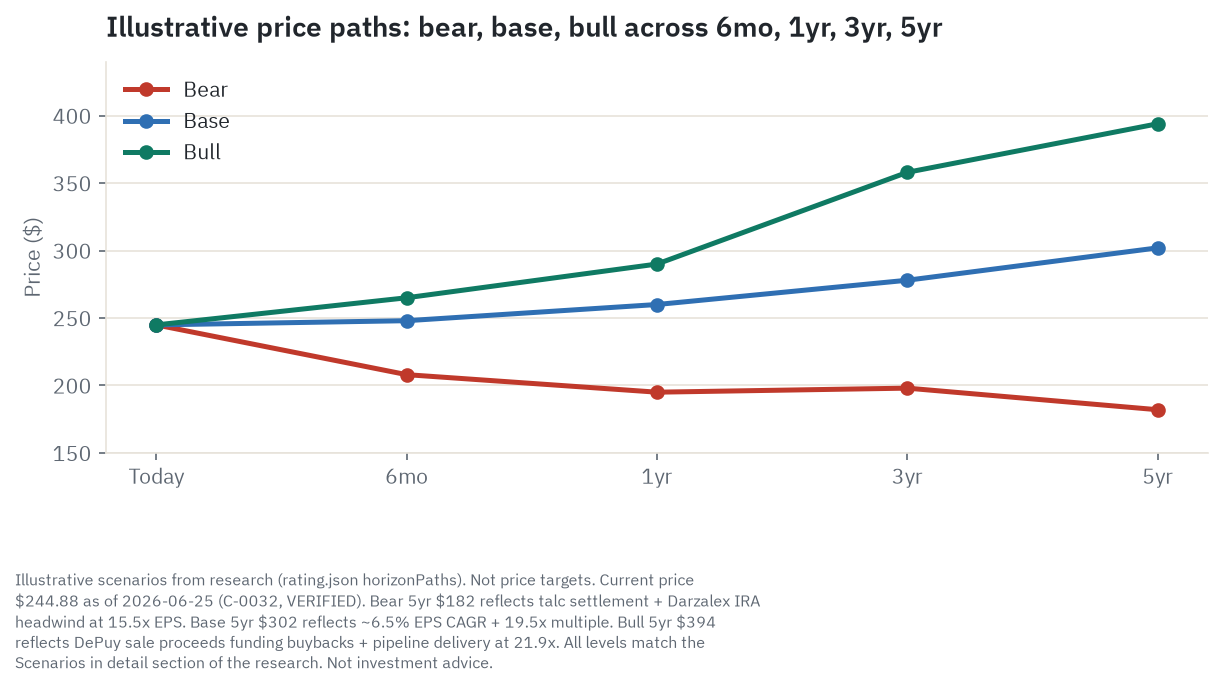
The next six months pivot on two dated events. Q2 2026 earnings land July 15 - the first clean quarter that will show how well Darzalex, Tremfya, Carvykti, and Caplyta are filling the hole left by Stelara’s ongoing decline. The second event is CMS’s publication of Erleada’s Maximum Fair Price under the IRA, expected November 2026, which will reveal the size of the Medicare discount on a drug generating roughly $3.6 billion in annual sales. In the base case those replacements are on track, Erleada’s MFP lands in the 40-60% range, and the stock drifts close to its current level, arriving near $248. A guidance raise on top of a favorable Erleada MFP number could push it to $265. The bear at $208 requires the Erleada MFP to land at 70% or above - a shock the market has not fully discounted - combined with any negative headline from the Carter Judkins federal bellwether talc trial scheduled for the second half of 2026. The single thing most likely to flip this horizon is the MFP announcement in November.
At one year the driver shifts to whether J&J’s FY2027 adjusted earnings consensus of approximately $12.70 (an estimate, not a primary filing figure) survives Erleada’s first year living under IRA pricing. The base at $260 assumes DePuy Synthes’s separation stays on an 18-24 month schedule from October 2025, talc litigation remains a costly tort grind rather than a settlement requiring a large reserve charge, and the multiple holds around 20.5x on sustained earnings momentum. The bull at $290 adds a confirmed DePuy sale above $20 billion in enterprise value - Bloomberg reported in February 2026 that J&J was exploring that option (a secondary press report, unconfirmed by J&J) - which would meaningfully reduce net debt and likely pull analysts toward a higher quality premium. The bear at $195 combines an adverse Carter Judkins verdict, a large reserve charge, and Erleada’s MFP landing at the high end, compressing the multiple toward 17x. That combination is possible but unlikely to materialize fully in 12 months. The single thing most likely to flip: the bellwether talc verdict.
Three years out the structural drivers are portfolio durability and the DePuy Synthes question. By 2028 Stelara’s decline will be fully absorbed, and the real test is whether Darzalex’s Faspro subcutaneous formulation - patent-protected to May 2036 with a second wall at April 2040 - can sustain 10-15% annual growth while Carvykti reaches the frontline myeloma indication via the CARTITUDE-5 Phase 3 readout. The base at $278 assumes roughly $14.25 in FY2029 adjusted EPS, Erleada’s IRA headwind absorbed by portfolio growth, DePuy separation complete, and the multiple at a steady-state quality-compounder 19.5x. The bull at $358 stacks DePuy sale proceeds (enough to retire roughly 75 million shares), a positive CARTITUDE-5 readout that moves Carvykti into earlier-line myeloma, and Darzalex approaching $21 billion globally, producing near $16.25 in FY2029 EPS at 22x. The bear at $198 materializes if talc settles at $12-15 billion total (generating additional reserve charges well above the current $3.4 billion book), Erleada loses 70% of Medicare pricing, and Darzalex decelerates toward 8-10% annual growth amid political pressure on the orphan exemption, leaving FY2029 EPS near $12 at a litigated-company 16.5x. The single thing most likely to flip the three-year horizon: Congressional action on the OBBBA orphan-drug exemption protecting Darzalex.
The five-year view is a platform durability question. Darzalex’s orphan-exemption wall under the OBBBA (the 2025 federal budget law) keeps it insulated from IRA negotiation through at least 2031, but that exemption cost Medicare an estimated $8.8 billion over 10 years per the Congressional Budget Office - large enough to attract attention whenever drug pricing returns to the legislative agenda. Invega Sustenna faces a generic entry date around January 2031 per DrugPatentWatch (a press-tier source, not primary filing confirmation), putting approximately $3.8 billion in FY2025 revenue at risk in the out-years (the franchise including Invega Trinza generated $3,810 million in FY2025, down 9.8% year-over-year). Against those headwinds, Rybrevant plus Lazcluze in lung cancer could, if management’s $5 billion annual revenue target proves closer to correct than analyst consensus near $1.8 billion, meaningfully change the growth picture in the late 2020s. The base at $302 assumes roughly $15.50 in FY2031 adjusted EPS at 19.5x. The bull at $394 builds in the DePuy sale buyback impact, a clean post-DePuy narrative, and approximately $18 in EPS at 21.9x. The bear at $182 sees the Darzalex orphan exemption narrowed by a 2029 legislative correction, the Invega generic cliff hitting EPS by around $0.60 per share, ongoing talc costs, and stagnant EPS near $11.75 at 15.5x. The single thing most likely to flip the five-year horizon is the durability of Darzalex’s competitive and regulatory protection.
Where the read lands today: J&J is a Hold. The quality is genuine and well-documented. The price reflects most of it. I would hold a position here but not add to it.
Companion tool
The interactive dashboard lets you sort, filter, and compare all 15 companies in J&J’s competitive orbit across valuation, growth, quality, risk, and momentum dimensions. The Excel model is a downloadable scenario builder with adjustable EPS and multiple assumptions for each horizon.
TL;DR
J&J posted $94.2 billion in FY2025 revenue and grew adjusted EPS 8.1% to $10.79, absorbing the largest single-drug biosimilar cliff in pharma history: Stelara lost $4.3 billion in revenue from FY2024 to FY2025, and Darzalex grew $2.6 billion in the same period without missing a beat. The company holds AAA and Aaa credit ratings - one of only two US corporations still carrying that designation from both agencies - has raised its dividend for 64 consecutive years, generated $19.7 billion in free cash flow in FY2025, and guided FY2026 adjusted EPS to a midpoint of $11.55. At $244.88 and roughly 21x forward earnings, after a one-year total return somewhere in the range of 48-58% (source estimates vary), the re-rating from the 13-15x multiple that reflected talc uncertainty is largely complete. Three live unknowns keep this at Hold rather than Buy: the talc litigation, where 68,000-plus federal MDL cases sit against a $3.4 billion on-book reserve and analyst exposure estimates in the $10-15 billion range; the Erleada IRA MFP coming November 2026; and whether DePuy Synthes’s separation - as spin or sale - can unlock meaningful capital return. A FTC antitrust brief filed against J&J’s Stelara patent strategy on June 23, 2026 added a new layer of long-term regulatory risk that the market shrugged off on the day but has not fully priced. The franchise earns its AAA for a reason. The question is just what you pay for it.
Explore it yourself: the interactive dashboard
What Johnson & Johnson actually is today
Most people still picture J&J as the baby shampoo and Band-Aid company. That business is now Kenvue, publicly traded under the ticker KVUE since 2023 and fully divested by J&J in May 2024 for roughly $7.9 billion in total proceeds. The strategic rationale for the spinoff was direct: concentrate the parent on higher-margin pharmaceutical and MedTech assets, let Kenvue be valued against consumer-staples peers instead of being dragged by a healthcare conglomerate discount, and free each company to allocate capital against its own growth profile - a logic that now previews the DePuy Synthes separation underway today. What remains is two industrial-scale segments.
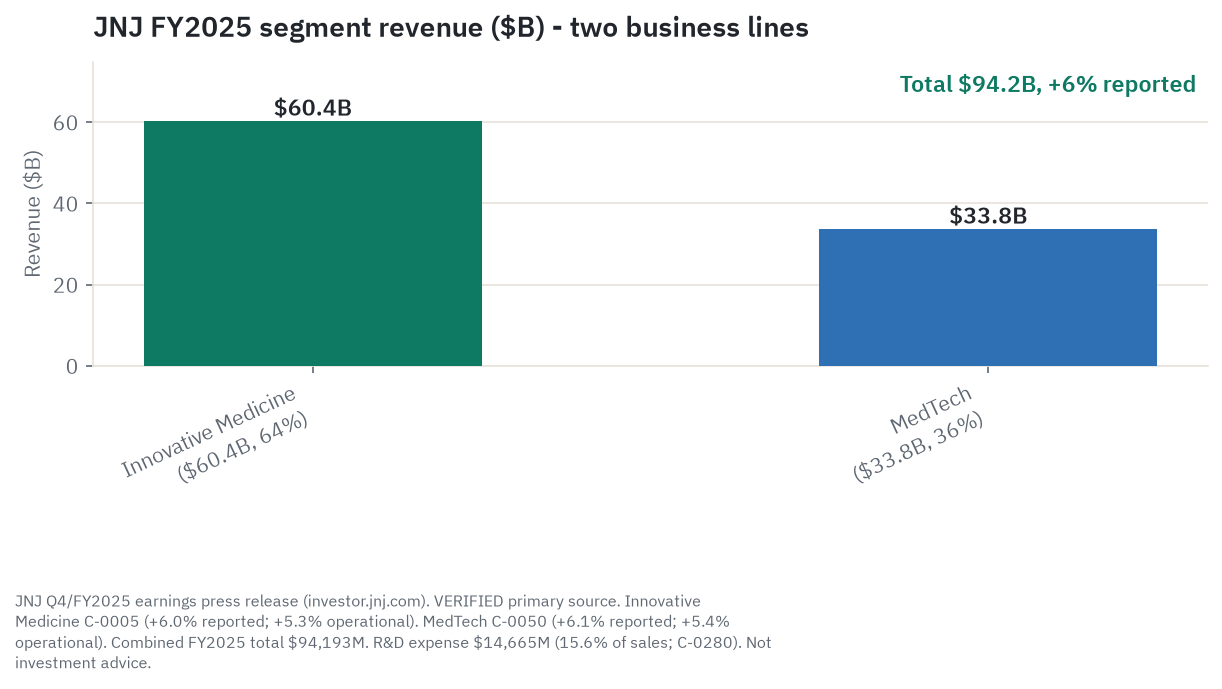
Innovative Medicine generated $60.4 billion in FY2025 sales at a 36.9% segment income-before-taxes (IBT) margin. This is a pharmaceutical engine concentrated in multiple myeloma, immunology, oncology, pulmonary hypertension, and mental health - with a capital-light model that earns roughly $1 in incremental IBT for every $2.71 in incremental revenue, once the drug reaches commercial scale. The heavy lifting is in R&D: $14.7 billion spent in FY2025 across research centers in Beerse (Belgium), Leiden (the Netherlands), Raritan (New Jersey), and elsewhere.
MedTech generated $33.8 billion in FY2025 sales at a 12.2% IBT margin. The contrast with pharma margins reflects the device industry’s higher capital intensity, shorter product cycles, and thinner pricing power versus branded drugs with 20-year patent protection. MedTech spans cardiovascular devices, surgical robotics in development, advanced surgical instruments, and orthopaedics - and it is in the middle of its own transformation.
The DePuy Synthes orthopaedics and spine unit, contributing roughly $9.3 billion annually, was announced for separation in October 2025 on an 18-24 month timeline, as either a spin-off or a sale. Bloomberg reported in February 2026 that J&J was exploring a sale above $20 billion in EV (a secondary press account; J&J has not confirmed terms or structure). If the separation closes as a sale, the remaining MedTech segment - centered on Biosense Webster electrophysiology, Shockwave intravascular lithotripsy, Abiomed heart pumps, and the Ottava surgical robot - would sit at roughly $24.5 billion in revenue running at a structurally higher growth rate. Think of it as trading low-growth orthopaedics, which faces GLP-1-driven demand uncertainty and China volume-based procurement pressure, for a faster-growing cardiovascular and robotics franchise.
How money flows through JNJ
flowchart TD
    RD["R&D Spend\n$14.7B/yr FY2025\n(Beerse, Leiden, Raritan)"]
    CLINICAL["Clinical Trials\n(JNJ + CRO partners)"]
    API_SM["Small-Molecule API\nGeel, Belgium\n~80% of JNJ APIs [C-0237]"]
    API_BIO["Biologics Drug Substance\nLeiden NL + Ireland (6 plants)\nWilson NC 2028 [C-0236]"]
    CART["CAR-T Mfg (Carvykti)\nRaritan NJ + Ghent BE\nLegend Biotech partner [C-0240]"]
    HALOZYME["Halozyme ENHANZE\nRoyalty on SC sales\n[C-0252]"]
    GENMAB["Genmab A/S\n12-20% Darzalex royalty\n~$2.4B est. [C-0250]"]
    JNJ_BRAND["JNJ Brand / IP Owner\nIM seg margin 36.9%\nMedTech seg margin 12.2% [C-0256]"]
    WHSL["Big 3 Wholesalers\nMcKesson, Cencora, Cardinal\n90%+ US drug distribution [C-0242]"]
    PBM["Big 3 PBMs\nESI, CVS Caremark, OptumRx\n200M+ covered lives [C-0244]"]
    CMS["CMS / IRA Pricing\nStelara MFP ~$4,695/mo\nDarzalex IRA-exempt thru IPAY 2029 [C-0266]"]
    GPO["Hospital GPOs\nVizient, Premier, HealthTrust\n75%+ hospital purchasing [C-0246]"]
    PATIENT_RX["Patient / Specialty Pharmacy\n(Oral / SC maintenance drugs)"]
    PATIENT_IV["Patient / Hospital Outpatient\n(Darzalex, Carvykti, Rybrevant\nPart B buy-and-bill)"]
    HOSPITAL["Hospitals / Surgeons / Labs\n(MedTech procedures)"]
    SHAREHOLDER["Shareholder Returns\n$18.3B FY2025 dividends + buybacks\n63yr dividend streak [C-0208]"]

    RD --> CLINICAL
    CLINICAL --> API_SM
    CLINICAL --> API_BIO
    CLINICAL --> CART
    API_SM --> JNJ_BRAND
    API_BIO --> JNJ_BRAND
    CART --> JNJ_BRAND
    HALOZYME -->|royalty toll| JNJ_BRAND
    GENMAB -->|royalty toll| JNJ_BRAND
    JNJ_BRAND --> WHSL
    JNJ_BRAND --> GPO
    WHSL --> PBM
    CMS -->|price ceiling| PBM
    PBM --> PATIENT_RX
    WHSL --> PATIENT_IV
    GPO --> HOSPITAL
    PATIENT_RX -->|net revenue| JNJ_BRAND
    PATIENT_IV -->|net revenue| JNJ_BRAND
    HOSPITAL -->|net revenue| JNJ_BRAND
    JNJ_BRAND --> SHAREHOLDER
Innovative Medicine: the drug portfolio
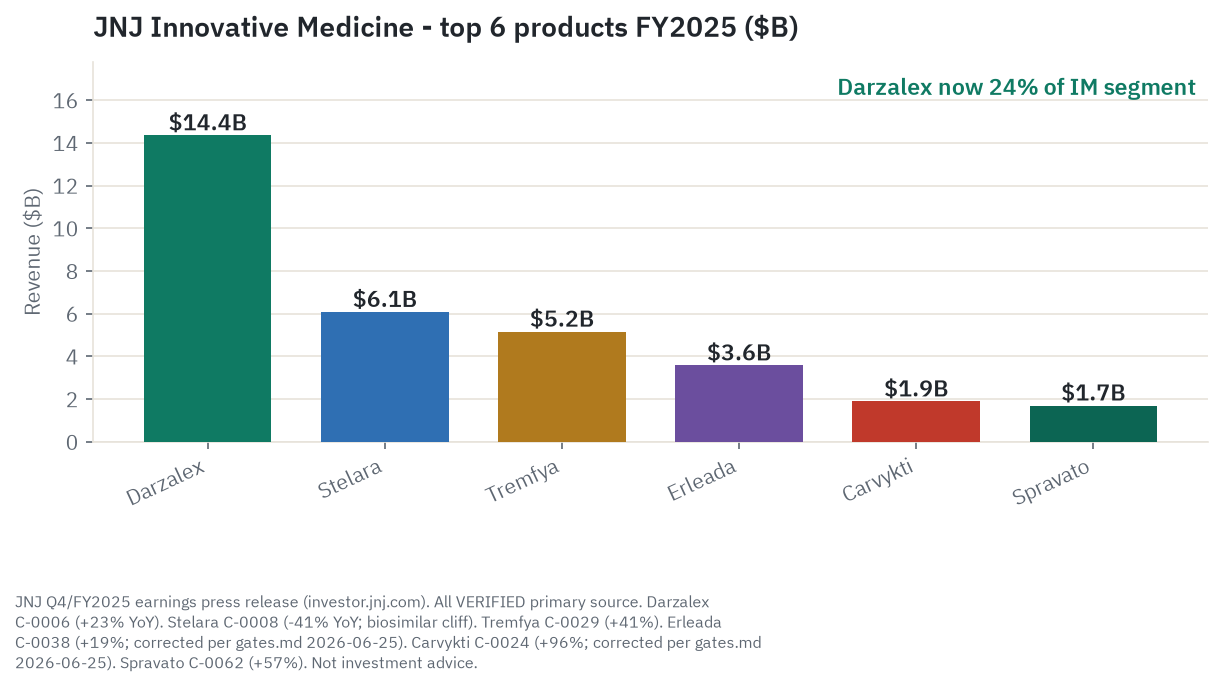
Darzalex: the franchise anchor
Darzalex (daratumumab) is J&J’s largest product and the engine that carried the company through Stelara’s fall. FY2025 revenue: $14,351 million, up 23.0% year-over-year. In Q1 2026 it grew another 22.5% to $3,964 million, putting it on a run-rate well above $15 billion annually.
The mechanism behind the growth is straightforward: multiple myeloma kills roughly 35,000 Americans per year, median survival without treatment is a few months, and Darzalex has earned FDA approval in nearly every line of therapy from newly diagnosed to late relapse. Each new approval expands the addressable patient pool and moves treatment earlier, where patients are healthier, take the drug longer, and generate more revenue per patient. The SC formulation, marketed as Darzalex Faspro using the Halozyme ENHANZE delivery platform, takes roughly 3-5 minutes to inject subcutaneously versus a 3-6 hour IV infusion, which has made it the dominant mode in most markets and deepened competitive barriers.
The payer economics for Darzalex are more favorable than most people appreciate. Because it is administered in a physician’s office or infusion center, it reimburses under Medicare Part B at the ASP-plus-6% rate (ASP = Average Sales Price, a CMS-calculated benchmark; the “+6%” is an add-on to the site of care). Gross-to-net adjustments are modest compared with oral drugs that move through pharmacy channels and must survive PBM (pharmacy benefit manager - organizations that control formulary positioning and rebate negotiations for 200 million-plus commercially insured lives) contract negotiations. That means reported revenues are close to actual cash collected. J&J’s own 2024 US Pricing Transparency Report disclosed $47.8 billion in rebates, discounts, and fees paid across its US portfolio - illustrating how large the gross-to-net wedge is for its oral Part D drugs by contrast. Darzalex mostly sits outside that wedge.
The intellectual property picture is equally favorable. The Darzalex Faspro formulation patent runs to May 2036, with a second wall at April 2040. These dates matter for competitive modeling: any eventual biosimilar would start in IV-only form (no access to the SC Faspro formulation), competing against a convenient 3-to-5-minute subcutaneous option that years of clinical training will have embedded in practice. In November 2025, the FDA approved Darzalex Faspro for high-risk smoldering multiple myeloma (HR-SMM) based on the AQUILA trial data, expanding the addressable patient pool further into earlier disease - a meaningful label addition that is not yet fully reflected in market models.
The orphan-drug exemption under the OBBBA (the 2025 federal budget law, officially the One Big Beautiful Bill Act) blocks CMS from selecting Darzalex for IRA price negotiation through at least the IPAY 2029 cycle. IPAY stands for Initial Price Applicability Year - the CMS term for the year when a negotiated Maximum Fair Price first takes effect. Orphan-drug designation applies to drugs for rare diseases affecting fewer than 200,000 US patients; Darzalex holds this designation for multiple myeloma. The exemption has a price tag the CBO estimated at $8.8 billion over 10 years - large enough to attract legislative attention if drug pricing returns to the Congressional agenda.
One structural cost sits on top of Darzalex’s gross margin: a tiered royalty of 12-20% paid to Genmab A/S, the Danish biotech that co-developed the antibody and licensed the CD38 mechanism. Genmab’s FY2025 total royalty revenue was approximately $3.1 billion, of which the vast majority is attributable to Darzalex. An implied effective royalty rate around 17% on $14.4 billion in sales would equal roughly $2.4 billion flowing to Genmab annually - this is a research estimate, not a figure either company separately discloses. A separate Halozyme royalty applies to the subcutaneous formulation. Both are sunk costs to J&J and are already reflected in the 36.9% segment IBT margin.
Stelara: the managed decline
Stelara (ustekinumab) peaked at roughly $10.9 billion in FY2023 and has been in steep decline since multiple biosimilars entered the US market in January 2025. A biosimilar is a competing biologic (a large-molecule drug derived from living cells) that launches after a reference drug’s patents expire; payers and PBMs can substitute it aggressively on formulary, driving large price cuts. FY2025 revenue was $6,078 million, down 41.3%. Q1 2026 revenue was $656 million, down 59.7% year-over-year.
The pattern here is instructive. Stelara’s dollar-share biosimilar penetration reached roughly 27% within 9-12 months of launch - approximately twice the speed Humira experienced in its first year (roughly 2% at the same point). Four factors drove the faster erosion, not two. First, the IRA Maximum Fair Price (-66% vs. list, effective January 1, 2026) compounded with the biosimilar launches simultaneously, squeezing the branded Stelara price floor from two directions at once. Second, Selarsdi (Teva/Alvotech’s ustekinumab biosimilar) achieved FDA interchangeable status in April 2025 - a designation that allows a pharmacist to substitute the biosimilar for the branded drug without a new physician prescription, removing a key adoption friction. Third, 9-plus biosimilar versions were commercially available by mid-2025, creating competitive pressure that drove list prices 80-90% below Stelara’s WAC within months of launch. Fourth, Stelara is a subcutaneous self-inject drug where formulary switching is administratively simpler than a drug requiring in-office infusion, so payer pressure translated immediately to patient-level substitution.
The lesson for modeling Darzalex’s eventual patent expiry (far out, but worth noting): once biosimilar access arrives on a self-inject product facing simultaneous IRA pricing pressure, the cliff can arrive faster than the Humira playbook suggests. And Darzalex’s eventual biosimilar will face an additional structural disadvantage from Faspro’s patent wall - it would enter as an IV-only competitor against a clinically entrenched subcutaneous option.
The Stelara-to-Tremfya handoff is critical for 2026. Tremfya targets IL-23 (a later node on the same pathway as Stelara’s dual IL-12/23 blockade) and is FDA-approved for plaque psoriasis, psoriatic arthritis, Crohn’s disease, and ulcerative colitis. The UC and Crohn’s approvals, filed under the TREMFYA program, are expanding the patient pool directly from Stelara’s primary indications. Q1 2026 showed Tremfya up 68.3% to $1,608 million - the fastest growth in J&J’s portfolio.
Tremfya, Carvykti, Erleada, and the growth drivers
Tremfya (guselkumab): FY2025 revenue $5,155 million (+40.5%). The GI approvals are still early in their rollout. Peak sales estimates from sell-side analysts range from $8-10 billion if it captures Stelara’s immunology franchise and adds GI penetration; this is a management-directional projection and not a consensus estimate verified from primary sources.
Simponi/Simponi Aria (golimumab): FY2025 revenue $2,668 million (+21.8%). Golimumab is an anti-TNF (tumor necrosis factor) monoclonal antibody approved for rheumatoid arthritis, psoriatic arthritis, ankylosing spondylitis, and ulcerative colitis. The intravenous Simponi Aria formulation has fueled the recent growth in the hospital setting; US biosimilar competition (Immgolis, FDA interchangeable approval May 2025) is an emerging headwind.
Remicade (infliximab): FY2025 revenue $1,768 million (+10.2%). Infliximab is an older anti-TNF; most markets face established biosimilar competition, and the FY2025 growth largely reflects pricing dynamics in remaining branded markets rather than volume expansion.
Carvykti (ciltacabtagene autoleucel, cilta-cel): FY2025 revenue $1,887 million (+95.9%). Note that earlier draft data for this article contained the FY2024 figure of $963 million mislabeled as FY2025; this figure has been corrected per the auto-gate resolution. Carvykti is a chimeric antigen receptor T-cell (CAR-T) therapy - a treatment where a patient’s own T-cells are removed, genetically engineered to recognize cancer targets, and reinfused - developed jointly with Legend Biotech (which handles the Chinese market under the Cilta-cel designation) targeting BCMA (B-cell maturation antigen) on myeloma cells. Each treatment is made from the individual patient’s own T-cells, extracted and then engineered at Raritan and Ghent facilities over roughly 4-6 weeks before reinfusion. List price is approximately $465,000 per treatment course. Manufacturing COGS is estimated at 30-40% of list price, reflecting the patient-specific production and the significant quality-control burden of cell therapy. Think of it less like a factory and more like a precision tailoring shop that can only serve one customer at a time. Growth at 95.9% in FY2025 and 62.1% in Q1 2026 reflects both an expanded supply network and CARTITUDE-4 data supporting earlier-line use. The CARTITUDE-5 frontline trial, if positive, would open the newly-diagnosed myeloma population and could double the addressable patient pool - no read date is confirmed.
Erleada (apalutamide): FY2025 revenue $3,574 million (+19.2%). Note the earlier-draft data issue here too: $2,999 million was the FY2024 figure. Erleada is an oral androgen receptor inhibitor for non-metastatic castration-resistant prostate cancer and metastatic castration-sensitive prostate cancer. It reached the IPAY 2028 IRA negotiation list per CMS’s January 2026 announcement; the Maximum Fair Price will be published in November 2026. Estimates for the discount range from 40% to 80% on Medicare-covered volumes - the actual number could remove anywhere from roughly $700 million to $1.8 billion annually from J&J’s top line once it takes effect in 2028. Erleada’s commercial generics are protected by formulation patents running to approximately 2040, despite a Zydus Pharmaceuticals paragraph IV certification approved in March 2025 (Zydus won approval but faces patent litigation on the formulation patents). The IRA issue is the near-term risk, not generic entry.
Spravato (esketamine): FY2025 revenue $1,696 million (+57.4%). This is an intranasal ketamine derivative for treatment-resistant depression, administered in a REMS-certified clinical setting under direct observation. It addresses a severe, underserved population and carries essentially no PBM rebate exposure because it must be dosed in a registered healthcare setting. Q1 2026 growth continued at strong double-digit rates.
Caplyta (lumateperone): FY2025 revenue $700 million (partial year; Intra-Cellular Therapies acquired April 2025 for $14.6 billion). Caplyta is an oral atypical antipsychotic FDA-approved for schizophrenia, bipolar I depression, bipolar II depression, and - following the November 6, 2025 approval under JNJ ownership - major depressive disorder (MDD) as an adjunctive therapy: four indications in total. J&J management projects Caplyta at $5 billion-plus in peak annual sales - a management target, not a sell-side consensus figure - based on the breadth of the indication set and the MDD launch trajectory, which opens the largest addressable patient pool of the four. Twelve months of revenue in a normalized full year would run at a materially higher annualized rate than the partial-year $700 million.
Imbruvica (ibrutinib): FY2025 revenue $2,823 million (-7.1%). This BTK (Bruton’s tyrosine kinase) inhibitor for blood cancers is co-developed and co-promoted with AbbVie. Imbruvica faces competitive pressure from newer BTK inhibitors with more selective binding profiles and better-established safety records - most notably AstraZeneca’s Calquence (acalabrutinib), which has gained share by demonstrating a cleaner atrial fibrillation signal in head-to-head data. Revenue erosion is expected to continue, and the IRA IPAY 2026 MFP (38% discount) adds further pressure on the Medicare Part D portion of the volume.
Xarelto (rivaroxaban): approximately $2,633 million in FY2025 (this figure was corrected from an earlier data error per the auto-gate resolution; Xarelto is a Bayer-licensed product, and J&J co-promotes it in the US). Revenue is in gradual decline as generic rivaroxaban enters the market; this is a managed-decline product.
Invega Sustenna / Invega Trinza (paliperidone palmitate): FY2025 revenue $3,810 million (-9.8% from $4,222 million in FY2024). These are long-acting injectable formulations of the antipsychotic paliperidone, administered monthly (Sustenna) or every three months (Trinza) for schizophrenia - a pharmacological equivalent of a depot shot rather than a daily oral pill, which significantly reduces adherence problems in a patient population where consistent medication is clinically critical. Generic entry is estimated around January 2031 (DrugPatentWatch, press-tier source; not confirmed from a primary patent filing or court order), at which point approximately $3.8 billion in annual revenue will be at risk. This is J&J’s next meaningful patent cliff after Erleada.
Pulmonary hypertension (Uptravi and Opsumit): Both were acquired from Actelion in 2017. Opsumit (macitentan) generated $2,325 million in FY2025 (+4.5%). J&J’s own FY2025 10-K explicitly states the company expects generic competition for Opsumit in 2026, which would likely result in a significant reduction in future sales - a disclosed, near-term headwind. Uptravi (selexipag) contributed the remainder of the combined PH portfolio.
Rybrevant (amivantamab) and Lazcluze (lazertinib): This combination bispecific targets EGFR and MET mutations in non-small cell lung cancer. FY2025 combined revenue was $734 million, growing above 80% quarterly. The clinical argument for the management optimism: in the MARIPOSA Phase 3 trial, the combination delivered a hazard ratio for overall survival of 0.75 against osimertinib (AstraZeneca’s Tagrisso, which commands roughly 60%-plus first-line market share) - a 25% reduction in the risk of death, statistically significant (p less than 0.005). At the 37.8-month follow-up, median OS was not yet reached for the combination versus 36.7 months for Tagrisso; 56% of combination patients were alive at 3.5 years versus 44% on Tagrisso. MARIPOSA is the first chemotherapy-free combination regimen to demonstrate an OS advantage over osimertinib. A subcutaneous formulation (Rybrevant Faspro, using the Halozyme ENHANZE platform) received FDA approval December 17, 2025, reducing administration time to approximately 5 minutes versus hours of IV infusion.
J&J management has stated a $5 billion-plus peak annual sales target; sell-side analyst consensus is approximately $1.8 billion (GlobalData estimated $3.9 billion in a separate projection). The analyst caution reflects Tagrisso’s deeply entrenched 60%-plus market share, which has survived earlier clinical challenges, and uncertainty about the time required to convert prescribers at this penetration depth. The divergence between the OS data (favorable) and the analyst consensus (cautious) is the key tension in modeling this asset. Readers should treat the management target as a ceiling and the analyst consensus as a planning baseline rather than a forecast.
Bispecifics - Talvey and Tecvayli: ASCO 2026 data for Talvey (talquetamab, GPRC5D x CD3) showed 72% progression risk reduction and 53% death risk reduction in the MonumenTAL-3 study. Tecvayli (teclistamab, BCMA x CD3) is the earlier-approved bispecific. Both are approved for relapsed/refractory myeloma and building revenue bases; they are currently small contributors but serve as pipeline options if Carvykti manufacturing capacity remains a growth bottleneck.
The Innovative Medicine pipeline
J&J received six notable regulatory approvals in the FY2025-Q1 2026 window:
- Caplyta for MDD (November 6, 2025): expanded Caplyta’s label from bipolar depression to major depressive disorder, materially widening the addressable population
- Icotyde (icotrokinra) (March 18, 2026): FDA approved for plaque psoriasis; first IL-17A receptor antagonist SC injection (monthly dosing); early in launch
- IMAAVY (nipocalimab) (April 30, 2025): FDA approved for generalized myasthenia gravis (gMG; antibody-positive patients age 12 and up). Nipocalimab is an FcRn blocker - it reduces circulating IgG antibodies that drive the neuromuscular attacks in gMG. A separate sBLA for warm autoimmune hemolytic anemia (wAIHA) is under FDA Priority Review as of June 2026; a Phase 3 trial in systemic lupus erythematosus (SLE, the GARDENIA study) was initiated January 2026 following positive Phase 2b results. Nipocalimab is an internally developed JNJ compound; it is distinct from the Halda Therapeutics acquisition, which brought a separate oncology platform (see capital allocation section).
- INLEXZO / TAR-200 (September 9, 2025): intravesical device releasing gemcitabine for bladder cancer
The Carter Judkins federal bellwether trial in MDL 2738, the CARTITUDE-5 frontline myeloma readout, and the Ottava commercial launch timeline (dependent on the FDA De Novo decision) are the three non-filing catalysts most likely to move the stock materially over 18 months.
MedTech: the device portfolio
Cardiovascular: the fastest-growing sub-segment
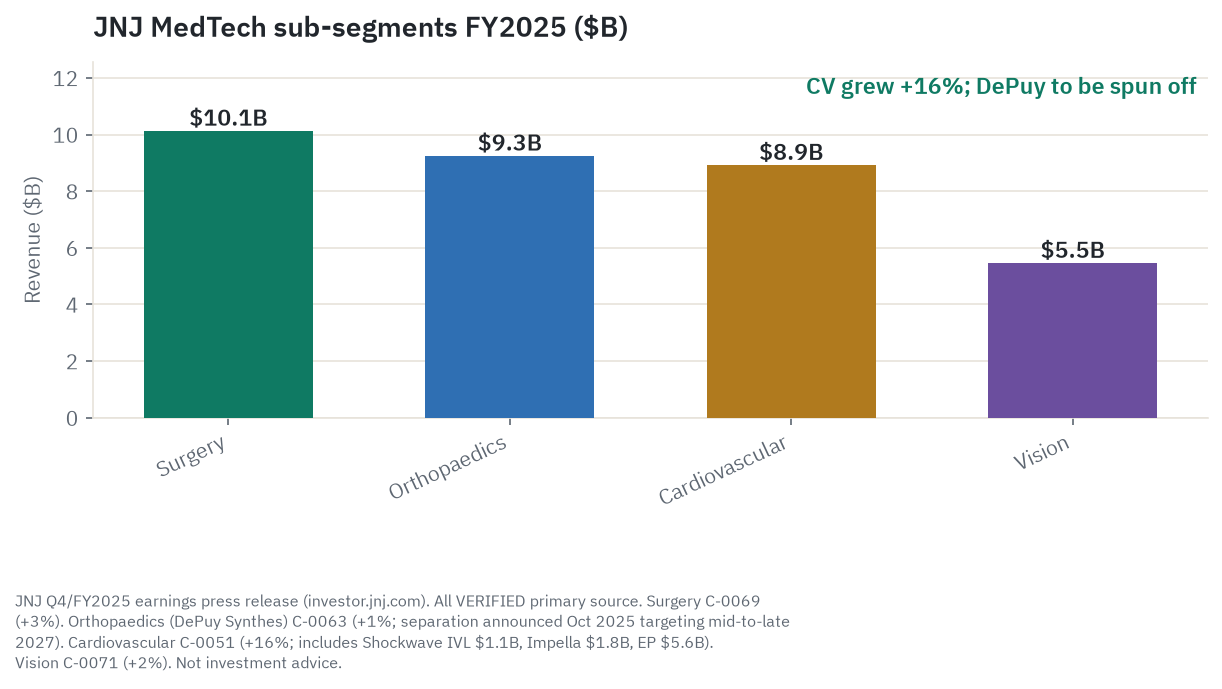
Cardiovascular generated $8,928 million in FY2025, up 15.8%. The growth is driven by three products at different stages of their adoption curves.
Biosense Webster (electrophysiology catheters and mapping systems): $5,634 million in FY2025. This is the dominant global franchise in catheter ablation for atrial fibrillation. Think of electrophysiology as precision cardiac GPS: a cardiologist navigates an electrode catheter into the heart, maps the electrical architecture in three dimensions, then burns or freezes the tissue generating aberrant signals. Biosense Webster’s CARTO system is the standard-of-care mapping platform in most US and European EP labs, which creates a lock-in effect analogous to a professional software suite - once the procedural team is trained and the hospital has integrated the system, switching costs are high.
Biosense Webster also fields the Varipulse pulsed-field ablation (PFA) system, which uses microsecond electrical pulses to selectively destroy cardiac tissue with less thermal spread and potentially lower risk of collateral injury than traditional radiofrequency or cryoballoon ablation. The Varipulse received FDA approval November 7, 2024; a brief pause in US rollout in January 2025 following four stroke reports was resolved and the system restarted in February 2025. A next-generation Varipulse Pro received CE Mark in Europe April 2026. JNJ used roughly 40,000 AFib patients globally in FY2025. The PFA market also includes Boston Scientific’s Farapulse - the current market leader by volume in PFA - and Medtronic’s PulseSelect, so Varipulse is competing in a segment where it is not the only new entrant. The mapping-system advantage (CARTO-3 integration) is where Biosense Webster’s durable competitive position lives; PFA catheter market share will require sustained clinical investment to build.
Abiomed (Impella heart pumps): $1,751 million in FY2025, up roughly 17.1%. Impella is a catheter-mounted micro-axial pump that temporarily takes over from a failing left ventricle during high-risk PCI procedures or cardiogenic shock. There is no equivalent device at scale; the clinical evidence base supports it in the highest-acuity cardiac settings.
Shockwave Medical (intravascular lithotripsy): $1,146 million in FY2025 (partial year following the $13.1 billion acquisition in May 2024). Shockwave’s IVL technology uses acoustic sound waves to fracture calcified plaque in coronary and peripheral arteries - calcium that is too hard for standard angioplasty balloons to compress. The coronary catheter sells at roughly $4,700 average selling price, and the market is in early adoption. Shockwave holds near-monopoly positioning until Abbott’s TECTONIC IVL system enters the market, expected around 2028. At that point the IVL market will have two competitors rather than one, which typically slows ASP growth while expanding overall category penetration.
Surgery and Ottava
Surgery generated $10,137 million in FY2025, up 3.0%. The Ethicon franchise (sutures, staplers, energy devices) is the base. The strategic bet here is Ottava, J&J’s surgical robot. J&J filed a FDA De Novo application for Ottava on January 7, 2026. De Novo review typically takes 9-15 months, putting commercial clearance at a theoretical earliest date of late 2026 but more realistically 2027.
Ottava faces an almost comically difficult competitive environment. Intuitive Surgical has 11,106 da Vinci systems installed worldwide (as of the most recent public data), each one generating a recurring blade-and-accessory revenue stream that makes the da Vinci approximately as defensible as a video-game console ecosystem. Ottava is entering this market with a materially different design (a 4-arm table-integrated robot rather than a bedside cart), which means it cannot directly reuse any of the 30 years of da Vinci procedural training that surgical residents have absorbed. Medtronic’s Hugo robot was cleared in December 2025, entering the market before Ottava. The opportunity is real - robotic surgery penetration outside the US is still low and da Vinci’s lead is not insurmountable - but the incumbency challenge is severe, and roughly 40% of hospital CFOs in 2026 surveys reported deferring major capital equipment purchases. This is a 5-10 year buildout story, not a near-term revenue driver.
Vision
Vision generated $5,469 million in FY2025, up 2.3%, led by ACUVUE contact lenses. GLP-1-related body composition changes do not affect contact lens demand materially, and this franchise has modest but consistent growth.
Orthopaedics and DePuy Synthes
DePuy Synthes generated $9,258 million in FY2025, up 1.1%. This is the lowest-growth sub-segment, affected by China’s volume-based procurement program (55-84% price cuts in orthopaedics, per available data), GLP-1-driven bariatric surgery volume reduction reducing knee replacement demand, and intensifying competition from Stryker and Zimmer Biomet. The DePuy separation removes J&J’s primary VBP and GLP-1 demand exposure; post-separation, the remaining MedTech portfolio is structurally healthier from a growth standpoint. DePuy CEO Namal Nawana was named to lead the future independent entity.
The Stelara cliff and IRA drug pricing exposure
The IRA Medicare drug pricing negotiation is the most structurally significant regulatory development affecting J&J’s portfolio in this decade. Each negotiation cycle is identified by its IPAY (Initial Price Applicability Year - the CMS term for the year in which a new Maximum Fair Price first takes effect). Here is the current schedule:
| IPAY | JNJ Product | MFP Published | MFP Effective | Disclosed/Estimated Discount |
|---|---|---|---|---|
| IPAY 2026 | Stelara | Sept 1, 2024 | Jan 1, 2026 | ~66% below list (~$4,695/30-day-supply, per press sources) |
| IPAY 2026 | Xarelto (Bayer/JNJ) | Sept 1, 2024 | Jan 1, 2026 | ~62% below list |
| IPAY 2026 | Imbruvica (JNJ/AbbVie) | Sept 1, 2024 | Jan 1, 2026 | ~38% below list |
| IPAY 2027 | No JNJ products selected | - | - | - |
| IPAY 2028 | Erleada | TBD November 2026 | Jan 1, 2028 | Estimate: 40-80% below list |
Stelara’s ~66% MFP applies to the Medicare Part D portion of Stelara revenue. Stelara’s overall decline in FY2025 was driven more by biosimilar competition than the IRA price alone - the biosimilar launched January 2024 and captured roughly 27% dollar-share within 9-12 months. The IRA MFP adds a floor effect: even the remaining branded Stelara revenue reimburses at a deep discount. For practical modeling purposes, Stelara is in permanent managed decline and will contribute negligible revenue by 2027.
The FY2026 Stelara offset bridge (estimate). A reasonable concern heading into 2026 was whether J&J’s portfolio could absorb a second large Stelara step-down on top of the $4.3 billion already absorbed in FY2025. The table below shows that the diversified portfolio is arithmetically sufficient under base assumptions - consistent with the $11.55 adjusted EPS guidance midpoint. All figures are estimates, not guidance or primary filing data.
| Source | FY2025 actual | FY2026 estimate (base) | Change (estimate) |
|---|---|---|---|
| Stelara | $6,078M | ~$2,500M | -$3,578M |
| Darzalex (+20% est.) | $14,351M | ~$17,221M | +$2,870M |
| Tremfya (+18% est.) | $5,155M | ~$6,083M | +$928M |
| Carvykti (+30% est.) | $1,887M | ~$2,453M | +$566M |
| Caplyta (full yr vs. partial) | $700M | ~$1,200M | +$500M |
| Erleada (+12% est.) | $3,574M | ~$4,003M | +$429M |
| Spravato + other growth (est.) | various | various | +~$600M |
| Net Innovative Medicine | +~$1,315M (est.) | ||
| MedTech growth (~mid-single digit est.) | $33,792M | ~$35,200M | +~$1,408M |
| Total revenue estimate | $94,193M | ~$100,800M | +~$6,607M |
The key vulnerability in this bridge is Darzalex deceleration. If Darzalex grows at 12% rather than the assumed 20%, roughly $1.1 billion of the offset disappears and FY2026 adjusted EPS could fall short of the $11.55 guidance midpoint by approximately $0.20-0.30. This is why Darzalex’s quarterly growth rate is the single most important number to track in each earnings release.
Erleada is the next watch item. At $3,574 million in FY2025, growing 19.2%, it is J&J’s fourth-largest product. The MFP will be published November 2026 and takes effect January 2028. The discount for a small-molecule drug like Erleada (9-year IRA eligibility window from approval) could be anywhere from 40% to 80% depending on Medicare’s negotiation posture, formulary structure, and competitive landscape for prostate cancer drugs. The range of annual impact is therefore roughly $700 million to $1.8 billion per year in eroded top-line revenue starting in 2028. Until November 2026, this is an open-ended number.
Darzalex’s orphan-drug exemption under the OBBBA keeps it out of the IPAY 2028 and IPAY 2029 selection pools. The exemption covers drugs with orphan designation for the indication being negotiated; Darzalex has orphan status for multiple myeloma. The exemption cost the government an estimated $8.8 billion over 10 years per CBO analysis - a figure cited in STAT News reporting in October 2025. Large-enough costs create legislative targets; this bears watching in any major budget reconciliation.
The talc litigation
Important notice before this section: Allegations by plaintiffs that Johnson & Johnson’s talc products caused cancer or contained asbestos are claims in active litigation that JNJ denies in their entirety. JNJ maintains that its talc products are safe, that they do not cause cancer, and that they are and have been asbestos-free. No court has issued a final unappealable judgment establishing aggregate JNJ talc liability. The description of litigation outcomes below reflects verified publicly available court records and press reports. Jury verdicts discussed here are under appeal; they are not final or unappealable judgments.
The talc litigation is the biggest single known risk in J&J’s story and the hardest to quantify. Approximately 68,000 cases are pending in federal MDL 2738 (Judge Freda Wolfson, District of New Jersey). Total filings across all venues exceed 90,000. The case count grew approximately 17% in the six months ending June 2026 per press reports - a trajectory that suggests the litigation is not shrinking toward resolution through individual settlements.
J&J attempted three times to use the Chapter 11 bankruptcy process (the “Texas Two-Step” structure, where a newly created subsidiary assumed talc liability, then filed for bankruptcy to pursue a global settlement) to achieve a capped aggregate resolution. The first two attempts were dismissed by courts. The third attempt, through a subsidiary called Red River Talc LLC, was dismissed by Judge Christopher Lopez on March 31, 2025. Judge Lopez’s 57-page opinion identified three grounds for dismissal: (1) voting and solicitation irregularities, including law firms casting votes without documented client authorization and claimants given unreasonably short solicitation windows; (2) impermissible nonconsensual third-party releases that would have shielded more than 700 non-debtor entities, including retailers and Kenvue, beyond the scope the bankruptcy code permits; and (3) structural bad faith - the court found that Red River Talc had no real business operations to reorganize, making the bankruptcy filing an improper use of the Chapter 11 process. J&J chose not to appeal. It reversed approximately $7.0 billion in previously accrued settlement reserves that had been carried in anticipation of a successful bankruptcy resolution and returned the full talc docket to the tort system. A fourth bankruptcy attempt is not on the table; JNJ management stated as much in April 2025.
J&J’s FY2025 10-K Note 19 discloses a talc-related reserve of approximately $3.4 billion present value as of December 28, 2025. This is J&J’s own disclosed accrual - not a court-determined total liability or a regulatory finding. As of Q1 2026 (March 30, 2026), the company stated the reserve remains approximately $3.4 billion. J&J’s 10-K explicitly states the company “is unable to estimate the possible loss or range of loss beyond the amounts accrued.”
Analyst estimates for J&J’s total talc exposure, as cited in financial press aggregators, range from approximately $10 billion to $15 billion. Bloomberg Intelligence has been cited in financial press as estimating approximately $11 billion. These figures are drawn from secondary press sources and have not been independently verified against direct analyst reports or a Bloomberg terminal; they are included here as illustrative of the range of opinion in the analyst community, not as confirmed figures.
The gap between the $3.4 billion on-book reserve and the $10-15 billion analyst range is not a discrepancy in arithmetic; it reflects genuinely different assumptions about how many of the 68,000-plus federal cases will result in adverse verdicts, at what damage levels, and how much of the punitive exposure survives appeal. The table below translates the range into approximate EPS impact, using JNJ’s 25% effective tax rate and a share count of approximately 2.4 billion. All figures are illustrative research estimates, not JNJ guidance or analyst published targets.
| Scenario | Total estimated exposure | Incremental above reserve | Approx. after-tax EPS impact | Approx. multi-year cash cost |
|---|---|---|---|---|
| Managed tort (booked reserve) | ~$3.4B | $0 | ~$0 incremental | Absorbed in existing reserve |
| Analyst midrange | ~$11-12B | ~$7.6-8.6B | ~$2.00-2.25/share over 3-4 years | ~$2-3B/yr; 10-15% of $19.7B FCF |
| High-end / runaway | ~$15-20B | ~$11.6-16.6B | ~$3.05-4.36/share over 4-5 years | ~$3-4B/yr; would pressure AAA |
At the analyst midrange, the annual cash cost is roughly 10-15% of JNJ’s $19.7 billion FCF - material but fundable without a dividend cut or an equity raise, given the AAA balance sheet and approximately $20 billion in cash. At the runaway scenario, the cost would pressure the AAA credit rating and force a choice between buybacks and litigation payments, but an equity raise would still not be required. JNJ explicitly states it cannot estimate the range of loss beyond the $3.4 billion booked reserve; these scenarios are illustrative only. Two recent developments widen the uncertainty:
The Cherie Craft verdict (December 22, 2025): A Baltimore state court jury awarded a total of approximately $1.56 billion to Cherie Craft - $59.84 million in compensatory damages and approximately $1.5 billion in punitive damages against JNJ and its subsidiary Pecos River Talc - in connection with allegations that use of Johnson’s Baby Powder over approximately four decades caused Ms. Craft’s peritoneal mesothelioma. JNJ denies that its talc caused Ms. Craft’s illness, called the verdict “egregious and patently unconstitutional,” and announced its intent to appeal. JNJ’s legal leadership stated the verdict is “far from final” and inconsistent with the majority of prior talc trial outcomes. Punitive awards at approximately a 25:1 ratio to compensatory damages are routinely scrutinized for constitutional compliance and are frequently reduced or reversed on appeal. The verdict does not constitute a final, unappealable finding of JNJ’s liability.
The California $40 million verdict (December 18, 2025): A Los Angeles Superior Court jury returned a $40 million verdict against JNJ in an ovarian cancer bellwether trial before Judge Theresa Traber - the first plaintiff verdict in a JNJ talc ovarian cancer case in approximately four years. The jury found JNJ was negligent, failed to warn of risks, and what the jury characterized as concealment of asbestos exposure risks - each finding JNJ disputes in its entirety. JNJ denies that its talc products caused any plaintiff’s illness, contained asbestos, or that any concealment occurred. JNJ announced an appeal on December 23, 2025. The verdict is not final.
A Los Angeles mesothelioma verdict (June 2026): A $32 million verdict was returned in Los Angeles in June 2026. JNJ has disputed this verdict as well. It is not final.
The critical upcoming event for the litigation trajectory is the Carter Judkins federal bellwether trial, the first trial in the MDL 2738 federal docket, currently scheduled for H2 2026. Bellwether trials are designed to produce data about litigation risk that can anchor settlement discussions; the MDL process typically moves faster after a bellwether verdict - in either direction. An adverse federal verdict in Carter Judkins at a meaningful dollar amount would be the single most likely catalyst to trigger a material reserve increase and potentially a new settlement approach.
The FTC dimension adds a separate legal risk layer. On June 23, 2026, the Federal Trade Commission filed an amicus brief with the U.S. Court of Appeals for the Fourth Circuit in a private antitrust class action (CareFirst of Maryland et al. v. Johnson & Johnson). In the brief, the FTC argued that JNJ’s acquisition of Momenta Pharmaceuticals and its subsequent use of the acquired patent portfolio constituted conduct that could have illegally maintained its monopoly on Stelara and delayed biosimilar competition. The FTC’s brief is a legal position submitted to the court; it is not a finding of fact or law by a regulatory body, and it is not an enforcement action against JNJ. No court has adjudicated whether JNJ violated antitrust law in connection with Stelara. The underlying litigation is ongoing and its outcome is uncertain. JNJ’s stock closed up 3.07% on the day the brief was filed, a data point that suggests the market treated the action as a known risk rather than a new development - but an adverse Fourth Circuit ruling could create private treble-damages exposure on top of any antitrust finding, and the long-run financial consequences are currently unknowable.
Capital allocation: the Dividend King, buybacks, and M&A
J&J raised its quarterly dividend to $1.34 per share in April 2026, bringing the annual rate to $5.36. That marks 64 consecutive years of annual dividend increases, a streak that qualifies J&J as a Dividend King. In FY2025, J&J paid $12,381 million in dividends, covered 1.59x by the $19,698 million in free cash flow generated that year. The dividend has never been cut; the streak is history, not a guarantee.
Buybacks were $5,953 million in FY2025 and accelerated to $4,028 million in Q1 2026 alone - an annualized pace of roughly $16 billion, a significant step-up from the FY2025 rate. The acceleration reflects management’s view that the stock represents fair value for a capital return program, even at current prices.
M&A has been the primary use of capital over the past two years. Three large deals closed in sequence:
- Shockwave Medical: $13.1 billion, closed May 31, 2024. Added IVL to Cardiovascular MedTech.
- Intra-Cellular Therapies: $14.6 billion, closed April 2, 2025. Added Caplyta (lumateperone) and the IMAAVY-adjacent neuroscience pipeline to Innovative Medicine.
- Halda Therapeutics: $3.05 billion, closed December 26, 2025. Added the RIPTAC platform (Regulated Induced Proximity TArgeting Chimeras), an oncology-focused protein-degradation technology with lead assets HLD-0915 (prostate cancer) and HLD-0117 (breast cancer). Both are early-stage. Halda is a separate and distinct acquisition from nipocalimab (IMAAVY), which is an internally developed JNJ compound approved for gMG in April 2025.
- Firefly Bio: $1 billion, announced June 2026, pending close. Adds undisclosed early-stage assets.
The combined deal spend over 24 months exceeded $31 billion, financed primarily with debt. Net debt rose from approximately $12.1 billion at December 2024 to approximately $27.8 billion at December 2025 to approximately $32.9 billion at March 2026 - a $20.8 billion increase in 15 months. The AAA credit rating has been affirmed (S&P, April 25, 2025, stable outlook; Moody’s Aaa, stable) and the debt load is manageable against $19.7 billion in annual free cash flow. But net debt now equals roughly 1.7x annual FCF, narrowing the near-term capacity for another large deal to a rough range of $10-15 billion before a credit-review conversation would arise.
The talc litigation interacts with capital allocation in ways worth making explicit. At the analyst-midrange talc scenario (approximately $11-12 billion total exposure, implying $2-3 billion in annual litigation costs over 3-4 years), the $12.4 billion annual dividend stays covered approximately 1.3-1.4x by the $19.7 billion FCF - the litigation runs from operating cash flow without touching the dividend. At the runaway scenario (approximately $15-20 billion total, implying $3-4 billion annually), dividend coverage compresses toward 1.0-1.1x; management would almost certainly cut buybacks well before cutting the dividend - the 64-year streak is a reputational and institutional commitment without parallel in US corporate history. The AAA balance sheet and $20 billion-plus cash position mean no equity raise would be required even in the runaway scenario; the cost would simply crowd out shareholder returns until the litigation tail runs off. These dynamics are estimates based on the scenario ranges above, not company guidance.
Financials from the filings
FY2025 income statement (GAAP, from the 10-K):
| Metric | FY2025 | FY2024 | Change |
|---|---|---|---|
| Total sales | $94,193M | $88,821M | +6.0% |
| Gross margin | 67.9% | 69.1% | -120 bps |
| R&D expense (organic*) | $14,665M | ~$13,846M | +5.9% |
| Adj EPS | $10.79 | $9.98 | +8.1% |
| GAAP EPS | $11.03 | $5.79 | n.m. (see note) |
*R&D note: FY2024 GAAP R&D was $17,232 million - elevated by approximately $3.4 billion in acquired in-process R&D (IPR&D) charges, including roughly $1.25 billion for the Yellow Jersey acquisition and additional IPR&D impairments. The $13,846 million shown above is the approximate organic comparable, excluding these non-recurring acquired IPR&D items. On a reported GAAP basis, FY2025 R&D of $14,665 million represents a year-over-year decline from the $17,232 million FY2024 GAAP total - a data point that appears in some aggregator screens and can mislead without context.
A note on GAAP EPS: $11.03 is inflated by approximately $7.0 billion in after-tax gains from the reversal of the Red River Talc settlement reserves in Q1 2025. The underlying recurring earnings power is better captured by adjusted EPS of $10.79. Readers comparing GAAP P/E ratios for JNJ across aggregators will encounter apparently low trailing P/E values around 22-23x that reflect the reversal. The GAAP trailing P/E on a reported basis, without adjusting for the reversal, is approximately 28.3x.
Segment breakdown (FY2025 IBT):
| Segment | Revenue | IBT | IBT Margin |
|---|---|---|---|
| Innovative Medicine | $60,401M | $22,266M | 36.9% |
| MedTech | $33,792M | $4,113M | 12.2% |
| Corporate / unallocated | - | -$4,500M (approx) | - |
Cash flow (FY2025):
- Operating cash flow: $24,530 million
- Capital expenditures: $4,832 million
- Free cash flow: $19,698 million
- Dividends paid: $12,381 million
- Share repurchases: $5,953 million
- Total cash returned to shareholders: $18,334 million
Balance sheet (December 28, 2025):
- Cash and equivalents: approximately $20.1 billion
- Total debt: approximately $47.9 billion
- Net debt: approximately $27.8 billion
- Goodwill: $48,772 million (dominated by the Shockwave, Intra-Cellular, and Actelion acquisitions)
- Intangible assets, net: $50,403 million
- Total assets: $199,210 million
Q1 2026 highlights (filed 10-Q):
- Total sales: $24,062 million (+9.9% reported; +5.8% operational)
- Innovative Medicine: $15,426 million (+11.2%)
- MedTech: $8,636 million (+7.7%)
- Net debt increased to approximately $32.9 billion (March 30, 2026) on continued buyback acceleration and acquisition-related cash outflows
FY2026 guidance (April 2026):
J&J guided FY2026 reported sales to a range of $100.3-101.3 billion (midpoint $100.8 billion) and adjusted EPS to $11.45-11.65 (midpoint $11.55), representing approximately 7.1% growth over FY2025 adjusted EPS. This guidance incorporates approximately $500 million in estimated MedTech tariff headwind from Section 232 medical device tariffs and assumes roughly flat FX impact for the full year.
Market action and valuation
J&J closed at $244.88 on June 25, 2026, representing a market capitalization of approximately $589.5 billion and an enterprise value of approximately $622.4 billion. The stock sits at 93.2% of its 52-week high of $251.71, with a 52-week low in the range of $150-151 (exact figure is disputed across data providers; the range is directionally consistent).
The multiple question: Forward P/E depends on the denominator. Using J&J’s FY2026 adjusted EPS guidance midpoint of $11.55, the forward P/E is approximately $244.88 / $11.55 = 21.2x. Using the street consensus NTM EPS estimate of approximately $11.57 from multiple aggregators (VERIFIED across three providers), the result is nearly identical at 21.2x. Some providers show a forward P/E in the 19-21x range depending on whether they use calendar year, NTM, or consensus timing differences; all methodologies land in roughly the same zone. The drug industry peer median forward P/E per GuruFocus in June 2026 was approximately 16.97x. J&J trades at approximately 22.7% above the industry median.
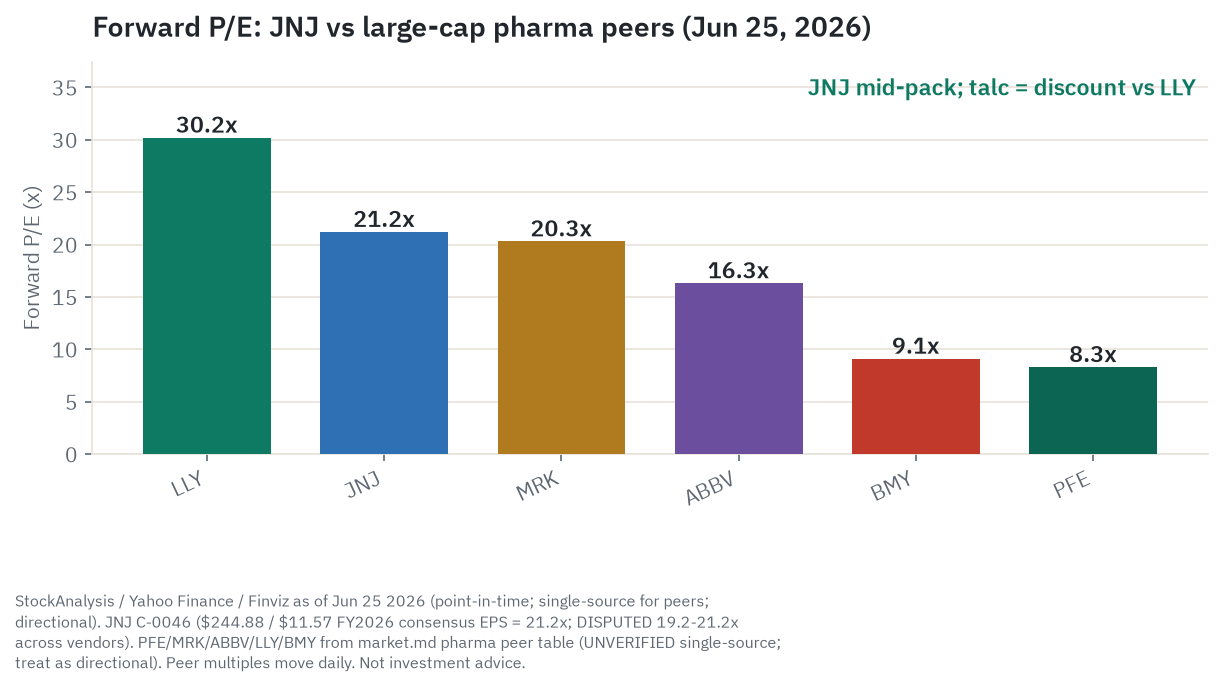
Peer comparison:
| Company | Forward P/E | Narrative |
|---|---|---|
| Pfizer (PFE) | ~8.3x | Post-COVID portfolio digestion; deeply discounted |
| Bristol Myers (BMY) | ~9.1x | Revlimid cliff; deeply discounted |
| AbbVie (ABBV) | ~16.3x | Post-Humira reconstruction; biosimilar navigation model |
| Merck (MRK) | ~20.3x | Keytruda peak; nearest quality-compounder comp |
| JNJ | ~21.2x | Quality premium + talc discount partially embedded |
| Stryker (SYK) | ~20.2x | MedTech premium; above JNJ despite less pharma margin |
| Eli Lilly (LLY) | ~30.2x | GLP-1 growth story; premium to all peers (see LLY deep-dive) |
At roughly 21x, J&J is priced at the Merck level - a quality compounder with a known but unresolved legal overhang. It is cheaper than Lilly’s GLP-1-driven growth premium but more expensive than ABBV, which successfully navigated an even larger biosimilar cliff on Humira and now trades at 16x. The valuation implies the market has largely re-rated J&J away from the talc-discount 13-15x range that prevailed through 2024, without quite crediting the post-DePuy, post-Erleada clean growth story that might justify 22-24x.
Sell-side: 24 analysts cover J&J. The consensus is Buy, with a composition of approximately 10 Strong Buy, 5 Buy, 8 Hold, and 1 Sell across aggregators (minor counting variations exist). The median price target is approximately $260, implying roughly 6.2% upside from $244.88. The target range runs from approximately $155 to $285. The narrow median upside - 6% - is consistent with a stock the sell-side views as a quality hold rather than a high-conviction opportunity. The most recent notable upgrade: Leerink Partners to Outperform, price target $265, May 13, 2026.
Dividend yield: approximately 2.19% at current price ($5.36 annual / $244.88).
Beta: approximately 0.23-0.26 (point-in-time; varies across providers). J&J’s low beta reflects its defensive positioning; it tends to fall less in broad market selloffs but captures less of the upside.
Competitive position
J&J faces distinct competitive dynamics in pharma and MedTech. The pharma competition is mostly product-by-product rather than company-level: AstraZeneca’s Tagrisso competes directly against Rybrevant/Lazcluze in EGFR-mutant lung cancer; Amgen’s Stelara biosimilar (ABP 654) is one of several eroding the ustekinumab franchise; Bristol Myers’s Revlimid and its successors plus Amgen’s Blincyto compete in multiple myeloma adjacent settings. The MedTech competition is more structural: Intuitive Surgical’s installed da Vinci base is the primary obstacle to Ottava, Stryker’s Mako system leads in robotic orthopaedics (a space J&J is exiting via DePuy), and Medtronic’s Hugo entered the soft-tissue robotic surgery market before Ottava.
A full competitive analysis of all 15 key companies appears in the dashboard and in the Companies to Watch section below.
Sentiment and narrative read
The dominant retail narrative for J&J in 2026 is Dividend King plus defensive rotation: a story of talc-behind-us safety and a 64-year dividend streak. The narrative is about half right. The dividend streak is real and well-covered. The “talc behind us” framing is not accurate - the bankruptcy route closed, the cases are in tort, and the reserve gap is live.
Four specific narrative vs. fundamentals divergences are worth naming:
1. “Talc is behind us”: The Red River dismissal in March 2025 and the ~$7 billion reserve reversal created a headline that talc was resolved. It was not. The reversal reflects an accounting adjustment (the reserve was tied to a settlement structure that no longer exists), not a legal resolution. The cases are still active.
2. “The re-rating has further to run”: The stock went from roughly $150 in mid-2025 to $244 in June 2026 - a ~63% move. At 13-15x forward earnings a year ago, a case existed that JNJ was priced for litigation disaster. At 21x, the quality is acknowledged. Sell-side median upside of 6% suggests analysts do not see meaningful re-rating left from here.
3. Jim Cramer’s Charitable Trust bought JNJ in April 2026 near the 52-week high. This is not by itself a contrarian signal - Cramer is a skilled media personality, not a systematic contrarian indicator - but institutional investors sometimes note his inclusion as a soft signal that retail sentiment has caught up to a thesis.
4. The FTC brief on June 23, 2026 went up 3.07% that day: The market interpreted the brief as a known legal risk in a private civil suit, not a new regulatory escalation. That interpretation is plausible but the brief could be a preview of an enforcement action. The 3.07% one-day gain on a day when a government agency called JNJ’s conduct anticompetitive is an unusual pattern that bears tracking.
Macro context
IRA: The Inflation Reduction Act’s drug-pricing schedule is the most significant macro input to JNJ’s pharmaceutical outlook. The IPAY 2026 discounts on Stelara, Xarelto, and Imbruvica are already running. The IPAY 2028 Erleada discount is the next unknown. J&J’s compliance team and investor communications suggest management has modeled the Erleada scenario; the November 2026 MFP publication will remove the uncertainty.
Tariffs: Section 232 medical device tariffs announced in April 2026 create approximately $500 million in FY2026 MedTech headwind per management guidance. J&J negotiated a Most Favored Nation trade deal on January 8, 2026, which provides 0% tariff on its pharmaceutical products (listed in Annex II) through January 20, 2029, contingent on a $55 billion US investment commitment. The investment is a commitment, not yet fully executed. The pharmaceutical tariff risk is neutralized near-term; the MedTech tariff headwind is real but quantified and included in guidance.
Foreign exchange: International revenue was approximately 42.9% of FY2025 total sales ($40.4 billion). Q1 2026 saw a 3.5 percentage-point FX tailwind; full-year 2026 FX is assumed roughly neutral in guidance. A meaningful US dollar strengthening would compress reported international revenue.
China VBP: The orthopaedic volume-based procurement program in China cut procedure device prices by 55-84% for knees and hips. J&J’s DePuy Synthes bears the primary VBP exposure; post-separation, remaining MedTech has lower China VBP risk. Contact lenses (Vision) are largely outside VBP scope.
GLP-1 demand effect: GLP-1 drugs reduce obesity-linked joint degeneration and bariatric surgery volumes. The primary channel from GLP-1 adoption to J&J’s revenue is through DePuy Synthes orthopaedic volumes - an exposure that disappears with the separation. Post-DePuy MedTech has minimal direct GLP-1 exposure.
Micro economics
The Innovative Medicine segment’s 36.9% IBT margin is best understood as a factory with two very different cost profiles. Small-molecule drugs like Erleada and Spravato have manufacturing COGS typically below 10% of net price once at scale - the cost of goods for a pill is mostly chemistry, not biology. Biologic drugs like Tremfya and Darzalex have higher manufacturing COGS (20-40% of net price is a rough range for monoclonal antibodies, varying by facility efficiency and batch size) plus the royalty payments flowing to Genmab and Halozyme. CAR-T (Carvykti) is the extreme case: patient-specific manufacturing, roughly $465,000 list price per treatment, and estimated COGS of 30-40% of list, plus a profit-share arrangement with Legend Biotech. At those economics, Carvykti’s gross margin to J&J at current scale is considerably lower than the segment average - but with each incremental manufacturing slot added (J&J brought a second site online in Ghent, Belgium in 2025), fixed-cost absorption improves.
The Part B vs. Part D distinction matters for understanding drug-level economics. Darzalex, Rybrevant, and Carvykti are all hospital/outpatient drugs that reimburse under Medicare Part B (ASP+6%), where J&J collects close to the sticker price. Erleada, Imbruvica, and Caplyta are oral drugs that move through pharmacy channels under Part D, where PBM rebates and formulary positioning reduce the net realized price materially below the list price. Gross-to-net is the difference between a drug’s list (or wholesale acquisition) price and the actual net revenue received after rebates, discounts, and fees - J&J’s 2024 US Pricing Transparency Report disclosed $47.8 billion in such adjustments across its US portfolio, which gives a sense of the scale at which list prices overstate actual collections. The IRA’s impact is consequently different across the two categories: Part D drugs are directly subject to the IRA MFP, while Part B drugs operate under a separate ASP-based adjustment mechanism that creates less gross-to-net erosion in normal commercial operation.
Shockwave’s approximately $4,700 coronary catheter ASP gives a rough anchor for the MedTech side. A standard coronary IVL procedure uses one or two catheters; hospital reimbursement for IVL-assisted PCI in the US is additive to standard DRG rates in most payer contracts. The near-monopoly status (until Abbott TECTONIC ~2028) means the ASP is not yet subject to competitive price pressure.
Biosense Webster’s electrophysiology economics are volume-intensive: each ablation procedure uses a mapping catheter, an ablation catheter, diagnostic catheters, and often a cryoballoon, with an average case value in the range of $2,000-5,000 in disposables. A single CARTO-3 mapping system can enable hundreds of cases per year; the installed-base flywheel generates recurring disposable revenue similar to the Intuitive da Vinci model.
Durability and synthesis
J&J’s underlying business is durable. The Darzalex franchise is protected by overlapping clinical utility, formulation patents (2036/2040), and an orphan exemption wall through at least 2029. The AAA balance sheet provides the cheapest cost of capital in the sector. The 64-year dividend streak reflects an organization that has consistently generated more cash than it needs for operations. The Stelara cliff was real, large, and navigated without a miss.
The durability is real. The price is also real. At 21x forward earnings, J&J’s equity is already pricing in AAA quality, mid-single-digit growth continuation, and the assumption that talc stays in slow-burn tort mode rather than settling at a cost that requires an earnings reset. The stock moved from 13-15x to 21x over 12 months. That expansion is the story of 2025-2026; it is not the story of 2027.
The bear case is not that J&J is a bad company. The bear case is that you pay 21x for a business carrying an uncapped legal overhang, an unquantified IRA headwind on its fourth-largest product, a late-entering surgical robot, and a net-debt trajectory moving toward $35 billion. The quality premium is justified but the margin of safety is thin.
The scenarios in detail
Bull scenario
Driver: DePuy Synthes sells above $20 billion in enterprise value (Bloomberg February 2026 report; unconfirmed). Proceeds fund approximately 75 million share buybacks, cutting the share count materially and boosting per-share earnings. Carvykti wins frontline myeloma approval via a positive CARTITUDE-5 Phase 3 readout, opening the newly-diagnosed patient population. Erleada MFP lands at the low end of the discount range (40% or below). Darzalex sustains 15%+ annual growth approaching $21 billion globally. Net: FY2029 adj EPS approximately $16.25, multiple expands to 22x on a cleaner growth story post-DePuy.
Price estimate at 3 years: $358. Price estimate at 5 years: $394.
Base scenario
Driver: DePuy Synthes separates on schedule as a spin-off (18-24 months from October 2025 announcement). Erleada MFP lands in the 40-60% range, generating a manageable $700 million-$1.2 billion annual headwind starting 2028. Darzalex grows at 12-15% annually. Carvykti delivers on existing approvals (CARTITUDE-4) but frontline data is inconclusive or delayed. Stelara fully absorbed by 2027. Net: FY2029 adj EPS approximately $14.25, multiple holds around 19.5x on quality compounder positioning.
Price estimate at 3 years: $278. Price estimate at 5 years: $302.
Bear scenario
Driver: An adverse Carter Judkins federal bellwether verdict triggers a talc reserve increase of $4-6 billion above current levels. Erleada’s MFP comes in at 70%+ discount (~$1.2-1.8 billion annual headwind). Darzalex decelerates toward 8-10% growth following congressional pressure on the orphan exemption. DePuy separation is delayed by regulatory review or market conditions. Net: FY2029 adj EPS approximately $12.00, multiple compresses to 16.5x on combined legal and pricing uncertainty.
Price estimate at 3 years: $198. Price estimate at 5 years: $182.
All scenario price figures are arithmetic estimates derived from stated EPS assumptions and exit multiple assumptions. They are not price targets and should not be treated as such.
Companies to watch (bull / base / bear)
The 15 companies below define J&J’s competitive, peer, and risk-context landscape. A full sortable table is in the dashboard.
Eli Lilly (LLY) - market cap approximately $700B+, fwd P/E ~30x: Lilly’s GLP-1 franchise (Mounjaro, Zepbound) is compounding at rates that make J&J’s growth look conservative. In the bull case for JNJ, the fact that Lilly trades at 30x while JNJ trades at 21x suggests quality-compounder multiples have headroom. In the bear case, Lilly is the benchmark for what disciplined capital allocation on truly breakthrough drugs produces - and JNJ’s portfolio, while excellent, does not currently have a GLP-1-scale catalyst. See the Lilly deep-dive for the full view.
Merck (MRK) - fwd P/E ~20x: The nearest true comp for JNJ. Merck is working through the Keytruda patent timeline while building out ADC and oncology pipeline. At 20.3x it is nearly identically priced to JNJ. Bears on JNJ would note that MRK has more single-product concentration risk; bulls would note Merck does not carry a talc overhang.
AbbVie (ABBV) - fwd P/E ~16x: The Humira biosimilar navigation is the template JNJ used when modeling the Stelara cliff. ABBV moved faster from a high-multiple peak through a biosimilar valley and is now rebuilding at 16x. If JNJ’s talc situation worsens and multiple compresses, ABBV’s 16x is the realistic floor.
AstraZeneca (AZN) - large European pharma: AZN’s Tagrisso (osimertinib) is the primary competitor to Rybrevant/Lazcluze in EGFR-mutant NSCLC. Tagrisso dominates; Rybrevant/Lazcluze must demonstrate superior clinical benefit to take market share. JNJ bulls need Rybrevant/Lazcluze to overperform; AZN strength is a headwind to that scenario.
Bristol Myers Squibb (BMY) - fwd P/E ~9x: BMY is deeply discounted on Revlimid cliff concerns. Its presence in the myeloma space (Opdivo, CAR-T Breyanzi) competes indirectly with JNJ’s Darzalex and Carvykti. A BMY recovery (if its pipeline delivers) would not hurt JNJ, as the myeloma market is expanding rapidly enough for multiple competitors to grow simultaneously.
Pfizer (PFE) - fwd P/E ~8x: At 8x, Pfizer is the opposite pole from JNJ’s quality premium. PFE bears watch as a data point on what the market does to pharma companies that disappoint on pipeline execution - and as a comparison for how the market might price JNJ if the talc liability materializes at the high-end estimate.
Novartis (NVS) - European peer: Kisqali (CDK4/6 inhibitor for breast cancer) and Kymriah (CAR-T) are the most relevant competitive overlaps. NVS’s radioligand therapy program (Lutathera, Pluvicto) represents a modality JNJ is not currently pursuing at scale.
Amgen (AMGN) - fwd P/E ~14x: Amgen makes the biosimilar version of ustekinumab (Stelara equivalent; ABP 654), directly competing against JNJ’s own branded Stelara. Amgen also competes in myeloma with its bispecific Blincyto and in earlier-generation immunology. An Amgen biosimilar success on Stelara accelerates JNJ’s revenue erosion in that product.
Novo Nordisk (NVO) - GLP-1 leader: The Ozempic/Wegovy franchise is the dominant driver of GLP-1-mediated reduction in bariatric surgery demand and, downstream, in orthopedic joint replacement demand. JNJ’s DePuy Synthes exposure to GLP-1 erosion is the primary channel. Post-DePuy separation, this connection largely disappears from J&J’s financials.
Intuitive Surgical (ISRG) - fwd P/E ~60x+: Intuitive is Ottava’s primary obstacle. With 11,106 installed da Vinci systems generating a recurring consumables revenue stream, the incumbency advantage is close to insurmountable in the near term. JNJ’s surgical robot thesis depends on either winning in markets where da Vinci has low penetration or carving out a procedure-specific niche. ISRG’s valuation premium reflects the market’s confidence in the installed-base flywheel.
Stryker (SYK) - fwd P/E ~20x: A pure MedTech play without pharma. Stryker’s Mako robotic system dominates robotic orthopaedics, the segment JNJ is exiting via DePuy. Post-separation, JNJ and Stryker have less direct competitive overlap. Stryker’s 20x multiple shows where high-quality MedTech trades without a talc overhang.
Medtronic (MDT) - fwd P/E ~13.5x: Medtronic’s Hugo surgical robot received CE Mark clearance in 2022 and FDA clearance in December 2025, entering the soft-tissue robotic market before Ottava. MDT’s discounted multiple relative to the sector reflects concerns about its pipeline and execution. JNJ would prefer Medtronic to validate the non-da-Vinci market rather than dominate it.
Abbott Laboratories (ABT): Diversified medical device and diagnostics company. Abbott’s FreeStyle Libre continuous glucose monitor competes in an adjacent market to JNJ’s Vision but is not a direct MedTech competitor in the segments J&J is retaining post-DePuy.
Boston Scientific (BSX): BSX competes directly with Biosense Webster in electrophysiology (the Rhythmia system and Farapulse pulsed-field ablation technology). Farapulse, BSX’s PFA catheter, currently leads in PFA market volume. JNJ counters with its own Varipulse PFA system (FDA-approved November 2024; Varipulse Pro CE Mark April 2026) integrated into the CARTO-3 mapping architecture. The competitive positioning in PFA will play out over the next 2-3 years as both systems build real-world evidence and hospital adoption data; the mapping system advantage (CARTO-3) is where JNJ’s durable EP defensibility sits regardless of PFA catheter market share.
Kenvue (KVUE) - the spinoff: Kenvue is the consumer health business J&J divested. J&J still faces legacy talc litigation that predates the spinoff; Kenvue has retained separate liability for certain talc claims. KVUE trades as a standalone consumer staples company and is not a direct competitor to the pharma or device business J&J operates today.
Risk controls
A read of Hold does not mean position and forget. These are the watch items that would prompt a reassessment:
-
Carter Judkins bellwether verdict (H2 2026): An adverse verdict with damages well above prior ranges would be a trigger for a reserve increase and a re-evaluation of the 3-year scenario. Monitor for trial start date and interim rulings.
-
Erleada MFP (November 2026): The specific discount percentage matters. A 40% discount is in guidance; 70%+ is a material earnings headwind not yet embedded in consensus. If the MFP is above 60%, revisit the 3-year and 5-year scenario math.
-
Darzalex quarterly trajectory: Any deceleration below 12% year-over-year growth in 2026 would break the FY2026 Stelara-offset bridge and signal earlier competitive or penetration saturation than the base case assumes. Growth below 18% is a watch signal; below 12% is a bear signal. Monitor each quarterly print.
-
DePuy Synthes separation progress: The 18-24 month timeline from October 2025 puts the target window at April-October 2027. Slippage to 2028 or beyond delays the capital return and multiple-expansion thesis in the bull case.
-
Net debt trajectory: At $32.9 billion as of March 2026, net debt is rising faster than FCF is growing. If net debt exceeds approximately $40 billion without a corresponding DePuy sale catalyst, credit-rating scrutiny increases and the buyback pace likely moderates.
-
OBBBA orphan exemption in budget negotiations: The $8.8 billion CBO cost estimate makes Darzalex’s exemption a visible legislative target. Any bill narrowing the orphan exemption before 2030 materially affects the 5-year scenario.
-
Ottava FDA De Novo decision: A clearance in 2026 would be upside; any complete response letter (RCL) or extended review would push commercial launch past 2027 and reduce the bull case’s device-margin contribution.
-
FTC Stelara antitrust litigation outcome: If the Fourth Circuit rules against JNJ in CareFirst and the case generates treble-damages liability, the financial exposure - while currently unquantified - could be significant.
-
China policy escalation: If China VBP programs expand into areas J&J retains post-DePuy (cardiovascular devices, contact lenses), the MedTech segment growth story becomes more complicated.
Methodology, sourcing, and data-quality flags
Valuation
J&J’s forward P/E of approximately 21.2x sits about 22-23% above the drug industry peer median per June 2026 data from GuruFocus - a source cited in the skeptic-report at this level. Using FY2026 guidance midpoint ($11.55) or consensus NTM estimates ($11.57), both methods give the same 21.2x result. The range appearing in some data aggregators (19-21x) reflects NTM vs. calendar-year denominator differences. The stock also shows a trailing GAAP P/E near 28x, elevated by the approximately $7 billion talc reserve reversal in the FY2025 GAAP earnings figure; investors should use adjusted EPS for all earnings-based comparisons. Compared to the nearest quality-compounder peer (Merck at 20.3x), JNJ trades at a slight premium that the research does not fully justify given the uncapped talc overhang. Compared to Eli Lilly (30.2x) and AbbVie post-biosimilar-navigation (16.3x), JNJ is priced between a clean-growth story and a proven-recovery story - consistent with its current position of managing a transition but not having fully completed it. On balance, the valuation evidence points toward modestly overvalued relative to current fundamentals and the outstanding litigation risk.
Growth
FY2025 adjusted EPS grew 8.1% to $10.79 and FY2026 guidance midpoint of $11.55 implies 7.1% continuation, both verified from primary filings. The growth engine is Darzalex ($14.4 billion, +23%), Carvykti ($1.9 billion, +96%), and Tremfya ($5.2 billion, +40.5%) - each verified from the Q4/FY2025 press release. Simponi/Aria ($2.7 billion, +21.8%) and Remicade ($1.8 billion, +10.2%) provide additional immunology support, though both face ongoing biosimilar entry. These growth drivers are pipeline-backed and patent-protected in the near to medium term. The offsetting headwinds include Stelara (-41.3% in FY2025 and continuing down in Q1 2026), Invega Sustenna (-9.8% in FY2025 on the path to a January 2031 generic cliff), Opsumit facing expected 2026 generic competition, and Erleada IRA pricing building from 2028. FY2027 consensus earnings of approximately $12.70 (an estimate, not a primary figure) depends on several simultaneous pipeline executions all going to plan at once - a planning assumption that is optimistic but not unreasonable for a portfolio of this breadth. Net growth evidence: real, supported by pipeline data, with compounding headwinds that arrive later in the decade. This dimension of the analysis supports a positive lean, though not a strong one.
Quality
The quality case for JNJ is the strongest element. AAA and Aaa credit ratings, both affirmed with stable outlook, place J&J alongside perhaps one other US corporate issuer with dual-AAA designation. FY2025 FCF of $19.7 billion ($24.5 billion operating CF minus $4.8 billion capex) covers the $12.4 billion annual dividend 1.59x - well above minimum comfortable coverage. The Innovative Medicine segment’s 36.9% IBT margin is best-in-class among large diversified pharma. The 64-year dividend increase streak has survived recessions, patent cliffs, and now the Stelara cliff without a cut. The only quality detractor worth noting is the net-debt trajectory: $12.1 billion in December 2024 rising to $32.9 billion by March 2026, a $20.8 billion increase in 15 months through acquisition spend and buyback acceleration. The debt load is manageable at roughly 1.7x FCF, and credit agencies have confirmed as much; the pace of increase narrows strategic flexibility for additional large acquisitions without credit-rating consequences. On the evidence available, the operating business quality is exceptional and the balance sheet quality, while recently stretched, remains investment-grade AAA.
Risk
The risk dimension captures three live, uncapped exposures. First and most significant: the talc litigation, where 68,000-plus MDL cases sit against a $3.4 billion on-book reserve and secondary-source analyst estimates of $10-15 billion total exposure. All three bankruptcy routes are exhausted. JNJ’s own 10-K states the company cannot estimate the range of loss beyond amounts accrued. The Carter Judkins federal bellwether in H2 2026 is the next material datapoint. Second: Erleada’s IRA MFP, unknown until November 2026, with annual impact estimates of $700 million to $1.8 billion starting 2028. Third: the Darzalex orphan exemption, politically visible given its $8.8 billion government cost, creating legislative risk in out-years. Offsetting factors include the MFN pharmaceutical tariff neutralization through January 2029, the defense wins on talc in state courts over prior years, and the FCF coverage providing a cushion for reserve increases. The risk evidence points toward a moderate negative lean - real exposures with meaningful financial magnitude, offset by the FCF buffer and defense track record, but not offset enough to ignore.
Momentum
Price momentum is positive but late. JNJ’s total return over the past year falls somewhere in the range of 48-58% depending on measurement method and source. The 200-day, 50-day, and 20-day moving averages are all below the current price, consistent with a trending upward pattern. RSI sits in the 64-65 range per point-in-time data - elevated but not yet at overbought territory above 70. The sell-side consensus is Buy, with median price target implying roughly 6% upside. Short interest is approximately 1% of float, negligible. The Leerink upgrade to Outperform ($265 target) in May 2026 and the Q1 2026 beat-and-raise in April added momentum catalysts. Against: the stock is at 93% of its 52-week high, the sell-side upside is thin, and the one-year run was driven heavily by multiple re-rating rather than earnings beats. Momentum is positive but the re-rating phase is largely over; the next leg would need to come from earnings acceleration or a DePuy catalyst. This dimension supports a mild positive lean.
Data-quality flags
- Forward P/E: DISPUTED across aggregators (19.2-21.2x range). This article uses the calculated figure of 21.2x from $244.88 divided by $11.57 NTM consensus.
- 52-week low: DISPUTED between $150.73 (Finviz) and $151.01 (Yahoo Finance). Both are directionally consistent; the range is noted.
- 1-year total return: UNVERIFIED from single-source aggregator (approximately 48-58%). Used as a range, not a point estimate.
- YTD return: Approximately +17-18% price-only from single-source data.
- Analyst mean target: DISPUTED $253-262 range across aggregators; median $260 is used.
- Genmab royalty $2.4B estimate: A research estimate from implied effective rates. Not separately disclosed.
- Invega Sustenna/Trinza FY2025 revenue $3,810M (-9.8%): VERIFIED from 10-K MD&A product table. Some earlier data sources cited $4,222M for FY2025 - that was the FY2024 figure. Generic entry estimated January 2031: DrugPatentWatch (press tier); not from a primary patent filing or court order.
- Analyst talc range $10-15B / Bloomberg Intelligence ~$11B: Secondary press sources; illustrative only; not independently verified.
- Moving averages and RSI: Single-source Finviz readings; UNVERIFIED against primary broker data; directional only.
- CARTITUDE-5 readout timing: No confirmed date in public filings as of June 25, 2026.
- DePuy Synthes sale price: Bloomberg February 2026 report of $20B+ is secondary press; not confirmed by JNJ.
- All five-year scenario EPS figures: Research estimates. Not primary filing figures. Not price targets.
The five-factor read, taken together, is a Hold: a quality business with genuine growth at a price that reflects much of that quality, against a risk backdrop that prevents a confident Buy. On balance the read lands at Hold.
This article is for informational and educational purposes only. It is not investment advice, not a solicitation, and not a recommendation to buy or sell any security. Johnson & Johnson is a public company; figures cited are from public filings and press reports as of June 25, 2026, and will have changed by the time you read this. All scenario prices are illustrative estimates, not price targets. The talc litigation analysis above reflects publicly available court records and press reports; all plaintiff allegations regarding JNJ’s talc products are disputed by JNJ, which denies that its products caused any illness or contained asbestos. The FTC amicus brief described is a legal filing in a private civil case, not a regulatory finding or enforcement action. Past dividend payments do not guarantee future dividends. Past stock performance does not predict future results. Conduct your own due diligence and consult a qualified financial adviser.