
Research date: July 2, 2026 | OSINT market research on AstraZeneca PLC (NYSE: AZN): the three growth engines running at once, the government price-setting mechanisms bearing down on the biggest one, the pending legal matter in China that the market seems to be underpricing, and the bull, base, and bear case from six months to five years. Live prices, stamped hard.
Important disclaimer. This is OSINT (open-source intelligence) research published for educational and informational purposes only. It is not investment advice, not a recommendation to buy, sell, or hold any security, and not a solicitation. I am not a financial advisor. Pharmaceutical companies carry patent-cliff, clinical-trial, and drug-pricing-regulation risk that can move results faster and further than a typical stock when a single molecule’s exclusivity status or a single government’s pricing decision changes. All figures below are point-in-time as of the stated research date (July 2, 2026) and move fast: prices, market caps, share counts, and valuation multiples will be stale by the time you read this. Any bull, base, or bear scenarios are illustrative arithmetic on stated assumptions, not price targets. Do your own due diligence and consult a licensed financial advisor before making any decision.
Where this stock could be in 6 months, 1 year, 3 years, and 5 years
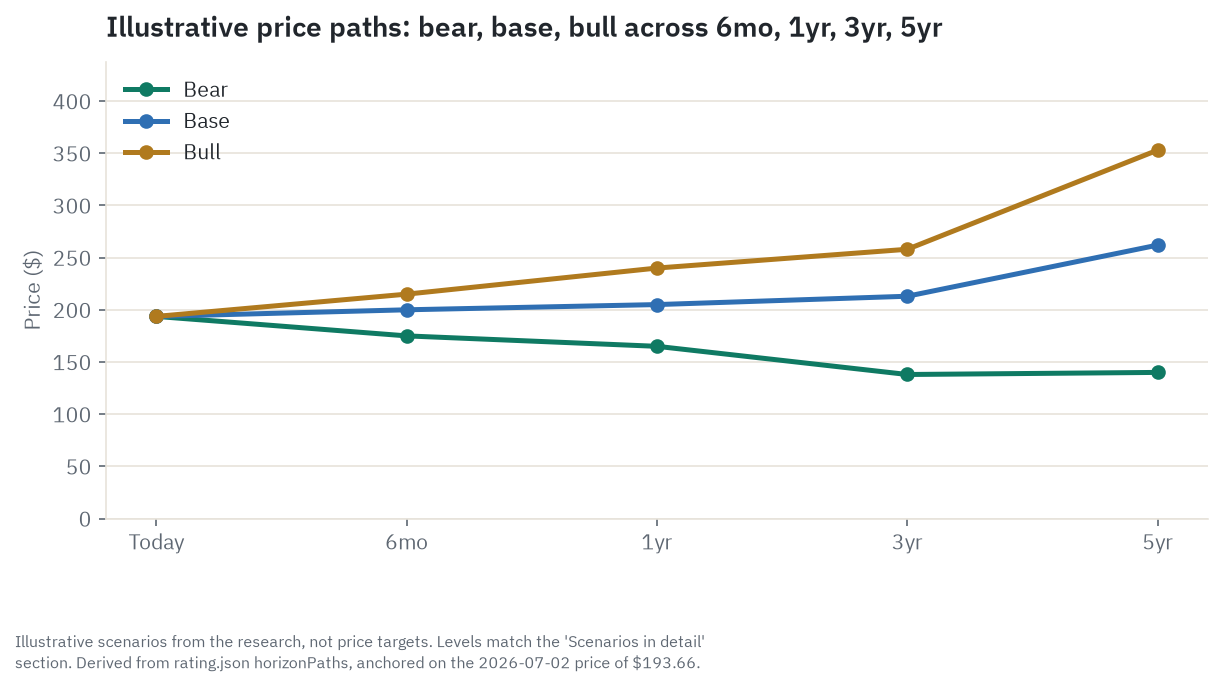
AstraZeneca has spent the last several months doing something most large pharma companies cannot: growing double digits across three separate franchises at once, oncology, rare disease, and respiratory and immunology, while its one clearly aging asset, the diabetes and heart-failure drug Farxiga, absorbs a government-mandated price cut that would have swallowed a less diversified company’s whole growth story. The tension that decides where the stock goes from here is that AstraZeneca’s actual biggest product, the lung-cancer drug Tagrisso, has not yet lived through the version of that same price-setting sequence Farxiga just went through, and a separate, unresolved legal matter in China sits over the stock with no fixed timeline for resolution. Every dollar level below is an estimate built on stated assumptions, not a price target, and the read at the end is a research signal, not advice.
Six months. This window is almost entirely about two dated events: the next earnings print, expected around July 27, 2026, and the July 31, 2026 effective date on which AstraZeneca’s accelerated tariff cohort under the Section 232 pharmaceutical tariff order kicks in. The base case (around $200) is a modest grind higher on an in-line quarter and a confirmed reduced tariff rate. The bull case (around $215, close to a fresh 52-week high) needs another genuine pipeline surprise in the style of March 2026’s tozorakimab win. The bear case (around $175) is what a tariff-cost miss, a soft print, or a negative headline on the pending China matter looks like inside six months. The single thing most likely to move this window is whether AstraZeneca has actually secured the reduced tariff rate its own $50 billion US manufacturing plan was built to earn.
One year. The dominant variable here is pipeline conversion against two very different kinds of bad news. The base case (around $205) assumes AstraZeneca keeps executing against its own guidance with no major surprise in either direction. The bull case (around $240) needs the 2026 cohort of Phase III readouts, tozorakimab, Datroway’s expanded uses, camizestrant, baxdrostat, to keep converting into approvals the way it already has this year. The bear case (around $165) is a Tagrisso version of the Farxiga playbook arriving sooner than expected, or a material escalation in the pending China indictment. AstraZeneca has already shown the market exactly what a government-negotiated price cut does to a drug’s economics; the question for this window is whether that mechanism reaches for AstraZeneca’s biggest product before the market expects it to.
Three years. By this point the structural drivers start to outweigh the quarterly news cycle. The base case (around $213) has core earnings compounding near AstraZeneca’s own guided low-double-digit pace while the market keeps paying roughly its current multiple. The bull case (around $258) needs the $80 billion-by-2030 ambition to look genuinely on track, most of the roughly 20 planned launches converting, Enhertu and Datroway scaling as billed, US revenue climbing toward half of the total. The bear case (around $138) is Tagrisso’s own price-setting-and-patent sequence beginning to bite on top of continued China pricing pressure, repricing the stock to something closer to the patent-cliff multiple Novartis trades at today as Entresto collapses in real time.
Five years. This horizon is almost entirely the durability question. The base case (around $262) is AstraZeneca’s three-engine model continuing to compound at roughly its guided pace, with the market still paying a fair, not a premium, multiple for it. The bull case (around $353) needs the next-generation pipeline, antibody-drug conjugates beyond Enhertu, bispecific antibodies, radioconjugates, and the still-unproven oral obesity franchise, to scale into enough real revenue that the market re-rates AstraZeneca toward the kind of premium multiple it already grants Eli Lilly. The bear case (around $140) is Tagrisso’s 2032-to-2035 patent-expiry window arriving the way Farxiga’s price cut and Humira’s biosimilar erosion arrived at their own companies, compounded by whatever the China legal matter and its pricing system have done to that franchise by then. The single thing most likely to flip this horizon is how cleanly AstraZeneca’s next wave of medicines replaces Tagrisso’s eventual decline, the same test AbbVie already passed once with Skyrizi and Rinvoq and Novartis is currently failing with Entresto.
Where the read lands today. On balance the read holds at Buy: a genuinely diversified pharma compounder carrying less debt than its closest peers, trading at a multiple the market has not yet stretched to match its execution. It is not a Strong Buy, because AstraZeneca is carrying real, structural, and partly unquantifiable risk at the same time, chiefly Tagrisso’s still-unlived price-setting sequence and a pending legal matter in China with no defined resolution. The single thing most likely to move that read is news on either of those two fronts: a favorable turn on the China matter or a later-than-feared Tagrisso timeline would push the lean toward Strong Buy, while an adverse development on either would pull it back toward Hold.
Companion tool
Jump to the interactive dashboard to sort and filter every company in this piece, or download the Excel model to flex the scenarios yourself.
TL;DR
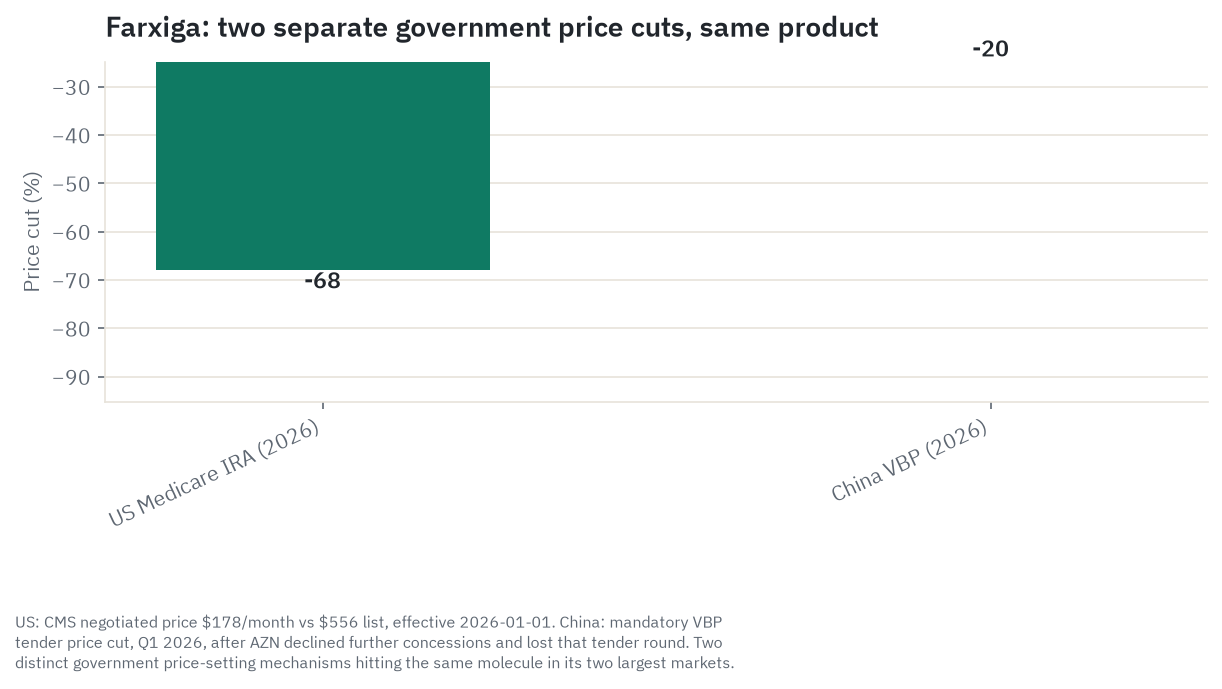
AstraZeneca is running three genuinely distinct growth franchises at the same time rather than defending one blockbuster: oncology (Tagrisso, Imfinzi, Enhertu, Calquence), a legacy cardiovascular, renal, and metabolic business built around the diabetes drug Farxiga, and a high-margin rare-disease unit (Ultomiris, Soliris) bought with the roughly $39 billion Alexion acquisition in 2021. Oncology alone grew 16 to 20 percent in the most recent quarter and is now 44 percent of revenue, the reason total revenue is compounding at a high single to low double-digit pace even as Farxiga absorbs a 68 percent US Medicare price cut and a separate 20 percent China price cut on the same drug in the same year. The company’s fastest-growing single product, the cancer drug Enhertu, is only partly AstraZeneca’s own: its manufacturing partner, Daiichi Sankyo, makes the drug and keeps 100 percent of its US sales, meaning AstraZeneca’s own reported growth understates the product’s true scale and its economics are structurally shared, not fully owned. The bull case is that AstraZeneca has already absorbed its cleanest, most predictable policy hit (Farxiga) while its actual biggest product, Tagrisso, still has years of patent protection ahead of it, and the stock trades at a moderate multiple despite one of the strongest multi-year returns in large-cap pharma. The bear case, and the reason this is a Buy and not a Strong Buy, is that Tagrisso has not yet lived through the same government price-setting sequence that just cut two-thirds off Farxiga’s price, and a pending, unresolved legal matter involving an AstraZeneca China subsidiary and named former executives is a genuine tail risk the current price does not appear to reflect.
Explore it yourself: the interactive dashboard
Open the dashboard in a full screen
The dashboard holds AstraZeneca’s company card, the full bull, base, and bear scenario table across all four horizons, and a peer and partner comparison table spanning Eli Lilly, Johnson & Johnson, AbbVie, Novartis, Merck, Pfizer, Bristol Myers Squibb, Roche, and AstraZeneca’s own manufacturing partner, Daiichi Sankyo. Use it to sort and check any single name while you read.
Prefer a spreadsheet? Download the Excel model with the peer table and an adjustable scoring tab. The levels in that file are illustrative arithmetic, not targets.
The three-engine aircraft
Most airlines that fly a three-engine jet do it for redundancy, not extra speed: lose one engine over open water and the other two still get the plane home. AstraZeneca has effectively built itself a three-engine aircraft out of its own drug portfolio. Oncology, the cardiovascular and metabolic business built around Farxiga, and rare disease each generate real, separate revenue, so when one engine loses power, as Farxiga’s did this year under a government price cut, the plane keeps climbing on the other two. That is a structurally different position from a pharma company running on one big engine, the way Merck depends on its cancer drug Keytruda for close to half its revenue, or the way Novartis is currently losing altitude as its heart-failure drug Entresto’s patent cliff hits in real time.
The complication with AstraZeneca’s three-engine design is that one of the engines, the fastest-growing one, is not entirely AstraZeneca’s own. Enhertu, the cancer drug now expanding into earlier and earlier stages of breast cancer treatment, is built and manufactured under a partnership with a Japanese company, Daiichi Sankyo, which also keeps all of the drug’s US sales for itself. AstraZeneca gets the ex-US revenue and pays milestone payments back to its partner on each new approval. It is less like AstraZeneca owning all three engines outright and more like leasing the newest, most powerful one from another airline, one whose own maintenance crew, not AstraZeneca’s, keeps that particular engine running. That arrangement has worked well so far. It is also a dependency AstraZeneca’s own manufacturing investment cannot fix if something ever goes wrong on the other side of it.
How the money flows
flowchart TD
    RD["R&D + Clinical Trials\nAZN in-house (~24% of revenue)\n+ Daiichi Sankyo (Enhertu/Datroway origin)\n+ Merck & Co. (Lynparza)"]
    REG["Regulatory Approval\nFDA (Project Orbis) / EMA / China NMPA\nChina approvals sometimes conditional"]
    SM["Small-Molecule Mfg\nTagrisso, Farxiga, Calquence tablets\nAZN in-house, low capital intensity"]
    BIO["Biologic Mfg\nFasenra, Imfinzi, Ultomiris, Soliris\nAZN in-house, capital-intensive"]
    ADC["ADC Mfg (Enhertu, Datroway)\nDaiichi Sankyo contractually responsible\nAntibody + DXd payload conjugation"]
    SPLIT["Revenue Recognition Split\nUS Enhertu/Datroway sales = Daiichi Sankyo\nEx-US sales = AstraZeneca"]
    DIST["Wholesale/Distribution\nMcKesson, Cencora, Cardinal (US)\nNational distributors (EU, China)"]
    US_PAYER["US Medicare / IRA\nCMS negotiated price\nFarxiga: $178 vs $556 list (-68%)"]
    CHINA_PAYER["China NRDL / VBP\nMandatory tender pricing\nForxiga -20%, Lynparza -30%, roxadustat -30% (Q1 2026)"]
    EU_PAYER["EU/UK HTA bodies\nNICE, G-BA, HAS\nCountry-by-country negotiated access"]
    PAT["Patients\nRare-disease patients highly sticky (no substitutes)\nOncology/CVRM more formulary-gated"]
    AZN_REV["AZN Revenue\n$58.7bn FY2025 (+9%)\nOncology 44% / BioPharma / Rare Disease 16%"]

    RD --> REG
    REG --> SM
    REG --> ADC
    REG --> BIO
    ADC --> SPLIT
    SM --> DIST
    BIO --> DIST
    SPLIT --> DIST
    DIST --> US_PAYER
    DIST --> CHINA_PAYER
    DIST --> EU_PAYER
    US_PAYER --> PAT
    CHINA_PAYER --> PAT
    EU_PAYER --> PAT
    PAT -->|"Prescription demand flows back up"| AZN_REV
    AZN_REV -->|"Funds R&D"| RD

    style AZN_REV fill:#1a6e38,color:#fff
    style US_PAYER fill:#8b0000,color:#fff
    style CHINA_PAYER fill:#8b0000,color:#fff
    style ADC fill:#1a3c6e,color:#fff
Follow the diagram from the top. AstraZeneca spends roughly 24 percent of total revenue on research and development, one of the higher R&D intensities in large pharma, running more than 100 ongoing Phase III trials with more than 20 late-stage results expected in 2026 alone. Some of that pipeline is entirely in-house; some of it, notably the Enhertu and Datroway antibody-drug conjugates, is co-developed with Daiichi Sankyo, and Lynparza is co-developed with Merck & Co. Once a drug clears regulatory approval, three separate manufacturing processes take over depending on what kind of drug it is: ordinary chemical synthesis for pills like Tagrisso and Farxiga, the cheapest and fastest to scale; cell-culture bioreactor production for biologics like Ultomiris and Soliris, slower and more capital-intensive; and, for Enhertu and Datroway specifically, a specialized antibody-conjugation process that Daiichi Sankyo, not AstraZeneca, is contractually responsible for.
That last branch feeds into the single most distinctive mechanical fact in this entire chain: sales of Enhertu and Datroway in the United States are recognized by Daiichi Sankyo, not by AstraZeneca. AstraZeneca books the revenue everywhere else in the world. That means AstraZeneca’s own reported Enhertu figure, $831 million in the most recent quarter, is an ex-US number only, and the drug’s true global scale runs meaningfully higher once Daiichi Sankyo’s US sales are added in. AstraZeneca pays its partner milestone payments on each new regulatory approval instead, $155 million for two new early-breast-cancer approvals in May 2026 alone, as the mechanism by which some of that expanded value flows back to AstraZeneca’s own balance sheet rather than its income statement.
After manufacturing, every product runs through the same wholesale distributors that carry any large pharma company’s drugs, McKesson, Cencora, and Cardinal Health in the United States, national distributors elsewhere, on thin, largely fixed fees. The real chokepoint sits one layer further down, at the payer. Three separate government or quasi-government pricing systems bind on different parts of AstraZeneca’s portfolio at once: the US Medicare drug-price negotiation program under the Inflation Reduction Act, which already cut Farxiga’s negotiated price by 68 percent; China’s volume-based procurement tender system, which cut Farxiga’s China price by a further 20 percent in the same year, alongside separate cuts on Lynparza and roxadustat; and the slower, country-by-country negotiations run by European health-technology-assessment bodies like NICE in the UK. For rare-disease drugs specifically, the patient at the bottom of the chain is unusually loyal, because there are few or no substitute treatments for the ultra-rare diseases Ultomiris and Soliris treat, a genuine structural moat that does not exist in AstraZeneca’s more competitive oncology and cardiovascular categories.
A field guide to what AstraZeneca actually sells
Tagrisso (osimertinib) is an oral pill that blocks EGFR, a mutated protein that drives a meaningful share of non-small-cell lung cancers, and it is AstraZeneca’s single largest product at $7.3 billion in FY2025 revenue, up 10 percent, with $1.8 billion in the most recent quarter alone, up 5 percent. Because it is a small molecule rather than a biologic, its patent protection is more binary than a biologic’s typically slower patent expiry, and AstraZeneca’s own investor-relations disclosure lists Tagrisso’s US patents running from 2027 through 2034, with independent trackers estimating generic entry anywhere from 2032 to 2042 depending on which specific patent or exclusivity is counted, a wide enough range that no single “cliff year” should be treated as settled fact. What actually matters more than the patent date is the separate clock that governs Medicare price negotiation: small molecules like Tagrisso become eligible for that process roughly nine years after approval, the same mechanism that has already cut Farxiga’s price by two-thirds, and the specific year Tagrisso crosses that threshold was not independently confirmed in this research and is the single most consequential open question in AstraZeneca’s whole outlook.
Farxiga (dapagliflozin) is an oral SGLT2 inhibitor used for type 2 diabetes, heart failure, and chronic kidney disease, generating $8.4 billion in FY2025, up 10 percent, and it is the clearest live case study of what government price-setting does to a branded drug’s economics. Farxiga was one of the first ten drugs selected for Medicare’s negotiated-pricing program, and its negotiated price took effect January 1, 2026 at $178 a month against a $556 list price, a 68 percent cut. In the same year, China’s mandatory volume-based procurement tendering system separately cut Farxiga’s China price by 20 percent after AstraZeneca chose not to offer further discounts and lost that tender round. A UK court has also revoked one of AstraZeneca’s own patents covering the drug’s active ingredient in a dispute with a generic challenger, a decision upheld on appeal, meaning even the company’s own disclosed 2028 patent-expiry estimate is not a guaranteed floor. Farxiga is, in effect, the drug that shows what happens when two separate government pricing systems and a patent challenge all converge on the same molecule inside roughly the same multi-year window.
Imfinzi (durvalumab) is a PD-L1 checkpoint inhibitor, an immunotherapy that blocks a signal cancer cells use to hide from the immune system, competing against Merck’s PD-1 drug Keytruda and Bristol Myers Squibb’s PD-1 drug Opdivo across a range of solid tumors. It generated $6.1 billion in FY2025, up 29 percent, the fastest growth of AstraZeneca’s larger oncology products.
Calquence (acalabrutinib) is an oral BTK inhibitor for chronic lymphocytic leukemia and other blood cancers, generating $3.5 billion in FY2025, up 12 percent.
Enhertu and Datroway are AstraZeneca’s antibody-drug conjugates, a drug class that chemically attaches a cell-killing chemotherapy payload to an antibody engineered to bind a specific protein on cancer cells, so the toxic payload concentrates on the tumor rather than circulating freely through the whole body the way traditional chemotherapy does. Both were discovered by Daiichi Sankyo and are jointly developed and commercialized with AstraZeneca everywhere except Japan, where Daiichi Sankyo keeps exclusive rights. Enhertu, AstraZeneca’s own recognized (ex-US) share, generated $2.8 billion in FY2025, up 40 percent, and $831 million in the most recent quarter alone, up 34 percent, after winning approval in two new early-stage breast-cancer settings in May 2026 that triggered a $155 million milestone payment to Daiichi Sankyo. Datroway, approved in 2025 for previously treated HR-positive, HER2-negative metastatic breast cancer, is the newer of the two. Some analysts, including Jefferies as relayed through BioPharma Dive, have projected Enhertu’s peak annual sales as high as $10 billion to $12 billion following the 2025 label expansion and Datroway’s peak sales near $6 billion by 2030, but these are analyst estimates from a single press chain, not AstraZeneca’s own guidance, and should be read as directional rather than settled.
Ultomiris and Soliris (ravulizumab and eculizumab) are complement-inhibitor biologics, inherited from the roughly $39 billion Alexion acquisition that closed in 2021, treating ultra-rare blood diseases including paroxysmal nocturnal hemoglobinuria and atypical hemolytic uremic syndrome, conditions with few or no substitute treatments once a patient is stabilized. Combined, the two generated $6.6 billion in FY2025. Soliris, the older of the two, is losing ground: its US patent runs to 2027 and its European patent already expired in 2023, biosimilar competitors including Amgen’s Bkemv and a Teva/Samsung Bioepis product have launched at roughly a 30 percent discount, and Soliris’s own 2024 sales reportedly fell as AstraZeneca actively transitions patients to its successor, Ultomiris, whose own patent protection runs to 2035 and, in some markets, into the early 2040s; that specific sales-decline figure comes from a single trade-press source and could not be independently cross-checked in this research, so treat the direction, not the precise magnitude, as the reliable part of the story. The broader complement-inhibitor category, once close to an AstraZeneca monopoly through Alexion, now faces real competition from Apellis’s Empaveli, Novartis’s oral Fabhalta, and Roche’s crovalimab (approved in China), and AstraZeneca has responded with its own add-on therapy, Voydeya, obtained through Alexion’s earlier acquisition of Achillion.
Tezspire (tezepelumab), an injectable biologic for severe asthma co-developed with Amgen, generated $1.1 billion in FY2025, up 65 percent, the fastest percentage growth of any named product in the portfolio.
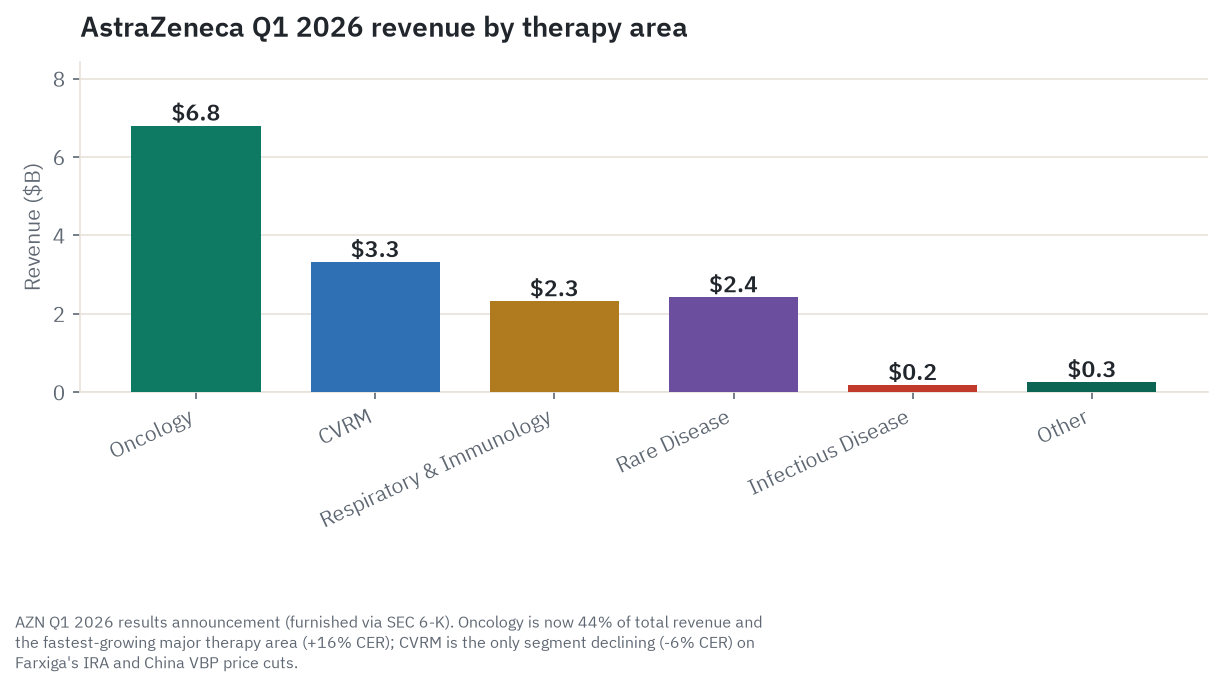
The chart above is the shape of the whole business in one picture. Oncology alone is now 44 percent of revenue and the fastest-growing major segment, while CVRM, the segment that houses Farxiga, is the only one shrinking on a constant-currency basis, the direct, already-visible fingerprint of the IRA and China VBP price cuts described above landing on the same molecule at once.
Beyond the marketed products, AstraZeneca is running an unusually dense late-stage pipeline: roughly seven clinical-stage antibody-drug conjugates beyond Enhertu and Datroway addressing an estimated 17 different cancer types (a figure reported by BioPharma Dive rather than confirmed directly against AstraZeneca’s own disclosure), a PD-1/CTLA-4-style bispecific antibody called volrustomig with reported peak-sales estimates above $5 billion, dual-acting cell-therapy candidates for multiple myeloma, a next-generation PARP inhibitor called saruparib positioned as a potential successor to the roughly $2 billion-a-year Lynparza franchise, and a radioconjugate platform obtained through the 2024 acquisition of Fusion Pharmaceuticals for approximately $2.4 billion including a contingent value right, whose lead asset targets metastatic castration-resistant prostate cancer with a radioactive isotope rather than a chemical payload. Further out, AstraZeneca is developing an oral small-molecule GLP-1 receptor agonist called AZD5004, licensed from China’s Eccogene in 2023, whose Phase 2 obesity and type 2 diabetes trials both met their primary endpoints; the company calls this a “multi-blockbuster potential” franchise but has not disclosed a specific peak-sales figure, so it remains a real but unquantified option on the industry’s biggest current growth category. AstraZeneca has also moved into AI-assisted drug discovery, entering a collaboration with China’s CSPC Pharmaceutical Group in 2025 with a total deal value reported at somewhere between roughly $4.7 billion and just over $5.2 billion depending on the outlet, and acquiring a Boston-based AI company, Modella AI, in January 2026 on undisclosed terms, described as the first acquisition of a dedicated AI company by a major pharmaceutical company.
Who wins where
In oncology, AstraZeneca competes for share against Merck’s Keytruda and Bristol Myers Squibb’s Opdivo in checkpoint inhibitors, and against a widening field of antibody-drug-conjugate developers as that category, valued at roughly $18.8 billion globally in 2025 and projected to reach around $36 billion by 2030, attracts more entrants and more capital. AstraZeneca and its partner Daiichi Sankyo are early leaders in that category through Enhertu, but the science is not exclusive to them, and the crowded field is the reason continued clinical differentiation, not just being first, is what actually protects the franchise’s economics.
In cardiovascular and metabolic disease, Farxiga competes against other SGLT2 inhibitors and, for some overlapping indications, the GLP-1 drugs that Eli Lilly and Novo Nordisk dominate, a genuine formulary-substitution risk layered on top of the IRA and VBP pricing pressure already described.
In rare disease, the competitive dynamic is different in kind: AstraZeneca’s Alexion-inherited franchise still leads the complement-inhibitor category by revenue, but Apellis, Novartis, and Roche have each brought a genuine alternative mechanism to market, ending what was close to a monopoly a few years ago.
Three separate government or quasi-government systems are the real structural winners over time regardless of which drug company wins the underlying science. The US Medicare negotiation program, once a drug is selected, simply overrides whatever price AstraZeneca would otherwise have set, with AstraZeneca’s only remaining lever being litigation timing, a lever that has already failed once at the Third Circuit Court of Appeals. China’s volume-based procurement system extracts a similar toll through mandatory tendering rather than direct negotiation. Wholesale distributors and generic or biosimilar manufacturers are the commodity fringe and eventual value-capturers respectively, exactly as in any other branded-pharma value chain: thin-margin logistics today, and the group that eventually captures the value once a molecule’s exclusivity lapses.
Company by company: who’s who
AstraZeneca (AZN, NYSE, market cap approximately $285 billion as of July 2, 2026) is the subject of this piece: a top-six global pharma company by revenue running three distinct growth engines (oncology, biopharmaceuticals, rare disease) simultaneously rather than defending one blockbuster. Q1 2026 revenue reached $15.29 billion, up 13 percent reported (8 percent at constant exchange rates), with Oncology at $6.798 billion (up 16 to 20 percent) and Rare Disease at $2.42 billion (up 19 percent), while Farxiga’s home segment, CVRM, shrank 6 percent at constant currency. Bull: the broadest, fastest-growing oncology and antibody-drug-conjugate pipeline in big pharma, more than 20 Phase III readouts expected in 2026 alone, plus a high-margin rare-disease franchise, gives AstraZeneca more distinct paths to its $80 billion-by-2030 ambition than any single-molecule peer. Bear: Farxiga’s IRA-negotiated US price already fell 68 percent and its patent protection runs out around 2028, Tagrisso’s own patent cliff looms in the early-to-mid 2030s with its IRA-eligibility date not yet clear, China exposure carries both volume-based-procurement pricing risk and a pending, unresolved legal matter involving an AstraZeneca subsidiary and former executives, and the company’s fastest-growing product, Enhertu, is manufactured entirely by partner Daiichi Sankyo, not AstraZeneca itself.
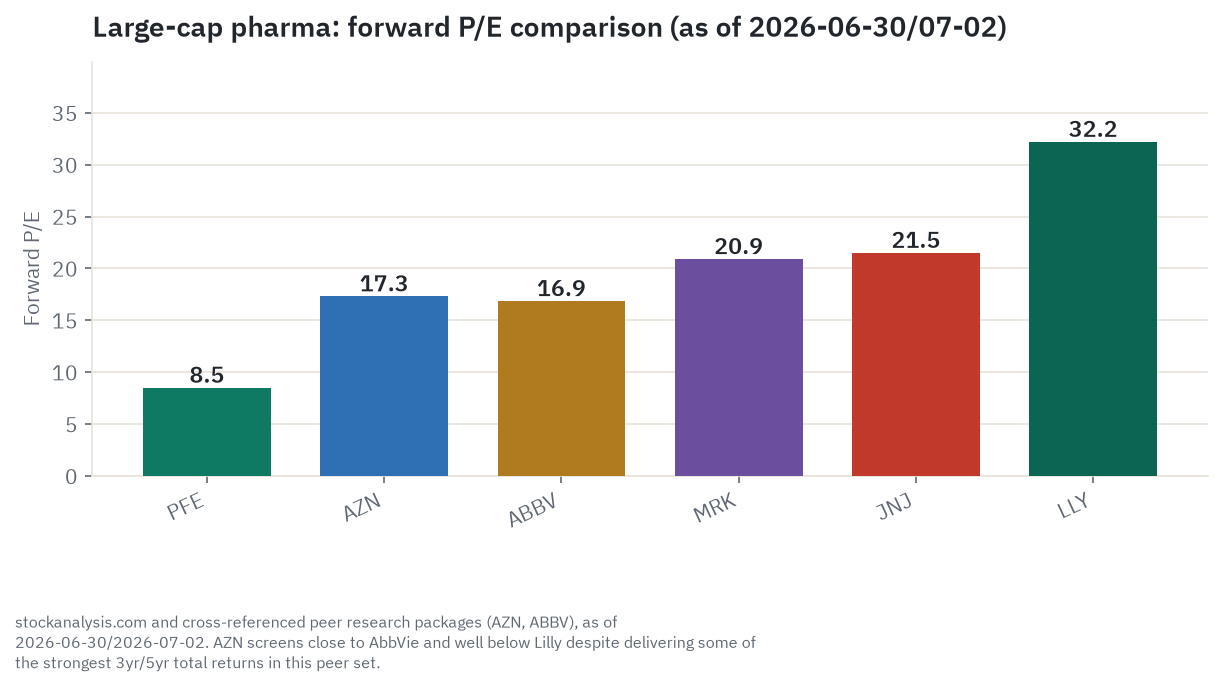
[Eli Lilly (LLY)], NYSE, market cap approximately $1.08 trillion, roughly three and a half to four times AstraZeneca’s size, is the world’s most valuable pharma company on the strength of its GLP-1 obesity and diabetes franchise, Mounjaro and Zepbound, alongside a smaller immunology and oncology book with minimal direct overlap with AstraZeneca. Bull: the obesity-drug market remains capacity-constrained rather than demand-constrained, and Lilly’s incretin franchise alone dwarfs AstraZeneca’s entire revenue base in growth rate and addressable market. Bear: the richest valuation in large-cap pharma, a forward price-to-earnings ratio around 32 times against AstraZeneca’s roughly 17 times, leaves almost no room for a stumble, and roughly 65 percent revenue concentration in tirzepatide is a sharper single-molecule risk than anything AstraZeneca carries.
[Johnson & Johnson (JNJ)], NYSE, market cap approximately $617 billion to $629 billion, is the largest diversified healthcare company in this peer set, spanning Innovative Medicine and MedTech, and competes directly with AstraZeneca’s oncology franchise through Rybrevant and Lazcluze, a direct Tagrisso-adjacent lung-cancer competitor. Bull: the most diversified revenue base of any name in this group cushions any single franchise’s patent cliff better than AstraZeneca’s pharma-only model can. Bear: a multibillion-dollar talc-litigation overhang remains a wildcard on reported earnings, and MedTech growth runs structurally slower than AstraZeneca’s oncology growth rate.
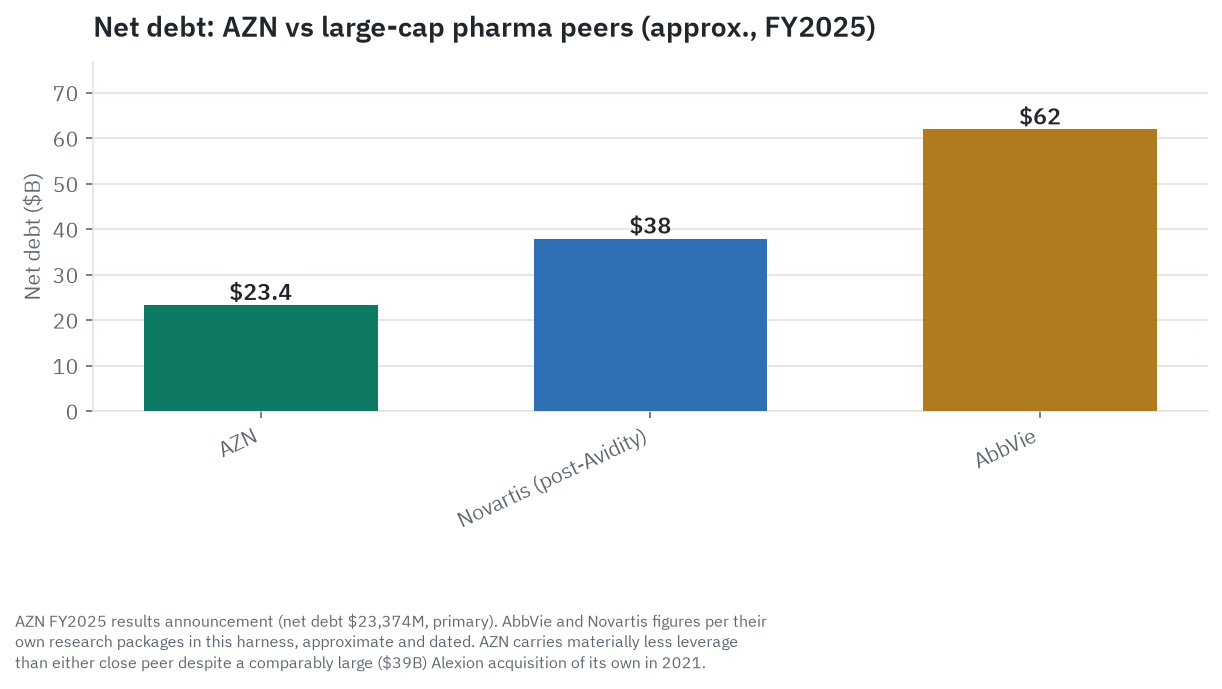
[AbbVie (ABBV)], NYSE, market cap approximately $448 billion to $458 billion, is the immunology category leader through Skyrizi and Rinvoq, the two drugs that already replaced its legacy blockbuster Humira’s peak revenue, with oncology assets (Venclexta, Elahere) that are a smaller fraction of AbbVie’s business than oncology is of AstraZeneca’s. Bull: AbbVie already proved the patent-cliff replacement playbook works once, and Skyrizi and Rinvoq are still growing 20 to 30 percent, a faster near-term clip than AstraZeneca’s overall portfolio. Bear: Rinvoq and Skyrizi’s own patent cliffs sit in the 2030s, Skyrizi’s entirely unprotected by any settlement, and AbbVie carries a negative-equity, debt-funded balance sheet from its 2020 Allergan deal, roughly $62 billion of net debt against AstraZeneca’s roughly $23.4 billion.
[Novartis (NVS)], NYSE ADR with its primary listing on the SIX Swiss Exchange, market cap approximately $283 billion to $303 billion, is AstraZeneca’s closest scale peer, similar total revenue and similar cardiovascular, oncology, and immunology mix, but mid-collapse on its own heart-failure blockbuster Entresto right now. Bull: a differentiated radioligand-therapy manufacturing platform, Pluvicto, that AstraZeneca does not have, plus a growth portfolio still compounding 30 to 90 percent. Bear: Entresto’s abrupt generic-driven collapse, down 42 percent in a single quarter, is a live, real-time preview of exactly the kind of small-molecule cliff AstraZeneca’s Farxiga and, eventually, Tagrisso, face later this decade.
[Merck (MRK)], NYSE, market cap approximately $313 billion to $316 billion, holds the world’s best-selling drug, the checkpoint inhibitor Keytruda, which alone generates close to half of Merck’s total revenue. Bull: a subcutaneous reformulation of Keytruda could extend its effective exclusivity meaningfully past its roughly 2028 intravenous-formulation patent cliff. Bear: Keytruda’s concentration, nearly half of Merck’s entire revenue, is a sharper single-product risk than anything in AstraZeneca’s portfolio, and its 2028 patent cliff combined with IRA-negotiation timing is a bigger, nearer-term cliff than anything AstraZeneca currently faces.
Pfizer (PFE), NYSE, market cap approximately $138.3 billion, the cheapest large-cap pharma name in this set by most multiples, is working through a post-COVID turnaround built on oncology assets from its Seagen acquisition and a shrinking legacy COVID franchise. Bull: deep-value multiples, a single-digit forward price-to-earnings ratio, and a high dividend yield already price in most of the bad news, with the non-COVID base growing again. Bear: no GLP-1 franchise and a smaller, less differentiated oncology pipeline than AstraZeneca’s antibody-drug-conjugate-led platform mean the valuation gap versus AstraZeneca exists for a structural reason, not simple market neglect.
Bristol Myers Squibb (BMY), NYSE, market cap approximately $116.8 billion to $117.3 billion, the smallest market cap among the major US-listed names here, markets Opdivo, the number-two PD-1 checkpoint inhibitor and Keytruda’s most direct competitor, alongside a newer growth portfolio working to offset legacy-drug erosion. Bull: the growth portfolio is scaling fast enough to offset legacy erosion, and the depressed valuation already reflects most of the market’s skepticism. Bear: Opdivo has structurally lost the PD-1 race to Keytruda for years, and the lowest market cap in this set reflects real, not misplaced, skepticism about the legacy portfolio’s continued decline.
Roche Holding (RHHBY), OTCQX American depositary receipt with its primary listing on the SIX Swiss Exchange, market cap approximately $324 billion to $344 billion, markets Tecentriq, a direct competitor to AstraZeneca’s Imfinzi in the checkpoint-inhibitor class, and separately runs the world’s largest in-vitro diagnostics business. Bull: the combined pharma-plus-diagnostics model gives Roche a second growth lever and a companion-diagnostics advantage that pure-play oncology peers, AstraZeneca included, do not have. Bear: Roche’s results carry real Swiss-franc currency-translation noise, and the US-traded RHHBY shares are a materially less liquid over-the-counter line than the primary Zurich listing.
Daiichi Sankyo (DSNKY), thinly traded American depositary receipt with its primary listing on the Tokyo Stock Exchange, market cap approximately $29.9 billion to $35.6 billion, is not a competitor to AstraZeneca at all but its single most important commercial dependency: the company that discovered Enhertu and Datroway, manufactures both drugs under contract, and recognizes 100 percent of Enhertu’s US sales under the companies’ collaboration agreement. Bull: as the sole manufacturer and the recognizer of Enhertu’s US sales, Daiichi Sankyo captures a larger, differently structured share of the drug’s global economics than a simple even-split partnership might suggest, and its broader antibody-drug-conjugate pipeline beyond the AstraZeneca deal gives it independent upside. Bear: heavily dependent on a small number of shared assets, meaning any AstraZeneca-side commercial or regulatory setback for Enhertu or Datroway directly hits Daiichi Sankyo’s own growth story, and the US-traded shares are thinly traded relative to the global importance of the drugs the company makes.
What the filings say
AstraZeneca’s most recent annual report is a Form 20-F, filed February 24, 2026 for FY2025, and its Q1 2026 results were furnished via Form 6-K on April 28, 2026. This is worth stating plainly: despite completing a direct listing of its ordinary shares on the NYSE in February 2026, delisting its previous Nasdaq American depositary shares in the process, AstraZeneca did not start filing a Form 10-K or 10-Q the way a US-domestic issuer does. It remains, and evidently still qualifies as, a Foreign Private Issuer under SEC rules, which is a legally distinct question from which exchange its stock trades on. That status also means AstraZeneca is not subject to the same Section 16 insider-transaction reporting regime that requires a US-domestic company’s officers and directors to file Forms 3, 4, and 5, so insider-ownership visibility here is noticeably thinner than for a comparable US filer, a data-quality point rather than an absence of insider activity.
Revenue and margins. FY2025 total revenue reached $58.7 billion, up 9 percent reported. Q1 2026 revenue was $15.29 billion, up 13 percent reported and 8 percent at constant exchange rates, ahead of consensus on at least one reading. Core (AstraZeneca’s own non-GAAP measure, which strips out acquisition-related intangible amortization and other one-off items) operating profit reached $18.478 billion in FY2025, and core research and development spending ran at roughly 24 percent of total revenue, among the higher R&D intensities in large-cap pharma. Core earnings per share grew 11 percent to $9.16 in FY2025, and Q1 2026 core earnings per share reached $2.58, up 5 percent at constant currency. Gross profit ran at approximately 82 percent of revenue, stable year over year. AstraZeneca’s reported, GAAP-equivalent operating profit and earnings run below these core figures because of intangible-asset amortization tied to the Alexion and other acquisitions, a similar dynamic to the GAAP-versus-adjusted gap seen at AbbVie, though smaller in relative terms here because the Alexion deal is now several years more mature than AbbVie’s more recent bolt-on acquisitions.
Segment mix. AstraZeneca discloses three headline therapy-area groupings rather than classic geographic segments. FY2025: Oncology $25.6 billion (44 percent of total, up 15 percent), CVRM $12.9 billion (22 percent, up 3 percent), Respiratory and Immunology $8.9 billion (15 percent, up 13 percent), Rare Disease $9.1 billion (16 percent, up 4 percent for the full year, though the most recent quarter alone showed 19 percent growth), and other medicines $1.0 billion (down 9 percent). FY2025 revenue by region: the United States 43 percent, Europe 22 percent, ex-China emerging markets 15 percent, China 11 percent, and the rest of the world 9 percent. AstraZeneca’s stated ambition is for the US share to reach roughly 50 percent of total revenue by 2030, alongside the broader $80 billion total-revenue target described below.
Cash flow and the balance sheet. Net cash inflow from operating activities rose $2.714 billion year over year in FY2025, and net cash inflow before financing activities rose $3.886 billion year over year (AstraZeneca’s own disclosure states these as year-over-year changes rather than absolute totals). Capital expenditure on tangible assets and software-related intangibles was $3.27 billion, reflecting continued investment in manufacturing capacity, including the announced $50 billion US manufacturing and R&D plan. Net debt stood at $23.374 billion at year-end 2025, down $1.196 billion year over year, a materially lower figure, both in absolute dollars and relative to revenue, than AbbVie’s roughly $62 billion or Novartis’s roughly $38 billion post-Avidity net debt, despite AstraZeneca having completed a comparably large, roughly $39 billion acquisition of its own, Alexion, in 2021.
Capital returns. AstraZeneca declared a $3.20-per-share dividend for FY2025 and has stated its intention to raise the annual dividend to $3.30 per share for FY2026. The payout ratio on trailing earnings runs at approximately 48 percent. AstraZeneca’s specific FY2025-to-2026 share-buyback cadence was not independently confirmed at the strongest source tier in this research pass and should be checked directly against the 20-F if precision matters to a reader’s own analysis.
Guidance. FY2026 guidance, issued alongside the FY2025 results in February 2026 and reiterated with Q1 2026 results, calls for total revenue growth in the mid-to-high single digits and core earnings-per-share growth in the low double digits, both at constant exchange rates, alongside an ambition for core operating margin in the mid-30s percent range by 2026 and an anticipated 18 to 22 percent core tax rate. AstraZeneca’s Chief Financial Officer, Aradhana Sarin, has publicly characterized the company’s $80 billion-by-2030 revenue ambition, first announced in May 2024 against an analyst consensus roughly $13 billion lower at the time, as “very much within reach” as of a January 2026 investor conference, per FiercePharma’s reporting; this specific characterization comes from a single press account of a conference remark and has not been independently corroborated elsewhere, so treat it as a management talking point rather than a confirmed inflection in the underlying growth rate.
Disclosed risks that matter. AstraZeneca’s own disclosures and recent regulatory history point to five risks worth naming specifically. First, US Medicare drug-price negotiation: Farxiga’s negotiated price took effect January 1, 2026 at a 68 percent cut, and AstraZeneca’s own constitutional challenge to the negotiation program was rejected by the Third Circuit Court of Appeals in May 2025, with a petition now pending before the Supreme Court, an unresolved appeal rather than a closed matter. Second, China legal and regulatory exposure: AstraZeneca disclosed in its filings that a subsidiary and former executives face charges in Shenzhen; the matter is pending and no outcome has been determined. This follows a separate, already-concluded earlier case in which AstraZeneca China staff were found to have altered lung-cancer patients’ genetic test results to fraudulently qualify them for Tagrisso reimbursement, resulting in prison sentences exceeding ten years for some staff; that earlier case is closed, but it is a distinct matter from the pending charges and should not be conflated with them. Third, China’s volume-based procurement pricing system, which cut Farxiga, Lynparza, and roxadustat prices by 20 to 30 percent in a single quarter in early 2026 after AstraZeneca declined to offer further concessions and lost that tender round. Fourth, patent-cliff timing: Farxiga’s US and UK patents and supplementary protection certificates expire around 2028, and Tagrisso’s run later, into the 2032-to-2035 window, though a UK court has already shown that even AstraZeneca’s own disclosed patent-expiry dates are not a guaranteed floor once a determined generic challenger litigates against them. Fifth, the Daiichi Sankyo partnership dependency: AstraZeneca’s own regulatory filings confirm that Daiichi Sankyo is contractually responsible for manufacturing and supply of both Enhertu and Datroway and recognizes 100 percent of Enhertu’s US sales, meaning a meaningful share of AstraZeneca’s most important growth-product economics, and all of its antibody-drug-conjugate manufacturing capacity, sit outside AstraZeneca’s own direct operational control.
Recent material events. The direct NYSE listing completed February 2, 2026, delisting the prior Nasdaq American depositary receipts. Enhertu was approved in the US for two new early-stage breast-cancer settings via a 6-K dated May 18, 2026, triggering the $155 million milestone payment to Daiichi Sankyo described above. Positive Phase III results for tozorakimab, an interleukin-33-targeting biologic for chronic obstructive pulmonary disease, from the OBERON and TITANIA trials, were announced March 27, 2026, in a therapeutic area where rival programs had previously failed, and drove a same-day stock jump. AstraZeneca signed a Most-Favored-Nation pricing deal with the Trump administration around December 2025, agreeing to MFN-style pricing for Medicaid and newly launched drugs in exchange for a three-year grace period from threatened pharma-specific tariffs, conditional on continued US manufacturing investment; AstraZeneca reaffirmed a $50 billion US manufacturing and research commitment, including a new $4.5 billion manufacturing facility in Virginia, as the visible follow-through on that deal.
Insider and institutional signal. AstraZeneca’s largest disclosed institutional shareholders are Capital Research and Management Company at roughly 8.8 percent, BlackRock at roughly 8.5 percent, Vanguard Group at roughly 4.6 percent, and T. Rowe Price Associates at roughly 3.17 percent (49.12 million shares). The aggregate institutional-ownership percentage is sharply disputed across data vendors, one source shows roughly 32 percent institutional ownership against roughly 68 percent implied retail, another shows roughly 72 percent institutional, likely reflecting different methodologies (free float versus total shares outstanding, or a stale UK-register-era calculation carried over from before the NYSE listing change) rather than a real disagreement about who owns the stock. The individually named large holders above are more reliably sourced than that aggregate percentage.
What the market is paying
AstraZeneca traded at $193.66 on July 2, 2026 (a second vendor’s snapshot minutes apart showed $193.33, a trivial difference), up 5.33 percent on the day on one reading, continuing a run of momentum built on the pipeline catalysts described above. The stock sits well up its 52-week range of $134.90 to $212.71, though below the top of that range. Market cap is sharply disputed between vendors: stockanalysis.com showed $285.33 billion on July 2, 2026, while companiesmarketcap.com showed $299.65 billion the day before, a roughly 5 percent gap wider than the typical single-day vendor discrepancy this kind of research usually turns up, likely related to AstraZeneca’s recent NYSE direct-listing transition and how different vendors handle the resulting share count. Shares outstanding run at approximately 1.55 billion, with a free float of roughly 99.69 percent of shares outstanding, essentially no closely held block, consistent with AstraZeneca’s thin disclosed insider ownership as a Foreign Private Issuer.
Returns. AstraZeneca’s total return (price appreciation plus dividends, per a single data provider, FinanceCharts, and not independently cross-checked against a second calculator in this research) has been unusually strong: roughly 53.5 percent over one year, 219.5 percent over three years, placing it in the top decile of its sector, and 354.1 percent over five years, in the top decile of its industry. On a simple annualized basis that works out to roughly 47 percent a year over three years and 35 percent a year over five years, one of the strongest multi-year compounding records in this entire large-cap pharma peer set, materially ahead of AbbVie’s roughly 40 percent, 108 percent, and 170 percent over the same three windows, and in the same league as Eli Lilly’s headline five-year number, though Lilly’s is driven by a single molecule class while AstraZeneca’s is spread across a more diversified oncology and rare-disease mix.
Volatility. AstraZeneca’s beta runs at 0.21 over five years, even lower than AbbVie’s already-low 0.27 to 0.31, making it one of the most defensive, lowest-beta names in this entire peer set despite its unusually strong recent price momentum. That combination, a very low beta alongside a very strong multi-year return, is worth flagging on its own terms rather than glossing over: the price has moved up steadily on a string of idiosyncratic pipeline and regulatory catalysts rather than tracking broad market swings, which is consistent with a low historical beta calculation even during a period of strong absolute performance.
Valuation. AstraZeneca’s trailing price-to-earnings ratio runs at 27.46 times, sitting well below AbbVie’s GAAP-charge-distorted roughly 124 times and modestly above Novartis’s typical high-teens-to-low-20s range. The forward price-to-earnings ratio, the more decision-useful figure, is 17.31 times, almost exactly level with AbbVie’s roughly 16 to 17 times and comfortably below Johnson & Johnson’s roughly 21.5 times, Merck’s roughly 20.9 times (disputed, one vendor shows 13.3 times), and Eli Lilly’s roughly 32.2 times. Enterprise value to EBITDA runs at 15.57 times, below AbbVie’s roughly 17.0 times and well below Lilly’s roughly 30.6 times. Price to sales runs at 4.72 times, below AbbVie’s roughly 7.1 times and well below Lilly’s roughly 14.8 times. The dividend yield is 1.66 percent on the $3.20-per-share trailing dividend, with a payout ratio of roughly 48 percent, meaningfully lower than AbbVie’s GAAP-distorted 336 percent or even a “clean” mid-30s-to-40s-percent range typical of growth-oriented large pharma, suggesting AstraZeneca retains more capital for reinvestment relative to peers that return a larger share of cash flow through the dividend. Put together: AstraZeneca screens as moderately valued, not expensive, on every forward-looking multiple in this peer set, even after one of the strongest three-to-five-year total-return runs among its large-cap pharma peers. The market has rewarded AstraZeneca’s execution with price appreciation but has not, at least not yet, re-rated it to the kind of premium multiple it grants Eli Lilly, which is itself a genuine further-upside case if the $80 billion-by-2030 ambition keeps being realized.
Liquidity and short interest. Average trading volume runs at roughly 2.0 million shares a day, reasonable for a roughly $285-billion-to-$300-billion mega-cap, though on the lighter side in absolute share-count terms given AstraZeneca’s high per-share price. Short interest is very low, approximately 1.72 million shares, or 0.11 percent of shares outstanding, meaningfully lower than even AbbVie’s already-modest roughly 1.33 percent of float, signaling essentially no active bearish positioning against the stock at current levels.
Sell-side. Consensus rests at Buy or Moderate Buy, but analyst counts and average targets diverge sharply across vendors in a way that matters for how much upside a reader should actually expect. MarketBeat shows 15 analysts, Moderate Buy, an average target of $205.33 (high $216, low $194) as of July 2, 2026, implying roughly 6 percent upside from the price on that date. A separate reading drawing on AstraZeneca’s London-listing dataset with a larger sample of analysts implies a materially larger, 14-to-32-percent range of upside, most likely because it mixes pound-denominated London targets against a dollar-denominated New York price without full currency reconciliation, a data-quality issue specific to recently relisted, dual-currency-quoted stocks like AstraZeneca. The more currency-consistent, roughly 6 percent figure is the safer read; treat the larger implied-upside figures with real skepticism until the currency basis is confirmed.
What the crowd is saying
News flow on AstraZeneca has turned solidly bullish over the past one to four months, and it is anchored in real, dated clinical and regulatory events rather than speculation. The March 27, 2026 tozorakimab win in chronic obstructive pulmonary disease, a therapeutic area where rival programs had previously failed, produced an immediate stock jump and was widely covered as a genuine pipeline surprise. The May 2026 Enhertu approvals in two new early-breast-cancer settings extended the drug’s addressable population into curative-intent care. A partnership with China-based Abbisko Therapeutics on a novel lung-cancer therapy signaled continued deal-making even amid China’s mixed operating environment for the company. Coverage of the tozorakimab win specifically noted it landed in an area “where rivals have failed,” reinforcing a narrative that AstraZeneca’s research organization is succeeding where competitors have stumbled.
Retail and social chatter is thin: AstraZeneca does not appear on Reddit or AltIndex most-mentioned-stock lists, in contrast to high-beta momentum names, broadly consistent with the stock’s own low beta and low short interest. Where retail commentary does surface, particularly in dividend- and income-focused investing forums and UK retail-investor communities given AstraZeneca’s London Stock Exchange heritage, the framing tends to emphasize the dividend and the stock’s status as a safe, diversified pharma holding rather than a high-conviction growth trade, a framing that, per the fundamentals described above, somewhat understates the actual growth-rate strength of the oncology and rare-disease franchises relative to a boring-dividend-stock stereotype. Attention appears event-driven rather than persistently elevated, tracking specific news, the March tozorakimab readout, the May Enhertu approvals, and quarterly earnings dates, rather than a sustained, off-baseline viral narrative independent of actual news flow, itself a reassuring signal that attention is tracking substance rather than speculation.
Employee sentiment is solidly positive and stable: a 4.0-out-of-5 rating across 8,917 Glassdoor reviews, 79 percent of employees saying they would recommend the company to a friend, and a 2026 Glassdoor Best Place to Work recognition, with the usual self-selection-bias caveat that applies to any workplace-review platform.
The most useful divergence between the crowd narrative and the underlying evidence involves China specifically. Where mainstream financial coverage discusses AstraZeneca’s China exposure at all, it tends to focus on the pricing-pressure story, the volume-based procurement cuts described above, a familiar, well-understood risk that markets have priced into China-exposed pharma names for years. The more serious matter, the pending legal charges against an AstraZeneca subsidiary and former executives described above, appears to receive less sustained retail and investor attention than its severity would seem to warrant, a case where the crowd narrative may be underpricing a genuine tail risk rather than overreacting to one. This observation is about relative media attention, not a prediction of how the matter resolves, which remains unresolved as of this research date.
Durability, and what has to be true
AstraZeneca’s revenue splits across three demand stories with meaningfully different durability profiles. Oncology, 44 percent of the most recent quarter’s revenue and growing 16 to 20 percent, is close to the least discretionary category of healthcare spending that exists: patients and payers do not defer treatment for a life-threatening diagnosis in a downturn, and the funding source is overwhelmingly public health systems, Medicare, and commercial insurance rather than out-of-pocket cash. The broader oncology category is itself a genuine secular growth market, with global cancer-medicine spending estimated at roughly $252 billion in 2024 and projected to reach roughly $441 billion by 2029, though growth is expected to slow starting around 2027 as some backbone therapies face their own generic and biosimilar competition. Rare disease, 16 percent of revenue and growing 19 percent in the most recent quarter, is the single most durable of the three: Ultomiris and Soliris treat conditions with few or no substitute therapies, and once a patient starts treatment it is typically lifelong. The biopharmaceuticals segment, which houses Farxiga, is the most exposed of the three: durable demand volume for chronic-disease management, but the price per unit is now under active, structural pressure from both the IRA and China’s VBP system in a way oncology has not yet faced.
The structural bull case. Three genuinely distinct growth engines reduce single-product concentration risk relative to Merck’s Keytruda-dependent model or, historically, AbbVie’s pre-Skyrizi-and-Rinvoq Humira dependency; no single AstraZeneca product approaches that level of revenue concentration. The company’s largest already-realized policy risk, Farxiga’s IRA price cut, is behind it rather than ahead of it, while its next major patent-cliff exposure, Tagrisso, sits later in the decade than several peers’ nearest-term equivalent risk. A genuinely dense, already-converting late-stage pipeline, more than 20 Phase III readouts in 2026 alone, with tozorakimab and the Enhertu early-breast-cancer approvals already realized within the year, supports the credibility of the $80-billion-by-2030 ambition. And materially lower balance-sheet leverage than AbbVie or post-Avidity Novartis gives AstraZeneca more capital-allocation flexibility to keep funding both the dividend and continued pipeline and manufacturing investment.
The real cyclical bear case, and its timing. AstraZeneca is running the same patent-cliff-delay playbook every large pharma company eventually must run, and several distinct pressure points converge inside the standard five-year outlook window. Farxiga’s IRA-negotiated price is already locked in at a 68 percent discount, and the drug’s own patent and supplementary-protection-certificate coverage runs out around 2028, meaning Farxiga faces both negotiated-price compression and generic entry within a similar multi-year window, potentially a sharper combined hit than either mechanism alone. China’s volume-based procurement mechanism is a rolling, not one-time, pricing headwind that will likely claim additional AstraZeneca products at future tender rounds, and the pending legal matter involving the company’s China subsidiary and former executives is a genuine, unresolved tail risk with no visibility into timing or outcome. The most probable trigger window is 2028 through the early 2030s: Farxiga’s patent protection lapses around 2028 absent further litigation, opening generic competition on top of the already-negotiated IRA price, a compounding rather than sequential hit to what is left of that franchise’s US economics; Tagrisso approaches its own IRA-eligibility window during roughly this same period even though its patent protection runs later; and the pipeline’s conversion rate from the dense 2026 cohort becomes the swing factor for whether growth decelerates gracefully, the way AbbVie’s Humira-to-Skyrizi-and-Rinvoq transition did, or more sharply. What could accelerate the bear case: an adverse Supreme Court outcome on the IRA constitutional challenge, though this would mainly confirm an already-expected result rather than surprise the market; an unfavorable outcome or expanded scope in the pending China legal matter; or additional AstraZeneca products losing future China VBP tenders. What could soften it: continued conversion of the 2026 Phase III pipeline into approved, commercially successful products, building a genuine next wave ahead of the Farxiga-and-Tagrisso cliff, the way AbbVie pre-built Skyrizi and Rinvoq ahead of Humira’s cliff.
The most likely outcome is a split by time horizon rather than a clean bull or bear. Through roughly 2028, oncology and rare disease continue double-digit growth as the 2026 pipeline converts into commercial revenue, while Farxiga’s US revenue base stabilizes at its post-IRA-negotiated level and the Section 232 tariff transition is a manageable, one-time cost adjustment assuming AstraZeneca secures a reduced-rate onshoring plan. From roughly 2028 to 2032, Farxiga’s US patent protection lapses, opening generic competition on top of the already-negotiated price, and Tagrisso approaches its own IRA-eligibility window, with the pipeline’s conversion rate becoming the decisive variable for whether growth decelerates gracefully or sharply. From 2032 onward, Tagrisso’s own patent-expiry window arrives, the next genuine large-molecule cliff event, with the outcome depending heavily on how far the Enhertu-and-Datroway platform, rare disease, and whatever the 2026-to-2030 pipeline cohort has scaled into by then. What has to be true for the bull case to hold over the full period: the pipeline conversion rate keeps running at or above its current pace, and the China legal matter resolves without materially disrupting AstraZeneca’s standing as China’s largest foreign drugmaker. Neither is yet confirmed either way.
The scenarios in detail
Four variables decide the five-year outcome, and the three scenarios below are just different settings of these same dials.
Pipeline conversion rate. How much of the more than 20 Phase III readouts expected in 2026, plus the broader oncology, rare-disease, and respiratory pipeline, actually turns into approved, commercially successful products, tozorakimab, Datroway’s expanded uses, camizestrant, baxdrostat, the next wave of antibody-drug conjugates and bispecifics, fast enough to outrun the aging legacy portfolio.
The Farxiga-then-Tagrisso price-setting sequence. How much of AstraZeneca’s cardiovascular and oncology revenue gets repriced by IRA Medicare negotiation and China VBP tendering, and on what timeline Tagrisso specifically becomes IRA-eligible and loses patent protection.
China, on two separate axes. The rolling VBP pricing mechanism, a familiar, quantifiable headwind, and the pending legal matter against a subsidiary and former executives, an unquantifiable, binary risk with no defined timeline.
Capital allocation and the Daiichi Sankyo dependency. Whether AstraZeneca’s comparatively low leverage keeps funding both the dividend and the pipeline without a leverage-driven de-rating, and how much of Enhertu and Datroway’s true economics AstraZeneca can capture given that Daiichi Sankyo manufactures both drugs and recognizes 100 percent of their US sales.
Bull scenario, illustrative valuation. Core earnings per share compound at roughly 14 percent a year as the 2026-to-2028 Phase III cohort converts at a high rate: tozorakimab, Datroway’s expanded indications, camizestrant, baxdrostat, and the next wave of antibody-drug conjugates and bispecifics all reach commercial scale; Enhertu’s global economics keep growing at a 30-percent-plus clip; the oral obesity and type 2 diabetes franchise clears Phase 3 and adds a genuine fourth growth engine; the pending China legal matter is resolved without material operational disruption; and the $80-billion-by-2030 revenue ambition is met or exceeded. Core earnings per share grow from $9.16 in FY2025 to roughly $17 to $18 by year five, and the market re-rates the forward multiple from its current roughly 17 times toward 19 to 20 times, closer to the premium the market already assigns Eli Lilly. That implies an illustrative level near $353 five years out, $258 at three years, $240 at one year, and $215 at six months. What has to be true: pipeline conversion keeps running at or above its current pace across several new modalities AstraZeneca has less commercial history in, radioconjugates, bispecifics, cell therapy, than its core small-molecule and biologics franchises. What most likely breaks it: a high-profile Phase III failure in the 2026-to-2027 cohort, or a materially adverse outcome in the China legal matter that disrupts AstraZeneca’s standing as China’s largest foreign drugmaker.
Base scenario, illustrative valuation. Core earnings per share compound at roughly 11 percent a year, matching AstraZeneca’s own “low double-digit” FY2026 core-earnings-growth guidance sustained over the period; the 2026 pipeline cohort converts at a moderate, not exceptional, rate; Farxiga’s US and China price cuts are already absorbed and stable; China VBP continues eroding a handful of additional products a year at the same 20-to-30-percent cadence already seen; the China legal matter remains unresolved but does not materially disrupt operations; and Tagrisso’s IRA-eligibility and patent-cliff timing arrive on their current disclosed schedule, not earlier. Core earnings per share grow from $9.16 to roughly $15.4 by year five, and the market continues paying roughly its current forward multiple, around 17 times, for a diversified, moderate-growth pharma. That implies an illustrative level near $262 five years out, $213 at three years, $205 at one year, and $200 at six months. What has to be true: execution roughly matches current guidance with no major surprise in either direction. What most likely breaks it: any single driver, pipeline conversion, the China legal matter, a patent-litigation surprise like the Farxiga UK SPC revocation, moving meaningfully worse than currently disclosed.
Bear scenario, anchored on the strongest case against the stock. Core earnings-per-share growth slows to roughly 5 percent a year as Tagrisso’s IRA-eligibility date arrives sooner than the market has priced, producing a Farxiga-style negotiated price cut on AstraZeneca’s single largest product, layered on top of continuing China VBP erosion across additional products; the pending China legal matter drags on for years without resolution, creating a persistent overhang on AstraZeneca’s standing in its largest single non-US market; the 2026-to-2027 Phase III cohort converts at a below-guidance rate; Daiichi Sankyo’s manufacturing or commercial performance on Enhertu and Datroway disappoints or is disrupted; and the Section 232 tariff transition proves costlier than the $50 billion onshoring plan was sized for. Core earnings per share grow from $9.16 to only roughly $11.7 by year five, real growth, but far below guidance, and the market re-rates the forward multiple down to roughly 12 times, a patent-cliff-appropriate multiple similar to how Novartis is currently priced through Entresto’s active decline. That implies an illustrative level near $140 five years out, $138 at three years, $165 at one year, and $175 at six months. What has to be true: multiple concurrent risks, Tagrisso’s cliff, China legal and pricing pressure, tariff costs, pipeline misses, all land within the same multi-year window rather than being absorbed sequentially with time to adjust in between, the scenario a genuine skeptical read argues the current multiple does not appear to price. What would flip the bear back toward the bull: any one of these risks resolving favorably, or on a slower timeline than the disclosed schedule implies, given AstraZeneca’s comparatively low leverage provides real room to absorb a single shock without a balance-sheet crisis.
Catalyst timeline. Near term: the next earnings print, expected around July 27, 2026; the Section 232 pharmaceutical-tariff effective date for AstraZeneca’s accelerated cohort, July 31, 2026; continued 2026 Phase III readouts, Datroway expansion trials, camizestrant, baxdrostat; and any scheduling news, a trial date or procedural update, on the pending China legal matter. Multi-year: Farxiga’s US patent and supplementary-protection-certificate coverage lapsing around 2028 absent further litigation; Tagrisso’s IRA-eligibility date becoming clear, not yet independently confirmed in this research; Tagrisso’s own patent-cliff window, 2032 to 2035, approaching; the US Supreme Court’s decision on whether to hear AstraZeneca’s constitutional challenge to the IRA program; and continued progress disclosures toward the $80-billion-by-2030 ambition and the 50-percent-US-revenue-share target.
Leading indicators worth tracking. Resolution, whether a trial date, a verdict, or a settlement, of the pending China legal matter against AstraZeneca’s subsidiary and former executives is the clearest binary legal-risk catalyst unique to this name in its peer set. China VBP tender results for additional AstraZeneca products in future rounds are an early read on how much further pricing erosion is coming from that specific mechanism. Any news pinning down Tagrisso’s specific IRA-eligibility year is the single most consequential missing data point in this entire outlook. Section 232 tariff onshoring-plan approval status for AstraZeneca specifically, ahead of and after the July 31, 2026 effective date, confirms whether the reduced or zero tariff rate was actually achieved. The conversion rate of the 2026 Phase III cohort into approvals and commercial revenue is the clearest read on whether AstraZeneca’s next growth wave is scaling ahead of the Farxiga-and-Tagrisso cliff. And quarterly progress disclosures against the $80-billion-by-2030 ambition and the US-revenue-share target are management’s own disclosed scorecard for the whole diversification strategy.
Companies to watch (bull, base, bear)
AstraZeneca (AZN), the subject of this piece. Bull: three genuinely distinct growth engines, a dense, already-converting late-stage pipeline, and a lighter debt load than its closest peers. Base: a diversified, moderate-growth compounder absorbing known price-setting pressure on schedule. Bear: Tagrisso’s still-unlived IRA-and-patent-cliff sequence, the pending China legal matter, and a fastest-growing product AstraZeneca does not fully control. Watch: Tagrisso’s IRA-eligibility date, resolution of the China legal matter, and the 2026 pipeline’s conversion rate.
[Eli Lilly (LLY)], the valuation benchmark AstraZeneca’s relative-cheapness argument leans on. Bull: the GLP-1 category leader with a growth rate and addressable market that dwarfs AstraZeneca’s entire revenue base. Bear: the richest multiple in the group leaves almost no room for a stumble, and roughly 65 percent revenue concentration in one molecule class is a sharper single-product risk. Watch: whether oral GLP-1 competition compresses Lilly’s premium multiple, which would remove some of AstraZeneca’s relative-value argument.
[Johnson & Johnson (JNJ)], the direct oncology competitor through Rybrevant and Lazcluze. Bull: the most diversified revenue base in this group cushions any single franchise’s patent cliff. Bear: the talc-litigation overhang remains a live multibillion-dollar wildcard. Watch: Rybrevant and Lazcluze’s continued share gains against Tagrisso specifically in lung cancer.
[AbbVie (ABBV)], the clearest precedent for how a patent-cliff replacement playbook can actually work. Bull: Skyrizi and Rinvoq already replaced Humira’s peak revenue and are still growing 20 to 30 percent. Bear: Skyrizi’s own unprotected 2033 patent cliff and a negative-equity, debt-funded balance sheet. Watch: whether AbbVie secures a Skyrizi-specific patent settlement before 2033, a template for what AstraZeneca will eventually need for Tagrisso.
[Novartis (NVS)], AstraZeneca’s closest scale peer, and the clearest live preview of an unmitigated patent cliff. Bull: a differentiated radioligand-therapy platform and a growth portfolio still compounding 30 to 90 percent. Bear: Entresto’s abrupt 42-percent quarterly collapse is happening in real time. Watch: how quickly Novartis’s newer launch brands offset the Entresto cliff, a template for how AstraZeneca’s own Farxiga-and-Tagrisso cliff might play out.
[Merck (MRK)], the sharpest single-product concentration risk in this peer set. Bull: a subcutaneous Keytruda reformulation could extend effective exclusivity past the 2028 patent cliff. Bear: Keytruda alone is nearly half of Merck’s revenue, a concentration risk far higher than anything AstraZeneca carries. Watch: whether Merck’s post-2028 replacement pipeline scales fast enough, a useful comparison for how hard the diversification playbook actually is.
Pfizer (PFE), the cautionary tale on how a stock can get left behind even at a cheap multiple. Bull: deep-value multiples and a high dividend yield already price in most bad news. Bear: no GLP-1 franchise and a thinner oncology pipeline than AstraZeneca’s. Watch: whether Pfizer’s underlying non-COVID business stabilizes, a signal for how much patience the market extends to a name once it loses growth-story status.
Bristol Myers Squibb (BMY), the smallest market cap in this set and a real-time precedent for legacy-portfolio erosion. Bull: the growth portfolio is scaling fast enough to offset legacy decline. Bear: Opdivo has structurally lost the PD-1 race to Keytruda for years. Watch: whether the growth portfolio’s share of total sales keeps climbing at its current pace.
Roche Holding (RHHBY), the diagnostics-plus-pharma diversification benchmark. Bull: the combined model gives Roche a second growth lever AstraZeneca does not have. Bear: real currency-translation noise and a thin, illiquid US-traded line. Watch: Tecentriq’s continued competitive position against Imfinzi in overlapping tumor types.
Daiichi Sankyo (DSNKY), AstraZeneca’s single most important commercial dependency, not a competitor. Bull: sole manufacturer and US-sales recognizer of Enhertu and Datroway, capturing a large, differently structured share of the drugs’ global economics. Bear: heavily dependent on assets shared with AstraZeneca, and thinly traded for US investors. Watch: any disruption to Daiichi Sankyo’s manufacturing or supply of Enhertu and Datroway, a direct AstraZeneca revenue risk that AstraZeneca’s own investment cannot fix.
Risk controls
The single largest risk sitting over this thesis is concentration of separate, structural pressures inside the same multi-year window rather than any one of them alone. Farxiga has already absorbed a 68 percent US price cut and a 20 percent China price cut in the same year, and its patent protection lapses around 2028, meaning the drug faces negotiated-price compression and generic entry within a similar timeframe, a potentially sharper combined hit than either mechanism working alone. Tagrisso, AstraZeneca’s actual largest product, has not yet lived through any version of this sequence, and the specific year it becomes eligible for Medicare price negotiation was not independently confirmed in this research, a genuine, unquantified near-term risk rather than a settled, priced-in fact.
The pending legal matter in China compounds this in a way that cannot be sized in dollars. AstraZeneca disclosed in its filings that a subsidiary and former executives face charges in Shenzhen; the matter is pending and no outcome has been determined, and no trial date has been set as of this research date. A reasonable reader should treat this as a genuine, currently unquantifiable tail risk, not a routine, already-priced-in pricing headwind like the separate, more familiar China VBP mechanism.
AstraZeneca’s balance sheet is a genuine mitigant rather than a compounding risk here, an important contrast with some peers: net debt of roughly $23.4 billion is materially lower, both in absolute terms and relative to revenue, than AbbVie’s roughly $62 billion or Novartis’s roughly $38 billion, giving the company real capacity to absorb a single adverse shock, whether from the China legal matter, a tariff-cost surprise, or a pipeline miss, without a balance-sheet crisis. The dependency on Daiichi Sankyo for Enhertu and Datroway’s manufacturing and a share of their economics is a separate, structural feature no amount of AstraZeneca’s own capital can directly fix.
Valuation risk is comparatively modest here relative to some peers: the stock trades at a mid-pack-to-cheap forward multiple across nearly every measure in this peer set despite one of the strongest multi-year total-return records in large-cap pharma, meaning there is less “priced for perfection” risk than a name like Eli Lilly carries at a much richer multiple. Liquidity and access are not concerns: AstraZeneca is a highly liquid mega-cap stock with essentially no short-interest buildup. What would change this thesis, in either direction: a confirmed, favorable resolution of the China legal matter or Tagrisso’s IRA-eligibility date being confirmed as later than currently feared would each meaningfully strengthen the bull case; a materially adverse China-matter outcome, a below-guidance 2026 pipeline conversion rate, or an unexpectedly early Tagrisso IRA selection would each pull the read toward Hold.
Methodology, sourcing, and data-quality flags
This piece was built from parallel research streams: the value-chain map, the SEC and filings analysis, market action and valuation, sentiment and narrative, macro and micro economics, a dedicated business-model-and-moat deep dive, and a forward outlook, then run past a skeptic who argued the short case and a compliance review of the disclaimers and framing. The source hierarchy, strongest first: primary filings (the FY2025 Form 20-F filed February 24, 2026, the Q1 2026 6-K, and AstraZeneca’s own patent-expiry investor-relations appendix); analyst and institutional estimates; reputable trade press; and this piece’s own labeled scenario arithmetic. Of 56 claims checked in this research, 47 were independently verified, 4 carry a named vendor dispute and are presented as a range or a clearly attributed estimate rather than a single figure, and 1, the specific peak-sales estimates for AstraZeneca’s next-generation oncology pipeline, remains an unverified, single-press-chain analyst estimate and is presented only as an explicitly attributed, hedged projection, never as company guidance or settled fact.
A note on the five-factor read itself, in plain terms rather than as a score. On valuation, the evidence reads moderately cheap rather than expensive: forward earnings, at 17.31 times, sit close to AbbVie’s own multiple and well below Johnson & Johnson, Merck, and Eli Lilly, despite AstraZeneca delivering some of the strongest three-year and five-year total returns, 219.5 percent and 354.1 percent, in this entire peer set. The market has rewarded execution with price appreciation but has not yet re-rated the stock to a growth-stock premium multiple. On growth, the read is genuinely strong: revenue grew 9 percent in FY2025 and 13 percent reported in the most recent quarter, with oncology up 16 to 20 percent and rare disease up 19 percent, a real, diversified, double-digit growth story across multiple franchises rather than a single blockbuster. The offsetting note is that the segment housing Farxiga is now shrinking on a constant-currency basis, and the specific peak-sales figures underpinning the next growth wave are analyst estimates from a single press chain, not AstraZeneca’s own guidance. On quality, the read is high: an approximately 82 percent gross margin, a mid-30s-percent core operating-margin ambition, and net debt of roughly $23.4 billion, meaningfully lower than AbbVie’s or Novartis’s, despite AstraZeneca funding a roughly 24-percent-of-revenue research and development budget and a growing dividend off its own comparably large Alexion acquisition. On risk, the read is elevated and structurally broad relative to peers: a pending, unresolved legal matter against a China subsidiary and named former executives with no defined resolution timeline; Tagrisso’s still-unlived price-setting-then-patent-cliff sequence sitting ahead rather than behind it; a rolling China pricing mechanism that has already claimed three products in a single quarter; an accelerated Section 232 tariff timeline; and a partner-dependency on Daiichi Sankyo for the manufacturing and a share of the economics of the fastest-growing product. AstraZeneca’s lower leverage provides real capacity to absorb any single one of these shocks, but the concurrence of several inside the same multi-year window is a genuine, not routine, risk profile, which is exactly why this factor weighs on the overall read the most. On momentum, the signal is soft and positive: a 53.5 percent one-year total return anchored in dated, verifiable pipeline catalysts rather than broad market moves, consistent with an unusually low 0.21 beta, tempered by a consensus target implying only modest further upside on the more currency-consistent reading, and thin retail attention. Netting these five factors together, a genuinely diversified, lower-leverage pharma compounder trading at a moderate multiple, carrying real and partly unquantifiable near-term risk on two named fronts, the lean lands at Buy: constructive, one notch below the strongest conviction call. It would move toward a stronger read on a confirmed, favorable China-matter resolution or a later-than-feared Tagrisso timeline. It would move down toward Hold on an adverse China-matter development, a below-guidance pipeline conversion rate, or an unexpectedly early Tagrisso IRA selection.
Data-quality flags:
- Point-in-time figures move fast. Every price, market cap, valuation multiple, short-interest reading, and analyst target here is stamped July 2, 2026 and will already have moved by the time this is read. The site’s live price and market-cap header above this article supersedes the $193.66 and roughly $285-billion figures used in the prose.
- Market cap is genuinely disputed between vendors, $285.33 billion versus $299.65 billion, a roughly 5 percent gap wider than the typical single-day vendor discrepancy, most likely tied to AstraZeneca’s recent NYSE direct-listing transition and how different vendors handle the resulting share count.
- Analyst consensus price target is significantly disputed across vendors, most likely reflecting a currency and listing mismatch between pound-denominated London targets and the dollar-denominated New York price rather than a genuine difference in sell-side sentiment; the roughly 6 percent implied-upside figure is the more currency-consistent read used in this piece.
- Total-return figures (53.5, 219.5, and 354.1 percent over one, three, and five years) are single-sourced to FinanceCharts and were not independently cross-checked against a second total-return calculator in this research.
- Institutional-ownership aggregate percentage is disputed (roughly 32 percent versus roughly 72 percent across vendors), likely a free-float-versus-total-shares or stale-register methodology difference; the individually named large holders are more reliably sourced than the aggregate percentage.
- China’s FY2025 revenue figure is disputed and arithmetically inconsistent across sources: a trade-press synthesis puts it at roughly $5.5 billion, up 4 percent, while the independently verified regional-mix disclosure (China at 11 percent of FY2025 total revenue) implies closer to $6.5 billion off the $58.7 billion total. Treat this as a range, roughly $5.5 billion to $6.5 billion depending on methodology, rather than a single settled figure.
- The pending China legal matter is a live, unresolved matter involving named former executives. It is corroborated across multiple reputable trade-press outlets but has not been confirmed against a primary AstraZeneca filing or court record, and no trial date or verdict exists as of the research date. This piece treats it strictly as a disclosed, pending matter throughout, never as an established finding of wrongdoing or a resolved outcome.
- Tagrisso’s specific IRA-eligibility year was not independently confirmed against AstraZeneca’s own disclosed patent and exclusivity calendar in this research; this is the single most consequential open question in the whole outlook and should be checked directly against AstraZeneca’s own disclosures before any reader treats a specific year as fixed.
- Peak-sales estimates for AstraZeneca’s next-generation oncology pipeline (datopotamab deruxtecan, volrustomig, and the revised Enhertu peak) trace to analyst estimates relayed through a single press chain rather than AstraZeneca’s own guidance or a broader consensus, and are presented throughout as explicitly attributed, hedged estimates rather than facts.
- AstraZeneca, as a Foreign Private Issuer, is not subject to the same Section 16 insider-transaction reporting regime as a US-domestic issuer, so insider-transaction visibility here is genuinely thinner than for a comparable US filer, a data-quality point rather than an absence of insider activity.
Key sources: AstraZeneca’s FY2025 Form 20-F (SEC EDGAR, filed February 24, 2026) and Q1 2026 results announcement (furnished via Form 6-K, April 28, 2026); AstraZeneca’s own patent-expiry investor-relations appendix (February 2026); the Enhertu-approval 6-K (May 18, 2026); CMS’s Medicare Drug Price Negotiation Program fact sheets for the 2026 initial price applicability year; the Third Circuit’s ruling in AstraZeneca v. Kennedy; stockanalysis.com and companiesmarketcap.com for market-data cross-checks; and Q1 2026 or most-recent-quarter disclosures from Eli Lilly, Johnson & Johnson, AbbVie, Novartis, Merck, Pfizer, Bristol Myers Squibb, Roche, and Daiichi Sankyo for the peer comparisons. Figures are point-in-time as of July 2, 2026.
Prepared July 2, 2026. Figures are point-in-time and will change. This is research and analysis for educational purposes, not investment advice, not a recommendation, and not a solicitation. Pharmaceutical companies carry patent-cliff, clinical-trial, and drug-pricing-regulation risk that can move results faster and further than a typical stock. Verify all figures independently and consult a licensed financial advisor before making any decision.