
Research date: July 2, 2026 | OSINT market research on Merck & Co., Inc. (NYSE: MRK): how one drug came to fund half the company, what happens when its patent runs out in 2028, and the bull, base, and bear case from six months to five years.
Important disclaimer. This is OSINT-based research and educational analysis, not investment advice. I am not a financial advisor. Nothing here is a recommendation to buy or sell any security, and the scenarios below are illustrative, not price targets. Pharmaceutical companies carry patent-cliff, clinical-trial, and drug-pricing-regulation risk that can move faster and further than a typical stock once a single molecule’s exclusivity status changes. Market caps, prices, valuation multiples, and market-share figures are point-in-time (July 2, 2026), press-reported where noted, and move fast. Do your own due diligence and consult a licensed advisor.
Where this stock could be in 6 months, 1 year, 3 years, and 5 years
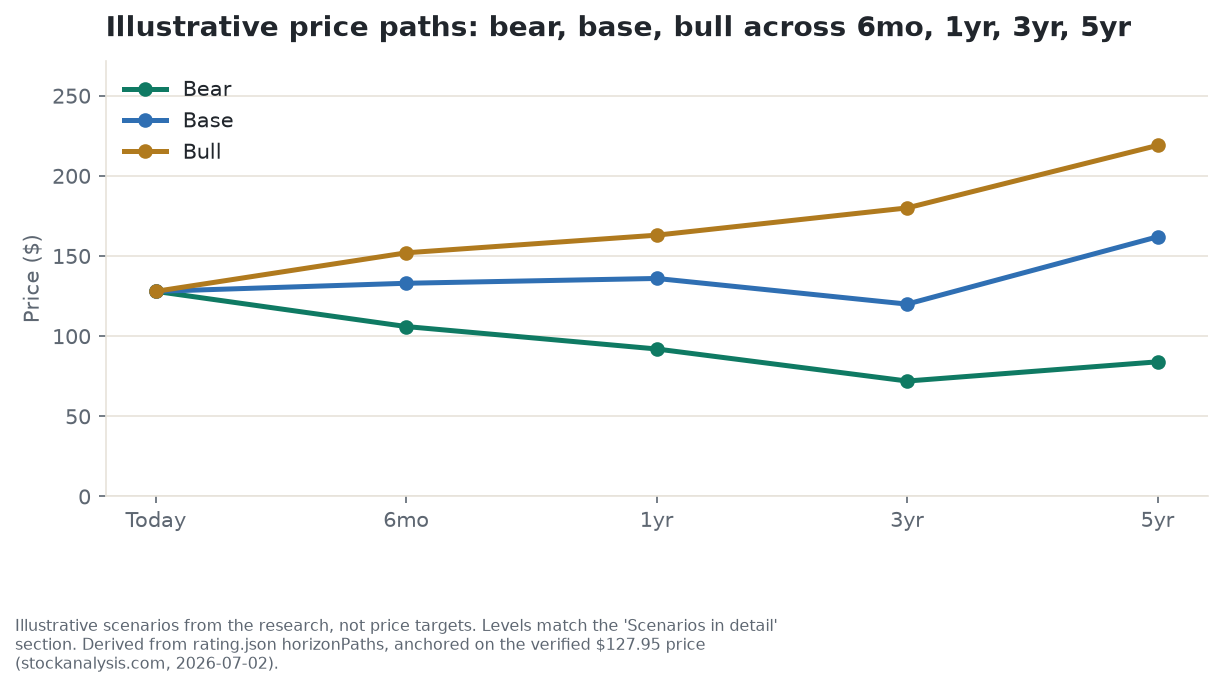
Roughly half of Merck’s revenue runs through a single drug, Keytruda, whose core US patent expires around December 2028. That one fact shapes every horizon below more than anything else about the company: the stock’s near-term path is mostly about proving the replacement plan is working, and its long-term path is mostly about whether that plan actually closes the gap. Every dollar level that follows is an estimate built on stated assumptions, not a price target, and the read at the end is a research signal, not advice.
Six months. This window is dominated by two upcoming earnings prints, not the structural story. Merck reports Q2 2026 on August 4 and Q3 2026 in late October, and at each print the market will watch two specific numbers: how fast Keytruda Qlex (the new under-the-skin version of Keytruda) is growing off its $128 million first-quarter base, and whether Gardasil’s China collapse has stopped getting worse. Pipeline data, particularly any Phase 3 results for the oral cholesterol drug enlicitide or the antibody-drug conjugate MK-2870, could move sentiment on the margin. The base case (around $133) is simply more of the same: steady Keytruda growth, Qlex on plan, the pipeline advancing. The bull case (around $152) needs Qlex conversion to visibly accelerate alongside good pipeline news. The bear case (around $106) is a disappointing Qlex number, a negative pipeline readout, or a broader market wobble. What flips this window fastest is a single quarter where Qlex revenue comes in under roughly $150 million, which would read as evidence the conversion story is stalling rather than accelerating.
One year. The dominant variable shifts to a policy decision: the Centers for Medicare and Medicaid Services is expected to announce its February 2027 drug selection for the 2029 negotiated-price year, and this is the first time Keytruda is eligible. Most observers expect it to be selected, and if it is, the market will start pricing in 2029 Medicare price-setting stacked directly on top of the patent cliff. Biosimilar timelines also get more concrete over this stretch, as developers like Samsung Bioepis and Amgen report Phase 3 data and file for approval. The base case (around $136) assumes the IRA selection is expected and largely priced in already, with a moderate biosimilar timeline and the pipeline still advancing. The bull case (around $163) has Qlex conversion beating targets and multiple pipeline approvals landing while the market has already discounted the IRA hit. The bear case (around $92) has both an IRA selection and accelerating biosimilar data arriving at once, compressing the multiple. What flips this window is the CMS selection decision itself: a surprise deferral would be read as bullish, an accelerated biosimilar approval timeline would be read as bearish.
Three years. This is the cliff year in the most literal sense. By mid-2029, Keytruda’s US patent will have expired for roughly six months, the first biosimilars may already be launching, and IRA-negotiated pricing on any remaining Keytruda volume could be taking effect. This is also the point where the market finally sees real-world erosion data instead of estimates, and where the pipeline has to be visibly scaling rather than just promising to. It is the widest uncertainty window in the whole outlook. The base case (around $120, a dip from the one-year level) reflects a genuine revenue trough and an earnings low, not a collapse: Qlex conversion in the 35 to 40 percent range, the pipeline replacing roughly half of what Keytruda loses. The bull case (around $180) has Qlex defense running stronger than that and the pipeline scaling fast enough that the market starts re-rating Merck on post-cliff growth visibility instead of penalizing it for cliff risk. The bear case (around $72) has rapid biosimilar erosion, Qlex conversion stalling at 15 to 20 percent, and the pipeline falling short, all compounding into multiple compression on top of falling earnings. What flips this window: if Qlex has reached over 40 percent conversion by late 2028, the bear case weakens sharply; under 15 percent, the bear case starts to look like the realistic base case instead.
Five years. By around mid-2031, the post-cliff revenue mix is basically settled, one way or the other. Either Merck has pulled off something close to what AbbVie did after Humira, where the replacement drugs eventually outgrew what was lost, or it has drifted into the kind of multi-year stagnation that followed Pfizer’s own blockbuster cliff a decade earlier. The base case (around $162, a recovery from the three-year trough) assumes the pipeline has delivered $25 billion to $30 billion of new annual revenue and total company revenue has climbed back to roughly $65 billion to $70 billion. The bull case (around $219) has the pipeline exceeding its targets, Qlex holding the line, and Merck genuinely re-rated as a diversified, multi-franchise pharmaceutical company rather than a one-drug story. The bear case (around $84, notably above the three-year bear level of $72, because by this point the worst of the transition is behind the company and the market has stopped penalizing it with a rock-bottom multiple) has the pipeline delivering only $15 billion to $20 billion and the Keytruda franchise settling at a fraction of its former size. What flips this window is a single cumulative number: pipeline revenue above $25 billion annually by 2031 would validate the bull case, and anything under $15 billion would confirm the bear case.
Where the read lands today. On balance the read holds at Hold: a business that earns genuinely strong, if cycle-peak, margins on a stock that screens statistically cheap for a real and specific reason, sitting on top of a countdown clock that nobody, including Merck’s own management, can fully resolve yet. The single most important number in the entire five-year picture, and the thing most likely to move this read in either direction, is Keytruda Qlex’s quarterly revenue over the next several prints: a visible acceleration off its $128 million base would push the read toward Buy, and a stall would push it toward Sell.
Companion tool
Jump to the interactive dashboard to sort and filter every company in this piece, or download the Excel model to flex the scenarios yourself.
TL;DR
Merck is a $316 billion pharmaceutical company that makes most of its money from one drug. Keytruda, the world’s best-selling medicine, brought in $31.7 billion in 2025, about 49 percent of Merck’s $65.0 billion in total revenue, and it is still growing at a double-digit clip in its twelfth year on the market. The problem is a date on a calendar: Keytruda’s core US patent expires around December 2028, at least seven biosimilar developers are already racing toward that date in the clinic, and government Medicare price-setting on Keytruda could land within about a year of the patent expiring. Merck’s answer is threefold: a reformulated, under-the-skin version of Keytruda called Qlex that carries its own new patents and could keep converted patients out of biosimilar reach into the early 2040s; a real, if still-early, pipeline led by the first-in-class lung-pressure drug Winrevair, which grew 133 percent year over year in its most recent quarter; and roughly $19 billion of recent bolt-on acquisitions bought specifically to have replacement revenue in the market before the cliff hits. None of this is resolved. Qlex converted only about 1.6 percent of the IV Keytruda base in its first full quarter. Merck’s own China vaccine business, Gardasil, already showed how fast a real franchise can lose 39 percent of its revenue in a single year when a cheaper local competitor arrives, which is exactly the dynamic biosimilars are built to trigger. The stock has rallied roughly 55 percent over the past year into a near all-time high, which means a lot of the good news, the FDA approvals, the raised guidance, is already reflected in the price, while the hardest structural question, whether the replacement math actually closes before 2028, is still years from having a real answer.
Explore it yourself: the interactive dashboard
Open the dashboard in a full screen
The dashboard holds Merck’s company card, the full bull, base, and bear scenario table across all four horizons, key financial metrics (margins, free cash flow, debt), and a peer comparison table against Eli Lilly, Johnson & Johnson, AbbVie, AstraZeneca, Novartis, Pfizer, Bristol-Myers Squibb, and Roche. Use it to sort and check any single name while you read.
Prefer a spreadsheet? Download the Excel model with the segment build, the scenario math behind the horizon chart, and the peer valuation table. The levels in that file are illustrative arithmetic, not targets.
A toll bridge with an expiration date
Think of Keytruda as the busiest toll bridge in the pharmaceutical world. For more than a decade, every dose crossing that bridge, across more than 40 approved cancer indications, has paid Merck close to monopoly pricing, because the patent on the bridge’s design keeps anyone else from building a competing crossing. That arrangement is not permanent. It is a concession with a printed expiration date, and the date is public: roughly December 2028 for the core US composition-of-matter patent. Once that concession lapses, at least seven well-capitalized biosimilar developers, including Samsung Bioepis, Amgen, and Sandoz, are already lined up to build their own free-to-cheap bridges right next to Merck’s, aimed at opening the moment the concession runs out.
Merck’s central strategy is not to fight the expiration date. It is to build a second, better bridge before the first one opens to competing traffic. Keytruda Qlex, an under-the-skin injection that FDA-approved in September 2025 and replaces Keytruda’s 30-minute IV infusion with a shot lasting a few minutes, comes with its own new patents on the delivery method and formulation, patents that do not expire when the original molecule’s patent does. If enough patients and their oncologists switch from the old IV bridge to the new Qlex bridge before 2028, Merck keeps collecting a toll on that traffic even after the free public bridge opens for everyone else. The catch is that the switch has barely started: Qlex brought in $128 million in its first full quarter on the market, against an $8.03 billion quarterly Keytruda franchise, an early conversion rate of roughly 1.6 percent. There are about ten quarters left before the patent expires. Whether that number becomes 40 percent or stays closer to 15 percent is, more than any other single fact, what decides where this stock trades in three years.
How the money flows
flowchart TD
    PAT["Patients / Employers\nPremiums, payroll taxes, out-of-pocket"]
    PAYER["Payers\nCommercial insurers, Medicare Part D, Medicaid"]
    PBM["PBMs (formulary gatekeepers)\nCVS Caremark, Express Scripts, Optum Rx\n~80% of US claims; extract the rebate wedge"]
    IRA["CMS / IRA price-setting\nJanuvia/Janumet already selected\nKeytruda enters Jan 1, 2029"]
    MRK["Merck net revenue\n$65.0B FY2025 (+1%)\nKeytruda = ~49% of total"]
    WHOLE["Wholesale distribution\nMcKesson, Cardinal Health, Cencora"]
    SITE["Dispensing / infusion sites\nHospital infusion (Keytruda IV)\nRetail/specialty pharmacy (Gardasil, Januvia)"]
    BIO["Biologics manufacture (Keytruda)\nCarlow Ireland - Singapore - new Delaware plant\ntariff-exposed, capital-intensive"]
    SMALL["Small-molecule / vaccine manufacture\nJanuvia, Gardasil, Capvaxive, Vaxneuvance"]
    RD["R&D + M&A pipeline\n$15.8B R&D (~24% of revenue)\n+ Verona Pharma ~$10B, Cidara ~$9.2B"]
    AH["Animal Health\n$6.4B (+8%), bypasses human PBM/IRA chain"]
    CHINA["China Gardasil demand\nshipments paused 2025-2026"]

    PAT --> PAYER
    PAYER --> PBM
    PBM -->|"Rebates set net price"| MRK
    IRA -->|"Government-set price overrides\nPBM deal on selected drugs"| MRK
    MRK --> WHOLE
    WHOLE --> SITE
    SITE --> PAT
    BIO -->|"Supplies Keytruda"| MRK
    SMALL -->|"Supplies Gardasil/Januvia/vaccines"| MRK
    MRK -->|"~24% of revenue"| RD
    RD -->|"Winrevair, Capvaxive, Ohtuvayre,\nEnflonsia, oral PCSK9"| MRK
    CHINA -.->|"-39% FY2025 Gardasil"| MRK
    AH -.-> MRK

    style MRK fill:#1a6e38,color:#fff
    style PBM fill:#8b0000,color:#fff
    style IRA fill:#8b0000,color:#fff
    style BIO fill:#1a3c6e,color:#fff
    style CHINA fill:#8b0000,color:#fff
Money does not reach Merck directly from patients. It starts with premiums and payroll taxes that fund commercial insurers, Medicare Part D, and Medicaid, and from there it runs into the same chokepoint every branded drugmaker in America has to clear: pharmacy benefit managers. CVS Caremark, Express Scripts, and Optum Rx together process roughly 80 percent of US prescription claims, and they decide which drugs sit on a favorable formulary tier in exchange for rebates that Merck pays out of its list price. Merck only ever sees what survives that negotiation, its net price, not the sticker price.
Since 2026, a second, government-run chokepoint sits on top of the PBM layer for Medicare patients: the Inflation Reduction Act’s price-negotiation program. It already applies to Januvia, Merck’s older diabetes drug, whose negotiated Medicare price fell 78 percent to $113 a month starting January 1, 2026, down from a $527 list price. Keytruda enters this same program on January 1, 2029, one year after its patent is expected to expire, meaning Merck’s largest asset faces two separate, compounding pricing threats landing within about a year of each other.
Below that pricing layer, physical production runs through two very different networks. Keytruda is a biologic, grown in bioreactors and purified over a multi-year-lead-time process concentrated in Carlow, Ireland and Singapore, with a new roughly $1 billion facility now under construction in Delaware specifically to bring more of that capacity onshore. Gardasil, Januvia, and most of the vaccine and small-molecule portfolio run through a more conventional chemical-synthesis network. About 24 percent of revenue, $15.8 billion in 2025, flows back into R&D and, increasingly, into acquisitions like the roughly $10 billion Verona Pharma deal and the $9.2 billion Cidara Therapeutics deal, the engine trying to build the next wave of products before the current one erodes. Animal Health, at $6.4 billion and growing 8 percent, sits almost entirely outside this chain: it sells to veterinarians and livestock producers directly, bypassing PBMs and IRA pricing altogether, which is part of why it has been one of the more stable pieces of the business while the human-pharma side has swung sharply between Keytruda’s growth and Gardasil’s collapse.
What Merck actually sells
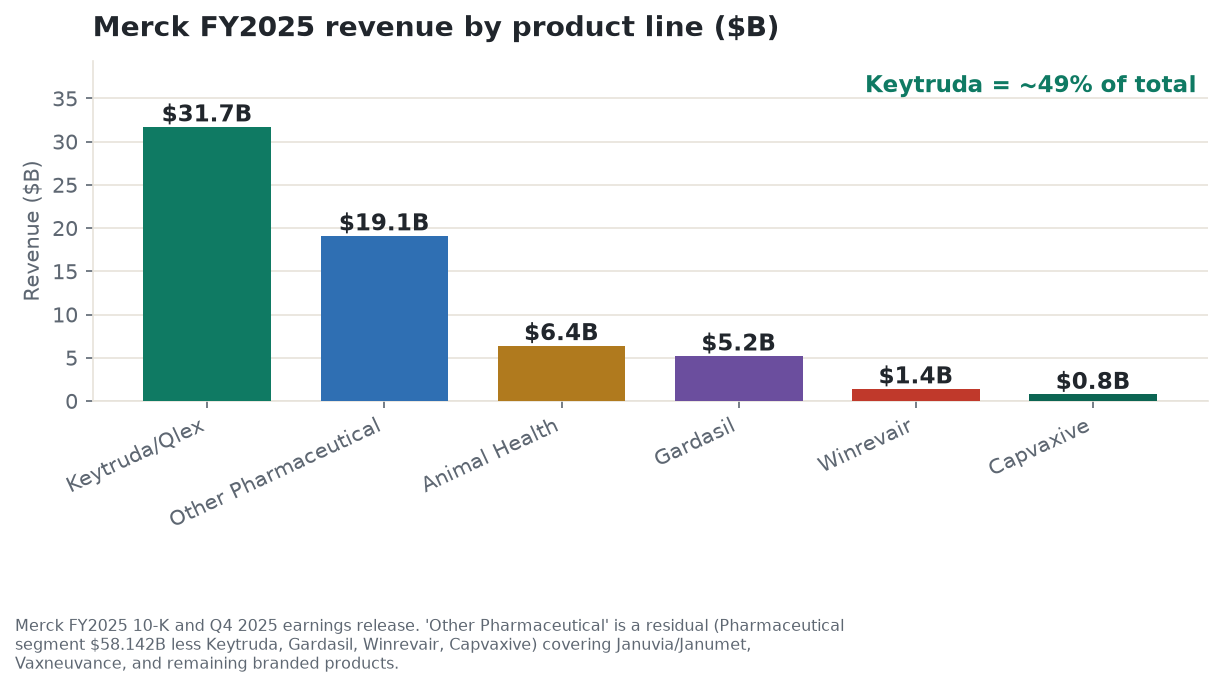
Keytruda and Keytruda Qlex (pembrolizumab): a PD-1 checkpoint inhibitor, a drug that essentially takes the brakes off a patient’s own immune system so it can recognize and attack tumor cells. Approved across more than 40 cancer indications, it is the best-selling drug in the world and generated $31.7 billion in 2025, up 7 percent, or roughly 49 percent of everything Merck sold that year. Qlex is the new subcutaneous version, an injection rather than an infusion, approved by the FDA in September 2025 and central to Merck’s plan for defending the franchise past the 2028 patent expiration.
Gardasil / Gardasil 9: an HPV vaccine that, until 2025, was Merck’s reliable second pillar. It fell 39 percent to $5.2 billion that year, almost entirely because a domestic Chinese competitor priced its own 9-valent HPV vaccine roughly 60 percent below Gardasil in a market where the vaccine sits outside China’s national immunization program and is paid for out of pocket. Merck paused shipments to China through the end of 2025 and restructured its distribution deal with its Chinese partner, moving away from fixed minimum-purchase commitments toward more flexible, demand-based ordering.
Winrevair (sotatercept): a first-in-class, disease-modifying treatment for pulmonary arterial hypertension, a rare and serious lung-pressure disorder. It came out of Merck’s 2021 acquisition of Acceleron Pharma, was FDA-approved in March 2024, and generated $1.4 billion in 2025 with its most recent quarter up 133 percent year over year, the clearest evidence in Merck’s current numbers that the pipeline can produce a genuine, fast-scaling growth asset. Merck’s own peak-sales target is $3 billion; some sell-side analysts model $5 billion to $7 billion, a real range rather than a settled number.
Capvaxive and Vaxneuvance: pneumococcal conjugate vaccines that protect against a bacterium that causes pneumonia and meningitis. Capvaxive generated $759 million in its first full launch year, genuine new vaccine revenue outside the Gardasil mess, competing against entrenched Pfizer and GSK products on the strength of broader serotype coverage.
Ohtuvayre (ensifentrine): a first-in-class COPD maintenance treatment acquired through the roughly $10 billion purchase of Verona Pharma, which closed in October 2025. Management has explicitly framed it as a growth driver reaching “into the next decade,” part of the deliberate bridge past Keytruda’s cliff.
Januvia and Janumet: older diabetes drugs, and the clearest present-tense example of what Medicare price negotiation does once it arrives: Januvia’s negotiated price is already 78 percent below its former list price, a live preview of the mechanism that could eventually apply to Keytruda.
Animal Health: livestock and companion-animal pharmaceuticals and vaccines, $6.4 billion in 2025 and growing 8 percent, competing against Zoetis, Elanco, and Boehringer Ingelheim. It is structurally separate from the human PBM and IRA chain, funded by veterinarians and producers rather than health insurers, and has been one of the steadier lines on Merck’s income statement.
The pipeline behind the pipeline: enlicitide decanoate, an experimental oral cholesterol drug (a PCSK9 inhibitor) that showed a 55.8 percent reduction in LDL cholesterol in its Phase 3 trial, though the outcomes trial proving that translates into fewer heart attacks will not finish until December 2029; and MK-2870 (sacituzumab tirumotecan), an antibody-drug conjugate licensed from China’s Kelun-Biotech and now in multiple Phase 3 oncology trials, part of Merck’s strategy to build oncology revenue that does not depend on the PD-1 mechanism at all.
Who wins where
Merck does not sit at a physical chokepoint the way a chipmaking-equipment maker or a port operator does. It wins, when it wins, by having the broadest, most defensible drug label on the market and the fastest follow-on innovation, not by controlling scarce capacity. Keytruda’s 40-plus approved indications are the product of more than a decade of trials that would take any competitor years to replicate even with an identical molecule, and that breadth is what has kept Keytruda growing 7 to 12 percent a year deep into its lifecycle, an unusually strong growth rate for a drug this mature.
The genuine toll-takers in this chain sit above and around Merck, not inside it. PBMs extract a rebate on essentially every dollar of US drug revenue before Merck ever sees it. CMS, through the Inflation Reduction Act, now sits above even the PBMs on selected drugs, capable of overriding a negotiated price entirely. Wholesalers like McKesson, Cardinal Health, and Cencora move nearly all branded US drug volume through a three-firm structure, though their own cut is thin, closer to a logistics fee than a real toll.
The weakest link in Merck’s own chain is exactly where it has already cracked: Gardasil in China, a market where Merck’s clinical edge was not enough to survive a “good enough,” dramatically cheaper domestic alternative once the payer structure (out-of-pocket spending, no national program) left the category fully exposed to a straight price comparison. That is the specific mechanism, a well-characterized copy priced well below the original, arriving into a payer system built to route volume toward the cheaper option, that Keytruda’s biosimilars are set up to repeat at a much larger dollar scale starting around 2028, unless Qlex’s fresh patent estate genuinely holds a meaningful share of the base out of reach.
Company by company: who’s who
Merck & Co. (MRK), the subject of this piece, is an oncology-dominant pharmaceutical company with $65.0 billion in 2025 revenue, roughly 49 percent of it concentrated in Keytruda, the most product-concentrated balance sheet of any large-cap pharma name in this peer set. Bull: Keytruda is still growing double digits and the Qlex reformulation could push meaningful exclusivity on converted volume well past the 2028 patent cliff. Bear: about half of revenue sits in one molecule facing patent expiration and Medicare price-setting within about a year of each other, and Gardasil’s China collapse already showed how fast a second pillar can crack.
Bristol-Myers Squibb (BMY) is Merck’s single closest competitor by mechanism. Its PD-1 inhibitor Opdivo is the world’s number-two checkpoint inhibitor at more than $9 billion in annual revenue, though it trails Keytruda by roughly three to four times in scale and label breadth. BMY carries the lowest market cap in this peer set, around $117 billion, reflecting real skepticism about its own post-cliff growth math even as its Growth Portfolio (up 12 percent to $6.2 billion in the first quarter of 2026) offsets a shrinking legacy book. Bull: the growth portfolio is scaling fast enough to offset legacy erosion, and Opdivo’s recent weakness looks more like an inventory drawdown than durable share loss. Bear: Opdivo has structurally lost the PD-1 race to Keytruda for years, and the depressed valuation reflects the market’s doubt that the growth portfolio alone can carry the company.
AstraZeneca (AZN) is arguably Merck’s most direct oncology-portfolio rival outside BMY, with oncology at roughly 44 percent of its product sales and growing faster (up 16 percent at constant currency) than Keytruda through drugs like Tagrisso, Enhertu, Imfinzi, and Calquence. AZN completed a direct NYSE listing of its ordinary shares in February 2026, replacing its old ADR structure, which has introduced some reporting-comparability noise into recent headline figures. Bull: a genuinely diversified, fast-growing multi-drug oncology base gives AZN a broader footprint than Merck’s single-molecule concentration. Bear: the recent relisting complicates near-term revenue comparisons, and AZN still carries currency exposure as a UK-domiciled multinational.
Johnson & Johnson (JNJ), whose own deep dive lives here, is the most diversified name in this set, combining an Innovative Medicine unit (Darzalex, Carvykti, Rybrevant, Tremfya) with a MedTech business spanning surgical devices, orthopedics, and cardiovascular products. Its oncology drugs compete with Keytruda in several solid-tumor regimens. Bull: the broadest revenue base in big pharma cushions any single franchise’s patent cliff in a way Merck’s Keytruda concentration cannot match. Bear: multibillion-dollar talc-litigation charges keep distorting reported earnings, and MedTech growth is structurally slower than pharma.
AbbVie (ABBV), covered in full here, is the closest structural analogy to what Merck is trying to do. AbbVie already lived through the Humira patent cliff and came out the other side with Skyrizi and Rinvoq, its replacement immunology drugs, growing 20 to 30 percent a year and already exceeding Humira’s old peak revenue combined. The key difference: AbbVie’s replacements were already generating well over $15 billion by the time Humira’s biosimilars actually arrived, while Merck’s own replacement pipeline, outside of Keytruda Qlex itself, is earlier in its ramp. Bull: AbbVie already proved the patent-cliff playbook works, a template Merck hopes to repeat. Bear: AbbVie’s own next-generation drugs face their own patent cliffs in the 2030s, and the company carries a more debt-funded balance sheet than Merck’s.
Eli Lilly (LLY), profiled here, is not a direct oncology competitor but is the clearest illustration in this set of what the market pays for visible, durable growth. Its GLP-1 obesity and diabetes franchise (Mounjaro, Zepbound) grew revenue 56 percent in the most recent quarter, and the stock trades at roughly $1.09 trillion, the largest market cap of any pharma name in this piece and a valuation Merck cannot approach without demonstrating its own post-cliff growth resumption.
Novartis (NVS), covered here, is a Swiss diversified pharma name with its own live preview of patent-cliff dynamics: its heart-failure drug Entresto fell 42 percent in a single quarter as generic competition arrived, even as newer oncology drugs Kisqali and Pluvicto grew 55 percent and 70 percent respectively. Bull: Kisqali and Pluvicto are genuine oncology growth engines with a differentiated radioligand-therapy platform Merck does not have. Bear: Entresto’s collapse is a real-time demonstration of how abruptly a generic-driven cliff can hit, and Novartis just added roughly $12 billion of fresh debt to fund the Avidity Biosciences acquisition.
Pfizer (PFE) is the cautionary-tale peer. It never replaced its COVID-era windfall with a Keytruda-scale growth engine, and it trades at the cheapest multiples in this entire set, around $139 billion in market cap, reflecting a market that has largely written off its post-COVID story. Bull: deep-value multiples already price in most of the bad news, and its non-COVID oncology and cardiovascular base is growing again. Bear: if Merck’s own pipeline underdelivers after 2028, Pfizer’s post-blockbuster decade of stagnation is the template to watch.
Roche Holding (RHHBY), a Swiss pharma-and-diagnostics conglomerate available to US investors only as a thinly traded OTC ADR, competes with Keytruda through its own PD-L1 checkpoint inhibitor, Tecentriq, though at a much smaller scale. Bull: the combined pharma-and-diagnostics model gives Roche a structurally different, more defensive revenue mix than pure-play peers. Bear: Tecentriq has never approached Keytruda-scale revenue, and Roche’s Swiss-franc-denominated results carry real currency-translation noise for US investors.
What the filings say
Merck’s FY2025 Form 10-K, filed February 24, 2026, and its Q1 2026 earnings release together tell a story of a company earning excellent margins on a mix that is quietly getting more concentrated, not less.
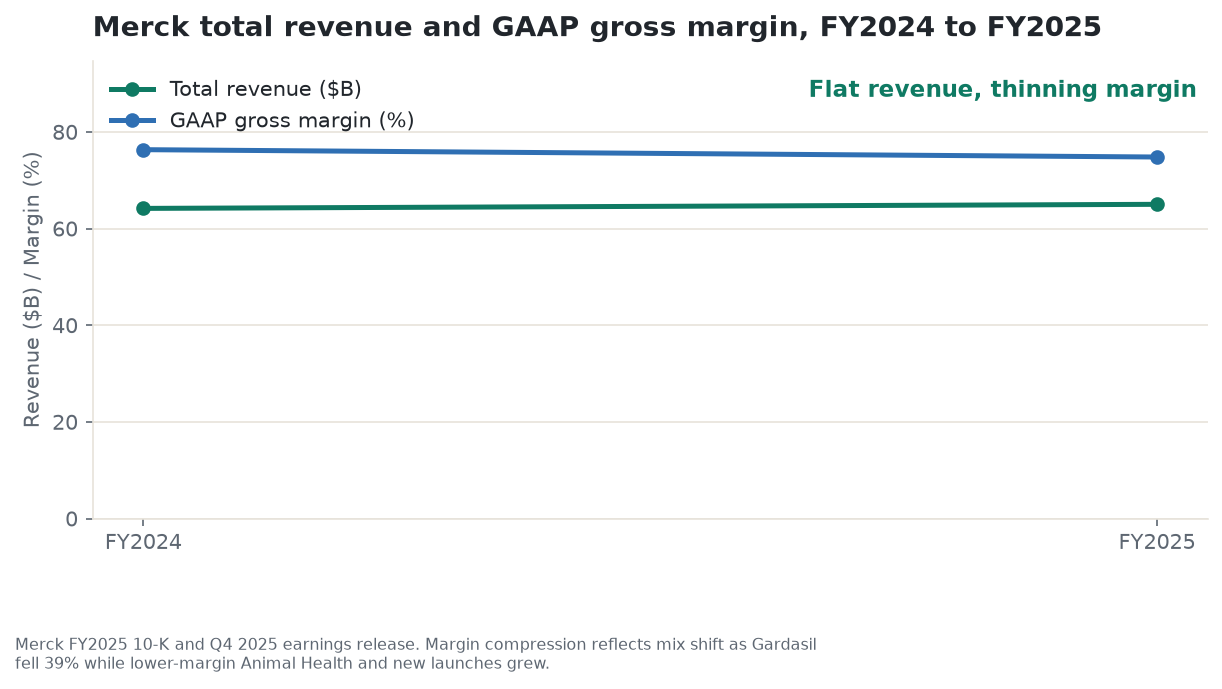
Revenue and segments. Total worldwide sales were $65.011 billion in 2025, up about 1 percent reported (roughly 2 percent excluding currency effects) from $64.168 billion in 2024, a headline that looks almost flat but masks two enormous offsetting moves. Merck reports two segments: Pharmaceutical ($58.142 billion) and Animal Health ($6.354 billion), with the small remainder classified as other revenue. Within Pharmaceutical, Keytruda and Keytruda Qlex combined for $31.680 billion, up 7 percent and now roughly 49 percent of total company revenue. Gardasil and Gardasil 9 fell 39 percent to $5.233 billion, down from about $8.6 billion in 2024, almost entirely on the China collapse described above. Januvia and Janumet, the older diabetes franchise already caught in Medicare price negotiation, brought in about $2.5 billion, up 12 percent. Winrevair jumped to $1.443 billion from $419 million in 2024. Capvaxive generated $759 million in its first full year, and Vaxneuvance added $825 million. Animal Health grew 8 percent (9 percent excluding currency) to $6.354 billion.
Margins and profitability. Gross margin was 74.80 percent on a GAAP basis in 2025, down from 76.32 percent in 2024, and 81.5 percent on a non-GAAP basis, a compression consistent with Gardasil’s collapse and a growing mix of lower-margin, earlier-stage products in the base. GAAP operating income was $21.218 billion, a 32.64 percent margin, up from $19.912 billion and 31.03 percent the prior year. GAAP net income was $18.263 billion, a 28.09 percent net margin, and GAAP diluted earnings per share were $7.28, up from $6.74. Non-GAAP diluted EPS was $8.98, up 17 percent year over year. R&D expense was $15.789 billion, about 24 percent of revenue, reflecting the scale of Merck’s post-Keytruda pipeline investment, while SG&A came to $10.733 billion.
Cash flow and the balance sheet. Operating cash flow fell to $16.472 billion in 2025 from $21.468 billion in 2024, a drop of about 23 percent, with capital expenditures of $4.112 billion, implying free cash flow of roughly $12.360 billion (an analyst calculation rather than a company-defined figure), down about 32 percent year over year. Merck ended the year with $14.565 billion in cash and total debt of approximately $49.339 billion, for net debt of roughly $34.8 billion. Total assets were $136.866 billion against stockholders’ equity of $52.662 billion, meaning Merck’s balance sheet remains solidly positive-equity, unlike some peers that have taken on debt-funded acquisition loads aggressive enough to push equity negative. Goodwill and other intangibles together represent roughly 35 percent of total assets, a reminder of how much of the balance sheet now reflects the Verona Pharma and other bolt-on deals. Press coverage cites an S&P A+ (stable) affirmation and a Moody’s upgrade of Merck’s senior unsecured rating to Aa3, both solidly investment-grade.
Capital returns. Merck paid $8.176 billion in dividends in 2025, up from $7.840 billion in 2024, and repurchased $5.084 billion of stock, nearly four times the $1.306 billion repurchased the year before, a step-up funded more by balance-sheet capacity than by the year’s lower free cash flow. The forward dividend is approximately $3.40 per share, a yield in the high-2-percent range depending on the exact entry price.
Guidance and the Cidara distortion. Merck’s initial FY2026 guidance, issued in February 2026, called for worldwide sales of $65.5 billion to $67.0 billion and non-GAAP EPS of $5.00 to $5.15, and was modestly raised with the Q1 2026 print to $65.8 billion to $67.0 billion in sales and $5.04 to $5.16 in EPS. Read in isolation against FY2025’s actual non-GAAP EPS of $8.98, that guidance looks like a 40-plus-percent earnings collapse. It is not. The gap is almost entirely a roughly $9.0 billion, $3.65-per-share non-cash charge tied to the January 2026 acquisition of Cidara Therapeutics (for CD388, an early-stage flu antiviral), which was accounted for as an asset acquisition and therefore expensed immediately rather than capitalized as goodwill. Strip that one-time charge out and Merck’s guided FY2026 non-GAAP EPS is approximately $9.03, modestly above FY2025’s actual result. The same accounting mechanic produced a Q1 2026 GAAP net loss of $4.24 billion, against a $5.08 billion profit in the prior-year quarter. This distortion also depresses Merck’s trailing price-to-earnings ratio, discussed further below, and any reader anchoring only on the headline guidance number without adjusting for the Cidara charge would badly misread the company’s actual earnings trajectory.
Disclosed risks, in the company’s own words. Merck’s 10-K states plainly that it “expects U.S. Keytruda sales to decline materially” once the drug enters government price-setting on January 1, 2029, a year after the expected patent expiration. It also discloses Section 232 tariff exposure on its Ireland- and Singapore-concentrated biologics manufacturing, mitigated for now by a three-year most-favored-nation pricing and US-investment agreement that brings Merck’s effective tariff rate to zero through January 2029, in exchange for a pledge of more than $70 billion in US manufacturing and R&D investment, with $6 billion already committed across four 2025 projects including a $3 billion facility in Elkton, Virginia. And it cites the Gardasil China episode directly as evidence of how quickly a single country’s demand can compress revenue in a product otherwise considered a reliable grower.
Institutional ownership. Vanguard and BlackRock are among Merck’s largest institutional holders, but the precise current ownership percentages are disputed across the data sources reviewed for this research, likely reflecting different filing dates rather than a real change in position, so no specific percentage is quoted here. Merck’s own 2026 proxy statement states that its 50 largest shareholders together held approximately 56 percent of shares outstanding as of December 31, 2025.
What the market is paying
Merck last traded around $127.95 in the days surrounding this research (June 28 through July 2, 2026), a price essentially at its all-time high after a strong multi-month run, and within a couple of dollars of a 52-week high near $130. The stock’s 52-week low was $76.66, meaning it has more than doubled off that low over the trailing year, and its reported 52-week price change stands at roughly plus 55 percent, a return that stands out against a peer set where several names have been flat to down over the same window.
Merck’s beta over the past five years is a low 0.20, screening as more defensive even than the already-low betas seen elsewhere in large-cap pharma, and short interest sits at just 1.23 percent of shares outstanding, consistent with routine index and hedging flow rather than any building bearish thesis.
Valuation, and the multiple to distrust. Merck’s trailing price-to-earnings ratio is 35.06 times, a genuinely elevated number by the company’s own multi-year history. But that figure is distorted, not a real re-rating: trailing-twelve-month operating income of $11.955 billion is barely half of FY2025’s actual $21.218 billion, purely because the ~$9 billion Cidara charge sits inside the trailing window. Strip that one-time item out using Merck’s own ex-Cidara guided non-GAAP EPS of about $9.03, and the stock trades closer to 14 times clean forward earnings, a materially cheaper picture than the headline trailing multiple suggests. Enterprise value to EBITDA, a multiple the Cidara charge does not distort in the same way, sits at roughly 12 times, toward the cheaper end of this large-cap pharma peer set. The PEG ratio of 2.38 is on the higher side, consistent with a company the market is not pricing as a fast grower given its roughly 1 to 3 percent guided top-line growth. Price-to-sales (4.71 times) and price-to-book (6.75 times) are both moderate, neither screaming cheap nor expensive on their own. The dividend payout ratio of nearly 94 percent looks alarming on trailing GAAP earnings, but again reflects the same Cidara-charge distortion rather than genuine dividend-coverage stress: Merck’s actual FY2025 free cash flow of roughly $12.4 billion comfortably covered the $8.2 billion it paid in dividends that year.
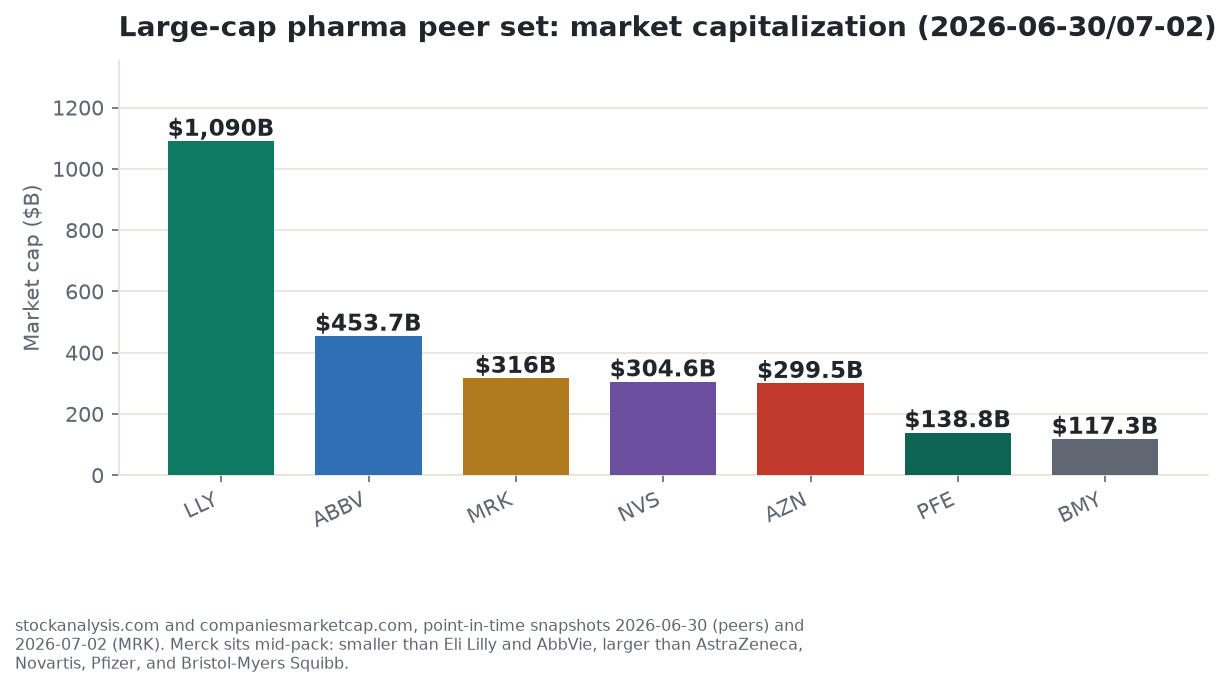
By size, Merck sits comfortably in the middle of this eight-name pharma group: dwarfed by Eli Lilly’s roughly $1.09 trillion market cap and well behind Johnson & Johnson (~$621.5 billion) and AbbVie (~$453.7 billion), but well ahead of Pfizer (~$138.8 billion) and Bristol-Myers Squibb (~$117.3 billion), and roughly in line with Novartis and AstraZeneca. On the multiples that matter most once the Cidara distortion is stripped out, forward earnings and EV/EBITDA, Merck screens toward the cheaper half of this group, cheaper than AbbVie’s own disputed 16-to-21-times forward range, cheaper than Roche’s diversified premium, and far cheaper than Eli Lilly’s GLP-1-driven multiple, while still commanding a real premium to Pfizer’s deep-value multiples. The single clearest reason for that discount within an otherwise strong-looking valuation picture is not anything unique to Merck’s execution: it is that no other name in this peer set carries anything close to Merck’s roughly 49 percent single-molecule revenue concentration, and the market appears to be partially, though not fully, pricing that structural risk into the multiple.
Sell-side and the next catalyst. Consensus sell-side rating is Buy or Moderate Buy across roughly 29 analysts, with a mean price target in the $129.74 to $130.78 range depending on the data provider, implying roughly 1 to 2 percent upside from current levels, essentially a statement that Wall Street sees the stock as fairly priced right now rather than meaningfully mispriced in either direction. Analyst price targets are opinions aggregated from third parties, not facts, and this research issues none of its own. The next hard data point is Merck’s Q2 2026 earnings call, scheduled for August 4, 2026, which will show whether the raised FY2026 guidance is holding and whether Qlex conversion is accelerating.
What the crowd is saying
Sentiment on Merck has warmed sharply over the past year, carried by a run of good news: repeated Keytruda label expansions (most recently FDA approvals in June 2026 for adjuvant kidney cancer alongside Welireg, and for first-line triple-negative breast cancer alongside Gilead’s Trodelvy), the Qlex approval itself, and a raised FY2026 outlook at the Q1 print. Against that backdrop, on July 1, 2026, the research date for this piece, Merck terminated a Phase 2 trial of its Alzheimer’s candidate MK-1167 after it missed efficacy criteria at a planned interim review, with no safety signal reported; shares fell more than 2 percent that day. Merck has a second, earlier-stage Alzheimer’s candidate, MK-2214, with data not expected until 2029, so the setback’s materiality to the long-run thesis looks low, but it is a real, verifiable negative data point that landed on the day this research was compiled.
No platform-level Reddit or StockTwits mention-volume data was available for this pass, so the retail framing here is an inference from dividend-investing and value-screener commentary rather than a measured social read. The dominant retail-facing framing casts Merck as a large-cap value and dividend name that “should be cheap given the Keytruda cliff, but has re-rated hard anyway,” with the roughly 55 percent one-year return off a 52-week low of $76.66 being the single easiest fact to circulate. No pump-and-dump or coordinated-promotion signal was found, which makes sense for a Dow-component-scale company with this much institutional ownership and sell-side coverage.
Three places where the crowd’s story and the underlying evidence pull apart stand out. First, the rally itself is being read by much of the coverage as evidence the patent-cliff problem has been “solved,” when in fact the core risk is still roughly two and a half years out and genuinely unresolved. Qlex has converted a small fraction of the IV base so far, and no biosimilar has actually launched yet. A meaningful share of the past year’s gain is better explained by a low starting point, the 52-week low reflected a period of maximum pessimism, than by the underlying patent-cliff math having materially improved. Second, the Cidara accounting charge is easy to misread as an earnings collapse by anyone taking the headline FY2026 guidance number at face value, when the underlying, ex-charge earnings trajectory is flat to modestly up. Third, Gardasil’s China collapse tends to be covered as a closed, one-off 2025 event rather than as a template. The mechanism behind it, a “good enough” domestic competitor undercutting an innovator on price in a market not shielded by broad insurance coverage, is not unique to HPV vaccines, and whether it eventually spreads to other Merck franchises with China exposure is a live, unresolved question the market does not appear to be actively pricing as its own distinct risk.
Cliff or hill: what the evidence shows
Merck’s chief executive, Rob Davis, has publicly described Keytruda’s coming patent expiration as “more of a hill than a cliff.” The honest answer sits somewhere between his framing and the sharper “cliff” language much of the press uses, and the evidence for each side is concrete enough to lay out directly.
The structural case for a hill. Global spending on cancer medicines was over $250 billion in 2024 and is projected by IQVIA to approach $440 billion or more by 2029, a genuinely structural growth curve driven by an aging population and rising cancer incidence, not a cyclical one that a recession would interrupt. Oncology demand is about as inelastic as demand gets: a patient with metastatic cancer does not defer a PD-1 inhibitor because rates went up. Winrevair’s 133 percent year-over-year growth is real, accelerating revenue, not a slide deck promise. Keytruda’s own IRA exposure has already been pushed out roughly a year, from an earlier eligibility date to February 2027 for the 2029 negotiated-price year, buying extra runway. And Merck’s balance sheet, solidly positive-equity and rated Aa3/A+, gives it more room to keep buying growth assets than a more debt-strained peer would have.
The cyclical case for a real cliff. The concentration problem has no precedent in pharmaceutical history. AbbVie’s Humira, the closest comparison, peaked at about $21 billion before its own cliff; Pfizer’s Lipitor peaked near $13 billion. Merck needs to replace something in the neighborhood of $25 billion to $30 billion or more from Keytruda alone, at least 50 percent larger than AbbVie’s challenge and more than double Pfizer’s. Management’s own framing, more than $70 billion of non-risk-adjusted commercial opportunity by the mid-2030s across 20-plus pipeline assets, is a statement of ambition, not an independently verified forecast; historically, non-risk-adjusted pipeline targets like this get cut by roughly half to two-thirds once probability of success and launch delays are applied.
Why the economics are so good today, and why that is temporary. A dose of Keytruda costs a small fraction of its price to manufacture; like most patent-protected biologics, the drug is priced off the clinical value it delivers, an avoided hospitalization, extra months or years of life, not off its production cost. That gap between cost and price is what produces Merck’s 81.5 percent non-GAAP gross margin, and every new indication Keytruda wins, including the June 2026 approvals in kidney cancer and triple-negative breast cancer, adds patients at close to zero incremental manufacturing cost. That gap starts closing hard the moment biosimilars launch, because biosimilar competition compresses price toward manufacturing cost quickly once it arrives, the same mechanism that has already sharply eroded other large-cap biologics once their own biosimilars reached the market. Merck is not a low-cost producer by design; it wins today by having the broadest label and, going forward, by trying to win on delivery-mechanism innovation through Qlex rather than on manufacturing cost, since generic and biosimilar makers will always be able to out-manufacture a patent-holder on price once the patent lapses.
Rates, financing, and currency matter less here than the patent calendar. Merck’s customers, hospitals, oncology practices, and Medicare, are not credit-constrained the way a capex-heavy industrial buyer would be, and Merck itself funds its business mostly from operating cash flow rather than debt, which is why its investment-grade credit ratings held up through a wave of acquisition spending. Rate levels show up mainly in two narrower channels: a higher-for-longer rate environment raises the hurdle rate on the large, back-loaded pipeline bets Merck is making to fill the post-2028 revenue gap, and as a dividend-paying mega-cap, MRK’s own equity valuation is sensitive to the discount rate applied to long-duration cash flows the same way any blue-chip payer’s is. On currency, an estimated 56 percent of FY2025 revenue was US-sourced with roughly 22 percent from Europe and the remainder split across Latin America, Asia-Pacific, and Japan (a secondary-aggregator estimate, not a direct filing figure), and foreign exchange was a modest tailwind to FY2025 growth; a reversal to a stronger dollar would turn that tailwind into a headwind of similar size, an exposure Merck shares with every large multinational pharma peer rather than one specific to its own story.
The Qlex math is the crux, and it is worth looking at directly:
| Qlex annual growth rate assumed | Implied Qlex run rate by late 2028 | Share of Keytruda franchise converted |
|---|---|---|
| 100 percent annual growth | roughly $2.0-2.5 billion | 6 to 8 percent |
| 150 percent annual growth | roughly $4.0-5.0 billion | 12 to 15 percent |
| 200 percent annual growth | roughly $7.0-8.0 billion | 20 to 25 percent |
Even the aggressive 200-percent-growth path leaves most of the Keytruda franchise still riding in the IV formulation and directly exposed to biosimilar competition once patents lapse. Mizuho, one sell-side house, estimates that a successful subcutaneous defense could hold five-year IV Keytruda erosion to around 30 percent, versus more than 75 percent without it, but that estimate implicitly requires Qlex to capture a large majority of the franchise, a bar the current $128 million starting quarter is nowhere near clearing yet. And Gardasil already showed what the analogous mechanism looks like in practice: a well-characterized, dramatically cheaper competitor arriving into a payer structure not built to protect the incumbent cost Merck 39 percent of that franchise’s revenue in a single year. A Keytruda cliff of comparable percentage magnitude would erase well over $12 billion in annual revenue.
The most likely outcome. Keytruda is a biologic, not a small-molecule generic, and biosimilar substitution for infused cancer drugs moves through physician comfort and site-of-care switching in a way that is inherently slower than pharmacy-counter generic substitution. Combined with a real, if still-early, pipeline and a deliberately front-loaded acquisition strategy, the most probable path is a multi-year plateau rather than a sudden collapse: a revenue dip in 2029 and 2030 followed by a recovery, not a permanent step down. But a 49 percent revenue concentration in a single asset facing a dated, well-funded biosimilar race is not a risk that diversification promises alone can fully offset by the time the patent actually expires. Some multi-year deceleration in 2029 through 2031 looks like the realistic base case, with the actual severity determined mostly by how fast the Qlex conversion curve runs and how many of the roughly 20 pipeline assets clear $1 billion or more in annual sales on schedule.
The scenarios in detail
The driver tree: what actually moves this stock
Four variables account for nearly all of the spread between the bull and bear cases above. Everything else, animal health growth, RSV vaccine share, foreign exchange, matters only at the margin.
- Keytruda erosion rate after the 2028 patent expiration. At roughly 49 percent of revenue, the pace of biosimilar erosion matters more to this stock than any other single variable in large-cap pharma today. The credible range runs from over 75 percent five-year erosion without an effective subcutaneous defense to roughly 30 percent with one, a spread worth on the order of $14 billion in annual revenue on a $32 billion franchise, more than the entire Animal Health segment.
- Keytruda Qlex conversion rate. The mechanism inside driver one. At an estimated 1.6 percent of the base converted after its first full quarter, the trajectory over the next ten quarters, and whether Qlex’s new patents can genuinely defend converted volume, decides whether the cliff is a manageable decline or a franchise-scale collapse.
- Pipeline replacement velocity. How fast Winrevair, Capvaxive, Ohtuvayre, enlicitide, MK-2870, and the rest of the roughly 20-asset pipeline reach commercial scale, and critically, whether that revenue ramps before or after Keytruda’s own decline hits.
- Margin trajectory through the transition. FY2025’s 81.5 percent non-GAAP gross margin is a cycle-peak number propped up by Keytruda’s near-monopoly pricing. As mix shifts toward newer, lower-margin launches, margin will compress; the bull case sees 2 to 3 points of compression, the bear case 5 to 8 points.
Bull case: the AbbVie playbook, at larger scale
Qlex conversion reaches 45 to 55 percent of the franchise by late 2028, and its new patents hold against IV biosimilars, leaving combined IV-plus-Qlex pembrolizumab revenue around $20 billion to $22 billion by 2031 (estimate). Winrevair reaches $4 billion to $5 billion, Capvaxive $2 billion to $2.5 billion, Ohtuvayre $2 billion to $3 billion, enlicitide approved and ramping toward $2 billion to $3 billion, and MK-2870 launched with early revenue, for roughly $15 billion to $18 billion in total new-launch revenue by 2031 (estimate). Total company revenue dips only briefly, to about $63 billion around 2029, before recovering to $75 billion to $80 billion by 2031 (estimate), with operating margin holding near 30 percent as cost-restructuring savings offset the mix shift. The market re-rates the stock from a clean forward multiple in the mid-teens to 18 to 20 times as confidence in the post-cliff growth profile builds. Illustrative valuation (estimate, not a target): roughly $11.50 in FY2032 non-GAAP EPS at a 19-times multiple implies about $219 a share. What has to be true: Qlex conversion must accelerate dramatically from today’s 1.6 percent run rate, multiple pipeline assets must reach blockbuster status in the same window, and biosimilar uptake must run slower than the historical median for oncology biologics. The single thing most likely to break this case: a biosimilar winning an interchangeability designation before Qlex has converted a meaningful share of the base, which would let pharmacies substitute automatically and bypass the physician-switching friction Merck is counting on.
Base case: a managed transition, plateau then recovery
Qlex converts 30 to 35 percent of the franchise by late 2028, and IV biosimilars take the rest down 60 to 70 percent, leaving combined pembrolizumab revenue around $15 billion to $18 billion by 2031 (estimate). Winrevair reaches $3 billion to $4 billion, Capvaxive and Ohtuvayre $1.5 billion to $2 billion each, enlicitide filed but not yet at peak, for roughly $10 billion to $14 billion in new-launch revenue (estimate). Total revenue troughs around $58 billion to $62 billion in 2029 to 2030, a two-to-three-year plateau rather than a cliff-edge collapse, before recovering to $65 billion to $70 billion by 2031 (estimate). Gross margin compresses 3 to 5 points, operating margin dips to 27 to 29 percent at the trough before recovering toward 30 percent, and the forward multiple stays in a 14-to-17-times range. Illustrative valuation (estimate, not a target): roughly $9.50 in FY2032 non-GAAP EPS at a 17-times multiple implies about $162 a share. What has to be true: the pipeline delivers at least $10 billion in new annual revenue by 2031, Qlex prevents total pembrolizumab decline from exceeding roughly 60 percent, and the $1.7 billion cost-restructuring target is actually delivered. The single thing most likely to break this case: pipeline timing slipping. If enlicitide or MK-2870 approvals slip 12 to 18 months, the revenue trough deepens and the earnings recovery pushes into 2032 or 2033.
Bear case: the skeptic’s case, steel-manned
Qlex conversion stalls at 15 to 20 percent as physician and payer switching friction proves lower than Merck assumed and biosimilars win interchangeability designations quickly, leaving combined pembrolizumab revenue at just $8 billion to $12 billion by 2031 (estimate). Winrevair reaches only $2 billion to $3 billion after hitting a competitive or label limitation; Capvaxive and Ohtuvayre plateau at $1 billion to $1.5 billion each; enlicitide’s 2029 outcomes trial delays approval or shows ambiguous benefit; MK-2870 faces stiff competition from other antibody-drug conjugates. Total new-launch revenue lands around $8 billion to $12 billion (estimate). Total company revenue falls to $50 billion to $55 billion by 2030, a genuine cliff rather than a plateau, and stabilizes only modestly above that by 2031. Gross margin compresses 5 to 8 points, operating margin falls to 22 to 25 percent, and the $1.7 billion in cost savings, while real, is not enough to offset the mix shift. Free cash flow falls from roughly $12 billion to $8 billion or $9 billion, dividends consume nearly all of it, and buybacks halt as the multiple compresses to 12 to 14 times, roughly where Pfizer trades today. Illustrative valuation (estimate, not a target): roughly $6.00 in FY2032 non-GAAP EPS at a 14-times multiple implies about $84 a share; at the three-year trough in mid-2029, the estimate is closer to $72, reflecting maximum uncertainty before any stabilization. What has to be true: biosimilar adoption in oncology runs at or above historical precedent for biologic patent expirations, Qlex conversion materially underperforms sell-side expectations, and multiple pipeline assets miss their peak-sales estimates. The single thing most likely to prove this case wrong: Qlex conversion data over the next four to six quarters showing a steep, doubling-or-tripling-per-quarter growth curve, which would invalidate the assumption that conversion stalls in the mid-teens.
Catalyst timeline
Near term. Q2 2026 earnings on August 4, 2026, and Q3 2026 in late October, with Qlex quarterly revenue and Gardasil’s China trajectory as the two most-watched numbers at each print. Possible Phase 3 data readouts for enlicitide or MK-2870 in the second half of 2026. CMS announces its February 2027 drug selection for the 2029 negotiated-price year, the first time Keytruda is eligible.
Multi-year. Keytruda’s US patent expires around late 2028, with the first biosimilar filings and approvals expected around the same date. If selected in February 2027, an IRA-negotiated Keytruda price would take effect January 1, 2029, the same window the current tariff and most-favored-nation exemption expires. Enlicitide’s cardiovascular outcomes trial is projected to complete around December 2029, a major swing factor for the cardiometabolic pipeline in either direction. By 2029 through 2031, the real-world biosimilar launch wave and erosion data become visible, alongside continued pipeline maturation. By the mid-2030s, management’s own $70 billion opportunity target date arrives, and the post-cliff revenue composition will either be validated or it will not.
Leading indicators worth tracking
Keytruda Qlex’s quarterly revenue and its sequential growth rate is the single most important number in the entire thesis; watch for a move toward $200 million or more in the second quarter of 2026 as a sign of acceleration, and anything under roughly $150 million as a negative signal. Total combined Keytruda (IV plus Qlex) quarterly revenue tells whether the franchise is still growing overall or facing pressure from mechanisms beyond biosimilars, such as newer antibody-drug conjugates and bispecifics. Pembrolizumab biosimilar clinical milestones from Samsung Bioepis, Amgen, and Sandoz specifically are worth tracking for Phase 3 completions and FDA filings. Winrevair’s quarterly trajectory, watch for sustained quarters above $500 million, and a deceleration below roughly $450 million would call the multi-billion-dollar peak-sales thesis into question. FY2026 and FY2027 guidance revisions, upward moves signal pipeline momentum, downward moves signal erosion arriving early. The February 2027 CMS selection decision itself. Merck’s own M&A pace and deal quality, whether future deals bring commercial-stage assets that reach revenue quickly or earlier-stage bets that carry more risk and generate more one-time IPR&D charges. And Gardasil’s China volumes, a live template indicator for whether domestic-competitor substitution spreads to other Merck franchises in that market.
Companies to watch (bull / base / bear)
AbbVie (ABBV), the template. Bull: already proved a patent-cliff playbook can work at scale, replacing Humira’s peak revenue with faster-growing drugs. Base: continues executing that playbook while facing its own next-generation patent cliffs later this decade. Bear: a heavier debt load than Merck’s, funding an aggressive acquisition strategy. Watch: whether AbbVie secures further patent-life extensions the way it did on Rinvoq, a signal for how much legal protection Merck might realistically expect on Qlex.
Bristol-Myers Squibb (BMY), the read-through on PD-1 competition. Bull: Opdivo’s recent weakness looks inventory-driven rather than structural share loss, and its Growth Portfolio is scaling. Base: continued gradual share erosion against Keytruda in a market both companies helped create. Bear: Opdivo has structurally lost the checkpoint-inhibitor race for years, and the market’s rock-bottom valuation of BMY reflects real doubt about the post-cliff math. Watch: Opdivo’s quarterly trajectory as an early tell on how oncology biosimilar and generic competition actually plays out in real-world prescribing.
Pfizer (PFE), the worst-case template. Bull: deep-value multiples already price in most of the bad news, and its non-COVID base is growing again. Base: continues as a lower-growth, income-oriented name trading at compressed multiples. Bear: never replaced its COVID windfall with a genuine growth engine, and a decade of post-Lipitor stagnation is the direct precedent for what happens if Merck’s pipeline underdelivers. Watch: whether Pfizer’s own multiple ever meaningfully re-rates, a signal for how the market treats a large-cap pharma name once its growth story is considered closed.
Eli Lilly (LLY), the valuation ceiling. Bull: the clearest demonstration of what the market pays for visible, durable growth, currently the GLP-1 franchise. Base: continues commanding a premium multiple as long as growth holds. Bear: the richest valuation in large-cap pharma leaves little room for a stumble. Watch: Lilly’s own multiple as a reference point for how far Merck’s could realistically expand if the pipeline transition succeeds cleanly.
Risk controls
Merck’s single largest risk is concentration, not competitive execution in the ordinary sense. Roughly half of company revenue sits in one molecule facing a dated, well-capitalized biosimilar race and a compounding government-pricing threat within about a year of each other. That is a different kind of risk than a company facing gradual, diversified competitive pressure across many products, and it argues for sizing any position with that concentration explicitly in mind rather than treating Merck as a typical diversified large-cap pharma holding.
The stock has also already rallied roughly 55 percent over the past year into a price near its all-time high, with the sell-side consensus target sitting only 1 to 2 percent above the current price. That leaves limited near-term upside from sentiment alone even if the next several quarters go well, and it means a disappointment, on Qlex conversion, on a pipeline readout, or on the China trajectory, has more room to hurt the stock than to help it from here. Liquidity and access are not concerns: Merck is a highly liquid, NYSE-listed, mega-cap name with deep institutional ownership and broad sell-side coverage, and it cannot be meaningfully moved by thin-float dynamics or promotional activity.
What would change this thesis in either direction is fairly specific and worth tracking directly rather than relying on the stock price alone as a signal. A bull case turning bearish would most likely start with flat or declining Qlex quarterly revenue through the back half of 2026, a biosimilar developer filing for FDA approval with an interchangeability designation, a negative cardiovascular-outcomes readout on enlicitide, or a second major franchise cracking the way Gardasil did. A bear case turning bullish would most likely start with Qlex conversion accelerating past $500 million quarterly by mid-2027, multiple Phase 3 readouts in 2027 and 2028 demonstrating real blockbuster potential beyond Winrevair, biosimilar development delays pushing first launches past 2029, or legislative changes narrowing IRA negotiation scope for biologics facing active biosimilar competition.
Methodology, sourcing, and data-quality flags
This research draws on Merck’s FY2025 Form 10-K (filed February 24, 2026), its Q4 2025 and Q1 2026 earnings releases and accompanying 8-K exhibits, Merck’s 2026 proxy statement, FDA approval records, CMS’s published Medicare drug-price negotiation data, and press and analyst coverage from outlets including Fierce Pharma, BioPharma Dive, CNBC, and sell-side research summarized in trade press. Every figure presented as fact traces to a claim in this research run’s ledger and was checked at either primary tier (the filing or company release itself), press tier (reputable trade or financial press), or analyst tier (a named research house’s estimate); figures that could not clear that bar are explicitly hedged or omitted rather than stated as settled fact.
The five-factor read. On valuation, Merck’s headline trailing multiple of 35 times is misleading, inflated by the one-time Cidara charge; on a clean, ex-Cidara forward basis the stock trades closer to 14 times earnings, and its EV/EBITDA of roughly 12 times sits toward the cheaper end of this large-cap pharma peer set, a genuine, if not extreme, discount that appears to reflect the market partially pricing in patent-cliff risk. On growth, FY2025 revenue grew only about 1 percent reported, a flat headline masking Keytruda’s continued double-digit growth against Gardasil’s collapse, and the next several years are dominated by the cliff itself: a likely revenue dip around 2029 to 2030 followed by a recovery that depends almost entirely on pipeline execution, against a large and genuinely growing global oncology market as a tailwind if the pipeline delivers. On quality, FY2025’s 81.5 percent non-GAAP gross margin, roughly 33 percent operating margin, and 28 percent net margin are genuinely best-in-class for the sector today, free cash flow comfortably covers the dividend, and the balance sheet carries investment-grade credit ratings and positive equity, though these margins are explicitly cycle-peak and not representative of what the business will likely earn once the cliff arrives. On risk, the roughly 49 percent single-molecule concentration in Keytruda is the most acute product-specific risk anywhere in large-cap pharma, compounded by a patent expiration and a Medicare price-negotiation date landing within about a year of each other, with Gardasil’s realized 39 percent collapse serving as a live demonstration of how fast the analogous mechanism can move. On momentum, the stock has gained roughly 55 percent over the trailing year on a run of FDA approvals and raised guidance, sell-side consensus is Buy with a mean target essentially at the current price, and short interest is minimal, a modestly positive momentum picture that also means much of the near-term good news is already reflected in the price. On balance, the read lands at Hold: a genuinely strong business trading at a real discount for a real reason, with the evidence not yet clear enough on the single decisive variable, Qlex conversion, to lean further in either direction.
Data-quality flags:
- Merck’s stock price and market cap moved enough during this research window that an earlier same-quarter data pull showed a materially lower, stale figure (around $279-285 billion) before a corrected, corroborated pull confirmed approximately $316.0 billion as of July 2, 2026. Treat any Merck market-cap figure as time-sensitive.
- Merck’s trailing price-to-earnings ratio (35.06 times) is distorted downward on the earnings side by the roughly $9 billion Cidara Therapeutics non-cash charge booked in the first quarter of 2026; the clean, ex-Cidara forward multiple of roughly 14 times is the more useful figure for assessing valuation, and is used as the primary valuation read in this piece.
- Institutional ownership percentages for Vanguard and BlackRock are disputed across the data sources reviewed, with different filing dates producing meaningfully different reported percentages; no precise current percentage is quoted in this piece for either holder.
- Management’s framing of “more than $70 billion” in cumulative pipeline opportunity by the mid-2030s is Merck’s own, non-risk-adjusted target, not an independent analyst forecast or a probability-weighted estimate, and is presented throughout this piece with that qualification.
- Keytruda’s precise US patent expiration date (around December 2028) is consistently reported across multiple trade-press and patent-tracking sources but was not independently confirmed against the primary patent filing or the FDA Orange Book in this research pass.
- The global oncology drug-spending market-size figures cited here (exceeding $250 billion in 2024, approaching $440 billion or more by 2029) reflect a corrected reading of IQVIA’s published research after an initial figure pulled in this research pass did not match IQVIA’s own report and was discarded.
- Winrevair’s peak-sales estimate is a genuine range across sources, from Merck’s own $3 billion target to sell-side models as high as $5 billion to $7 billion, and no single number should be read as consensus.
- Mizuho’s estimate on Keytruda IV erosion with and without successful subcutaneous conversion (more than 75 percent versus roughly 30 percent) is one analyst house’s model, not an industry consensus.
- Credit ratings cited (S&P A+, Moody’s Aa3) are sourced to press and ratings-aggregator coverage rather than a direct rating-agency release or Merck’s own 8-K disclosure of the rating action, and should be treated as directionally reliable but not independently re-verified here.
Key sources: Merck’s FY2025 Form 10-K and Q4 2025/Q1 2026 earnings releases (merck.com, SEC EDGAR); Merck’s 2026 proxy statement; FDA drug-approval records for Keytruda Qlex; CMS Medicare Drug Price Negotiation Program materials on Januvia’s negotiated price; stockanalysis.com and companiesmarketcap.com for point-in-time market data; Fierce Pharma, BioPharma Dive, CNBC, and PatSnap for patent-cliff, biosimilar-landscape, and pipeline coverage; IQVIA’s Global Oncology Trends research for market-size context; and Q1 2026 earnings releases from Eli Lilly, Johnson & Johnson, AbbVie, AstraZeneca, Novartis, Pfizer, Bristol-Myers Squibb, and Roche for the peer comparisons in this piece. Figures are point-in-time as of the stated research date and will change.
This article is OSINT research for educational purposes only and is not investment advice. I am not a financial advisor, and nothing here is a recommendation to buy, sell, or hold any security. Pharmaceutical companies carry patent-cliff, clinical-trial, and drug-pricing-regulation risk that can move faster and further than a typical stock. Figures are point-in-time as of July 2, 2026 and will change. Do your own due diligence and consult a licensed financial advisor before making any decision.