
Research date: June 30, 2026 | OSINT market research on AbbVie Inc. (NYSE: ABBV): how Skyrizi and Rinvoq replaced Humira’s old peak revenue and became the new growth engine, the rebate-and-government-pricing chokepoints sitting on top of that engine, and the bull, base, and bear case from six months to five years. Live prices, stamped hard.
Important disclaimer. This is OSINT (open-source intelligence) research published for educational and informational purposes only. It is not investment advice, not a recommendation to buy, sell, or hold any security, and not a solicitation. I am not a financial advisor. Pharmaceutical companies carry patent-cliff, clinical-trial, and drug-pricing-regulation risk that can move results faster and further than a typical stock when a single molecule’s exclusivity status changes. All figures below are point-in-time as of the stated research date (June 30, 2026) and move fast: prices, market caps, share counts, and valuation multiples will be stale by the time you read this. Any bull, base, or bear scenarios are illustrative arithmetic on stated assumptions, not price targets. Do your own due diligence and consult a licensed financial advisor before making any decision.
Where this stock could be in 6 months, 1 year, 3 years, and 5 years
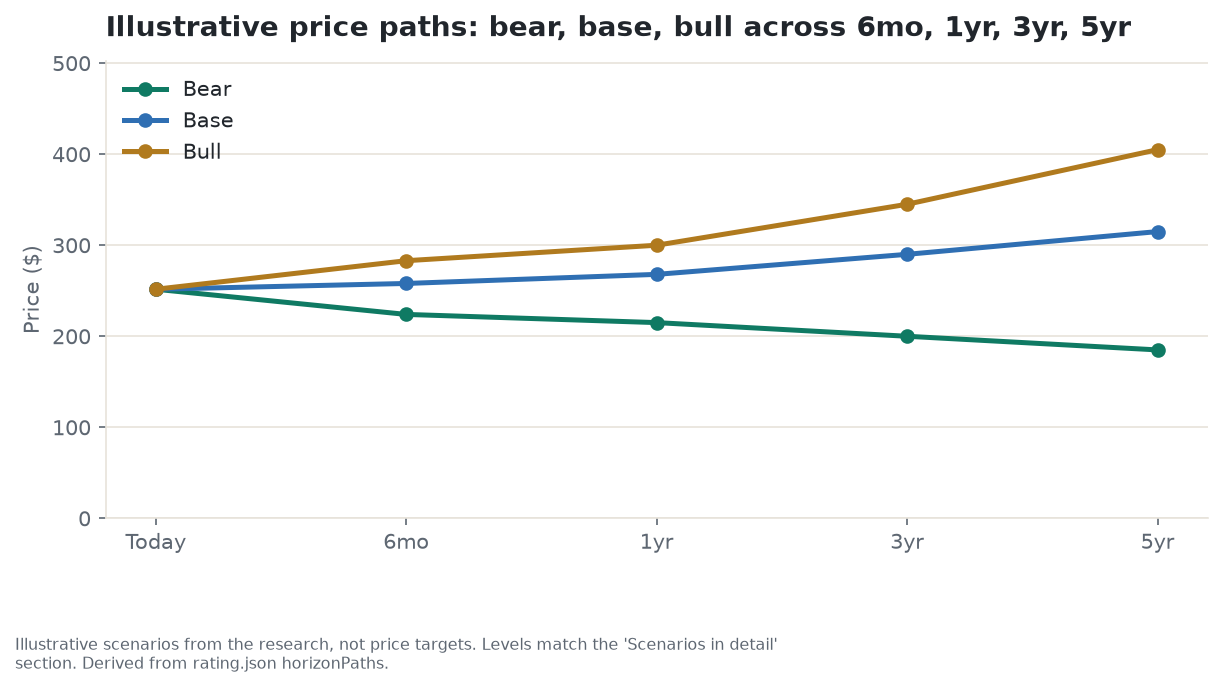
AbbVie closed at $251.64 on June 30, 2026, near the top of its own 52-week range of $181.75 to $255.99, a stock sitting about 94 percent of the way up that band and within a couple of dollars of its all-time high. The reason it is there is not a mystery: Skyrizi and Rinvoq, the two immunology drugs built to replace Humira, combined for $25.9 billion in revenue last year, already more than Humira ever made in its best single year, and they are still growing at a double-digit clip. The tension that decides where the stock goes from here is that both of those replacement drugs walk into a calendar of government price-setting and patent expiration over the next several years, and the biggest one of the two has no legal insurance policy against it. Every dollar level below is an estimate built on stated assumptions, not a price target, and the read at the end is a research signal, not advice.
Six months. This window is mostly about the next two earnings prints and a tariff deadline, not the long structural story. The stock has already rallied about 15 percent in the past month on regulatory wins and management’s own claim that Wall Street is undermodeling Skyrizi and Rinvoq’s ceiling, so the base case (around $258) is roughly another in-line-to-raised quarter meeting a price that already has good news baked in. The bull case (around $283) needs a genuine beat plus a guidance raise to break the stock out of its current range. The bear case (around $224) is a multiple wobble at the top, a harsher-than-expected bill from the Section 232 pharmaceutical tariff that takes effect for AbbVie’s named cohort on July 31, or a stumble in the Apogee Therapeutics acquisition working through the close. The single thing most likely to flip this window is whether AbbVie’s next quarterly disclosure of Skyrizi and Rinvoq’s net price, what it actually collects after rebates, shows any softening ahead of schedule.
One year. The first genuinely structural event of this whole outlook lands here: negotiated Medicare prices on Vraylar and Linzess take effect in January 2027, a 44 percent and 75 percent cut to those two drugs respectively. Neither drug is large on its own, but this is the market’s first live look at how the broader Inflation Reduction Act pricing cascade actually flows through AbbVie’s income statement. The base case (around $268) has immunology growth still outrunning those cuts comfortably. The bull case (around $300) has Skyrizi tracking past $20 billion in annual sales a year ahead of AbbVie’s own prior schedule, with credit starting to flow to the pipeline AbbVie has been building. The bear case (around $215) has the Street beginning to price in the full 2028 to 2033 calendar of price cuts and patent risk well ahead of when any of it actually lands, the same way it began discounting Humira’s cliff around 2018, five years before biosimilars actually arrived. What flips this window is whether 2027 guidance implies double-digit or merely high-single-digit earnings growth.
Three years. Now the structure starts to dominate the cycle. Botox faces its first Medicare Part B negotiated price in 2028, a case AbbVie itself is contesting in federal court, which is a fairly clear signal from the company about how much it thinks that fight matters. Rinvoq also crosses into its own window of Medicare price-negotiation eligibility around this time, while its FDA boxed warning keeps it a second-line therapy behind older drugs in several conditions, a structural ceiling on how large it can ultimately grow. The base case (around $290) has AbbVie’s newer pipeline bets beginning to offset a decelerating immunology core. The bull case (around $345) has Skyrizi and Rinvoq proving genuinely undermodeled and a third franchise starting to show real revenue, not just slides. The bear case (around $200) has the market pricing in Skyrizi’s unprotected patent cliff years before it actually arrives, paying a patent-cliff multiple instead of a premium defensive one. What flips this window is whether Apogee’s newly acquired pipeline, the oncology assets from ImmunoGen, or the neuroscience assets from Cerevel are showing up as real dollars in the income statement by then.
Five years. By around 2031 Skyrizi’s 2033 patent expiration sits squarely inside every serious analyst’s forecast window, and the durability question stops being abstract. The base case (around $315) is a mid-teens price-to-earnings compounder whose earnings keep grinding higher at a high single-digit pace. The bull case (around $405) is a company that has visibly built its third growth wave and earns a re-rating for it, the same trick it already pulled once with Humira. The bear case (around $185) is a de-rating toward the low-teens multiple that mature, patent-cliff pharma stocks trade at once Skyrizi’s biosimilar risk, the accumulated Inflation Reduction Act price cuts, and a heavily indebted balance sheet all converge at once. What flips this window is simple to state and hard to know in advance: whether AbbVie’s build-the-next-drug playbook, which has already misfired once on a $8.7 billion schizophrenia bet, works a second time before the clock runs out.
Where the read lands today. On balance the read holds at Accumulate: a fairly valued, cash-generative compounder that has already done the hard part once, replacing its biggest drug’s peak revenue with two better ones, trading at a discount to peer multiples but at an all-time-high price that already reflects most of that good news. Accumulate here means something specific and sits a notch below Buy: build or hold a position with conviction on the strength of the evidence, adding on weakness rather than chasing strength, while watching two named risks rather than treating the thesis as settled. It is not a Hold, which would mean the evidence is too mixed to lean either way, and it is not a Buy, which would mean the risk is already resolved or priced generously in the investor’s favor. The single thing most likely to move that read is whether AbbVie secures any kind of exclusivity extension on Skyrizi before 2033 the way it already did for Rinvoq. Get that, and the read moves toward Buy. Lose the argument in court or in the patent office, or see the Inflation Reduction Act cuts and net-price compression actually show up softening in a quarter’s numbers, and it moves toward Hold or worse.
Companion tool
Jump to the interactive dashboard to sort and filter every company in this piece, or download the Excel model to flex the scenarios yourself.
TL;DR
AbbVie makes most of its money from four franchises: immunology (Skyrizi and Rinvoq, plus the fading legacy of Humira), neuroscience (Botox Therapeutic and Vraylar), oncology (Imbruvica and Venclexta), and aesthetics (Botox Cosmetic and Juvederm). Skyrizi and Rinvoq alone are now about 42 percent of the company’s $61.2 billion in 2025 revenue, and that combined figure already exceeds the best year Humira ever had, which is the single most important fact in this entire story: AbbVie proved it could survive losing its biggest patent, something few pharma companies pull off cleanly. The money itself does not flow simply. AbbVie billed roughly $126 billion at list price in 2025 and gave back about $65.1 billion of it in rebates and discounts, mostly to pharmacy benefit managers who control which drugs get covered, before a dollar of the $61.2 billion in net revenue ever reached the income statement. Layered on top of that private toll booth is a public one: the Inflation Reduction Act now lets Medicare set prices directly on selected drugs, and AbbVie already has Imbruvica, Vraylar, Linzess, and (pending litigation) Botox caught in that net, with Rinvoq’s own eligibility window opening around 2028. The bull case is that AbbVie has already run this exact playbook once, replacing Humira years ahead of its 2023 cliff, and is doing it again with a new wave of acquired pipeline assets. The bear case, and the reason this is not a stronger conviction Buy, is that Skyrizi, the single largest product AbbVie has, carries no settlement extending its patent past 2033 the way Rinvoq’s does to 2037, and the stock is priced at an all-time high that already assumes the next act goes as well as the last one did.
Explore it yourself: the interactive dashboard
Open the dashboard in a full screen
The dashboard holds AbbVie’s company card, the full bull, base, and bear scenario table across all four horizons, the key financial metrics (margins, free cash flow, debt), and a peer comparison table against Johnson & Johnson, Eli Lilly, Merck, Pfizer, Bristol Myers Squibb, Amgen, and Novartis. Use it to sort and check any single name while you read.
Prefer a spreadsheet? Download the Excel model with the segment build, the scenario math behind the horizon chart, and the peer valuation table. The levels in that file are illustrative arithmetic, not targets.
Rebuilding the engine mid-flight
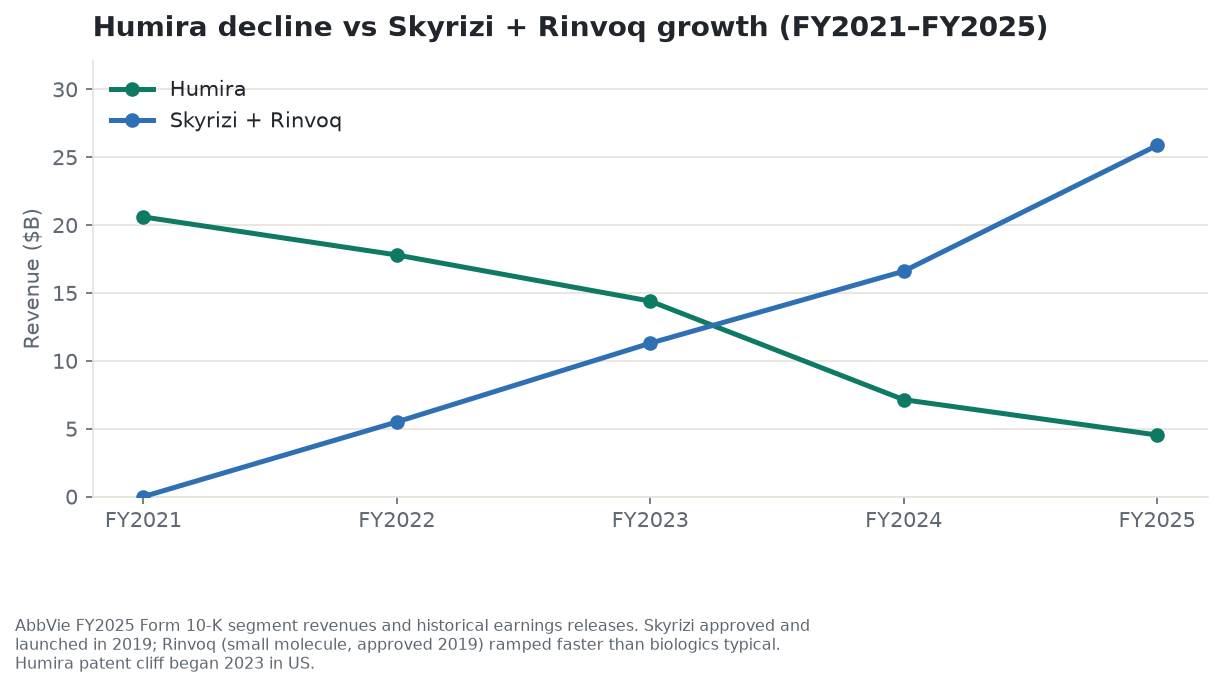
Picture a commercial jet that has to swap out its own engine while it is still airborne, because the old engine is scheduled to fail on a known date and cannot simply be repaired. That is roughly what AbbVie did with Humira. Humira, an anti-inflammatory biologic used for rheumatoid arthritis, psoriasis, and Crohn’s disease among other conditions, was for years the best-selling drug in the world, generating $20.6 billion in 2021 alone. Its US patent protection ended in January 2023, and biosimilar competitors piled in. A biosimilar is an FDA-approved copy of a biologic drug, highly similar to the original but not an exact molecular match the way a small-molecule generic is to a chemical pill, made through its own manufacturing process and typically priced well below the original once it launches. Humira’s revenue has since fallen to $4.5 billion, a collapse of roughly 78 percent from its peak.
Most companies facing that kind of cliff either shrink with the drug or spend a decade searching for a replacement. AbbVie did something different: it built Skyrizi and Rinvoq years before the cliff hit, launched them in 2019, and by 2025 the two combined for $25.9 billion, more than Humira ever generated in a single year. The new engine was running before the old one failed. That is the single fact that separates AbbVie’s story from a typical patent-cliff pharma name, and it is also why the stock trades near an all-time high rather than in the doldrums that hit peers like Bristol Myers Squibb after their own cliffs.
The catch with mid-flight engine swaps is that you eventually have to do it again. Skyrizi and Rinvoq have their own scheduled failure dates, a US patent expiration around 2033 for both. AbbVie has already secured a legal settlement pushing Rinvoq’s generic entry out to April 2037, but no equivalent protection exists yet for Skyrizi, which is the bigger of the two drugs. The company is already assembling parts for engine number three, spending more than $31 billion on acquisitions since 2024 to build a new pipeline. Whether that third engine is ready before the second one gives out is the whole question this article works through.
How the money flows
flowchart TD
    PAT["Patients / Employers\nPremiums, payroll taxes, out-of-pocket copays"]
    PAYER["Payers\nCommercial insurers, Medicare Part D, Medicaid\n~76% of ABBV revenue is US-sourced"]
    PBM["PBMs (formulary gatekeepers)\nCVS Caremark, Express Scripts, Optum Rx\n~80% of US claims; extract the rebate wedge"]
    IRA["CMS / IRA price-setting\nImbruvica 2026, Vraylar+Linzess 2027, Botox 2028"]
    ABBV["AbbVie net revenue\n$61.16B FY2025 (+8.6%)\nSkyrizi+Rinvoq = ~42% of total"]
    WHOLE["Wholesale distribution\nMcKesson, Cardinal Health, Cencora\n'substantially all' of US sales; 84% of AR"]
    PHARM["Retail / specialty pharmacy\nCVS, Walgreens, hospital & specialty pharmacy"]
    MFG["Manufacturing (AbbVie-owned)\nNorth Chicago IL (new API plant) - Barceloneta PR\nCork/Sligo Ireland - Worcester MA - 18 sites total"]
    RD["R&D / pipeline\n$9.1B, 15% of net revenue"]
    AES["Aesthetics (cash-pay, bypasses PBMs)\nBotox Cosmetic + Juvederm = $5.2B"]

    PAT --> PAYER
    PAYER --> PBM
    PBM -->|"Rebates: $65.1B in 2025,\nlarger than net revenue kept"| ABBV
    IRA -->|"Government-set price overrides PBM deal\non selected drugs"| ABBV
    ABBV --> WHOLE
    WHOLE --> PHARM
    PHARM --> PAT
    MFG -->|"Supplies product"| ABBV
    ABBV -->|"15% of revenue"| RD
    RD -->|"Funds next-gen pipeline"| ABBV
    PAT -.->|"Direct cash pay,\nno PBM/insurer"| AES
    AES -.-> ABBV

    style ABBV fill:#1a6e38,color:#fff
    style PBM fill:#8b0000,color:#fff
    style IRA fill:#8b0000,color:#fff
    style MFG fill:#1a3c6e,color:#fff
Follow the arrows from top to bottom. Patients and their employers fund the system through premiums, payroll taxes, and copays, which flow to commercial insurers, Medicare Part D plans, and Medicaid. Those payers hire pharmacy benefit managers, PBMs, as their negotiating agents. CVS Caremark, Express Scripts, and Optum Rx together process roughly 80 percent of US prescription claims, and they are the chokepoint in this whole diagram: they decide which drugs sit on the preferred formulary tier, and they extract rebates from manufacturers as the price of that placement. AbbVie recorded $65.1 billion of rebates and chargebacks against gross billings in 2025, an amount larger than the $61.2 billion of net revenue it actually kept. That single fact means AbbVie’s real customer, in a pricing-power sense, is not the patient at all. It is the PBM.
Sitting above the PBM layer is a second, newer chokepoint: the federal government, acting through the Inflation Reduction Act’s Medicare drug-price negotiation program. Once a drug is selected, the negotiated price simply overrides whatever the PBM would otherwise have arranged, for the Medicare-covered share of that drug’s volume. AbbVie already has three products caught in this net (Imbruvica, effective 2026; Vraylar and Linzess, effective 2027) and a fourth, Botox, selected for the 2028 round and being contested by AbbVie in federal court. Once the negotiated price is set, AbbVie has no further lever on the outcome, only on the timing, through patent litigation and settlement strategy.
Below AbbVie in the diagram sits its own manufacturing network, eighteen sites split between the US and a cluster of Irish, Costa Rican, and other international facilities, feeding the pipeline that keeps the whole system running. AbbVie plows about 15 percent of revenue back into research and development, which is the fuel for the next generation of drugs that must eventually replace Skyrizi and Rinvoq the way Skyrizi and Rinvoq replaced Humira. And running alongside the whole regulated, PBM-mediated chain is one segment that skips it entirely: Aesthetics. Botox Cosmetic and Juvederm are elective, out-of-pocket purchases with no insurer or PBM in the loop, which is precisely why AbbVie has kept that business since acquiring it as part of the 2020 Allergan deal. It is a smaller, more cyclical business than immunology, but it answers to consumer demand rather than to a rebate negotiation.
A field guide to what AbbVie actually sells
Skyrizi (risankizumab) is an injectable biologic that blocks interleukin-23, a signaling protein involved in psoriasis, psoriatic arthritis, Crohn’s disease, and ulcerative colitis. It is AbbVie’s single largest product, generating $17.562 billion in FY2025 revenue and holding more than 45 percent of total prescription share in the US psoriasis biologics market, plus roughly 75 percent frontline capture among newly treated inflammatory bowel disease patients overall (about 80 percent in Crohn’s specifically). Skyrizi carries no FDA boxed warning and is broadly eligible as a first-line therapy, which is a meaningful part of why it outsells its sibling drug Rinvoq by a wide margin despite both launching the same year. The mechanistic reason traces back to what each drug blocks: Humira blocks TNF, a signaling protein that sits further upstream and touches a wider swath of immune activity, which is why regulators and doctors historically treated TNF-blockers with more caution before first use; Skyrizi blocks IL-23 specifically, a narrower, more downstream target, and that precision is what let it earn a clean first-line label instead of the step-therapy restrictions older biologics carried, a big part of how it grew fast enough to replace Humira’s peak profit rather than just nibbling at its edges.
Rinvoq (upadacitinib) is an oral JAK (Janus kinase) inhibitor, a small-molecule pill rather than an injectable, approved across rheumatoid arthritis, psoriatic arthritis, ankylosing spondylitis, atopic dermatitis, ulcerative colitis, and Crohn’s disease, with positive European opinions for alopecia areata and vitiligo issued in June 2026 and US decisions pending. It generated $8.304 billion in FY2025. JAK sits inside the cell as a broader signaling hub that multiple immune messengers route through, rather than a single narrow target like IL-23, so blocking it dials down a wider swath of immune activity at once, the trade-off for a pill that works across so many different inflammatory diseases. Unlike Skyrizi, Rinvoq carries the FDA’s most serious boxed warning, covering serious infections, mortality, malignancy, major adverse cardiovascular events, and thrombosis, a class-wide label added to JAK inhibitors following a safety study of a competitor drug, and that broader mechanism, not a manufacturing or trial flaw, is the direct reason IL-23-specific biologics like Skyrizi never picked up the same warning. As a direct result, Rinvoq is indicated as a second-line therapy in rheumatoid arthritis and several other conditions, meaning a patient must first fail or be intolerant to a TNF-blocker biologic before a doctor can prescribe it. That labeling restriction is a real structural ceiling on how large Rinvoq can grow relative to an unrestricted first-line drug like Skyrizi, and it is the direct rebuttal to any claim that Rinvoq’s peak sales potential is unlimited.
Humira (adalimumab) is the legacy anti-inflammatory biologic that built AbbVie’s immunology franchise before losing US patent protection in January 2023. It generated $20.6 billion at its 2021 peak, still had $14.4 billion in sales as recently as 2023, and has since fallen to $4.540 billion in FY2025 as biosimilar competitors captured share. Its decline is now largely complete rather than a forward risk, having shrunk from an estimated 100 percent share of the adalimumab molecule to roughly a 50-50 split with biosimilar makers.
Botox Therapeutic and Botox Cosmetic are the two faces of the same neurotoxin, sold through different regulatory and payment channels. The therapeutic version treats chronic migraine, muscle spasticity, and overactive bladder and is billed through insurance and Medicare, generating $3.769 billion in FY2025 within the neuroscience segment; it is also the product CMS selected for a 2028 Medicare price negotiation, a selection AbbVie is contesting in court on the argument that Botox’s plasma-derived (human serum albumin) content makes it statutorily exempt. The cosmetic version is an elective, cash-pay wrinkle treatment sold within the Aesthetics segment, generating $2.602 billion in FY2025, down modestly as competitors like Galderma’s Dysport and Revance’s Daxxify chip at the category.
Vraylar (cariprazine) is an oral antipsychotic used for schizophrenia, bipolar disorder, and as an add-on treatment for major depressive disorder, generating $3.621 billion in FY2025 within the neuroscience segment. It is one of the drugs selected for Medicare price negotiation effective January 2027.
Venclexta and Imbruvica are AbbVie’s two largest oncology drugs, treating chronic lymphocytic leukemia and related blood cancers, generating $2.792 billion and $2.869 billion respectively in FY2025. Imbruvica was in the first round of Medicare price negotiations, taking a price cut effective January 2026, and its revenue is now declining as oral-agent competition and government pricing both bite. Elahere, an antibody-drug conjugate for ovarian cancer acquired through the 2024 ImmunoGen deal, is the newer, faster-growing name in the oncology portfolio at $690 million and rising 44 percent.
Juvederm is AbbVie’s dermal filler line, generating $993 million in FY2025 within Aesthetics, competing against Galderma’s Restylane, Merz, and a field of Asian biosimilar filler entrants on price and duration.
Across roughly $8.5 billion of remaining revenue sit AbbVie’s smaller established brands, including its eye-care portfolio and legacy drugs such as Lupron and Creon that fall outside the four headline franchises.
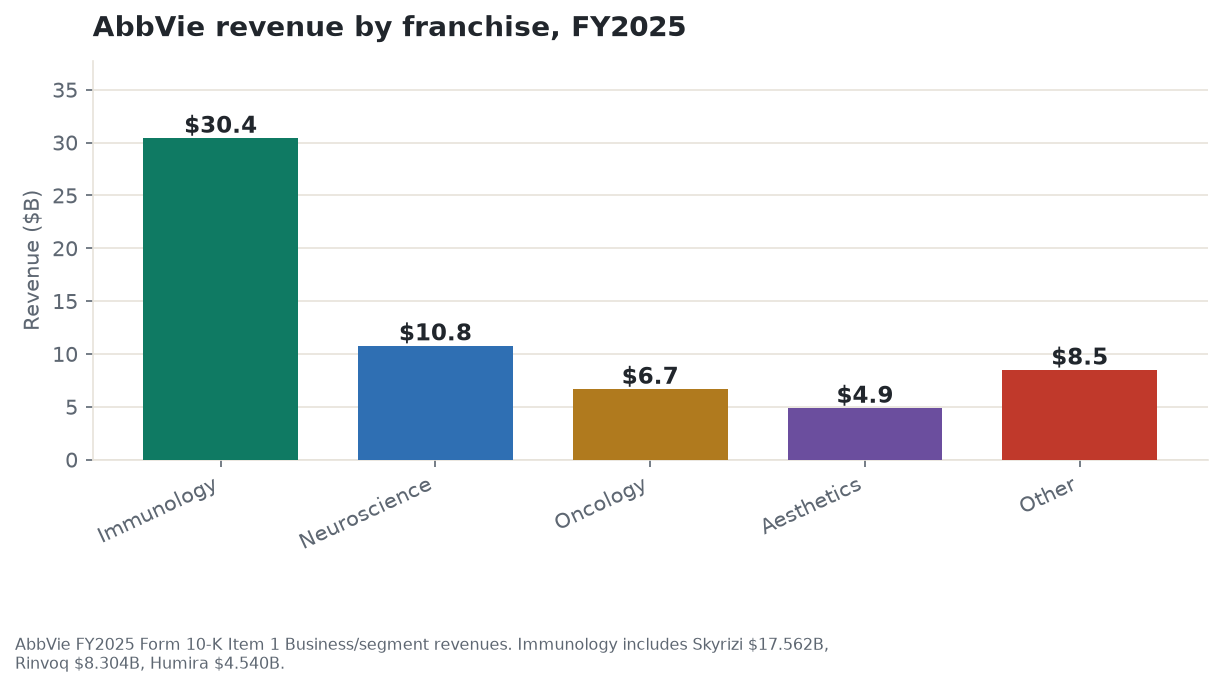
The chart above is the shape of the whole business in one picture: half of AbbVie now runs through immunology, and within that half, the crossover already happened. The chart below shows it directly. Humira peaked at $20.6 billion in 2021 and has fallen to $4.540 billion in FY2025 as biosimilar competition took hold, while Skyrizi and Rinvoq combined climbed from essentially nothing at their 2019 launch to $25.866 billion in FY2025, already more than Humira’s best year ever managed.
Who wins where
Immunology biologics and JAK inhibitors are a business where AbbVie, the manufacturer, competes for formulary placement against a small number of rival branded drugs, most notably Novartis’s Cosentyx and [Johnson & Johnson]‘s Stelara and Tremfya, plus a growing field of Humira biosimilar makers led by Amgen’s Amjevita and Sandoz’s Hyrimoz. AbbVie wins the volume war today because Skyrizi and Rinvoq have out-executed rivals on efficacy data and label breadth, holding the leading US psoriasis prescription share. But every formulary renewal is a fresh rebate negotiation, and the PBMs are the structural winners in the sense that their share of the gross-to-net spread grows as more credible in-class competitors enter, regardless of who ultimately wins the prescription.
The government is the newest and, over a long horizon, the most durable claimant on AbbVie’s pricing power. Once the Inflation Reduction Act selects a drug for Medicare negotiation, AbbVie’s only remaining lever is timing, through patent litigation and settlement, not the negotiated outcome itself. Imbruvica’s 38 percent Medicare price cut, effective January 2026, is the template for what a completed negotiation looks like.
Wholesale distribution, handled by McKesson, Cardinal Health, and Cencora, and retail dispensing, handled by pharmacy chains and specialty pharmacies, are the commodity fringe of this chain: thin, largely fixed-fee businesses with essentially no pricing power of their own, though the three wholesalers together hold a large share of AbbVie’s accounts receivable, giving them real sway over the company’s working capital.
The Aesthetics segment plays by different rules entirely. Botox Cosmetic and Juvederm compete in a genuinely price-competitive, discretionary consumer market against Galderma, Merz, Revance, and a widening field of neuromodulator entrants, with no regulatory exclusivity moat left on decades-old formulations. That segment declined 6.1 percent in FY2025, the one franchise in AbbVie’s portfolio actually shrinking, reflecting real competitive and macro pressure rather than a patent event.
Biosimilar and generic manufacturers are the group that eventually captures the value AbbVie is defending. Humira is the completed case study: AbbVie’s own molecule now generates a fraction of its former revenue, with the difference split between biosimilar makers competing on price, PBMs extracting deeper rebates on the now-crowded adalimumab category, and some savings passed through to payers. The same dynamic is the long-run risk sitting over Skyrizi and Rinvoq.
Company by company: who’s who
AbbVie (ABBV, NYSE, market cap approximately $444.6 billion as of June 30, 2026) is the immunology leader transitioning off Humira, with Skyrizi and Rinvoq now the growth engine. Q1 2026 revenue reached $15.0 billion, up 12.4 percent, with Skyrizi at $4.48 billion (up 30.9 percent) and Rinvoq at $2.12 billion (up 23.3 percent), while Humira continued fading to $688 million (down 38.6 percent). Bull: Skyrizi and Rinvoq already replaced Humira’s peak revenue and are still growing at a double-digit clip, giving AbbVie the immunology category by both volume and price. Bear: Rinvoq and Skyrizi’s own patent cliffs sit inside the 2030s, Skyrizi’s earlier and entirely unprotected, and AbbVie must keep acquiring companies to refill its pipeline while carrying debt left over from the 2020 Allergan deal.
Johnson & Johnson (JNJ, NYSE, market cap approximately $611.4 billion) is the largest diversified healthcare company by market value, spanning Innovative Medicine (Darzalex, Carvykti, Tremfya) and MedTech (surgical, orthopedic, vision, and cardiovascular devices). Q1 2026 Innovative Medicine growth ran 7.4 percent operationally with ten brands growing at a double-digit pace, and full-year guidance was raised to roughly $100.8 billion in sales. Bull: the most diversified revenue base in big pharma cushions any single franchise’s patent cliff, and Tremfya is taking real immunology share directly from Skyrizi, Rinvoq, and Humira biosimilars. Bear: talc-litigation charges remain a multibillion-dollar wildcard on reported earnings even as underlying guidance keeps rising, and MedTech growth runs structurally slower than pharma.
Eli Lilly (LLY, NYSE, market cap approximately $1.07 trillion) is the GLP-1 and obesity-drug category leader through Mounjaro and Zepbound, alongside a smaller immunology book (Taltz, Omvoh) that overlaps only tangentially with AbbVie. Q1 2026 revenue reached $19.8 billion, up 56 percent, driven by Mounjaro’s 125 percent growth. Bull: the obesity drug market remains capacity-constrained rather than demand-constrained, and [Lilly’s] incretin franchise alone dwarfs AbbVie’s entire immunology book in growth rate and addressable market. Bear: the largest single valuation in pharma leaves almost no room for a stumble, and oral GLP-1 competition later this decade is a real multi-year risk.
Pfizer (PFE, NYSE, market cap approximately $137.2 billion) is a post-COVID turnaround story built on oncology assets from the Seagen acquisition, the cardiomyopathy drug Vyndaqel, and a shrinking legacy COVID franchise. Q1 2026 revenue of $14.5 billion beat consensus, with underlying ex-COVID business growing 7 percent. Bull: the stock trades near book value with an underappreciated multi-year revenue floor and the highest dividend yield in this peer set. Bear: the post-COVID revenue base has not fully stabilized, Pfizer has no GLP-1 franchise to ride the decade’s biggest pharma growth story, and its legacy COVID products remain in structural decline.
Bristol Myers Squibb (BMY, NYSE, market cap approximately $117.7 billion) is a legacy cardiovascular and oncology name working through the Revlimid patent cliff, with a newer “growth portfolio” (Camzyos, Reblozyl, Breyanzi, Cobenfy) that crossed 54 percent of total sales for the first time in Q1 2026. Bull: the growth portfolio’s majority-of-sales milestone shows the post-Revlimid transition is further along than the stock’s depressed multiple implies. Bear: Bristol Myers is still working through the steepest patent-cliff decade among these peers, with a thinner late-stage pipeline than AbbVie or Merck, and its experience is the closest real-world preview of what an unmitigated cliff does to a stock’s multiple.
Merck (MRK, NYSE, market cap approximately $317.4 billion) is the immuno-oncology leader through Keytruda, which grew 12 percent to $8.03 billion in Q1 2026 alone. Bull: Merck is pre-funding its post-2028 patent-cliff replacement pipeline (Winrevair, subcutaneous Keytruda, newly acquired antivirals) years ahead of Keytruda’s own patent wall, running essentially the same forward-building playbook AbbVie used with Skyrizi and Rinvoq. Bear: Keytruda’s US core patent expires around 2028 and it is a single asset worth more than $30 billion a year, with no replacement of comparable scale yet proven and the Inflation Reduction Act targeting it directly, a close mirror of the concentration risk sitting over AbbVie’s own two flagship drugs.
Amgen (AMGN, NASDAQ, market cap approximately $195.4 billion) is both a direct Humira-biosimilar competitor through Amjevita and a broader biosimilars maker, with a Phase III obesity candidate, MariTide, offering a potentially less-frequent dosing profile than weekly GLP-1 injectables. Bull: MariTide’s dosing profile could differentiate it from the Lilly-Novo duopoly if Phase III data holds up, while the biosimilars book takes a direct, profitable bite out of AbbVie’s legacy Humira base. Bear: Amjevita has captured only a modest slice of a crowded ten-biosimilar Humira field, and MariTide remains clinically unproven against an already-dominant incumbent pair.
Novartis (NVS, NYSE ADR, primary listing SIX Swiss Exchange, market cap approximately $286.8 billion) competes directly against Skyrizi and Rinvoq through Cosentyx in the same psoriasis, psoriatic arthritis, and axial spondyloarthritis indications, while its cardiovascular blockbuster Entresto is losing US patent protection in real time. Bull: Cosentyx is still growing at a double-digit pace and taking real immunology share in AbbVie’s core indications, with newer launch brands offsetting the Entresto cliff. Bear: Entresto’s abrupt US generic-driven collapse this quarter is a live, real-time preview of exactly the kind of cliff every large-cap pharma name, AbbVie included, eventually has to survive.
What the filings say
AbbVie’s FY2025 Form 10-K, filed February 20, 2026, and its subsequent 8-K earnings releases are the primary sources for everything in this section.
Revenue and margins. FY2025 net revenue reached $61.160 billion, up 8.6 percent reported, a new company record despite roughly $16 billion of cumulative Humira erosion since biosimilar entry in 2023. GAAP operating earnings were $15.075 billion, an operating margin of 24.7 percent, up sharply from FY2024’s margin, which had been depressed by a $4.5 billion intangible-impairment charge. GAAP diluted earnings per share came to $2.36, but adjusted (non-GAAP) diluted earnings per share was $10.00, a gap driven mainly by $5.016 billion of acquired in-process research and development and milestone charges tied to AbbVie’s acquisition strategy, plus $5.793 billion of other expense, largely non-cash intangible amortization from the Allergan, ImmunoGen, and Cerevel deals. That GAAP-versus-adjusted gap is the single most important thing to understand about AbbVie’s reported numbers: it is real accounting, not manipulation, but it means the trailing GAAP figures materially understate the company’s cash-generating power. Adjusted gross margin ran approximately 84 percent for the year, a structural pharma margin reflecting patent protection on high-value biologics and small molecules, not a cyclical peak. Research and development spending ran about 14.9 percent of revenue ($9.096 billion) and selling, general, and administrative expense about 22.9 percent ($14.010 billion).
Segment mix. AbbVie discloses itself as a single global reportable operating segment rather than splitting profit by business line, but the underlying franchise mix tells the real story. Immunology generated $30.406 billion (50 percent of total revenue), built on Skyrizi’s $17.562 billion, Rinvoq’s $8.304 billion, and Humira’s now-small $4.540 billion. Neuroscience reached $10.767 billion (18 percent), led by Botox Therapeutic ($3.769 billion) and Vraylar ($3.621 billion). Oncology reached $6.655 billion (11 percent), with Imbruvica ($2.869 billion, declining) and Venclexta ($2.792 billion, growing) as the two largest products. Aesthetics reached $4.860 billion (8 percent) and was the only segment to shrink in FY2025, down 6.1 percent, with Botox Cosmetic at $2.602 billion and Juvederm at $993 million. The remaining roughly $8.5 billion sits across eye care and other established brands. Geographically, the United States generated $46.603 billion (76.2 percent) of FY2025 revenue against $14.557 billion (23.8 percent) internationally, a heavier domestic weighting than most large-cap pharma peers, which concentrates AbbVie’s exposure to US drug-pricing policy specifically.
Cash flow and the balance sheet. Operating cash flow reached $19.030 billion in FY2025, against capital expenditures of $1.214 billion, implying free cash flow of roughly $17.8 billion (an analyst calculation, since AbbVie does not report free cash flow as a defined metric in its filings). Cash and equivalents stood at $5.229 billion at year-end. Total debt was approximately $67.5 billion (short-term borrowings of $2.499 billion, current portion of long-term debt of $6.056 billion, and long-term debt of $58.941 billion), against which net debt runs roughly $62.3 billion. Goodwill of $35.640 billion and net intangible assets of $52.641 billion together make up roughly two-thirds of AbbVie’s $133.960 billion in total assets, the legacy of the Allergan, ImmunoGen, and Cerevel acquisitions. Total stockholders’ equity is negative, at negative $3.270 billion as of December 31, 2025, driven by a $15.493 billion accumulated deficit built up mostly from the debt taken on for the 2020 Allergan deal and years of dividends and buybacks exceeding retained earnings. This is a real structural feature of the balance sheet, not a bookkeeping error, and it means the usual equity-based debt ratios do not apply cleanly to AbbVie the way they would to a company with a conventional capital structure. It is worth pairing that fact with the other side of the ledger: Moody’s upgraded AbbVie’s senior unsecured credit rating to A2 (stable) from A3 in February 2026, and the company had nothing drawn on either of its two revolving credit facilities at year-end, with no near-term maturity wall or covenant stress evident in the filing. Rating agencies plainly do not read AbbVie’s negative equity as a distress signal, and neither should a reader on its own.
Dividends and buybacks. AbbVie raised its quarterly dividend from $1.64 to $1.73 per share, a 5.5 percent increase declared October 31, 2025 and first payable February 17, 2026. Cash dividends paid totaled $11.657 billion in FY2025, consuming roughly 61 percent of operating cash flow. Against the $17.8 billion free-cash-flow figure above, that implies dividend coverage of about 1.53 times, comfortable coverage for a company with more than five decades of consecutive dividend increases. Buybacks were comparatively modest and, notably, the exact FY2025 figure does not fully reconcile within AbbVie’s own 10-K: the MD&A narrative states the company repurchased 3 million shares for $606 million during the year, while the cash-flow statement’s “purchases of treasury stock” line shows $980 million for the same period. Both numbers come from the same filing, and the gap has not been resolved; treat AbbVie’s FY2025 buyback as somewhere in the $600 million to $1.0 billion range rather than a single precise figure. Weighted-average diluted shares outstanding have been essentially flat for three straight years at 1,773 million, meaning stock-based compensation dilution is being fully offset by the modest buyback pace, not adding net new shares, even though capital return still skews heavily toward the dividend over repurchases.
Guidance. AbbVie initially guided FY2026 adjusted diluted earnings per share to $14.37 to $14.57 in its February 4, 2026 release, explicitly excluding any impact from future acquired research and development charges, since such deals cannot be forecast. An April 3, 2026 filing then pre-announced a $744 million pretax charge tied to acquired research and development in the first quarter, a $0.41-per-share hit, and restated the range down to $13.96 to $14.16 to reflect it, an accounting mechanic rather than an operating miss. On April 29, 2026, alongside Q1 results, management then raised full-year guidance again, to $14.08 to $14.28, citing Q1 strength and reaffirmed momentum in the growth drivers.
Disclosed risks, in the company’s own words. The 10-K’s risk factors flag the loss of patent protection and increased biosimilar and generic competition as a risk that “may adversely affect AbbVie’s revenues and operating earnings,” a risk that has already played out once with Humira and is the central concern for Skyrizi and Rinvoq’s own eventual cliffs. On the Inflation Reduction Act, AbbVie’s own language warns that “more of our products, including products that generate substantial revenues, could be selected in future years, which could…accelerate revenue erosion prior to expiration of intellectual property protections.” On acquisitions, the filing acknowledges that deals “may not be successful or may require significantly greater resources and investments than originally anticipated” and could cause AbbVie to “incur or assume significant debt and unknown or contingent liabilities,” language directly relevant given the debt load already on the balance sheet plus the newly announced Apogee Therapeutics deal. Taken together, the four IRA-selected drugs disclosed to date, Imbruvica, Vraylar, Linzess, and Botox Therapeutic, generated roughly $11 to $12 billion combined in FY2025, an estimated 18 to 20 percent of total company revenue. That combined figure is the number that actually matters for materiality: at the individually disclosed cut rates (38 percent on Imbruvica, 44 percent on Vraylar, 75 percent on Linzess, with Botox’s cut still pending litigation), fully phased in by the late 2020s and assuming flat volume, the cumulative gross-revenue drag across all four could run in the low double digits as a percentage of total company revenue, an estimate rather than a disclosed figure, since AbbVie does not publish a consolidated IRA impact number.
Recent material events. AbbVie announced on June 22, 2026 that it will acquire Apogee Therapeutics for $135.11 per share in cash, a total equity value of approximately $10.9 billion, adding an IL-13 antibody in late-stage development for atopic dermatitis (zumilokibart) and an asthma combination candidate. The deal is expected to close in the third quarter of 2026, and AbbVie itself has guided that it will not become accretive to adjusted earnings per share until 2032, a long payback horizon that is itself informative about how far out the company is willing to invest against Skyrizi and Rinvoq’s own approaching patent cliff. Separately, in January 2026 AbbVie signed a three-year voluntary agreement with the federal government, pledging $100 billion in US research, development, and manufacturing investment over the next decade in exchange for lower Medicaid pricing commitments and a stated exemption from Section 232 pharmaceutical tariffs and future federal pricing mandates for the deal’s term. The broader Section 232 proclamation issued in April 2026, though, separately named AbbVie among a cohort of companies facing an earlier tariff effective date of July 31, 2026, and the research underlying this article could not fully confirm whether the January bilateral deal supersedes that April cohort designation. Readers should treat AbbVie’s actual near-term tariff exposure as a genuinely open question rather than a settled fact either way.
Ownership. Institutional ownership is concentrated in index managers: Vanguard holds 10.02 percent of shares outstanding and BlackRock holds 8.09 percent, per AbbVie’s 2026 proxy (though the BlackRock figure traces to a filing dated December 2023, the most recent one AbbVie’s proxy references, a staleness flag worth noting). Directors and executive officers as a group hold less than 1 percent of shares, and recent Form 4 filings from insiders reflect routine equity award grants rather than open-market buying or selling, a weak and largely uninformative signal that should not be read as either bullish or bearish conviction.
What the market is paying
AbbVie’s $251.64 close on June 30, 2026 sits about 94 percent of the way up its 52-week range of $181.75 to $255.99, within roughly 2 percent of its all-time high, on a market cap of approximately $444.6 billion. Shares outstanding run about 1.77 billion. Enterprise value is reported around $508.1 billion by a single data provider, a figure this research could not independently cross-check against a second source, so treat that specific number as an approximation.
Returns. Price alone, AbbVie is up roughly 35.6 percent over the trailing year, 85.7 percent over three years, and 115.9 percent over five years. Including dividends reinvested, one vendor puts the one-year total return near 40 percent, though a second total-return calculator shows a materially lower figure closer to 18 percent for a nearby date, an unusually wide gap between vendors that this research could not fully reconcile; the safest framing is that AbbVie has clearly outperformed the S&P 500 and the health-care sector ETF over the trailing year, with the exact margin dependent on which calculator you trust. Against its direct large-cap pharma peers over the trailing twelve months, AbbVie is actually the second-weakest performer of the group, behind Johnson & Johnson, Merck, and Eli Lilly, though still well ahead of Pfizer, meaning its relative momentum has cooled even as its absolute price sits near a record high. Over three and five years the picture flips: AbbVie is the second-best performer in the same peer set, trailing only Eli Lilly’s GLP-1-fueled run.
Volatility. AbbVie’s beta runs somewhere between 0.27 and 0.31 depending on data provider, a genuinely low-beta, defensive pharma profile rather than a volatile momentum stock. Even so, the trailing 52-week high-to-low spread implies a roughly 29 percent drawdown was possible within the past year even for a stock this defensive, a reminder that low beta does not mean immune to a sharp correction, even if AbbVie has historically bought those dips back.
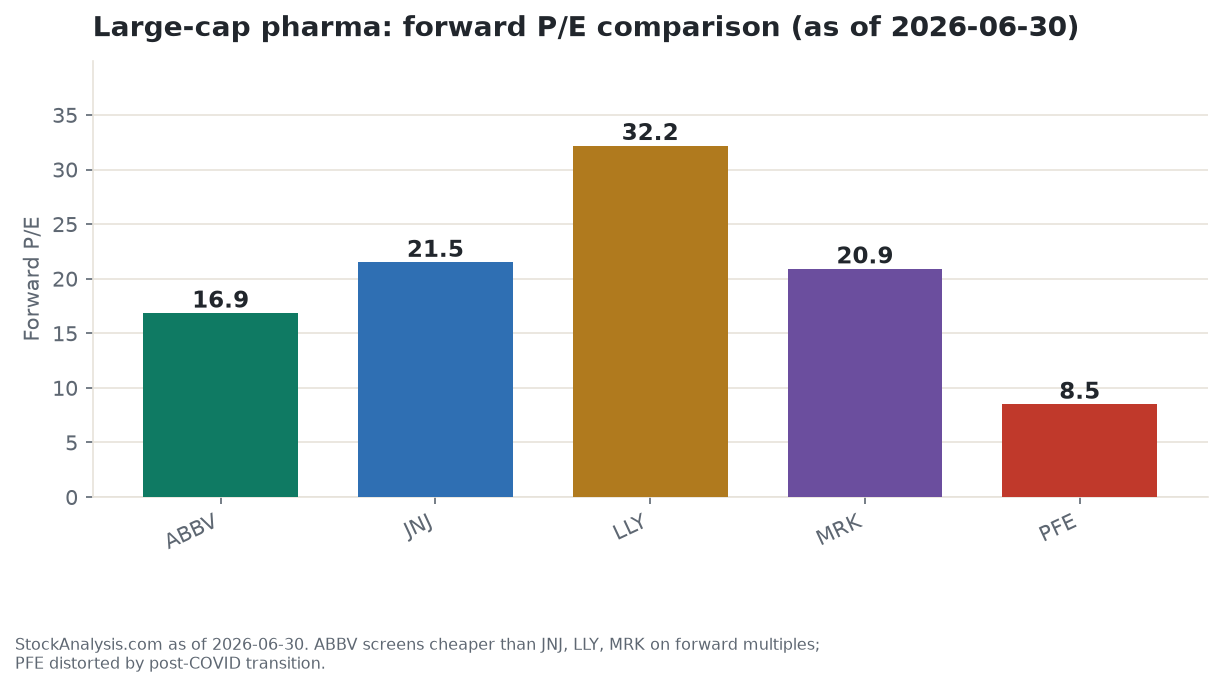
Valuation. This is where AbbVie’s numbers get genuinely confusing unless you know which multiple to trust. Trailing GAAP price-to-earnings runs around 124 times, a wild outlier against peers trading in the high teens to low forties, but this is almost entirely an artifact of the one-time acquisition and litigation charges described in the filings section above, not a re-rating of the underlying business; AbbVie’s price-to-sales multiple, a cleaner cross-check, has only drifted from about 4.3 times to 7.1 times over the same stretch that the GAAP earnings multiple exploded from 21 times to 124 times. Forward price-to-earnings, the more decision-useful number, is disputed between vendors at 16.85 times and 15.56 times, so call it a range of roughly 16 to 17 times, which is cheaper than the peer average of about 21 times across Johnson & Johnson, Eli Lilly, and Merck (Pfizer’s 8.5 times is itself distorted by its post-COVID transition). Enterprise-value-to-EBITDA sits at 16.99 times, almost exactly at the peer average, and has actually come down from a 2024 peak above 21 times even as the share price rallied, meaning earnings growth has outpaced enterprise-value growth over the past two years. Price-to-sales at 7.08 times likewise sits almost exactly at the peer average. The dividend yield is 2.72 percent (annualized at $6.92 per share), and while the headline payout ratio against trailing GAAP earnings looks alarming at 336 percent, that figure inherits the same one-time-charge distortion described above; measured against free cash flow instead, AbbVie’s dividend is covered about 1.53 times over, comfortable coverage. The honest one-line summary: on the multiples that actually matter for a business like this, forward earnings, EV/EBITDA, and price-to-sales, AbbVie screens as fully priced but not obviously stretched relative to peers; the multiple that looks alarming, trailing GAAP price-to-earnings, is the least meaningful one for judging this business today.
Liquidity and short interest. Average daily volume runs around 7 million shares, unremarkable and highly liquid for a mega-cap stock. Short interest sits at roughly 1.33 percent of float as of mid-June 2026, up only modestly from about 1.30 percent two weeks earlier, and low in absolute terms against a peer-group average closer to 6.9 percent. This reads as routine hedging activity, not a building bearish thesis.
Sell-side. Consensus rests at Buy or Moderate Buy across two data providers, with a mean price target of roughly $254, implying about 1 percent upside from the current close, though the two providers disagree meaningfully on both the number of analysts covering the stock (25 versus 32) and the range of individual targets ($214 to $298 versus $200 to $328). Read the roughly 1 percent implied upside as the sell-side collectively thinking the stock is fairly priced right now, not as a forecast, and remember that analyst targets are opinion, typically revised after the fact rather than ahead of it.
Technicals. The stock is running well above all of its major moving averages, roughly 9.5 percent above its 20-day average, 16.2 percent above its 50-day average, and 13.5 percent above its 200-day average, consistent with an extended uptrend testing its own 52-week high as the obvious near-term resistance. That positioning is descriptive, not predictive: an extended stock at resistance can break out or digest, and the data alone does not say which.
What the crowd is saying
News flow on AbbVie has turned decidedly warm over the past one to three months. A cluster of June 2026 catalysts, European regulatory approvals for Rinvoq in alopecia and vitiligo, a pediatric label extension for Skyrizi, and management’s own assertion at a June healthcare conference that Wall Street is “meaningfully undermodeling” both drugs’ peak sales, has shifted the narrative from “post-patent-cliff survivor” to “growth inflection story.” The stock rallied roughly 17 percent in the month leading into this research date on the back of that news flow.
Retail and social chatter is thin in absolute terms, AbbVie ranks near the bottom decile of stock-discussion platforms for mention volume, but what chatter exists leans bullish and reacts specifically to real news rather than speculation: sentiment jumped noticeably around the Rinvoq patent-settlement announcement, for example, and no evidence of coordinated pump-and-dump activity or debunked-rumor collateral damage turned up in this research. Blogger sentiment runs meaningfully more bullish than the broader health-care sector average. Employee sentiment via workplace-review sites is stable but softening slightly, a rating in the high 3s out of 5 with a small year-over-year decline, consistent with a company managing a leaner, post-acquisition-integration environment rather than a distress signal. Patient-satisfaction data on Skyrizi specifically is strong, with high reported treatment satisfaction and a notably lower switch-away rate than competing biologics, a genuinely hard signal of real-world clinical durability rather than a marketing claim.
The most useful divergence between the crowd narrative and the underlying evidence involves AbbVie’s own dividend-investor base. The common framing, a boring, safe income stock with a long streak of dividend increases and modest growth, is accurate but incomplete. AbbVie is no longer defending Humira; that cliff has already been weathered, and management is actively signaling that consensus estimates for Skyrizi and Rinvoq’s ultimate peak sales may be too conservative. Whether that management claim is correct is a genuine open question, not a settled fact, but the dividend-focused crowd narrative has plainly not caught up to the scale of the underlying transition. A second, much smaller divergence involves AbbVie’s quiet, early-stage bet on an amylin-based obesity treatment, licensed for a modest upfront payment, positioned as a long-shot, low-visibility option on a category currently dominated by Eli Lilly and Novo Nordisk rather than a near-term threat to that duopoly.
None of this sentiment evidence is a hard signal on its own. It should be read alongside the filings and market data above, not in place of them.
Durability, and what has to be true
AbbVie is really three demand stories bolted together, and they do not share the same durability. Immunology, neuroscience, and oncology, together roughly 92 percent of revenue, are chronic-disease, insurance-funded, physician-prescribed businesses. Patients being treated for progressive autoimmune disease or cancer do not defer treatment in a downturn the way a consumer defers a discretionary purchase, and the funding source is overwhelmingly commercial insurance and Medicare rather than out-of-pocket cash. That makes AbbVie’s core revenue close to recession-proof at the patient-volume level. Aesthetics, the remaining roughly 8 percent, is the genuine exception: Botox Cosmetic and Juvederm are elective, self-pay purchases exposed to consumer discretionary spending and, in particular, Chinese demand, and that segment is already showing real cyclical softness. The demand risk that actually matters for AbbVie over a five-year horizon is not a garden-variety recession. It is reimbursement policy, a risk that does not show up in GDP data at all.
The structural bull case. AbbVie has already run its hardest possible test once, successfully. The Humira-to-Skyrizi/Rinvoq transition is not a hypothetical; it is a completed, audited fact, with the new drugs already exceeding the old one’s best year while still growing at a double-digit pace. The Inflation Reduction Act’s eligibility timeline currently favors AbbVie in the near term too: Skyrizi, as a biologic, gets an eleven-year runway before Medicare-negotiation eligibility versus Rinvoq’s seven years as a small molecule, both counted from their 2019 approval date, buying real time before either flagship faces government pricing. AbbVie has also shown a demonstrated willingness to litigate and settle for extended patent exclusivity, exactly what it did to defend Humira for years past its headline expiration and has now done again with Rinvoq’s push to 2037. And a diversified, non-Humira-dependent pipeline is actively being rebuilt through acquisition, most recently the Apogee Therapeutics deal, following earlier purchases of ImmunoGen’s oncology assets and Cerevel’s neuroscience pipeline.
The real cyclical bear case, and its timing. The patent-cliff cycle is never actually repealed, only postponed, and the postponement is not infinite. Skyrizi’s US patent expires around 2033 and Rinvoq’s generic entry is blocked only until 2037 by a settlement, not by an underlying patent that naturally runs that long, and both dates sit at or just past the edge of a standard five-year investment horizon, calendared events the market will begin discounting years in advance the same way it began pricing in Humira’s cliff around 2018, five years ahead of the actual 2023 event. The most probable trigger window is 2028 through 2033: Rinvoq’s likely Medicare negotiation eligibility lands around 2028 to 2029, echoing the roughly 40 to 65 percent negotiated-price cuts already seen on Imbruvica, Linzess, and Vraylar; Skyrizi’s own eligibility follows a few years later as its biologic clock runs out; and both drugs’ underlying patents expire in 2033, opening the door to biosimilar competition specifically on Skyrizi, the larger and unprotected one. What could accelerate this: a more aggressive regulatory posture toward the patent-settlement strategy that has worked for AbbVie twice already, an adverse ruling against the Rinvoq exclusivity settlement, or an extension of most-favored-nation-style pricing pressure from GLP-1 drugs to other high-list-price categories. What could soften it: a genuinely scaling third replacement franchise, built well before the cliff arrives, repeating the exact playbook that already worked once with Skyrizi and Rinvoq.
The most likely outcome is neither the clean bull nor the clean bear, but a split by time horizon. Through roughly 2028, AbbVie’s current velocity continues largely uninterrupted, with policy exposure limited mainly to the already-known Imbruvica cut. From about 2028 to 2032, the Inflation Reduction Act and early biosimilar dynamics begin to bite, most visibly on Rinvoq, while Skyrizi stays largely protected on the biologic clock through most of that window. From 2032 onward, the next real loss-of-exclusivity event arrives, and whether it plays out as manageably as Humira’s did depends entirely on how far along AbbVie’s current acquisition vintage, Apogee, ImmunoGen, Cerevel, and whatever follows, has scaled by then. What has to be true for the bull case to hold: AbbVie needs to either secure a Skyrizi-specific exclusivity extension before 2033, the way it already did for Rinvoq, or have a visibly scaling third franchise in place well before that date. Neither has happened yet.
The scenarios in detail
Four variables decide the five-year outcome, and the three scenarios below are just different settings of these same dials.
The Skyrizi and Rinvoq growth trajectory. Combined FY2025 revenue of $25.87 billion already exceeds Humira’s all-time peak, and 2026 guidance points toward roughly $31.8 billion combined. This single pairing of drugs is about 42 percent of total revenue and rising. How long the two keep compounding at a double-digit pace, and how much of Rinvoq’s ceiling is capped by its boxed warning and second-line labeling, sets the base of the whole model.
Margin and adjusted-earnings conversion. Roughly 84 percent adjusted gross margin, FY2025 adjusted earnings per share of $10.00, and an FY2026 guide of $14.08 to $14.28 (the GAAP-to-adjusted gap being acquisition-related charges, not a weaker cash business). The open question is how fast realized net price erodes, first from rebate pressure, later from Inflation Reduction Act negotiation, against continued volume and label-expansion growth.
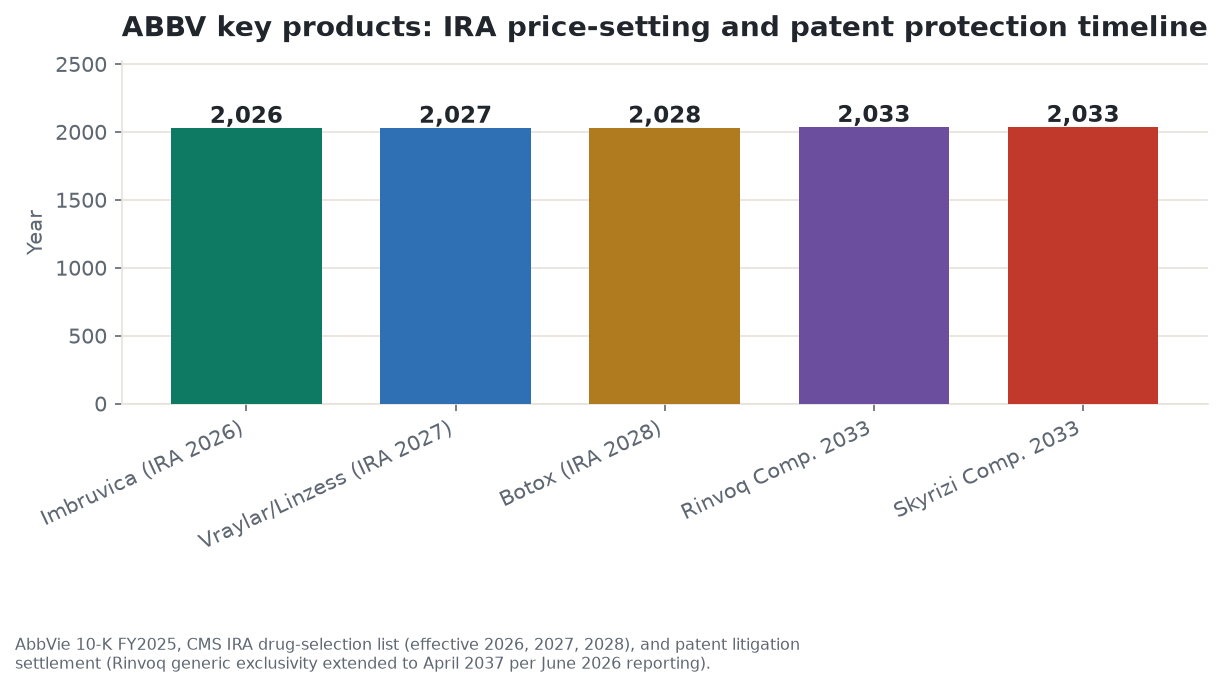
The Inflation Reduction Act and patent-cliff calendar, the dominant structural force. The datable sequence runs: Imbruvica’s 38 percent Medicare price cut (2026), Vraylar’s 44 percent cut and Linzess’s 75 percent cut (2027), Botox’s selection for negotiation effective 2028 (with AbbVie suing to escape it), Rinvoq’s own eligibility window opening around 2028 to 2029, and then the two patent cliffs themselves: Skyrizi’s US patent expiring around April 2033 with no known settlement extension, the single largest product on the earliest and least-protected timeline, and Rinvoq locked to April 2037 by its settlement, though as a small-molecule cliff, one that historically erodes 70 to 90 percent within one to two years once it arrives, versus a biologic’s typically slower, multi-year taper.
The multiple and capital allocation. A forward price-to-earnings ratio around 16 to 17 times, cheaper than the roughly 21-times peer average, with a well-covered dividend near 2.7 percent, but sitting on a stretched balance sheet: roughly $67.5 billion of debt, negative equity of $3.27 billion, two-thirds of assets in goodwill and intangibles, and a debt-funded acquisition pace that has already produced one clear failure (Cerevel’s emraclidine, which missed its primary endpoint in Phase 2 schizophrenia trials in November 2024) and a flagship new deal, Apogee, that is not guided to become earnings-accretive until 2032. The swing factor is whether the market keeps paying a premium defensive multiple through the approaching 2033 cliff, or begins discounting it early, the way it discounted Humira’s from around 2018.
Bull scenario, illustrative valuation. Skyrizi and Rinvoq compound faster than consensus expects, management’s undermodeling claim proves out, and combined revenue pushes into the high $30 billions. Neuroscience and the newly acquired pipeline (Apogee’s IL-13 assets, ImmunoGen’s oncology antibody-drug conjugates) add a credible third leg, while Inflation Reduction Act impact stays a manageable share of Medicare-billed volume rather than total revenue. Adjusted earnings per share compound toward roughly $23 to $24 by around 2031, on a multiple holding near 17 to 18 times, implying an illustrative level near $405 five years out, $283 at six months, $300 at one year, and $345 at three years. What has to be true: the Street really is undermodeling peak sales, and the third replacement wave scales before 2033 arrives. What most likely breaks it: Skyrizi’s unprotected cliff enters the market’s modeling window and investors refuse to keep paying a premium multiple through it regardless of how good the current numbers look.
Base scenario, illustrative valuation. Skyrizi and Rinvoq stay strong but decelerate as the 2026 guide of roughly $14.18 grows at a high single-digit annual pace, tapering as Rinvoq’s Inflation Reduction Act eligibility and rebate pressure bite, partly offset by neuroscience, oncology, and the acquired pipeline. Adjusted earnings per share reach roughly $19 to $20 by around 2031, at a multiple drifting modestly from about 17 times toward 15 to 16 times as the 2033 cliff enters the forecast window, implying an illustrative level near $315 five years out, $290 at three years, $268 at one year, and $258 at six months. What has to be true: the immunology franchise matures gracefully and the Inflation Reduction Act hit arrives as a slope rather than a cliff before 2033. What most likely breaks it: an accelerated first-filer clause pulling Rinvoq’s generic entry earlier than 2037, an adverse court or regulatory ruling against the patent-settlement playbook, or a most-favored-nation-style pricing action compressing Skyrizi’s net price ahead of schedule.
Bear scenario, anchored on the strongest case against the stock. Vraylar and Linzess cuts land in 2027, Botox in 2028, Rinvoq’s Inflation Reduction Act eligibility and second-line ceiling both bite around 2028 to 2029, and the market begins discounting Skyrizi’s unprotected 2033 cliff years early, exactly as it discounted Humira’s from around 2018. Adjusted earnings per share growth stalls to a low single-digit pace, reaching only about $15 to $16 by around 2031, as net-price erosion, Inflation Reduction Act compression, and the possibility of another pipeline miss (emraclidine already sets the precedent) converge on a negative-equity, heavily indebted balance sheet with the dividend consuming a large share of operating cash flow. The multiple de-rates to roughly 11 to 12 times, the range mature patent-cliff pharma names like Bristol Myers Squibb have traded at, implying an illustrative level near $185 five years out, $200 at three years, $215 at one year, and $224 at six months. What has to be true: the 2033 Skyrizi cliff is real and unmitigated, the Inflation Reduction Act cascade compounds across products, and the replacement pipeline underdelivers. What would flip the bear back toward bull: a Skyrizi-specific exclusivity settlement, a second version of the win AbbVie already secured on Rinvoq, or a clearly scaling third franchise that proves the replacement playbook works a third time.
Catalyst timeline. Near term: Q2 2026 earnings in late July or early August, watched for Skyrizi and Rinvoq’s net-price trend and any guidance revision; the Section 232 pharmaceutical tariff’s July 31, 2026 effective date for AbbVie’s named cohort; the Apogee Therapeutics deal closing in Q3 2026; the annual CMS Inflation Reduction Act selection announcement in early 2027, watched specifically for whether Rinvoq appears on a future selected-drugs list; and further Rinvoq label decisions on alopecia and vitiligo following June 2026’s positive European opinions. Multi-year: January 2027, when the Vraylar and Linzess negotiated Medicare prices take effect; 2028, Botox’s first Part B negotiated price, pending the outcome of AbbVie’s own lawsuit; 2028 to 2029, Rinvoq’s likely Inflation Reduction Act negotiation eligibility; around 2030 to 2032, Skyrizi approaching its own eligibility window as Apogee is guided to begin accreting; April 2033, Skyrizi’s core US patent expiration; and April 2037, Rinvoq’s settlement-locked generic entry date.
Leading indicators worth tracking. AbbVie’s quarterly disclosure of Skyrizi and Rinvoq’s net price against volume growth is the single most useful number, the earliest possible read on whether rebate pressure is compressing realized price ahead of any formal Inflation Reduction Act event. Whether Rinvoq ever appears on a CMS selected-drugs list is the clock on the larger of the two small-molecule risks. The presence or absence of a Skyrizi-specific exclusivity settlement, a second version of Rinvoq’s 2037 win, is close to the entire bull-versus-bear pivot on AbbVie’s biggest single product. Whether Apogee’s IL-13 assets, the ImmunoGen oncology franchise, or Cerevel’s neuroscience pipeline start showing actual revenue rather than pipeline slides is the test of the third-wave story. And the trend in free-cash-flow dividend coverage and net debt tells you whether AbbVie’s capital-allocation model is holding steady or straining under each new acquisition.
Companies to watch (bull, base, bear)
AbbVie (ABBV), the subject of this piece. Bull: Skyrizi and Rinvoq already replaced Humira’s peak and keep compounding at a double-digit pace, with a well-covered dividend and a discount to peer forward multiples. Base: a durable, cash-generative compounder whose growth decelerates gracefully against a known regulatory calendar. Bear: Skyrizi’s unprotected 2033 patent cliff, Rinvoq’s boxed-warning ceiling, an expanding Inflation Reduction Act cascade, and a debt-funded acquisition treadmill with one already-failed bet on a negative-equity balance sheet. Watch: Skyrizi and Rinvoq net-price trends, any Skyrizi-specific exclusivity settlement, and third-wave pipeline revenue.
[Johnson & Johnson (JNJ)], the direct competitive threat to Skyrizi through Tremfya and the diversification benchmark. Bull: the broadest revenue base in big pharma, with Tremfya taking real share in AbbVie’s own core indications. Bear: talc litigation remains a live multibillion-dollar overhang. Watch: Tremfya’s continued share gains against Skyrizi and Rinvoq specifically.
[Eli Lilly (LLY)], the valuation benchmark AbbVie’s relative-cheapness argument leans on. Bull: the GLP-1 category leader with a growth rate and addressable market that dwarfs AbbVie’s entire immunology book. Bear: the richest multiple in the group leaves almost no room for a stumble. Watch: whether oral GLP-1 competition compresses Lilly’s premium, which would remove AbbVie’s relative-value argument.
Merck (MRK), running the closest mirror of AbbVie’s own patent-cliff-replacement playbook. Bull: pre-funding a post-2028 Keytruda cliff years in advance, the same forward-building strategy AbbVie used with Skyrizi and Rinvoq. Bear: a single asset worth more than $30 billion a year with no proven replacement yet at comparable scale. Watch: whether Merck’s own replacement bets scale faster than AbbVie’s third wave, a useful comparison for how hard this playbook actually is to repeat.
Pfizer (PFE), the cautionary tale on how a stock can get left behind even at a cheap multiple. Bull: trades near book value with an underappreciated revenue floor. Bear: down or flat total returns over one, three, and five years despite the group’s cheapest multiples, evidence that a discount alone does not guarantee a re-rating. Watch: whether Pfizer’s underlying business stabilizes, a signal for how much patience the market extends to a name once it loses growth-story status, which is the long-run risk sitting over AbbVie post-2033.
Bristol Myers Squibb (BMY), the clearest real-world precedent for what an unmitigated patent cliff does to a stock’s multiple over time. Bull: its newer growth portfolio crossed the majority-of-sales threshold for the first time. Bear: still working through the steepest patent-cliff decade in this peer set. Watch: Bristol Myers’s multiple as the benchmark for where AbbVie’s own stock could trade if the market starts pricing the Skyrizi cliff the way it already prices Bristol Myers’s Revlimid cliff.
Amgen (AMGN), both a direct Humira-biosimilar competitor and a cautionary note on how slowly biosimilar share actually accrues. Bull: MariTide’s dosing profile could differentiate it in obesity if Phase III data holds. Bear: its own Humira biosimilar has captured only a modest slice of a crowded field, a data point that cuts both ways for AbbVie, comforting on how slowly Skyrizi’s eventual biosimilars would ramp, but also confirming that erosion, once it starts, does not stop. Watch: Amjevita’s US biosimilar share trend as a proxy for how fast Skyrizi’s eventual biosimilars could realistically capture volume after 2033.
Novartis (NVS), the direct immunology competitor experiencing a patent cliff in real time, right now, in the same quarter as its growth story. Bull: Cosentyx is still taking real share in AbbVie’s core indications. Bear: Entresto’s abrupt US generic collapse this quarter is happening at the same time as the growth narrative, a live preview of the kind of shock every large-cap pharma name eventually has to survive. Watch: how quickly Novartis’s newer launch brands offset the Entresto cliff, a template for how AbbVie’s own eventual cliff might play out.
Risk controls
The single largest risk sitting over this thesis is concentration timed to arrive all at once. Skyrizi and Rinvoq are about 42 percent of revenue and rising, and both face government price-setting eligibility and their underlying patent expirations inside the same 2028 to 2033 window, with Skyrizi, the larger of the two, carrying no settlement extension at all as of this research date. A reasonable position sizing here should account for the fact that this is not a diversified pharma bet in the way the “four franchises” framing might suggest; it is increasingly a bet on two molecules whose risk events cluster in time.
The balance sheet compounds that concentration risk rather than offsetting it. Negative stockholders’ equity, roughly $67.5 billion of total debt, and a dividend consuming about 61 percent of operating cash flow leave less room to absorb a genuine earnings disappointment than a company with a cleaner capital structure would have, even though credit-rating agencies currently view the structure as stable and investment-grade. The company’s own replacement-pipeline strategy has already produced one clear miss, Cerevel’s lead schizophrenia asset failing its Phase 2 trial, a real data point against assuming the next acquisition automatically works.
Valuation risk is real but more nuanced than the headline trailing price-to-earnings ratio suggests. The stock trades at a discount to peers on forward earnings and in line with peers on EV/EBITDA and price-to-sales, but it does so at an all-time-high absolute price that already reflects a warming narrative and two consecutive earnings beats. There is limited room for disappointment priced in at current levels, even if the multiple itself is not extreme.
Liquidity and access are not concerns here. AbbVie is a highly liquid mega-cap stock with no meaningful short-interest buildup and routine institutional ownership. What would change this thesis, in either direction: securing (or conclusively failing to secure) a Skyrizi-specific patent settlement before 2033 is the single clearest fork in the road, alongside the pace at which Apogee, ImmunoGen, and Cerevel’s acquired pipeline assets start generating real, disclosed revenue rather than remaining pipeline commentary.
Methodology, sourcing, and data-quality flags
This piece was built from parallel research streams, the value-chain map, the SEC filings analysis, market action and valuation, sentiment and narrative, macro and micro economics, a dedicated business-model-and-moat deep dive, and a forward outlook, then run past a skeptic who argued the short case and a compliance review of the disclaimers and framing. The source hierarchy, strongest first: primary filings (the FY2025 Form 10-K filed February 20, 2026, subsequent 8-K earnings releases and exhibits, the DEF 14A proxy, and CMS’s own negotiated-price fact sheets); analyst and institutional estimates; reputable trade press; and this piece’s own labeled scenario arithmetic. Of 133 load-bearing claims checked in this research, 118 were independently verified, 7 carry a named vendor dispute and are presented as a range rather than a single figure, and 8 were dropped or excluded from the draft as unreliable, including two rows traced to what appears to be a scraping error on a single third-party blog (a stock price and a revenue-guidance figure both off by a wide, implausible margin) and a stray “97 percent Humira market share” figure that conflicts with the well-documented erosion story and should not be treated as current.
A note on the five-factor read itself, in plain terms rather than as a score. On valuation, the evidence reads fair rather than cheap or expensive: forward earnings, at roughly 16 to 17 times, sit below the large-cap-pharma peer average near 21 times and below AbbVie’s own history, backed by a well-covered dividend near 2.7 percent, but the stock trades at an all-time high within about 1 percent of the sell-side’s own consensus target and near the top of its own historical price-to-sales range, so the peer-relative discount is offset by a full absolute price. On growth, the read is genuinely strong: Skyrizi and Rinvoq have already replaced Humira’s peak revenue and are still compounding at a double-digit pace, guidance has been raised twice this year, and the underlying immunology market remains large, though the qualifier is that this growth decelerates against a visible, calendared price-setting and patent-expiration schedule and is concentrated in two molecules rather than spread across a broader portfolio. On quality, the read is high but not fortress-grade: an approximately 84 percent adjusted gross margin and roughly $17.8 billion of free cash flow covering the dividend about 1.5 times over, alongside a recent credit-rating upgrade, are offset by negative stockholders’ equity, roughly $67.5 billion of debt, and two-thirds of total assets sitting in goodwill and acquired intangibles, a picture of strong cash generation built on a financially engineered balance sheet rather than an unlevered one. On risk, the read is elevated and mostly structural rather than speculative: the concentration in two molecules, the expanding Inflation Reduction Act price-setting cascade already touching four products, Skyrizi’s unmitigated 2033 patent cliff on the single largest product, Rinvoq’s boxed-warning-driven ceiling on its own peak sales, and a debt-funded acquisition strategy with one already-disclosed failure are all calendared, disclosed facts rather than speculative worries, which is exactly why this factor weighs on the overall read the most. On momentum, the signal is soft and positive but not overwhelming: the stock is up roughly 35 percent over the trailing year with a warming news narrative, a consensus Buy rating, and low, only mildly rising short interest, tempered by the fact that two direct peers, Johnson & Johnson and Merck, actually outran AbbVie’s own one-year return, and the stock currently sits pinned at technical resistance. Netting these five factors together, a fairly valued, durable, cash-generative compounder with a real and already-proven post-Humira growth inflection, priced fully at an all-time high, carrying a visible and calendared 2028-to-2033 regulatory and patent wall on a stretched balance sheet, the lean lands at Accumulate: constructive, but not a table-pounding conviction call. It would move toward a stronger Buy on a confirmed Skyrizi-specific exclusivity settlement or clear evidence of a scaling third franchise. It would move down toward Hold if the 2033 cliff begins visibly de-rating the multiple, an adverse Inflation Reduction Act or patent-litigation ruling lands against AbbVie, or dividend coverage compresses meaningfully from current levels.
Data-quality flags:
- Point-in-time figures move fast. Every price, market cap, valuation multiple, short-interest reading, and analyst target here is stamped June 30, 2026 and will already have moved by the time this is read. The site’s live price and market-cap header above this article supersedes the $251.64 and $444.6 billion figures used in the prose.
- GAAP versus adjusted is the single biggest distortion in AbbVie’s reported numbers. FY2025 GAAP diluted earnings per share of $2.36 versus adjusted diluted earnings per share of $10.00 is almost entirely acquisition-related charges, not a weaker underlying cash business, and it is what drives the otherwise-alarming 124-times trailing GAAP price-to-earnings ratio, a number not comparable to peers on a like-for-like basis.
- Forward price-to-earnings is genuinely disputed between data vendors, 16.85 times versus 15.56 times, an approximately 8 percent gap that appears to reflect different consensus-earnings windows rather than an error on either side; the same disagreement shows up even more sharply on Merck’s forward multiple across the same two vendors, suggesting this is a sector-wide data-sourcing issue rather than an AbbVie-specific one.
- Total-return calculators disagree materially and should not be quoted as a single hard number. One-year total-return figures for AbbVie range from roughly 18 percent to 40 percent depending on which calculator is used; the cross-vendor-corroborated price-only return series is the harder anchor if a single number is needed.
- AbbVie’s own FY2025 buyback figure cannot be pinned to one number even within its own 10-K. The MD&A narrative ($606 million) and the cash-flow statement’s treasury-stock line ($980 million) do not reconcile within the same filing; present this as a range rather than picking one.
- AbbVie’s near-term Section 232 tariff exposure is a genuine open question. The company’s January 2026 voluntary agreement with the federal government describes a tariff exemption for its three-year term, but the April 2026 Section 232 proclamation separately named AbbVie among companies facing an earlier, July 31, 2026 effective date. This research could not confirm whether the January deal supersedes the April cohort designation, and it should not be treated as resolved in either direction.
- Skyrizi’s own patent-protection status beyond 2033 is an absence-of-evidence claim, not a confirmed fact. No public settlement extending Skyrizi’s exclusivity has been found as of this research date, unlike the confirmed Rinvoq settlement to April 2037, but the absence of a found settlement is not proof that none exists or that none will be reached before 2033.
- Enterprise value and the implied net-debt figure are single-sourced to one data provider and were not independently cross-checked against a second calculation method, which can vary by how minority interest and cash are treated.
- Sell-side analyst count and price-target range differ by data provider (25 analysts, $214 to $298 versus 32 analysts, $200 to $328), even though the mean target of roughly $254 agrees closely across both; this likely reflects a difference in which analysts each provider counts as active coverage rather than an error.
- A “97 percent Humira market share” figure surfaced in one market-research summary and directly conflicts with the well-documented, roughly 50-50 current split between Humira and its biosimilar competitors. It has been excluded from this article and should not be used as a current fact about Humira’s market position.
Key sources: AbbVie’s FY2025 Form 10-K (SEC EDGAR, filed February 20, 2026) and Q1 2026 earnings release (8-K Ex-99.1, filed April 29, 2026); AbbVie’s DEF 14A proxy filed March 23, 2026; CMS’s official Medicare Drug Price Negotiation Program fact sheets for the 2026, 2027, and 2028 initial price applicability years; the FDA-approved drug label for Rinvoq (upadacitinib) via DailyMed; AbbVie’s June 22, 2026 8-K on the Apogee Therapeutics acquisition; stockanalysis.com and finviz.com for market-data cross-checks; and Q1 2026 earnings releases from Johnson & Johnson, Eli Lilly, Pfizer, Bristol Myers Squibb, Merck, Amgen, and Novartis for the peer comparisons. Figures are point-in-time as of June 30, 2026.
This article is OSINT research for educational purposes only and is not investment advice. I am not a financial advisor, and nothing here is a recommendation to buy, sell, or hold any security. Pharmaceutical companies carry patent-cliff, clinical-trial, and drug-pricing-regulation risk that can move faster than a typical stock. Figures are point-in-time as of June 30, 2026 and will change. Do your own due diligence and consult a licensed financial advisor before making any decision.