
Research date: June 22, 2026 | OSINT market research on Eli Lilly and Company (LLY, NYSE), its GLP-1/incretin franchise, the wider obesity-drug field, and a five-year bull/base/bear read
Important disclaimer. This is OSINT-based research and educational analysis, not investment advice and not medical advice. I am not a financial advisor and I am not a clinician. Nothing here is a recommendation to buy or sell any security, and nothing here is a recommendation to start, stop, switch, or dose any medication. Every clinical figure below is a result from a named trial, reported as a trial result, not a treatment claim or a promise about any individual. The scenarios are illustrative, not price targets. Pharma is a sector where trials fail, a single concentrated franchise can carry most of the earnings, and drug-pricing policy can move the numbers in a single news cycle. Market caps, prices, valuation multiples, and market-share figures are point-in-time (June 22, 2026), press-reported where noted, and move fast. Do your own due diligence, consult a licensed financial advisor before any investment decision, and consult a qualified clinician for any health decision.
Where this stock could be in 6 months, 1 year, 3 years, and 5 years
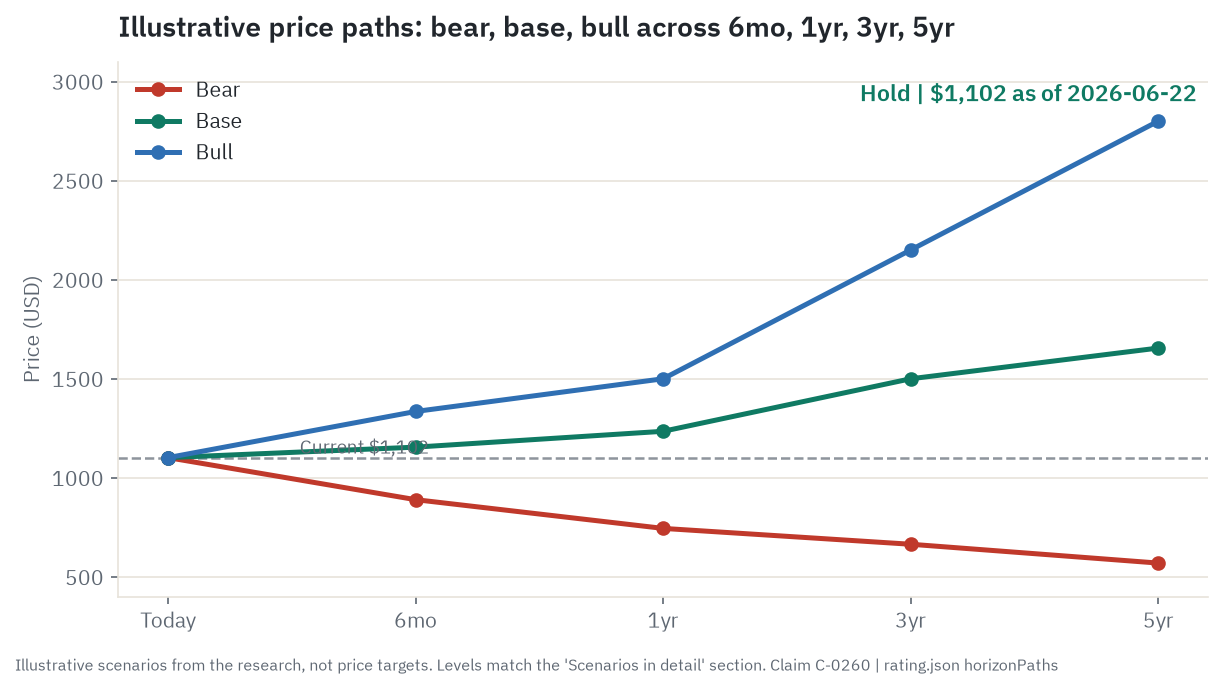
Eli Lilly closed at $1,102.08 on June 22, 2026, near a 52-week high of $1,182.73 and a long way above the $623.78 low set last August. The four paths below are illustrative arithmetic, a stated earnings path times a stated exit multiple, built so the math is auditable. None of them is a price target.
Six months. This window is governed by datable prints, not by anything structural. Q2 results land August 6, then Q3, and the Medicare GLP-1 Bridge program starts July 1. The whole read flips on one line in the earnings release: net realized price per script. If unit volume keeps outrunning the price drag (US net price fell about 7 percent in Q1 2026, ex-US about 25 percent on China’s reimbursement-list inclusion) and the new oral pill holds its share, the base case drifts back toward the recent $1,110 to $1,180 zone, roughly $1,155, with a bull case near $1,335. If a print shows net price eroding faster than volume can cover, or guidance gets trimmed, the multiple compresses fast toward a bear case around $890. The August 2025 single-day drop of about 14 percent is the template for how quickly this stock can move on a number.
One year. The dominant twelve-month variable is whether full-year 2026 lands inside the company’s $82 to $85 billion revenue guide with net price intact, plus the retatrutide regulatory filing expected around Q4. The base case near $1,235 is essentially “consensus is right and the franchise compounds into the guide,” and it sits inside the sell-side cluster of roughly $1,216 to $1,231 by construction. The bull case near $1,500 needs a clean beat plus pipeline data that re-rates the stock. The bear case near $745 is the slow grind arriving early: pricing and policy take growth from around 50 percent toward 15 to 20 percent faster than the Street expects, with no earnings to catch the multiple, landing near the $850 analyst-low and the 2025 recovery base.
Three years. Now the structural drivers start to show. The base case near $1,500 is the franchise compounding earnings into the low-$60s per share as the multiple drifts toward roughly 25 times, with the market beginning to price the eventual 2036 patent cliff. The bull case near $2,150 is the second franchise leg working: the next-generation drug retatrutide launched and ramping, the oral pill expanding the market, and share held against the field. The bear case near $665, below today’s price, is the commoditization read: net price competed down, the oral pill landing mid-range rather than blockbuster, and the premium multiple gone. The flip factor is simple to state and hard to call: is obesity a durable, multi-indication chronic market, or a price-competed, high-churn category?
Five years. This window is dominated by class durability and by the 2036 cliff coming into view. The base case near $1,655 is earnings in the mid-$70s per share at a fair multiple around 22 times, good compounding with the multiple fading toward the cliff. The bull case near $2,800 is the full franchise-as-a-class outcome: retatrutide as the new efficacy crown, the oral pill at global scale, and new indications (sleep apnea, heart failure, liver disease) converting weight-loss users into retained chronic-disease patients. The bear case near $570 is a de-rating of 30 to 40 percent as net-price erosion, competition, and the cliff fuse together and a great company gets re-rated from flawless to merely good.
Where the read lands today. On balance the read holds at Hold. Lilly is the efficacy leader in the largest new drug market in a generation, compounding revenue in the 45 to 55 percent range on one franchise, with a pill and a higher-efficacy successor behind it. But at roughly 30 times forward earnings and about 13.6 times sales, with 65 percent of last quarter’s revenue in a single molecule class and net price falling every quarter, the premium leaves almost no margin of safety. The single thing most likely to flip it either way is the net-price line: stabilize it and the read can climb; let it erode faster than volume and the multiple does the work on the way down.
Companion tool
Jump to the interactive dashboard to sort and filter every company in the piece, or download the Excel model to flex the scenarios yourself.
TL;DR
First, the one piece of biology that the whole thesis rests on. GLP-1 (glucagon-like peptide-1) and GIP are gut hormones your body releases after you eat; they tell the brain you are full and help the pancreas manage blood sugar. The class of drugs here, called incretins, mimics those hormones, which is why one molecule can both blunt appetite for weight loss and control blood sugar in diabetes. Keep that single idea in mind and the rest of the piece follows.
Almost all of Eli Lilly’s growth comes from one place: tirzepatide, sold as Mounjaro for type 2 diabetes and Zepbound for obesity. Those two products were 56 percent of 2025 revenue and 64.8 percent of Q1 2026 revenue, and the company is leaning into that concentration, not diversifying away from it. The bull case is genuine and well-backed: tirzepatide has the highest weight loss of any approved obesity drug in its Phase 3 trial, Lilly holds roughly 60 percent of the US GLP-1 market, an oral pill (orforglipron, branded Foundayo) was approved in April 2026 and expands the market because most of its early patients were new to the drug class, and a triple-agonist successor (retatrutide) hit 28.3 percent mean weight loss in its late-stage obesity trial. The single biggest risk is the mirror image of the bull case. One molecule class, a composition-of-matter patent that expires around January 2036, net realized price falling 7 to 13 percent a quarter under pressure from the most-favored-nation Medicare deal and the pharmacy-benefit middlemen, real-world discontinuation rates that undercut the total-market math, and a valuation roughly two to three times the pharma peer group leave no room for a stumble. The franchise is excellent. The price assumes almost none of it goes wrong.
Explore it yourself: the interactive dashboard
Open the dashboard in a full screen
One company, one molecule, a trillion-dollar question
Think of Eli Lilly in mid-2026 as a power plant with one enormous turbine. The turbine is tirzepatide. It is running at full output and the lights it powers are spreading across the country, and the question every investor is really asking is not whether the turbine works. It clearly works. The question is how long it runs at this output before something slows it: a cheaper turbine next door, a regulator capping the price of the electricity, or the day in 2036 when the patent that keeps competitors off the same design runs out.
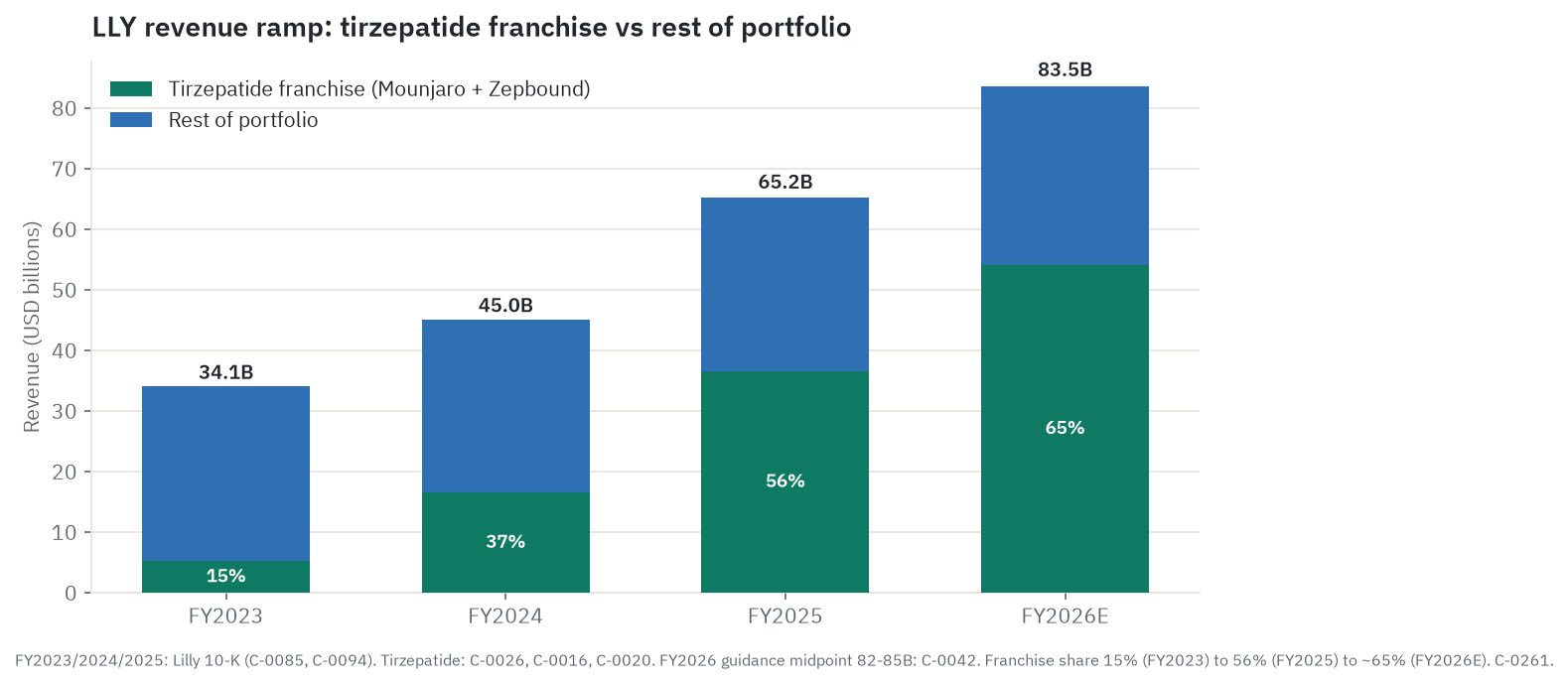
The numbers behind that picture are stark. In 2025 Lilly booked $65.2 billion in revenue, up 44.7 percent year on year, and guided 2026 to $82 to $85 billion. Mounjaro and Zepbound together were $36.5 billion of 2025 revenue, and in the first quarter of 2026 they were $12.8 billion out of $19.8 billion, almost two-thirds of the company. Lilly’s own 10-K flags this in plain language: its six largest products were 82 percent of 2025 revenue, and Mounjaro plus Zepbound alone were 56 percent. The five non-incretin products the company highlights as growth drivers (the cancer, immunology, and Alzheimer’s launches) summed to about $549 million in Q1 2026, against $12.8 billion of incretins. Diversification, for now, is a rounding error against the main franchise.
That concentration is the whole story, in both directions. It is why revenue grew faster than almost any large company in the market. It is also why a single bad trial readout, a payer decision, or a pricing rule can move the stock 14 percent in a day. The rest of this piece walks the money from the lab bench to the patient and back, names every competitor and every risk, looks hard at what the filings actually say, and asks the only question that matters at this price: is the lead durable enough to justify what you pay for it?
How the money flows
flowchart TD
    RD["R&D + Clinical Trials\nLilly $13.3bn/yr (20.5% of rev)\nSURPASS / SURMOUNT programs"]
    FDA["FDA Approval\nSingle-regulator gate\nEach indication separate"]
    API_P["Peptide API Synthesis\nKinsale Ireland (primary, $9bn site)\nLebanon IN (2027, $9bn buildout)"]
    API_SM["Small-Molecule API\nOrforglipron synthesis\nLebanon IN / Texas (2029)"]
    FF["Fill-Finish + Device\nLilly Wisconsin, Indiana, NC\nSterile injectable lines; no device for oral"]
    DIST["Wholesale Distribution\nMcKesson · Cencora · Cardinal\n>90% US market; 2-4% WAC margin"]
    PBM["PBMs (Formulary Gatekeepers)\nCVS Caremark · Express Scripts · Optum Rx\n80% claims; rebate extracts gross-to-net wedge"]
    PAY["Payers\nMedicare ($245/mo net post-MFN)\nCommercial insurers · Medicaid\n<50% large employers cover obesity"]
    PHARM["Retail/Specialty Pharmacy\nCVS · Walgreens · Amazon Pharmacy\nNear-zero margin on GLP-1 branded"]
    PAT["Patients\n$50/mo Medicare copay (GLP-1 Bridge)\n$149-349/mo LillyDirect self-pay\n40-60% 12-mo discontinuation"]
    LILLY["Lilly Net Revenue\n$65.2bn FY2025 (+45% YoY)\nTirzepatide 56% of revenue\n83% gross margin"]

    RD --> FDA
    FDA --> API_P
    FDA --> API_SM
    API_P --> FF
    API_SM --> FF
    FF --> DIST
    DIST --> PBM
    PBM --> PAY
    PAY --> PHARM
    PHARM --> PAT
    PAT -->|"Prescription demand flows back up"| LILLY
    LILLY -->|"Funds R&D"| RD

    style LILLY fill:#1a6e38,color:#fff
    style PBM fill:#8b0000,color:#fff
    style API_P fill:#1a3c6e,color:#fff
The demand originates at the bottom of that diagram, with patients and the people who pay for them: commercial insurers, employer health plans, Medicare and Medicaid, and the growing pool of self-pay buyers. They fund the prescriptions. Lilly collected $65.2 billion in net revenue in 2025, and the incretin class (tirzepatide plus the older Trulicity) was $40.8 billion, about 63 percent of it. Trace that money upward and you can see exactly where the margin sits and where the chokepoints are.
The first chokepoint is the deepest and the least visible: a clinical trial that works. A drug that fails Phase 3 takes the entire rest of the chain down with it, which is why a single readout can crater the stock. Tirzepatide exists as a $36 billion franchise because the SURPASS and SURMOUNT trial programs proved it superior to the prior class leader on both blood sugar and weight. After the trials comes the FDA, a single-regulator gate where every new indication needs a fresh approval. Then comes manufacturing, which splits into two very different paths. Tirzepatide is a 39-amino-acid peptide that needs a specialized, capital-intensive synthesis and then sterile fill-finish into pens and vials; the oral pill is a small molecule made with conventional chemistry, no cold chain, no injection device. That difference matters enormously, and I come back to it.
The chokepoint that does the most to shape the investing case sits between the manufacturer and the patient: the pharmacy-benefit managers, shaded dark red in the diagram. CVS Caremark, Express Scripts, and Optum Rx together processed about 80 percent of US prescription claims in 2025. They decide whether a drug is on the formulary at all, at what copay tier, and with what prior-authorization hoops. Their lever is the rebate: Lilly pays them a slice of the list price in exchange for preferred placement, and those rebates are subtracted before the net revenue Lilly reports. This is where the gross-to-net wedge lives, and it is why the list price ($1,080 to $1,086 a month, the published sticker drug-pricing people call WAC, or wholesale acquisition cost) tells you almost nothing about what Lilly actually keeps. The branded manufacturer with a patent-protected blockbuster is the toll-taker for the whole chain (83 percent gross margin, about 39.5 percent pre-tax operating margin), but the PBM is the gate that can open or close the toll road. When CVS Caremark removed Zepbound from its major formularies on July 1, 2025, an estimated 100 million-plus commercially insured Americans lost coverage, and Lilly had to concede richer rebates to get reinstated on October 1, 2026. One contracting decision, a large share of the country’s access. That is the shape of the chain, and it is the investing point.
Field guide: Lilly’s portfolio and segments
Lilly reports as a single business, so the useful way to understand it is by therapeutic area. Here is the plain-language map, with rough 2025 revenue weight.
Cardiometabolic health is the engine, at $48.2 billion or 74 percent of 2025 revenue. Inside it:
- Mounjaro (tirzepatide) is the type 2 diabetes brand and the largest single product at $23.0 billion in 2025, up 99 percent. It is a once-weekly injectable that activates two gut-hormone receptors (GIP and GLP-1), which is what “dual agonist” means: one molecule hitting two receptors at once, and the reason it out-loses single-receptor drugs.
- Zepbound (tirzepatide) is the same molecule marketed for obesity, at $13.5 billion in 2025, up 175 percent. Same drug, different label, different reimbursement channel.
- Orforglipron (Foundayo) is the new oral GLP-1 pill, FDA-approved for obesity in April 2026. It is early in its launch and gets its own deep section below.
- Legacy diabetes includes Trulicity (an older GLP-1, now in decline at $4.3 billion and falling as tirzepatide cannibalizes it), Jardiance ($3.4 billion, co-marketed with Boehringer Ingelheim), and the insulins.
Oncology is $9.4 billion, 14.4 percent of revenue. Verzenio (abemaciclib, for HR-positive breast cancer) leads at $5.7 billion, up 8 percent, with seven-year trial data confirming a survival benefit. Newer launches include Inluriyo (imlunestrant, approved September 2025 for ESR1-mutated breast cancer) and Jaypirca (pirtobrutinib, a reversible BTK inhibitor for certain blood cancers, growing fast off a small base).
Immunology is $5.2 billion, 8.1 percent. Taltz (ixekizumab, for psoriasis and related conditions) leads at $3.6 billion, with Ebglyss (lebrikizumab, atopic dermatitis) and Omvoh (mirikizumab, inflammatory bowel disease) ramping quickly.
Neuroscience is $1.4 billion, 2.1 percent, anchored by Kisunla (donanemab), the once-monthly Alzheimer’s infusion approved in July 2024. Its ramp is real but slow ($124 million in Q1 2026) because the treatment gates uptake on two steps: a doctor has to confirm amyloid plaque in the brain (via PET scan or spinal fluid) before starting, and then watch with repeated MRIs for ARIA, the brain swelling and small bleeds the drug can cause. That testing-and-monitoring burden shrinks the pool of patients who can both qualify and be safely followed, and the clinics set up to do it are still being built. A 2025 dosing-label change cut the swelling rate roughly in half, which helps, but the gating is structural.
The takeaway from the chart is the one that governs the whole investment: the tirzepatide franchise went from a thin slice of revenue in 2023 to 56 percent in 2025 to an estimated 65 percent at the 2026 guidance midpoint. The rest of the portfolio is essentially flat in aggregate. Everything that has changed about Lilly in three years has come from one molecule.
The GLP-1 / incretin franchise: the core of the thesis
This is the section that decides the stock. Everything else is context around it.
The tirzepatide ramp
Tirzepatide’s revenue trajectory is unusual for any product, let alone one this large. Mounjaro went from $5.2 billion in 2023 to $11.5 billion in 2024 to $23.0 billion in 2025. Zepbound, launched into the obesity market in late 2023, went from $176 million to $4.9 billion to $13.5 billion. In Q1 2026 the two together grew 108 percent year on year. Crucially, the international leg is now accelerating faster than the US: ex-US Mounjaro revenue stepped from $1.9 billion in Q2 2025 to $4.4 billion in Q1 2026, driven by China’s National Reimbursement Drug List inclusion plus launches in Brazil and India. That volume comes at a much lower net price, which is why ex-US realized price fell about 25 percent in Q1 2026 even as ex-US volume rose 95 percent.
Lilly holds the leading position. Its combined US GLP-1 market share (diabetes plus obesity) was 60.5 percent in Q4 2025 per its own earnings materials, and the best directly sourced figure, from IQVIA prescription data, was about 57 percent in Q2 2025. The trajectory is unambiguous: Lilly’s share is rising and Novo Nordisk’s is falling. By late 2025 Lilly had also become the GLP-1 leader outside the US.
The market it is chasing, and the honest caveat
The total addressable market here is large and genuinely uncertain. US adult obesity prevalence is around 42.5 percent (roughly 107 million adults), and the CDC projects it rising toward 47 percent by 2035. Morgan Stanley estimates the global GLP-1 market could reach about $190 billion by 2035, with US penetration of the eligible population still around 6 percent in 2025 and rising toward 30 percent by 2035. Those are analyst estimates, not facts, and the houses disagree sharply: Goldman Sachs cut its US 2030 peak estimate from about $95 billion to about $70 billion, citing exactly the things the bulls tend to skip, namely lower net realized prices and patient adherence below projections.
That adherence point deserves its own line because it cuts against the total-market math directly. US electronic-health-record data show roughly 46.5 percent of type 2 diabetes patients and 64.8 percent of non-diabetic patients discontinue within 12 months, and a Danish national study found about 52 percent stop semaglutide within a year. Every TAM model assumes a treated-and-retained population; the real-world persistence data say a large share of patients fall off in the first year. This is the single most important caveat to the secular story, and I treat it as a load-bearing part of the bear case rather than a footnote.
Orforglipron (Foundayo): the oral pill and the efficacy gap
The oral pill is the most contested asset in the story, so it gets the most careful treatment.
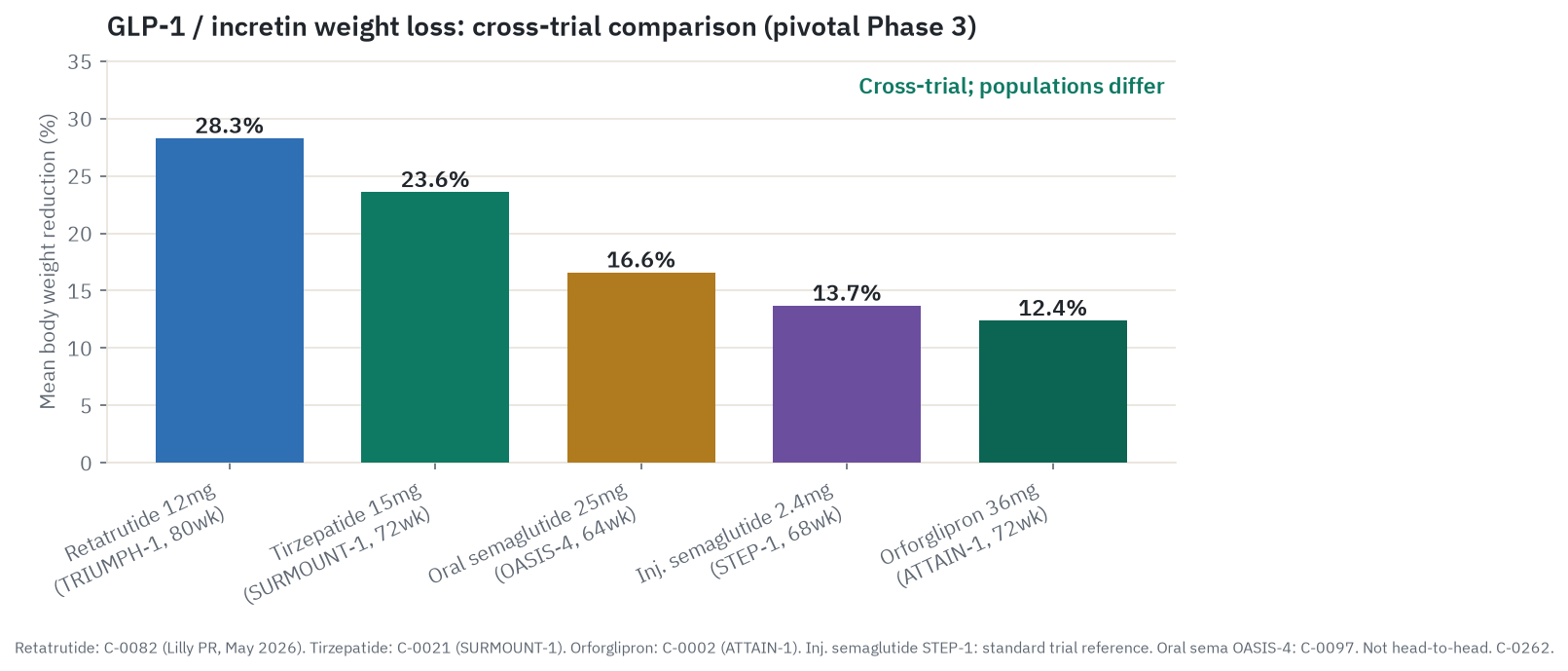
Start with the data, framed as trial results. In the Phase 3 ATTAIN-1 trial in obesity, the highest dose of orforglipron produced 12.4 percent mean weight loss (about 27.3 pounds) at 72 weeks, versus 0.9 percent on placebo. That is a real, statistically significant result. It is also well below injectable tirzepatide, which produced about 23.6 percent in its SURMOUNT-1 trial, and marginally below injectable semaglutide’s roughly 13.7 percent in STEP-1. The most apples-to-apples bar on the chart is the other oral pill: Novo’s oral Wegovy (oral semaglutide) reached about 16.6 percent in its OASIS-4 obesity trial, several points above orforglipron’s 12.4 percent. So the closest comparable, an oral against an oral, also out-loses Foundayo, which sharpens rather than softens the point that comes next: the pill’s edge was never going to be efficacy. These are cross-trial comparisons, not controlled head-to-head studies; the patient populations and trial designs differ, and the chart above is labeled accordingly. But the gap was large enough that when the topline came out in August 2025, Lilly stock fell about 14 percent in a single session, its worst day in years, because investors had whispered numbers closer to 15 percent.
So why does an oral pill that loses on weight loss matter? Because its value is not efficacy leadership, it is access. Orforglipron is a small molecule synthesized with conventional chemistry. It needs no cold chain, no sterile injectable fill-finish, and no injection device. It can be taken any time, with or without food, unlike Novo’s oral semaglutide which requires an empty stomach and a fasting window. And the early launch signal supports the market-expansion thesis: Lilly said on its Q1 2026 call that roughly 20,000 patients had started Foundayo and more than 80 percent were new to the GLP-1 class. If that holds, the pill is bringing in patients who would never have taken an injection, rather than cannibalizing Mounjaro and Zepbound.
The bear counter is equally real. Novo’s oral Wegovy reached the obesity market first (December 2025 versus April 2026), launched at the same $149-a-month self-pay starting price, and became the fastest GLP-1 launch on record with more than 2 million prescriptions in 14 weeks. After that, buy-side estimates for 2026 Foundayo sales were cut from around $4 billion to under $2 billion. Peak-sales estimates for orforglipron span from HSBC’s roughly $10 billion to Citi’s more than $40 billion, a four-times spread that is itself the tell: nobody really knows. The mid-range anchors that get cited most (UBS at about $15 billion, a Bloomberg buy-side survey near $18 billion by 2030) are reasonable base-case numbers, but they are estimates with a wide confidence interval. There is one genuine head-to-head data point in Lilly’s favor: in the ACHIEVE-3 diabetes trial, orforglipron beat oral semaglutide on both A1c and weight. A1c is the standard blood-sugar yardstick, a single blood test that reflects average glucose over the prior two to three months, so a bigger drop means tighter control. Orforglipron cut A1c by about 2.2 percentage points against semaglutide’s 1.4, and lost more weight too, though with numerically worse tolerability (about 9.7 percent stopped for side effects versus 4.9 percent). That trial is in diabetes, not obesity, which is why it does not overturn the weight-loss chart, but it is the one place an oral-versus-oral comparison was actually run rather than inferred across trials.
Retatrutide: the next-generation efficacy asset
Behind tirzepatide sits the drug that backfills the eventual patent cliff. Retatrutide is a triple agonist: where tirzepatide hits two receptors, retatrutide hits three (GIP, GLP-1, and glucagon), and adding the glucagon arm is what pushes its weight loss above the dual-agonist class. In the Phase 3 TRIUMPH-1 obesity trial, the 12-milligram dose produced 28.3 percent mean weight loss (about 70 pounds) over 80 weeks, with 45.3 percent of participants losing 30 percent or more of their body weight, which is in the range of bariatric surgery. That is the highest efficacy of any drug in the chart above. Lilly has guided a regulatory filing around Q4 2026 with approval projected for late 2027 and launch around early 2028.
The catch is tolerability. In TRIUMPH-1, discontinuation due to side effects at the top dose was 11.3 percent, higher than tirzepatide (6.1 percent), semaglutide (8.0 percent), and even orforglipron (10.3 percent), with a tingling/burning side effect in about 12.5 percent at the highest dose. Analysts read this as a segmentation play: retatrutide for higher-BMI patients who need maximum weight loss and can tolerate it, tirzepatide remaining the default. It does not simply replace Zepbound; it sits above it.
Label expansion: every new indication is a new demand lever
The under-appreciated part of the franchise is that tirzepatide keeps unlocking new, separately reimbursable populations. Obstructive sleep apnea was FDA-approved in December 2024 (the trial showed up to a 62.8 percent reduction in the apnea index, with about half of participants reaching disease resolution at 52 weeks). A heart-failure indication (HFpEF) was filed in November 2025 on Phase 3 data showing a 38 percent reduction in cardiovascular death or worsening heart-failure events. Liver disease (MASH) is in late-stage study. Each approval brings a new prescriber base (pulmonologists, cardiologists) and a new reason for a payer to cover the drug as medically necessary rather than as a lifestyle choice. This is how the bull case argues the franchise becomes a durable chronic-disease class rather than a single weight-loss molecule with a fuse.
Manufacturing capacity and supply
For two years, the binding constraint on this franchise was not demand, it was the ability to make the drug. That has flipped, and the way it flipped is central to the bull case.
Tirzepatide is a peptide, and peptide manufacturing is brutally capital-intensive. The process mass intensity (the kilograms of input material per kilogram of finished active ingredient) for peptide synthesis is roughly 13,000 to 1, something like 40 to 80 times less efficient than conventional small-molecule chemistry. You cannot simply repurpose existing pharmaceutical plants to make it; you need dedicated reactors. On top of that, injectables need sterile fill-finish into vials and pens, a separate, highly regulated step with three-to-five-year lead times for new capacity. When Novo Holdings bought the contract manufacturer Catalent in December 2024 and sold three of its fill-finish sites to Novo Nordisk for $11 billion, a key piece of open-market capacity vanished, and Lilly responded by bringing the work in-house.
The scale of that response is the headline number that gets quoted: more than $50 billion in cumulative US manufacturing investment since 2020. The cornerstone is Indiana, including a $9 billion active-ingredient site in Lebanon targeted to open in 2027 that Lilly calls the largest such facility in US history. There is a roughly $3.9 billion injectable fill-finish complex in Wisconsin (the Nexus plant Lilly bought for $925 million in April 2024, then expanded), facilities in North Carolina, and four new sites announced in 2025 in Virginia, Texas, Alabama, and Pennsylvania, operational around 2031 to 2032. As of mid-2026, the FDA had removed tirzepatide from its shortage list (in October 2024), and supply now tracks demand rather than gating it. Lilly’s CEO said the company produced more than 1.6 times the salable incretin doses in the first half of 2025 versus a year earlier.
The oral pill changes the supply economics again, and in Lilly’s favor. Orforglipron is a small molecule. No specialized peptide reactors, no sterile fill-finish, no device, no cold chain. Lilly built up about $1.5 billion in pre-launch inventory before approval, something you simply cannot do safely with a biologic, and analysts estimate the production cost is 30 to 50 percent below injectable tirzepatide. I flag that cost figure as an unverified analyst estimate; Lilly has never quantified it. But the structural logic is sound, and it means the most expensive constraint in the franchise gets cheaper as the mix shifts toward oral.
Two cautions belong here. First, capacity is a durable moat for injectables (years of build time competitors cannot shortcut) but a weaker one for small molecules, where contract manufacturers can pivot faster. Second, the build itself is a financial drag: capex has risen from about 5 percent of revenue before the boom to roughly 12 percent now, and as the new plants come online from 2027 the depreciation will weigh on gross margin even as revenue grows. Management has guided 2026 gross margin as “relatively stable to slightly down.”
The pipeline beyond GLP-1 and the patent timeline
The reason the 2036 patent date matters so much is that it is the terminal event for the current earnings structure, and what backfills it is still small.
Outside the incretins, the most established asset is Verzenio in oncology ($5.7 billion in 2025), but its own primary patent expires in September 2031, with a generic challenge already filed in March 2026. The newer oncology launches (Inluriyo, Jaypirca) and immunology launches (Ebglyss, Omvoh) are growing fast (the non-incretin growth products grew about 160 percent collectively in Q1 2026) but from a combined base near $549 million a quarter. Kisunla in Alzheimer’s is commercially viable and ramping but slow, with peak-sales estimates ranging anywhere from $500 million to about $7 billion depending on how fast neurologists adopt the testing and monitoring.
The patent map is the part to read carefully, with the standing caveat that patent litigation and biosimilar timing can move every one of these dates.
| Drug | Primary patent expiry | Generic/biosimilar entry estimate | Note |
|---|---|---|---|
| Trulicity (dulaglutide) | 2027 | 2027 and after | Already in steep decline from self-cannibalization |
| Taltz (ixekizumab) | 2027 to 2030 (sources conflict) | 2027 to 2030 and after | Biologics data protection to 2028 |
| Jardiance (empagliflozin) | core 2026 to 2027 | around 2034 (full portfolio) | Co-marketed with Boehringer |
| Verzenio (abemaciclib) | September 2031 | September 2031 | Generic challenge filed March 2026 |
| Mounjaro/Zepbound (tirzepatide) | around January 2036 (composition of matter) | around 2041 (estimate, full portfolio) | The franchise’s terminal date |
The tirzepatide composition-of-matter patent expiring around January 2036 is verified across multiple sources. The longer date, generic entry around 2041, depends on a thicket of follow-on formulation patents, and that is genuinely disputed. The advocacy group I-MAK published a report in April 2025 arguing Lilly’s secondary patents stretch effective protection to the end of 2041; law firms including those at IPWatchdog published rebuttals in October 2025 arguing the patent counts were inflated. The honest framing is the one I will use throughout: the molecule patent runs to about January 2036, and meaningful generic competition is unlikely before roughly 2038 to 2041 regardless of which side is right, but anyone modeling cash flows past 2036 is implicitly betting on the late date.
Who wins where
The obesity and incretin field sorts into clear tiers in mid-2026.
The leaders are two, and the gap between them is widening. Lilly leads on efficacy (tirzepatide’s roughly six-percentage-point weight-loss advantage over semaglutide has held in real-world data and in a direct head-to-head), on the oral pill, and on a visible next-generation asset in retatrutide. Novo Nordisk remains the volume leader in injectable obesity with the Wegovy brand and launched the first oral obesity pill, but it lost the head-to-head that defined the year: its combination drug CagriSema managed 20.2 percent weight loss against tirzepatide’s 23.6 percent in the REDEFINE 4 trial.
The fast followers are all behind, and all years away from market. Amgen’s MariTide offers monthly dosing (a real convenience edge) but Phase 2 efficacy of up to 20 percent trails tirzepatide and a tolerability signal already forced a Phase 3 dosing redesign; the key readout is around early 2027. Roche has two assets (CT-388 and the amylin drug petrelintide) heading into Phase 3 in 2026. Viking Therapeutics has an injectable and an oral candidate with Phase 3 data due starting Q3 2026. AstraZeneca and Structure Therapeutics each have oral small molecules moving to Phase 3 in 2026, with Structure’s posting the highest placebo-adjusted weight loss among oral candidates so far. Pfizer exited the oral race entirely in April 2025 after a safety signal.
The commodity and compounding fringe is winding down. The compounding pharmacies that sold copycat tirzepatide during the shortage had to stop by early 2025, and in April 2026 the FDA proposed permanently barring tirzepatide, semaglutide, and liraglutide from large-scale compounding. That removes a gray-market drag, though litigation continues and a 2036 patent cliff still opens the door to true biosimilars eventually.
The reasoning on who keeps the economics is straightforward: in a category where the leading drug is six points better on the headline outcome, has a pill for the needle-averse, has the manufacturing capacity built, and has the most efficacious successor in its own pipeline, the efficacy-plus-access combination is the moat. The risk to that logic is not that Lilly loses; it is that a monthly-dosing or oral competitor reaches good-enough efficacy and forces the whole field to compete on price before the patent even expires.
Company by company: who’s who
From the research file, point-in-time as of June 22, 2026. Each name carries a real bear line, not a token one.
Eli Lilly (LLY), about $983 billion market cap. The subject. Dominant GLP-1 franchise, oral pill now approved, broad pipeline. Q1 2026 revenue $19.8 billion, up 55 percent, with net income $7.4 billion at a 37.4 percent margin; raised full-year guidance to $82 to $85 billion. Bull: efficacy leader in the largest new drug market in a generation, now adding a patent-protected pill that opens global access and collapses manufacturing cost, with two franchise legs and room to expand into cardiovascular, liver, sleep, and oncology indications. Bear: roughly 65 percent revenue concentration in one molecule class with the patent cliff starting around 2036, mounting price pressure from the Inflation Reduction Act (the 2022 law, the IRA, that lets Medicare negotiate prices on selected high-spend drugs) and the most-favored-nation deal and payer pushback, and a $50 billion-plus capex supercycle that will keep free cash flow below net income.
Novo Nordisk (NVO), about $203 billion. The Danish co-inventor of the class (semaglutide, sold as Ozempic, Wegovy, and Rybelsus). Q1 2026 sales about $15 billion, up 32 percent, with the oral Wegovy pill debuting and injectable Wegovy up 12 percent, but diabetes GLP-1 declining 16 percent at constant currency. Bull: oral Wegovy is the fastest GLP-1 launch on record, the insulin franchise is defensive, and CagriSema could recover share. Bear: it lost the head-to-head (CagriSema at 20.2 percent versus tirzepatide at 23.6 percent in REDEFINE 4), guided 2026 operating profit to a decline of 5 to 13 percent, and faces semaglutide patent losses in several international markets. NVO is the cautionary comp here, not a recovery bet.
Amgen (AMGN), about $186 billion. Large-cap biotech entering obesity via MariTide, a monthly antibody-peptide conjugate in Phase 3. Q1 2026 revenue $8.6 billion, up 6 percent. Bull: monthly dosing could differentiate if Phase 3 tolerability holds, and Amgen has the manufacturing depth to scale a novel format. Bear: Phase 2 efficacy trails tirzepatide and required a dosing redesign; if the tolerability concern is structural, the obesity franchise is a distant third and legacy products are in secular decline. The bull is speculative until the early-2027 readout.
Johnson & Johnson (JNJ), about $557 billion. No direct GLP-1 exposure, included as a valuation comp. Diversified pharma and medtech, Q1 2026 revenue $24.1 billion. Bull: recession-resilient cash flows and a growing dividend at a far lower premium than single-molecule bets. Bear: Stelara biosimilar erosion is material and there is no near-term mega-blockbuster to replace it.
Merck (MRK), about $285 billion. A comp, and the most instructive one. Built on Keytruda, the world’s top-selling cancer drug, which is roughly half of revenue and faces biosimilar entry around 2028. Bull: Keytruda’s expansion into earlier-stage cancers and a subcutaneous version extends the runway. Bear: the post-Keytruda cliff is the biggest single risk in large-cap pharma, and the market does not pay Merck a premium for it. That last point matters for Lilly: the market does not reward concentration-plus-cliff with a high multiple, which is precisely Lilly’s structure with a longer fuse.
AbbVie (ABBV), about $406 billion. A comp. Rebuilt post-Humira on Skyrizi and Rinvoq, which together run near a $30 billion annualized pace. Bull: durable immunology franchises replacing Humira faster than feared. Bear: the peak-sales estimates are already in the multiple, so upside needs the early pipeline to deliver.
Viking Therapeutics (VKTX), about $3.8 billion. A clinical-stage small-cap with no marketed drug, all value in its VK2735 obesity candidate (injectable and oral), Phase 3 data due starting Q3 2026, about $603 million in cash. Bull: if Phase 3 confirms Phase 2 efficacy, VK2735 becomes a highly acquirable validated asset. Bear: Phase 2 efficacy is competitive but not differentiated from the established benchmarks, so without a surprise or a partner the stock trades entirely on takeover hope in a crowded space. High binary risk.
What the filings say
Now the numbers from the 10-K (filed February 12, 2026) and the Q1 2026 10-Q (filed April 30, 2026). All figures are GAAP unless noted, and every one comes from a filing.
Revenue and growth. Full-year 2025 revenue was $65.2 billion, up 44.7 percent, after $45.0 billion in 2024 and $34.1 billion in 2023. Q1 2026 revenue was $19.8 billion, up 55.5 percent year on year, an annualized run rate near $79 billion. The company raised 2026 guidance to $82 to $85 billion in revenue, with non-GAAP earnings per share of $35.50 to $37.00 (up about $2 from the initial guide) and a non-GAAP performance margin of 47.0 to 48.5 percent.
Product and geographic mix. Cardiometabolic health was 74 percent of 2025 revenue. By geography, the US was 66.7 percent of 2025 revenue ($43.5 billion), with Europe at $11.6 billion, Japan $2.1 billion, China $2.0 billion, and the rest of the world $6.1 billion. The notable shift is that ex-US revenue is now growing faster than US (Q1 2026 ex-US was up 81 percent versus US up 43 percent), but at lower net prices, mainly from China’s reimbursement-list inclusion.
Margins. Gross margin was 83.0 percent in 2025, up from 81.3 percent in 2024 and 79.2 percent in 2023, the structural property of a patent-protected blockbuster scaling against a partly fixed cost base. It dipped slightly to about 82 percent in Q1 2026 on lower realized prices. GAAP pre-tax operating margin expanded sharply, from 19.2 percent in 2023 to 28.2 percent in 2024 to 39.5 percent in 2025. Net income was $20.6 billion in 2025 (a 31.7 percent net margin), with diluted EPS of $22.95.
Cash flow and the capex drag. Operating cash flow was $16.8 billion in 2025, but capital expenditure was $7.8 billion (about 12 percent of revenue), so free cash flow was about $9.0 billion. That is the number to sit with: against $20.6 billion of net income, free cash flow was less than half, because the manufacturing build is absorbing roughly half of operating cash. Capex has more than doubled in two years, from $3.4 billion in 2023.
Balance sheet and capital returns. Total debt was $42.5 billion at the end of 2025 (net debt about $35.2 billion), and a roughly $8 billion debt issuance in May 2026 pushed gross debt above $45 billion, mostly to extend maturities. Leverage of about two times operating cash flow is manageable but rising with the build. On returns, Lilly paid $5.4 billion in dividends in 2025 (raised to a $6.92 annualized rate for 2026) and bought back $4.1 billion of stock, with $10.9 billion left on the authorization. Here is the tension the skeptic flags correctly: dividends plus buybacks of about $9.6 billion already exceeded the roughly $9.0 billion of free cash flow. A premium growth multiple on a company returning slightly more than it free-cash-generates is fragile to any demand or price shock.
The risk factors Lilly itself discloses. The 10-K is unusually candid. It states that Mounjaro and Zepbound were 56 percent of 2025 revenue and the top six products 82 percent, naming the concentration as a risk. It flags IRA price negotiation (Jardiance effective 2026, Trulicity and Verzenio effective 2028, more to come) and the voluntary most-favored-nation deal, warning in its own words that the company “may fail to adequately capitalize” on the expanded access “if the revenues generated from such expanded access are insufficient to offset pricing concessions.” It flags manufacturing execution risk and the threat of mass-compounded copies. These are the company’s own words, attributed, not my characterization.
Ownership signal. The most important ownership fact is the Lilly Endowment, the founding-family-linked nonprofit, which holds about 9.8 percent and does not sell. Vanguard (8.6 percent), BlackRock (6.8 percent), and PNC (5.4 percent) round out the large holders. Insiders collectively own less than 1 percent, so management’s alignment runs through compensation, not personal capital at risk. No insider selling pattern appeared in the filed materials.
What the market is paying
Point-in-time, as of June 22, 2026, and these figures move daily.
Price and performance. Lilly closed at $1,102.08, about 7 percent below the 52-week high of $1,182.73 set on June 8 (on strong retatrutide data) and well above the August 8, 2025 low of $623.78 (the orforglipron-miss day). Over one year the stock returned about 44 percent, crushing the S&P 500’s roughly 14 percent and the healthcare ETF’s about 16 percent. Over five years it returned about 377 percent. Year to date in 2026 it has lagged, up about 2.5 percent against a tech-led market, but on any longer window it is among the best large-cap returns anywhere.
Volatility, and why beta lies here. The five-year beta is 0.52, which makes Lilly look like a sleepy defensive pharma name. Do not believe it. The peak-to-trough swing inside the trailing 52 weeks was 47.3 percent. The dominant risk is not correlation with the market, it is binary events: trial readouts, FDA decisions, pricing policy. A stock can have a low beta to daily market moves and still fall 14 percent in a session when a Phase 3 number misses. Beta is the wrong risk descriptor for this name.
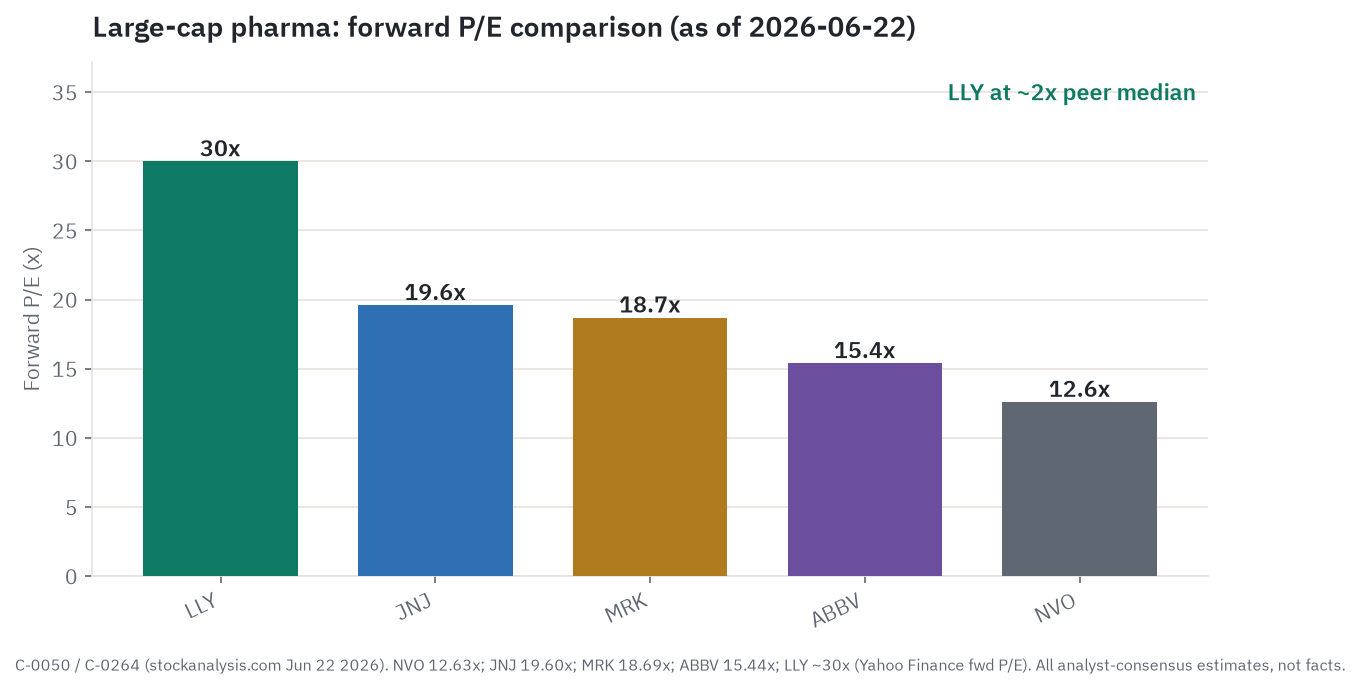
The valuation, both sides. Lilly is the most expensive name in its peer group on every static measure. Forward price-to-earnings is roughly 30 times (sources put it at 29.6 to 30.3 times), against Johnson & Johnson near 20, Merck near 19, AbbVie near 15, and Novo near 13. EV/EBITDA is about 28 times, against a drug-manufacturer sector median around 13 to 15. Price-to-sales is 13.6 times trailing. On these numbers Lilly trades at roughly two to three times the peer group. That is unambiguously rich.
The other side is the growth. No other name in that peer group grows revenue at 40 to 60 percent. The PEG ratio (price-to-earnings against growth) is about 1.3 to 1.4 times, below Lilly’s own roughly two-times historical median, and the trailing P/E has actually fallen from a peak near 135 times in 2023 to about 39 times today, because earnings grew faster than the share price. A 30-times multiple on a business compounding earnings at 25 to 40 percent is not obviously stretched; the same multiple on a business growing at 5 to 8 percent would be absurd. So the premium is a growth premium, backed by the pipeline, the capacity, and the oral optionality.
The vulnerability is the price-to-sales line. Revenue multiples are the most exposed to pricing pressure, because if net realized price compresses (from the IRA, from rebates, from competition), the revenue base itself deflates even if unit volumes hold. At 13.6 times sales there is very little cushion for any revenue-level disappointment, as opposed to a volume disappointment. That is the number I would watch hardest.
Positioning and the Street. Lilly is among the most liquid stocks in the market, about $3.3 billion of average daily dollar volume. Short interest is about 1 percent of float and rising modestly, which reads as hedging into catalysts rather than a fundamental bear thesis; there is no squeeze setup. The sell-side consensus is a Moderate Buy from roughly 30 analysts, with a mean target around $1,220 (the cluster runs $1,216 to $1,231), a high of $1,400, and a low of $850. The mean implies only about 10 to 12 percent upside over a year, which tells you consensus has kept pace with the price rather than leading it. Treat all of that as opinion, not fact.
What the crowd is saying
Sentiment is signal, not fact, and the softest signal in this report. With that caveat, the read is useful precisely because of how aligned it is.
The dominant narrative in mid-2026 is “Lilly is winning the GLP-1 war.” The year’s news arc was U-shaped: the brutal August 2025 orforglipron-miss day, then a steady climb back on execution. Novo guided to its first profit decline in years and lost the CagriSema head-to-head; Lilly beat and raised guidance for six straight quarters; the retatrutide data in June 2026 reset expectations upward and set the 52-week high. On StockTwits, sentiment moved from bearish a year ago to “extremely bullish,” with message volume reportedly up around 250 percent over the year (a platform-published figure that cannot be independently audited). Search data shows Zepbound and Mounjaro overtaking Wegovy in US search since early 2025. There is no evidence of coordinated promotion or thin-float games; this is a $983 billion large-cap, and the chatter reads like long-term holders, not meme traders.
The useful part is where the crowd and the filings diverge, and there are three live tensions. First, valuation: the crowd reads the compressing P/E as “now it’s cheap relative to growth,” while a minority of the Street (one bearish fair value near $900, a handful of bearish options positions) reads $983 billion at high-30s-to-40s earnings as priced for near-perfect execution. Both are partly right. Second, the Foundayo launch: the crowd treated the pill as an instant blockbuster, but the early script count lagged Novo’s oral Wegovy, and a full quarter of launch data has not resolved it. Third, and most important, the secular-megatrend framing assumes a large, adherent, growing patient base, while the real-world discontinuation rates of 40 to 65 percent within a year say persistence is the soft spot. A January 2026 adherence study and a September 2025 FDA warning letter (about marketing materials understating side effects) are early signs the patient-experience reality is messier than “obesity is solved.”
The honest note to end on: when narrative and fundamentals are this perfectly aligned, the risk is not in the known risks. It is in the ones not yet visible, an undisclosed safety signal, a policy change that moves faster than modeled, a second-generation trial that fails. The crowd is not pricing those, and at this multiple the stock has limited cushion if one shows up.
Macro and policy: pricing, the IRA, the MFN deal, and tariffs
This is the most consequential outside force on Lilly, and the one most likely to decide whether the five-year path lands closer to the bull or the bear case. The underlying demand is about as recession-resistant as anything in the economy; nobody defers diabetes medication because GDP shrinks. The vulnerability is not patient willingness, it is what governments and payers will pay per unit.
The Inflation Reduction Act (IRA). Under the 2022 law, Medicare drug-price negotiation is live. Jardiance was negotiated to $197 a month effective January 2026. Trulicity and Verzenio were selected for prices effective January 2028; the analyst read (Leerink) is that the combined 2028 impact is 3 percent or less of total revenue, because Trulicity is already declining anyway. Crucially, tirzepatide itself is not eligible for formal negotiation until around 2031 under the small-molecule rules, which is a real buffer.
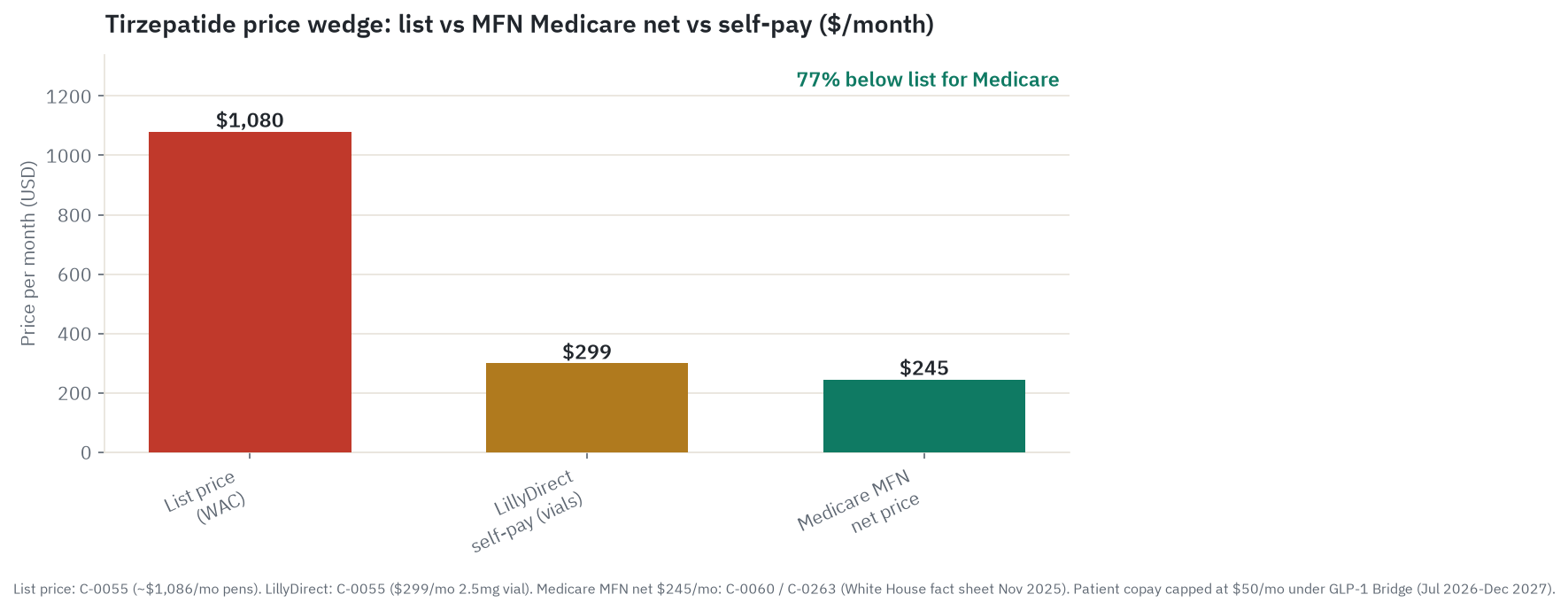
The most-favored-nation deal. Most-favored-nation, or MFN, pricing means the US price gets pegged to the lowest price Lilly charges in a basket of comparable wealthy countries, so the US can no longer pay several times what Germany or Japan pays for the same drug. This is the swing factor. In November 2025 Lilly agreed with the Trump administration to price Mounjaro and Zepbound at a $245-a-month net across Medicare and Medicaid, down from a list price of about $1,080, a roughly 77 percent cut from list. (Note the number: the verified figure is $245, not the truncated “$45” that appears in some raw data.) The chart above shows the wedge. But here is the honest part the gates require me to state plainly: the net-of-rebates revenue impact of this deal is unquantified by any primary or analyst source, because Medicare patients were already getting substantial rebates before the deal. Two effects run at once. The price-compression effect cuts per-unit revenue. The volume-expansion effect comes from the Medicare GLP-1 Bridge program, starting July 1, 2026 and running through December 2027, which covers Mounjaro, Zepbound, and Foundayo at a $50 patient copay for a previously excluded population of 50-million-plus Medicare beneficiaries. Whether the new volume offsets the price concession is the single biggest open question in the model, and it is a sensitivity, not a fact.
The policy fragility underneath it. Federal statute still bars Medicare Part D from covering drugs “primarily for weight loss.” The GLP-1 Bridge is a demonstration program, not a permanent law, and it expires in December 2027. A broader Medicare model (called BALANCE) was effectively shelved in April 2026 after it failed to get 80 percent insurer sign-up, with CVS declining to participate. The permanent legislative fix (the TREAT Act) has not passed. So the Medicare obesity coverage that the bull case leans on rests on a workaround with an expiry date, and a change of administration, a court challenge, or a failure to renew could unwind it without Congress lifting a finger.
Tariffs. A Section 232 executive order in April 2026 imposed up to 100 percent tariffs on patented pharmaceutical imports. This was a genuine binary risk, because Lilly’s main tirzepatide active-ingredient site is in Ireland. The MFN deal plus the $50 billion-plus US manufacturing commitment qualified Lilly for a 0 percent rate, avoiding what would have been a serious cost headwind on a $36 billion product. That exemption runs to January 2029, which makes finishing the US manufacturing build both an operational priority and a political hedge.
Currency. About a third of revenue is now outside the US and growing, so a stronger dollar is a headwind. The 2026 guidance embeds specific euro, yen, and yuan assumptions; material dollar strength would force a downward revision. China’s reimbursement-list pricing is the most visible example of the trade-off: huge volume, sharply lower net price.
Durability and the bear case
Pull the threads together. The structural bull case is real and I am not dismissing it. Obesity and diabetes are a genuine megatrend, not a cycle; the disease burden does not remit in a recession. Lilly has the efficacy lead, holds it in head-to-head data, has the oral pill that expands access, has built the manufacturing capacity competitors cannot replicate quickly, and has the most efficacious successor drug in its own pipeline. Each new indication (sleep apnea, heart failure, liver disease) is a fresh reimbursed population. If obesity proves to be a durable, multi-indication, multi-decade chronic-disease market and Lilly keeps the crown through retatrutide, the franchise is a class, not a molecule, and today’s price is reasonable.
Now the bear case, and I mean it. The most likely way this goes wrong is not a blow-up, it is a grind. Tirzepatide volume keeps growing but net price keeps falling, as the MFN $245 Medicare price ramps, China’s list pricing bites, the PBMs extract richer rebates, and the IRA reaches tirzepatide around 2031. Revenue growth decelerates from around 50 percent toward 15 to 20 percent faster than consensus expects. The oral pill lands mid-range, around $12 to $15 billion rather than the bull’s $30 billion-plus, because oral Wegovy launched first and a wave of 2027 to 2028 oral entrants competes it down, and because real-world discontinuation caps repeat scripts. The capex supercycle keeps free cash flow below net income and below capital returns. None of that is a disaster. It is simply good, not perfect. But at 30 times forward earnings and 13.6 times sales, good-not-perfect is a 30 to 40 percent de-rating, and the trigger is most likely a pricing print or a guidance trim, not a trial failure. The August 2025 single-day drop is the template for how fast the multiple moves.
The most likely outcome is a split, and it has a shape and a timeline. Through 2026 and 2027, current velocity probably persists: the company hits the guide, the Bridge adds Medicare volume, ex-US penetration continues, and volume more than offsets the price headwind. Then 2028 to 2030 is where the repricing cycle bites: CagriSema and possibly MariTide reach the market, share recedes from about 60 percent toward 45 to 50 percent, the gross-to-net gap widens, the December 2027 Bridge expiry forces a renegotiation, and growth steps down to the 15 to 25 percent range. The difference between the bull and bear over five years is not whether people want these drugs. They will. It is what the government and payers pay per unit, and whether Lilly keeps enough differentiation to hold formulary share at a premium price.
The scenarios in detail
The lede chart is the summary; this is the math behind it. The same dollar levels apply.
The driver tree
Four variables decide the five-year outcome, and every scenario is just a different setting of these four.
- Incretin net revenue, which is volume growth minus net-price erosion. This is the entire engine. Volume is still compounding fast (US GLP-1 volume up 49 percent in Q1 2026), but net price is falling every quarter, and the rebate liability on the balance sheet grew 51 percent in 2025, faster than the 44.7 percent revenue growth. The forward question is when volume growth decelerates toward the rate of net-price decline. While it stays well ahead, revenue and gross profit compound; when they converge, growth rolls over fast given a 13.6-times sales multiple.
- The second franchise leg: the oral pill plus retatrutide. The pill’s value is market expansion (small-molecule cost, no cold chain, 80-percent-plus new-to-class at launch), not efficacy leadership. Retatrutide is the next-generation efficacy asset that backfills the cliff. Whether these become a real second leg or get out-competed is the swing factor for years three to five.
- The net-price and policy regime. The MFN deal, the Medicare Bridge (expiring December 2027), the IRA reaching tirzepatide around 2031, and demonstrated PBM power. The dollar impact of MFN is unquantified, which makes it the single largest sensitivity in the whole model.
- The multiple, and the cliff that sets its terminal value. At 30 times forward and 13.6 times sales the stock prices durable premium growth. The terminal anchor is the roughly January 2036 patent. Capital intensity matters here too: capex at 12 percent of revenue keeps free cash flow well below net income.
Bull: the franchise becomes a durable class
Volume keeps outrunning net-price erosion, retatrutide launches around 2028 as the new efficacy leader, the oral pill expands rather than cannibalizes the market, label expansion converts weight-loss users into retained chronic-disease patients, and the Bridge volume more than offsets the $245 net price. Earnings climb from roughly $36 in 2026 toward the high-$90s per share by 2031; revenue passes $100 billion comfortably. The multiple stays premium on that higher path. Illustrative levels, labeled estimates and not price targets: about $1,500 at one year, about $2,150 at three years, about $2,800 at five years (roughly 30 times a high-$90s earnings number). What has to be true: obesity is a structural, multi-decade, multi-indication market and Lilly keeps the crown. What most likely breaks it: an oral or monthly competitor that matches injectable efficacy and erodes share and pricing before the cliff.
Base: good, not perfect
Volume growth decelerates gradually as coverage saturates and net price keeps falling 5 to 8 percent a year, so revenue growth steps down from about 50 percent toward the mid-teens by the end of the decade. The oral pill lands solid but not spectacular, around $12 to $18 billion in the early 2030s. Retatrutide launches and ramps respectably. Share drifts from about 60 percent toward the low-50s as the field broadens but the efficacy lead holds. The multiple compresses from 30 times toward 22 times as the 2036 cliff approaches. Earnings go from about $36 in 2026 to roughly $75 by 2031; revenue reaches the $100 to $120 billion zone. Illustrative levels: about $1,155 at six months, about $1,235 at one year (28 times a roughly $44 earnings number, inside the sell-side cluster by construction), about $1,500 at three years, about $1,655 at five years. What has to be true: absolute net revenue keeps compounding despite the per-unit cut, and the pipeline seeds the cliff. What most likely breaks it: net-price erosion accelerating so growth converges toward the price decline a year or two early.
Bear: the slow grind
This is the skeptic’s strongest case, and it is not a blow-up. Volume keeps growing but net price keeps falling faster than consensus models, so revenue growth decelerates from about 50 percent toward 15 to 20 percent. The oral pill lands at $12 to $15 billion, not $30 billion-plus, as competitors and real-world discontinuation cap it. Capex keeps free cash flow below net income and below capital returns. At 30 times forward and 13.6 times sales, “good not perfect” is a 30 to 40 percent de-rating, and the concentration plus the cliff remove any margin of safety. Earnings stall, going from about $36 toward roughly $41 by 2031, and the multiple does the damage. Illustrative levels: about $890 at six months, about $745 at one year (19 times stalled earnings, near the $850 analyst low), about $665 at three years, about $570 at five years (14 times). What has to be true: obesity proves a price-competed, high-churn category that commoditizes faster than the patent runway. What flips it bullish again: net price stabilizing while volume re-accelerates revenue, plus pipeline and indication breadth that prove the franchise is a durable class.
Catalyst timeline
- Q2 2026 earnings, August 6, 2026: the net-price trend, the Foundayo launch curve versus oral Wegovy, and guidance.
- Medicare GLP-1 Bridge starts July 1, 2026: the first read on Medicare obesity volume against the $245 net price.
- CVS Caremark reinstates Zepbound, October 1, 2026: at richer rebates; watch the gross-to-net.
- Retatrutide regulatory filing, around Q4 2026: the pipeline re-rating catalyst.
- 2027: Amgen MariTide readout (around early 2027); Roche and Viking Phase 3 data; the retatrutide launch runway toward 2028.
- December 2027: the Medicare Bridge expires, a coverage cliff to watch.
- Around 2031: tirzepatide becomes eligible for IRA negotiation.
- Around January 2036: the tirzepatide composition-of-matter patent expires (generic launch around 2041 is an estimate, and litigation can move both dates).
Leading indicators to watch
These tell a holder, in real time, which scenario is winning: net realized price per script and the gross-to-net trend (the rebate liability versus revenue growth); US volume growth versus the net-price decline; Foundayo script share and new-to-class mix versus oral Wegovy; Lilly’s combined US GLP-1 share versus Novo; the competitor Phase 3 readouts (retatrutide, MariTide, the orals); and free cash flow closing the gap to net income.
Companies to watch (bull / base / bear)
Eli Lilly (LLY). The subject; the efficacy leader at a premium price. Bull: the franchise becomes a durable, multi-indication class and the pipeline backfills the cliff. Base: steady compounding into consensus with the multiple fading toward 2036. Bear: the slow grind, net price eroding faster than volume can cover, a 30-to-40-percent de-rating. Watch: the net-price line every quarter, the Foundayo launch curve, the retatrutide filing.
Novo Nordisk (NVO). The number-two and the cautionary comp. Bull: oral Wegovy momentum and a CagriSema recovery. Base: a slow-growth year while it absorbs the head-to-head loss and pricing pressure. Bear: the 2026 operating-profit decline deepens as semaglutide loses exclusivity in international markets. Watch: whether oral Wegovy’s launch pace is durable past the novelty.
Amgen (AMGN). The monthly-dosing hope. Bull: MariTide Phase 3 confirms tolerable monthly dosing. Base: a credible but third-place obesity entrant by 2028. Bear: the tolerability signal is structural and the program disappoints. Watch: the MARITIME-1 readout around early 2027.
Roche (RHHBY). The well-funded fast follower. Bull: CT-388 and petrelintide deliver and a combination works. Base: a 2028-plus entrant in a crowded field. Bear: the data lands mid-pack and the assets arrive late. Watch: the Phase 3 starts and the combination data in 2026.
Viking Therapeutics (VKTX). The takeover candidate. Bull: Phase 3 confirms the efficacy and a large pharma buys it. Base: a validated asset trading on M&A optionality. Bear: the data is undifferentiated and no buyer appears. Watch: the VANQUISH Phase 3 readouts starting Q3 2026.
Risk controls
The honest risk paragraph. The franchise concentration is the master risk: roughly 65 percent of recent revenue in one molecule class means a single safety signal, competitive loss, or access restriction on tirzepatide would be existential to the current earnings path, and the company itself says so. The patent cliff around January 2036 is the terminal date, with the post-cliff timeline genuinely disputed. Pricing and policy are evolving and unsettled: the MFN net-revenue impact is unquantified, the Medicare Bridge expires December 2027, and PBM power is demonstrated, not hypothetical. Trial and safety risk is binary and can move the stock double digits in a day; beta badly understates it. Valuation risk is real after a 377-percent five-year run: at 13.6 times sales there is little cushion for a revenue-level disappointment, as opposed to a volume one. Currency is a growing headwind as ex-US revenue rises. The thing that would change the constructive read is the net-price line stabilizing while volume keeps re-accelerating revenue, and the pipeline proving the franchise is a class; the thing that would turn it negative is a pricing print or a trial miss that forces the multiple to do the work on the way down.
Methodology, sourcing, and data-quality flags
This piece is built from parallel research streams: the value-chain map, the SEC filings (10-K, 10-Q, 8-K, proxy), the market action and valuation, the OSINT and social-sentiment read, the macro and policy backdrop, the GLP-1 franchise and oral-pill clusters, the pipeline and patent work, the manufacturing and competition clusters, and a forward five-year outlook. Every load-bearing number is recorded to a claims ledger with a source and a tier. The source hierarchy is, in order: primary filings and the FDA and trial publications first; named analyst houses and IQVIA next; reputable trade press after that; and clearly labeled estimates last. A pharmaceutical company carries an extra compliance posture: every efficacy and safety figure here is a named-trial result, attributed, not a treatment claim, and cross-trial comparisons are flagged as such (the one true head-to-head between CagriSema and tirzepatide, REDEFINE 4, is labeled a head-to-head; the orforglipron-versus-injectables comparison is labeled cross-trial).
The five-factor read, in plain prose, is where the Hold conclusion comes from.
Valuation nets to mildly dear. Lilly is rich on every static measure: roughly 30 times forward earnings, about 28 times EV/EBITDA, 13.6 times sales, two to three times the pharma peer group. The offset is a PEG around 1.3 to 1.4 times, below its own roughly two-times median, and a trailing P/E that fell from about 135 times in 2023 to about 39 times as earnings outran the price. A 30-times multiple on 25-to-40-percent earnings growth is defensible; the same multiple if growth decelerates to 10 to 15 percent is not. The net is a growth premium with little margin of safety, slightly negative.
Growth is exceptional and the standout in the peer group. Revenue up 44.7 percent in 2025 and 55.5 percent in Q1 2026, guidance raised to $82 to $85 billion with non-GAAP EPS of $35.50 to $37.00, against a structurally growing TAM (Morgan Stanley’s roughly $190 billion by 2035, with Goldman’s downward US revision noted, both attributed estimates). No large-cap pharma peer grows like this. Strongly positive.
Quality is best-in-class but not pristine. An 83 percent gross margin, a roughly 46-to-48 percent non-GAAP performance margin, a 31.7 percent GAAP net margin, and $16.8 billion of operating cash flow are excellent. They are tempered by a leveraged and rising balance sheet (net debt around $35 to $40 billion) and free cash flow (about $9.0 billion) running below capital returns (about $9.6 billion). Net positive.
Risk is where the premium gets paid back. Roughly 65 percent of recent revenue in one molecule class, a 2036 composition-of-matter cliff, net price falling 7 to 13 percent a quarter, demonstrated PBM power, evolving policy whose dollar impact is unquantified, and binary catalyst risk that a low beta hides. Net negative.
Momentum is mixed and soft, and carries low weight. The price is above all major moving averages and up about 44 percent on the year, but it is about 7 percent off the June high, with only 10 to 12 percent implied upside to the consensus target, short interest rising, and a neutral RSI. Roughly neutral.
Put together, the picture is a high-quality, exceptional-growth franchise carrying a real premium and real concentration and policy risk. On balance the read lands at Hold: a slight constructive tilt at the upper end of neutral, not a conviction call. It would move up if net price stabilizes or the pipeline re-rates, and down if a pricing print or trial miss forces a de-rating. This is a labeled research signal, not personalized investment advice and not a recommendation, and not medical advice; see the disclaimers.
Data-quality flags:
- Point-in-time prices. Price ($1,102.08), market cap (about $983 billion), multiples, moving averages, short interest, and the consensus target (about $1,220, cluster $1,216 to $1,231) are all as of June 22, 2026 and move daily.
- Forward figures are forecasts, not facts. Every horizon dollar level, the peak-sales estimates, the TAM figures, and the multi-year earnings paths are illustrative estimates, never price targets.
- TAM ranges bounce by house. Goldman cut its US 2030 peak from about $95 billion to about $70 billion; Morgan Stanley models about $190 billion globally by 2035. The spread is the honest signal; both are paired with the real-world discontinuation data (40 to 65 percent within a year).
- Net realized price is undisclosed. Lilly reports the change in net price, never the absolute gross-to-net. The MFN $245 Medicare net price is verified (White House fact sheet, November 2025), but its net-revenue impact on Lilly is unquantified by any source and is treated as a sensitivity, not a fact.
- Patent dates carry a litigation hedge. The tirzepatide composition-of-matter patent (around January 2036) is verified; the post-cliff generic timeline (around 2041) is an estimate and is disputed (the I-MAK report versus its rebuttals). Litigation and biosimilar timing can move these dates.
- Cross-trial efficacy comparisons are not head-to-head. The weight-loss chart compares results from different trials with different populations and is labeled as such.
- Sentiment is soft. The social-media figures are platform-published and not independently auditable; the early Foundayo launch metrics come from Lilly’s own call and are framed accordingly.
- Some peer one-year returns are estimated. Only Novo’s and Lilly’s one-year returns are precisely sourced; the others are approximations.
Key sources: Lilly FY2025 10-K and Q1 2026 10-Q and 8-K earnings releases and 2026 proxy; FDA approval documents and the NEJM and Lancet trial publications for ATTAIN-1, ATTAIN-2, ACHIEVE-3, ACHIEVE-4, TRIUMPH-1, SURMOUNT-1, and REDEFINE 4; the White House most-favored-nation fact sheet (November 2025) and CMS materials on the GLP-1 Bridge and BALANCE model; Section 232 executive-order documents; Morgan Stanley and Goldman Sachs GLP-1 market analyses; IQVIA prescription-share data; Novo Nordisk, Amgen, Roche, AstraZeneca, Structure, and Viking investor materials; and stockanalysis.com, Yahoo Finance, Barchart, and MarketBeat for point-in-time market data.
Prepared June 22, 2026. Figures are point-in-time and will change. This is research and analysis for educational purposes, not investment advice, not a recommendation, and not a solicitation, and nothing here is medical advice or a treatment recommendation; every clinical figure is a named-trial result, not a claim about any individual. Pharma is a sector where trials fail, a single concentrated franchise can carry most of the earnings, and pricing policy can move the numbers in one news cycle. Verify all figures independently, consult a licensed financial advisor before making any decision, and consult a qualified clinician for any health decision.