
Research date: June 29, 2026 | OSINT research on Mastercard Inc. (NYSE: MA), how a four-party card network earns a toll on $10.6 trillion of spending without ever taking credit risk, the second engine it has built in value-added services, the four regulatory fronts and the on-chain-settlement question hanging over its richest fee lane, and the payments peers it is measured against. Live prices, stamped hard.
Important disclaimer. This is OSINT (open-source intelligence) research published for educational and informational purposes only. It is not investment advice, not a recommendation to buy, sell, or hold any security, and not a solicitation. I am not a financial advisor. Mastercard is a toll-taker on global card volume, so its results bend with the consumer and cross-border travel cycle, while its valuation is acutely sensitive to four converging regulatory fronts and to a live question about whether on-chain settlement compresses its highest-margin lane. All figures are point-in-time as of the stated research date (June 29, 2026) and move fast: prices, market caps, share counts, and valuation multiples will be stale by the time you read this. Any bull, base, or bear scenarios are illustrative arithmetic on stated assumptions, not price targets. Do your own due diligence and consult a licensed financial advisor before making any decision.
Where this stock could be in 6 months, 1 year, 3 years, and 5 years
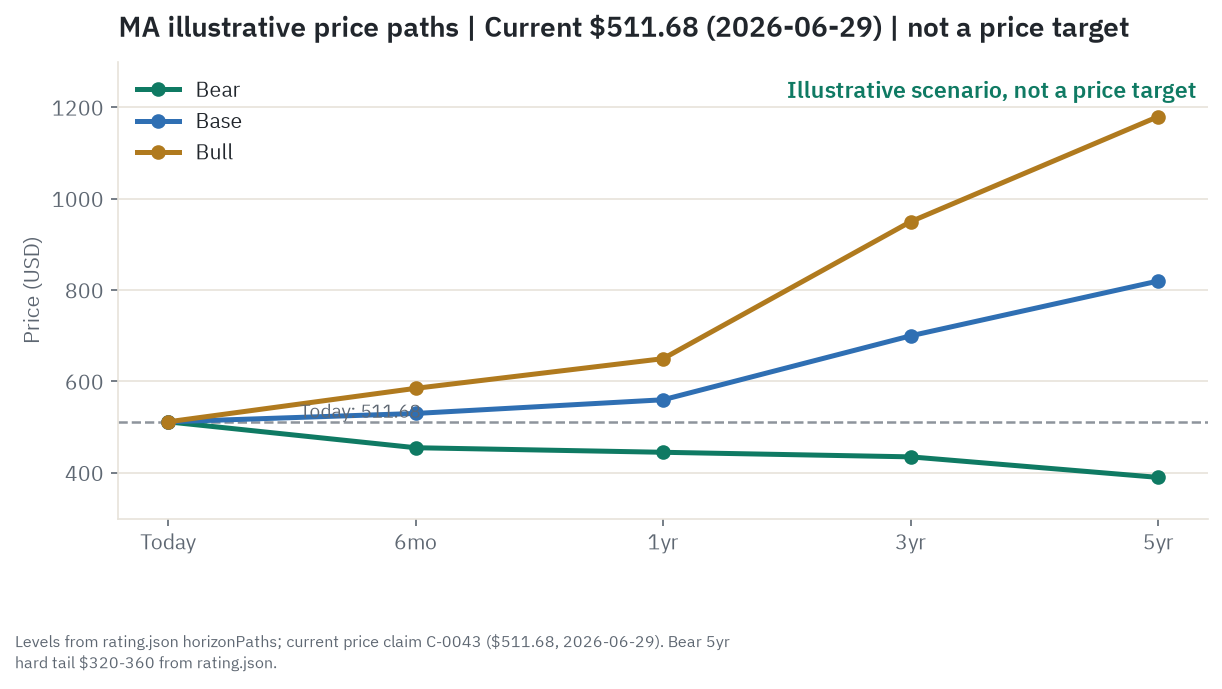
Mastercard traded around $512 on June 29, 2026, a market cap near $452 billion as of that research-date snapshot (the live header quote above carries the current figure). On its FY2025 adjusted earnings of $17.01 a share that is about 29.6 times trailing and roughly 25 to 26 times forward, which puts the stock close to a quarter below its own ten-year median multiple of about 37.6 times. That gap is the whole debate. Everything below is the case for whether a best-in-class toll-road is on sale, or whether the old multiple was a zero-rate artifact you should not expect back. Every dollar level here is an estimate built on stated assumptions, not a price target.
Six months. This window is the cycle and the headlines, not the structure. The next datable event is Q2 2026 earnings on July 30, where the read on cross-border travel matters more than the EPS print after travel growth fell from 8 percent in Q1 to roughly 2 percent in April on Middle East disruption. The base case is a modest drift up to about $530 as guidance holds and the interchange settlement grinds toward final approval. The bull case is about $585 if travel re-accelerates and the multiple firms on a clean beat. The bear case is about $455 if a single adverse headline lands, whether a soft cross-border quarter, a routing-bill attachment attempt, or a wobble in settlement approval. The single thing most likely to flip the read is whether the stock can finally rally on a beat: in Q1 it beat and fell, which is the tell that the market is repricing terminal value, not the quarter.
One year. Now it is about delivering the roughly $19.66 FY2026 consensus EPS bar and proving that low-double-digit revenue growth is durable. The base case is about $560, with the multiple flat and the earnings carrying the stock. The bull case is about $650, which is where the sell-side mean target sits, and it needs the regulatory clouds to thin while growth holds. The bear case is about $445 if cross-border yield visibly stalls or the Credit Card Competition Act finds a legislative vehicle. What flips it is the cross-border yield trend, meaning volume growth minus revenue growth, and whether the settlement clears cleanly or reverts toward trial.
Three years. The structural dials start to show here. By this point the four regulatory verdicts should largely be known, and three years of cross-border data will reveal whether on-chain settlement is quietly de-coupling volume from yield. The base case is about $700 as low-teens earnings compound at a held multiple. The bull case is about $950 if the disintermediation fear proves overblown and Mastercard’s stablecoin rail actually earns a fee. The bear case is about $435, flat-to-down dead money against a compounding index, if growth decelerates to high-single-digits and the multiple settles near 20 times. What flips it is the blended take rate, 30.9 basis points and rising today: if it stalls then falls, the two-engine thesis is broken.
Five years. This is pure durability territory. Is the roughly 150-basis-point cross-border take rate still intact, has value-added services scaled toward half of revenue, and what terminal multiple does the market assign a mature payments network. The base case is about $820, roughly 60 percent above today, on about $33 of earnings at near today’s forward multiple, with no re-rating back to the bubble-era median. The bull case is about $1,180 if Mastercard genuinely becomes the on-chain toll-road and the multiple reverts partway toward history. The bear case is about $390, with a hard tail to $320-$360, if stablecoin cross-border erosion, the routing act, and the EU and UK caps compress both growth and the multiple at once. This is the widest and most honest gap in the analysis, roughly three-to-one bull-to-bear, and it turns almost entirely on the cross-border lane.
Where the read lands today. On balance the read lands at Buy, Undervalued. This is a best-in-class toll-road with about 59 percent operating margins and a value-added-services engine growing twice as fast as the core network, trading about a quarter below its own ten-year multiple, where the market is paying you to take genuine but probably survivable regulatory and disintermediation risk. The single thing most likely to move that read is the cross-border yield trend: hold it and the quality discount closes, watch volume keep growing while revenue per unit of cross-border spend quietly compresses and the bear case is the right one.
Companion tool
Jump to the interactive dashboard to sort and filter every company in this piece, or download the Excel model to flex the scenarios yourself.
TL;DR
Mastercard is not a bank and it does not lend. It runs the switch between the world’s issuing banks and acquiring banks, and earns a toll on every transaction that crosses it, with zero credit risk on its own books. In FY2025 that toll ran across $10.6 trillion of gross dollar volume and produced $32.791 billion of net revenue, split between the payment network at $19.476 billion (about 59 percent, growing 12 percent) and value-added services at $13.315 billion (about 41 percent, growing 23 percent reported). The franchise is exceptional: a 57.6 percent GAAP operating margin, $17.159 billion of free cash flow on that revenue, returns on capital well north of 100 percent, and a share count that fell about 10 percent over five years on roughly $14.5 billion of buybacks and dividends in FY2025 alone. The blended take rate has climbed from 27.8 to 30.9 basis points as the faster-growing services mix lifts the yield, even though the pure network rate is roughly flat. The reason it is on sale, near 25 to 26 times forward against a ten-year median around 37.6 times, is a real one: a four-front regulatory cycle (the MDL 1720 interchange settlement, the Credit Card Competition Act, a UK cross-border cap, and an EU scheme-fee probe) all converge in the 2026 to 2028 window, and the richest lane Mastercard owns, cross-border, is exactly the lane that near-zero-cost stablecoin settlement could compress. The single biggest risk is not next quarter’s volume; it is that the market reprices the terminal take rate long before any volume moves. The honest read is Buy, Undervalued: you are paid a discount to history to take risk that is elevated but structural and survivable, with the upside capped until the regulatory fog lifts.
Explore it yourself: the interactive dashboard
Open the dashboard in a full screen
What Mastercard actually is: a toll-road that never holds the money
Picture a tollgate on a bridge that everyone has to cross, except the operator never owns a car, never lends anyone the money to buy one, and never eats the loss when a driver crashes. That is Mastercard. It is one half of a global card duopoly with Visa, and it does one thing supremely well: it switches a payment from a merchant’s bank to a cardholder’s bank, enforces the rulebook, and takes a small fee for the passage. This is what the industry calls the four-party model: four distinct players (the cardholder, the issuing bank, the merchant, and the acquiring bank), with Mastercard’s network connecting the separate issuer and acquirer banks as the toll-taker in the middle that bears none of the credit risk.
The structural fact that trips up most first looks at this business is where the big fee goes. On a $100 US consumer credit card purchase, the merchant pays a total merchant-discount rate of roughly $2.00 to $2.25. The largest slice of that, about $1.75, is interchange, and it flows from the merchant’s acquirer to the cardholder’s issuing bank. The issuer keeps it as payment for bearing the credit risk, funding the credit line, and covering fraud losses. That interchange does not touch Mastercard’s revenue line. Mastercard’s own cut, the assessment and processing fee it actually charges, is about $0.13 to $0.15 on that same $100. The remaining roughly $0.20 to $0.22 stays with the acquirer and its processor as the spread for handling the merchant’s side, so the $2.10 splits roughly $1.75 to the issuing bank, about $0.20 to the acquirer, and about $0.14 to Mastercard. When merchants and politicians rage about card fees, they are mostly arguing about interchange, which goes to banks. Mastercard collects its dime and a half, carries no loan, and walks away.
That is why the margins look the way they do. With no cost of goods and near-zero marginal cost to switch one more transaction, almost every incremental revenue dollar reaches operating income. The network is a five-decade-old, two-sided monopoly that no private company has replicated in any major economy; the only proven way to build a competing domestic network at scale has been a government mandate, as China did with UnionPay. The economics sit at the network layer and nowhere else: not with the issuer who carries the credit, not with the acquirer who competes margins to the bone, not with the merchant who is a price-taker, and not with the processor who fights for thin spreads. Mastercard owns the gate.
How the money flows: the full fee cascade
flowchart TD
    CH["Cardholder - 3.7B cards, $10.6T GDV 2025"]
    ISS["Issuing Bank - earns interchange, bears credit risk"]
    MC["Mastercard Network - toll-taker, $32.8B net rev FY2025"]
    ACQ["Acquirer/Processor - earns merchant-discount spread"]
    MER["Merchant - pays MDR ~2.1pct of sale"]
    CB["Cross-Border Premium - extra 0.45pct, vol +15pct FY2025"]
    VAS["VAS Layer - $13.3B net rev, fraud/identity/data"]
    COM["Commercial/B2B - 13pct of GDV, $80T addressable"]

    CH -->|"spends at point of sale"| MER
    MER -->|"MDR withheld at settlement"| ACQ
    ACQ -->|"interchange remitted to issuer"| ISS
    ACQ -->|"auth + clearing routed via switch"| MC
    ISS -->|"card portfolio, network rules"| MC
    MC -->|"rebates and incentives paid back"| ISS
    MC -->|"premium toll on currency crossing"| CB
    MC -->|"fraud, identity, open-banking revenue"| VAS
    MC -->|"virtual-card and B2B flows"| COM
Read the diagram top to bottom. Spending originates with the cardholder, the demand that drives the whole machine; in FY2025 that was $10.6 trillion of gross dollar volume across roughly 3.7 billion Mastercard-branded cards, up 9 percent on a local-currency basis. The merchant accepts the card and the merchant-discount rate is withheld at settlement. The acquirer routes the authorization through Mastercard’s switch, which forwards it to the issuer and routes the answer back. Interchange settles from acquirer to issuer. Mastercard sits in the middle and earns its assessment.
Two things complicate the simple picture, and both matter for the investment case. First, the gross-to-net bridge. Mastercard’s gross payment-network revenue was roughly $25 billion in FY2025, but it paid back a large slug of rebates and incentives to issuers and acquirers to win and renew card portfolios. Those rebates are best estimated around $20 billion to $21 billion for the year, extrapolated from confirmed quarterly figures (the full-year line is not separately broken out in an accessible filing, so treat it as an estimate, not a hard fact). After those rebates, payment-network net revenue was $19.476 billion. The rebate line grows around 16 percent a year, slightly faster than the net revenue it offsets, which means Mastercard is quietly competing its core take rate down at the margin even before any regulator acts. That is the cost of staying the issuer’s preferred network against Visa.
Second, the cross-border premium lane, drawn off to the side of the diagram because it behaves differently from everything else. When the cardholder’s currency differs from the merchant’s, an American paying a hotel bill in euros, a Brazilian booking a US airline, Mastercard adds a cross-border assessment of roughly 0.45 percent on top. The marginal cost of switching that transaction is almost identical to a domestic one, so the extra fee is almost pure margin. Cross-border volume grew 15 percent on a local-currency basis in FY2025, and the cross-border assessment line alone ran $3.27 billion in Q4 2025, annualizing toward roughly $13 billion. This is the richest and fastest-growing slice of the network, and as we will see, it is also the most exposed.
Unit economics: the toll-road in numbers
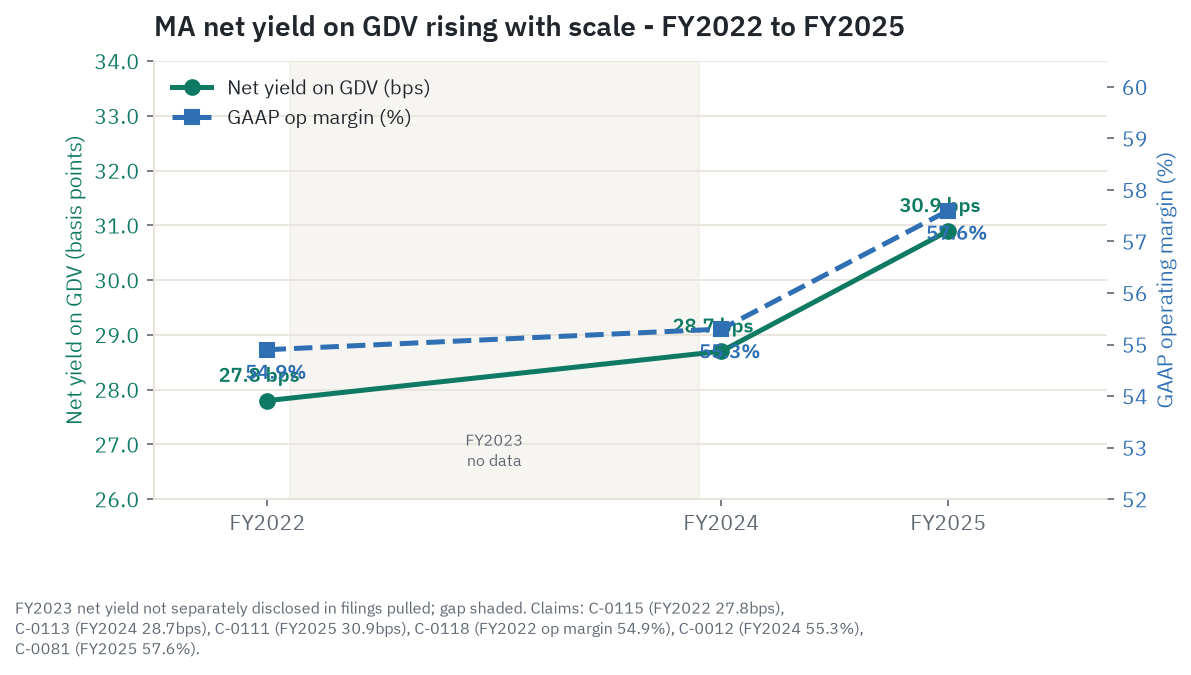
The take rate Mastercard actually keeps is net revenue divided by gross dollar volume. It is tiny in absolute terms and it is rising: about 27.8 basis points in FY2022, 28.7 in FY2024, and 30.9 in FY2025. On $10.6 trillion of volume, every fraction of a basis point is real money.
The important nuance is what is driving that climb. The pure payment-network yield, the network revenue alone divided by volume, is roughly flat at about 17.7 to 18.4 basis points across the same years. The blended number rises because value-added services revenue is not denominated in volume at all; it is sold on contracts, subscriptions, and per-event pricing, and it is growing far faster than the network. As services climbed from 38.5 percent of revenue in FY2024 to 40.6 percent in FY2025, the dollar of net revenue per dollar of volume rose even though the network rate barely moved. The yield expansion is a mix-shift story, not a pricing-power story. That distinction will matter a great deal in the bear case.
On margins, the fixed-cost economics are the real engine. Each incremental dollar of revenue between FY2022 and FY2025 dropped roughly 67 cents to operating income, well above the 57 to 59 percent run-rate margin, because the network is a fixed-cost platform where one more transaction costs little more than electricity and bandwidth. GAAP operating margin expanded from 54.9 percent in FY2022 to 57.6 percent in FY2025, with the adjusted figure at 59.2 percent. The realistic near-term ceiling looks like the 59 to 61 percent range; pushing past it would require either a major cut in rebate intensity, which is unlikely while Visa is competing for the same issuers, or services reaching full margin parity with the network, which is a multi-year story.
Mastercard does show surgical pricing power where it can act. In mid-2026 it introduced a new fee stack for high-risk specialty merchants (crypto, adult content, certain subscriptions): a $1,000 annual registration fee doubled from $500, a new $50,000 acquirer license fee, a $0.02 per-transaction fee, and a 10-basis-point volume fee, with no opt-out short of exiting the category. Those merchants have few banking alternatives, so the elasticity is low. It is a demonstration that the pricing power exists; it just cannot be exercised broadly on standard merchants because of the political and litigation scrutiny that the next section is all about.
Value-added services: the second engine
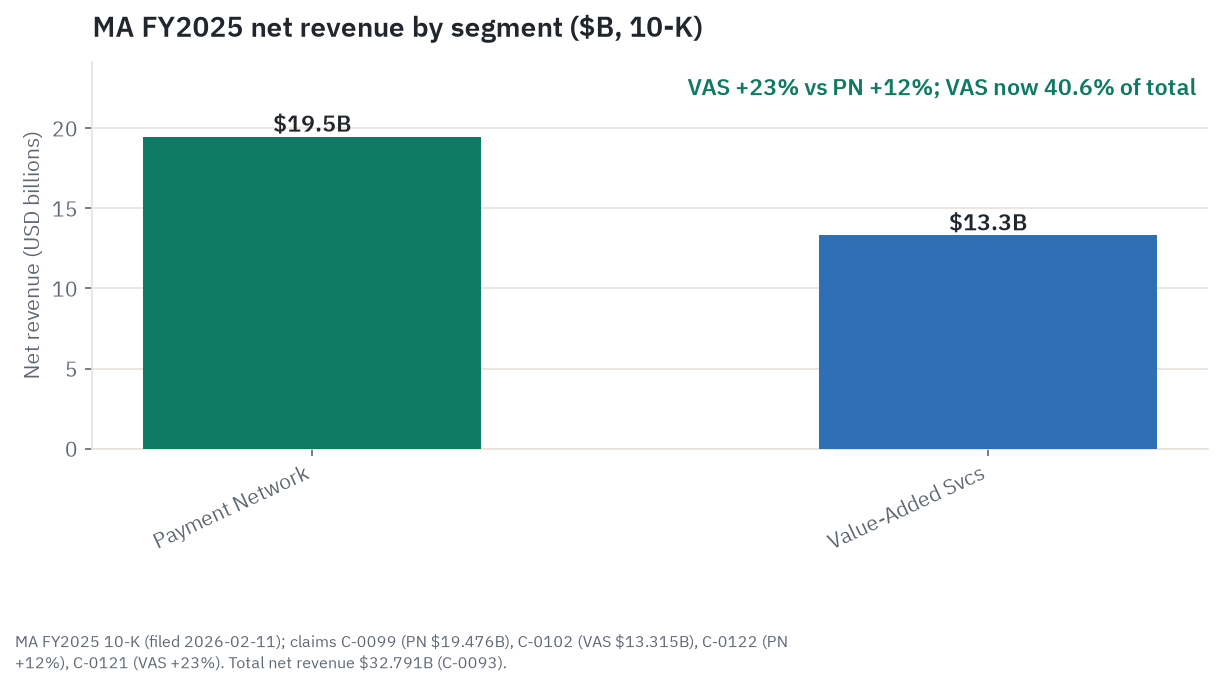
The reason Mastercard is not just a slowing toll-road is the business it has built alongside the network. Value-added services and solutions reached $13.315 billion in FY2025, up 23 percent reported and 21 percent currency-neutral, against the core network’s 12 percent. It is now 40.6 percent of net revenue, up from 38.5 percent a year earlier, and on its trajectory it could approach half of revenue this decade. The segment spans five buckets:
- Cybersecurity and fraud. Token-level fraud scoring (tokenization replaces the real card number with a device-specific token so the actual number is never exposed at checkout, which is both a security layer and a Mastercard value-added revenue line), dispute resolution, and the threat-intelligence business anchored by the $2.65 billion Recorded Future acquisition in December 2024. This is delivered at transaction time, so it carries high incremental margin once scaled.
- Identity and decisioning. Consumer identity verification, synthetic-identity detection, and behavioral biometrics. A data asset that compounds.
- Open banking and real-time rails. Finicity in the US and Aiia in Europe for account-linking and pay-by-bank, plus Vocalink, acquired in 2017, which runs the UK’s Faster Payments system, the BACS batch backbone, and the Link ATM network. This is the deliberate hedge: Mastercard owning the bank-to-bank rail so it earns a fee even when a payment does not ride a card.
- Data analytics and consulting. SpendingPulse, merchant analytics, and Mastercard Commerce Media, launched late 2025, which connects roughly 500 million permissioned consumers with 25,000 merchant advertisers.
- Loyalty and marketing. Rewards-program management and personalization.
Roughly 60 percent of services revenue is network-linked, riding alongside card transactions, which means it both carries high margin and deepens the switching cost on the core relationship: a bank that runs its fraud systems on Mastercard’s tools is a stickier issuer. The other 40 percent, particularly open banking and threat intelligence, runs entirely off card rails and does not require the counterparty to be a Mastercard issuer at all. That decoupling is the point. It is Mastercard making itself relevant to payment architectures that may not use its card network. Management does not break out services margin or sub-segment revenue separately, so the profitability split is an informed estimate, not a disclosed figure.
Regulatory and litigation: the structural risk map
This is the heaviest weight on the multiple, and it is four distinct fronts converging on the same five-year window. None of them is settled, and Mastercard’s specific dollar exposure on any of them is not quantified in its public filings, which is itself the problem: silence is not safety, it is an un-modeled tail.
MDL 1720, the US interchange litigation. This case has run since 2005, and two tracks must not be confused. The damages track, a $5.54 billion monetary settlement, was finalized in 2019, upheld on appeal in 2023, and is effectively closed for Mastercard, with a second fund distribution approved in June 2026. The live track is the November 2025 revised equitable settlement, which won preliminary approval from Judge Brian Cogan in the Eastern District of New York on June 9, 2026. Its terms cut the combined average effective credit interchange rate by 10 basis points for five years, cap standard consumer credit interchange at 1.25 percent for eight years, and let merchants decline specific card categories. The key point for Mastercard is that this is injunctive relief, not a cash payment by the company, and the 10-basis-point cut hits what issuers earn, not Mastercard’s own assessment line directly. That is not harmless, and the transmission is what makes it the heaviest weight on the multiple. Interchange is the revenue that funds issuer card economics: the rewards, points, and cash-back that make a card worth carrying, and the bank’s incentive to push one network over the other. Cap it and issuers have less to fund those rewards and less reason to favor Mastercard, which slows the volume Mastercard tolls and pushes issuers to lean harder on the rebates and incentives Mastercard already pays back to them (the gross-to-net line that, as noted earlier, grows faster than net revenue). So the assessment line is not capped directly; the engine that drives Mastercard’s volume is throttled second-order. Mastercard’s specific accrued share has been reported in press summaries around $275 million, but that figure is not independently confirmed from the primary filing, so treat it as attributed, not asserted. The real risk is the tail: 37 objections remain, including Walmart, the National Retail Federation, and the National Association of Convenience Stores, and a prior settlement was rejected in June 2024. If final approval fails, the case reverts to trial, where the exposure is a structural injunction with no time limit, potentially perpetual independent pricing of interchange or routing mandates. That outcome is not priced into a 25-times-forward multiple.
The Credit Card Competition Act. Reintroduced as S.3623 and H.R.7035 on January 13, 2026, with bipartisan sponsors and a public endorsement from President Trump the same day, the bill would force large banks to enable at least two unaffiliated networks on credit cards and hand merchants routing choice, exactly what the 2010 Durbin Amendment did to debit. Visa and Mastercard together control roughly 77 percent of US credit, so routing competition would make the networks compete on price in domestic credit for the first time. The bill has failed in prior Congresses and missed two attachment attempts in early 2026, so passage in the calendar year remains low-to-moderate odds, but the probability is structurally higher this cycle than before. No analyst house has published a quantified estimate of Mastercard’s domestic-credit assessment revenue at risk; that figure does not exist in any primary or analyst source, and its absence is exactly why the risk is hard to weight.
The UK cross-border cap. After Brexit, the networks raised UK-to-EEA card-not-present interchange sharply, to as much as 1.15 percent on debit and 1.5 percent on credit. On January 15, 2026, the High Court confirmed that the Payment Systems Regulator has the statutory authority to cap those fees. The regulator has not yet set a level or a timeline, but if it lands near EU levels of 0.2 and 0.3 percent, it would cut the post-Brexit premium by roughly 80 percent. The size of that corridor is not disclosed in Mastercard’s filings, so the revenue hit cannot be sized precisely.
The EU scheme-fee probe. Begun in September 2024 and deepened in May 2025, this investigation covers the network access and participation fees that are Mastercard’s actual revenue line, not interchange. It is still in the information-gathering phase with no formal charges. A finding of infringement carries a theoretical maximum fine of 10 percent of global annual revenue, roughly $3.3 billion against FY2025 net revenue, though actual antitrust fines usually land well below the ceiling, and these cases often resolve via behavioral commitments rather than maximum penalties.
The honest framing: the interchange debate has run since 2005 without breaking Mastercard’s model, and the company has repeatedly turned European caps into a reason to grow assessment and services revenue that falls outside them. The genuine structural threats are the routing act if it passes, the UK cap if set near EU levels, and EU open-banking rules enabling account-to-account checkout late this decade. The recurring headline noise is the settlement objector rhetoric and the near-term displacement fears. The trouble is that any one of these can trigger a one-time multiple de-rate on a single bad headline, regardless of what the volume does that quarter.
The disintermediation question: rails, stablecoins, and the richest lane
This is the slower-moving and, in my read, the more genuinely underpriced risk. Start with what is not the threat. Domestic real-time rails in the US, FedNow and RTP, are overwhelmingly institutional. FedNow’s average payment in 2025 was roughly $101,000 and RTP’s about $4,500, against a consumer debit transaction averaging $30 to $50. They are not eating point-of-sale retail. A reasonable read is that less than 5 percent of Mastercard’s US debit volume is genuinely at account-to-account risk within three years, possibly 10 to 15 percent over a decade if a routing mandate forces the issue; that figure is my own estimate, not an analyst’s, and it is illustrative.
The harder case is offshore and in the highest-margin lane. Brazil’s Pix, a central-bank rail with zero interchange, reached 42 percent of Brazilian purchase value in 2024 against 41 percent for cards, and is projected toward 50 percent by 2028. India’s UPI handles roughly 19 billion transactions a month, about 85 percent of the country’s digital payments. These are proof that government-backed account-to-account systems can shift national payment habits within a few years. For Mastercard the EM story is mostly lost future growth rather than displaced existing volume, because high-ticket and cross-border spending in those markets still rides card rails, but it caps the cash-to-digital runway that the bull case leans on.
Then there is the lane that decides the terminal value: cross-border, and stablecoins. A card cross-border transaction earns roughly 150 basis points all-in, and that figure stacks several fee layers rather than being a single charge: the cross-border assessment of roughly 0.45 percent from the money-flow section, plus the base domestic-style switching and assessment fees, plus the currency-conversion (FX) margin. That stack is why cross-border is worth close to ten times the roughly 13 to 15 basis points Mastercard nets on a domestic transaction, and it is exactly why this is the high-margin lane the cheaper rails target. A stablecoin cross-border rail’s native cost is 0.1 to 0.5 percent, and remittances under 1 percent. B2B stablecoin payment volume grew 733 percent in 2025 to roughly $390 billion annualized, in exactly Mastercard’s premium corridor. The newer twist on top of that is agentic commerce: AI agents that shop and pay on a user’s behalf, which could be programmed to route each payment over the cheapest rail (a stablecoin or an account-to-account bank transfer) and bypass the card networks at checkout entirely. That is the terminal-value risk to the toll model, the buyer’s own software optimizing Mastercard out of the transaction. Mastercard’s answer is to own the infrastructure rather than be bypassed by it: the BVNK acquisition, announced March 17, 2026 for up to $1.8 billion ($1.5 billion base plus $300 million contingent, closing late 2026), plus an on-chain settlement framework spanning USDC, PYUSD, and other tokens across Ethereum, Solana, Polygon, Base, Arbitrum, and the XRP Ledger. The bull view is that Mastercard becomes the on-chain toll-road and earns a fee regardless of the rail. The bear view, which I think the market is right to start pricing, is that owning the tollbooth on a free highway is not the same business: a fee that is 150 basis points on a card cannot be preserved on a rail whose native cost is a fraction of a basis point, even if Mastercard owns the rail. BVNK is a $1.8 billion bet to participate in flows whose economics are an order of magnitude below today’s take. That can be a good defensive move and still mean the richest lane gets less rich.
The way this shows up is subtle and that is why it is dangerous: cross-border volume keeps growing, which keeps the bulls calm, while cross-border revenue yield quietly compresses. Watch the gap between the two, not the volume alone.
Company by company: who’s who
The peer set spans four roles in and around the four-party model. All market caps are point-in-time as of June 29, 2026 and move daily.
Visa (V), NYSE, market cap about $640 billion, FY2025 net revenue $40.0 billion. The other half of the duopoly and the essential comp. Same model, no credit risk, identical regulation in most markets. The differences that matter: Visa dominates US debit at about 76 percent share against Mastercard’s 23 percent, which is a strategic asset and a regulatory liability, since it carries the active DOJ debit-monopolization suit filed in September 2024 with a trial possibly in 2027 or 2028, a suit Mastercard does not face. Mastercard has the slightly richer cross-border and faster services mix; Visa has more scale and absolute free cash flow. On valuation they are within a turn of each other, Visa near 24 times forward against Mastercard’s 25 to 26. Bull: dominant debit, global scale, settlement resolving the overhang. Bear: the DOJ debit case is a real precedent risk, and a higher debit mix is more exposed to a Durbin-for-credit routing regime.
American Express (AXP), NYSE, market cap about $232 billion, FY2025 revenue $72.2 billion. The three-party (closed-loop) contrast: where Mastercard’s four-party model connects separate banks, Amex is issuer, network, and acquirer in one and lends to its own cardholders, so it captures the full economics of a premium swipe and also carries the credit risk. The $72.2 billion revenue figure includes net interest income on card balances and is not comparable to a network-only line. Billed business grew 8 percent to $1.67 trillion in FY2025, and management guided FY2026 EPS of $17.30 to $17.90. Bull: closed-loop pricing freedom independent of interchange caps, strong younger-affluent card acquisition, no debit-routing risk. Bear: full credit risk means a recession hits revenue, provisions, and capital at once, and the roughly 19 times forward multiple gives less cushion if earnings disappoint.
PayPal (PYPL), NASDAQ, market cap about $38 billion, FY2025 revenue $33.2 billion. A customer of the networks, not a competitor: most PayPal card transactions ride Visa and Mastercard rails. Its 18.3 percent operating margin against Mastercard’s 57.6 percent is the clearest illustration of the gap between the middleware layer and the toll-road layer. Bull: cheap at about 7.8 times forward, with checkout and Venmo monetization as a re-rating path. Bear: 4 percent revenue growth is the issue, and a low multiple on slow growth is a value trap unless a concrete re-acceleration catalyst appears. Do not let “cheap” stand alone here. For a Mastercard investor, if PayPal loses wallet share, that spend does not leave the card network; it moves to a competing wallet still running on the rails.
Fiserv (FI), NYSE, market cap about $26 billion, FY2025 revenue about $21 billion. An acquirer-processor in the merchant leg, in the middle of a credibility crisis: the stock fell roughly 70 percent or more from its 2024 peak after a Q3 2025 earnings miss ($2.04 against $2.64 expected), a guidance cut from about 10 percent organic growth to 3.5 to 4 percent, disclosure that prior growth included non-recurring items, a CEO departure, and a Jana Partners activist campaign. Bull: the Clover acquiring franchise may be worth much of the enterprise value if the reset works. Bear: this is a falling knife with destroyed management credibility and tough competition from Toast, Block, and Stripe. The bull only stands if paired with that crisis in the same breath.
FIS, NYSE, market cap about $21 billion, FY2025 revenue $10.7 billion. Bank-technology, not merchant acquiring, after selling Worldpay in 2023. It sits behind the issuer, running core-banking and capital-markets software. Revenue grew 5 percent, with free cash flow up 19 percent to $1.6 billion. Bull: mission-critical software with switching-cost stickiness. Bear: legacy core-banking faces cloud-native displacement, and 5 percent growth is not compelling. Relevant to Mastercard only as background plumbing for issuers.
Global Payments (GPN), NYSE, market cap about $18 billion, FY2025 net revenue $9.3 billion. Repositioned in 2025 as a pure-play merchant acquirer after taking on Worldpay and divesting Issuer Solutions. Net revenue grew just 2 percent, while adjusted EPS rose 11 percent to $12.22. Bull: Worldpay makes it a top-three acquirer and the Genius platform could win mid-market merchants, cheap at this cap. Bear: high integration risk on a historically struggling asset and no organic momentum. For Mastercard, acquirer consolidation is a mild positive at most; it cannot move network assessment fees.
Adyen (ADYEN.AS, US OTC ADYEY), market cap about $28 billion to $29 billion, FY2025 net revenue 2.4 billion euros. The most technically advanced acquirer in the set, a single unified stack built from scratch for large global merchants. It rides Visa and Mastercard rails as a customer. Net revenue grew 18 percent on 1.4 trillion euros of processed volume, with a 53 percent EBITDA margin and 20 to 22 percent growth guided for 2026. Bull: best-in-class platform, enterprise merchants pay for quality, top-tier growth. Bear: a forward EV/EBITDA near 30 times demands flawless execution, the stock is already down about 50 percent from its peak, and Stripe competes on the same tier. A practical note for US investors: the liquid listing is in Amsterdam; the OTC ADR is thin.
The disruptor category: FedNow, RTP, UPI, Pix, and stablecoin settlement. Not cleanly investable as standalone equities. The bull framing that these rails are tiny and additive is the most self-serving line in the bull case. Pix already exceeds Visa and Mastercard combined in daily Brazilian transactions, and UPI is about 85 percent of India digital payments. These are not tiny; they are the proof of concept that government-backed account-to-account can displace cards at national scale within a few years. The closest public proxies are Mastercard and Visa themselves as they build on-chain infrastructure, FIS and Fiserv as bank processing partners, and Coinbase or the private Circle for stablecoin exposure.
What the filings say
The FY2025 numbers (10-K filed February 11, 2026) are the spine of the case. Net revenue was $32.791 billion, up 16 percent reported and 15 percent currency-neutral, splitting into payment network at $19.476 billion (up 12 percent) and value-added services at $13.315 billion (up 23 percent reported, 21 percent currency-neutral). Operating income was $18.897 billion at a 57.6 percent GAAP operating margin, up from 55.3 percent in FY2024, with the adjusted margin at 59.2 percent. The margin expanded because revenue grew 16 percent while total operating expense grew only 10 percent. GAAP net income was $14.968 billion, GAAP diluted EPS $16.52, and adjusted diluted EPS $17.01.
Cash generation is the standout. Operating cash flow was $17.648 billion and, after just $489 million of capital expenditure, free cash flow was $17.159 billion, a 52.3 percent free-cash-flow margin. The balance sheet at year-end 2025 carried $10.566 billion of cash against about $19.0 billion of total debt, for net debt near $8.4 billion, less than half a year of free cash flow. Stockholders’ equity of $7.746 billion looks thin against $54.157 billion of total assets, but that is a deliberate consequence of returning nearly all free cash to owners and buying back stock, which compresses book value while returns on capital run north of 100 percent. Interest coverage is roughly 49 times, and an $8 billion revolver sits fully undrawn. A June 2026 $5 billion multi-tranche note issuance, partly to fund the BVNK acquisition, is a post-year-end event and does not strain any of this.
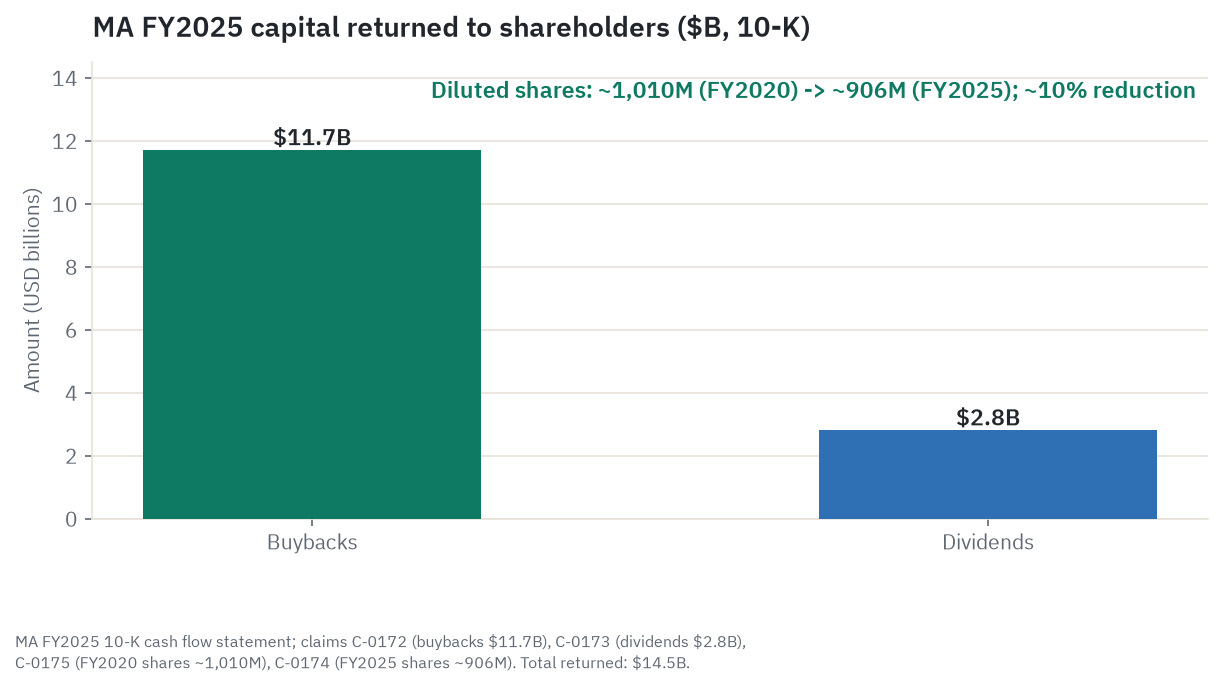
On capital return, FY2025 saw $11.727 billion of buybacks (21.1 million shares) and $2.756 billion of dividends, roughly $14.5 billion returned. Diluted weighted-average shares fell from about 1,010 million in FY2020 to about 906 million in FY2025, a cumulative reduction near 10 percent. The board authorized a new $14.0 billion repurchase program in December 2025 and raised the quarterly dividend 14 percent to $0.87 a share, an annual rate of $3.48 and a yield near 0.7 percent. This is a compounder that returns cash, not a yield vehicle.
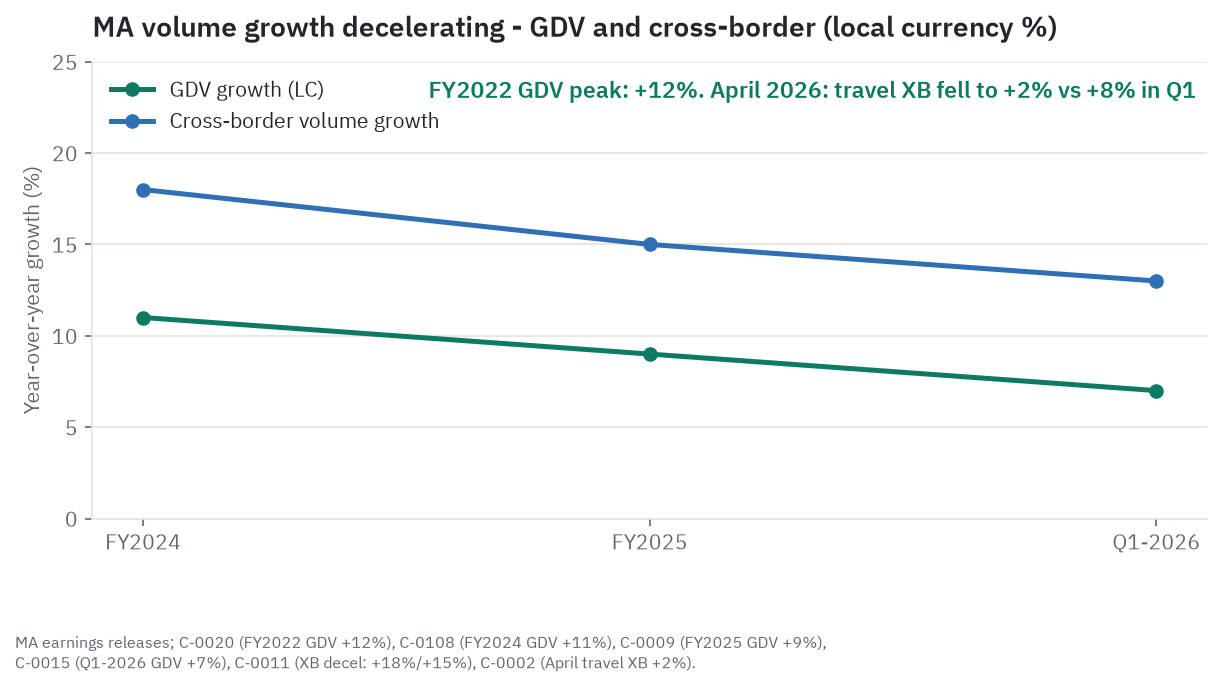
The operating metrics tell the deceleration story honestly. Gross dollar volume reached $10.6 trillion in FY2025, up 9 percent local currency, but the trend has stepped down monotonically: 12 percent in FY2023, 11 percent in FY2024, 9 percent in FY2025, and 7 percent in Q1 2026. Cross-border volume grew 15 percent in FY2025 and 13 percent in Q1 2026, with the travel component sliding from 8 percent at the start of Q1 to roughly 2 percent in April on Middle East disruption. Switched transactions grew 10 percent. Q1 2026 (period ended March 31) showed net revenue of $8.4 billion, up 16 percent reported and 12 percent currency-neutral, with adjusted EPS of $4.60 up 18 percent currency-neutral and operating margin at 60.8 percent, but payment network grew only 8 percent currency-neutral against services at 18 percent.
Management’s FY2026 guidance, issued April 30, is for net revenue growth at the high end of low double digits currency-neutral, operating expense growth in the low double digits, and a non-GAAP tax rate of 20 to 21 percent, a headwind from FY2025’s 19.4 percent. For Q2 it guided the low end of low double digits and flagged Middle East travel as the largest headwind in that quarter before recovery. Management guides conservatively by habit; the corporate incentive scored 145 percent of target in FY2025. On insiders, the pattern is consistent award-driven selling with no open-market buying anywhere in the $450 to $530 range across 2025 and 2026, baseline behavior for a high-multiple large-cap rather than a directional signal.
The 10-K’s own three load-bearing risk factors are worth naming: interchange litigation and regulatory capping; disintermediation and payment-rail competition, which is precisely what the BVNK deal answers; and data security and operational continuity, since a single major breach would be ruinous to a trust-based franchise. None of those is boilerplate; all three map directly onto the bear case.
What the market is paying
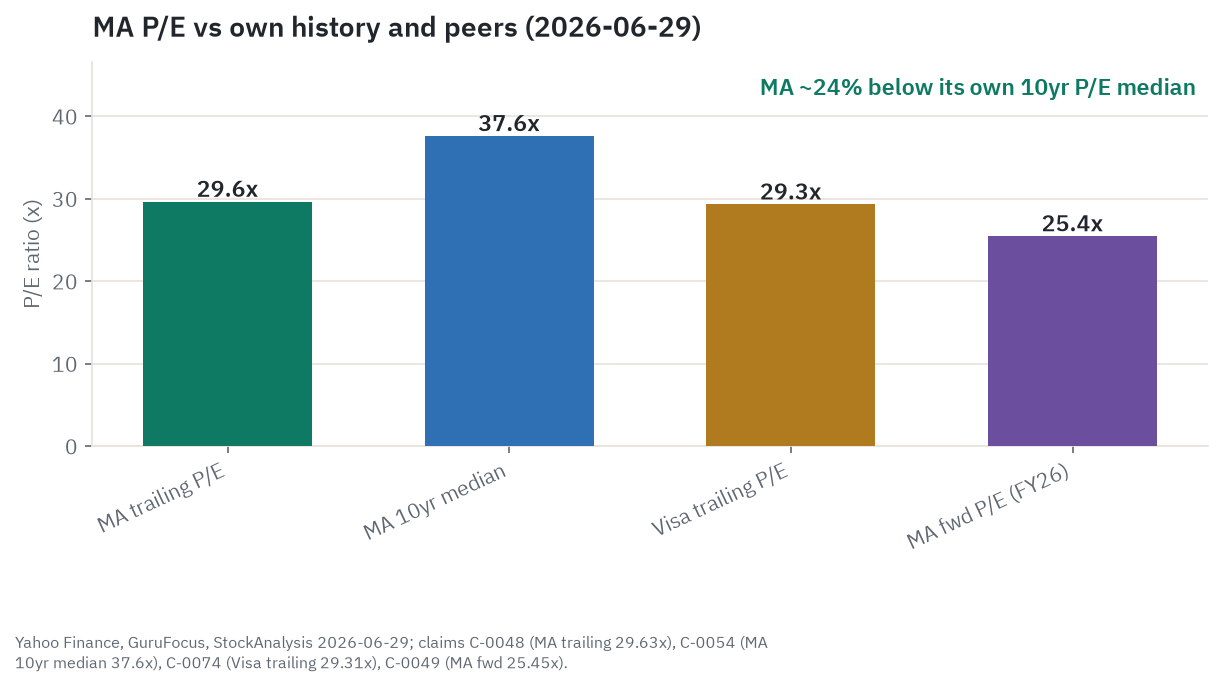
All of this is point-in-time as of June 29, 2026 and will be stale by the time you read it. The stock sat around $512, market cap about $452 billion, with roughly 883.6 million basic shares. It is in the lower third of its 52-week band: the low was $464.52 on June 3, 2026, just 26 days before the research date, and the high was $601.77 on August 22, 2025, so the stock was about 15 percent below its peak and had bounced about 10 percent off the trough.
The return profile is a strong long-term compounder having a poor year. Over ten years the stock is up about 467 percent and over five about 33 percent, but year-to-date it was down 10.5 percent and over 52 weeks down 7.2 percent, against an S&P 500 up roughly 7 to 8 percent year-to-date (the exact index figure is approximate from a source that flagged delayed data). The telling comparison is the twin: Visa was down only about 2 percent over 52 weeks against Mastercard’s 7 percent. If this were pure sector de-rating the duopoly would move together. It has not, and the things that differentiate Mastercard negatively, a higher cross-border and services mix that means more stablecoin exposure on the richest lane, are exactly the bear pillars. Beta is moderate at 0.74 (one source says 0.82), so the stock is less volatile than the market but not immune: it fell about 63 percent in 2008-09 and about 40 percent in the March 2020 shock before recovering.
On valuation, Mastercard traded near 29.6 times trailing earnings, roughly 25 to 26 times forward (sources disagree between about 24.7 and 25.5 times next-twelve-months, so call it a range), about 21.7 times EV/EBITDA, and roughly 13.3 times sales, with a free-cash-flow yield near 3.9 percent. Against its own history the trailing multiple is about 24 percent below the ten-year median near 37.6 times and close to the bottom of its decade range. Against Visa, the two are within a turn of each other on essentially every metric. Three reasons recur for the compression: the interchange and routing overhang, macro uncertainty on consumer and travel spend into the second half of 2026, and a broad de-rating of high-multiple compounders since mid-2025.
Liquidity is a non-issue, with about $1.9 billion traded daily, and short interest is extremely low at roughly 0.73 percent of float, so there is neither a short-side bet nor any squeeze fuel. The sell-side is near-unanimous: about 39 analysts at a Strong Buy consensus, an average target around $645, a high of $735 and a low of $550, implying roughly 26 percent upside. Targets are opinions, not facts, and the consensus has been bullish for years while the stock sits 15 percent below its high. The next binary event is the July 30 earnings print, with consensus Q2 EPS at $4.76. Technically the stock had just reclaimed both its 50-day ($494.77) and 200-day ($492.61) moving averages with an RSI near 67, a constructive bounce that is also short-term extended.
What the crowd is saying
Sentiment is signal, not fact, and the soft data here should be weighted lightly. The dominant press tone over the 90 days into the research date was cautiously constructive on the operating story and uneasy on the headlines. The Q1 print on April 30 beat on both EPS ($4.60 against $4.41) and revenue, with operating margin at 60.8 percent, and the stock fell 4 to 5 percent in premarket anyway. That “beat and fell” reaction became the second-order headline, and the April cross-border travel deceleration from 8 to 2 percent was the single data point the bears seized.
The loudest single sentiment event was a Citrini Research note arguing that AI agents would route transactions around interchange via stablecoins by roughly 2027, which press coverage tied to a single-day drop of about 6 percent for Mastercard, 5 percent for Visa, and 7 percent for American Express. I am flagging that hard: the exact date and the precise close-to-close return are unverified, so treat the magnitude as an impression, not a fact. The point that survives the soft sourcing is that the market moved on a forward-speculative thesis with zero current volume evidence, which tells you terminal-value fear is already in the tape.
Retail chatter is low-intensity and long-biased; Mastercard sits in the quality-compounder bucket that forums hold rather than trade, and with an over-$400 billion cap and roughly 89 percent institutional ownership it is structurally immune to thin-float manipulation. The Mastercard Foundation, a legacy charitable holder, has been methodically trimming, which is a supply overhang and not an investment signal. Employee sentiment on Glassdoor is solid but softening (about 4.1 of 5, with reorganization and leadership-change complaints), a mild execution-risk flag for the services build-out, not an acute one.
The useful part is the divergence. The crowd’s story is structural disintermediation from AI, stablecoins, and routing law, and it has suppressed the stock 10 to 13 percent year-to-date despite fundamentals materially above consensus. The sell-side, at Strong Buy with a target implying about 26 percent upside, treats the regulatory headlines as manageable and the disintermediation thesis as speculative. The crowd is probably wrong that the threat is imminent within the one-to-two-year window driving the price; the routing act has stalled repeatedly, the UK probe is at investigation stage, and the settlement is progressing toward resolution. The crowd may have a real point that cross-border is the most economically sensitive and highest-yield lane, and that the BVNK bet, at $1.8 billion for a pre-scale infrastructure play, carries unpriced execution risk.
Durability: what makes this a forever business, and what could end it
The structural case rests on three reinforcing facts. The cash share of global payments is still around 46 percent and declining, so every cash transaction that converts adds permanently to volume, and the runway is longest in exactly the emerging markets growing fastest. Mastercard earns on the full dollar value of every transaction, so inflation, prosperity, and growth all lift the base; in 2022, with US CPI running 7 to 8 percent, volume grew 12 percent local currency. And the services layer is a genuine second engine with high switching costs that is less correlated to transaction volume, extending the moat beyond the toll.
The historical record on cyclicality is reassuring without being complacent. In the 2008-09 crisis, the deepest US recession since the 1930s, full-year volume was roughly flat in local currency and never turned materially negative; the toll-on-volume model with no credit book insulated Mastercard from the loss cycle that crushed banks. In the 2020 COVID shock, volume fell 10 percent in Q2 and cross-border collapsed more than 50 percent as travel stopped, yet the company stayed profitable and recovered within quarters. The floor in a demand recession is essential-goods spending on cards, and travel shocks have historically recovered in quarters, not years. As of mid-2026 the read on the consumer is resilient but cooling rather than cracking: gross dollar volume still grew 7 percent in Q1, switched transactions 10 percent, and the cross-border softness was concentrated in Middle East travel disruption rather than a broad pullback in everyday spend. The risk into the second half of 2026 is a genuine consumer slowdown layering on top of the structural questions, but the current data shows deceleration, not contraction.
Now the real bear case, and it is not a recession. The danger is structural: a quiet de-coupling of cross-border volume from cross-border yield as stablecoin and agentic settlement scale from B2B into everyday commerce, compressing the roughly 150-basis-point premium lane even where Mastercard owns the rail. The skeptic’s sharpest point is that the “24 percent below the ten-year median” framing is a classic value-trap signal when the median itself was earned in a 2015 to 2021 era of zero rates, an undisputed-duopoly narrative, and an accelerating cross-border re-rating, none of which holds in 2026. A maturing compounder facing four regulatory fronts and a credible disintermediation thesis can compress toward the market multiple just as easily as it can revert up. And the deceleration is already in the filings: volume growth stepping down monotonically, cross-border cooling, payment-network revenue at 8 percent currency-neutral in Q1, and rebates growing faster than the net revenue they offset. The blended-yield expansion is almost entirely a services mix-shift artifact, not network pricing power.
The most likely outcome is a split, which is why the read lands where it does. The franchise quality is not in question and the balance sheet is a fortress. The honest tension is that the terminal take rate the market is being asked to pay for today is genuinely uncertain, and the upside is capped until the regulatory fog lifts and the cross-border yield trend proves out.
The scenarios in detail
Four variables decide where this business and stock sit in five years, and every scenario is just a different setting of the dials. First, cross-border yield, the richest and most exposed lane, where the question is not whether volume grows (it will) but whether the yield on it holds against near-zero-cost rails. Second, services growth and whether it keeps the blended yield rising even as the network rate stays flat. Third, the four regulatory verdicts, all landing in the 2026 to 2028 window. Fourth, gross dollar volume and the consumer and cross-border cycle, which dominates the near horizons. A fifth dial, the exit multiple, is not a business driver but a market judgment about the other four, and it does most of the near-term work.
The base-case adjusted-EPS path runs from $17.01 in FY2025 to about $19.66 in FY2026 (consensus), then roughly $22, $24.6, $27.3, and about $30 by FY2030, low-teens compounding fading toward 10 percent. The bear path grows about 5 to 8 percent (FY2030 near $21.7); the bull path holds the lane and reaches the mid-$30s to $40 by FY2031. Every level below is illustrative arithmetic, not a price target, and the bull-to-bear levels match the chart at the top of this piece.
Bull, about $1,180 in five years. Cross-border yield holds because BVNK and on-chain settlement let Mastercard earn a real fee on stablecoin flows; services sustains 18 to 22 percent growth toward half of revenue; the regulatory clouds clear benignly; and volume compounds 7 to 9 percent on the cash-to-digital and EM runway. Adjusted EPS reaches roughly $40 by FY2031, and at about 28 to 30 times, a multiple that reverts only partway toward the historical 36 to 38 median, that is about $1,180. What breaks it: cross-border yield compresses even as volume grows, because the fee-preserved-across-the-rail assumption is an assertion the unit economics do not yet support.
Base, about $820 in five years. Cross-border volume keeps growing but yield erodes slowly at the edges, a few percent of B2B and remittance migrating to stablecoin rails by 2031, not a cliff. Services decelerates gently toward mid-teens but stays the faster engine. Regulatory verdicts land mixed: the settlement clears as injunctive relief with no direct cash, the routing act stays stalled, and the UK and EU caps trim Europe modestly. Adjusted EPS compounds low-teens to about $33 by FY2031, and at roughly 24 to 25 times, near today’s forward multiple rather than the bubble-era median, that is about $820, roughly 60 percent above today. The single most important assumption in the whole piece is that deliberate choice not to re-rate the multiple up. What breaks it: the blended take rate stalls because services decelerates and cross-border softens at the same time, turning a two-engine story into a one-engine story.
Bear, about $390 in five years, hard tail $320 to $360. Cross-border yield compression is the load-bearing risk: stablecoin and agentic settlement scale into everyday cross-border and the 150-basis-point lane compresses an order of magnitude even where Mastercard owns the rail. The routing act passes and merchants route domestic credit to cheaper networks; the UK cap and EU probe both bite Europe; settlement approval wobbles. Services cannot offset because the yield-mix story reverses. Adjusted EPS grows only about 5 percent a year, to roughly $21.7 by FY2030. At 18 times that is about $390; the three-year waypoint is about $435 (20 times on about $21.4), dead money against a compounding index. The cross-border stablecoin-erosion sensitivity behind that 5 percent path, if 10, 20, or 30 percent of cross-border B2B and remittance volume migrates to near-zero-take rails by 2031, is modeled illustratively and is not sourced. The hard tail of $320 to $360 is a one-time re-rate to 16 to 17 times if the settlement is rejected into a structural injunction or the routing act is enacted with fast merchant routing.
The asymmetry is the honest crux. At 29.6 times trailing, the bull is about 26 percent of upside resting on the multiple reverting up to a bubble-era median while growth decelerates; the bear is roughly 16 to 37 percent of downside resting on the multiple compressing toward the market while the richest lane is disrupted. “Quality on sale” is only true if 37.6 times is the right anchor. The base case deliberately does not assume it is, which is why the Buy is a measured one rather than a table-pound.
On the calendar: the near-term catalysts are Q2 earnings on July 30 (the cross-border travel print), the CFO transition completing in Q3 as Ling Hai succeeds Sachin Mehra, the BVNK close in late 2026, and the settlement final-approval hearing in late 2026 or early 2027, the single most important binary near-term event. The multi-year inflections are any routing-act attachment to must-pass legislation, the UK cap level, an EU statement of objections versus behavioral commitments, EU open-banking implementation enabling account-to-account checkout in late 2027 to 2028, and the point where B2B stablecoin settlement crosses into everyday cross-border.
Companies to watch (bull / base / bear)
- Mastercard (MA) - the subject. Bull: best-in-class margins, a faster-growing services engine, and a quarter-below-history multiple. Base: low-teens compounding at a held multiple to about $820 in five years. Bear: the premium cross-border lane is the disintermediation lane, and the on-chain hedge has unproven economics an order of magnitude below today’s take. Watch: the cross-border volume-versus-yield gap, the blended take rate, and the settlement final-approval outcome.
- Visa (V) - the duopoly twin. Bull: dominant debit and scale. Bear: it carries the active DOJ debit-monopolization suit that Mastercard does not, and a higher debit mix is more exposed to credit-routing law. Watch: the DOJ trial timeline and relative cross-border growth.
- American Express (AXP) - the closed-loop alternative. Bull: pricing freedom outside interchange caps. Bear: full credit risk hits revenue, provisions, and capital together in a recession. Watch: card-member loan delinquencies and billed-business growth.
- PayPal (PYPL) - network customer. Bull: cheap with a checkout and Venmo re-rating path. Bear: 4 percent revenue growth makes the low multiple a trap absent a named catalyst. Watch: branded-checkout volume and Venmo monetization.
- Fiserv (FI) - acquirer in crisis. Bull: Clover may be worth much of the cap if the reset works. Bear: destroyed credibility, possible prior revenue inflation, activist circling. Watch: organic-growth credibility and any asset sale.
- Global Payments (GPN) - repositioned acquirer. Bull: Worldpay scale plus the Genius platform. Bear: 2 percent growth and high integration risk on a long-struggling asset. Watch: organic net-revenue growth ex-acquisition.
- Adyen (ADYEY) - the modern acquirer. Bull: 20 to 22 percent growth and a best-in-class stack. Bear: a near-30-times EV/EBITDA demands perfect execution with Stripe on the same tier. Watch: processed-volume growth and take-rate trend.
- The disruptor category (FedNow, RTP, UPI, Pix, stablecoins) - not cleanly investable. Watch: B2B and cross-border stablecoin volume share in Mastercard’s premium corridor, and any government mandate that pushes account-to-account to the point of sale.
Risk controls
This is a high-quality compounder with a genuine regulatory and disintermediation tail, which is a specific risk profile, not a generic one. The asymmetry to respect is that the damage here is more likely to arrive as a one-time multiple de-rate on a headline than as a slow earnings miss, because the market reprices terminal value before volume actually moves. A position should be sized so that a single adverse verdict, a settlement rejection or a routing-act attachment, is survivable rather than thesis-ending.
The developments that would mechanically change the read: the read would move up toward Strong Buy if a regulatory cloud clears decisively (settlement final approval holds as injunctive relief, or the routing act dies again) while the blended take rate keeps expanding. It would move down toward Hold if cross-border revenue yield visibly decouples from volume for two or more consecutive quarters, if the blended take rate rolls over, or if the routing act attaches to a must-pass bill. The leading indicators worth tracking are concrete: the cross-border yield-versus-volume gap, the blended take rate (30.9 basis points today), the gap between services growth and network growth (21 versus 12 percent in FY2025), the settlement approval date and outcome, any routing-act legislative vehicle, and monthly cross-border travel growth with IATA passenger data as the external cross-check. And the standing reminder: every scenario above is arithmetic on stated assumptions, not a price target, and every price is a June 29, 2026 snapshot.
Methodology, sourcing, and data-quality flags
This piece was built from parallel research streams (the value-chain and money-flow map, the SEC filings, market action and valuation, sentiment and OSINT, the macro and micro economics, a regulatory and competitive deep dive, and a forward outlook), then run past a skeptic who argued the short side and a compliance review of the disclaimers and framing. The source hierarchy, strongest first: primary filings (the FY2025 10-K filed February 11, 2026, the Q1 2026 10-Q and 8-K earnings release, the December 2025 capital announcement, and the April 2026 proxy); analyst and institutional estimates and sell-side consensus aggregators; reputable trade press for the regulatory and sentiment record; and the piece’s own labeled scenario arithmetic. Every load-bearing financial figure was checked against the filing or the named source.
A note on the read itself, factor by factor, in plain terms rather than as scores. On valuation, the evidence reads modestly cheap: about 29.6 times trailing and 25 to 26 times forward, roughly 24 percent below the ten-year median near 37.6 times and within a turn of Visa, with the honest caveat that the historical median was a zero-rate, undisputed-duopoly artifact, so “cheap” is real but tempered. A positive, not a screaming one. On growth, the read is a clear positive held back by deceleration: FY2025 net revenue up 16 percent and adjusted EPS up 17 percent, services up 23 percent, against volume growth stepping down 12 to 11 to 9 to 7 percent and cross-border cooling toward 9 percent by April; the runway is large and durable but the richest lane carries a real disintermediation question. On quality, the read is best-in-class and unambiguous: about 59 percent operating margins, a 52 percent free-cash-flow margin ($17.2 billion on $32.8 billion), returns on capital well north of 100 percent, zero cardholder credit risk, net debt under half a year of free cash flow, and a share count down about 10 percent since 2020. This is the strongest factor and the reason any premium exists. On risk, the read is the binding constraint and net negative: four regulatory fronts converge in 2026 to 2028 with Mastercard’s dollar exposure on each unquantified in filings, and the cross-border and agentic disintermediation thesis is a genuine terminal-value risk the market reprices before volume moves, partly offset by a fortress balance sheet, diversified global volume, a defensive 0.74 beta, and no credit book. Elevated but structural, not a crisis. On momentum, the read is mixed and low-weight: the 12-month tape is poor (down about 10.5 percent year-to-date, underperforming both the index and Visa, with a beat-and-fell Q1), but the last three months turned up and the stock reclaimed its 50- and 200-day averages, with a near-unanimous Strong Buy and about 26 percent implied upside to the mean target. Net neutral. Netting it out, a genuinely high-quality compounder, modestly cheap versus its own history, with a double-digit growth runway, set against a real four-front regulatory overhang and a credible cross-border disintermediation question that caps the upside. The labeled research signal lands on Buy, not Strong Buy, with the valuation tag at Undervalued: the quality and the discount are real, but the tension with the terminal-take-rate risk keeps it at the lower end of Buy. The read would move up on a regulatory cloud lifting while the take rate keeps expanding, and down if cross-border yield visibly stalls or the routing act advances.
Data-quality flags:
- Point-in-time figures move fast. Every price, market cap, valuation multiple, moving average, peer comparison, and analyst target is stamped June 29, 2026 and will drift. The freshness bar on this piece is live-prices; treat all of it as a snapshot. The stock itself traded between roughly $499.50 and $511.68 within June 29 alone.
- Read the claim, not a stray value. The internal ledger had a formatting issue that stripped some currency symbols and leading digits from raw value fields; every figure here was taken from the underlying claim text and cross-checked against the filing, so the dollar amounts above are the corrected ones.
- The forward multiple is a range. Vendors disagree on next-twelve-months P/E (about 24.7 times versus 25.5 times), so it is presented as roughly 25 to 26 times forward rather than a single number.
- The interchange-settlement cost is not quantified. Specific litigation-accrual dollar figures were cut because the available numbers could not be reconciled to the filing; the settlement is framed qualitatively as injunctive relief with no direct Mastercard cash and a second-order risk to issuer economics. The roughly $275 million Mastercard accrual share cited in press is attributed, not asserted as fact, and the net present value of the interchange reductions to Mastercard is unquantified in public sources.
- The routing-act revenue at risk is unquantified. No primary or analyst source sizes how much of Mastercard’s domestic-credit assessment revenue is exposed to the Credit Card Competition Act. The risk is real and weighted qualitatively; it is not modeled to a number.
- Two estimates are explicitly ours, not analysts’. The “less than 5 percent of US debit volume at account-to-account risk within three years” figure and the cross-border stablecoin-erosion sensitivity (10, 20, or 30 percent migration by 2031) are illustrative author estimates built to stress the bear case, not sourced forecasts.
- The annual rebate total is extrapolated. Only quarterly rebate figures are confirmed from filings; the roughly $20 billion to $21 billion full-year FY2025 figure is extrapolated from quarterly cadence and is an estimate, as is the FY2023 segment split.
- The Citrini sentiment event is unverified in magnitude. The exact date of the note and the precise single-day returns (about 6 percent for MA, 5 percent for V, 7 percent for AXP) are from press coverage, not a verified return calculation. The existence and general market impact are likely real; the precise numbers are not confirmed.
- Beta and the S&P 500 comparison are soft. Beta is reported at 0.74 by two sources and 0.82 by another; the S&P 500 year-to-date and 52-week figures came from a source that flagged delayed data. The directional read (Mastercard underperformed both the index and Visa) is robust; the exact index numbers are approximate.
- Forecasts are forecasts. The FY2026 EPS path, the guidance, the regulatory timelines, and the scenario multiples are outlooks. Their attribution is verified; their truth is not. Each is labeled an estimate.
Key sources: Mastercard FY2025 10-K (CIK 0001141391, accession 0001141391-26-000013, filed February 11, 2026), the Q1 2026 10-Q and 8-K earnings release, the Q4 2025 8-K, the December 2025 capital announcement, and the April 2026 DEF 14A proxy; the Q1 2026 earnings call transcript; court and regulatory records for MDL 1720 (EDNY preliminary approval June 9, 2026), the Credit Card Competition Act (S.3623 / H.R.7035), the UK High Court PSR ruling (January 15, 2026), and the EU scheme-fee investigation; FedNow, RTP, UPI, and Pix volume data from the Federal Reserve, The Clearing House, and trade press; stablecoin cost and B2B-volume data from named third-party sources; stockanalysis.com, Yahoo Finance, Barchart, and MarketBeat for market data; and trade-press coverage for the sentiment and competitive record. Figures are point-in-time as of June 29, 2026.
This article is OSINT research for educational purposes only and is not investment advice. I am not a financial advisor, and nothing here is a recommendation to buy, sell, or hold any security. Mastercard is a toll-taker on global card volume whose results bend with the consumer and cross-border cycle and whose valuation is sensitive to regulatory and disintermediation risk that can move faster than the underlying business. Figures are point-in-time as of June 29, 2026 and will change. Do your own due diligence and consult a licensed financial advisor before making any decision.