
Research date: July 2, 2026 | OSINT market research on Dell Technologies Inc. (DELL, NYSE), the server, storage, and PC maker that has become the largest disclosed beneficiary of the AI-infrastructure build-out among traditional hardware OEMs, and the tensions that come with it: a backlog that keeps growing faster than the company can ship it, a margin structure on that same backlog that management itself describes as thin, a balance sheet levered to fund the growth, and a voting structure where two shareholders control the outcome of anything a public shareholder might want to change.
Important disclaimer. This is OSINT-based research and educational analysis, not investment advice. I am not a financial advisor. Nothing here is a recommendation to buy or sell any security, and the scenarios below are illustrative, not price targets. DELL-specific risks: AI-server revenue carries a mid-single-digit operating margin by management’s own description, well below the blended segment rate, so a dollar of AI-server revenue growth is not worth the same dollar of profit as a dollar of legacy hardware revenue; total debt of $31.2 billion sits atop negative stockholders’ equity; Michael Dell and Silver Lake affiliates control 91.7% of the vote through a dual-class structure, and a July 1, 2026 conversion to a Texas corporation raised the ownership bar to bring a derivative lawsuit against a director or officer to 3% of shares outstanding; and hyperscalers, Dell’s largest addressable customer base, are simultaneously investing in custom silicon and buying some AI-server capacity directly from ODMs, a structural substitution risk to the merchant-GPU-server market Dell competes in. Market caps, prices, valuation multiples, and market-share figures are point-in-time (July 2, 2026), press-reported where noted, and move fast - DELL fell 8.29% in the single trading session this research is stamped to. Do your own due diligence and consult a licensed advisor.
Where this stock could be in 6 months, 1 year, 3 years, and 5 years
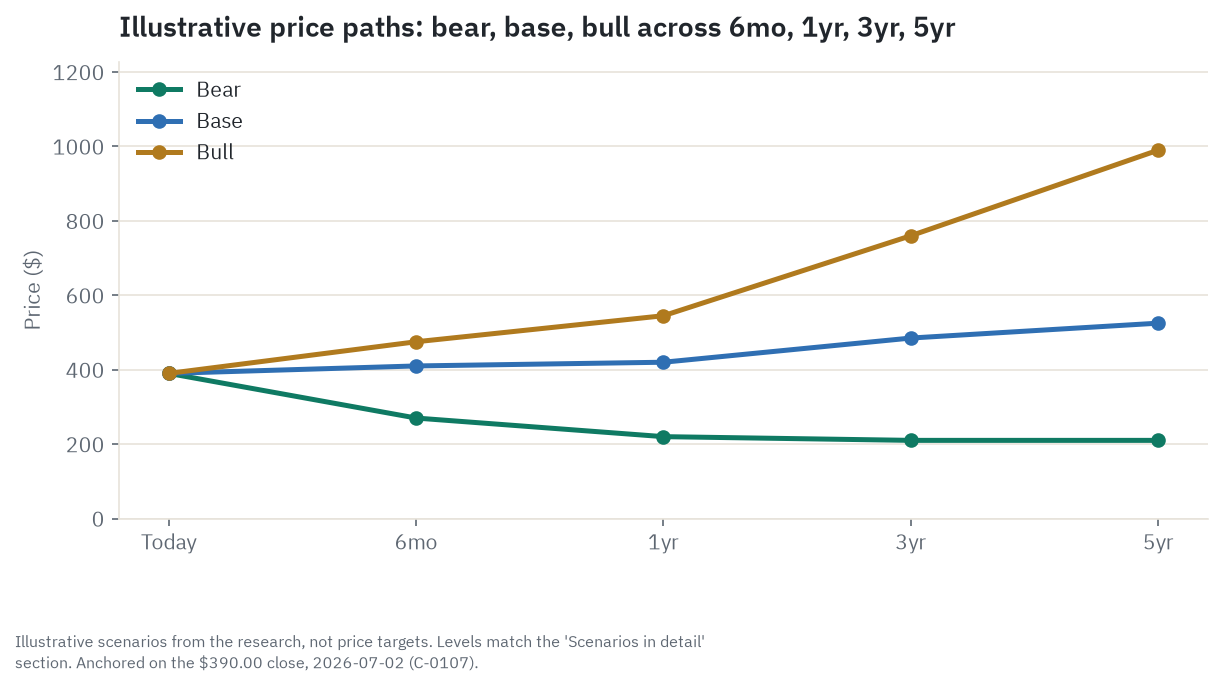
6 months. The next two earnings prints - Q2 FY2027 in roughly August 2026 and Q3 FY2027 in roughly November 2026 - decide whether the 2026 re-rating holds or unwinds further. This research is stamped to a day the stock fell 8.29%, part of a roughly 18% three-month pullback that began when GF Securities cut Dell to Hold on June 25, 2026, arguing that after a roughly 200% rally since February, “AI revenue revisions of up to $70 billion” were already priced in. If the next two quarters confirm the guided $44.0-45.0 billion Q2 revenue range and the backlog keeps growing, the base case holds around $410; a soft AI-orders print or a public admission that AI-server margin is moving the wrong way could push the stock toward $270; a beat-and-raise repeat could push it back toward $475. The single thing most likely to flip this window: what Dell says about its own AI-server margin trend on the next call.
1 year. By mid-2027, Dell will have reported full FY2027 results (expected around February 2027) against the current guide of $165-169 billion in revenue and roughly $17.90 in non-GAAP earnings per share at the midpoint. The dominant variable is whether that print, plus the FY2028 guide that comes with it, shows the backlog converting on schedule and the AI-server margin stabilizing - the base case, around $420 - or slipping further while a hyperscaler trims its own capital-spending guidance, the bear case, around $220. A scenario where margin actually starts to improve on services and storage attach points toward $545. What flips this horizon: any of the four biggest hyperscalers cutting AI capital-spending guidance, the single most direct read on whether Dell’s demand pipeline is expanding or plateauing.
3 years. By 2029, the structural drivers start to dominate the quarter-to-quarter noise. This is where the hyperscaler self-build and direct-to-manufacturer threat either has visibly eaten into Dell’s addressable AI-server market or has not: industry data already shows custom-chip-based server shipment share rising toward 28% of the market in 2026, the highest share since 2023. In the bear case, around $210, Dell’s AI-server growth decelerates sharply as more hyperscaler capacity goes to custom silicon or straight to contract manufacturers, while cheaper rivals keep capping Dell’s pricing power. In the base case, around $485, Dell holds a durable enterprise, government, and specialized-cloud-provider niche and blended margin stays roughly where it is today. In the bull case, around $760, Dell’s storage and services attach genuinely lifts the AI-server line’s own economics while the addressable market keeps growing faster than it gets carved up. What flips this horizon: the custom-silicon shipment-share trend line, and whether Dell’s non-hyperscaler AI customer base keeps growing in absolute dollars.
5 years. By 2031, the question is whether Dell used this AI-server supercycle to become a structurally better business or just a bigger one. The bear case, around $210, is the cycle finally normalizing: component-cost inflation and the debt taken on to fund Dell’s own customer-financing arm weigh on returns, and the business reverts toward the low-margin hardware-assembler profile it had before 2025. The base case, around $525, is a Dell that has roughly doubled its FY2026 revenue base while still running thin AI-server margins, its storage and traditional-server profit engine intact. The bull case, around $990, requires the margin-mix shift - more services and software revenue riding alongside every dollar of AI-server hardware - to actually happen at scale over a multi-year build-out that does not depend on any single customer. What flips this horizon: whether Dell’s blended margin trajectory, five years out, looks more like today’s durable storage business or more like today’s thin, volume-dependent AI-server line.
Where the read lands today. On balance the five-factor read nets to a Hold: the growth here is real and the backlog is the largest disclosed number of its kind among the traditional server makers, but the margin quality behind that growth, the leverage funding it, and the voting control sitting on top of it are real enough offsets that this does not read as a clean Buy. The single thing most likely to flip it toward Buy is a confirmed, several-quarter improvement in AI-server margin; the single thing most likely to flip it toward Sell is a hyperscaler capital-spending cut or a confirmed structural margin decline.
Companion tool
Jump to the interactive dashboard to sort and filter Dell against its peer set, or download the Excel model to flex the scenarios yourself.
TL;DR
Dell books more disclosed AI-server backlog than any other traditional server OEM - $51.3 billion at the end of its Q1 FY2027 (quarter ended May 1, 2026), up from $43 billion three months earlier, even after recognizing $16.1 billion of AI-server revenue in the quarter. That backlog is the reason the stock is up roughly 221-224% year to date through July 1, 2026. The part the rally has been slower to price is what management itself says on earnings calls: the AI-server line’s own operating margin runs in the mid-single digits, well below the 10.5-11.7% blended margin of the segment it sits inside, because Dell is mostly reselling Nvidia silicon at a thin, mostly fixed markup rather than capturing outsized value per dollar of revenue. The margin that is actually expanding sits in storage and traditional servers, the slower-growing, less exciting two-thirds of the business. Underneath all of it: $31.2 billion of total debt against negative $1.4 billion of stockholders’ equity, a customer-financing arm growing in lockstep with the AI cycle it funds, and a dual-class voting structure - just reinforced by a move from Delaware to Texas incorporation - that leaves Michael Dell and Silver Lake in control of 91.7% of the vote. None of that makes the growth fake. It does mean a reader should separate “AI-server revenue is up 757%” from “AI-server profit is up 757%,” because those are two very different numbers, and only the second one is what eventually reaches a public shareholder.
Explore it yourself: the interactive dashboard
Open the dashboard in a full screen
From PC maker to the biggest disclosed AI-server backlog in the OEM peer group
For most of the 2020s, Dell was a PC-replacement story with a storage subplot. That flipped in fiscal 2026 (the year ended January 30, 2026) and flipped again in the fiscal first quarter just reported (ended May 1, 2026): total revenue of $43.84 billion, up 88% year over year, with Infrastructure Solutions Group (ISG) revenue of $29.01 billion, up 181%, inside which AI-optimized server revenue alone came to $16.13 billion, up 757% year over year. Dell booked $24.4 billion of new AI-server orders in that single quarter and ended it with a backlog of $51.3 billion, spread across more than 5,000 customers.
Think of Dell’s AI-server business the way you would think of a moving company that has just been handed the contract to move an entire city’s furniture. The moving company does not manufacture the couches and refrigerators it carries - Nvidia does that, in the form of GPUs and networking silicon - it charges for the labor of packing, loading, driving, and delivering. A moving job worth $10,000 in furniture might only net the mover a few hundred dollars in profit even though the invoice says $10,000; the value of the couch is not the mover’s to keep. Dell’s AI-optimized servers work the same way: the invoice is dominated by the cost of the Nvidia GPU tray inside the rack, and Dell adds integration, cooling, networking, software, and support on top at what management itself describes as a mid-single-digit operating margin, well below the 10.5-11.7% blended rate the whole ISG segment reports. The stock re-rated because the moving company suddenly got handed a much bigger city to move. The stock’s actual economics did not re-rate anywhere close to the same degree, because the fraction of each invoice that Dell actually keeps did not change.
Companion tool orientation, in one more sentence
Everything quoted below - every dollar figure, every margin, every backlog number - traces to a claim recorded from Dell’s own SEC filings, its earnings releases, or a named, dated press or analyst source, with the hedges spelled out where a figure could not be independently cross-confirmed this pass.
How the money flows
flowchart TD
    A[Enterprise IT and AI demand: hyperscalers, neoclouds, sovereign AI programs, enterprise data-center refresh, PC refresh cycle] --> B[Dell Technologies go-to-market]

    B --> C[ISG: AI-optimized servers - PowerEdge XE9712 / XE9680 class]
    B --> D[ISG: Traditional servers and networking]
    B --> E[ISG: Storage - PowerStore, PowerScale, PowerProtect, ObjectScale]
    B --> F[CSG: PCs - Latitude, OptiPlex, Precision, XPS/Alienware]

    G[NVIDIA: Blackwell/Blackwell Ultra GPUs, Grace CPUs, NVLink/networking silicon] --> C
    H[Intel and AMD: server and PC CPUs] --> C
    H --> D
    H --> F
    I[Memory and NAND: SK hynix, Samsung, Micron - DRAM, HBM, SSD/NAND] --> C
    I --> D
    I --> E
    I --> F
    J[Networking and storage silicon: Broadcom, Marvell and other component vendors] --> D
    J --> E
    K[Single-source and limited-source component vendors flagged as a named 10-K risk] --> C
    K --> D
    K --> E

    C --> L[Assembly and system integration]
    D --> L
    E --> L
    F --> L

    L --> L1[United States: Austin/Round Rock and Nashville - servers, high-touch enterprise builds]
    L --> L2[Mexico and Brazil: contract-manufacturer and owned-plant assembly - PCs, peripherals]
    L --> L3[Malaysia: Penang - servers, networking, PC assembly]
    L --> L4[China: multiple owned and contract-manufacturer sites - PC and component assembly]
    L --> L5[Other owned plants: India, Poland, Ireland]

    L1 --> M[Distribution and go-to-market]
    L2 --> M
    L3 --> M
    L4 --> M
    L5 --> M

    M --> N[Direct sales force]
    M --> O[Channel partners, distributors, retail]
    M --> P[Dell Financial Services: leases, loans, subscription, as-a-Service, utility pricing]

    N --> Q[End customers: hyperscalers, neoclouds, sovereign/government, enterprise, SMB, consumer]
    O --> Q
    P --> Q
    Q -.new orders and backlog.-> A
Dell does not fabricate a single chip. It buys silicon, memory, and storage components from a concentrated set of suppliers, designs and validates full systems around them, has those systems built at owned plants and contract manufacturers on four continents, and sells them through a direct sales force, a channel network, and its own financing arm, Dell Financial Services (DFS). The two reportable segments - Infrastructure Solutions Group (servers, storage, networking) and Client Solutions Group (PCs, workstations, peripherals) - both sit on that same sourcing-and-assembly backbone.
The chokepoints sit above and below Dell in this chain, not inside it. Above: Nvidia is the toll-taker on Dell’s fastest-growing line, and Intel, AMD, and the memory makers (SK hynix, Samsung, Micron) are the second chokepoint - one that became visible in the income statement this year, as DRAM contract prices rose roughly 90-95% quarter over quarter in the first quarter of 2026, with another 58-63% quarter-over-quarter rise forecast for the second quarter. Dell and its peers passed that cost through: Dell raised commercial hardware prices by roughly 17% effective March 30, 2026. Below: assembly is genuinely diversified (owned plants in the United States, Malaysia, China, Brazil, India, Poland, and Ireland, plus a global contract-manufacturer network), which is Dell’s structural hedge against a single-country tariff or supply shock, even though the company’s own 10-K flags that “a significant concentration of such outsourced manufacturing is performed by only a few contract manufacturers, often in single locations.” Distribution runs through direct sales, a channel network, and DFS - and DFS is not a side business. It is how Dell converts a multi-billion-dollar-a-quarter AI-server order book into cash: DFS funded $11.9 billion of financing originations in fiscal 2026 (up from $8.4 billion in each of the two prior years) against a $14.3 billion receivables portfolio, growing directly because of AI-server demand.
What Dell actually sells: a field guide to the two segments
Infrastructure Solutions Group (ISG) is servers, storage, and networking, and it overtook CSG as Dell’s larger segment for the first time in fiscal 2026. Inside ISG there are three distinct businesses that behave nothing alike:
- AI-optimized servers - rack-scale systems built around Nvidia’s GB200/GB300-class GPU platforms (the PowerEdge XE9712 and related designs), sold to hyperscalers, specialized cloud providers, sovereign/government programs, and large enterprises. This is the fastest-growing line in the company by far: $24.7 billion in fiscal 2026, up 166% year over year, and $16.1 billion in the first quarter of fiscal 2027 alone, up 757%. It is also the thinnest-margin line, running at what management describes as a mid-single-digit operating income rate.
- Traditional servers and networking - the conventional (non-AI) enterprise and cloud server and switch business. Revenue grew 9% in fiscal 2026 and a much sharper 92% in the first quarter of fiscal 2027, alongside record overall demand; this line is a steadier, healthier contributor to segment margin than the AI-server line.
- Storage - enterprise arrays and software-defined storage, sold standalone or attached to servers. This was Dell’s traditionally best-margin ISG line, and it was nearly flat in fiscal 2026 (up just 1% to $16.6 billion) even as the rest of the segment boomed, before reaccelerating to 8% growth in the first quarter of fiscal 2027.
Chart below: what fiscal 2026 revenue looked like across all four lines, side by side.
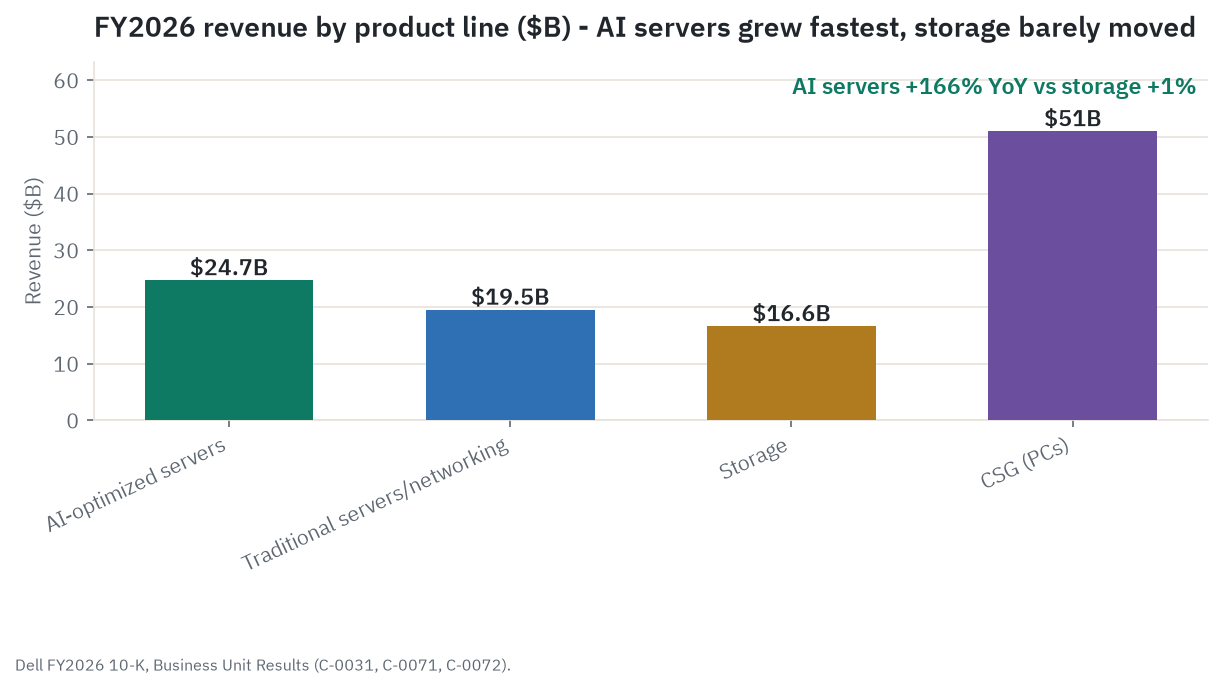
ISG’s blended operating margin was 11.7% for fiscal 2026 and 10.5% in the first quarter of fiscal 2027 (down from the full-year rate, because the AI-server mix inside the segment kept rising). That blended number is doing a lot of work to hide the underlying split: with AI-optimized servers now more than half of ISG revenue and running a margin management calls mid-single-digit, the arithmetic implies that traditional servers and storage - the smaller, slower-growing two-thirds of the segment by unit count but a much larger share of its actual profit dollars - are carrying most of the segment’s real earnings power.
Client Solutions Group (CSG) is PCs, workstations, and displays: Latitude and OptiPlex for commercial buyers, Precision workstations, XPS and Alienware for consumers and creators. CSG revenue grew a modest 5% in fiscal 2026 to $51.0 billion (commercial PCs up 8% to $44.1 billion, consumer down 8% to $6.9 billion) at a 5.6% operating margin - roughly half of ISG’s blended rate. Dell itself guides PC unit sales as roughly flat for 2026, and company-wide gross margin actually contracted 140 basis points year over year in one recent quarter specifically on competitive CSG pricing. This is the steady, unglamorous base of the business: real, structural, recurring demand from a roughly 1.5-billion-unit global installed base, but not a growth engine right now, and one where Dell is closer to a price-taker than a price-setter given how commoditized PC hardware has become.
Dell Financial Services (DFS), while not a reported segment, is the mechanism that makes the other two segments’ growth possible for many customers: leases, loans, subscription and as-a-service financing, and private-label credit, funded $11.9 billion of originations in fiscal 2026 against a $14.3 billion receivables portfolio, with a 0.2% charge-off rate that management describes as strong credit quality today.
Who wins where
Dell competes with two fundamentally different kinds of rival at once, and the distinction matters for how durable its position is. HPE and Lenovo build the same class of branded, service-attached AI servers and storage, competing on the same Nvidia-content-pass-through economics Dell does; HPE in particular has raised its own fiscal 2026 revenue-growth guidance to 29-33% (from 17-22%) on a doubling AI backlog after a Juniper Networks acquisition broadened its networking stack. Super Micro Computer (SMCI) competes as a leaner, less service-heavy box builder that can undercut on price for each new Nvidia platform generation, running structurally thinner margins (gross margin in the 6-10% range across recent quarters, against Dell’s 10.5-11.7% ISG operating margin) and carrying its own overhang: a reported investigation into alleged chip-export irregularities at its Taiwan operations, which the market has priced into a short-interest level (17.6% of float) more than three times any other name in this peer set. On storage specifically, NetApp and Everpure (the storage company formerly known as Pure Storage, which renamed and changed its ticker from PSTG to P in 2026) compete on software-defined data services and subscription economics rather than box price, and both are credible, differentiated rivals rather than price-takers themselves.
The more structural threat sits one layer up the chain from any of these named competitors: hyperscalers increasingly buy AI-server racks directly from Nvidia-certified contract manufacturers - reportedly Foxconn, Quanta, Wistron, and Wiwynn among them - bypassing branded OEMs like Dell and HPE entirely for their own captive data-center buildouts. Dell’s own stated counter-strategy is to lead with enterprise, sovereign, and specialized-cloud-provider customers rather than chase hyperscaler-direct business, differentiating on services, support, security, and its combined direct-plus-channel footprint rather than competing on bill-of-materials price alone. That is a rational retreat from a fight Dell cannot win on price, but it means Dell’s growth increasingly depends on the smaller slice of AI-infrastructure spending rather than the largest, best-funded slice controlled by the four biggest hyperscalers directly.
Company by company: who’s who
Dell Technologies (DELL) - NYSE, market cap approximately $252.0 billion (July 2, 2026). Leader by revenue among traditional server OEMs and a top-three global PC maker. Q1 FY2027 revenue $43.84 billion, up 88% year over year; ISG revenue $29.01 billion, up 181%, including AI-optimized server revenue of $16.13 billion, up 757%; AI-server backlog $51.3 billion with $24.4 billion booked in the quarter; FY2027 AI-server revenue guidance raised to roughly $60 billion, up 144%. Bull: the biggest pure-play beneficiary of the AI-server build-out among traditional OEMs, with a backlog that keeps growing faster than shipments, plus a resilient PC and storage base underneath. Bear: AI-server revenue is largely a GPU pass-through that inflates the top line while compressing blended margin, funded by a balance sheet that carries $31.2 billion of debt against negative stockholders’ equity, and controlled by two shareholders who hold 91.7% of the vote.
Hewlett Packard Enterprise (HPE) - NYSE, market cap approximately $54.2 billion. Number-two or -three enterprise server and AI-infrastructure vendor behind Dell, strengthened on the networking side by its Juniper Networks acquisition. Fiscal Q2 2026 server revenue $5.45 billion, up 32.7% year over year; Cloud and AI revenue up 22.9%; full-year revenue-growth guidance raised to 29-33% (from 17-22%) on a doubling AI backlog. Bull: the Juniper deal gives HPE a full-stack AI networking-plus-compute story, and its backlog is compounding faster than guided. Bear: smaller scale than Dell, thinner reported AI-server margins per trade press, and real integration and execution risk from a large, recent acquisition - and HPE’s own trailing P/E of 41x against a forward multiple of 11.4x is priced for a guidance beat that has to keep happening.
Super Micro Computer (SMCI) - NASDAQ, market cap approximately $17.5 billion. A high-density, liquid-cooled AI-server specialist that competes on speed-to-market for each new Nvidia platform rather than on breadth of portfolio. Trailing-twelve-month revenue $33.70 billion, up 56.2%; gross margin thin at roughly 8.4%, recovering from a 6.4% low earlier in the year. Bull: fastest time-to-market on new Nvidia platforms and a lower cost base let it win share whenever GPU supply, not integration breadth, is the bottleneck. Bear: the thinnest margins in this peer group, a reported investigation into alleged chip-export irregularities at its Taiwan operations, and short interest at 17.6% of float - more than three times any other name here - reflecting real, priced-in doubt about governance and durability, not just cyclical caution.
Lenovo Group (0992.HK, ADR: LNVGY) - primary listing Hong Kong Stock Exchange, market cap approximately US$35 billion (converted). Global PC-share leader and a fast-growing AI-server challenger to Dell and HPE. Fiscal-year 2025/26 revenue $83.1 billion, up 20%, the first year over $80 billion; Infrastructure Solutions Group revenue $19.2 billion for the year; AI-server order pipeline $21 billion, up from $15.5 billion. Bull: scale PC leadership plus a fast-growing AI-server pipeline gives Lenovo a rare combined consumer-and-enterprise AI story at a lower valuation than its US peers. Bear: China domicile and US-China trade friction are structural overhangs for a US investor, and the US-traded ADR is materially thinner (roughly 99,000 shares a day) than the Hong Kong primary listing - a real liquidity gap a dollar-for-dollar comparison with DELL, HPE, or SMCI would obscure.
NetApp (NTAP) - NASDAQ, market cap approximately $30.1 billion. A pure-play enterprise storage competitor to Dell’s storage line, not a supplier. Fiscal 2026 revenue $6.93 billion, up 5.37%, a record for the year; all-flash revenue $4.2 billion, up 11%. Bull: a steady, high-margin storage-and-software franchise with an all-flash and cloud-data-services mix still growing faster than the base business. Bear: growth here is modest next to the AI-server story running elsewhere in this piece, storage is a slower and more mature market than AI infrastructure, and NetApp has no AI-server exposure of its own to catch the same tailwind.
Everpure, formerly Pure Storage (NYSE: P) - market cap approximately $24.1 billion. A subscription-first storage challenger that rebranded from Pure Storage to Everpure and changed its ticker from PSTG to P in 2026. Fiscal 2026 total revenue $3.7 billion; subscription revenue $1.69 billion, up 15%; fiscal 2027 guidance $4.3-4.4 billion, up 18.8% at the midpoint. Bull: a subscription-heavy mix and a differentiated “Enterprise Data Cloud” architecture give it recurring-revenue quality that legacy arrays lack. Bear: small compared to Dell and NetApp in storage scale, and the corporate rename and ticker change create real data-continuity friction for investors screening on the old PSTG symbol.
What the filings say
Dell’s fiscal year ends the Friday nearest January 31; fiscal 2026 is the year ended January 30, 2026, and fiscal 2027 is the year ending roughly January 29, 2027. Everything in this section traces to the FY2026 Form 10-K, the Q1 FY2027 Form 10-Q, and the associated 8-K earnings exhibits, all filed with the SEC.
Revenue and margin. Fiscal 2026 total net revenue was $113.5 billion, up 19% year over year (fiscal 2025 was $95.6 billion, up 8%). GAAP gross margin was $22.7 billion, or 20.0% of revenue, down from 22.2% a year earlier on the AI-server mix shift described above. GAAP operating income was $8.1 billion (7.2% of revenue), up 31%; net income was $5.9 billion (5.2% margin), up 30%; diluted earnings per share were $8.68, up 36%. Non-GAAP operating income was $10.0 billion (8.8% margin), up 17%, and non-GAAP EPS was $10.30, up 27%. That trajectory accelerated sharply into the first quarter of fiscal 2027: record revenue of $43.8 billion, up 88%; GAAP operating income of $3.66 billion, up 214%; net income of $3.44 billion, up 256%; diluted EPS of $5.24, up 282%. GAAP gross margin rate fell to 17.8% from 21.1% a year earlier even as gross margin dollars grew 58% to $7.78 billion and operating margin rate actually rose (8.3% of revenue versus 5.0% a year ago) - because AI-server revenue is growing so much faster than the operating expense needed to support it, even while diluting the gross-margin percentage.
Dell’s own language on this, from the FY2026 10-K’s “Fiscal 2027 Expectations”: “We expect margin growth, while balancing anticipated margin rate pressure resulting from a continuing shift in mix towards our AI-optimized servers offerings. We anticipate notable inflation for component costs in Fiscal 2027.” That is the single most important sentence in Dell’s own filings for understanding this stock: revenue and operating-income dollars are growing fast, while the gross-margin rate is being structurally diluted by AI-server mix, with 2026’s memory-price spike adding a second, more temporary headwind on top.
Geography. Fiscal 2026 US net revenue was $63.1 billion against $50.4 billion from foreign countries - roughly 45% of revenue from outside the US, down from about 50% in fiscal 2025, as US-heavy AI-server demand grew faster than the rest of the business. No single foreign country reached 10% of consolidated revenue in any of the three fiscal years Dell presented.
Cash flow. Fiscal 2026 operating cash flow was $11.2 billion, up 147% year over year (fiscal 2025: $4.5 billion), driven by revenue growth and profitability, partially offset by higher financing receivables tied to AI-server DFS originations. Free cash flow was $8.6 billion, up 337%; adjusted free cash flow was $11.5 billion, up 272%. Capital expenditures were $2.6 billion for the year. Cash and equivalents ended fiscal 2026 at $11.5 billion, up from $3.6 billion a year earlier.
Debt and the balance sheet. Total debt principal rose $7.0 billion in fiscal 2026 to $31.8 billion, split between “core” debt outside the financing arm ($17.0 billion) and DFS-related debt ($14.6 billion) - the latter growing specifically to fund AI-server customer financing. As of the first quarter of fiscal 2027 (May 1, 2026): total assets $114.9 billion, cash $11.6 billion, total debt $31.2 billion ($7.55 billion short-term, $23.6 billion long-term), and total stockholders’ equity of negative $1.4 billion. That deficit is not new - it dates to the 2018 Class V/EMC-merger recapitalization and years of large share buybacks reducing paid-in capital below accumulated treasury stock, and it is not on its own evidence of distress - but it does mean Dell’s leverage cannot be read on a standard debt-to-equity basis and should instead be judged against cash flow and debt-service coverage. Accounts receivable jumped to $25.9 billion (from $17.6 billion at the prior fiscal year-end) and accounts payable to $45.3 billion (from $33.6 billion), both a direct function of the AI-server shipment scale-up and its working-capital needs. Since fiscal year-end, Dell refinanced its revolving credit facility into a new $6.0 billion facility maturing 2031 (nothing drawn) and issued $3.0 billion of new Senior Notes across three tranches maturing 2031, 2034, and 2037.
Capital returns and dilution. The board authorized a cumulative $20 billion share-repurchase program (originally approved 2021), then an additional $10 billion on February 26, 2026, leaving about $15.2 billion available. Dell repurchased roughly 54 million shares for about $6.0 billion in fiscal 2026 (versus 22 million shares/$2.6 billion in fiscal 2025), then a further roughly 11 million shares for about $1.6 billion in the first quarter of fiscal 2027. The board also approved a 20% dividend increase to $0.630 per share per quarter starting the first quarter of fiscal 2027, up from $0.525 (itself up from $0.445 in fiscal 2025); fiscal 2026 total dividends paid were $1.5 billion. Weighted-average diluted shares fell to 656 million in the first quarter of fiscal 2027 from 702 million a year earlier, down 7%, as buybacks outran stock-based-compensation dilution.
Ownership and control. Class A shares (held by Michael Dell, through himself and a family trust) and Class B shares (held by Silver Lake Partners-affiliated funds) each carry 10 votes; the publicly traded Class C stock (NYSE: DELL) carries 1 vote per share. As of March 9, 2026, Michael Dell and Silver Lake affiliates together held approximately 91.7% of total voting power of Dell’s outstanding common stock, while holding a minority of the economic shares outstanding. Dell discloses this itself as a risk factor: “the limited ability of unaffiliated holders of the Class C Common Stock to influence matters requiring stockholder approval may adversely affect the trading price of the Class C Common Stock,” and the structure has in the past led to exclusion from certain stock indices.
Disclosed risks, in the company’s own words. Three from the 10-K matter most to this thesis. First, single-source and limited-source supplier dependence: “the impact of supply constraints on our operations may be more acute during periods of rapid growth in demand for new products and services, such as the current demand for AI-optimized solutions.” Dell does not name Nvidia, Intel, AMD, or its memory suppliers in this language, but the mechanism plainly describes the dependency. Second, non-linear AI-server demand: “there is inherent non-linearity in the timing of demand and subsequent shipments for our AI-optimized servers offerings, which continues to drive variability in our revenue” - the mechanism by which a beat-and-raise quarter can coexist with a shrinking blended gross-margin rate, and by which a slowdown in bookings could hit revenue in lumps rather than smoothly. Third, the multi-class voting concentration described above.
The most consequential recent corporate event. On July 1, 2026 - the date this research is stamped to - Dell completed its conversion from a Delaware corporation to a Texas corporation, approved by stockholders at the June 25, 2026 annual meeting (combined-class vote: 3.358 billion shares for versus 107.7 million against). The new Texas charter elects a Texas Business Organizations Code provision requiring a derivative-suit plaintiff, or group of plaintiffs, to hold at least 3% of outstanding shares before suing a director or officer on the company’s behalf - a materially higher bar than the equivalent Delaware standard, and a governance change worth naming plainly: it reduces minority shareholders’ practical ability to bring derivative litigation. Dell states there is no change to headquarters, business, jobs, management, or assets as a result of the conversion.
Insider and institutional signal. June 2026 Form 4 filings around the redomestication vote were routine in size: a Silver Lake-affiliated director sold an aggregate 16,679 Class C shares on June 26, 2026 (roughly $6.6 million), and another director exercised options and sold 12,022 shares around $421 on June 17, 2026 - both small relative to the holders’ aggregate stakes and consistent with routine post-vesting liquidity rather than a signal. Third-party aggregation of 13F filings puts institutional ownership at roughly 76% of shares as of the most recent reporting period - a figure worth keeping conceptually separate from the 91.7% voting-power concentration above, since institutional holders sit almost entirely inside the single-vote Class C float, not the super-voting Class A/B shares.
What the market is paying
DELL traded at $390.00 as of mid-afternoon on July 2, 2026, down $35.25, or 8.29%, on the day. The 52-week range is $110.22 to $469.47 - more than a 4x spread, reflecting the stock’s re-rating from a legacy-hardware multiple to an AI-infrastructure growth multiple and a partial pullback since. Through the July 1 close the stock was up roughly 221-224% year to date, almost entirely on the AI-server revenue and backlog acceleration disclosed across the fiscal 2026 and Q1 fiscal 2027 earnings releases.
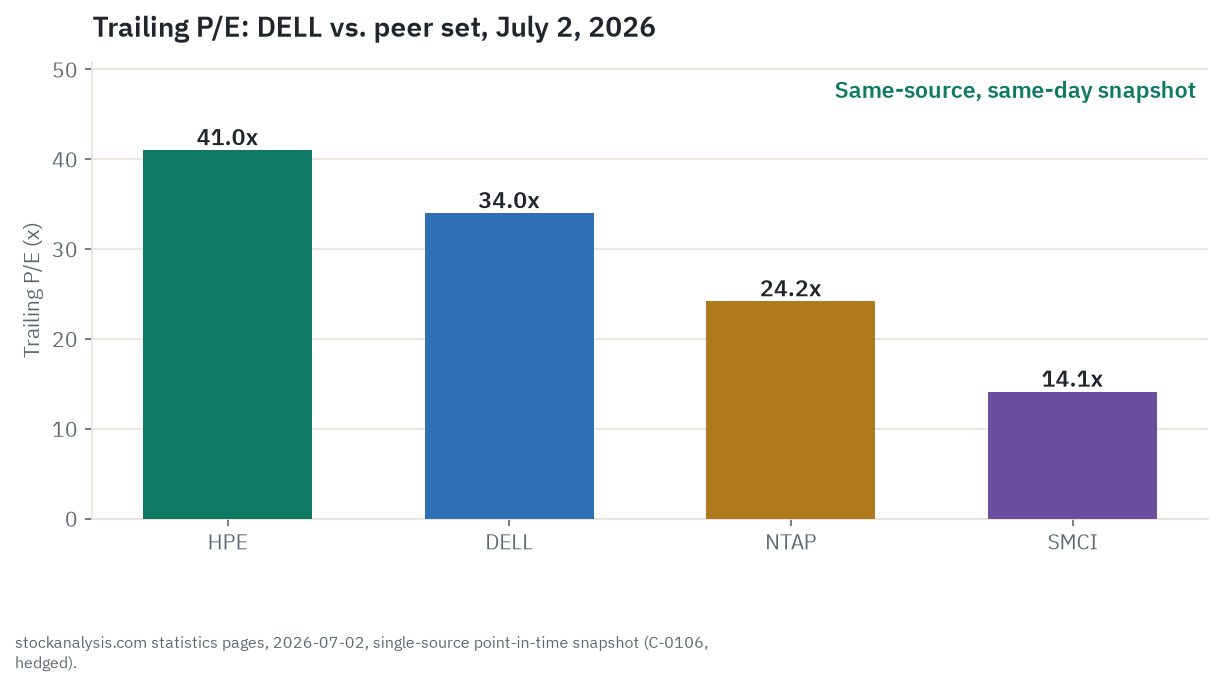
That gain has come with a sharp recent pullback: DELL was down about 6% over the week ended July 1-2 and roughly 18% over the trailing three months, after GF Securities downgraded the stock to Hold from Buy on June 25, 2026, arguing that after a roughly 200% run since February, “AI revenue revisions of up to $70 billion” were already priced into a stock trading near 34x trailing earnings - well above its longer-run historical median closer to 13x. A second, concurrent pressure has been renewed memory-cost-inflation concern across the sector, which compounds the same gross-margin story documented in the filings above.
| Metric | DELL | HPE | SMCI | NTAP |
|---|---|---|---|---|
| Price | $390.00 | $40.99 | $26.97 | $154.02 |
| Market cap | $252.0B | $54.27B | $17.44B | $30.18B |
| Trailing P/E | 33.99 | 41.01 | 14.12 | 24.18 |
| Forward P/E | 22.95 | 11.41 | 9.11 | 17.24 |
| EV/EBITDA | 20.33 | 13.13 | 16.67 | 15.87 |
| P/S | 1.98 | 1.49 | 0.55 | 4.44 |
| Beta (5Y) | 1.38 | 1.45 | 1.94 | 1.43 |
| Short % of float | 5.24% | 5.78% | 17.57% | 8.82% |
| Dividend yield | 0.65% | 1.39% | n/a | 1.36% |
Same-source, same-day snapshot (stockanalysis.com, July 2, 2026); reported here per one market-data aggregator and not independently re-derived from the primary financials above.
DELL is the most expensive of these four names on both trailing P/E and EV/EBITDA, though its forward P/E of 23x sits below its own trailing multiple of 34x and below HPE’s trailing 41x - meaning the market is pricing meaningful further earnings growth into Dell’s coming fiscal year, consistent with the guided 47% revenue growth and 74-99% EPS growth described above. SMCI trades at the cheapest multiples of the group on every metric except beta, consistent with both its thinner margins and its much higher short interest. Beta of 1.38 puts DELL modestly more volatile than the broad market, in line with (slightly below) HPE and NetApp and well below SMCI’s 1.94.
Sell-side consensus on DELL is Buy, with roughly 14 buy, 7 hold, and no sell ratings among one count of 21 covering analysts (a separate count puts it at 27 analysts, still consensus Buy). Price targets cluster with wide dispersion: an average around $465-484, a median around $490-500, a high of $700 from Susquehanna (May 29, 2026), and a low of $213. Morgan Stanley raised its target to $448 on June 1, 2026. GF Securities’ June 25 downgrade to Hold was the first crack in what had been a nearly uniform upgrade cycle, and a UBS note referenced in trade press carries a similar message - the stock has “nearly doubled in 2026” and, in UBS’s view, “likely won’t go any further” from current levels. The width of that $213-to-$700 target range - more than 3x - is itself informative: sell-side analysts looking at the same filings disagree sharply on how much of Dell’s AI-server backlog converts into durable, profitable revenue versus how much is a temporary pass-through spike that compresses margin as it scales.
Liquidity. DELL’s roughly $252 billion market cap makes it comfortably the largest name in this peer set - more than 4.6x HPE, about 14.5x SMCI, and about 8.3x NetApp. Only the Class C shares (roughly 324 million of the 649 million total shares outstanding across all classes) are freely tradable on the NYSE; Class A and Class B are not publicly listed, which caps DELL’s effective public float meaningfully below its total market cap and share count.
What the crowd is saying
Financial press coverage this year has been uniformly impressed on the top line and increasingly split on what it means for the bottom line. Outlets covering Dell’s earnings calls have converged on the same second-half-of-the-story angle: AI-server revenue is largely a GPU pass-through, so a dollar of AI-server revenue that displaces a dollar of legacy server revenue can pull the blended margin down even as absolute operating-income dollars rise. The same fact set gets read as both validation and warning depending on the outlet - some call Dell “the picks-and-shovels winner of the AI boom,” others flag “the margin problem nobody is talking about.” PC-cycle coverage is calmer and more structural: trade press treats the slow Windows-11 migration as a durable but stretched-out tailwind, not a catalyst about to snap into a single upgrade wave.
Retail attention (Stocktwits) flipped to “extremely bullish” immediately after the May 2026 earnings print, with 24-hour message volume up more than 1,200% and trailing-month volume up over 1,100%; watcher count, a rough proxy for new retail eyeballs on the name, rose about 6.2% in the same window. That is a large, fast attention spike, and importantly it is not unanimous cheerleading: alongside the bullish volume surge, retail-board coverage explicitly notes traders asking “if this isn’t a bubble then what is” even while staying net long - a pattern more consistent with momentum-chasing that knows it is momentum-chasing than with a calm, valuation-anchored thesis. That combination tends to make a stock more reflexive to headline risk (a single soft AI-orders data point, a GPU-supply hiccup, a customer-concentration scare) than its underlying fundamentals alone would suggest. Reinforcing the point: DELL and Super Micro traded up together the day after SMCI’s Taiwan-investigation-driven plunge, consistent with investors treating the AI-server hardware names as one basket that moves on sector sentiment as much as on company-specific news.
Employee sentiment (Glassdoor) sits at 3.7 out of 5 across roughly 43,900 reviews, down about 2% over the trailing 12 months; 63% would recommend Dell to a friend and 55% report a positive business outlook - middling-to-decent scores, not a red flag on their own. The more consistent theme in individual reviews is layoff fatigue: recurring references to workforce reductions “every 3 to 4 months” and a “culture of fear,” alongside complaints that cost discipline has gone far enough that some teams lack the tools or headcount to do the work. Read alongside the financial story, this looks like a useful internal counter-signal: the parts of Dell riding the AI-server supercycle are hiring and expanding scope, while cost actions elsewhere in the company - likely concentrated in the lower-margin PC business and back office - keep showing up as employee-reported layoffs.
The narrative in circulation - “Dell is the biggest pure-play winner of the AI-infrastructure build-out” - is directionally supported by real, filed numbers: the backlog, the bookings, and the guidance raises are not vibes. The divergence risk is not that AI-server growth is fake; it is that the market narrative has been slower to price in the margin structure underneath that growth than it has been to price in the top-line acceleration itself. A second, smaller divergence: customer-concentration risk - specialized cloud providers whose own backlogs depend on further downstream capital commitments from the hyperscalers - gets far less retail and even sell-side airtime than the headline backlog number itself, even though it is the more obvious channel through which a slowdown would first show up.
Is this durable, or is it a cycle peak wearing a growth-stock multiple?
The structural case for durability: the AI-infrastructure build-out Dell is filling is not being funded like a normal enterprise-IT upgrade cycle. Microsoft, Amazon, Alphabet, and Meta are guiding to a combined roughly $725 billion of 2026 capital spending, up about 77% from roughly $410 billion in 2025 - an order of magnitude larger and faster-moving than any prior enterprise hardware cycle Dell has ever participated in. Unlike the dot-com buildout, much of today’s capacity is pre-sold or pre-committed through long-dated capacity agreements between the largest players, which reduces (though does not eliminate) the risk of building ahead of real demand. If this cycle keeps compounding for several more years, Dell’s backlog-to-revenue conversion alone - a $51.3 billion backlog against a roughly $60 billion fiscal 2027 guide - provides a kind of multi-year revenue visibility the old PC-cycle version of Dell never had.
The cyclical bear case: every capex supercycle in the history of technology hardware has ended in overbuilding relative to realized demand, and this one already shows the same fingerprint. Component costs - memory in particular - are inflating fast enough that even the best-funded hyperscalers are having to raise their own capital-spending guidance just to hold capacity flat in real terms, a classic late-cycle signal of spending more to get the same amount of stuff. The specific trigger to watch is a disappointing realized return on AI investment at one or more of the four hyperscalers: if enterprise AI adoption or inference-revenue growth disappoints against the capital already committed, capital-spending guidance cuts have historically shown up within two to four quarters of the disappointment becoming visible, and Dell’s order backlog - a forward commitment, not yet-recognized revenue - is exactly the kind of number that can be pushed out or trimmed quickly in that scenario. A second, more immediate trigger is monetary policy: the Federal Reserve held its policy rate at 3.5%-3.75% at its June 2026 meeting and removed its prior guidance for a 2026 rate cut, with officials now split on whether the next move is a cut or a hike; a more hawkish path raises financing costs for the debt-funded portion of the hyperscaler buildout, for Dell’s own DFS book, and compresses Dell’s own equity multiple all at once.
The most likely outcome is a genuine split rather than a clean call in either direction. AI-server demand funding ISG is probably durable through at least fiscal 2027 given the size and specificity of the booked backlog, but the margin Dell captures on that revenue is structurally thin and will likely stay that way unless Dell’s mix shifts further toward higher-margin services and storage attach - plausible, but not guaranteed. The PC business is a slow, low-volatility tailwind through 2026, not a second growth engine. The realistic risk is not that AI-server demand evaporates; it is that component-cost inflation and monetary policy raise the cost of the buildout faster than hyperscalers can absorb it without trimming guidance, or that the market’s current roughly-34x multiple assumes a pace of AI-server margin improvement that management’s own commentary does not yet support - producing a sentiment-driven de-rating even if the underlying order book stays intact.
The scenarios in detail
Four variables decide where Dell actually lands over the next five years, in order of how much they move the outcome: (1) the pace at which the $51.3 billion AI-server backlog keeps converting into recognized revenue; (2) whether the AI-server line’s own mid-single-digit operating margin holds, improves, or slips further; (3) how much of the still-growing AI-infrastructure market shifts toward hyperscaler custom silicon and direct-to-manufacturer purchases, shrinking Dell’s addressable slice even if total demand keeps growing; and (4) how much cushion the balance sheet - $31.2 billion of debt atop negative equity - provides if any of the first three turns against the base case. A fifth, slower variable, the PC replacement cycle, sets the size of the stable base underneath the story but is not what moves the stock; it is guided roughly flat for 2026 and its recent shipment uptick is itself attributed by every major analyst tracker to channel pre-buying ahead of memory price hikes rather than a genuine demand recovery.
Bull - Dell converts the supercycle into a durable, better-margin franchise
Backlog conversion continues at or above the current pace; enterprise, sovereign, and specialized-cloud demand more than offsets any share Dell loses to hyperscaler self-build or direct-to-manufacturer purchasing; services and software attach genuinely lift the AI-server line’s own margin over several years, on top of the storage and traditional-server strength already showing up today; PC stabilizes and modestly improves off its current pricing-pressure trough; buybacks and the now-$0.630-per-share quarterly dividend keep compounding earnings per share on top of revenue growth. Under these assumptions, revenue compounds at a mid-to-high-teens rate from the fiscal 2027 guided base of roughly $167 billion, and non-GAAP earnings per share compound even faster on margin-mix improvement and continued buybacks. Illustrative estimate: roughly $990 per share in five years - an EPS estimate compounding into the high-$40s-to-low-$50s range at an 18-20x exit multiple, consistent with (not richer than) today’s forward multiple of roughly 23x. What breaks it: a single large hyperscaler pulling back capital-spending guidance, or the AI-server margin rate proving structurally stuck rather than improving.
Base - growth continues, margin quality stays roughly where it is
Backlog conversion continues but decelerates as the initial capacity ramp normalizes; AI-server operating margin holds in the mid-single digits rather than improving or worsening materially; non-hyperscaler demand grows but hyperscaler self-build and direct-to-manufacturer purchasing take some addressable share at the margin; PC stays a slow, low-volatility base business; the balance sheet stays levered but comfortably serviced by operating cash flow. Revenue growth decelerates from fiscal 2027’s roughly 47% guided pace toward a still-healthy low-double-digit rate over the following several years; non-GAAP EPS grows steadily, helped by continued buybacks. Illustrative estimate: roughly $525 per share in five years - an EPS estimate in the mid-$30s at a mid-teens exit multiple, reflecting a market that has stopped paying a hypergrowth multiple for a mid-single-digit-margin growth line but still credits the durable storage-and-traditional-server base. What breaks it: a sharper-than-expected acceleration of the custom-silicon/direct-to-manufacturer substitution trend would push this toward the bear case; a genuine margin-mix improvement would push it toward the bull case.
Bear - the AI-capex cycle matures and Dell’s economics revert
AI-server bookings growth stalls as more hyperscaler capacity shifts to custom silicon and direct-to-manufacturer purchases; the mid-single-digit AI-server margin proves to be a ceiling rather than a floor that improves; component-cost inflation and a hawkish Fed raise the cost of the debt Dell has taken on to fund its financing arm and its own balance sheet; PC stays weak on soft enterprise IT budgets; the negative-equity, $31.2-billion-debt balance sheet leaves little room to absorb a downturn without cutting capital returns or issuing more debt. Revenue growth decelerates sharply from the fiscal 2027 guided pace, and non-GAAP EPS grows slowly or stays flat as margin dilution persists and buybacks become the main lever left to grow earnings per share. Illustrative estimate: roughly $210 per share in five years - an EPS estimate in the high teens at an 11x exit multiple, consistent with the multiple SMCI and legacy hardware OEMs have historically carried when growth decelerates and margin quality is in question. What would confirm this scenario, rather than the base case: a hyperscaler capital-spending guidance cut, or a management admission of worsening AI-server margin - the two earliest, most direct confirming signals.
Companies to watch (bull / base / bear)
Dell Technologies (DELL). Role: the largest disclosed AI-server backlog among traditional OEMs. Bull: backlog conversion holds, margin mix improves via services and storage attach. Base: backlog converts more slowly, margin stays thin but stable, PC stays flat. Bear: hyperscaler capex pulls back or the custom-silicon shift accelerates, margin dilution proves structural, the debt load becomes a constraint on capital returns. Watch: AI-server operating-margin commentary on every earnings call.
Hewlett Packard Enterprise (HPE). Role: the closest full-stack competitor, now with a stronger networking story via Juniper. Bull: Juniper integration succeeds and AI backlog keeps compounding faster than guided. Base: steady share-of-market alongside Dell, similar margin dynamics. Bear: integration risk from the Juniper acquisition surfaces, and HPE’s own 41x trailing multiple against an 11.4x forward multiple proves to be pricing a beat that does not keep happening. Watch: Cloud & AI segment revenue growth versus guidance.
Super Micro Computer (SMCI). Role: the leanest, fastest-moving AI-server pure-play. Bull: wins share whenever GPU supply, not integration breadth or support, is the bottleneck. Base: continues as a smaller, cheaper, higher-beta alternative to Dell/HPE. Bear: the reported Taiwan export investigation resolves unfavorably, or thin margins compress further under pricing competition. Watch: resolution of the reported investigation and any further gross-margin trend.
Lenovo Group (0992.HK / LNVGY). Role: global PC-share leader building a genuine AI-server pipeline. Bull: AI-server order pipeline (currently $21 billion) keeps growing while PC leadership holds. Base: steady share gains in both PC and server lines at a persistent valuation discount to US peers. Bear: US-China trade or export-control escalation directly constrains its AI-server ambitions. Watch: AI-server order pipeline growth and any new export-control action affecting China-domiciled hardware makers.
NetApp (NTAP). Role: the steady, high-margin storage specialist without AI-server exposure. Bull: all-flash and cloud-data-services mix keeps growing faster than the base storage business. Base: modest, single-digit growth continues, unglamorous but durable. Bear: growth stays structurally slower than every AI-server name in this piece, capping re-rating potential. Watch: all-flash revenue growth rate.
Everpure, formerly Pure Storage (NYSE: P). Role: the subscription-first storage challenger. Bull: subscription mix keeps climbing, supporting a software-like re-rating. Base: steady growth in line with fiscal 2027 guidance. Bear: small scale relative to Dell/NetApp, and the rename/ticker change creates lingering investor-recognition friction. Watch: subscription annual recurring revenue growth.
Risk controls
Leverage and the balance sheet. $31.2 billion of total debt sits atop negative $1.4 billion of stockholders’ equity. Dell’s own framing - that the deficit dates to a 2018 recapitalization and years of buybacks, not distress - is fair, and operating cash flow of $11.2 billion in fiscal 2026 comfortably covers the $8.0 billion of debt due within 12 months. But every dollar of that debt is a fixed claim ahead of shareholders with no equity cushion below it, at the same moment Dell is issuing more debt to fund a customer-financing book that scales with the same AI-server cycle carrying the thin margin described throughout this piece.
Governance and control. Michael Dell and Silver Lake affiliates control 91.7% of the vote while holding a minority of the economic shares outstanding, and the July 1, 2026 move to Texas incorporation raised the ownership threshold to bring a derivative lawsuit to 3% of shares outstanding. A public Class C shareholder is, structurally, a passenger on strategy and capital-allocation decisions, and just became a passenger with less recourse if something goes wrong.
Customer and structural concentration. The AI-server backlog spans hyperscalers, specialized cloud providers, and sovereign programs; some of that backlog is one derivative layer removed from the ultimate payer, since specialized-cloud customers’ own order books depend on further downstream capital commitments from the hyperscalers. Separately, and more structurally, hyperscalers are simultaneously investing in their own custom silicon and, per industry reporting, buying some AI-server capacity directly from contract manufacturers - a trend that could shrink Dell’s addressable slice of AI-infrastructure spending even while total spending keeps growing.
Valuation after a large run. Shares are up roughly 221-224% year to date through July 1, 2026, and trade at the richest trailing multiple in this peer set. The first sell-side downgrade of the cycle already argues that a large amount of further AI-revenue upside is priced in.
Component-cost inflation. Sharp memory-price increases in 2026 are a genuine two-sided factor: they lift average selling prices and reported revenue in the near term, but compress margins and could eventually dampen unit demand if passed through too aggressively to customers.
What would change the thesis. A confirmed, several-quarter improvement in AI-server operating margin would be the strongest bull-side confirmation. A hyperscaler capital-spending guidance cut, or public confirmation that AI-server margin is structurally stuck or declining, would be the strongest bear-side confirmation. Any sign that the backlog is being pushed out or trimmed - not just growing more slowly - would be an early, concrete warning sign worth more weight than a single soft quarter of revenue.
Methodology, sourcing, and data-quality flags
This piece is built from Dell’s own SEC filings (the fiscal 2026 Form 10-K, the Q1 fiscal 2027 Form 10-Q, and associated 8-Ks), Dell’s own earnings releases and call transcripts, named analyst-tracker data (IDC, Gartner, TrendForce), named trade and financial press, and market-data aggregators for point-in-time price and valuation figures. Every load-bearing figure above is recorded in a claims ledger with its source, its as-of date, and a confidence tier (primary filing, analyst estimate, press report, or internal estimate); a small number of load-bearing figures that could not be independently cross-confirmed with a second source in this research pass are hedged explicitly below rather than stated as bare fact.
Data-quality flags.
- Dell discloses ISG segment operating margin (10.5% in Q1 FY2027, 11.7% in FY2026) but not a per-product-line margin. The “mid-single-digit” AI-server-specific operating margin cited throughout this piece is management’s own qualitative framing on earnings calls, not a filed GAAP figure - real and repeatedly stated, but an estimate rather than an audited rate.
- Market-share figures for servers, storage, and PCs bounce by tracker and quarter, and several rely on a single secondary outlet summarizing an IDC or Gartner release rather than the primary release itself; every specific market-share percentage in this piece should be read as directional, not audited.
- The claim that hyperscalers increasingly buy AI-server racks directly from contract manufacturers, bypassing Dell and HPE, traces to a single industry account; it is directionally consistent with Dell’s own stated strategy of pursuing enterprise, sovereign, and specialized-cloud customers instead of hyperscaler-direct business, but is reported here as an industry account, not a filed fact.
- Same-day valuation multiples and the July 2, 2026 intraday price move trace to a single market-data aggregator; a second live quote source was not independently fetched for this specific pass, which is standard practice for point-in-time market data but is flagged here for transparency.
- Sell-side price targets vary meaningfully by aggregator ($465.95 to $483.83 to $490.38 depending on source and analyst count), reported here as a range rather than a single consensus figure for that reason.
- Institutional ownership (~76%) is a third-party aggregation of 13F filings, not independently re-derived line by line, and is conceptually distinct from the 91.7% voting-power concentration held by Michael Dell and Silver Lake, which is a primary, filed figure on a completely different basis (votes, not economic shares held by the public float).
Where the five-factor read lands. Valuation nets to rich: DELL carries the highest trailing P/E and EV/EBITDA in its four-name peer set, and while its forward multiple is lower than its trailing one, the first sell-side downgrade of the cycle explicitly argues that a large amount of further AI-revenue upside is already priced in. Growth is exceptional and well-documented: 88% quarterly revenue growth, 757% AI-server revenue growth, and a backlog that grew even after a record quarter of shipments. Quality is genuinely mixed: cash generation is strong and improving (free cash flow up 337% in fiscal 2026) and the blended ISG segment margin is healthy, but the fastest-growing line inside that segment earns only a mid-single-digit margin, gross margin rate has contracted on competitive PC pricing, and the balance sheet carries negative stockholders’ equity. Risk is the weakest factor: $31.2 billion of debt atop that negative equity, a dual-class voting structure controlling 91.7% of the vote with a just-raised bar for derivative litigation, disclosed non-linear demand risk, and a real structural substitution threat from hyperscaler custom silicon and direct-to-manufacturer buying. Momentum is net positive but no longer one-directional: a roughly 221-224% year-to-date gain has come with a recent sharp pullback and the first sell-side downgrade of the cycle. Taken together, as a rules-based research signal and not personalized investment advice, this reads as a Hold: real, exceptional growth and cash generation offset by rich valuation, thin incremental margin quality, meaningful balance-sheet and governance risk, and cooling-but-still-positive momentum.
Key sources: Dell Technologies fiscal 2026 Form 10-K and Q1 fiscal 2027 Form 10-Q and 8-K exhibits (sec.gov); Dell Technologies investor-relations press releases; IDC Worldwide Quarterly Server Tracker and Enterprise Storage Systems Tracker (via Network World and Blocks & Files); Gartner worldwide PC shipment data; TrendForce AI-server shipment forecasts; stockanalysis.com for point-in-time price and valuation data; Stocktwits and Glassdoor for sentiment signal; Blocks & Files, Futurum Group, The Motley Fool, and TIKR for earnings-call analysis; Barchart, Benzinga, and TradingKey for sell-side consensus data.
Prepared July 2, 2026. Figures are point-in-time and will change. This is research and analysis for educational purposes - not investment advice, not a recommendation, and not a solicitation. DELL-specific risks include thin AI-server margin economics, a levered and negative-equity balance sheet, concentrated voting control, and structural substitution risk from hyperscaler custom silicon and direct-to-manufacturer buying. Verify all figures independently and consult a licensed financial advisor before making any decision.