
Research date: July 2, 2026 | OSINT market research on Arista Networks, Inc. (ANET, NYSE), the AI-era Ethernet switching leader whose software-defined networking operating system turns commodity merchant silicon into a 64-percent-gross-margin systems business, now facing its first real test from a vertically integrated Nvidia.
Important disclaimer. This is OSINT-based research and educational analysis, not investment advice. I am not a financial advisor. Nothing here is a recommendation to buy or sell any security, and the scenarios below are illustrative, not price targets. Networking-equipment stocks tied to hyperscaler capital-spending cycles can swing sharply on a single earnings call or a single customer’s budget decision; treat every forward number as an estimate, not a guarantee. Market caps, prices, valuation multiples, and market-share figures are point-in-time (July 2, 2026), press-reported or analyst-sourced where noted, and move fast. Do your own due diligence and consult a licensed advisor.
Where this stock could be in 6 months, 1 year, 3 years, and 5 years
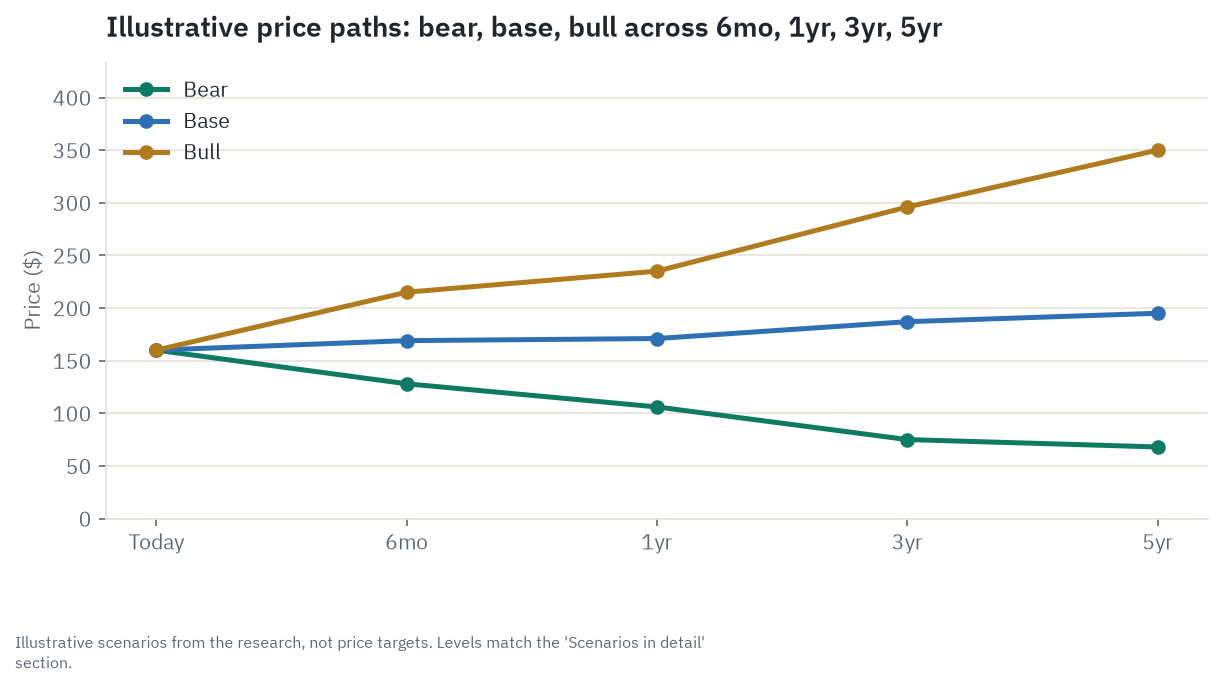
6 months. The next two quarters are almost entirely about execution against a number the company already gave the market: an $11.5 billion FY2026 revenue guide and a $3.5 billion AI-fabric target, both raised on the May 2026 earnings call. Watch Q2 and Q3 prints and, just as important, what the big hyperscalers say about their own 2027 capital budgets when they report in October and November. In the base case, Arista tracks the guide, the stock earns a little ground as earnings growth outpaces a gentle cooling in the multiple, and shares drift toward $169. The bull case, $215, needs a clean beat-and-raise on both quarters plus strong hyperscaler capex commentary for 2027, holding the market’s willingness to pay something like 43 times forward earnings. The bear case, $128, needs the opposite: an early sign of capex caution from Meta or Microsoft, or a fresh data point showing Nvidia’s Spectrum-X pulling further ahead in the datacenter-switching numbers, either of which would push the multiple into the low 30s. The single thing most likely to decide this window: what Microsoft, Meta, Amazon, and Alphabet say about 2027 capital spending on their autumn earnings calls.
1 year. By next summer, FY2026 will be fully reported and the market will have real evidence on whether FY2027 growth is holding or fading. The base case has FY2027 revenue near $14 billion, a shade over 20 percent growth, with the multiple continuing to normalize toward the mid-30s as the initial AI-build phase matures - the net effect is shares roughly flat with the six-month mark, around $171. The bull case, $235, needs FY2027 to clear $15 billion with the AI-fabric line above $5 billion and a new double-digit customer emerging to broaden the base beyond the current two. The bear case, $106, needs visible capex deceleration confirmed alongside an IDC data point showing Nvidia has taken the outright number-one position in datacenter switching. The deciding variable here is simply the FY2027 growth rate relative to FY2026’s.
3 years. This is where the structural question gets a real answer: was 2024 through 2027 a one-time AI infrastructure build-out, or a permanent step up in how much networking hardware the cloud needs? In the base case, revenue reaches the high teens of billions, growth has settled into the low teens, the multiple has cooled to the low 30s, and shares sit around $187 - a modest, mostly earnings-driven gain from today. The bull case, $296, requires Ethernet to have won the AI-fabric architecture argument outright and Arista’s newer campus and enterprise push to have meaningfully diversified revenue. The bear case, $75, is a real digestion cycle: revenue stalling near $13 billion as hyperscaler capex contracts, margins compressing under Nvidia and Cisco competition, and the stock re-rating to a cyclical-hardware multiple in the low 20s. What flips this window: whether the AI workloads hyperscalers are paying to run are generating enough revenue of their own to justify the capex that built them, visible in cloud-services growth rates by 2028.
5 years. The widest spread of any horizon, $68 to $350, which is the honest reflection of a high-beta, two-customer-concentrated business riding a capital-spending cycle nobody can fully forecast five years out. In the base case, Arista is a $22 billion-revenue company growing high single digits with stable margins, earning around $6.50 a share at a 30 multiple, near $195 - a quality business that has finally grown into today’s rich price tag. In the bull case, Arista is a $29 billion franchise with expanding margins and durable AI-Ethernet leadership, earning near $10 a share, still commanding a growth premium, above $350. In the bear case, the capex cycle peaked around 2027, Nvidia and Cisco have taken real share, and a $14 billion Arista trades at a cyclical-hardware multiple near 19 times, around $68 - a 57 percent decline from today. The clearest early tell for which path is playing out: gross margin and the customer-concentration percentage in each quarterly filing.
Where the read lands today. On balance, the five-factor read holds at Buy: the growth and the balance sheet are about as good as large-cap technology gets, but the valuation leaves little room for the two customers that make up 42 percent of revenue to disappoint, or for Nvidia to keep closing the gap it has already closed once. The single thing most likely to flip this read is a visible slowdown in hyperscaler capex growth showing up in two straight quarters of Arista revenue growth below 20 percent.
Companion tool
Jump to the interactive dashboard to sort and filter every company in this piece, or download the Excel model to flex the scenarios yourself.
TL;DR
Arista does not build data centers or make GPUs. It sells the Ethernet switches that move data between them, and it wraps that hardware in EOS, a single-binary network operating system that has run across its entire product line since 2008, turning what would otherwise be a 15-to-25-percent-gross-margin commodity box into a 64-percent-margin systems product. That software moat, plus a debt-free balance sheet holding more than $12 billion in cash and a free-cash-flow margin near 47 percent, is why the stock has compounded so hard through the AI infrastructure build-out: revenue grew 28.6 percent in FY2025 and 35.1 percent in the most recent quarter, and management just raised its FY2026 revenue guide to roughly $11.5 billion. The tension is that two customers, widely reported to be Microsoft and Meta, together account for about 42 percent of that revenue, and Nvidia’s Spectrum-X switching platform, bundled directly into GPU orders, reached a hair’s breadth of Arista’s own share of the datacenter-switching market in barely two years from a standing start. The stock trades at roughly 55 times trailing earnings and 42 to 45 times forward earnings, the richest multiple in its own five-year history and well above every direct peer, which means the market has priced in years of continued 20-percent-plus growth with very little cushion if either the hyperscaler capex cycle cools faster than expected or Nvidia keeps taking share at the next port-speed transition. The read lands at a cautious Buy: an excellent business, priced for one.
Explore it yourself: the interactive dashboard
What Arista actually does
Arista makes the switches and routers that move data around the inside of a data center and between data centers - the plumbing that lets thousands of servers, or thousands of GPUs, talk to each other fast enough to act like one giant computer instead of a warehouse of separate boxes. It reports as a single business segment, but the products fall into two practical buckets. The first, and by far the larger, is data-center and cloud networking: high-radix Ethernet switches sold to hyperscale cloud operators and to AI infrastructure builders, running from established 400G and 800G platforms up to the newly launched 1.6 terabit-per-second 7060XE7 family aimed squarely at the next generation of AI training and inference clusters. The second is campus and enterprise networking, where Arista competes for the wiring-closet and office-network business that Cisco and HPE’s newly acquired Juniper unit have historically dominated. Management targets roughly $1.25 billion in campus and enterprise revenue for FY2026, up from an estimated $750 to $800 million in FY2025, making it still under 15 percent of total revenue but the fastest-growing non-AI line in the company.
What actually makes the money is not the box. It is EOS, Arista’s network operating system, and CloudVision, its fleet-wide monitoring and automation layer. Arista buys the switching silicon that does the actual packet forwarding from Broadcom, largely, and to a lesser extent Intel, the same way most of the industry does. What it does not buy off a shelf is the software: a single EOS binary has run across the company’s entire hardware line since 2008, meaning a network engineer who learns Arista’s command syntax and automation tooling on a small switch can run it, unmodified, on the company’s largest AI-fabric platform. That consistency is the reason a metal box full of merchant silicon that a contract manufacturer could otherwise assemble at a 15-to-25-percent gross margin instead sells at 64 percent. Revenue splits 84.1 percent product and 15.9 percent service in FY2025, with service revenue, mostly software support and subscription renewals, growing almost exactly in step with product revenue - a sign the installed base is renewing rather than churning.
Geographically, Arista is overwhelmingly a US-facing business: 79.1 percent of FY2025 revenue came from the Americas, 11.9 percent from EMEA, and 9.0 percent from Asia-Pacific, reflecting where the hyperscaler capex that funds Arista’s growth is actually being spent rather than a deliberate international push.
How the money flows
flowchart TD
    subgraph Demand["Demand: AI / cloud capex"]
        HC["Hyperscaler capex<br/>roughly $660-725B combined 2026 (5 firms)"]
        ENT["Enterprise / campus IT budgets"]
    end
    subgraph Vendors["Network equipment vendors"]
        ANET["Arista Networks<br/>EOS + CloudVision, ~$11.5B FY26E rev"]
        CSCO["Cisco<br/>Silicon One custom ASICs"]
        NVDA_NET["Nvidia Spectrum-X<br/>vertically integrated GPU fabric"]
        HPE_J["HPE / Juniper<br/>$14B deal July 2025, Mist AI"]
    end
    subgraph WhiteBox["Commodity tier"]
        WB["White-box ODMs<br/>Celestica, Edgecore/Accton"]
    end
    subgraph Silicon["Merchant silicon (chokepoint)"]
        AVGO["Broadcom<br/>Trident/Tomahawk/Jericho ASICs"]
        INTC_S["Intel<br/>Tofino/Barefoot"]
    end
    subgraph Assembly["Contract manufacturing"]
        CM["Jabil / Sanmina / Flex / Foxconn<br/>Malaysia, Vietnam, Mexico"]
    end
    subgraph Optics["Optical transceivers"]
        OPT_CN["InnoLight / Eoptolink<br/>~60% of global 800G volume"]
        OPT_W["Coherent / Lumentum<br/>Western diversification"]
    end

    HC --> ANET
    HC --> CSCO
    HC --> NVDA_NET
    HC --> HPE_J
    HC --> WB
    ENT --> CSCO
    ENT --> HPE_J
    ENT --> ANET

    ANET --> AVGO
    ANET --> INTC_S
    ANET --> CM
    ANET --> OPT_CN
    ANET --> OPT_W
    CSCO --> CM
    CSCO --> OPT_CN
    HPE_J --> AVGO
    HPE_J --> CM
    WB --> AVGO
    WB --> CM
The money starts as capital expenditure at a small number of hyperscale cloud and AI infrastructure operators. Five companies, Microsoft, Meta, Amazon, Alphabet, and Oracle, are guiding toward a combined $660 billion to $725 billion of 2026 capital spending, most of it earmarked for AI data-center build-out. That capital has to move through a network fabric before it reaches a single GPU, and that is where Arista sits: Microsoft alone is roughly 26 percent of Arista’s revenue and Meta about 16 percent, so 42 cents of every dollar Arista books traces back to just two customers’ budgets. A smaller, more diversified stream of enterprise and campus IT spending sits behind that hyperscaler core.
Arista itself makes nothing physically. It is a fabless hardware-and-software company: it designs the switch and router platforms, writes the EOS operating system that runs them, then pays Broadcom, primarily, and Intel for the merchant silicon that does the packet switching, pays contract manufacturers such as Jabil, Sanmina, Flex, and Foxconn to assemble the boxes in Malaysia, Vietnam, and Mexico, and pays optical-module makers for the pluggable transceivers that link switches to servers and to each other. None of Arista’s suppliers has an exclusive or guaranteed-supply relationship with the company, a point Arista’s own 10-K flags as a risk. The moat is not the silicon, which Arista buys off the same price list as its competitors. It is the software wrapped around it.
The same Broadcom chips that power Arista’s boxes also go to a tier of white-box original design manufacturers, Celestica, Accton and its Edgecore brand, Delta, and UfiSpace, who sell bare switches directly to hyperscalers willing to run their own network operating systems, Meta’s FBOSS or Microsoft’s SONiC, instead of paying for a branded one. That is the commodity floor beneath Arista’s pricing: any hyperscaler with in-house networking talent can, in principle, route around Arista for undifferentiated switching. Cisco, competing through its own custom Silicon One chips rather than Broadcom’s merchant silicon, Nvidia, competing by bundling its vertically integrated Spectrum-X switches with GPU orders, and HPE, having spent $14 billion in July 2025 to buy Juniper and its Mist AI networking stack, are the three names most likely to take share, each attacking from a different angle.
The AI networking field guide
EOS (Extensible Operating System) is Arista’s single-binary network operating system, running unmodified across every switch the company sells, from a small campus box to the largest AI-fabric platform. It is the software layer that lets Arista charge systems-level prices for what is, underneath, a commodity hardware assembly.
CloudVision is Arista’s network-wide telemetry, automation, and change-management layer, sold on top of the installed hardware base as a recurring, subscription-like add-on. On the company’s own Q4 2025 earnings call, management said subscription-based network services and software revenue contributed roughly 17 percent of total revenue, a company-disclosed figure though not a discrete line item on the audited income statement.
AI-fabric revenue is Arista’s term for the portion of its business tied specifically to AI training and inference clusters, distinct from general cloud and enterprise networking. Management raised the FY2026 target for this line from $3.25 billion to $3.5 billion in May 2026, out of a roughly $11.5 billion total-revenue guide - meaning AI-specific demand is now expected to be nearly a third of the company’s business this year, up from a base that barely existed three years ago.
The 1.6 terabit-per-second transition. Every network runs at a given port speed, the rate at which a switch can move data through a single connection. Arista has more than 100 cumulative customers on its 800G platforms as of the first quarter of 2026 and just launched its first 1.6T family, the 7060XE7, with initial units shipping in the fourth quarter of 2026 and higher-density, liquid-cooled versions following in the first quarter of 2027. Think of a port-speed transition like a city widening its highway from four lanes to eight: existing traffic still needs to get somewhere, but the wider road unlocks new kinds of traffic that could not have moved efficiently before. Each transition is a genuine growth catalyst as customers refresh gear, but it is also a competitive reset, because every vendor gets a fresh shot at winning the socket regardless of who won the previous generation.
Ethernet versus InfiniBand. These are two different families of networking technology used to connect the tightest-latency parts of an AI training cluster. InfiniBand, historically controlled by Nvidia through its Mellanox acquisition, has been the default choice for the largest, most latency-sensitive clusters. Ethernet, Arista’s home turf, is cheaper, more standardized, and supported by a much broader supplier base. Arista’s central strategic bet is that Ethernet displaces InfiniBand even at the largest cluster sizes as workloads scale; management says a fourth major AI customer completed a production-scale migration to Ethernet as of the first quarter of 2026, with more expected. Independent analyst Dell’Oro projects Ethernet dominating both the tightest in-rack connections and the broader cluster-to-cluster networking in AI data centers going forward, though this is a forecast, not a settled outcome.
Who wins where
The competitive map for AI datacenter networking sorts into four tiers that behave very differently through a downturn. At the top sits the software-differentiated systems layer, where Arista, and increasingly Cisco, sell an integrated hardware-and-operating-system product; this tier captures the best risk-adjusted economics in the whole chain, because the switching costs that come from retraining network operations staff and rewriting automation scripts persist even if a customer’s overall spending pauses. Below that is the merchant-silicon layer, dominated by Broadcom, which earns high margins on its own chip business but is exposed to the same boom-bust cycle as any leading-edge semiconductor maker, and increasingly to competition from captive silicon designed in-house by hyperscalers or by Nvidia for its own switches. Below that sits contract manufacturing, Jabil, Sanmina, Flex, and Foxconn, which assembles the physical boxes for low-single-digit to low-teens margins with no exclusivity and gets squeezed first in any pullback. Off to the side sits the white-box tier, Celestica and Accton’s Edgecore brand among them, selling bare Broadcom-based switches directly to hyperscalers who are willing to run their own operating systems; this is the commodity floor that caps how much Arista, or anyone else, can charge for undifferentiated switching.
The newest and most disruptive entrant does not fit neatly into any of those four tiers. Nvidia is not a merchant-silicon customer of Broadcom for its own Spectrum-X switches, and it does not sell switches as a standalone product the way Arista or Cisco does. It bundles Spectrum-X switches, BlueField data-processing units, and LinkX cabling directly into the same purchase order as its GPUs, meaning the networking often arrives at effectively zero incremental sales cost to Nvidia and at a system-level discount a standalone switch vendor cannot match. That is a structurally different kind of competitor than anything Arista has faced before, and it is the single most important reason the competitive risk in this business looks different today than it did three years ago.
Company by company: who’s who
Arista Networks (ANET, NYSE). Market cap roughly $201 billion. The category leader in AI and cloud Ethernet switching, built on the EOS software layer described above. Q1 2026 revenue was $2.709 billion, up 35.1 percent year over year; FY2025 revenue was $9.006 billion, up 28.6 percent, with GAAP gross margin of 64.1 percent and net income of $3.511 billion. Management raised FY2026 revenue guidance to roughly $11.5 billion and the AI-fabric revenue target to $3.5 billion on the May 2026 call. Bull: a category-leading franchise riding still-growing hyperscaler capex, with software lock-in, 64-percent-plus gross margins, and management raising guidance in the same quarter it reported results. Bear: extreme customer concentration, two accounts near 42 percent of revenue, at a stock priced around 55 times trailing and 42 to 45 times forward earnings, leaving no room for error if Nvidia or Cisco take share at the same hyperscalers Arista depends on.
Cisco Systems (CSCO, NASDAQ). Market cap roughly $463 billion. The largest diversified networking incumbent, re-emerging as a credible AI-networking competitor through its Silicon One custom chips. Fiscal Q1 2026 total revenue was $14.9 billion, up 8 percent, with networking revenue up 15 percent to $7.77 billion; management guided to roughly $9 billion of hyperscaler AI infrastructure orders for the full fiscal year, about 4.5 times the prior year’s total. Bull: a far larger installed base, balance sheet, and enterprise moat than Arista, with real Silicon One design wins at three hyperscalers, trading at roughly 38 times trailing earnings against Arista’s roughly 55 times. Bear: legacy enterprise and security lines grow far slower than the AI datacenter niche, and Cisco has repeatedly ceded early ground in cloud and AI switching to Arista and now to Nvidia.
Nvidia Corporation (NVDA, NASDAQ). Market cap roughly $4.73 trillion. The dominant AI accelerator maker whose Spectrum-X Ethernet switching platform is extending its reach from GPU compute into the networking layer that connects its own chips. Per independent analyst IDC, Spectrum-X took the top spot in first-quarter 2026 datacenter-segment Ethernet switching with 21.5 percent share and $2.1 billion of revenue, up 192.7 percent year over year, narrowly ahead of Arista’s 20.7 percent share and $2.2 billion of revenue, up 37.3 percent, though Arista’s absolute datacenter dollar revenue still edged out Nvidia’s in that same quarter. Meta and Oracle have both been named as adopters of Spectrum-X switches for their AI fabrics. Bull: owns the GPU that anchors the entire AI build-out and is now bundling fast-growing networking with it, at a far lower trailing multiple, roughly 30 times, than Arista. Bear: networking is a small side business relative to Nvidia’s core GPU franchise, and its near-193-percent growth rate is off a tiny base; any GPU-cycle slowdown would hit the much larger core business first.
Broadcom Inc. (AVGO, NASDAQ). Market cap roughly $1.75 trillion. The merchant-silicon supplier whose Tomahawk and Trident chips power most of Arista’s, and the industry’s, Ethernet switches, alongside a fast-growing custom AI-accelerator design business for hyperscalers directly. Arista’s own SEC filings name Broadcom as a sole or limited source of supply for its switching silicon, a supplier-concentration risk the company discloses as a formal risk factor. Bull: sits upstream of nearly every Ethernet switch vendor as the dominant merchant-silicon supplier, while also winning custom AI-chip design contracts directly with hyperscalers, a toll-taker position with the option to compete with its own customers. Bear: the richest valuation in this peer set at roughly 61 times trailing earnings, pricing in flawless execution on two different franchises at once.
Hewlett Packard Enterprise (HPE, NYSE). Market cap roughly $54.6 billion to $58.2 billion, having pulled back sharply from an all-time high of $64.25 in June 2026. Since closing its roughly $14 billion acquisition of Juniper Networks in July 2025, HPE now combines Juniper’s Mist AI-driven networking with its own Aruba portfolio. Fiscal second-quarter 2026 combined networking segment revenue was $2.7 billion, up 148.2 percent year over year on the Juniper contribution, with segment operating margin of 21.6 percent. Bull: the Juniper deal instantly created a credible number-two or number-three campus and AI-networking portfolio at much greater scale, trading at a low forward multiple around 11 times if execution holds. Bear: the networking segment is still primarily a campus and enterprise story rather than a hyperscaler AI-fabric one, integration risk from the Juniper deal is real, and the stock’s sharp single-day swings suggest the market remains unsettled about the durability of the post-merger growth rate.
Ciena Corporation (CIEN, NYSE). Market cap roughly $59.8 billion to $64.25 billion. An optical-networking and data-center-interconnect vendor, complementary to Arista’s Ethernet switching rather than a direct substitute, connecting facilities rather than servers inside them. Fiscal second-quarter 2026 revenue was $1.57 billion, up 40 percent year over year, with adjusted earnings per share up 290 percent, and management raised FY2026 revenue guidance to $6.3 billion at the midpoint. Bull: AI datacenter build-outs need more optical bandwidth between and within facilities, and Ciena is capturing that adjacent wave. Bear: a trailing price-to-earnings ratio near 140 times prices in years of continued acceleration, and the stock’s own sharp single-day drop around this date shows how richly the growth is already priced.
What the filings say
Arista’s audited FY2025 Form 10-K, filed February 17, 2026, and the Q1 2026 Form 10-Q show a company whose growth and profitability have both been rising at once, a combination that is rare at this scale. Revenue ran $5.860 billion in FY2023, $7.003 billion in FY2024, and $9.006 billion in FY2025, growth rates of 33.7 percent, 19.5 percent, and 28.6 percent respectively. That FY2024 dip to 19.5 percent is worth flagging on its own: it lines up with a broader, brief cloud-infrastructure spending pause across the industry in 2022 and 2023, and it is the clearest historical precedent for what a digestion year in Arista’s own numbers actually looks like. Growth then reaccelerated sharply, with the first quarter of 2026 coming in at $2.709 billion, up 35.1 percent year over year.
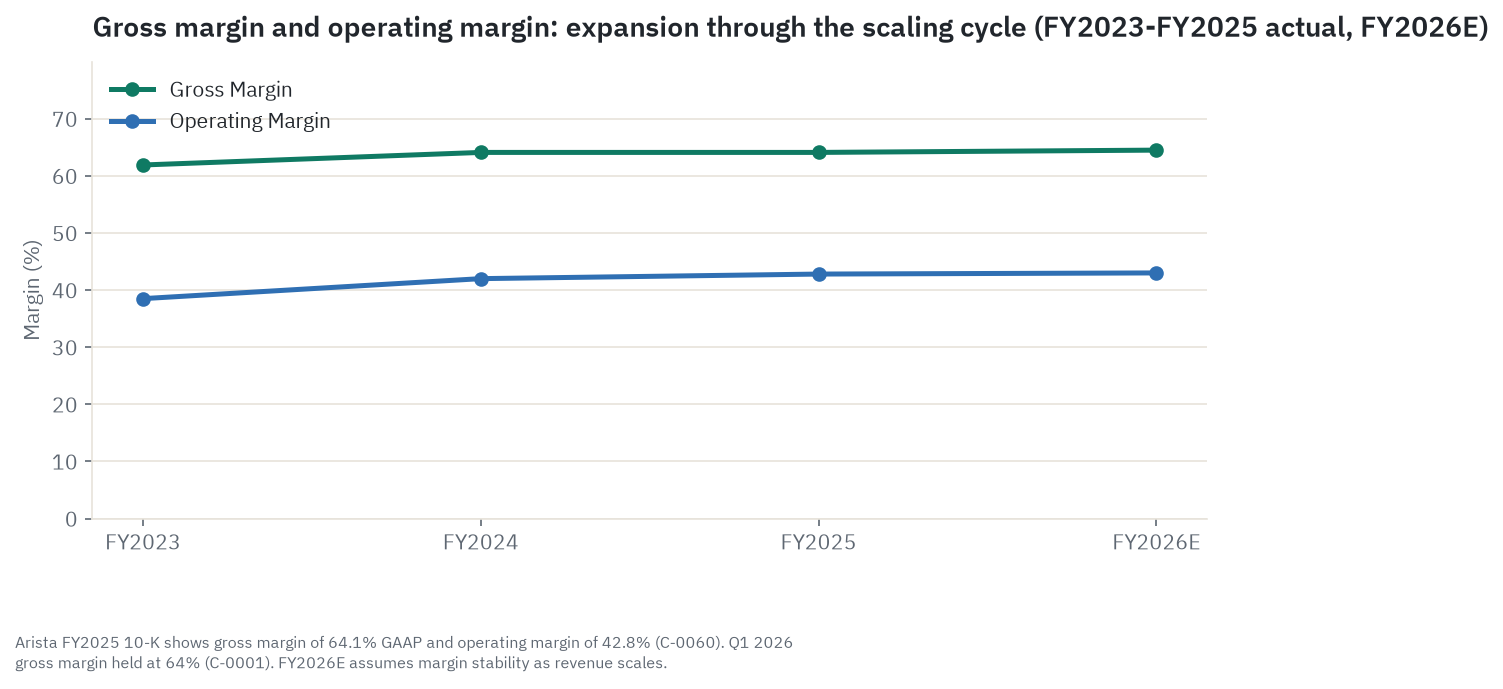
Margins expanded alongside that growth rather than trading off against it. GAAP gross margin moved from 61.9 percent in FY2023 to 64.1 percent in both FY2024 and FY2025. Operating margin expanded every single year in the three-year window, from 38.5 percent to 42.0 percent to 42.8 percent, even as research and development spending grew 45 percent over the same two years, evidence of genuine operating leverage rather than cost-cutting. Net margin dipped slightly in FY2025, to 39.0 percent from 40.7 percent, but that was purely a tax-rate effect, since operating income and pretax income both grew faster than revenue that year; the tax provision simply rose faster than pretax income.
Arista reports only one business segment, so there is no product-line profit breakout to analyze, but the revenue mix tells its own story. Product revenue was $7.577 billion in FY2025, 84.1 percent of the total and up 28.8 percent, while service revenue, mostly software support and subscription renewals, was $1.429 billion, 15.9 percent of the total and up 27.7 percent, growing in almost exact lockstep with product revenue. That parallel growth suggests the installed base is renewing at a healthy rate rather than churning. Geographically, the Americas accounted for 79.1 percent of FY2025 revenue, EMEA 11.9 percent, and Asia-Pacific 9.0 percent, with the non-Americas share rising from 18.2 percent in FY2024 as management attributes the shift explicitly to where its largest global customers’ capex is landing, not to a deliberate international diversification push.
The balance sheet is about as clean as a large-cap technology company’s gets. Cash and marketable securities stood at $10.743 billion at the end of FY2025, up from $8.304 billion a year earlier, and rose further to $12.353 billion by the end of the first quarter of 2026. There is zero long-term or short-term debt on the balance sheet in either the FY2025 10-K or the Q1 2026 10-Q. Operating cash flow was $4.372 billion in FY2025 against just $119.5 million of capital expenditure, producing free cash flow of roughly $4.25 billion, a free-cash-flow margin near 47 percent, on a business model that outsources manufacturing entirely and needs almost no capital of its own to grow. Inventory rose from $1.835 billion to $2.247 billion to $2.380 billion across the last two fiscal year-ends and the first quarter of 2026, a deliberate build management has framed as de-risking component lead times for the AI-fabric ramp. Deferred revenue, cash already collected for support contracts and prepaid multi-year customer agreements not yet recognized as revenue, nearly doubled from $2.791 billion to $5.372 billion between the end of FY2024 and the end of FY2025, then rose again to $6.199 billion by the end of the first quarter of 2026, one of the fastest-growing lines on the balance sheet and a genuinely forward-looking positive signal.
Capital returns tell a more nuanced story. FY2025 stock repurchases were $1.603 billion, a large step up from $423.6 million in FY2024 and $112.3 million in FY2023. But the Q1 2026 10-Q discloses that the company repurchased zero shares in that quarter, and only $817.9 million remained of the $1.5 billion authorization approved in May 2025. No dividend is paid, and stock-based compensation was $439.2 million in FY2025, 4.9 percent of revenue and rising from $355.4 million and $296.8 million in the two prior years, a real and growing source of dilution. Share count has nonetheless stayed roughly flat, from 1,261.3 million shares outstanding at the end of 2024 to 1,256.5 million at the end of 2025, ticking back up slightly to 1,259.2 million by March 2026 as buybacks paused, meaning capital returns have so far offset dilution but the cushion is thin: only $818 million of remaining authorization against more than $4 billion a year of free cash flow.
Arista’s own 10-K risk factors, in the company’s own framing, put three items front and center. First, customer concentration sitting right next to supply-chain concentration: large purchases by a limited number of customers make up a substantial share of revenue, and key components come from sole or limited sources of supply, meaning a demand pause at one of the two large customers and a supply disruption at the one dominant silicon vendor could hit the business from both directions at once. Second, gross-margin variability, flagged as an explicit risk rather than just a historical data point, an acknowledgment from management itself that the current 64.1-percent margin is not guaranteed to be a one-way ratchet upward. Third, tariffs and trade policy, a more prominent entry in this year’s filing than in prior years, reflecting Arista’s reliance on contract manufacturers building largely in Taiwan-adjacent supply chains across Malaysia, Vietnam, and Mexico. Institutional ownership runs roughly 69 to 71 percent of shares outstanding and insider ownership around 8.5 percent; CEO Jayshree Ullal and co-founder Andreas Bechtolsheim both sold well over $100 million each between April and June 2026 under pre-established, scheduled trading plans, a detail notable in its dollar scale even though it reflects routine diversification rather than any impropriety.
What the market is paying
Arista closed at $159.99 on July 2, 2026, down 3.98 percent on the day, sitting roughly three-quarters of the way up its 52-week range and well off its all-time closing high of $177.73 set on April 22, 2026. The stock has been one of the strongest large-cap compounders of the last decade: roughly 22 percent year to date, 58 to 64 percent over the trailing twelve months, and an annualized return above 45 percent over the last ten years, comfortably ahead of both the S&P 500’s roughly 22 percent trailing-year gain and the Nasdaq’s roughly 30 percent over the same window. That performance has not come without turbulence. The stock fell 38.4 percent peak to trough in the 2022 bear market, roughly one and a half times the S&P 500’s decline over the same stretch, and more recently fell about 28 to 29 percent from an October 2025 high near $162 to a November 2025 low near $117, before rallying to April’s all-time high and pulling back again to today’s level. A beta near 1.61 to 1.67 means the stock moves roughly 60 percent more than the broad market in both directions, and swings of 25 to 40 percent within a single year have been the norm rather than the exception.
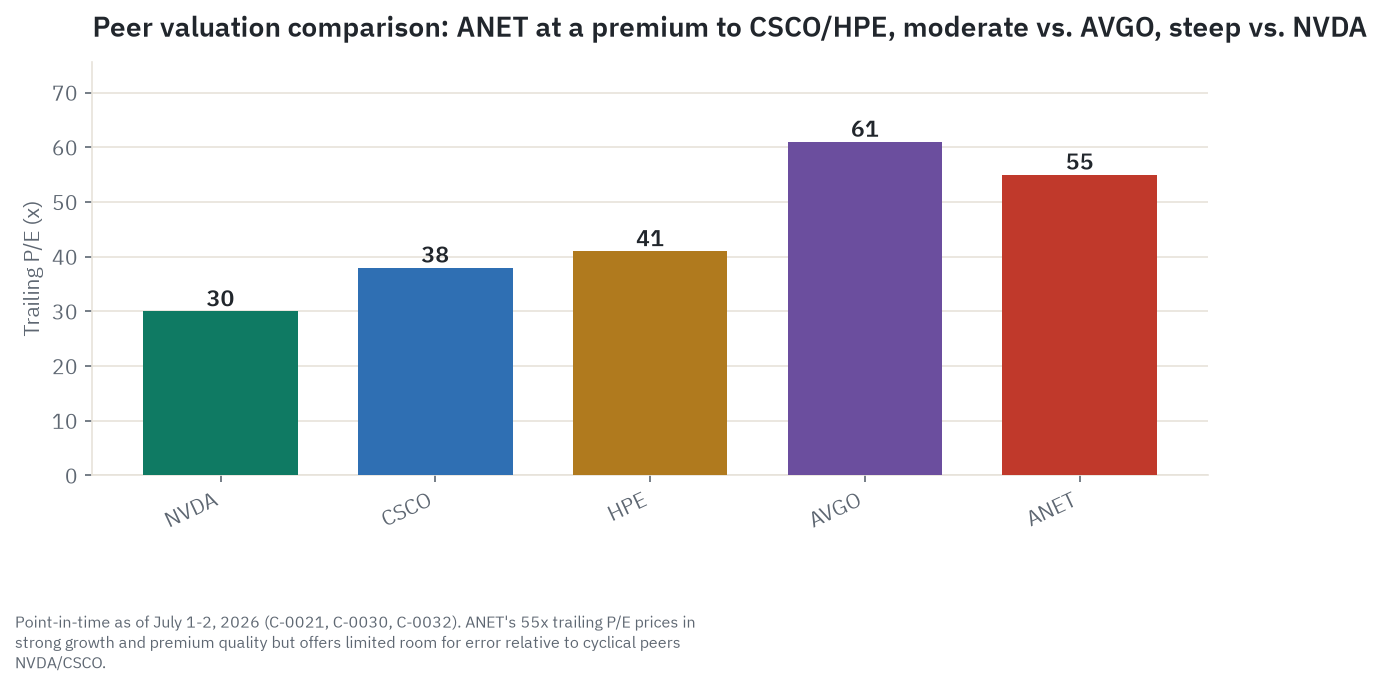
The valuation is the part of the story that leaves the least margin for error. Trailing price-to-earnings runs roughly 55 times, forward price-to-earnings 42 to 45 times, both the richest multiples in Arista’s own five-year history: fiscal year-end trailing price-to-earnings ran 54.66 times in 2021, 28.36 times in 2022, 35.68 times in 2023, 49.57 times in 2024, and 47.65 times in 2025, meaning today’s 55 times sits above every one of those prior year-end prints. Price-to-sales, at roughly 20.8 times, is likewise a new high for the stock. Against peers, Arista’s forward multiple is materially higher than Nvidia’s roughly 20 times, Broadcom’s 23 to 28 times, or Cisco’s roughly 25 times, despite Arista being the smallest of the four companies by both revenue and market capitalization. A PEG ratio near 2.41, above the rough one-to-two range investors generally consider fairly valued, reinforces that the multiple is running ahead of consensus growth expectations. This is not a margin catch-up story or a story about superior balance-sheet scale; Arista’s margins are already excellent and its balance sheet, while clean, is smaller than its larger peers’. It is a bet on continued growth and continued market-share gains in AI networking, priced at the top of the group.
Liquidity is ample for a company this size, with average daily volume near 9.6 to 9.8 million shares, and short interest is low and falling, under 2 percent of float against a peer-group average closer to 8 percent, suggesting there is little organized bear positioning against the stock right now, whether because the bull case is widely accepted or simply because momentum has deterred short sellers. Sell-side coverage is heavily positive: a consensus rating of Strong Buy across roughly 30 covering analysts, with price targets ranging from $164 to $220 and averaging around $190, about 19 percent above the current price, though these targets are opinions that tend to follow the stock rather than lead it, not facts. The stock currently trades almost exactly at its 50-day moving average and comfortably above its 200-day average, with neutral momentum readings, consistent with a stock consolidating after a pullback from an all-time high rather than in the middle of an obvious trend reversal in either direction.
What the crowd is saying
The dominant narrative through May and June 2026 has been an “AI superpower” story anchored to hyperscaler capex momentum: real earnings beats, a doubled AI-fabric revenue target, and a widely covered new 1.6-terabit switch launch have generated broadly positive financial-media coverage, with Arista’s placement as a Leader in Gartner’s Magic Quadrant adding a layer of institutional credibility in late May. Retail sentiment on platforms like StockTwits flipped to extremely bullish immediately after May’s earnings report, with message volume spiking roughly twentyfold in a day, framing the stock as the one way to play rack-scale AI networking without paying “Nvidia’s tax.” That enthusiasm looks organic rather than manufactured, and has since settled back to a more normal baseline by late June, a healthy pattern rather than a sign of a fading mania.
Two things complicate the otherwise warm story. First, coverage in late May and early June pivoted toward supply constraints across wafers, silicon, memory, and optical components that management itself warned could persist for one to two years, introducing a cooling undertone to what had been an unambiguously upbeat narrative. Second, and more visible to retail investors watching the same Form 4 filings journalists cover, CEO Ullal, co-founder Bechtolsheim, and chief technology officer Kenneth Duda together sold more than $430 million of stock across roughly sixty days between April and June 2026, all under pre-scheduled trading plans adopted well in advance and fully disclosed within the legally required window. That is not evidence of impropriety, but the scale is genuinely notable, and it lands at the same moment the company itself chose not to repurchase a single share in the first quarter of 2026. Retail forums discuss this openly, mostly rationalizing it as routine diversification, but the juxtaposition, insiders selling while the company pauses its own buying, is worth a reader’s attention rather than dismissal.
The sharpest divergence between the crowd’s story and what the filings actually show sits on customer concentration and margin durability. The narrative treats “hyperscaler capex is growing” as roughly equivalent to “Arista’s revenue is safe,” when the truth is narrower: capex at the industry level can keep growing while Arista’s specific share of it shrinks, because Nvidia and Cisco are now actively contesting the same sockets. The retail and much of the sell-side framing also assumes the 62-to-64-percent gross margin band holds comfortably, while management’s own supply-constraint commentary suggests real pressure on that number over the next one to two years. None of this makes the bull case wrong. It does mean the crowd is pricing a cleaner, more assured version of the story than the company’s own risk disclosures support. Employee and customer sentiment, for what soft signals are worth, remain genuinely strong: an internal customer satisfaction score in the high 80s and an employee review rating around 4.0 out of 5, both well above typical large-technology-company benchmarks, with no visible churn or exec-departure red flags.
The durability question: run-rate or cycle peak
Every element of Arista’s current profile, the growth rate, the gross margin, the multiple the market is willing to pay, rests on one underlying question: is the current AI datacenter build-out a genuine structural expansion of how much networking hardware the world needs, or is it a cyclical surge that eventually digests the way every prior capital-spending supercycle has?
The structural case is real. AI training and inference workloads consume far more server-to-server network bandwidth per dollar of compute than prior cloud workloads did, and that ratio has risen with every successive model generation. Arista management says scale-across networking, connecting multiple data centers as if they were one giant cluster, will account for at least a third of 2026 AI networking revenue on its own, a use case that barely existed as a line item two years ago. Five companies with investment-grade balance sheets, not speculative telecom carriers financing a buildout with junk debt, are funding a combined $660 billion to $725 billion of 2026 capital spending substantially out of their own operating cash flow. If AI inference becomes the larger workload relative to AI training over the next five years, as most industry roadmaps assume, that shift favors exactly the kind of always-on, standards-based Ethernet fabric Arista sells over a training-cluster arms race that eventually slows.
The cyclical case is just as real, and it has history on its side. Every prior data-center and telecom capital-spending cycle looked structurally different in real time and still ended in overbuilding: fiber optic networks in 2000 and 2001, wireless infrastructure in the mid-2010s, and cloud infrastructure capex itself in 2022 and 2023, a cycle that produced a genuine, if brief, digestion pause for networking vendors including Arista, visible in that same 19.5-percent-growth year noted above. The specific trigger to watch this time is AI monetization lagging AI capex: if the revenue that hyperscalers themselves earn from generative AI products fails to scale fast enough to justify the return on hundreds of billions of dollars of infrastructure spending, capex guidance gets cut, and because two customers make up 42 percent of Arista’s revenue, a pullback at even one of them would show up in Arista’s results faster and more visibly than at almost any more diversified supplier. Layer on top of that a Federal Reserve funds rate near 3.6 to 4 percent, which raises the hurdle rate a hyperscaler chief financial officer applies to any marginal GPU cluster, and two credible, well-funded competitors, Nvidia and Cisco, actively taking share in the exact socket Arista’s AI growth story depends on.
The realistic picture is a genuine split rather than a clean call in either direction. Hyperscaler capex is very likely to keep growing through 2026 and probably into 2027; the guidance behind that is too recent, too large, and too broadly corroborated across five independent companies to dismiss outright. But the growth rate of that capex is already guided to decelerate meaningfully, from roughly 52 percent in 2026 to something like 13 percent in 2027 per aggregated hyperscaler guidance, and Arista’s own share of hyperscaler switching spend is being actively contested, not just diluted by a bigger pie. The most probable multi-year path is continued absolute revenue growth through the 1.6-terabit upgrade cycle, but a normalizing growth rate and possibly a normalizing gross margin as competition intensifies at each speed transition, with customer concentration remaining the single largest source of quarter-to-quarter surprise risk in either direction.
The scenarios in detail
Four variables decide where Arista’s stock lands over the next five years. Everything else, the day-to-day narrative, the sentiment, the technical chart patterns, flows through these.
Hyperscaler AI capex growth rate. Arista’s revenue is a derivative of capital-spending decisions made at five companies: Microsoft, Meta, Amazon, Alphabet, and Oracle. Combined 2026 capex is guided near $660 billion to $725 billion, but the growth rate of that spending is expected to decelerate from roughly 52 percent in 2026 to an estimated 13 percent in 2027 and approximately 5 percent in 2028, per aggregated analyst estimates, though one bank’s more bullish estimate has 2027 growth as high as 45 percent, which shows how wide the range of plausible outcomes actually is. The absolute dollar level keeps growing even in the slower scenarios, but when capex growth itself slows, networking orders, which sit one step downstream of the spending decision, can flatten or decline before the capex spending itself peaks.
Arista’s share of AI and datacenter networking spend versus Nvidia and Cisco. Nvidia’s Spectrum-X reached 21.5 percent of datacenter Ethernet switching revenue in the first quarter of 2026, against Arista’s 20.7 percent, effectively reaching parity in under two years from a near-zero starting point. Cisco has guided to roughly $9 billion of fiscal 2026 hyperscaler AI orders. Every port-speed transition, from 400G to 800G to 1.6T and eventually 3.2T, is a competitive reset, and Nvidia’s ability to bundle networking directly with GPU purchase orders is a structural advantage Arista cannot replicate, since Arista does not make GPUs and cannot subsidize a switch sale with compute-business margins.
Gross and operating margin trajectory. FY2025 GAAP gross margin was 64.1 percent, operating margin 42.8 percent, both near historical highs and driven by the EOS software layer. The open question is whether these margins hold as competition intensifies at the 1.6-terabit transition, as supply constraints, which management has flagged as a one-to-two-year issue, flow through to the cost of goods sold, and as the largest customers, Meta capable of building its own switches, Microsoft pushing its own SONiC operating system, exert pricing leverage that a standalone switch vendor has limited power to resist.
Valuation multiple. Arista trades at roughly 55 times trailing and 42 to 45 times forward earnings, the richest multiples in its own history and above every direct networking peer. At these levels, the multiple embeds an expectation of sustained growth above 25 percent. Even a modest deceleration to mid-teens growth would historically warrant a forward multiple closer to 25 to 35 times, not 42 to 45 times. The multiple is not a passive output of the other three variables; it is itself the largest single swing factor for returns from today’s price.
Each dollar level in the chart at the top of this piece is calculated the same way: an estimated forward twelve-month earnings-per-share figure at that horizon, multiplied by an assumed forward price-to-earnings multiple. The multiple assumptions decline over time in every scenario, from today’s 42 to 45 times toward long-run levels of roughly 30 times in the base case, 35 times in the bull case, and 19 times in the bear case by the five-year mark, reflecting the simple mathematical reality that growth normalization compresses valuation multiples even in a fundamentally healthy business.
Bull case: Ethernet wins, Arista holds its ground, the cycle extends
This scenario requires hyperscaler AI capex to grow 35 to 40 percent in 2027, at the high end of current forecasts, and to sustain 15 to 20 percent growth through 2029 as inference workloads scale up. It requires Arista to hold or gain datacenter Ethernet switching share, staying near 20 to 22 percent of the segment as the 1.6T and 3.2T transitions favor its software integration and multi-vendor flexibility over Nvidia’s bundled, single-vendor approach. It requires gross margin to hold at 63 to 65 percent as CloudVision subscription attachment deepens across a growing installed base, with operating margin expanding to 45 to 47 percent. And it requires a new customer above 10 percent of revenue to emerge, likely Amazon or Oracle based on management’s own commentary, diversifying the current concentration from 42 percent to roughly 35 percent for the top two accounts.
Under those assumptions, revenue grows from an estimated $11.8 billion in FY2026 to roughly $29.1 billion by FY2031, with earnings per share rising from around $3.71 to near $9.69. At a 35-times forward multiple on that final-year earnings estimate, reflecting a sustained growth premium comparable to where high-quality mid-teens compounders have historically traded, the implied share price is around $350. For this case to hold, Ethernet has to decisively win the architecture argument for AI fabrics, hyperscaler AI monetization has to materialize fast enough to justify continued double-digit capex growth beyond 2028, and Nvidia’s bundling advantage has to prove less durable than it currently looks. The single thing most likely to break it is a major hyperscaler, Meta or Microsoft, publicly committing to Spectrum-X as its primary AI networking platform, or a visible shift toward in-house white-box switches at the 1.6-terabit transition.
Base case: growth normalizes, the multiple contracts, earnings do the work
This is the scenario the market’s current pricing most closely resembles. Hyperscaler capex grows 20 to 25 percent in 2027, then decelerates to 10 to 15 percent in 2028 and single digits after that, neither a crash nor a continuation of the 2025-2026 surge. Arista’s datacenter share stabilizes near 19 to 21 percent, losing a point or two to Nvidia at the AI back end but holding the broader datacenter franchise, while campus networking grows to roughly $1.5 billion by FY2028. Gross margin drifts to 62 to 63 percent as competitive pricing at the 1.6T transition takes a modest toll, while operating margin holds near 42 to 43 percent as leverage elsewhere in the cost structure offsets that pressure. Customer concentration improves modestly, with the top two accounts near 38 percent by FY2028 as the enterprise and smaller cloud customer base grows faster than the largest two.
Revenue under this path runs from roughly $11.7 billion in FY2026 to about $22.0 billion by FY2031, with earnings per share reaching near $6.50. At a 30-times forward multiple, comparable to where quality large-cap technology companies growing in the high single digits have historically traded, the implied share price is around $195, a cumulative return from today of roughly 22 percent, or about 4 percent annualized, the arithmetic penalty for buying a great business at 55 times trailing earnings. This case holds as long as the AI capex cycle slows but does not crash, Arista’s software moat protects the installed base even as new-socket competition intensifies, and management successfully executes the campus and enterprise diversification push. The single thing most likely to break it is a hyperscaler capex pause lasting more than two quarters, which would compress both near-term earnings and the multiple at the same time.
Bear case: the cycle peaks, concentration bites, the multiple re-rates
This scenario draws directly on the strongest points in the adversarial case against the thesis: customer concentration is a binary risk, Nvidia is a structurally different kind of competitor than Cisco ever was, post-build capex deceleration is a real historical pattern, and the current valuation is priced for something close to perfection. Hyperscaler capex growth decelerates sharply, to 13 percent in 2027, flat to 5 percent in 2028, then contracts 5 to 10 percent in 2029 as the initial AI-build phase matures and return-on-investment scrutiny tightens. Nvidia’s Spectrum-X takes the outright number-one position in AI back-end switching, reaching 25 to 28 percent share by 2028, while Cisco’s Silicon One wins incremental hyperscaler sockets; Arista’s total datacenter share slips from around 21 percent to 16 to 18 percent, and Meta shifts more than 30 percent of its networking budget to Spectrum-X. Gross margin compresses to 58 to 60 percent as pricing competition at the 1.6T and 3.2T transitions intensifies and supply constraints keep component costs elevated, with operating margin contracting to 35 to 37 percent. Customer concentration stays extreme or worsens because growth from the diversified customer base cannot offset the outsized weight of hyperscaler AI-fabric revenue.
Under this path, revenue actually contracts in the middle years, from roughly $11.3 billion in FY2026 to a trough near $12.9 billion in FY2029 after peaking around $13.3 billion in FY2028, before recovering modestly to about $14.0 billion by FY2031, with earnings per share falling from around $3.39 to a low near $3.34 before recovering to roughly $3.66. At a 19-times forward multiple, re-rated toward hardware-cyclical peer levels, a discount to even Cisco’s diversified-franchise multiple to reflect Arista’s narrower business and compressed margins, the implied share price is around $68, a 57 percent decline from today. This case requires AI monetization to disappoint relative to the capex invested, forcing hyperscalers to slow spending; Nvidia’s GPU-plus-networking bundle to prove more compelling than open Ethernet at the 1.6-terabit transition; and at least one of the top two customers to materially reduce its Arista spend. The single thing most likely to make this scenario less bad is AI inference revenue at hyperscalers growing fast enough to justify continued capex growth beyond 2028, which would prevent the revenue contraction at the core of this case.
Catalysts and the leading indicators to watch
Near term, the second-quarter 2026 earnings report expected in August will be the first full quarter of 1.6T product-ramp commentary, and hyperscaler third-quarter earnings in October and November will bring the first real 2027 capex guidance from Microsoft, Meta, Amazon, and Alphabet, arguably the single most important catalyst on the calendar because Arista’s growth rate is a direct derivative of those four companies’ spending plans. The third-quarter 2026 earnings report in November will show customer-concentration percentages roughly three-quarters of the way through the fiscal year, and initial shipment volumes of the 7060XE7 family beginning in the fourth quarter of 2026 into the first quarter of 2027 will start to show early customer-adoption and design-win data against Nvidia’s Spectrum-X at the 1.6-terabit socket.
Further out, the resolution of the Ethernet-versus-InfiniBand question over 2027 and 2028 will structurally expand or narrow Arista’s addressable market depending on how it plays out, and the next major port-speed generation, 3.2 terabit, already visible in Broadcom’s silicon roadmap for 2029 and 2030, will be both a fresh growth catalyst and a fresh competitive reset. Whether campus networking scales from a small base today to a genuine $2 billion to $3 billion line by 2028 or 2029 is a real diversification variable that would reduce hyperscaler concentration risk, and whether the company issues a fresh share-buyback authorization, only $818 million remained as of the first quarter of 2026 against more than $4 billion a year of free cash flow, is a capital-return signal worth watching in 2026 and 2027.
For a reader trying to track which scenario is actually playing out in real time, five things matter most: hyperscaler capex guidance revisions on each of the big four or five companies’ quarterly calls, the earliest signal of a demand pause; Arista’s own disclosed customer-concentration percentages in each 10-Q, where rising concentration signals rising binary risk and falling concentration signals the diversification thesis working; independent analyst data on Nvidia’s share of datacenter Ethernet switching versus Arista’s, where a move above 25 percent for Nvidia in any single quarter would confirm the competitive-threat thesis; the quarterly GAAP gross margin, the earliest fundamental tell of whether pricing competition is biting, with a break below 62 percent in two consecutive quarters signaling the bear-case margin path is active; and deferred revenue growth, which nearly doubled in FY2025 and would be an early warning if it stalls or reverses, since it reflects bookings and renewals ahead of when they show up in recognized revenue.
Companies to watch (bull / base / bear)
Arista Networks (ANET) is the name itself. Bull: continued share holds near 20 to 22 percent of datacenter Ethernet switching alongside a new double-digit customer diversifying the base. Base: modest share erosion offset by an expanding total market. Bear: Nvidia’s Spectrum-X confirmed above 25 percent share in back-to-back quarters while Meta or Microsoft visibly cuts its Arista spend. Watch: the quarterly customer-concentration disclosure and the gross-margin print, together the two fastest tells of which path is unfolding.
Nvidia (NVDA) is the competitive read. Bull for Arista: Spectrum-X growth decelerates as the easy early design wins are exhausted. Bear for Arista: Spectrum-X’s 192.7-percent year-over-year growth rate persists even off its now-larger base, confirming the bundling advantage is structural rather than a one-time land grab. Watch: the next two quarters of IDC datacenter-switching share data.
Cisco (CSCO) is the incumbent re-acceleration signal. Bull for Arista: Cisco’s AI order guidance disappoints relative to its own $9 billion target, suggesting incumbency alone is not enough to win new AI sockets. Bear for Arista: Cisco’s Silicon One design wins convert into recognized revenue on schedule, proving a second credible full-stack alternative to Arista exists. Watch: Cisco’s quarterly AI infrastructure order intake against its own guided pace.
HPE/Juniper (HPE) is the enterprise and campus signal. Bull for Arista: HPE’s post-merger integration stumbles, leaving the campus and enterprise diversification opportunity more open for Arista. Bear for Arista: the combined Juniper Mist AI networking portfolio scales cleanly, creating a genuine third full-stack competitor. Watch: HPE’s networking-segment revenue growth and any specific Mist AI enterprise-account wins reported over the next several quarters.
Risk controls
The honest risk in owning Arista at today’s price starts with concentration: 42 percent of revenue tied to two customers means a single boardroom decision at either Microsoft or Meta can move Arista’s growth rate by several percentage points overnight, and there is no operational fix for that inside the next few quarters beyond the slow work of diversifying the customer base. Layered on top of that is a valuation that has essentially no cushion: at 55 times trailing and 42 to 45 times forward earnings, the stock has already shown, in the scenarios above, how a modest deceleration in growth translates into a large percentage move in the share price, because the multiple itself compresses at the same time earnings growth slows. A third risk sits one level upstream: Broadcom is Arista’s sole or limited source of switching silicon with no guaranteed-supply contract, so a price increase, an allocation decision favoring another customer during a shortage, or a strategic shift by Broadcom to sell more aggressively to white-box competitors would flow directly into Arista’s cost structure or its competitive position.
For a reader thinking about position sizing and risk framing rather than a trade recommendation, three things are worth holding onto. First, this is a high-beta stock, with historical drawdowns in the 28-to-52-percent range even during a broader bull market for the business itself, so the risk of a sharp near-term price decline exists independent of any long-term view on the company’s quality. Second, the balance sheet genuinely is a floor: zero debt and more than $12 billion in cash mean there is no existential risk to the company even in the bear scenario above, only a re-rating of what the market is willing to pay for its earnings. Third, the single fastest-moving leading indicator, hyperscaler capex guidance on quarterly earnings calls, is public, dated, and available to any reader well before it shows up in Arista’s own results, which is the closest thing this situation has to an early-warning system.
Methodology, sourcing, and data-quality flags
This piece draws on Arista’s audited FY2025 Form 10-K (filed February 17, 2026) and Q1 2026 Form 10-Q, read directly from SEC EDGAR, cross-checked against the Q4 2025 and Q1 2026 earnings-release 8-K exhibits; analyst-tier sources including IDC datacenter-switching share data, Dell’Oro AI back-end switching market forecasts, and aggregated hyperscaler capital-expenditure guidance; press-tier sources including earnings-call transcripts, trade press, and financial-data aggregators for market action, valuation multiples, and sentiment; and estimate-tier figures for every forward-looking scenario number, each labeled as such throughout. All underlying claims are recorded with their source and as-of date in this run’s claims ledger.
A handful of data-quality points are worth carrying into how a reader weighs the numbers above. Market-share denominators differ by scope: IDC’s narrower “AI-datacenter Ethernet switching” segment share, where Nvidia at 21.5 percent and Arista at 20.7 percent are close to even, is a different cut than IDC’s broader “total Ethernet switch portfolio” figure, where Cisco leads on a wider base that includes campus and enterprise switching; these should not be read on the same ladder as directly comparable numbers. The Microsoft and Meta customer names are analyst-corroborated rather than company-confirmed: Arista’s own 10-Q anonymizes its two customers above 10 percent of revenue, and the specific company names come from analyst commentary relayed through financial media, not from Arista’s own filing text. Arista’s year-to-date 2026 return is best stated as roughly plus 22 percent, calculated from a confirmed December 31, 2025 closing price of $131.07; a conflicting figure of negative 3.85 percent appeared in one data source but could not be reconciled to a consistent calculation methodology and should be treated as an artifact of that source rather than a real number. Buyback figures in this piece use the primary 10-K and 10-Q disclosures, $1.603 billion repurchased in FY2025 and zero in the first quarter of 2026, rather than an earlier, less precise press-tier trailing-twelve-month estimate that did not match the company’s own quarterly disclosure. Valuation multiples such as enterprise-value-to-EBITDA, price-to-sales, and PEG can vary 10 to 15 percent across data vendors depending on trailing-versus-forward windows and how each vendor constructs enterprise value; the figures used here are stated with their source and should be read as directionally accurate rather than precise to the decimal. Finally, every hyperscaler capex figure, every total-addressable-market claim, and every analyst price target in this piece is a forecast or an opinion, not a fact, and is labeled that way throughout.
The full read across the five factors behind the rating: Valuation is stretched. Arista trades at roughly 55 times trailing and 42 to 45 times forward earnings, at or above every prior fiscal year-end in its own five-year history and materially above every direct networking peer. A PEG ratio of 2.41 sits above the range investors typically consider fairly valued, and price-to-sales at 20.8 times is a new high for the stock. The balance sheet, zero debt and more than $12 billion in cash, provides a genuine floor, but the multiple offers less cushion than at any point in the last five years. Growth is exceptional by almost any standard: FY2025 revenue grew 28.6 percent, the most recent quarter grew 35.1 percent, FY2026 guidance was raised to $11.5 billion, and the AI-fabric revenue target was doubled from an earlier base to $3.5 billion. Deferred revenue nearly doubled in a single year, effectively pre-funding a chunk of future service revenue, and the 1.6-terabit product cycle provides a visible near-term catalyst. Quality is not in dispute: a 64.1-percent gross margin on what is fundamentally a merchant-silicon hardware product reflects genuine software differentiation, operating margin has expanded every year for three straight years even as research and development spending grew 45 percent, free cash flow margin runs near 47 percent on a capital-light model, and the company carries zero debt against more than $12 billion in cash. Risk is concentrated and real: two customers make up 42 percent of revenue, Broadcom is a sole-source silicon supplier with no guaranteed-supply contract, Nvidia’s Spectrum-X has already reached rough parity with Arista in one closely watched competitive measure, and insider selling exceeded $430 million combined in a recent sixty-day window even as the company itself paused its own buyback program. Momentum and sentiment are strongly positive but not without caution flags: the stock is up roughly 22 percent year to date and 58 to 64 percent over the trailing year, sell-side consensus is Strong Buy with an average price target meaningfully above the current price, and Russell Top 50 index inclusion provides a structural passive-flow tailwind, tempered by a roughly 10-percent pullback from April’s all-time high, unusually low short interest that means few skeptics are positioned against the stock, and the visible insider selling noted above.
Taken together, this is a rules-based research signal, not personalized advice: the read lands at Buy because the growth, quality, and momentum factors are strong enough to outweigh a stretched valuation and a real, concentrated risk profile, but the margin for error is thinner than at almost any point in the company’s history as a public company.
Data-quality flags:
- IDC’s “AI-datacenter Ethernet switching” segment share (Nvidia 21.5 percent, Arista 20.7 percent) uses a narrower scope than IDC’s “total Ethernet switch portfolio” figure; the two should not be compared directly.
- The Microsoft and Meta customer names are analyst-corroborated, not disclosed by Arista itself, which anonymizes customers above 10 percent of revenue in its own filings.
- Arista’s 2026 year-to-date return is best stated as roughly plus 22 percent (from a confirmed December 31, 2025 close of $131.07); a conflicting negative 3.85 percent figure from one aggregator could not be reconciled and should be disregarded.
- Buyback figures use primary 10-K/10-Q disclosures ($1.603 billion repurchased in FY2025, zero in Q1 2026, $817.9 million of authorization remaining) rather than a less precise press-tier trailing-twelve-month estimate.
- Valuation multiples (EV/EBITDA, price-to-sales, PEG) vary 10 to 15 percent across data vendors depending on methodology; figures here are directionally accurate, not precise to the decimal.
- All hyperscaler capex, total-addressable-market, and analyst price-target figures are forecasts or opinions, never settled facts.
Key sources: Arista Networks FY2025 Form 10-K and Q1 2026 Form 10-Q (SEC EDGAR); Arista Q1 2026 and Q4/FY2025 earnings-release 8-K exhibits; IDC datacenter Ethernet switching market share reports; Dell’Oro Group AI back-end switching forecasts; company earnings-call transcripts; StockAnalysis.com, Investing.com, and MarketBeat.com for point-in-time market data; and sell-side analyst consensus aggregations.
Prepared July 2, 2026. Figures are point-in-time and will change. This is research and analysis for educational purposes - not investment advice, not a recommendation, and not a solicitation. Networking-equipment stocks tied to hyperscaler capital-spending cycles can move sharply on a single earnings call or a single customer’s budget decision. Verify all figures independently and consult a licensed financial advisor before making any decision.