
Research date: June 30, 2026 | OSINT research on UnitedHealth Group (NYSE: UNH), the largest US health insurer’s climb back from a self-inflicted 2025 margin collapse, the Optum vertical-integration engine that is both its profit source and its regulatory target, and the honest bull, base, and bear case from six months to five years out.
Important disclaimer. This is OSINT-based research and educational analysis, not investment advice. I am not a financial advisor. Nothing here is a recommendation to buy or sell any security, and the scenarios below are illustrative, not price targets. Health insurance is a regulated, government-payer-dependent business, and it also carries a dense set of reported legal and regulatory matters discussed below, every one of which is disclosed, ongoing, disputed by the company, and not adjudicated; no finding of wrongdoing exists against UnitedHealth on any of them. Market caps, prices, valuation multiples, and market-share figures are point-in-time as of June 30, 2026, press-reported where noted, and move fast. Do your own due diligence and consult a licensed advisor.
Where this stock could be in 6 months, 1 year, 3 years, and 5 years
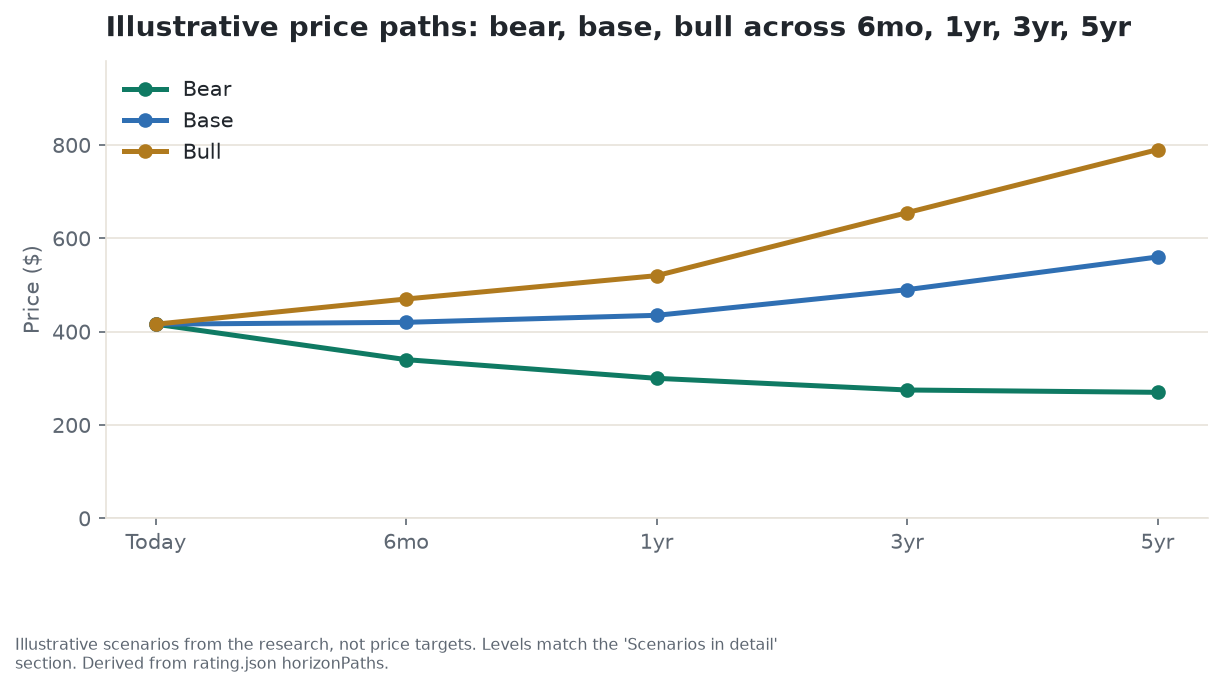
Six months. This window belongs to the calendar, not the thesis. The Q2 2026 print lands July 16, and it is the next hard test of whether the twice-raised full-year guide (adjusted earnings per share above $18.25) is holding and whether the medical care ratio, the share of every premium dollar paid back out as medical claims, keeps behaving the way Q1’s 83.9% suggested. The base case is roughly flat, around $420, because the stock has already rallied above Wall Street’s own average price target, so the easy recovery money looks spent. The bull case is about $470 on a clean beat and another guidance raise. The bear case is about $340 on a cost-ratio wobble or a headline escalation in the Department of Justice matter described below. The single thing most likely to flip this window is the reserve-development language behind the next quarterly cost ratio: is the improvement coming from genuinely lower claims, or from one-time favorable adjustments that mask an underlying trend that has not actually turned.
One year. Over twelve months the deciding variables are whether full-year 2026 actually lands where guided, the first look at 2027 guidance, and the Centers for Medicare and Medicaid Services’ rate notice for plan year 2028, expected around January 2027. The base case is about $435: earnings keep grinding higher, but the market lets the multiple drift down toward 19 to 20 times forward earnings as the recovery becomes the new normal rather than a surprise, so the price gain is modest even as profit improves. The bull case is roughly $520 if cost trends have visibly reconverged with pricing and the government’s rate-setting stays as friendly to insurers as it was for 2027. The bear case is about $300 if a second cost shock appears, such as a further step-up in specialty-drug utilization, or if the Justice Department matter turns concrete. The flip here is whether the 2028 rate cycle repeats 2027’s late-breaking industry-friendly surprise or reverses it.
Three years. This is where the structural story starts to matter more than the quarterly print. UnitedHealth cannot keep shedding roughly a million Medicare Advantage members a quarter forever without eroding the very scale that makes Optum work, so by this horizon the company needs a genuine, not just repriced, improvement in medical trend. It is also the window in which the 2028 pharmacy-benefit-manager reform law becomes binding and any resolution of the reported Justice Department inquiry, benign or not, most plausibly lands. The base case is about $490, assuming margins recover most but not all of the way back and the multiple settles a touch below its own long-run average. The bull case is roughly $655 if the government matter resolves without a coding change and Optum’s care-delivery arm returns to a stable, mid-single-digit margin. The bear case is about $275 if a Medicare Advantage risk-adjustment coding remedy permanently trims revenue per member at the same time the pharmacy-benefit reform compresses Optum Rx, both landing on a de-rated multiple. The flip is simply how that Justice Department matter resolves and what Optum Rx’s real, not guided, margin looks like once the new pharmacy rules bite.
Five years. At this distance the question is not whether people keep aging into Medicare (they will; roughly 10,000 Americans turn 65 every day and Medicare Advantage already covers more than half of eligible seniors), but what price per member Washington ultimately allows UnitedHealth’s captive insurer-pharmacy-provider model to charge. The base case, about $560, is a slower, still-dominant compounder that never fully sheds a standing regulatory discount and stays below its own 2024 peak. The bull case, roughly $790, says the legal and regulatory tax proves manageable and management’s stated long-term earnings-growth target of 13 to 16 percent a year re-engages, a level that would reclaim and exceed the stock’s all-time high. The bear case, about $270, says the repricing runs out of room and the underlying model gets repriced by Washington instead, landing the stock back near its 52-week low. The flip is whether “back to normal” describes a normal that regulation and medical-cost trend will actually let return.
Where the read lands today. On balance the read holds at Hold, and Overvalued on the valuation factor specifically. This is a dominant, cash-generative franchise that is genuinely mid-recovery from a crisis it largely created for itself, trading at roughly 20 to 22 times forward earnings, close to its own long-run average but the richest multiple in its peer group besides Humana’s unproven turnaround story, and sitting slightly above both the sell-side’s own average price target and the price at which Berkshire Hathaway fully exited its stake earlier this year. The recovery so far looks more like repricing and deliberate membership shedding than proven cost control, since the company’s own guidance still points to a cost ratio well above its pre-crisis level. Operationally, Hold means: if you already own it, there is a real franchise underneath the multiple and no reason to panic-sell into a genuine earnings recovery, but this is not the price to add aggressively, because the easy re-rating from crisis lows has largely happened and you would be chasing a stock trading above where professional analysts collectively expect it to land. The read would improve to Accumulate on a cheaper entry price paired with a clean multi-quarter cost-ratio track record, or with a benign resolution of the regulatory matters below. It would move to Reduce if the stock keeps climbing with no matching earnings catch-up, or if the Justice Department or pharmacy-reform overhang converts from a reported risk into a quantified earnings cut. The single thing most likely to flip the whole read either way is not the quarterly print, it is how the government’s Medicare Advantage billing inquiry resolves.
Companion tool
Jump to the interactive dashboard to sort and filter every company in this piece, or download the Excel model to flex the scenarios yourself.
TL;DR
UnitedHealth is two businesses stitched together: an insurer, UnitedHealthcare, that collects premiums and pays out roughly 84 cents of every premium dollar in medical claims, and Optum, a pharmacy-benefit manager plus care-delivery-and-data conglomerate that captures a service margin on the spend UnitedHealthcare would otherwise send to an outside hospital, physician group, or drugstore. That captive arrangement, in which UnitedHealth’s own health plans route the bulk of their pharmacy and a large share of their care-delivery spend to UnitedHealth’s own units, is the entire reason UNH has historically traded at a premium to a plain insurer, and it is also precisely the mechanism a reported Department of Justice inquiry and a dated 2028 pharmacy-reform law are both aimed at. In 2024 and 2025 a medical-cost shock outran UnitedHealth’s own pricing, its cost ratio jumped from 83.2 percent to 89.1 percent of premium revenue in two years, operating profit fell 41 percent even as revenue grew 12 percent, the chief executive was replaced, and Optum’s care-delivery arm swung to an outright operating loss. By the first quarter of 2026 the cost ratio had improved to 83.9 percent and guidance had been raised twice, but the improvement so far reads as premium repricing and deliberate shedding of roughly a million unprofitable Medicare Advantage members a quarter, not yet a demonstrated return to genuine cost control, since full-year guidance still points to a cost ratio near 88.8 percent, well above the pre-crisis baseline. Layer on top of the operating story a dense and genuinely unresolved legal and regulatory tail (a company-acknowledged Department of Justice inquiry into Medicare Advantage billing practices, a Senate oversight report, an AI-assisted claims-denial class action in discovery, a new IRS transfer-pricing dispute, and a 2028 law that bans the spread pricing OptumRx’s economics currently rely on) and the picture that emerges is a real recovery trading at a premium multiple within its own peer group, above the Street’s own average price target, for a business model that is itself the object of the regulatory scrutiny. That combination, not any single number, is the whole debate this piece works through.
Explore it yourself: the interactive dashboard
Open the dashboard in a full screen
The dashboard holds UnitedHealth and the five managed-care peers it is measured against here, sortable by market cap, by forward valuation, and by the rating and factor read behind it, plus the full bull, base, and bear horizon table. Prefer a spreadsheet? Download the Excel model, which lays out the peer table, the segment build, and the scenario math behind the horizon chart. The levels in that file are illustrative arithmetic, not price targets.
What UnitedHealth actually does
Picture two businesses that used to be adversaries, bolted into one company. The first is a health insurer, UnitedHealthcare, which collects a premium from an employer, an individual, the federal government’s Medicare Advantage program, or a state Medicaid agency, and in exchange promises to pay whatever medical bills that covered person runs up over the year. That is a spread business: collect a fixed amount up front, pay out a variable amount later, and keep the difference. One of those government sources, Medicare Advantage, deserves its own definition because so much of this piece turns on it: it is the private alternative to traditional government Medicare, letting Americans 65 and older enroll in a plan run by an insurer like UnitedHealthcare instead of the traditional program, with CMS paying that insurer a fixed, risk-adjusted amount per member to take on the member’s care; enrollment now covers more than half of Medicare-eligible seniors, up from under 30 percent a decade ago. That arrangement carries a structural vulnerability unique to this business: CMS is simultaneously the customer paying UnitedHealth and the regulator setting the rate, so UnitedHealth cannot negotiate the price the way it could with a private employer, it can only accept whatever CMS decides to pay. The second business is Optum, a conglomerate of pharmacy-benefit management, direct patient care, and health-care data and technology services, which sells those same services back into the system, including to UnitedHealthcare itself.
The reason those two businesses are worth more bolted together than apart is simple and mechanical. When UnitedHealthcare pays a claim to an outside hospital or an independent pharmacy, that money leaves the company for good. When UnitedHealthcare instead routes that same dollar to Optum Rx for prescription management or to an Optum-owned medical group for care, UnitedHealth keeps a service margin on top of the insurance margin it already earned, because the money never actually left the corporate family. That is vertical integration in its most literal sense: own both ends of the transaction so the toll gets collected twice.
UnitedHealth Group is, by a wide margin, the largest company in this business. It generated $447.6 billion of consolidated revenue in fiscal 2025, more than the next four managed-care rivals discussed later in this piece combined on a like-for-like insurance basis, and it is the single largest Medicare Advantage carrier in the country. At close to $416 a share as of June 30, 2026 (the quote above will already have moved), the market values it at roughly $377.5 to $378 billion. It got there, and then very nearly gave a huge chunk of it back in 2025, on the strength and then the failure of exactly the two-engine model described above, which the rest of this piece walks through in detail.
How the money flows
flowchart TD
    CMS["CMS Medicare Advantage/Part D - 44% of $447.6B revenue"]
    STATES["State Medicaid agencies - Community & State $94.4B"]
    EMP["Employers - group commercial"]
    IND["Individuals - ACA/individual market"]
    EMP --> COMM["Commercial premiums $79.2B"]
    IND --> COMM
    CMS --> UHC["UnitedHealthcare segment - $344.9B revenue"]
    STATES --> UHC
    COMM --> UHC
    UHC --> CLAIMS["Medical claims to outside providers - MCR 89.1%"]
    UHC --> INTERCO["Intercompany payments to Optum - net $168.0B"]
    INTERCO --> ORX["OptumRx PBM - $96.9B from UHC"]
    INTERCO --> OH["OptumHealth care delivery - $63.6B from UHC"]
    INTERCO --> OI["OptumInsight data/tech - $12.9B from UHC"]
    PHARMA["Pharma manufacturers"] -- rebates --> ORX
    ORX -- rebates passed back --> UHC
    ORX --> EXTCLI["External PBM clients - $57.7B"]
    OH --> EXTPROV["External care clients - $36.9B"]
    OI --> EXTDATA["External data/consulting clients - $6.4B"]
    CLAIMS --> PROVIDERS["Hospitals, physician groups, pharmacies"]
    ORX --> PROFIT["Operating earnings $19.0B / net earnings $12.1B"]
    OH --> PROFIT
    OI --> PROFIT
    PROFIT --> CAPITAL["Dividends, buybacks, M&A"]
Follow the diagram from the top and the whole business model is visible. Four payer groups fund UnitedHealthcare: the federal government through CMS Medicare Advantage and Part D, state Medicaid agencies, employers buying group coverage, and individuals buying their own plans, often through an Affordable Care Act exchange. In fiscal 2025 those four sources together produced $344.9 billion of UnitedHealthcare segment revenue, and CMS premium revenue alone was 44 percent of UnitedHealth’s entire consolidated $447.6 billion, up from 40 percent the prior two years. Inside UnitedHealthcare’s own book, government-funded lives (Medicare and Medicaid combined) now generate roughly 77 percent of segment revenue, a concentration that keeps rising as Medicare Advantage enrollment grows.
Once UnitedHealthcare collects a premium dollar, most of it goes straight back out as a medical claim paid to a doctor, hospital, or pharmacy. That is the medical care ratio, and it printed 89.1 percent in fiscal 2025, up sharply from 85.5 percent in 2024 and 83.2 percent in 2023, an increase of nearly six full points in two years that is the single most consequential number in this entire story: it is the difference between UnitedHealth being a wide-margin compounder and a thin-margin pass-through, and 2025 pushed it hard toward the latter.
The part of every premium dollar that does not leave the building as an external medical claim is where the Optum flywheel lives. In fiscal 2025, UnitedHealthcare paid its own Optum units a net $168.0 billion in intercompany, “affiliated” revenue, up from $150.9 billion in 2024 and $136.4 billion in 2023. Of that, OptumRx billed $96.9 billion for managing prescriptions, OptumHealth billed $63.6 billion for care delivery and value-based-care arrangements, and OptumInsight billed $12.9 billion for data, technology, and consulting services. A separate rebate mechanism sits inside OptumRx: drugmakers pay OptumRx rebates for favorable formulary placement across the tens of millions of lives it manages, OptumRx carried $13.6 billion of pharmaceutical-manufacturer rebates receivable on its balance sheet as of December 2025, and it passes most of that back to plan sponsors, including its own parent, as a reduction in the net cost of drugs, while keeping a spread, the portion of the negotiated rebate OptumRx retains as its own fee or margin rather than passing through. That rebate machine is the exact target of the political fight over pharmacy-benefit managers described further down: a dated 2028 federal law mandates fuller pass-through of manufacturer rebates to plan sponsors regardless of how competitive the PBM market is at that time, which permanently compresses the spread OptumRx currently earns on both its captive UnitedHealthcare volume and its external clients, and hits the same captive-routing profit engine described above.
What is left after external medical claims are paid and intercompany payments settle inside Optum is UnitedHealth Group’s consolidated operating profit, $19.0 billion in fiscal 2025 on $447.6 billion of revenue, funding $12.1 billion of net earnings attributable to shareholders, dividends, buybacks, and the acquisitions that keep extending Optum’s reach into more of the health-care dollar. The shape of the whole chain is the investing point: UnitedHealth’s economics do not primarily come from any single segment’s reported margin, which the next section shows is thin nearly everywhere right now, but from the structural fact that it captures a service fee on internal spend other insurers have to send outside the building.
The two engines, segment by segment
UnitedHealthcare is the insurance engine and, in dollar terms, still the largest segment: $344.9 billion of fiscal 2025 revenue split across Employer and Individual commercial business ($79.2 billion), Medicare and Retirement, mostly Medicare Advantage ($171.3 billion, up 23 percent), and Community and State, its Medicaid book ($94.4 billion, up 17 percent). Segment operating earnings were $9.425 billion, a 2.7 percent margin, down from 5.2 percent in 2024 and 5.8 percent in 2023. Think of it as the front door of the whole company: virtually every dollar that flows to the rest of the business, including to Optum, passes through here first. The Medicaid growth is worth a caveat: it is not new members joining, it is largely a mix shift. When pandemic-era continuous Medicaid coverage unwound in 2023 and 2024, the healthier, lower-cost members were the ones who dropped off the rolls first, leaving a smaller, sicker, more expensive residual population that states then had to raise rates to cover. That is a one-time re-basing, not a repeatable growth engine, and it also means the Medicaid book is now more sensitive to medical-cost swings than it used to be.
OptumRx, the pharmacy-benefit manager, is now Optum’s largest and most reliably profitable piece: $154.7 billion of fiscal 2025 revenue and $7.193 billion of operating earnings, a 4.6 percent margin that has actually been expanding. Sixty-three percent of OptumRx’s revenue is internal, meaning UnitedHealth’s own health plans routing their pharmacy benefit management to their own captive PBM rather than to an outside competitor such as CVS Caremark or Cigna’s Express Scripts. Those three companies together administer the large majority of all US prescription-drug claims, real, concentrated negotiating power over pharmacies, but also exactly the concentration that has drawn sustained legislative attention (more on the 2028 delinking rule below).
OptumHealth, the care-delivery and value-based-care arm, is the standout problem of the last two years. It swung from a $7.8 billion profit (7.4 percent margin) in fiscal 2024 to a $278 million operating loss in fiscal 2025, on $102.0 billion of revenue that was itself down 3 percent, driven by the acceleration of anticipated 2026 losses on certain value-based-care contracts recognized early plus an adverse shift in the mix of members it serves. The mechanism matters: when OptumHealth takes on a capitated or risk-bearing contract, meaning it accepts a flat payment per patient and bears the medical-cost risk directly rather than being paid a service fee, it inherits the exact same utilization-trend risk that hit UnitedHealthcare’s insurance book, without the annual repricing backstop an insurer gets. In a bad cost-trend year, that makes OptumHealth more exposed, not less, to the same shock, which cuts hard against the story it was sold to investors on: a stable, insulated, high-margin annuity business. Q1 2026 showed a partial recovery, an adjusted operating margin of 5.4 percent, but this segment’s margin needs several more clean quarters before it can be called fixed rather than merely less broken.
OptumInsight, the data, analytics, and consulting arm, is the smallest of the four segments by a wide margin, about $19.4 billion of fiscal 2025 revenue, but the highest-margin one at 13.5 percent, down sharply from 22.5 percent in 2023. It most resembles a true services business, the least directly exposed to medical-cost swings of anything UnitedHealth runs, but its own contract backlog fell to $31.1 billion at the end of 2025 from $32.8 billion a year earlier, a soft leading indicator worth watching even though it is small relative to the other three engines.
Put together, the honest conclusion from the current numbers is that none of UnitedHealth’s four segments is running above its own historical margin right now. Every one is still below its pre-2024 run-rate as of the first quarter of 2026, evidence the recovery is real but incomplete, and a reason to be skeptical of any framing that treats current earnings as an unsustainable peak. It also means the bull case for further margin recovery is not yet asking the market to believe something new, it is asking it to believe a return to numbers UnitedHealth has already produced before.
Who wins where
The managed-care landscape splits into a few distinct roles rather than one uniform competitive set. UnitedHealth and CVS Health (through its Aetna and Caremark units) are the scaled generalists, running insurance, pharmacy benefits, and increasingly owned care-delivery assets together, betting that owning more of the chain beats being paid a fee at any single link. Humana is the purest Medicare Advantage play in the group, with by far the highest concentration of MA revenue of any public peer, which makes it the cleanest barometer of MA economics specifically, for better and for worse. Cigna is the inverse of a pure insurer: the majority of its profit now comes from Evernorth, its pharmacy and specialty-services arm, giving it a different risk profile than the balance-sheet-heavy underwriters. Elevance Health is the Blue Cross Blue Shield-affiliated regional powerhouse across 14 states, with a large Medicaid book that makes state rate-setting a bigger swing factor for it than for UnitedHealth. Centene is the government-program specialist, the largest Medicaid managed-care insurer plus a sizeable Affordable Care Act marketplace book, and the name most exposed to federal subsidy policy of anyone in the group.
The toll-taking economics in this business sit less with any single company and more with the pharmacy-benefit layer generally: OptumRx, CVS Caremark, and Cigna’s Express Scripts together administer the large majority of US prescription-drug claims, a genuine three-firm chokepoint over how branded drugs reach patients and how rebate dollars get split between manufacturers, plan sponsors, and the PBM itself. That is precisely the layer a dated 2028 federal law now targets directly, discussed in the filings section below, which is why every company in this group with a large captive PBM (UnitedHealth and Cigna most of all) carries a structural question mark on that piece of its economics that a pure regional insurer like Elevance does not.
Company by company: who’s who
UnitedHealth Group (UNH, NYSE), market cap roughly $377.5 to $378 billion as of June 30, 2026. The largest US health insurer and managed-care company by revenue, running UnitedHealthcare’s benefits business (more than 49 million medical members across employer, individual, Medicare Advantage, and Medicaid) alongside Optum’s care-delivery, pharmacy-benefit, and data businesses. First-quarter 2026 results (reported April 21, 2026): revenue $111.7 billion versus $109.6 billion a year earlier, medical care ratio improved to 83.9 percent from 84.8 percent, operating earnings roughly $9.0 billion, adjusted earnings per share $7.23, and full-year 2026 guidance raised to adjusted earnings per share above $18.25 from above $17.75. Bull: the largest scale in US managed care plus Optum’s pharmacy, data, and care-delivery engine give management multiple levers to keep fixing the cost trend and rebuild margin off the 2025 trough. Bear, and this is the one that matters most in this piece: the margin recovery so far is repricing and member-shedding, not demonstrated cost control (UnitedHealth shed roughly 965,000 Medicare Advantage members in a single quarter, its national MA market share fell from about 29 percent to about 26 percent in a year, and full-year 2026 guidance still points to a cost ratio near 88.8 percent, far above the 83.2 percent the company posted as recently as 2023). Optum Health lost money for the full year in 2025. And the reported Department of Justice inquiry into Medicare Advantage billing, plus the 2028 pharmacy-benefit reform law, both target the exact captive-routing mechanism the stock’s premium multiple is paying for. The stock currently trades slightly above the sell-side’s own average price target and above the price at which Berkshire Hathaway fully exited its position earlier this year.
Elevance Health (ELV, NYSE), market cap roughly $84.0 billion. The Blue Cross Blue Shield-affiliated managed-care company across 14 state licenses, running commercial, Medicare Advantage, and a large Medicaid book, plus Carelon, its pharmacy-benefit and health-services arm. First-quarter 2026: operating revenue $49.5 billion, up 1.5 percent and ahead of estimates, adjusted earnings per share $12.58 versus an $11.03 estimate, benefit expense ratio 86.8 percent, up 40 basis points on Medicaid cost trend partly offset by better Medicare performance, and full-year 2026 adjusted earnings-per-share guidance raised to at least $26.75. Bull: a beat-and-raise quarter shows the Medicare book stabilizing while Carelon diversifies the company away from pure underwriting risk. Bear: Elevance has accrued roughly $935 million for an unresolved Medicare Advantage risk-adjustment matter under CMS scrutiny, with management itself flagging the ultimate liability could run up to $565 million higher, and Medicaid cost trend remains a drag. This is the cheapest of the large peers on forward earnings.
The Cigna Group (CI, NYSE), market cap roughly $72.9 billion. A health-services holding company where the majority of profit now comes from Evernorth, its pharmacy and specialty-services arm (built around the Express Scripts PBM), rather than from Cigna Healthcare’s insurance underwriting. First-quarter 2026: total revenue $68.5 billion, up 5 percent and ahead of the $66.2 billion estimate, adjusted income-from-operations earnings per share $7.79, Evernorth adjusted revenue $58.4 billion with $1.47 billion of pre-tax adjusted income, Cigna Healthcare running a 13.2 percent pre-tax margin, and full-year 2026 adjusted earnings-per-share guidance raised to at least $30.35. Bull: Evernorth’s pharmacy and specialty scale gives Cigna less exposure to pure medical-cost-trend risk than balance-sheet-heavy peers, and the raise shows that mix working. Bear: the pharmacy-benefit business is the single most politically targeted model in this entire group right now, facing the same 2028 delinking reset as OptumRx, on top of a February 2026 FTC settlement involving Express Scripts.
Humana (HUM, NYSE), market cap roughly $47.7 billion. The most Medicare Advantage-concentrated of the group by a wide margin, plus a smaller Medicaid, military health, and CenterWell care-delivery and pharmacy business. First-quarter 2026: revenue $39.6 billion, up 23 percent on roughly 22 percent Medicare Advantage membership growth, adjusted earnings per share $10.31, down from $11.58 a year earlier as medical-cost trend outpaced plan funding, management targeting a return to a sustainable individual Medicare Advantage margin of at least 3 percent only by 2028, and full-year 2026 GAAP earnings-per-share guidance cut to at least $8.36 while adjusted guidance was affirmed at at least $9.00. Bull: the fastest membership growth in the group gives Humana the largest base to reprice once its 2027 to 2028 margin-recovery plan takes hold. Bear: adjusted earnings per share fell year over year even as revenue jumped 23 percent, and management’s own multi-year plan admits margin recovery is not expected until 2028. Humana also carries the single richest forward multiple in the entire managed-care peer group, roughly 37.7 times forward earnings, on a turnaround that is still years from proof, making its valuation the hardest of any name here to defend purely on the numbers.
CVS Health (CVS, NYSE), market cap roughly $132.0 billion, the largest by market cap in this group mainly because of its retail pharmacy and PBM scale rather than because Aetna is the biggest insurer. A vertically integrated conglomerate combining Aetna (managed care), Caremark (PBM), and a large retail pharmacy and front-store chain plus Oak Street and Signify care-delivery assets, making it the most diversified business model of the peer set. First-quarter 2026: consolidated revenue $100.4 billion, up 6.2 percent, adjusted earnings per share $2.57 versus a $2.21 estimate, adjusted operating income $5.15 billion, up 12.4 percent, Aetna’s adjusted operating income improving by more than $1 billion year over year, and full-year 2026 adjusted earnings-per-share guidance raised to $7.30 to $7.50. Bull: Aetna’s cost-trend turnaround is now showing up in the numbers, and CVS’s non-insurance retail and PBM segments give it earnings diversification the pure insurers lack. Bear: retail pharmacy remains structurally low-margin and under reimbursement pressure, CVS carries more debt and integration risk than the pure-play peers, and Caremark faces the same pharmacy-reform reset as OptumRx.
Centene (CNC, NYSE), market cap roughly $31.7 billion, the smallest of the group and the most exposed to Affordable Care Act subsidy and Medicaid redetermination policy of any name here. The largest Medicaid managed-care insurer in the country plus a sizeable ACA marketplace business and a smaller Medicare book. First-quarter 2026: total revenue $49.9 billion, up from $46.6 billion, net earnings $1.5 billion, adjusted diluted earnings per share $3.37, roughly 50 cents above estimates, ACA marketplace membership falling sharply to 3.6 million from 5.6 million a year earlier after enhanced premium tax credits expired at the start of 2026, and full-year 2026 adjusted earnings-per-share guidance floor raised to more than $3.40. Bull: the beat-and-raise quarter shows Centene managing the post-subsidy ACA membership shrinkage better than feared, with the remaining marketplace members skewing toward better-margin risk pools. Bear: losing roughly 2 million ACA members in a single year is a structural headwind tied to federal subsidy policy largely outside Centene’s control, and fiscal 2025 carried a $6.67 billion net loss from a goodwill impairment.
What the filings say
The headline collapse and the early recovery. UnitedHealth’s fiscal 2025 revenue rose 12 percent to $447.6 billion, up from $400.3 billion in 2024, but profitability moved in the opposite direction as revenue grew: consolidated operating earnings fell to $19.0 billion, a 4.2 percent margin, from $32.3 billion (8.1 percent) in 2024 and $32.4 billion (8.7 percent) in 2023, a 41 percent drop in operating earnings on 12 percent higher revenue. GAAP net earnings attributable to shareholders fell to $12.1 billion from $14.4 billion in 2024 and $22.4 billion in 2023. Diluted earnings per share came in at $13.23 for 2025, down from $15.51 in 2024 and $23.86 in 2023, a 45 percent decline from the 2023 peak in just two years. Adjusted, non-GAAP earnings per share was $16.35, well above the GAAP figure, because the GAAP number absorbs a fourth-quarter 2025 charge of $1.8 billion after tax for cyberattack finalization costs, portfolio divestitures, and restructuring. (Both figures matter and are not interchangeable: the 10-K only reports GAAP results; adjusted figures come from the company’s own earnings-release presentations.)
The medical care ratio, the single most consequential number in this piece. UnitedHealth’s medical care ratio, medical costs divided by premium revenue, rose from 83.2 percent in 2023 to 85.5 percent in 2024 to 89.1 percent (an adjusted 88.9 percent, up 340 basis points year over year) in 2025. Management’s own words in the 10-K describe the year bluntly: “our pricing trends and patient and member health status assumptions were well-short of the medical cost trends incurred, significantly impacting our earnings.” There are real, primary-sourced signs of stabilization: the first quarter of 2026 printed 83.9 percent, down 90 basis points from 84.8 percent a year earlier, but management still guides the full 2026 year to 88.8 percent plus or minus 50 basis points, and continues to describe utilization and unit-cost trends as “consistently elevated,” language that says the gap has narrowed, not closed.
Segment mix. UnitedHealthcare generated $344.9 billion of fiscal 2025 revenue and $9.425 billion of operating earnings, a 2.7 percent margin, down from 5.2 percent in 2024. OptumRx, now Optum’s biggest and most reliably profitable piece, generated $154.7 billion of revenue and $7.193 billion of earnings, a 4.6 percent margin that has actually been expanding. OptumInsight is the highest-margin segment at 13.5 percent, down from 22.5 percent in 2023, on $19.4 billion of revenue. OptumHealth is the standout problem: it flipped from a $7.77 billion profit (7.4 percent margin) in 2024 to a $278 million operating loss in 2025, driven by the acceleration of anticipated 2026 losses on certain value-based-care contracts recognized early plus an adverse shift in member mix. Consolidated revenue nets out to $447.6 billion after $168.0 billion of intercompany eliminations between Optum and UnitedHealthcare. CMS premium revenue was 44 percent of total consolidated revenue, up from 40 percent the prior two years. Membership at year-end 2025: total commercial 29.65 million, Medicare Advantage 8.445 million, Medicaid 7.38 million, Medicare Supplement 4.285 million, total UnitedHealthcare medical membership 49.76 million.
Cash flow and the balance sheet. Operating cash flow fell to $19.697 billion in 2025 from $24.204 billion in 2024 and $29.068 billion in 2023, with management flagging that some of 2025’s cash flow was effectively pulled forward from 2026 due to payment timing. Capital expenditures were $3.622 billion. At year-end 2025: cash and equivalents $24.365 billion, total debt $78.389 billion, goodwill $110.5 billion, up from $106.7 billion in 2024 and $93.4 billion in 2022, an acquisition-heavy balance sheet, total assets $309.6 billion, total equity $100.1 billion, and a debt-to-capital ratio of 43.9 percent against a management target of 40.0 percent it expects to reach in 2026. By the end of the first quarter of 2026 (March 31), cash stood at $28.0 billion, total debt $77.9 billion, and debt-to-capital had eased to 42.9 percent, modest deleveraging underway.
Capital returns and dilution. Share repurchases fell sharply to $5.545 billion in 2025 from $9.0 billion in 2024, $8.0 billion in 2023, and $7.0 billion in 2022, with none at all in the fourth quarter of 2025, as the company preserved cash through the earnings reset. Full-year 2026 guidance points to buybacks of only about $2.5 billion. Despite the pullback, share count has still shrunk on the strength of a decade-plus of prior buybacks, from 932.8 million shares in January 2023 to 907.7 million by February 2026. The company raised its dividend twice in as many years: to an annualized $8.84 per share in June 2025, up from $8.40, and again in June 2026, a roughly 5 percent increase to a quarterly rate of $2.32, its 17th consecutive year of dividend increases but the smallest percentage hike in over a decade, itself a visible sign of capital discipline during the reset. Combined dividends paid ($7.916 billion) and buybacks ($5.545 billion) returned more than $13 billion to shareholders in fiscal 2025.
Guidance, the reset-and-rebuild timeline. In April 2025, UnitedHealth cut its 2025 outlook, citing “heightened care activity indications within UnitedHealthcare’s Medicare Advantage businesses” and “unanticipated changes in the profile of Optum Health members.” In May 2025, chief executive Andrew Witty stepped down, Stephen Hemsley (chief executive from 2006 to 2017, most recently board chair) was named chief executive effective immediately, and the company suspended its 2025 outlook entirely, saying care activity continued to accelerate, while stating it expected to return to growth in 2026 and to its long-term 13 to 16 percent earnings-growth objective. On January 27, 2026, the company reported full-year 2025 actuals (GAAP earnings per share $13.23, adjusted $16.35, both below even the April 2025 cut) and issued initial 2026 guidance: revenue above $439.0 billion, GAAP earnings per share above $17.10, adjusted earnings per share above $17.75, medical care ratio 88.8 percent plus or minus 50 basis points. On April 21, 2026, following first-quarter results, that guidance was raised to GAAP earnings per share above $17.35 and adjusted earnings per share above $18.25.
Insider and institutional signal. In the week following the May 2025 chief-executive transition and guidance withdrawal, incoming chief executive Stephen Hemsley made an open-market purchase of 86,700 shares at a weighted average price of $288.57, roughly $25.0 million, and at least four other directors filed similar open-market purchase disclosures the same week, a notable cluster of insider buying that reads as a signal of board confidence at what turned out to be close to the stock’s crisis low. It is worth being precise about how stale that signal now is: it dates to May 2025, more than thirteen months before this piece was written, at a price roughly 44 percent below where the stock trades today, and no 2026 open-market insider buying has been documented in the sources reviewed for this piece. Separately, Berkshire Hathaway bought roughly 5.04 million UnitedHealth shares in the second quarter of 2025 at around $271 a share, held the position through year-end 2025, and then sold the entire stake in the first quarter of 2026 at around $394 a share under Vice Chairman Greg Abel’s repositioning of the portfolio. That is worth stating precisely too, because it is often mischaracterized: this was not “Buffett walking away” from a long-held compounder, it was a purchase and then a full exit within roughly nine months, and the exit price was below where the stock trades as of this research date.
Disclosed risk factors, in the company’s own words. The 10-K’s own risk-factor language on medical-cost mismanagement (premium revenues from risk-based products are nearly 80 percent of total consolidated revenue) is the risk that materialized across 2024 and 2025. On cybersecurity, the filing names the Change Healthcare business specifically, disclosing it “was subject to a cyberattack in 2024,” and the fourth-quarter 2025 charge included $799 million of final cyberattack costs, net of tax. On government-reimbursement dependency, the 10-K flags Medicare Advantage funding-rate pressure, risk-adjustment data-validation audits, and ongoing government investigations as risks that “could materially and adversely affect” the business.
The legal and regulatory matters, stated carefully. Risk adjustment, the mechanism at the center of this whole matter, works like this: CMS pays Medicare Advantage plans more for sicker members, so insurers document each member’s diagnoses, and more numerous or more severe diagnoses raise that member’s risk score and the payment CMS sends the plan. Regulators are examining whether some of that diagnosis documentation runs ahead of how sick members actually are, which would inflate risk scores and payments; that is an allegation under review, not an adjudicated finding, and UnitedHealth disputes any suggestion of impropriety. UnitedHealth itself confirmed, in its own July 24, 2025 public statement, that it was cooperating with formal criminal and civil requests from the Department of Justice regarding aspects of its Medicare Advantage billing and risk-adjustment practices. The company said it has “full confidence in its practices” and pointed to independent CMS audits and a favorable prior court finding in an older, separate case as support. Press reporting beyond that statement (including Wall Street Journal reporting relayed by trade outlets) describes the inquiry’s reported scope as extending to OptumRx billing and to UnitedHealth’s reimbursement of its own affiliated physicians. It is important to be precise about what does and does not appear where: the word “criminal” does not appear anywhere in the Government Investigations note of either the fiscal 2025 10-K or the first-quarter 2026 10-Q. The only Department of Justice Medicare matter those filings specifically name and describe is a much older 2011 whistleblower False Claims Act suit, in which the department intervened in 2017, alleging improper risk-adjustment submissions; a court-appointed Special Master recommended summary judgment in UnitedHealth’s favor in March 2025, the Department of Justice moved to reject that recommendation in April 2025, and the company states in its own filings that it “cannot reasonably estimate the outcome.” No charges have been filed in either matter. No wrongdoing has been found or admitted. UnitedHealth disputes any characterization of impropriety.
Separately, a Senate Judiciary Committee review released in January 2026, based on more than 50,000 pages of UnitedHealth-provided records, concluded the company “appears to be” (the committee’s own hedged phrasing) aggressively gaming Medicare Advantage risk-score submissions. This is a majority-staff congressional oversight finding, not a Department of Justice finding, not a court finding, and not a company admission, and should be read as exactly that: an oversight allegation, not an adjudication.
A separate, ongoing class action, Lokken v. UnitedHealth Group, is in discovery in the District of Minnesota over the company’s use of an artificial-intelligence tool in Medicare Advantage claims review. Plaintiffs allege the tool has been used to override clinician judgment and drive a high rate of claim denials that are later reversed on appeal; a March 2026 order compelled broad discovery, with the next briefing deadline set for September 14, 2026. These remain allegations under active litigation. There has been no verdict, no class certification confirmed, and no settlement.
One matter that is genuinely resolved rather than ongoing: a Department of Justice antitrust review of UnitedHealth’s Amedisys home-health acquisition was settled in August 2025, requiring divestiture of 164 home-health and hospice locations plus a modest civil penalty paid by Amedisys, and the settlement was court-finalized in December 2025. That matter is closed.
Finally, in March 2026, UnitedHealth received IRS Notices of Proposed Adjustment covering the 2017 through 2020 tax years, related to intercompany transfer pricing with a foreign subsidiary. The company disputes the positions and intends to contest them. No dollar amount of potential exposure has been publicly disclosed, and none should be estimated.
A sober note on a separate, unrelated tragedy. In December 2024, UnitedHealthcare’s chief executive, Brian Thompson, was fatally shot in Manhattan, in what New York City police classified as a targeted attack. This is a confirmed criminal act committed against the company’s leadership, not an allegation against the company, and it deserves to be stated with the same care as everything above: soberly, factually, and without speculation on motive. The killing intensified public and political scrutiny of the industry’s claims-management and prior-authorization practices generally, and it occurred within the same broad 2024 to 2025 window as the company’s operating crisis and the parent-company chief-executive transition described earlier, though those were separate events with separate, disclosed causes.
Governance. At the June 1, 2026 annual meeting, Hemsley was re-elected director with 95.7 percent support, the say-on-pay vote passed with 82.7 percent support, a relatively soft showing for a company this size, and a shareholder proposal for an independent board chair was defeated, drawing only 20.2 percent support.
What the market is paying
UnitedHealth last closed around $416 on June 30, 2026 (the live quote above will have moved since). The 52-week range is $234.60 to $427.93, meaning the stock sits close to its 52-week high after a large recovery from its low. Market capitalization is roughly $377.5 to $377.8 billion depending on vendor, on about 908 million shares outstanding. Enterprise value is roughly $418 to $428 billion across two vendor reads that use slightly different debt and cash snapshot dates, so treat any single-decimal figure for it skeptically.
The number that frames everything else is the stock’s all-time high of $630.73, reached on November 11, 2024. Today’s roughly $416 is about 34 percent below that peak. The 52-week low of $234.60, reached during the 2025 guidance-cut crisis, was 63 percent below the peak at its worst. The honest framing: UnitedHealth has recovered roughly 78 percent of the dollar value it lost from peak to trough, but it remains a third below its 2024 high, a real and large recovery, not a completed one.
Returns. UnitedHealth is up roughly 25.9 percent year to date through the research date. Over the trailing year, vendors disagree on the exact magnitude (a range of roughly 27.7 percent to 33.2 percent depending on measurement window), but the direction and rough scale of a strong rebound are not in dispute. Over three years the stock is still down roughly 10 percent, because the 2025 crash sits inside that window, and over five years the total return is close to flat, roughly 1 to 3 percent, meaning what was for most of the prior decade a reliable compounder has produced essentially no return over half a decade. For context, the S&P 500 returned roughly 71 percent and the healthcare sector ETF roughly 23 percent over the same five years, so this was a period in which UnitedHealth badly lagged the broader market and its own sector, driven almost entirely by its own 2025 crisis rather than a sector-wide problem, although every managed-care peer except CVS also posted a negative three-year total return, evidence this was at least partly a sector-wide reset.
Volatility and drawdown. UnitedHealth’s five-year beta is a modest 0.62, but that number should be read carefully. A beta below one usually signals a calm stock; here it mostly reflects that UnitedHealth’s biggest moves over the past five years were idiosyncratic, its own guidance cuts and cost-ratio shock, rather than correlated with the broader market. The real risk signal is the drawdown: a 63 percent peak-to-trough decline from the November 2024 high to the August 2025 low, driven by the medical-cost blowup and three successive guidance cuts across 2025. Whatever the beta says, this has been a violent stock, not a calm one.
Valuation. Trailing price-to-earnings sits around 31.4 to 31.7 times, elevated mainly because the trailing earnings figure it is dividing into is still depressed by the 2025 collapse, a classic high-multiple-on-a-beaten-down-denominator situation rather than evidence the market is paying up for growth. Forward price-to-earnings, the more useful number, is roughly 20 to 22 times depending on vendor and consensus-estimate set. Set against UnitedHealth’s own history, a 10-year average trailing multiple around 22.3 times and a pre-crisis 12-month average closer to 18.8 times, today’s forward multiple sits roughly in line with or modestly below its own long-run average: not obviously cheap versus its own history, but not stretched either.
Versus its peer group, though, UnitedHealth’s forward multiple is above the median: Elevance trades at roughly 14.7 times forward earnings, Cigna at roughly 8.9 times, CVS at roughly 13.6 times, and Centene at roughly 18.4 times. Only Humana, on its own unproven Medicare Advantage star-rating turnaround story, is priced richer, at roughly 37.7 times. On enterprise value to EBITDA the gap is starker, and itself genuinely disputed between vendors (one read shows the high teens as of mid-2026, another shows a figure taken two months earlier closer to 16.5 times, with much of the gap likely explained by the share-price rally between the two reads), but even the lower of the two readings sits above UnitedHealth’s own 10-year median of roughly 14 times, and both readings are well above Elevance’s roughly 12.4 times and Cigna’s roughly 7.2 times. Price-to-sales (0.84 times) and price-to-book (3.86 times) are simply what a diversified, thin-margin, huge-revenue managed-care company looks like on those particular measures and are not especially informative on their own. Dividend yield is roughly 2.1 to 2.2 percent, middling for the group.
The bottom line on valuation: UnitedHealth is not cheap right now. It has recovered most of its 2025 dollar losses, and on both forward earnings and enterprise-value multiples it now trades at a premium to most of its own peer group. The market is paying for the belief that 2026 guidance represents a genuine, durable reset and that scale plus Optum still justify a premium; that belief has not yet been tested by a full year of clean quarters.
Liquidity, short interest, and sell-side view. Average daily trading volume of roughly 7.1 to 7.7 million shares makes this a highly liquid mega-cap with no practical liquidity concern for an ordinary investor. Short interest is low, about 1.9 percent of float, notably low for the group’s largest single-name drawdown, evidence most holders are treating the story as an event-driven recovery rather than a structurally broken business. Sell-side consensus is “Moderate Buy” across roughly 27 to 28 covering analysts, with a mean price target of roughly $411 to $412 and a wide range from $287 on the low end to $492 on the high end. At around $416, the stock is trading slightly above that average target, meaning the rally has, for now, run a bit ahead of where analysts collectively expect it to settle over the next twelve months, even though the consensus rating label remains constructive. During the 2025 crisis, individual targets swung as low as $270 and as high as $575 within a few weeks of each other, a reminder of how wide the range of professional opinion was at the low point, and how much these figures move.
What the crowd is saying
News tone on UnitedHealth has shifted decisively over the past eighteen months, from crisis and scandal (the December 2024 killing of Brian Thompson, the guidance suspension, the leadership change) to a story about operational recovery and margin restoration. The first-quarter 2026 print, with the cost ratio stabilizing near 84 percent and adjusted earnings beating consensus by a wide margin, is being read by much of the financial press as evidence the “fix the cost structure” turnaround is working, helped by Hemsley’s own operating credibility from his prior tenure as chief executive and a reported reshuffling of roughly half the company’s top 100 executives.
Retail and social sentiment has followed the same arc, moving from acutely bearish in the immediate aftermath of the Thompson killing to something closer to neutral, cautiously constructive territory by mid-2026. The crowd narrative leans toward a “cheapest it has ever been, generational value” framing: the stock fell roughly half from its peak, the first-quarter print shows real margin recovery, and Hemsley is a known, credible operator. Retail buying after Berkshire’s disclosed exit was read by some traders as contrarian opportunity rather than a warning sign, a genuine divergence in how two groups of investors interpreted the same fact. Search interest in the stock, by contrast, has faded well below its December 2024 crisis peak and now sits in a low percentile versus healthcare-sector peers, consistent with a story that has moved from front-page news to a quieter, numbers-driven recovery narrative that ordinary consumers are no longer following closely, even as traders and investors remain engaged.
Employee sentiment tells a different story than the stock price does. Glassdoor ratings for both UnitedHealthcare and the parent company sit in the mid-3s out of 5 and have drifted down slightly over the past year, with job security, headcount reduction, and compensation cited as the leading concerns. That is worth noting specifically because it cuts against the standard pattern: turnarounds that are genuinely working typically show rising employee engagement before the stock price catches up, and here the opposite is happening.
The core divergence worth naming plainly: the crowd’s bullish case rests on an assumption that the company can sustain margin improvement through continued repricing, while the underlying numbers show something narrower. The 83.9 percent first-quarter cost ratio came from premium increases and from shedding roughly 965,000 Medicare Advantage members in a single quarter, not from demonstrably lower medical utilization. Losing that many members is not, on its own, a sign of competitive strength; it is a sign the company priced a large number of people out of its own book. If medical-cost inflation persists and the ability to keep raising prices hits either a regulatory ceiling or a competitive one, from rivals underpricing to grab the share UnitedHealth is deliberately shedding, the margin story can compress again just as quickly as it improved. None of that makes the crowd’s optimism wrong, but it does mean the smart version of the bull case is narrower than “the turnaround is done”: it is closer to “the repricing window is working for now, and the open question is whether that window closes before cost trend and regulation both catch up to it.”
There is no evidence in the sources reviewed here of coordinated hype, pump-and-dump activity, or bot-driven promotion around the stock. The sentiment shift tracks real, datable operating events, the leadership change, the guidance raises, the cost-ratio improvement, rather than manufactured chatter, which is itself a useful, if soft, piece of hygiene evidence about how organically this recovery narrative formed.
The recovery, the regulatory tax, and what has to be true
The structural case. The demand side of this business is not in question. Roughly 10,000 Americans turn 65 every day for the rest of this decade, and Medicare Advantage now covers more than half of Medicare-eligible seniors, up from under 30 percent a decade ago. UnitedHealth is the largest single participant in that program, and no realistic scenario removes that demographic tailwind. When the Centers for Medicare and Medicaid Services set its 2027 payment rates, it delivered a net 2.48 percent industry-wide increase, worth more than $13 billion across the sector, a meaningful positive surprise against a much flatter 0.09 percent figure originally proposed, largely because the agency chose to delay a further, tougher recalibration of the risk-adjustment model it had been phasing in. That is genuine evidence that when regulators are confronted with the reality of destabilizing the country’s largest health insurers heading into an election-adjacent cycle, they tend to soften their stance, and it supports a real bull case: if medical-cost trend genuinely normalizes through 2026 and 2027 as the current repricing earns through a full policy year, UnitedHealth comes out the other side of this cycle with a smaller, better-underwritten book and materially improved margins, much like past insurance hard-cycle recoveries.
The cyclical and legal bear case, taken seriously. Worth stating plainly before anything else in this section: the medical care ratio can improve on arithmetic alone, without any real cost control. Raise premiums while the dollar amount of claims stays roughly flat, and that same claims total becomes a smaller share of a larger premium base, so the ratio falls purely on the denominator, which is exactly why this recovery is fragile if underlying medical-cost trend stays elevated rather than actually moderating. UnitedHealth’s unit economics have a structural quirk that makes any cost-trend acceleration a guaranteed near-term margin event: premium is priced once a year, but medical costs can move every quarter. That one-year repricing lag is exactly what produced the 2024 to 2025 shock, and it means a second utilization leg, a new high-cost specialty-drug class, an unusually severe flu or respiratory season, or simply care-seeking behavior settling at a permanently higher baseline than pre-pandemic norms, could reopen the cost-ratio gap before the current round of repricing has fully earned through a complete policy year. UnitedHealth also cannot shed a million Medicare Advantage members a quarter indefinitely without eventually gutting the captive volume that makes the entire Optum model work; at some point the company either has to hold price on a stabilized, smaller book, or resume competing for share on price, which would reopen exactly the margin pressure it is currently working so hard to escape.
Layered on top of that ordinary cycle is something insurance hard-cycles do not usually carry: an active, company-acknowledged Department of Justice inquiry into the pricing and coding basis of the flagship product line itself. If that inquiry, or any of the related congressional oversight attention, ultimately produces even a negotiated settlement that requires a change to how UnitedHealth documents and submits diagnoses for Medicare Advantage risk adjustment, that would not be a one-year headwind, it would be a permanent reduction in revenue per member on the core insurance book, arriving on top of, not instead of, the ordinary cost-trend cycle. None of that has happened. No charges have been filed and no findings have been made. But it is the single largest identified source of tail risk in this entire piece precisely because it targets the mechanism, not just the margin.
Add to that the dated 2028 pharmacy-benefit reform law, which bans the spread pricing OptumRx currently monetizes and mandates full rebate pass-through, a structural reset to that segment’s traditional economics that is not speculative, only not yet binding. And add the reputational dimension: the December 2024 killing of Brian Thompson crystallized a level of sustained public and political hostility toward Medicare Advantage and claims-denial practices that has not fully faded, evidenced by a softer-than-typical say-on-pay vote and declining internal employee sentiment even as the headline numbers improve.
The most likely path, on the current evidence. This is genuinely a split call, not a clean one. The demographic demand engine keeps growing steadily; no plausible scenario removes it. The near-term cost-ratio and margin cycle likely continues its gradual, bumpy improvement through 2026 and 2027 as the aggressive 2025 repricing earns through, helped rather than hurt by the friendlier 2027 rate environment. But UnitedHealth will very likely carry a persistent legal and policy overhang, the Department of Justice matter, the 2028 pharmacy reform, recurring Medicare Advantage rate-setting uncertainty, that caps how much credit the market is willing to give the stock even as reported earnings recover, and that overhang could convert at any point from a discount on the multiple into an actual, structural cut to earnings if the Department of Justice matter resolves unfavorably. The most defensible base case, in plain language, is that margins recover most but not all of the way back to 2022 and 2023 levels, and the stock trades at a somewhat lower multiple than it did before 2024, because the market now prices in a standing regulatory tax on the Medicare Advantage and Optum model that simply did not exist before.
The scenarios in detail
The driver tree. Four variables decide where UnitedHealth sits roughly five years from now, and every scenario below is just a different setting of these same four dials.
- The medical care ratio, the master switch. It ran 83.2 percent in 2023, 85.5 percent in 2024, and 89.1 percent in 2025, then printed 83.9 percent in the first quarter of 2026 against full-year guidance of about 88.8 percent. Every 100 basis points of this ratio is worth billions of operating dollars. The single question is whether the 2025-to-2026 repricing durably reconverges with underlying cost trend near the mid-80s, or whether a second utilization leg reopens the gap.
- The captive-integration engine, and the regulatory tax on it. UnitedHealth’s premium over a plain insurer comes from routing its own members’ spending to its own units, 63 percent of OptumRx’s revenue is internal, and OptumHealth captures care-delivery margin on the same premium dollar. That exact mechanism is targeted from two dated directions at once, the reported Department of Justice inquiry (which, if it forced a coding change, would be a permanent per-member revenue markdown, not a one-year headwind) and the 2028 pharmacy-reform law.
- Optum’s margin recovery. OptumHealth swung from a $7.8 billion profit in 2024 to a $278 million loss in 2025, then posted a partial first-quarter 2026 recovery. Whether value-based care returns to a stable, mid-single-digit-plus margin, rather than a book that simply inherits the same cost-trend risk the insurance side carries, decides how much of the earnings recovery is real and durable.
- The multiple the market is willing to pay. At around $416, UnitedHealth trades roughly 20 to 22 times forward earnings and around 20 times enterprise value to EBITDA, above every large managed-care peer except Humana. Whether that multiple holds near its long-run average, re-rates higher on a clean recovery, or de-rates toward the peer group’s 14 to 15 times on a standing regulatory tax is the single biggest swing factor in the price itself.
Bull scenario, roughly five years out. The medical care ratio reconverges to the mid-80s by 2027 or 2028 and holds there, medical-cost trend normalizes without a second utilization shock, the Department of Justice matter resolves without a material coding change, OptumHealth returns to a stable margin above 6 percent, CMS rate notices stay as friendly as the 2027 one was, and pharmacy reform compresses OptumRx modestly but scale and specialty growth offset it. Adjusted earnings per share climbs from about $18.25 in 2026 toward roughly $37 to $38 by around 2031, and every segment’s margin sits above its current run rate. On an illustrative basis, that level of earnings at a modestly re-rated multiple of about 21 times, still below the stock’s own five-year average multiple, works out to a price on the order of $780 to $800, a market capitalization on the order of $700 to $730 billion. This is an estimate, not a target. What breaks it: a second medical-cost-trend leg, such as a further step-up in specialty-drug or GLP-1-related utilization, appearing before the current round of repricing has fully earned through, which would reopen the cost ratio and undo the re-rating.
Base scenario, roughly five years out. Margins recover most, but not all, of the way back to the 2022-to-2023 baseline; the cost ratio settles in the high 80s in 2026 and then gradually drifts toward the mid-80s by 2028 or 2029 without ever fully returning to 83 percent; the Department of Justice matter resolves into a civil settlement plus a corporate integrity agreement that trims Medicare Advantage revenue per member at the margin, a real but not catastrophic outcome; pharmacy reform modestly compresses OptumRx starting in 2028; and earnings grow roughly 8 to 10 percent a year, below management’s own 13 to 16 percent long-term aim, while the market settles the multiple around 18 times, slightly below its own long-run average, to reflect a standing regulatory tax. Adjusted earnings per share moves from about $18.25 in 2026 to roughly $26 to $27 by around 2030 and roughly $31 by around 2031. At an illustrative 18 times multiple, that works out to a price on the order of $560, a market capitalization on the order of $500 to $510 billion, below the stock’s 2024 high. This is the most probable path on the current evidence: the recovery is real, but the regulatory tax survives it.
Bear scenario, roughly five years out, built on the strongest version of the skeptical case. The margin “recovery” turns out to have been a repricing artifact, and UnitedHealth runs out of clean membership to shed by 2027, at which point a second cost-trend leg reopens the cost-ratio gap before the current repricing has earned through. Simultaneously, the Department of Justice matter resolves into an outcome that forces a change to risk-adjustment coding practice, permanently marking down Medicare Advantage revenue per member, and the 2028 pharmacy delinking rule compresses OptumRx’s captive economics on schedule. None of that is individually catastrophic; together it is a permanently lower earnings base carrying a permanently lower multiple. Adjusted earnings per share barely moves, stalling around $19 to $20 by around 2031, essentially flat from 2026, as coding and pricing markdowns offset ordinary demographic volume growth. The market re-rates the stock from around 21 times toward the peer group’s 13 to 14 times on that reduced, structurally capped earnings base. On an illustrative basis, that works out to a price on the order of $270, a market capitalization on the order of $245 billion, back near the 52-week low. What would turn this bear case wrong (toward the base case): a benign Department of Justice settlement with no coding remedy, or medical-cost trend simply normalizing on its own actuarial clock, either of which restores the earnings base this bear scenario assumes away.
Illustrative sizing of an adverse outcome (estimate, not a prediction, and predicated on outcomes that have not occurred and that UnitedHealth disputes). To put rough numbers on the “structural markdown” language used throughout this piece, rather than leaving it as an unquantified adjective: OptumRx earned roughly $7.2 billion of operating income in fiscal 2025, about 22 percent of the roughly $32 billion pre-shock operating base the company posted in fiscal 2024, before comparing that to fiscal 2025’s actual, still-depressed $19.0 billion of operating earnings. If the 2028 pharmacy delinking rule compressed OptumRx’s operating earnings by an illustrative 20 to 30 percent, that would put roughly $1.4 to $2.2 billion of pretax operating income at risk, before any volume or specialty-mix offset, and it would work against an already-guided, shrinking, lower-margin base. Separately, CMS premium was about 44 percent of fiscal 2025 revenue, roughly $197 billion, sitting inside a Medicare and Retirement book of roughly $171 billion; a Department of Justice-driven coding change that trimmed risk-adjusted revenue per member by an illustrative 1 to 2 percent would be on the order of $1.7 to $3.4 billion of revenue, most of which would drop toward operating income given how thin that book’s margins already are. Combined, an adverse outcome on both fronts at once is on the order of $3 to $6 billion of pretax operating income, roughly 15 to 25 percent of the roughly $24 billion of operating earnings guided for 2026. Again: this is illustrative arithmetic to give the reader a sense of scale, not a forecast, and it is predicated on outcomes that have not occurred, that would follow a lengthy legal and regulatory process, and that the company disputes.
Catalysts and timeline. In the near term: second-quarter 2026 earnings on July 16, 2026, the next hard test of the twice-raised guidance and the cost-ratio track; third-quarter earnings around October 2026; fourth-quarter and full-year 2026 results plus the first look at 2027 guidance around January 2027; the October-to-December 2026 Medicare annual enrollment period, which will reveal whether the deliberate membership shedding is proceeding on plan; the CMS rate notice for plan year 2028, expected around January 2027, which will show whether the agency revives the tougher risk-model recalibration it deferred for 2027; and any development in the Department of Justice, Senate, or Lokken litigation matters, none of which carries a disclosed timeline except the September 14, 2026 discovery briefing deadline in the Lokken case. Multi-year inflections to watch: the 2028 pharmacy delinking rule becoming binding; the eventual Department of Justice resolution, whenever it comes, most likely in the next one to two years given the reported pace of the matter; the continued maturing of Medicare Advantage penetration as a share of the eligible population; and the 2027 convergence test, whether medical-cost trend and pricing actually reconverge on the timeline management’s guidance implies.
Leading indicators worth tracking. The quarterly cost ratio, and specifically the “reserve development” language management uses to explain it, is the single most useful real-time signal of whether the improvement is durable cost control or a one-off masking the underlying trend. Medicare Advantage membership trends through each year’s enrollment period will show whether the company is holding price on a smaller book or losing more share than planned. OptumHealth’s segment margin will show whether the value-based-care bet is working. OptumRx’s margin and its internal-volume mix heading into 2028 will be the direct read on the pharmacy-reform impact. Any Department of Justice, Senate, or Lokken filing or resolution is the single binary event that can override everything else on this list. And whether the stock’s multiple persists above the sell-side’s own average target with no matching earnings catch-up is the clearest real-time valuation warning available to a reader.
Companies to watch (bull / base / bear)
UnitedHealth Group (UNH). The name this entire piece is built around. Bull: scale plus Optum gives management multiple levers to finish fixing the cost trend; a clean multi-quarter track record plus a benign resolution of the legal overhang could re-rate the stock materially higher. Bear: the recovery to date is repricing and deliberate member-shedding rather than demonstrated cost control, OptumHealth lost money for the full year in 2025, and the reported Department of Justice inquiry plus the 2028 pharmacy reform both target the exact captive-routing mechanism the stock’s premium is paying for; the stock already trades above the Street’s average target and above the price at which Berkshire fully exited. Watch: the quarterly cost ratio and its underlying reserve-development language, Medicare Advantage membership trends through the enrollment period, and any Department of Justice or Lokken development.
Elevance Health (ELV). Bull: a beat-and-raise quarter shows the Medicare book stabilizing while Carelon diversifies the earnings base away from pure underwriting. Bear: the roughly $935 million Medicare Advantage risk-adjustment accrual is unresolved and management itself has flagged it could grow by up to $565 million more, and Medicaid cost trend remains a drag. Watch: resolution of the CMS accrual matter and Medicaid rate-setting through 2027.
The Cigna Group (CI). Bull: Evernorth’s pharmacy and specialty scale gives Cigna less exposure to pure medical-cost risk than balance-sheet-heavy peers. Bear: the pharmacy-benefit model is the single most politically targeted business in this group, and Evernorth’s spread economics face the identical 2028 delinking reset that threatens OptumRx. Watch: pharmacy-reform implementation milestones and the FTC’s ongoing scrutiny of Express Scripts.
Humana (HUM). Bull: the fastest membership growth in the group gives Humana the largest base to reprice once its multi-year margin plan takes hold. Bear: adjusted earnings per share fell year over year even as revenue jumped 23 percent, management’s own plan defers a sustainable Medicare Advantage margin to 2028, and the stock carries the richest forward multiple in the entire peer group on an unproven turnaround, the single hardest valuation in this group to defend on the numbers. Watch: whether the 2027-to-2028 margin-recovery plan shows any interim progress before then.
CVS Health (CVS). Bull: Aetna’s cost-trend turnaround is now visible in the numbers, and the non-insurance retail and pharmacy segments diversify the earnings base. Bear: retail pharmacy is structurally low-margin under reimbursement pressure, CVS carries the heaviest debt and integration risk in the group, and Caremark faces the same pharmacy-reform reset as OptumRx. Watch: Aetna’s medical-cost trend and progress toward the company’s debt-reduction targets.
Centene (CNC). Bull: the beat-and-raise quarter shows Centene managing the post-subsidy Affordable Care Act membership shrinkage better than feared. Bear: losing roughly 2 million marketplace members in a single year is a subsidy-policy headwind entirely outside the company’s control and could continue, and fiscal 2025 carried a large goodwill-impairment loss. Watch: federal subsidy policy and further ACA marketplace membership trends.
Risk controls
Cyclicality. UnitedHealth is a spread business with a built-in one-year repricing lag: premium is set annually, medical costs move every quarter. Any acceleration in medical-cost trend, a new specialty-drug class, a bad flu season, utilization simply settling at a higher baseline, is a guaranteed near-term margin event until the next repricing cycle catches up. That is exactly what happened in 2024 and 2025, and nothing structurally prevents it from happening again.
Concentration. Forty-four percent of consolidated revenue comes from a single government counterparty, CMS, and UnitedHealth has effectively no geographic diversification away from US health policy; the international footprint is immaterial and shrinking further. A business this concentrated in one payer and one regulatory regime has no other market to lean on if Washington moves against Medicare Advantage economics or pharmacy-benefit rules. This is not ordinary customer concentration: an employer client can be renegotiated with, walked away from, or replaced with another employer, but UnitedHealth cannot negotiate CMS’s rate, cannot walk away from Medicare Advantage, and has nowhere else geographically to shift its book, because the same counterparty paying 44 percent of revenue is also the sole regulator writing the rules that revenue depends on, a regulatory imbalance with no competitive escape valve.
Valuation after a run. The stock has recovered a large share of its 2025 losses and now trades at a premium to most of its own peer group on forward earnings and enterprise value, slightly above the sell-side’s own average price target, and above the price at which Berkshire Hathaway exited its position. None of that makes the stock wrong, but it does mean a reader adding here is paying up for a recovery that has not yet been proven across a full year of clean quarters.
Regulatory and legal tail. This is the least typical risk in this piece and the one most worth taking seriously precisely because it targets the mechanism, not just the margin: a company-acknowledged, ongoing, non-adjudicated Department of Justice inquiry into Medicare Advantage billing practices with reported civil and criminal components, a Senate oversight report using hedged but pointed language, an AI-assisted claims-denial class action in active discovery, a new IRS transfer-pricing dispute, and a dated 2028 law that will reset the pharmacy-benefit-manager economics OptumRx currently relies on. None of these has produced a finding of wrongdoing. All of them are real, disclosed, and unresolved, and any one of them converting from an overhang into a quantified outcome would be the single most likely thing to change this thesis.
Access and liquidity. None of these risks are access risks. UnitedHealth is a large, liquid, easily tradable mega-cap with low short interest, meaning the risks here are business and regulatory risks, not risks of being able to get in or out of the position.
What would change the thesis. Toward the bear case: a second utilization shock reopening the cost-ratio gap before current repricing earns through, a Department of Justice resolution that forces a coding change rather than just a fine, membership attrition overshooting and gutting the captive volume Optum needs, or the multiple staying elevated with no matching earnings catch-up. Toward the bull case: two or three clean quarters where cost-ratio improvement is driven by genuine cost control and favorable trend rather than repricing and shedding alone, a benign Department of Justice resolution with no coding remedy, friendly 2028 CMS rate-setting, and OptumHealth’s margin stabilizing at a level that restores the earnings base the bear case assumes away.
Methodology, sourcing, and data-quality flags
This piece draws on 91 load-bearing claims recorded against UnitedHealth’s own SEC filings (the fiscal 2025 10-K and the first-quarter 2026 10-Q, fetched directly from EDGAR), the company’s own earnings-release exhibits, its own public statements on the Department of Justice matter, CMS rate-announcement documents, the Senate Judiciary Committee’s own published report, independent legal-press coverage of the Lokken litigation, and cross-checked market-data vendors. Of those 91 load-bearing claims, 89 were independently verified against a primary source or a second, independent vendor, and 2 are disputed, meaning legitimate vendors disagree, and are presented above as ranges rather than single precise figures: UnitedHealth’s enterprise value (roughly $418 to $428 billion, depending on the debt and cash snapshot date used) and its forward price-to-earnings multiple (roughly 20 to 22 times, depending on the vendor and consensus-estimate set). No load-bearing claim in this piece remains unverified.
The full five-factor read. On valuation, the read is modestly negative: UnitedHealth is the expensive name in its own peer set on both forward earnings (roughly 20 to 22 times against Elevance’s 14.7 times, Cigna’s 8.9 times, and CVS’s 13.6 times) and enterprise value to EBITDA (roughly high teens against Elevance’s 12.4 times and Cigna’s 7.2 times), and above its own 10-year median on that second measure, while also trading slightly above the sell-side’s own average target and above the price at which Berkshire exited. On growth, the read is a modest positive: the demographic engine (roughly 10,000 Americans aging into Medicare daily, Medicare Advantage penetration above 55 percent of eligibles) is genuinely structural, earnings are inflecting off a self-inflicted 2025 trough with guidance raised twice, and management targets 13 to 16 percent long-term earnings growth, tempered by the fact that Medicare Advantage penetration is maturing and the company is deliberately shrinking its own book for margin right now. On quality, the read nets to roughly neutral: a dominant, genuinely cash-generative franchise (nearly $19.7 billion of fiscal 2025 operating cash flow, a decade of net share shrinkage, a 17-year streak of dividend increases) offset by real, recent deterioration (a 41 percent drop in operating income on 12 percent higher revenue, a 360-basis-point cost-ratio blowout, every segment margin sitting below its own run rate, and Optum Health actually losing money for the full year). On risk, the read is strongly negative and is the single factor keeping this name from rating higher: a dense, unresolved, non-adjudicated legal and regulatory tail (the company-acknowledged Department of Justice inquiry, the Senate oversight review, the Lokken litigation in discovery, the new IRS dispute, and the dated 2028 pharmacy-reform law) aimed squarely at the captive-integration model that is the company’s profit engine, layered on top of a 44 percent revenue concentration in a single government payer and no geographic diversification away from it. On momentum, a soft, low-weight signal, the read is a mild positive, hedged: price trend is firmly positive and above every major moving average, and news and social tone has warmed from crisis to cautious optimism, but the stock trades above the mean analyst target, Berkshire exited during the recovery rather than holding through it, the only documented insider buying is a stale, thirteen-month-old cluster, and employee sentiment on Glassdoor continues to decline even as the operating story improves.
Overall lean. A dominant, cash-generative franchise that is genuinely mid-recovery and still a third below its own 2024 high, set against a rich relative valuation and a real, unresolved regulatory tail on its own profit engine, nets to a neutral, Hold-equivalent research signal: constructive on the underlying franchise, unwilling to pay up above where the Street and the most patient capital in the market just priced it, and unwilling to let a non-adjudicated legal matter alone drive the read into outright bearish territory. This is a labeled research signal, not personalized investment advice.
Data-quality flags.
- All market data (price around $416, market cap around $377.5 to $378 billion, the 52-week range, beta, the various valuation multiples, and the analyst price target) is point-in-time as of June 30, 2026, and will be stale within days.
- UnitedHealth reports headline earnings per share in two flavors every quarter, GAAP and adjusted, and the two can differ meaningfully ($13.23 versus $16.35 for fiscal 2025, for example). The 10-K and 10-Q carry only GAAP figures; adjusted figures come from the earnings-release exhibits. This piece labels which is being cited wherever it matters.
- Forward price-to-earnings, PEG, and enterprise-value-to-EBITDA multiples all show a genuine, confirmed cross-vendor spread of roughly 10 to 30 percent; none of these figures should be treated as precise to more than one significant figure.
- Medicare Advantage market-share figures move by data-cut date; two independent analyses of CMS enrollment data agree on the direction and rough magnitude of UnitedHealth’s share decline and Humana’s gain but differ on the precise measurement window and point figure. This piece presents the trend as robust without over-specifying an exact member count.
- The Department of Justice matter requires precise, layered sourcing every time it appears: what UnitedHealth itself has confirmed (cooperating with criminal and civil requests, no wrongdoing found, disputes any impropriety), what press reporting adds beyond that (a reported broader scope), and what the SEC filings themselves actually name (only the older 2011 civil matter). This piece keeps those three levels separate every time the matter is discussed.
- The Senate Judiciary Committee report is a congressional oversight finding with no binding legal effect, and its own language is hedged (“appears to be”).
- The Lokken class action is presented throughout as an allegation under active litigation, never as an established fact, consistent with its current, unresolved procedural status.
Key sources. UnitedHealth Group fiscal 2025 Form 10-K and first-quarter 2026 Form 10-Q (SEC EDGAR, primary); UnitedHealth Group fourth-quarter/full-year 2025 and first-quarter 2026 earnings-release exhibits (primary); UnitedHealth Group’s July 24, 2025 public statement on the Department of Justice matter (primary); the Centers for Medicare and Medicaid Services’ 2027 Medicare Advantage and Part D rate announcement (primary); Senator Grassley’s published Senate Judiciary Committee report (primary); the Kaiser Family Foundation’s Medicare Advantage enrollment analysis (analyst); Healthcare Dive, CNBC, and Drug Channels reporting on sector developments, the Department of Justice matter’s reported scope, and pharmacy-benefit economics (press and analyst); legal-press coverage of the Lokken litigation from ArentFox Schiff and Healthcare Finance News (press); and multi-vendor market-data pulls from stockanalysis.com, finviz, marketbeat, and gurufocus (press, cross-checked where noted as disputed above).
Structured data
{
  "@context": "https://schema.org",
  "@type": "BlogPosting",
  "headline": "Is UNH a buy after the crash: UnitedHealth's repricing recovery, the DOJ tail, and the bull/base/bear from 6 months to 5 years",
  "description": "Deep research on UnitedHealth: bear/base/bull across 6 months, 1 year, 3 years, 5 years. Hold, Overvalued. MCR recovery is repricing not cost control; DOJ investigation over Optum.",
  "datePublished": "2026-06-30",
  "dateModified": "2026-06-30",
  "author": {
    "@type": "Person",
    "name": "Deep Market Research Harness"
  },
  "image": "/og/unh.png"
}
{
  "@context": "https://schema.org",
  "@type": "FAQPage",
  "mainEntity": [
    {
      "@type": "Question",
      "name": "What is the 6-month outlook for UnitedHealth (UNH) stock?",
      "acceptedAnswer": {
        "@type": "Answer",
        "text": "The six-month window to September 2026 belongs to the calendar and the next quarterly print test. The base case is roughly flat near $420, as the stock has already rallied above Wall Street's average price target and much of the easy recovery money looks spent. The bull case reaches approximately $470 on a clean beat and another guidance raise. The bear case falls to approximately $340 on a cost-ratio wobble or a headline escalation in the Department of Justice matter. The single most likely catalyst is reserve-development language behind the next quarterly cost ratio: whether improvement comes from genuinely lower claims or from one-time favorable adjustments masking an underlying trend that has not actually turned."
      }
    },
    {
      "@type": "Question",
      "name": "What is the 1-year forecast for UnitedHealth stock?",
      "acceptedAnswer": {
        "@type": "Answer",
        "text": "Over twelve months, the deciding variables are whether full-year 2026 guidance lands as guided, the first look at 2027 guidance, and the Centers for Medicare and Medicaid Services' rate notice for plan year 2028, expected around January 2027. The base case is approximately $435: earnings keep grinding higher, but the market lets the multiple drift down toward 19 to 20 times forward earnings as the recovery becomes the new normal, so the price gain is modest even as profit improves. The bull case is roughly $520 if cost trends visibly reconverge with pricing and the government's rate-setting stays as friendly. The bear case is about $300 if a second cost shock appears or if the Justice Department matter turns concrete. The determining factor is whether the 2028 rate cycle repeats 2027's industry-friendly surprise or reverses it."
      }
    },
    {
      "@type": "Question",
      "name": "What is the 3-year forecast for UnitedHealth stock?",
      "acceptedAnswer": {
        "@type": "Answer",
        "text": "At the three-year horizon, the structural story starts to matter more than the quarterly print. UnitedHealth cannot keep shedding roughly a million Medicare Advantage members a quarter forever without eroding the scale that makes Optum work, so by this horizon the company needs a genuine improvement in medical trend. This is also the window in which the 2028 pharmacy-benefit-manager reform law becomes binding and any resolution of the Department of Justice inquiry most plausibly lands. The base case is about $490, assuming margins recover most but not all of the way back and the multiple settles a touch below its own long-run average. The bull case is roughly $655 if the government matter resolves without a coding change and Optum's care-delivery arm returns to a stable, mid-single-digit margin. The bear case is about $275 if a Medicare Advantage coding remedy permanently trims revenue per member at the same time pharmacy reform compresses Optum Rx. The key flip is how the Department of Justice matter resolves and what Optum Rx's real margin looks like once new pharmacy rules take effect."
      }
    },
    {
      "@type": "Question",
      "name": "What is the 5-year forecast for UnitedHealth stock?",
      "acceptedAnswer": {
        "@type": "Answer",
        "text": "At five years out, the question is not whether people keep aging into Medicare—they will, roughly 10,000 Americans per day—but what price per member Washington ultimately allows UnitedHealth's captive insurer-pharmacy-provider model to charge. The base case, about $560, is a slower, still-dominant compounder that never fully sheds a standing regulatory discount and stays below its own 2024 peak. The bull case, roughly $790, says the legal and regulatory tax proves manageable and management's stated long-term earnings-growth target of 13 to 16 percent a year re-engages, reclaiming and exceeding the stock's all-time high. The bear case, about $270, says the repricing runs out of room and the underlying model gets repriced by Washington instead, landing the stock back near its 52-week low. The decisive factor is whether 'back to normal' describes a normal that regulation and medical-cost trend will actually allow to return."
      }
    }
  ]
}
Prepared June 30, 2026. Figures are point-in-time and will change. This is research and analysis for educational purposes, not investment advice, not a recommendation, and not a solicitation. Health insurance is a regulated, government-payer-dependent business, and the legal and regulatory matters discussed above are disclosed, ongoing, and disputed by the company; none has produced a finding of wrongdoing. Verify all figures independently and consult a licensed financial advisor before making any decision.