
{
  "@context": "https://schema.org",
  "@type": ["Article", "FAQPage"],
  "headline": "Rio Tinto (RIO) stock forecast: a Hold as copper offsets iron ore",
  "description": "Rio Tinto stock forecast across 6 months to 5 years with bear, base, and bull price scenarios. Copper growth at Oyu Tolgoi offsets iron ore headwind. Hold at fair value.",
  "author": {
    "@type": "Organization",
    "name": "Market Supply Chain Research"
  },
  "datePublished": "2026-07-02",
  "dateModified": "2026-07-02",
  "articleBody": "Deep research analyzing Rio Tinto's investment profile across multiple time horizons, from six months to five years, with detailed bear, base, and bull case scenarios based on iron ore and copper price assumptions.",
  "mainEntity": {
    "@type": "FAQPage",
    "mainEntity": [
      {
        "@type": "Question",
        "name": "What is the 6-month outlook for Rio Tinto (RIO) stock?",
        "acceptedAnswer": {
          "@type": "Answer",
          "text": "In the base case with iron ore holding near $90 a tonne and copper above $4.50 a pound, RIO likely consolidates around $95 while collectors gather the dividend. The bull case, with copper extending past $5 a pound, points to roughly $108. The bear case, with a China-driven iron ore selloff toward $80 a tonne, suggests $78. The near-term focus is the second-quarter production report and first-half financial results due in late July and August."
        }
      },
      {
        "@type": "Question",
        "name": "What is the 1-year forecast for RIO stock?",
        "acceptedAnswer": {
          "@type": "Answer",
          "text": "At one year, iron ore price trajectory is the dominant variable. In the base case with the benchmark drifting toward $80-85 a tonne as Simandou ramps, but copper growth from Oyu Tolgoi offsetting some headwind, RIO is guided toward $100. The bull case, with copper holding elevated levels, points to $118. The bear case, with iron ore weakness compressing the segment that generates 60% of group profit, suggests $72. Mongolia's sovereign-risk posture remains a live wildcard."
        }
      },
      {
        "@type": "Question",
        "name": "What is the 3-year forecast for RIO stock?",
        "acceptedAnswer": {
          "@type": "Answer",
          "text": "By 2029, structural questions dominate: whether Simandou's ramp sustains iron ore pricing pressure, and whether copper's share of earnings grows enough to re-rate Rio as a copper-growth story. In the base case, with modest EBITDA growth and a stable multiple, the read is $115. The bull case, with copper holding strong and the supercycle thesis playing out, points to $145. The bear case, with iron ore at $75 a tonne and no copper offset, suggests $62."
        }
      },
      {
        "@type": "Question",
        "name": "What is the 5-year forecast for RIO stock?",
        "acceptedAnswer": {
          "@type": "Answer",
          "text": "At five years, the central question is whether Rio Tinto has become a copper-led diversified miner, or whether iron ore's structural decline has dragged the group down. In the base case at $130, copper is close to 40% of EBITDA and lithium contributes something meaningful. The bull case, with copper supercycle and successful Oyu Tolgoi/Simandou/Resolution Copper execution, points to $165. The bear case, with prolonged commodity downturn and persistent iron ore surplus, suggests $55 and a dividend cut."
        }
      }
    ]
  }
}
Research date: July 2, 2026 | OSINT market research on Rio Tinto, the dual-listed diversified miner behind Pilbara iron ore, Oyu Tolgoi copper, and the newly acquired Arcadium lithium business
Important disclaimer. This is OSINT-based research and educational analysis, not investment advice. I am not a financial advisor. Nothing here is a recommendation to buy or sell any security, and the scenarios below are illustrative, not price targets. Rio Tinto is a commodity cyclical whose largest segment depends on Chinese steel demand and a benchmark price the company cannot control, and whose second-largest growth project sits inside an active sovereign-risk dispute in Mongolia. Market caps, prices, valuation multiples, and commodity forecasts are point-in-time (July 2, 2026), press-reported where noted, and move fast. Do your own due diligence and consult a licensed advisor.
One housekeeping note before anything else, because it matters for how you actually buy this stock. Rio Tinto is not one company with one ticker, it is two legally separate companies run as a single business since 1995: Rio Tinto plc, incorporated in London, and Rio Tinto Limited, incorporated in Melbourne. Same board, same dividend per share, one balance sheet, two share registers. For a US investor, Rio Tinto plc trades as an American Depositary Receipt on the NYSE under the ticker RIO, with roughly 4 to 6 million shares changing hands on an average day. Rio Tinto Limited also trades in the US, but only as a thinly quoted over-the-counter ADR under RTNTF, and every source checked for this piece agrees on one thing: daily volume is a few hundred shares at most, wide bid-ask spreads and all, effectively untradeable for any real position. Several data aggregators show RTNTF’s “market cap” as nearly identical to RIO’s, which is a data-vendor artifact, not a signal that the two lines are worth the same amount independently; it almost certainly reflects the combined group value being pasted onto both tickers. This piece uses RIO, the liquid NYSE line, as the pricing reference throughout, and treats RTNTF purely as a curiosity for readers who might otherwise wonder why their broker shows two Rio Tinto quotes.
Where this stock could be in 6 months, 1 year, 3 years, and 5 years
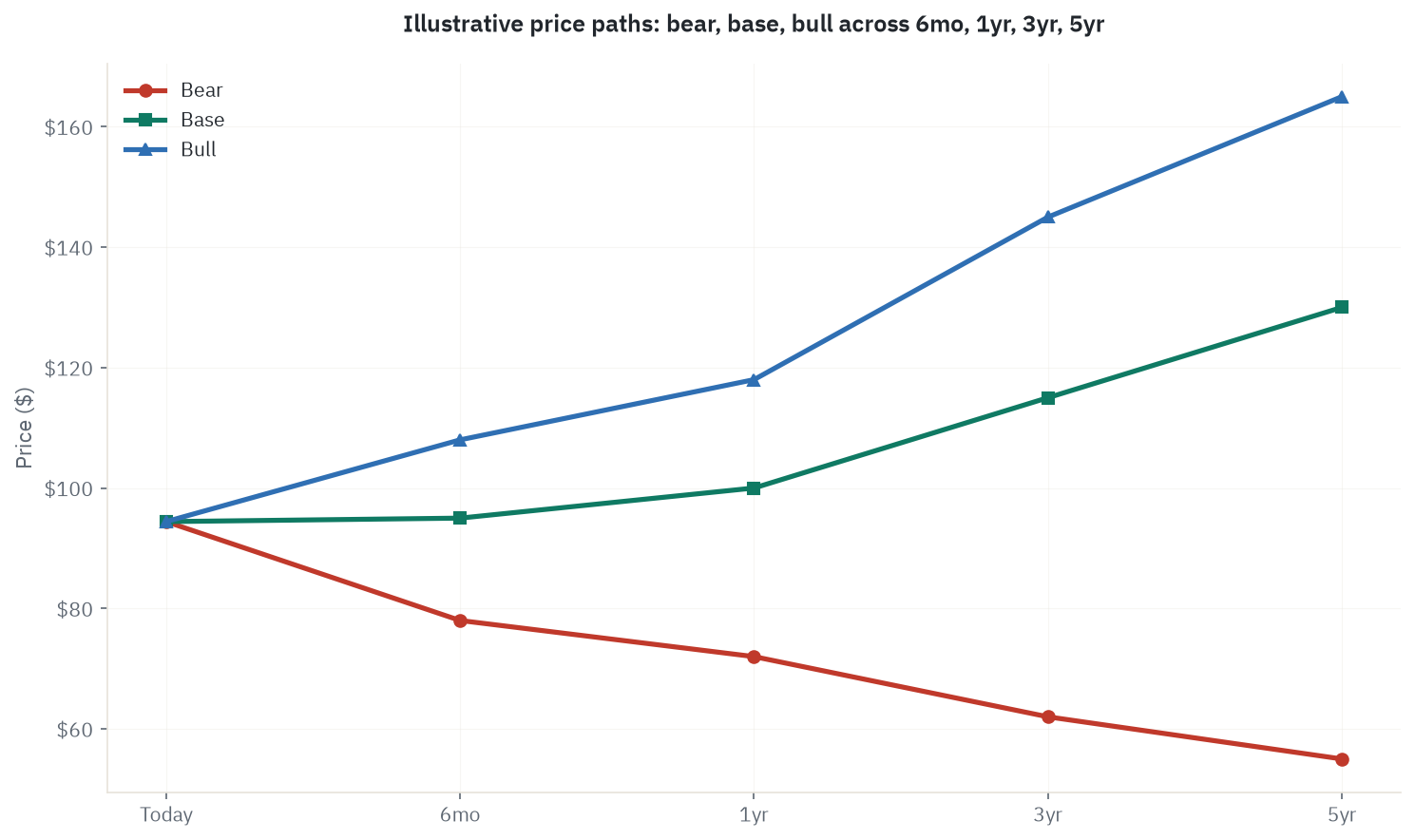
Every dollar figure below comes from the same simple method: an assumed EBITDA level times an assumed EV/EBITDA multiple, less net debt, divided by the roughly 1.626 billion combined shares. None of it is a price target, and none of it should be traded on directly.
Six months. This window turns on two datable prints: the second-quarter production report due around late July, and first-half financial results due around August, the first real read on how the copper-versus-iron-ore earnings mix is shaping up under new CEO Simon Trott. The near-term wildcard already happened once this cycle: on June 17, protesters blockaded the export road at Oyu Tolgoi, Rio’s flagship copper mine in Mongolia, halting shipments for a day before security intervened, a reminder that the copper growth story carries a live sovereign-risk tail even at the six-month horizon. If Pilbara iron ore shipments recover the roughly 8 million tonnes lost to first-quarter cyclones and copper holds above $4.50 a pound, the stock likely consolidates in the base case, around $95. A China-driven iron ore selloff toward $80 a tonne would be the bear path, toward $78, while copper extending its rally past $5 a pound is the bull path, toward $108.
One year. Over twelve months the dominant variable is the full-year iron ore price trajectory, not any single event. If Simandou, the new Guinea mega-project Rio itself is building, ramps faster than expected while Chinese steel demand keeps disappointing, the seaborne market could tip into surplus earlier than the base case assumes and the benchmark could fall toward $82 to $85 a tonne, compressing the segment that still generates roughly 60 percent of group profit. Copper growth from the Oyu Tolgoi ramp helps but cannot fully offset an $8 to $10 move in iron ore. The base case has Rio earning something like $25 billion to $26 billion of EBITDA and the stock drifting toward $100. The bear case, near $72, needs both iron ore weakness and a copper pullback; the bull case, near $118, needs copper to hold at today’s elevated levels. Mongolia is the wildcard again here: the government has been pushing since early 2026 for a larger share of Oyu Tolgoi’s economic returns, and any further escalation of that dispute would weigh on the copper side of this bet before it shows up in the numbers.
Three years. By 2029 the structural questions take over from the quarterly ones. Either Simandou is fully ramped and pushing iron ore into a sustained surplus, which is the bear case, or its ore’s high-grade premium holds up better than expected while copper growth from Oyu Tolgoi lifts group EBITDA meaningfully above today’s level, which is the base or bull case. The mix shift is the thing to track: if copper rises from roughly 27 percent of segment EBITDA today toward 35 to 40 percent, the market has reason to re-rate Rio Tinto as a copper-growth story rather than an iron-ore income stock, and the multiple can expand alongside the earnings. The base case is around $115, assuming modest EBITDA growth and a stable multiple. The bear case, around $62, assumes iron ore at $75 a tonne with no copper offset. The bull case, around $145, assumes the copper supercycle plays out roughly as its proponents describe.
Five years. At the five-year horizon the whole question is whether Rio Tinto has actually become a copper-led diversified miner, or whether iron ore’s structural decline has dragged the group down with it. In the base case, around $130, copper is close to 40 percent of group EBITDA, lithium is contributing something meaningful for the first time, and the dividend has compounded modestly, likely yielding somewhere in the 3 to 4 percent range on the current entry price. In the bear case, around $55, a prolonged commodity downturn and a persistent iron ore surplus leave the company overleveraged and force a dividend cut, a scenario the company has been through before, in 2016. In the bull case, around $165, the copper supercycle and successful execution across Oyu Tolgoi, Simandou, and Resolution Copper together produce a business earning $40 billion to $45 billion of EBITDA and a market willing to pay up for it.
Where the read lands today. On balance, the Hold read holds here. Rio Tinto is a genuinely strong business with an exciting, real copper growth story, but the iron ore structural headwind, a stock that has nearly doubled off its 52-week low, and the leverage Rio took on to buy Arcadium Lithium leave limited room for anything to go wrong. The single thing most likely to flip this read upward is iron ore holding above $90 a tonne through 2027 while the copper ramp delivers on schedule, which would prove the structural-decline story wrong. The single thing most likely to flip it downward is the free cash flow math not adding up, since the dividend already exceeded free cash flow in 2025, and another year of soft iron ore prices would make a cut, not a raise, the live question.
Companion tool
Jump to the interactive dashboard to sort and filter Rio Tinto against its peer set of diversified and pure-play miners across valuation, growth, quality, risk, and momentum, or download the Excel model to flex the bull, base, and bear scenarios with your own commodity price and multiple assumptions.
TL;DR
Rio Tinto is four commodity businesses sharing one balance sheet and one dual-listed stock: Pilbara iron ore, the cash engine that generated $15.2 billion of the group’s $25.4 billion FY2025 EBITDA; a fast-growing copper business built around the Oyu Tolgoi mine in Mongolia, up 114 percent year on year to $7.4 billion of EBITDA; a vertically integrated aluminium chain; and a newly bought lithium business via the roughly $7.6 billion Arcadium acquisition that closed in March 2025. The bull case is real: copper-equivalent production is compounding, Resolution Copper in Arizona finally cleared its federal land-exchange hurdle in March 2026, and management walked away from a roughly $260 billion Glencore merger rather than overpay, a genuine sign of capital discipline. The bear case is equally real and, on the evidence, at least as strong. Iron ore, still around 60 percent of group profit, faces a double squeeze: Chinese steel demand is forecast to keep contracting into 2026 even as Simandou, the giant new Guinea project Rio co-built with Chinese state-linked partners, adds a fresh 60 to 120 million tonnes a year of supply into the same market Rio sells its Pilbara ore into. Net debt tripled to $14.4 billion on the Arcadium deal, and the 2025 dividend, at $6.5 billion, already exceeded free cash flow, an unsustainable pattern if iron ore prices soften further. Two weeks before this research was compiled, protesters physically blocked copper shipments out of Oyu Tolgoi as Mongolia pushes for a larger share of the mine’s returns, a live and escalating sovereign-risk story the market has not fully priced. At roughly 7 times EV/EBITDA, near the top of Rio’s own ten-year valuation range, the stock offers a fair read on a genuinely good business, not a bargain. The verdict is Hold.
Explore it yourself: the interactive dashboard
Open the dashboard in a full screen
What Rio Tinto actually is
Think of Rio Tinto less as one mining company and more as four separate toll roads that happen to share a head office, a board, and a stock ticker. Each road carries a different kind of truck: one carries iron ore to Chinese steel mills, one carries copper concentrate toward the wiring and grids of the electrification economy, one carries bauxite through Rio’s own refineries and smelters into aluminium cans and car parts, and the newest, smallest road carries lithium brine toward battery makers. In any given year, the group’s overall result is simply whichever combination of tolls the commodity cycle happens to be paying best. In FY2025 that mix was iron ore $15.194 billion of underlying EBITDA, copper $7.369 billion, and aluminium plus lithium combined $4.574 billion, against $25.363 billion of group underlying EBITDA.
Iron ore is still the dominant road by a wide margin. Rio shipped 327.3 million tonnes from its century-old, fully integrated Pilbara mine-rail-port network in Western Australia in 2025, and that ore travels almost entirely to Chinese steel mills, which absorb roughly 70 to 75 percent of everything that moves by sea globally. Copper is the fastest grower, up 114 percent in EBITDA terms as the underground expansion at Oyu Tolgoi in Mongolia ramps toward its full design output. Aluminium is the most vertically integrated chain Rio runs, owning the bauxite mines, the alumina refineries, and the smelters, including a hydro-powered expansion in Quebec. Lithium is the newest and by far the smallest, bought rather than built, via the roughly $7.6 billion Arcadium acquisition that closed in March 2025 and currently contributes only about $0.2 billion of group EBITDA.
The unifying fact across all four roads is that Rio Tinto is fundamentally a price-taker. Iron ore, copper, aluminium, and lithium are all priced on global benchmarks Rio cannot move at the margin. What Rio actually controls is its position on the cost curve, and here it is genuinely excellent: Pilbara iron ore costs roughly $21 to $22 a tonne to produce and sells for around $90, a cash margin of 60 to 65 percent that puts it in the bottom quartile of the global cost curve, alongside only BHP’s Pilbara operations and Fortescue as true peers.
How the money flows
flowchart TD
    TOP["China steel demand + global electrification/construction demand"]
    TOP --> STEEL["Chinese steelmakers - ~70-75pct of seaborne iron ore demand"]
    TOP --> LOWC["Electrification - EV, grid, data-centre copper demand"]
    TOP --> INDCON["Construction, packaging, auto, aerospace, battery demand"]

    STEEL --> IRONSALE["Iron ore sold FOB at benchmark price - 90 USD per dmt realised 2025"]
    LOWC --> CUSALE["Refined copper sold at LME price - 457 cents per lb realised 2025"]
    INDCON --> ALSALE["Aluminium sold at LME plus premium - 3318 USD per tonne realised 2025"]
    INDCON --> LISALE["Lithium carbonate sold at spot price - 9451 USD per tonne avg 2025"]

    IRONSALE --> PILBARA["Pilbara mine-rail-port, WA - 327.3Mt FY2025, Rio operated"]
    IRONSALE --> SIMANDOU["Simandou, Guinea - Rio 53pct SimFer JV with Chalco-led China consortium"]
    CUSALE --> OYUTOLGOI["Oyu Tolgoi, Mongolia - Rio 66pct, Govt 34pct, ramping to 500kt per yr by 2028-36"]
    CUSALE --> KENNECOTT["Kennecott, Utah - Rio-owned mine plus smelter"]
    CUSALE --> RESOLUTION["Resolution Copper, Arizona - Rio 55pct, BHP 45pct, land exchange done Mar 2026"]
    ALSALE --> BAUXITE["Bauxite mines - 62.4Mt FY2025 record"]
    LISALE --> RINCON["Rincon plus Arcadium assets, Argentina - 57kt LCE FY2025"]

    BAUXITE --> ALUMINA["Rio-owned alumina refineries - 7.6Mt FY2025"]
    ALUMINA --> SMELTER["Rio-owned smelters incl AP60 Quebec expansion"]

    PILBARA --> RAIL["Rio-owned rail and port network"]
    SIMANDOU --> RAIL2["New Guinea rail and port infrastructure"]
    RAIL --> DIESEL["Diesel input - 1.6bn litres per yr, two thirds Pilbara"]
    RAIL2 --> DIESEL

    OYUTOLGOI --> MONGOLIATAX["Mongolia govt - disputed 440 million USD tax assessment"]

    SMELTER --> RIO["Rio Tinto group - 25.4bn USD FY2025 underlying EBITDA"]
    KENNECOTT --> RIO
    RESOLUTION --> RIO
    PILBARA --> RIO
    SIMANDOU --> RIO
    OYUTOLGOI --> RIO
    RINCON --> RIO
Read the diagram from the top down. Two very different kinds of buyer sit at the head of the chain. Chinese steelmakers, mostly the state-linked Baowu and Ansteel plus hundreds of smaller mills, buy iron ore for construction, infrastructure, and manufacturing steel, and they decide how much ore to buy in any given month based on their own economics, not Rio’s. A completely different buyer sits behind the copper demand: grid operators, EV makers, and data-center builders, all part of the broader electrification economy, buying refined copper priced on global exchanges (LME, COMEX, SHFE).
From there, ore and metal move through Rio’s own mines and, in copper’s case, through joint ventures with sovereign or corporate partners. The Pilbara is entirely Rio-operated; Simandou in Guinea is a joint venture where Rio holds 53 percent alongside a Chalco-led Chinese consortium that includes Baowu, the same company that is also one of Rio’s largest iron ore customers, a structural overlap worth sitting with for a moment. Oyu Tolgoi in Mongolia is 66 percent Rio and 34 percent the Mongolian government, a structure that gives Mongolia both an equity stake and separate taxing authority, which it has already used to assess a disputed $440 million tax bill. Resolution Copper in Arizona, 55 percent Rio and 45 percent BHP, only cleared its federal land-exchange requirement in March 2026 after years of litigation.
Underneath every one of these four roads sits one shared, non-negotiable input: energy. Rio burns roughly 1.6 billion litres of diesel a year, two-thirds of it moving Pilbara ore by rail and truck, and every $10-a-barrel move in the oil price shifts Pilbara unit costs by about 15 cents a tonne, a direct, quantified link between something like a Middle East supply shock and the margin on Rio’s largest and most profitable business.
The four businesses: iron ore, copper, aluminium, lithium
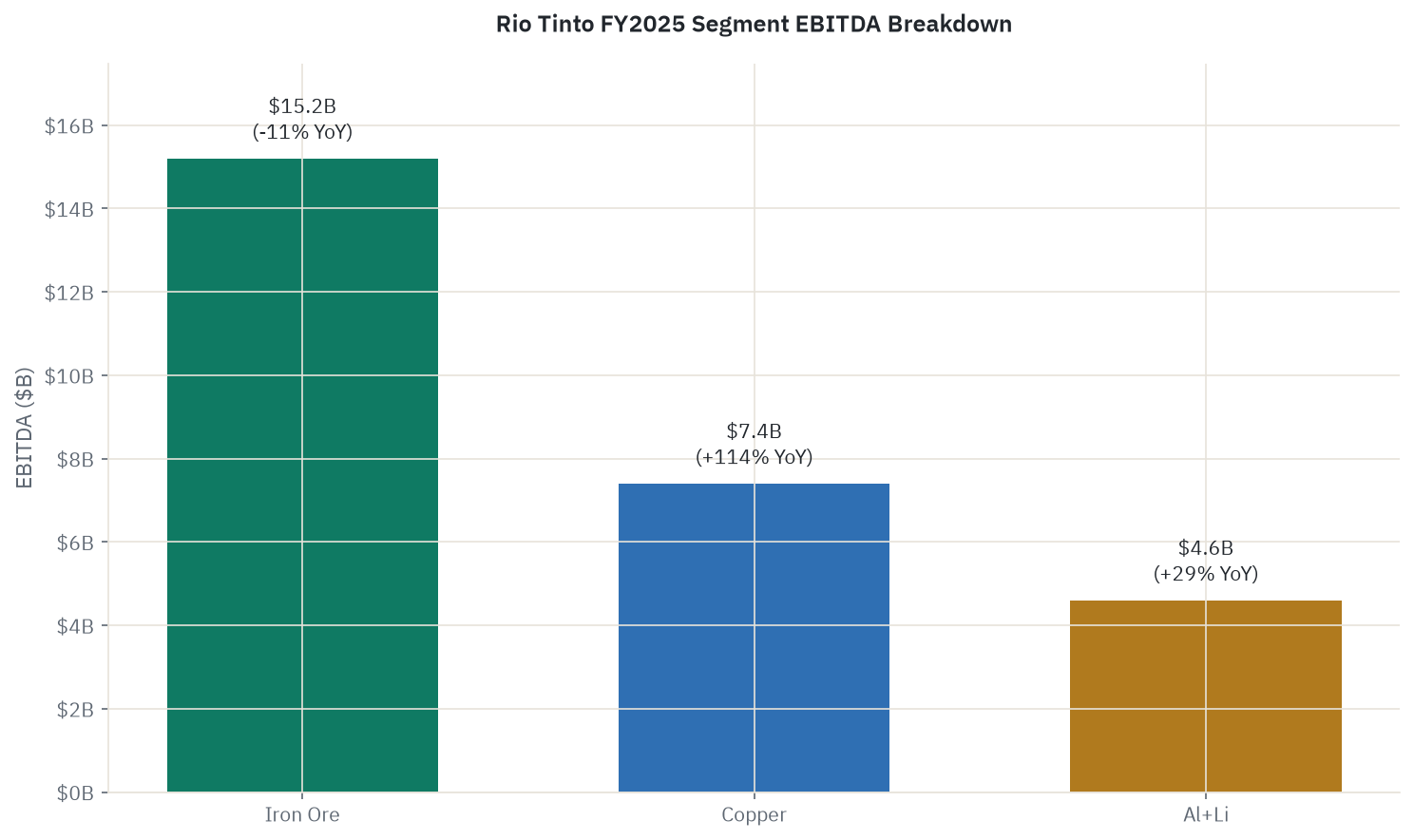
Iron Ore is still the cash engine, generating $15.194 billion of underlying EBITDA in FY2025, down 11 percent year on year, on segmental revenue of $28.989 billion, down 8 percent. Rio shipped 327.3 million tonnes from the Pilbara at a realised price of $90.0 per dry metric tonne, down 8 percent year on year, against a cash cost of roughly $21 to $22 a tonne. Five major replacement mines, including Western Range, which opened on time and on budget in June 2025, are underway to sustain 345 to 360 million tonnes a year of mid-term system capacity. The newest addition to this segment is Simandou in Guinea, which shipped its first ore in December 2025 after decades of on-and-off development, and is guided to ship 5 to 10 million tonnes in 2026, scaling toward Rio’s own 27-million-tonne annual share of a combined project that could eventually run 60 to 120 million tonnes a year across all participants.
Copper is the growth story, and the numbers back it up: $7.369 billion of underlying EBITDA, up 114 percent year on year, on segmental revenue of $13.729 billion, up 48 percent, driven by a 61 percent increase in copper production and higher realised copper and gold prices. The engine here is Oyu Tolgoi in Mongolia, where the underground expansion completed in late 2025 and is ramping toward roughly 500,000 tonnes a year of copper by 2028 to 2036, which would make it the world’s fourth-largest copper mine by 2030. Rio also runs Kennecott in Utah, where it owns its own smelter and refinery alongside the mine, and is now moving Resolution Copper in Arizona toward development following the March 2026 land-exchange completion, though as covered below that project is a decade, not a year, from first production.
Aluminium and Lithium together contributed $4.574 billion of underlying EBITDA, up 29 percent year on year, on revenue of $17.056 billion, up 25 percent. Aluminium did the heavy lifting within this segment, contributing $4.4 billion at a 13 percent return on capital employed, while Lithium contributed only $0.2 billion. Rio recorded a record 62.4 million tonnes of bauxite production and 3.38 million tonnes of primary aluminium, and is expanding the AP60 smelter in Quebec, a hydro-powered jurisdiction, targeting first hot metal in the first quarter of 2026 and full ramp by year end. The Aluminium division absorbed roughly $1 billion of gross US tariff cost in 2025 after losing its Section 232 exemption in March that year, though the US Midwest premium has since adapted to largely offset the hit. Lithium, the segment bought via the Arcadium acquisition, produced 57,000 tonnes of lithium carbonate equivalent in 2025, 46,000 tonnes attributable to Rio after the deal closed in March 2025, into a market where spot prices fell 28 percent across the year before jumping 55 percent in the fourth quarter alone on renewed battery-storage and EV demand optimism.
Who wins where
The value chain groups cleanly into leaders, sovereign toll-takers, commodity fringe, and geographic-risk exposures. Rio Tinto and BHP are the clear leaders in seaborne iron ore, both running the lowest-cost mines in the world thanks to the Pilbara’s thick, near-surface ore bodies and captive rail-and-port infrastructure that took a century to build and cannot be replicated quickly by a new entrant. Vale is the third leader, with Brazil’s lower mine-site costs offset by materially higher freight costs to the Chinese market that all three depend on.
Copper’s leader board looks different. Freeport-McMoRan and Southern Copper are the purest large-cap plays on the electrification demand story, while Rio’s Oyu Tolgoi and Resolution Copper are genuine growth assets that do not yet carry the scale of Escondida (BHP’s flagship) or Grasberg (Freeport’s). The toll-takers in copper are not miners at all but the independent smelters, heavily concentrated in China, that charge treatment and refining charges on every tonne of concentrate Rio does not process itself, and the sovereign partners, Mongolia at Oyu Tolgoi most acutely, who hold both equity and separate taxing power over the project.
Aluminium’s economics are set by energy cost more than by ore scarcity, which is why Rio’s hydro-powered Quebec smelters and Alcoa’s own hydro-heavy portfolio sit at the low-cost end, while Chinese coal-powered capacity, structurally cheaper on labor but more expensive on power, sits at the high end. Lithium remains the commodity fringe here, a market still working through oversupply and price volatility that has not yet rewarded Rio’s Arcadium bet, and Glencore’s coal-and-trading model is a genuinely different animal from a pure miner, a hybrid that captures value through logistics and information as much as through rock in the ground.
Company by company: who’s who
Rio Tinto (RIO, NYSE ADR) - the anchor of this piece, a diversified miner spanning iron ore, copper, aluminium, and lithium. Recent: FY2025 revenue $57.638 billion, up 7 percent; underlying EBITDA $25.363 billion, up 9 percent; net earnings $9.966 billion, down 14 percent on higher Arcadium-related debt costs. Bull: copper growth at Oyu Tolgoi, a derisked Resolution Copper, and management’s demonstrated capital discipline in walking away from the Glencore deal. Bear: iron ore, still around 60 percent of profit, faces a structural China-demand headwind and a self-inflicted new supply source in Simandou; net debt tripled on the Arcadium deal; Mongolian sovereign risk is escalating, not resolving.
BHP Group (BHP, NYSE ADR) - the world’s largest diversified miner by market value, around $205 billion to $210 billion as of late June and early July 2026, and the number-one iron ore producer globally, running Western Australian iron ore alongside copper at Escondida and Olympic Dam and a new potash project, Jansen, coming online. Bull: the largest, lowest-cost iron ore franchise plus a top-tier copper asset and a new commodity leg in potash. Bear: even more iron-ore-concentrated than Rio, around 65 percent of EBITDA, so it carries the same China demand exposure with less diversification, and its own Anglo American merger talks also collapsed, leaving a capital-deployment question unanswered.
Vale S.A. (VALE, NYSE ADR) - the Brazilian iron ore and nickel major, around $64 billion market cap, the world’s number-two iron ore producer. Bull: the cheapest of the large-cap iron ore names on a price-to-earnings and dividend-yield basis, with the lowest-cost open-pit mine in the world at Carajas. Bear: even more dependent on iron ore than Rio, over 80 percent of EBITDA, with no copper growth story to offset a structural iron ore decline, plus ongoing Brumadinho and Mariana dam-disaster liabilities and Brazilian political and currency risk.
Freeport-McMoRan (FCX, NYSE) - a pure-play copper and gold miner, around $91 billion market cap, operating the Grasberg deposit in Indonesia along with Morenci in Arizona and other Americas mines. Bull: the purest large-cap copper exposure to the electrification story, anchored by a world-class deposit. Bear: single-commodity concentration, Indonesian sovereign risk given the government’s 51 percent ownership of Grasberg since 2018, and higher production costs than Oyu Tolgoi.
Alcoa Corporation (AA, NYSE) - a pure-play aluminium producer, around $12 billion to $12.9 billion market cap, notably smaller than Rio’s aluminium segment alone. Bull: rising aluminium prices and a tightening global alumina market are improving profitability from cyclical lows. Bear: deeply cyclical earnings, smaller scale, and higher average smelting costs than Rio’s hydro-powered Quebec operations.
Glencore plc (GLNCY, OTC ADR) - a diversified miner and the world’s largest independent commodity trading house, around $85 billion market cap, and the counterparty in Rio’s collapsed merger talks. Bull: the mining-plus-trading model gives information and logistics advantages, with meaningful copper and cobalt exposure. Bear: coal exposure is a genuine ESG liability, trading profits are volatile and opaque, and the company carries a history of bribery-related governance settlements.
Southern Copper Corporation (SCCO, NYSE) - controlled by Grupo Mexico at roughly 88 percent ownership, around $110 billion market cap, with mines in Peru and Mexico and among the largest copper reserves of any public miner. Bull: low-cost Peruvian operations and a strong dividend history. Bear: the controlling shareholder structure limits minority rights, and community opposition to the Tia Maria project in Peru is an ongoing, specific risk.
Teck Resources (TECK, NYSE) - a Canadian miner transitioning toward copper after selling its steelmaking coal business to Glencore in 2024, around $35 billion market cap, anchored by the QB2 copper mine in Chile. Bull: a clean copper-growth story post-divestiture. Bear: the QB2 ramp has been plagued by delays and cost overruns, and Chile’s royalty regime is a live fiscal risk.
What the filings say
Rio Tinto reports to the SEC via Form 20-F annually and 6-K filings for material events and quarterly production, filing under CIK 863064 as a dual-listed company. FY2025 consolidated sales revenue was $57.638 billion, up 7 percent year on year from $53.658 billion, with underlying EBITDA of $25.363 billion, up 9 percent, a 44.0 percent group EBITDA margin. Revenue has recovered from a 2022 to 2024 range of roughly $53.7 billion to $55.6 billion, and the FY2025 rebound was copper- and aluminium-led, not iron ore-led.
Underlying earnings were $10.868 billion, roughly flat year on year, but net earnings attributable to owners fell 14 percent to $9.966 billion from $11.552 billion in 2024, driven by higher taxes and finance costs after the debt taken on for the Arcadium acquisition. That gap between a growing EBITDA line and a shrinking net earnings line is the balance-sheet cost of the deal showing up directly in the bottom line.
On cash flow, the company generated roughly $15.6 billion from operations against $12.335 billion of group capital expenditure purchases (Rio’s own share $11.4 billion), leaving free cash flow of approximately $4.2 billion, before dividends and acquisitions. That is a meaningfully lower conversion rate than Rio’s historical pattern of $15 billion to $20 billion of operating cash flow against $7 billion to $9 billion of capex, and it reflects a genuinely elevated growth-capex phase across Oyu Tolgoi, Simandou, the Pilbara replacement mines, and the AP60 smelter expansion. Management guides 2026 capex at “up to $11 billion” again, meaning this compressed free cash flow phase does not end this year.
Net debt jumped 162 percent year on year to $14.362 billion at the end of 2025, from $5.491 billion, taking net gearing from 9 percent to 18 percent, almost entirely because of the roughly $7.6 billion Arcadium Lithium acquisition that closed in March 2025, funded via a $9 billion multi-tranche bond issuance across 5-, 10-, and 30-year tenors. Credit ratings remain investment grade, Moody’s A1 and S&P A, and interest coverage on roughly $25 billion of EBITDA against an estimated $1 billion to $1.5 billion of interest expense is comfortable in isolation. The concern is not solvency today, it is capacity for the dividend if commodity prices soften, covered in the risk section below.
On capital returns, the FY2025 ordinary dividend was $6.5 billion in total, 402 US cents per share, a 60 percent payout ratio and the tenth consecutive year at the top of the company’s stated 40 to 60 percent payout range. Rio Tinto funds acquisitions with debt, not equity, so there has been no shareholder dilution from the Arcadium deal.
2026 guidance, reaffirmed after the first quarter, holds Pilbara iron ore shipments at 323 to 338 million tonnes (100 percent basis) against 327.3 million tonnes actually shipped in 2025, mined copper at 780,000 to 850,000 tonnes against roughly 760,000 tonnes in 2025, and lithium carbonate equivalent around 60,000 tonnes. Capital Markets Day, held December 4, 2025 under new CEO Simon Trott, reiterated a roughly 3 percent compound annual growth target for copper-equivalent production to 2030 and roughly 4 percent a year in unit-cost reductions, targets some analysts model into a 40 to 50 percent EBITDA upside by 2030 at long-run consensus prices, though that modeling is analyst work, not company guidance.
The company’s own disclosed risk factors span commodity price volatility, climate transition and physical risks including cyclones and water scarcity, community and social-license risk tied to the Juukan Gorge legacy, sovereign and political risk in Mongolia, Guinea, Argentina, and Serbia, operational safety following two worker fatalities in the first quarter of 2026, cybersecurity, and project execution risk across the multiple simultaneous growth projects underway.
On ownership, Chinalco, the Chinese state-linked aluminum company, is reported to hold approximately 14 to 15 percent of Rio Tinto plc, making it one of the largest single shareholders. That figure comes from press reporting rather than a primary shareholding disclosure checked directly for this piece, and readers should verify against company filings for the current position before relying on it. Share counts as of late January 2026 were 371,346,214 for Rio Tinto Limited and 1,254,475,491 for Rio Tinto plc, confirmed against company filings.
The most notable governance event of the period was one that did not happen: on January 8, 2026, Rio Tinto confirmed preliminary talks with Glencore on a possible all-share combination reported at up to roughly $260 billion in combined value, then, on February 5, formally filed a “no intention to bid” statement with the SEC, saying it could not reach agreement on terms that would deliver value to shareholders. That walk-away is a real data point for capital discipline. It is also worth noting that UK takeover rules bar Rio from re-approaching Glencore until August 2026, so this particular question is not permanently closed.
What the market is paying
RIO closed around $94.42 on July 2, 2026, and the stock has had a wild year: a 52-week range of $57.66 to $112.58, an all-time closing high of $112.04 hit on May 13, 2026, and roughly a doubling off its 52-week low before pulling back about 16 percent from that high. That round trip lines up with the news flow: a copper and gold price rally, a first-quarter production beat, and the Resolution Copper derisking event drove the run-up, while a string of analyst downgrades from Barclays, HSBC, JPMorgan, RBC, and Zacks between January and April 2026, all citing peak valuation, coincided with the pullback.
Market capitalization is worth a genuine caveat here rather than a single confident number. Different sources place Rio Tinto’s combined dual-listed group value anywhere from roughly $150 billion to $163 billion as of early July 2026, a real spread traceable to whether the aggregator is counting the NYSE ADR line alone or the entire plc-plus-Limited group, since the two entities have different share counts (roughly 1.254 billion for plc, 371 million for Limited) but trade as one economic entity. Treat any single-decimal market cap figure as a snapshot rather than a precise number, and never assume RTNTF’s quoted figure is additive to RIO’s; they represent overlapping claims on the same combined business.
On valuation, enterprise value of roughly $177 billion (market cap plus $14.4 billion net debt) against $25.4 billion of EBITDA works out to about 7.0 times EV/EBITDA. That sits roughly in line with BHP and other mining majors, comfortably below the S&P 500’s 13 to 15 times, but near the top, not the middle, of Rio’s own ten-year range, which runs roughly 5 to 9 times with a three-year average closer to 5.2 times and a five-year average around 5.6 times. Trailing price-to-earnings is cited anywhere from about 12 times on a forward basis to nearly 17 times trailing, and dividend yield is cited between roughly 3.5 percent and 5.1 percent depending on the source, date, and whether the figure is trailing or forward. Both ranges reflect genuine cross-source disagreement, not a single clean number, and the honest summary is that the yield has compressed meaningfully from a historical 5 to 6 percent average as the stock re-rated off its lows.
Free cash flow of roughly $4.2 billion against a market cap in the $150 billion-plus range implies a rich price-to-free-cash-flow multiple in the high 30s, though this reflects the elevated growth-capex phase rather than normalized earnings power; on a more normal $8 billion to $9 billion capex run-rate, free cash flow would be closer to $6 billion to $7 billion, a somewhat less stretched multiple in the low-to-mid 20s.
On the sell side, Wall Street is genuinely split, not quietly bullish. MarketBeat shows a consensus “Hold” from 15 analysts, one Sell, nine Hold, four Buy, and one Strong Buy, with an average price target of $101.75 and a range of $83.50 to $120.00, roughly 8 percent upside from current levels. Other aggregators show meaningfully different splits, some leaning “Moderate Buy,” others “Neutral” with more Sell ratings mixed in, and price targets clustering anywhere from the high $80s to the low $100s depending on the platform and pull date. The honest framing is a roughly balanced to mildly cautious Street view, not a consensus Buy, with the wide target range itself reflecting real uncertainty about where commodity prices and the growth-versus-cyclicality tradeoff land.
Liquidity on RIO is solid, averaging 4 to 6 million shares a day with tight bid-ask spreads, typically under 5 cents. Short interest is low, under 2 percent of float, consistent with a mega-cap held mostly by long-only institutions rather than a name attracting bearish positioning. Beta sits around 1.0 to 1.2 against the S&P 500, moderate for a miner because Rio’s iron ore, copper, and aluminium exposures do not all move together on the same cycle.
What the crowd is saying
The news narrative over the past six months has genuinely evolved. Coverage of the Glencore merger talks in January and February 2026 was intense and largely neutral-to-cautious on deal risk, turning relief-focused once the talks collapsed and the market repriced Rio as a standalone operator. From December 2025 through May 2026, the dominant story was copper euphoria: the stock rallied roughly 47 percent off its October 2025 low, peaking intraday around AUD 192 on the ASX line on May 14, 2026, as copper prices themselves rose sharply on a genuinely structural, multi-source demand story spanning AI infrastructure, electrification, and renewable buildout. Simandou’s first shipment and a strong first-quarter production report added confidence through the same window, treated by coverage as de-risking rather than speculative news.
Two threads have since cooled that tone. Two worker fatalities in the first quarter, one at Simandou in February and one at Kennecott in the US, prompted CEO Simon Trott to say publicly the company is “not where it needs to be” on safety, and safety has become a genuine credibility question in coverage rather than a passing incident. Analyst downgrades from five major houses between January and April 2026 have shifted the sell-side tone from “conviction Buy” to “priced for the good outcome.”
On retail chatter specifically, the signal is thin but directionally clear. StockTwits sentiment peaked at “extremely bullish” during the Glencore-talks period in early 2026 and cooled to “bullish” by June, with message volume and participation dropping from high to normal levels, a classic peak-sentiment pattern: the amplitude of chatter fading even while the stock still sits well above its 52-week low. Reddit and broader social chatter on Rio Tinto specifically is sparse, consistent with a name dominated by institutional and commodity-trader positioning rather than retail momentum. No pump-and-dump or coordinated promotion signal was found; this reads as an organic, commodity-driven trade rather than a manufactured one.
The most useful divergence to flag is where the crowd’s attention sits versus where the actual risk sits. The story the market has been telling itself is about copper, which rallied roughly 33 percent year on year to record highs. Iron ore prices, by contrast, rose only about 7 percent over the same period, a much more muted move for the segment that still generates roughly 60 percent of group profit, and that quieter number is where the real structural risk to Rio’s earnings lives. A second divergence sits in ESG: five years after the 2020 Juukan Gorge event, Rio’s own disclosures show a 683 percent increase in Indigenous leadership roles and a 27 percent increase in Indigenous supplier spend, yet some Aboriginal groups say core commitments remain unfulfilled, and the market has largely shrugged this off with the stock up sharply over the past year. If a major pension or superannuation fund with an ESG mandate moves to formally divest or downgrade Rio on this basis, that is a slow-burn risk the current price does not appear to reflect.
Durability and the moat: what survives the commodity cycle
Put the top-down and bottom-up pictures together and the durability read is genuinely two-sided, not a coin flip dressed up as balance. The structural case for Rio Tinto rests on real, hard-to-replicate advantages. Pilbara iron ore sits in the bottom quartile of the global cost curve because of century-old, fully owned mine-rail-port infrastructure that no new entrant could build at similar cost today; Rio’s own analysis puts the operation profitable down to roughly $40 to $45 a tonne, a level iron ore last briefly touched in 2015 to 2016. Copper’s demand tailwind is structurally sound too: an average electric vehicle uses three to four times the copper of a combustion vehicle, each gigawatt of new data-center capacity needs several thousand tonnes of copper, and new mine supply takes ten to fifteen years to bring on from discovery, a long lead time that has left the industry structurally under-invested since the mid-2010s downturn.
The real, and reasoned, bear case is that the two biggest legs of this thesis both carry a self-inflicted or escalating wound. On iron ore, Simandou is genuinely a double-edged project: Rio profits from building and part-owning it, but its very existence, a new 60 to 120 million tonnes a year of high-grade supply, is the single biggest reason analysts expect the seaborne benchmark to keep drifting lower. One estimate models a roughly 200 million tonne cumulative seaborne surplus between 2026 and 2028 as Simandou ramps into a Chinese steel market that a leading industry forecaster expects to keep contracting into 2026 before merely plateauing, not recovering, in 2027. Run the arithmetic on Rio’s own book: a $10-a-tonne decline in realised price across 327 million tonnes of Pilbara shipments wipes out roughly $3.0 billion to $3.3 billion of Iron Ore EBITDA, on the order of 12 percent of the entire group’s profit, from a single $10 move. And because Rio co-built Simandou with Chinese state-linked partners who are simultaneously its largest Pilbara customers, a rough back-of-envelope on the net effect, a roughly $5-a-tonne benchmark decline across the larger Pilbara base costs about $1.6 billion while Simandou’s own contribution at its planned Rio-share volume adds back something closer to $0.8 billion, suggests the project could plausibly be a net drag on group EBITDA for years, not the clean win it is often described as. Layered underneath that is the slower, longer-run threat of electric arc furnace steelmaking displacing blast-furnace iron ore demand in China as scrap steel availability grows; if China’s EAF share rises from roughly 15 percent today toward the 25 to 30 percent some project by 2035, the iron ore volume displaced could run to roughly 160 million tonnes, close to half of Rio’s entire Pilbara output, a genuine structural ceiling on long-run demand independent of any single year’s price.
On copper, the sovereign-risk side of the ledger has gotten worse over the research period, not better. Mongolia’s government passed new sovereign-wealth legislation in April 2025 giving it the ability to take larger equity stakes in strategic mines, and by early 2026 reports had Mongolia targeting more than half, then reportedly pushing toward 60 percent, of Oyu Tolgoi’s economic returns, a dramatic shift from the existing ownership split. The flashpoint is a roughly $12 billion shareholder loan Rio extended to the project, structured with an effective interest rate that compounds close to the size of the principal itself, deferring Mongolia’s originally anticipated first dividend from 2019 out toward 2041, a structure Mongolia considers unfair and is actively pushing to renegotiate. This is not an abstract dispute: on June 17, 2026, protesters physically blockaded the road used to export copper concentrate from Oyu Tolgoi to China, halting shipments before security intervened and normal operations resumed the next day, and late that same month Rio agreed to adjust the loan’s interest rate, a concession that suggests more ground will likely be given, not less. Resolution Copper, meanwhile, is genuinely derisked on the legal front after the March 2026 land-exchange completion, but it remains a decade or more from first production; treating it as a near-term catalyst rather than a 2030s-plus asset would be a mistake.
The most likely path, weighing both sides honestly, is a split outcome rather than a clean win for either case: iron ore drifting gradually lower as Simandou ramps into a soft-but-not-collapsing Chinese demand backdrop, while copper growth continues but against a rockier, more expensive sovereign-risk backdrop in Mongolia than the bull case typically assumes. That split outcome is roughly what the base case above already prices in, which is one reason the read lands at Hold rather than at either extreme.
The scenarios in detail
Four variables decide where Rio Tinto lands over the next five years.
- The iron ore benchmark price. Pilbara iron ore is roughly 60 percent of group EBITDA, and the benchmark is set by Chinese steel demand against seaborne supply, led by the Simandou ramp. Rio realised $90 a tonne in FY2025; one forecaster projects roughly $90 for 2026, with others seeing $83 to $90 by 2027 depending on house and vintage, a range that has itself moved during the research period as forecasters revise their models.
- Copper price and the Oyu Tolgoi ramp. Copper is the fastest-growing segment, and Oyu Tolgoi is targeting roughly 500,000 tonnes a year by 2028 to 2036. Whether that ramp translates into earnings depends on both the copper price holding up and Mongolia’s sovereign-risk posture not escalating further.
- Capital allocation and leverage. Net debt jumped to $14.4 billion, an 18 percent gearing ratio, largely on the Arcadium deal. Capex runs around $11 billion a year. The open question is whether management can maintain the 40 to 60 percent dividend payout policy while deleveraging and funding growth simultaneously, especially given the 2025 dividend already exceeded free cash flow.
- China’s macro trajectory. China accounts for roughly 70 to 75 percent of seaborne iron ore demand and is a meaningful copper and aluminium buyer as well. Its property downturn, infrastructure stimulus, and broader growth path determine demand for most of what Rio digs up.
Bull case (illustrative, an estimate, not a target). Copper holds $5 to $6 a pound through 2028 to 2031 on electrification, EV adoption, and data-center power demand outrunning new supply, with Oyu Tolgoi reaching its roughly 500,000-tonne target on schedule and Resolution Copper entering development. Iron ore holds $85 to $90 a tonne as Chinese demand stabilises and Indian and Southeast Asian demand grows to partially fill the gap. Lithium recovers to $15,000 to $20,000-plus per tonne. Net debt declines to $5 billion to $8 billion by 2031 as the elevated capex phase ends around 2028 to 2029, and buybacks resume. Revenue grows roughly 5 to 7 percent a year to $75 billion to $80 billion by 2031, EBITDA reaches $40 billion to $45 billion, copper becomes roughly 40 percent of group EBITDA, and the multiple expands toward 7 to 8 times as the market re-rates the copper-growth story. What breaks it: a Chinese economic shock that crashes both iron ore and copper together, a stalled Oyu Tolgoi ramp on the Mongolian dispute, or a copper supply glut from accelerated new-mine development elsewhere.
Base case (illustrative). Copper settles around $4.50 a pound, consistent with moderate electrification growth, with Oyu Tolgoi reaching 400,000 to 450,000 tonnes a year by 2029, slightly below its full target, and Resolution Copper’s own production still pushed out past 2031. Iron ore declines gradually to $80 to $85 a tonne by 2028 to 2030 as Simandou ramps and Chinese demand softens further, though Pilbara’s roughly $22-a-tonne cost keeps the operation solidly profitable even at those levels. Lithium recovers modestly to $12,000 to $15,000 a tonne. Net debt declines to $8 billion to $10 billion, and the dividend is maintained at the 50 to 60 percent payout range with no buyback. Revenue grows roughly 3 to 4 percent a year to $68 billion to $72 billion, EBITDA grows modestly to $30 billion to $35 billion as copper growth offsets iron ore pricing headwinds, and copper’s share of segment EBITDA moves to roughly 35 percent. What breaks it: iron ore falling below $75 a tonne before copper growth is large enough to compensate, or cost overruns and delays at Oyu Tolgoi.
Bear case (illustrative, and this is the skeptic’s strongest sequence, not a token downside). Simandou’s ramp pushes the seaborne iron ore market into a sustained surplus while Chinese steel demand contracts a further 2 to 3 percent a year, taking the benchmark to $70 to $75 a tonne by 2028 to 2030 as electric arc furnace steelmaking permanently displaces some blast-furnace iron ore demand. Copper normalizes to $3.50 to $4.00 a pound as new supply from Oyu Tolgoi, Kamoa-Kakula, and other projects catches up with demand, meaning the supercycle thesis was premature rather than wrong in direction. Lithium spot stays around $8,000 to $10,000 a tonne, and the Arcadium acquisition looks like an overpayment, with some assets impaired. Net debt stays elevated at $10 billion to $12 billion because lower cash flow limits deleveraging, and the dividend is cut to the bottom of the 40 to 60 percent payout range, a roughly 34 percent reduction from current levels. The Mongolian tax and shareholder-loan dispute escalates further, and any ESG-driven institutional divestment adds pressure. Revenue is flat to declining, EBITDA contracts to $16 billion to $18 billion by 2029 to 2031, and Iron Ore’s segment margin compresses from 52 percent toward 40 percent. What breaks the bear: Chinese stimulus well beyond expectations, such as a major property-sector bailout, or copper demand from data centers and EVs outrunning every supply response.
Catalysts and timeline. In the near term: the second-quarter 2026 production report, expected around late July, is the first read on whether Pilbara shipments recover from the cyclone-driven shortfall; first-half 2026 financial results, expected around August, give the first look at the copper-versus-iron-ore EBITDA mix under Simon Trott; Simandou’s 2026 shipment ramp is guided at 5 to 10 million tonnes for the full year; the AP60 smelter targets full ramp by the end of 2026; and the Mongolian tax dispute’s resolution timeline remains open. Over the multi-year horizon: Oyu Tolgoi reaching design capacity around 2028 to 2030, Simandou reaching its full combined run-rate around the same window, a Resolution Copper development decision whose timeline is still to be determined, the lithium project ramp across Rincon, Fenix, and Sal de Vida through 2026 to 2028, and a capex step-down guided for around 2028 to 2029 as the current growth phase completes.
Leading indicators to watch. The single most important number is the iron ore benchmark price itself: above $90 a tonne, the bull case holds; below $80, the bear case intensifies. After that, watch Oyu Tolgoi’s quarterly copper production against its roughly 500,000-tonne target and any further Mongolian government escalation; Simandou shipment volumes, since a faster-than-expected ramp increases the iron ore supply pressure directly; Chinese steel production and property-starts data, the demand side of the iron ore equation; the LME copper price itself, where above $5 a pound supports the supercycle thesis and below $4 undermines it; the quarterly net debt trajectory, since a figure that fails to decline from $14.4 billion signals the leverage concern is intensifying rather than resolving; and the dividend payout ratio, where a move below 50 percent would signal genuine balance-sheet stress.
Companies to watch (bull / base / bear)
Rio Tinto (RIO). Role: the anchor name. Bull: iron ore holds above $90 a tonne through 2027, disproving the structural-decline thesis, while copper delivers on schedule. Base: iron ore grinds lower but stays profitable, copper growth partially offsets. Bear: iron ore falls below $80 alongside a copper pullback below $4, compressing group EBITDA below $20 billion and forcing a dividend cut, the scenario the skeptic report treats as the single most likely way this thesis goes wrong. Watch: the quarterly net debt figure and the dividend payout ratio.
BHP Group (BHP). Role: the scale leader and closest direct comparison. Bull: the lowest-cost, largest iron ore franchise plus a new potash leg in Jansen. Bear: even greater iron ore concentration than Rio means a China demand shock hits BHP harder in percentage terms. Watch: BHP’s own capex trajectory as an early read on whether major miners are bracing for a downturn.
Vale S.A. (VALE). Role: the value-versus-value-trap test case. Bull: cheapest of the large-cap iron ore names on traditional multiples. Bear: without a copper growth story, a persistent iron ore surplus turns “cheap” into “correctly priced for decline.” Watch: whether Vale’s dividend and buyback pace holds up as a read on how the whole iron ore cohort is pricing the surplus thesis.
Freeport-McMoRan (FCX). Role: the pure-play copper comparison. Bull: the cleanest large-cap read on the electrification demand thesis. Bear: Indonesian sovereign risk at Grasberg is a live analogue to Rio’s own Mongolian dispute. Watch: FCX’s own realised copper price and cost trajectory as a cross-check on whether the supercycle thesis is holding company-wide, not just at Oyu Tolgoi.
Alcoa Corporation (AA). Role: the aluminium-cycle read-through. Bull: rising prices and tight alumina supply improving margins off a cyclical low. Bear: small scale and higher costs mean Alcoa is a magnified version of any weakness in Rio’s own aluminium segment. Watch: alumina spreads as an early signal for Rio’s own aluminium margin.
Glencore plc (GLNCY). Role: the road not taken. Bull: a successful future combination, should talks ever resume after the August 2026 standstill expires, could reshape the sector. Bear: coal exposure and governance history are exactly the kind of assets that made the original deal fall apart on valuation. Watch: any signal that Rio is re-approaching Glencore once the standstill lifts, since that would say more about management’s appetite for deals than about operational performance.
Southern Copper (SCCO) and Teck Resources (TECK). Role: the copper-growth cohort against which Oyu Tolgoi’s execution should be judged. Bull: both offer additional copper supply that either validates or crowds the supercycle thesis. Bear: Southern Copper’s Grupo Mexico control structure and Teck’s QB2 cost overruns are reminders that copper growth projects routinely run behind and over budget, a risk Oyu Tolgoi and Resolution Copper both still carry. Watch: QB2’s ramp specifically, since delays there would corroborate skepticism about Rio’s own ramp timelines.
Risk controls
The honest risk list starts with the balance sheet math, because it is the most concrete near-term concern. Rio’s free cash flow was roughly $4.2 billion in 2025 against a $6.5 billion dividend commitment, a payout ratio above free cash flow generation, meaning the dividend was effectively funded partly by debt in a year when iron ore still averaged $90 a tonne. If iron ore drops toward $80 in 2026 or 2027, as one prominent forecast places among its base scenarios, Iron Ore EBITDA could fall by roughly $3 billion, operating cash flow would compress further, and the arithmetic stops working: a dividend cut to the bottom of the 40 to 60 percent payout range becomes the realistic outcome, not a tail risk, and history shows Rio has cut the dividend before, in 2016.
Mongolian sovereign risk is the second concrete, escalating item, not a background footnote. The disputed $440 million tax assessment remains unresolved, new sovereign-wealth legislation has the government pushing for a majority share of Oyu Tolgoi’s economic returns, and the June 17, 2026 blockade of the mine’s export road demonstrated the risk is operational, not merely theoretical. Every concession Rio makes on the underlying shareholder loan terms, and it made one in late June 2026, reduces the copper segment’s effective return on the capital it has already invested.
China concentration is the structural risk underneath everything else: roughly 70 to 75 percent of seaborne iron ore demand comes from China, and iron ore is roughly 60 percent of group EBITDA, meaning something on the order of 40 to 45 percent of total group profit ultimately traces back to Chinese steel mills, a single-country dependency few other diversified commodity businesses carry at this scale. Layered on top, the Simandou joint venture puts Chinese state-linked entities on both sides of Rio’s largest trade simultaneously, as customer and as co-owner of the new supply pressuring the price that same customer pays.
Valuation itself is a risk, not a cushion, at this point in the cycle. At roughly 7 times EV/EBITDA, Rio sits near the top, not the middle, of its own ten-year range, and the stock has already run up roughly 47 percent over the trailing year before its recent pullback. That is a re-rating that has largely happened, not one still ahead of the reader.
Governance and social-license risk round out the list. Five years after the 2020 Juukan Gorge destruction of Aboriginal rock shelters in the Pilbara, an event that triggered a parliamentary inquiry and executive departures and pushed Rio to pledge modernized agreements with more than sixty Indigenous groups, some Aboriginal groups say core commitments remain unfulfilled even as Rio continues signing new agreements and disclosing remediation activity in its FY2025 filings. Institutional ESG-focused capital has flagged this as a watch-list item, and it is the kind of slow-burn risk that does not show up in a quarterly earnings print until it suddenly does, via a large fund’s divestment decision. Two worker fatalities in the first quarter of 2026, at Simandou and Kennecott, and the CEO’s own public admission that safety is “not where it needs to be,” are a related and current operational risk. Separately, the Arcadium Lithium acquisition, at roughly $7.6 billion against a segment currently contributing only around $0.2 billion of EBITDA, is a bet that lithium prices recover well above the roughly $9,451-a-tonne 2025 average; the deal likely needs sustained prices well above that level, closer to the tens of thousands of dollars per tonne, before it earns back its cost of capital, and current forecasts for 2026 and 2027 lithium prices remain well short of that bar.
What would meaningfully change this thesis for the better: iron ore holding above $90 a tonne through 2027, Chinese stimulus materially exceeding current expectations, or a resolution of the Mongolian dispute on terms that do not further erode Oyu Tolgoi’s economics. What would change it for the worse: a simultaneous iron ore and copper price decline that compresses group EBITDA below roughly $20 billion, forcing the dividend cut described above, or a further escalation of the Mongolian dispute into a full renegotiation of the underlying Investment Agreement.
Methodology, sourcing, and data-quality flags
This piece draws on Rio Tinto’s own SEC filings (Form 20-F and 6-K, including the FY2025 results release of February 19, 2026, the Q1 2026 production report of April 21, 2026, the December 2025 Capital Markets Day announcement, and the February 2026 Glencore “no intention to bid” filing), point-in-time market data pulled in the final days of June and the first days of July 2026, and analyst and trade-press sourcing for forward-looking commodity forecasts and competitive context. The source hierarchy used throughout is primary company filings first, then analyst-tier forecasts (Fitch, Worldsteel, Goldman Sachs, and similar houses), then reputable trade press, then explicitly labeled estimates. All told, 49 claims were logged to the research ledger; 35 were independently re-verified against a second source beyond the one originally cited, 4 were confirmed as genuine cross-source disagreements and are presented above as ranges rather than single figures, and the remaining sentiment and OSINT claims are treated throughout as soft signal, never as fact.
Data-quality flags:
- Rio Tinto’s combined market capitalization is genuinely ambiguous across sources, ranging roughly $150 billion to $163 billion as of early July 2026, because the company trades as two separate legal entities (plc on the NYSE and LSE, Limited on the ASX and OTC) and different aggregators count the NYSE line alone versus the full combined group inconsistently. Treat any single-decimal figure in this piece, or anywhere else, as a snapshot rather than a precise, reconcilable number.
- RTNTF, the OTC line, is not economically tradeable at scale. Volume estimates ranged from roughly 100 to 700 shares a day across sources checked, a wide spread on the precise number but universal agreement that the line is effectively illiquid for any real position; RIO is the reference ticker used throughout this piece.
- Analyst consensus ratings and price targets are aggregator-dependent and move quickly. Different platforms showed materially different rating mixes for RIO in the same week, from a mildly cautious “Hold” to a “Moderate Buy” lean, with average price targets clustering roughly $88 to $102 across a full cited range of $83 to $120. Present this as a range dated to the pull date, never as a single consensus number.
- Forecasts are forecasts, not facts, and go stale within months. Both the Chinese steel-demand outlook and the iron ore price forecast are point-in-time analyst views that get revised; one house’s own 2027 iron ore forecast moved between vintages cited during this research. Every forward-looking figure above is labeled with its source house.
- The Chinalco shareholding figure (approximately 14 to 15 percent of Rio Tinto plc) is sourced to press reporting rather than a primary shareholding filing checked directly for this piece, and should be verified against Rio’s own disclosures before being treated as precise.
- The Juukan Gorge narrative is well-documented historically (the underlying 2020 event, the parliamentary inquiry, and the executive departures are corroborated across academic, press, and the company’s own subsequent filings) but the specific claim that core commitments remain “unfulfilled” traces to press and Indigenous-group statements, not an independent audit, and is presented here as a reported view, not an adjudicated fact.
- Peer market caps for BHP, Vale, Freeport-McMoRan, Alcoa, Glencore, Southern Copper, and Teck are all point-in-time, pulled across a roughly three-to-four-day window in late June and early July 2026. Day-to-day moves of a few percent for commodity-linked large caps are normal and are not, by themselves, evidence of a bad source.
- Some of the sharpest bear-case detail in this piece, including the June 17, 2026 Oyu Tolgoi blockade, Mongolia’s push toward 60 percent of the mine’s economic returns, and the Arcadium lithium breakeven-price arithmetic, is sourced to trade press and analyst reporting compiled after the initial research pass, rather than to Rio Tinto’s own SEC filings, because these are live, unfolding stories the company has not yet formally addressed in a filing at the time of writing. Treat these specific items with that caveat in mind even though the underlying reporting is from credible, named outlets.
On the five-factor read, in plain prose, since the numbers behind a rating deserve to be shown, not just asserted.
Valuation nets to fair, not cheap. At roughly 7 times EV/EBITDA, Rio Tinto trades in the middle of its peer group but near the top of its own ten-year historical range, and the dividend yield has compressed meaningfully from its historical average as the stock re-rated off its 52-week low. The stock sits close to the sell-side average price target, implying modest upside on that basis alone, but that also means little of the good news is not already reflected in the price.
Growth nets modestly positive. Rio has a genuine growth story in copper, with the Oyu Tolgoi ramp progressing, Resolution Copper newly derisked on the legal front, and management’s own targets for roughly 3 percent annual copper-equivalent production growth to 2030. That growth is real but partially offset by the iron ore structural headwind described throughout this piece, so the net picture is positive without being transformational.
Quality nets clearly positive. This is the lowest-cost iron ore producer in the world, a vertically integrated aluminium business, an investment-grade balance sheet even after the Arcadium-driven leverage increase, and a ten-consecutive-year record of paying dividends at the top of its stated payout range. Management’s decision to walk away from the Glencore deal rather than overpay is a genuine, demonstrated capital-discipline signal.
Risk nets clearly negative. Net debt increased 162 percent in a single year, iron ore concentration runs to roughly 60 percent of group EBITDA against a China demand base that is roughly 70 to 75 percent of the relevant market, the Mongolian sovereign dispute at Oyu Tolgoi is escalating rather than resolving, and the Juukan Gorge legacy remains an unresolved governance overhang. The FCF-versus-dividend gap in 2025 is the most immediate, checkable risk item.
Momentum and sentiment net roughly neutral. The stock is up sharply over the trailing year but has pulled back from its all-time high, and multiple analyst downgrades between January and April 2026 have cooled institutional enthusiasm even as retail chatter, thin as it is, shows the same fading-from-peak pattern.
Weighing all five factors together, on balance the read lands at Hold: a fundamentally strong business, genuinely exciting in its copper growth, but priced fairly rather than cheaply, and carrying real, live, and in some cases worsening risks that leave limited margin of safety at current levels. This is a labeled, evidence-based research signal, not personalized investment advice. See the disclaimer above.
Key sources: Rio Tinto FY2025 results press release (SEC 6-K, February 19, 2026); Rio Tinto Q1 2026 production results (SEC 6-K, April 21, 2026); Rio Tinto Capital Markets Day announcement (SEC 6-K, December 4, 2025); Rio Tinto Rule 2.8 “no intention to bid” statement on Glencore (SEC 6-K, February 5, 2026); Rio Tinto’s own dual-listed company structure disclosure (riotinto.com); stockanalysis.com and companiesmarketcap.com for point-in-time price and market cap data (late June to early July 2026); MarketBeat for analyst consensus and price targets; Worldsteel’s Short Range Outlook for Chinese and global steel demand; Fitch and other analyst-house forecasts for iron ore pricing; Goldman Sachs and other analyst notes for iron ore surplus and copper price forecasting; company peer market-cap data via companiesmarketcap.com and stockanalysis.com; and trade press including mining.com, S&P Global, Bloomberg, and The Diplomat for the Oyu Tolgoi sovereign-risk and June 2026 blockade reporting.
Prepared July 2, 2026. Figures are point-in-time and will change. This is research and analysis for educational purposes - not investment advice, not a recommendation, and not a solicitation. Rio Tinto is a commodity cyclical whose largest segment depends on Chinese steel demand and a benchmark price the company cannot control, and whose second-largest growth project sits inside an active sovereign-risk dispute in Mongolia. Verify all figures independently and consult a licensed financial advisor before making any decision.