
Research date: July 2, 2026 | OSINT market research on BHP Group Ltd (BHP, NYSE ADR; primary listing ASX: BHP), the world’s largest diversified miner by market capitalization. Produces iron ore (Western Australia), copper (Chile, South Australia), metallurgical coal (Queensland, BMA JV), and potash (Jansen, Saskatchewan, under construction). Nickel operations suspended.
Important disclaimer. This article is OSINT research produced for educational and informational purposes only. It is not investment advice, not a solicitation to buy or sell any security, and not a personalized recommendation. All prices, market capitalizations, dividend yields, and financial figures are point-in-time as of July 2, 2026, and move continuously. BHP’s ADR traded at approximately $83 and iron ore (62% Fe CFR China) at roughly $100 per tonne on the research date; both are fast-moving figures that will differ from current reality by the time you read this. Key risks specific to this company include commodity price cyclicality, China demand concentration, Jansen potash execution risk and cost overruns, Simandou iron ore supply addition, ESG pressure on coal assets, Samarco dam litigation tail, nickel impairment, and FX exposure (AUD costs, USD revenues). Nothing here constitutes a guarantee of future returns, a dividend guarantee, or a prediction of commodity prices. Conduct your own due diligence and consult a qualified financial adviser before making any investment decision.
Where this stock could be in 6 months, 1 year, 3 years, and 5 years
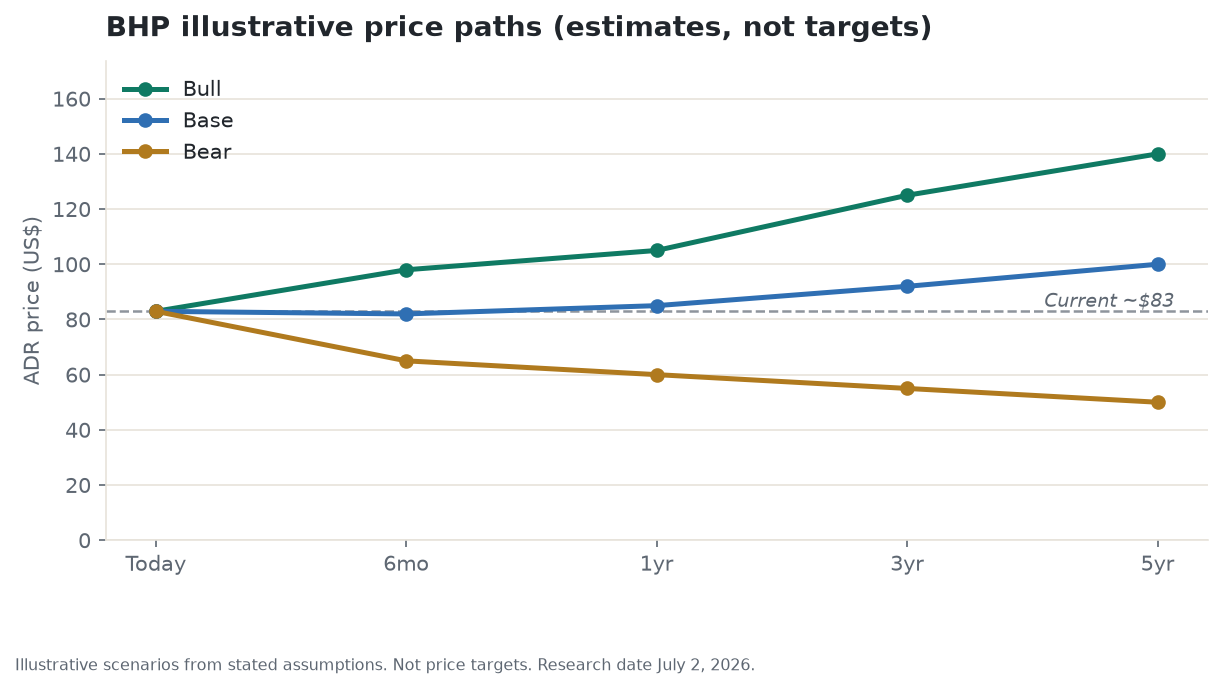
BHP’s ADR closed at approximately $83 on July 2, 2026, roughly 12 percent below its 52-week high of $93.83, which was set in mid-June when copper prices were pressing toward $12,000 per tonne. The stock has nearly doubled from its 52-week low of $45.74 a year ago, driven by the market’s recognition that copper has overtaken iron ore as the dominant earnings driver. All ranges below are estimates derived from stated scenario assumptions. They are not price targets.
6 months. The window to approximately January 2027 centers on the FY2026 results (August 2026) and the iron ore/copper price trajectory into year-end. In the base case, copper holds in the $9,000-10,000 per tonne range, iron ore softens toward $90-95 per tonne as Simandou volumes build, and the stock consolidates near an estimated $82. In the bull case, copper sustains above $10,500 and FY2026 EBITDA comes in above $30 billion, pushing the stock toward an estimated $98. In the bear case, a China growth disappointment pushes iron ore below $90 and copper corrects toward $8,500, pulling the stock toward an estimated $65. The single thing most likely to flip the 6-month read is the FY2026 EBITDA print and copper’s share of it.
1 year. By approximately July 2027, Jansen Stage 1 should have produced its first potash. In the base case ($9,500-10,500 copper, $88-95 iron ore), BHP EBITDA is roughly $28-32 billion and the stock sits near an estimated $85 with dividends providing most of the total return. In the bull case ($11,000-12,000 copper, Jansen on time), EBITDA reaches $32-35 billion and the stock reaches an estimated $105. In the bear case ($8,000-9,000 copper, iron ore below $85), EBITDA compresses toward $22-25 billion and the stock corrects toward an estimated $60. The Jansen first-production announcement is the key corporate catalyst.
3 years. By approximately July 2029, Jansen Stage 1 should be at or near full production, Simandou should be at 40-50+ Mtpa, and the copper supply deficit should be more visible. In the base case, copper grows steadily and iron ore settles structurally lower, supporting an estimated $92. In the bull case, the copper structural deficit thesis plays out and the stock reaches an estimated $125. In the bear case, recession pushes all commodities lower and the stock revisits an estimated $55, where the dividend yield of approximately 5-6 percent provides an income floor.
5 years. By approximately July 2031, the question is whether BHP’s copper pivot and Jansen potash have delivered on their promise. In the base case, the stock reaches an estimated $100 with dividends providing roughly 3-4 percent annual return. In the bull case, copper exceeds $13,000 per tonne and the stock reaches an estimated $140. In the bear case, green steel transition accelerates and all commodities weaken, pulling the stock toward an estimated $50.
Where the read lands today. At approximately $83 and a yield of roughly 3.5 percent, I would call BHP a Hold. The copper growth story is real and the cost position is best-in-class, but the stock has already re-rated dramatically (up 89 percent in one year) and trades above the sell-side average target of approximately $75. The iron ore leg faces a real structural headwind from Simandou. Jansen adds optionality but has demonstrated execution risk ($2.3 billion impairment, 47 percent cost overrun). This is a quality compounder at a fair-to-full price.
Companion tool
Jump to the interactive dashboard to sort and filter every company in this piece, or download the Excel scoring model to flex the scenarios yourself.
TL;DR
BHP is the world’s largest diversified miner, and for the first time in the company’s 140-year history, copper has overtaken iron ore as the largest earnings contributor. In the first half of FY2026 (six months to December 2025), copper generated 51 percent of underlying EBITDA, driven by record copper prices and a production base that reached 2.02 million tonnes in FY2025 - the highest in the industry and up 28 percent over three years. Western Australia Iron Ore (WAIO) delivered a third consecutive annual production record at 290 million tonnes (100 percent basis) at a C1 cash cost of US$15.98 per tonne, the lowest among the major iron ore producers. The balance sheet is fortress-grade (A+/A1, net debt US$12.9 billion within a US$10-20 billion target range), and the FY2025 dividend of 110 US cents per share (US$5.6 billion total, 55 percent payout ratio) demonstrates the cash-generation machine. The tension is equally real. Iron ore, still 45 percent of revenue, faces the Simandou mine in Guinea ramping from 15-20 million tonnes in 2026 toward 120 Mtpa at full capacity into a weakening China property cycle (construction accounts for roughly 50 percent of Chinese steel demand). Jansen potash, BHP’s biggest-ever capital commitment at approximately US$15.3 billion for both stages, has overrun by 47 percent on Stage 1 (US$5.7 billion to US$8.4 billion) and 41 percent on Stage 2 (US$4.9 billion to US$6.9 billion), triggering a US$2.3 billion impairment. Stage 2 first production has been pushed from FY2029 to FY2031. The stock has nearly doubled in a year (1-year total return approximately 89 percent) and at approximately $83 trades above the sell-side average target of roughly $75. The EV/EBITDA of approximately 8.8x commands a 50-75 percent premium over Rio Tinto (approximately 5.5x) and Vale (approximately 4.5x), a premium earned by the copper pivot but not cheap. On balance, the lean is Hold.
Explore it yourself: the interactive dashboard
Open the dashboard in a full screen
What BHP actually is: the 90-second primer
BHP is a commodity extraction company. It digs ore bodies out of the ground, processes the raw material into a shippable form (iron ore fines, copper concentrate, metallurgical coal, potash), and sells it to downstream processors who turn those raw materials into things people use: steel, electrical wiring, fertilizer. BHP does not make steel, does not refine copper into wire, does not blend fertilizer. It operates at the extraction layer of the supply chain, which is where the highest margins live because the ore bodies are irreplaceable.
Think of BHP as a landlord sitting on four different types of mineral real estate. The iron ore estate (Pilbara, Western Australia) is mature, high-margin, and fully developed, but the tenant base (Chinese steelmakers) is shrinking. The copper estate (Escondida in Chile, Olympic Dam in South Australia) is growing in value because the world needs more copper for electrification and AI data centers than mines can supply. The coal estate (BMA in Queensland) is profitable but politically unfashionable and being gradually wound down. And there is a US$15.3 billion new potash estate under construction in Saskatchewan (Jansen) that will not start producing until mid-2027.
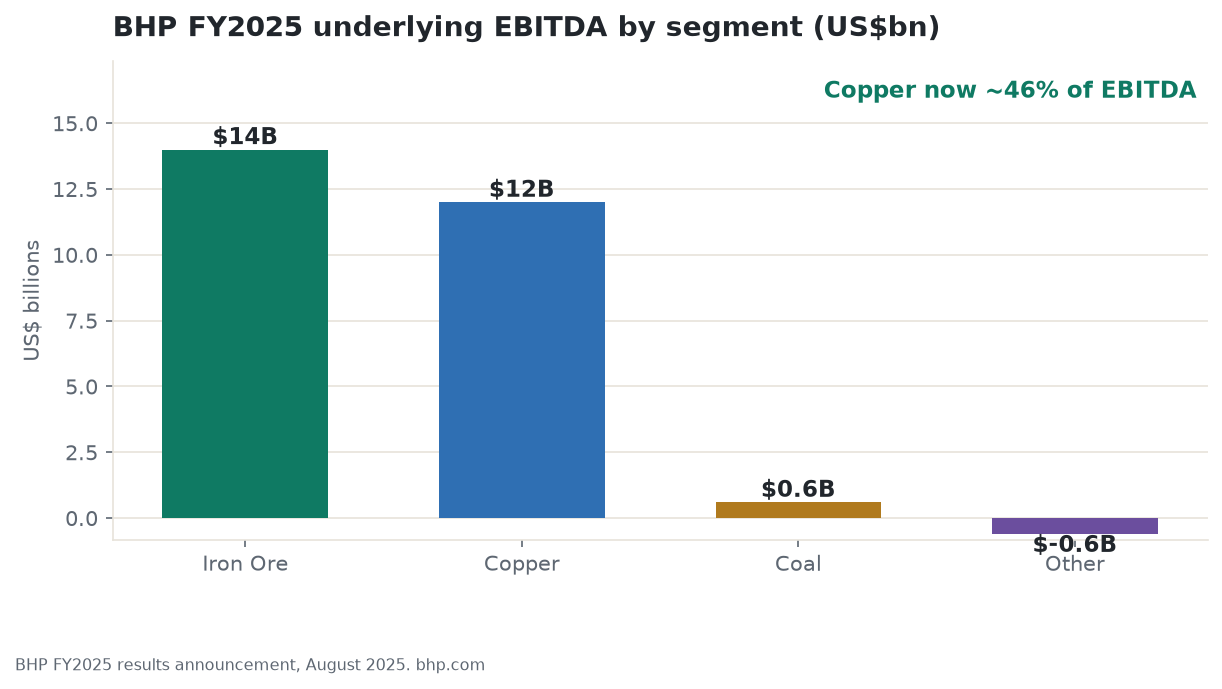
BHP reports four operating segments. Iron Ore generated US$22.9 billion in revenue and approximately US$14 billion in underlying EBITDA in FY2025 (year ended June 30, 2025). Copper generated US$22.5 billion in revenue and approximately US$12 billion in EBITDA, up 44 percent year-on-year. Coal (BMA metallurgical coal plus NSW Energy Coal thermal) generated US$5 billion in revenue but only US$0.6 billion in EBITDA as met coal prices weakened. Nickel (Western Australia Nickel) was suspended in October 2024 due to a global oversupply driven by Indonesian production growth and is on care-and-maintenance at roughly US$300 million per year.
The scale is significant. At 2.02 million tonnes in FY2025, BHP is the world’s largest copper producer. At 290 million tonnes of iron ore (100 percent basis), WAIO is the second-largest iron ore operation after Vale (by volume, though WAIO is lower-cost). Brandon Craig took over as CEO on July 1, 2026, succeeding Mike Henry after six and a half years. Craig spent 25 years at BHP, most recently as President Americas, where he oversaw the copper and potash operations that define BHP’s growth strategy.
How money flows through a diversified miner
flowchart TD
    DEMAND["Global end demand<br/>BHP US$51.3B revenue FY2025"]

    STEEL["Steelmakers<br/>China ~55% of global output<br/>CMRG pooling 600+ mills"]
    SMELT["Copper smelters and refiners<br/>China, Japan, India, Chile"]
    COKEOV["Coke ovens and blast furnaces<br/>Met coal to coke to iron"]
    FERTB["Fertilizer blenders<br/>K2O to NPK fertilizer to farmers"]

    WAIO["WAIO Iron Ore - US$22.9B rev<br/>257 Mt BHP share; C1 US$15.98/t<br/>World's lowest-cost major producer"]
    COPPER["Copper - US$22.5B rev<br/>2.02 Mt; C1 US$1.28/lb<br/>World's largest producer"]
    BMA["BMA Met Coal - US$5.0B rev<br/>50:50 BHP/Mitsubishi JV<br/>5 Bowen Basin mines"]
    JANSEN["Jansen Potash (under construction)<br/>Stage 1 mid-2027; 4.35 Mtpa<br/>~US$8.4B total cost"]

    PILBARA["Pilbara rail and port<br/>Port Hedland; 290 Mtpa capacity<br/>Integrated infrastructure moat"]
    CHILE["Chilean operations<br/>Escondida 57.5% op; Spence 100%<br/>Water and power constraints"]
    SASK["Saskatchewan, Canada<br/>Jansen mine site"]
    QLD["Queensland, Australia<br/>Bowen Basin; Hay Point terminal"]

    DEMAND --> STEEL
    DEMAND --> SMELT
    DEMAND --> COKEOV
    DEMAND --> FERTB

    STEEL --> WAIO
    SMELT --> COPPER
    COKEOV --> BMA
    FERTB --> JANSEN

    WAIO --> PILBARA
    COPPER --> CHILE
    BMA --> QLD
    JANSEN --> SASK
The chart above traces where cash originates and where it flows. Notice three things. First, BHP’s revenue is split nearly evenly between iron ore and copper (US$22.9 billion versus US$22.5 billion in FY2025), but the profitability has tilted decisively toward copper, which overtook iron ore as the largest EBITDA contributor in H1 FY2026. Second, the two commodities respond to different demand drivers: iron ore follows the Chinese steel cycle (property construction, infrastructure), while copper follows the global electrification cycle (power grids, EVs, data centers). This provides genuine portfolio diversification, but it is not a hedge because both commodities can decline simultaneously in a global recession. Third, Jansen potash sits entirely on the investment side of the ledger today. It will not contribute revenue until mid-2027 and will not reach full Stage 1 capacity until the end of the decade.
The deepest competitive moat in this value chain is not the ore bodies themselves but the infrastructure that connects them to the sea. BHP’s Pilbara rail network, connecting mines to Port Hedland (the world’s largest bulk export port), took decades and tens of billions of dollars to build. No competitor can replicate it. This infrastructure moat is why iron ore from the Pilbara has remained the lowest-cost source of supply through every commodity cycle for 50 years, and why new entrants (even Simandou, with higher-grade ore) face structural cost disadvantages on logistics.
The company and its peers
| Company | Ticker | Mkt Cap (approx.) | Makes | One-line bull | One-line bear |
|---|---|---|---|---|---|
| BHP Group | BHP | ~$211B | Iron ore, copper, met coal, potash (construction) | Copper re-rating just beginning; lowest-cost iron ore; Jansen adds potash | Simandou iron ore headwind; Jansen cost overruns; China demand decline |
| Rio Tinto | RIO | ~$118B | Iron ore, aluminum, copper | Simandou commissioning; Oyu Tolgoi copper ramp | Lower copper exposure; Simandou adds supply pressure |
| Vale | VALE | ~$64B | Iron ore, nickel, copper | Cheapest large miner at P/E ~7-8x; volume growth | Brazil political risk; Samarco litigation; lower ore quality |
| Freeport-McMoRan | FCX | ~$89B | Copper, gold, molybdenum | Purest large-cap copper play; Grasberg at full output | Indonesia political risk; high beta; no diversification |
| Southern Copper | SCCO | ~$144B | Copper, zinc, silver | Lowest-cost copper; massive 50-year reserve base | Grupo Mexico governance; Mexico political risk |
| Glencore | GLNCY | ~$90B | Copper, coal, zinc, cobalt, trading | Trading arm provides stability; largest cobalt producer | ESG pressure on thermal coal; trading opacity |
| Fortescue | FSUGY | ~$55B | Iron ore | High dividend yield (~8-10%); green hydrogen option | Lower ore quality; no copper; hydrogen capex uncertain |
All market caps are approximate, point-in-time as of July 2, 2026, and move daily. Sources: StockAnalysis, CompaniesMarketCap.
BHP trades at a meaningful premium to every diversified mining peer except FCX and SCCO (which are pure copper plays commanding their own premium). The BHP premium reflects three things: (1) the copper pivot is real and accelerating, (2) WAIO’s cost position is genuinely best-in-class, and (3) BHP has the balance sheet and scale to develop Jansen, Resolution Copper, and other long-dated projects that smaller miners cannot fund. Whether the premium is fully earned or has been pulled forward by the 89 percent 1-year run is the central question.
Financials from the filings
All figures below are from BHP’s FY2025 results announcement (August 19, 2025), the H1 FY2026 results (February 17, 2026), and recent SEC 6-K filings. BHP reports under IFRS and files a 20-F with the SEC as a foreign private issuer.
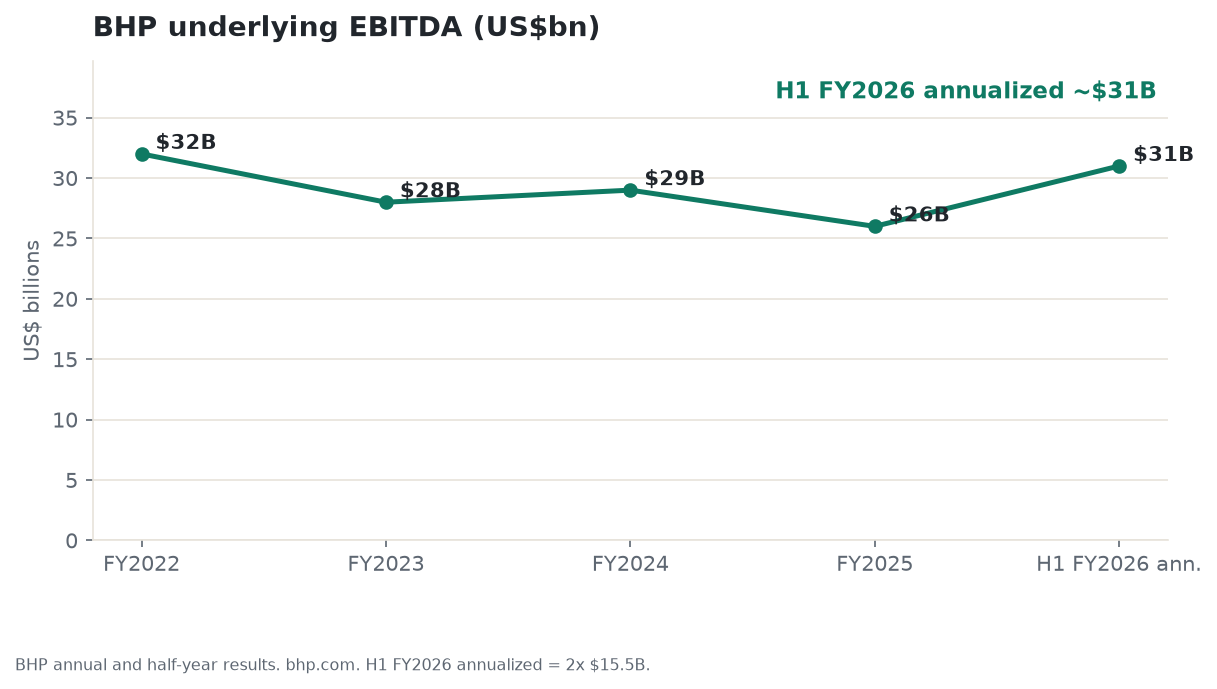
Income statement. FY2025 revenue US$51.3 billion (down 8 percent from US$55.7 billion in FY2024), underlying EBITDA US$26.0 billion (53 percent margin, down from US$29.0 billion/56 percent), underlying attributable profit US$10.2 billion (down 26 percent from US$13.7 billion), statutory net profit US$9.0 billion. The decline was driven almost entirely by lower realized iron ore and met coal prices. Copper partially offset on record prices and volumes.
H1 FY2026 (half year to December 31, 2025): revenue US$27.9 billion, underlying EBITDA US$15.5 billion (58 percent margin, up 25 percent year-on-year), underlying attributable profit US$6.2 billion. The margin expansion came from copper price strength. On an annualized basis, H1 FY2026 implies full-year EBITDA of roughly $31 billion, though the second half will reflect any copper/iron ore price movements.
Cash flow and capex. FY2025: operating cash flow US$18.7 billion, capital and exploration expenditure US$9.8 billion, free cash flow approximately US$8.9 billion. FY2027 group capex guided at approximately US$11 billion, reflecting Jansen Stage 1 completion spending and Stage 2 ramp.
Balance sheet. FY2025 year-end net debt US$12.9 billion (up from US$9.1 billion in FY2024), within the revised target range of US$10-20 billion. Credit rating A+/A1. The net debt increase reflects the OZ Minerals acquisition (completed October 2023, A$14.35 billion) and rising Jansen capex. BHP’s gearing remains conservative for a mining company.
Dividends. FY2025 total dividend: 110 US cents per share (US$5.6 billion), representing a 55 percent payout ratio. BHP’s minimum payout policy is 50 percent of underlying attributable profit. The current yield is approximately 3.5 percent, which is below the diversified mining sector average (Rio Tinto approximately 5-6 percent, Vale approximately 7-8 percent). The dividend stepped down from FY2024’s 142 US cents per share, reflecting the commodity cycle rather than a structural cut.
Jansen potash project. Stage 1: approximately US$8.4 billion total cost (revised from US$5.7 billion original sanction, a 47 percent overrun), 68 percent complete, first production targeted mid-CY2027. Stage 2: approximately US$6.9 billion (revised from US$4.9 billion, 41 percent overrun), first production pushed to late FY2031 (from FY2029). Combined capacity approximately 8.5 Mtpa, roughly 10 percent of global potash production. BHP expects to recognize a US$2.3 billion impairment charge against Jansen Stage 2 in its FY2026 results.
Market action and valuation
All figures point-in-time as of July 2, 2026.
Price and range. BHP ADR at approximately $82.95. The 52-week range is $45.74 to $93.83. The stock has nearly doubled from the 52-week low and sits roughly 12 percent below the high. The trailing 1-year total return of approximately 89 percent is exceptional and reflects the market re-pricing BHP as a copper growth story.
Valuation multiples. Trailing P/E approximately 20.5x (reflecting FY2025’s lower earnings), forward P/E approximately 15.9x (reflecting expected copper-driven recovery), EV/EBITDA approximately 8.8x, dividend yield approximately 3.5 percent, beta approximately 0.80.
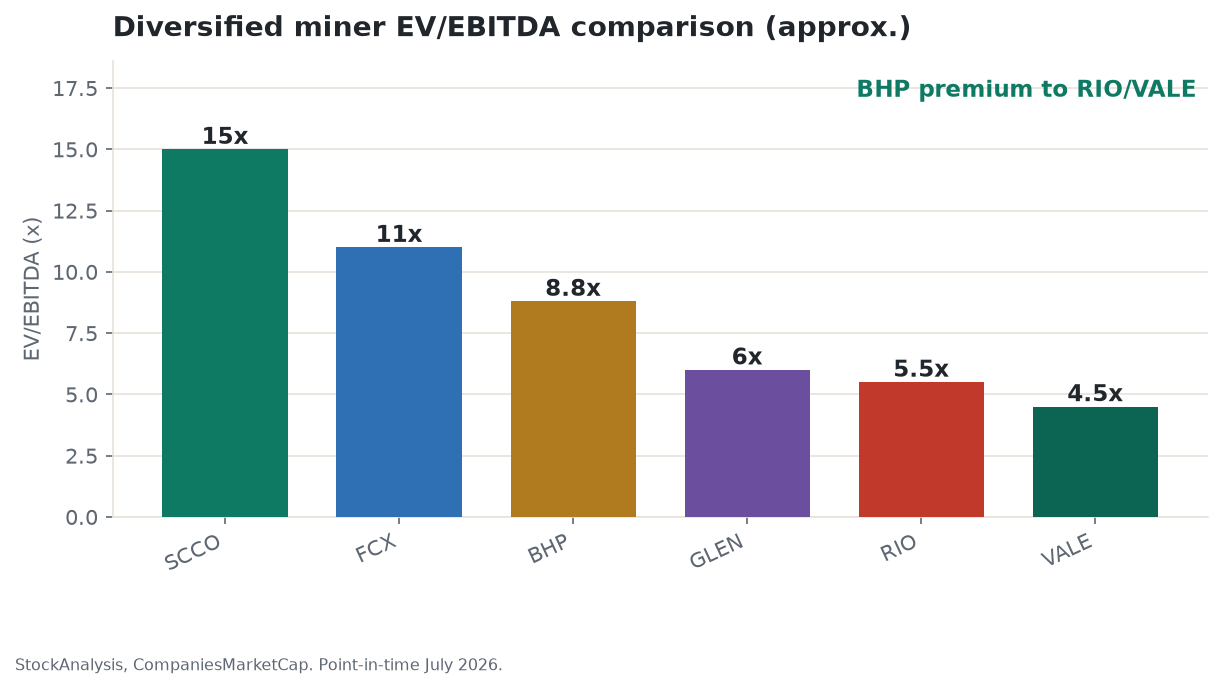
The EV/EBITDA premium over Rio Tinto (approximately 5.5x) and Vale (approximately 4.5x) is the largest it has been in recent years. The premium is earned by the copper pivot, but at 8.8x, BHP is approaching the valuation territory of pure-play copper miners (FCX approximately 11x, SCCO approximately 15x). The question is whether BHP deserves to trade as a copper company (justified premium) or a diversified miner (premium overstretched).
Sell-side consensus. Approximately 23 analysts cover BHP. The average price target is roughly US$75 (range approximately $48 to $95). The consensus rating is Hold/Neutral. The stock at approximately $83 trades above the average target, which is notable: the analyst community has not yet fully reflected the copper re-rating in their target prices, or the stock has run past fair value. Either interpretation supports caution.
Short interest. Approximately 0.65 percent of float, which is negligible.
Sentiment and narrative
The dominant narrative around BHP in mid-2026 is “copper re-rating.” The market has latched onto BHP’s transition from a China-steel-cycle proxy to a copper-and-electrification play, and the 89 percent 1-year return reflects that repricing. The CEO transition to Brandon Craig (effective July 1, 2026) has been orderly and well-received. Craig’s background as President Americas, where he oversaw copper and potash operations, reinforces the strategic direction.
The Jansen cost overruns and impairment generated negative headlines but did not meaningfully dent the stock, suggesting the market is more focused on copper than potash. The BHP-CMRG yuan pricing deal (April 2026), in which BHP became the first of the “Big Four” miners to accept a yuan-denominated benchmark for some iron ore sales, received limited market attention but represents a structurally important power shift toward China’s centralized purchasing.
Retail investor engagement with BHP is muted relative to US tech or meme stocks. Social media chatter is dominated by professional investors and mining-sector specialists. Analyst sentiment is cautious, with several neutral or hold ratings based on the run-up from $46 to $83.
The economics
Top-down. BHP’s earnings depend on two macro forces moving in opposite directions. Iron ore demand is structurally softening as China’s property sector deleverages (construction accounts for roughly 50 percent of Chinese steel end-use demand). Beijing’s infrastructure push provides a partial offset but is less steel-intensive. On the supply side, Simandou is the most bearish iron ore development in decades: first commercial shipment arrived in January 2026, with production expected to ramp from 15-20 Mt in 2026 toward 120 Mtpa at full capacity. Consensus iron ore price forecasts cluster around US$90-100 per tonne for 2026-2027, with downside risk.
Copper demand is the opposite story. Electrification, AI data center power build-out, EVs, and grid infrastructure are driving structural demand growth. S&P Global expects global copper demand to rise from 28 Mt per year to 42 Mt by 2040 (approximately 50 percent growth). Supply deficit forecasts vary widely - ICSG at approximately 150,000 tonnes, UBS at more than 400,000 tonnes, J.P. Morgan at 330,000 tonnes for 2026. The houses disagree on the near-term, but the structural direction is the same: copper supply is not growing fast enough.
Bottom-up. BHP’s unit economics are best-in-class. WAIO C1 iron ore cash cost of US$15.98 per tonne is the world’s lowest among major producers. At $100 per tonne iron ore, the margin per tonne is approximately $80-85 before royalties and overhead. Copper C1 cash cost of US$1.28 per pound (first quartile globally) leaves roughly $3.20 per pound of margin at $4.50 per pound copper. These cost positions are structurally embedded in the ore body quality and infrastructure, not dependent on favorable commodity cycles.
The operating leverage works both ways. A US$10 per tonne move in iron ore changes WAIO EBITDA by roughly US$2.5-2.9 billion. A US$0.50 per pound move in copper changes copper EBITDA by roughly US$2.0-2.2 billion. In strong commodity markets, BHP’s earnings growth is amplified. In weak markets, the decline is equally sharp.
Durability and synthesis
The bull case, steel-manned. BHP is the only large-cap miner with the world’s largest copper production, the world’s lowest-cost iron ore operation, and a near-production potash project that could become the world’s newest top-tier commodity franchise. Copper is entering a structural deficit era driven by electrification and AI demand that no conventional supply pipeline can match. The Escondida debottlenecking, OZ Minerals integration, and eventually Resolution Copper provide years of organic copper growth. Jansen, despite its cost overruns, positions BHP in a commodity (potash) with guaranteed long-term demand (food production) and an oligopoly supply structure. The balance sheet can absorb Jansen’s capex while maintaining investment-grade credit and 50 percent-plus dividend payouts.
The bear case, steel-manned. The 89 percent run in one year has pulled forward multiple years of value creation. The stock trades above the sell-side average target. Simandou is adding 15-20 million tonnes of high-grade iron ore supply in 2026, scaling toward 120 Mtpa, into a market where China’s property-driven steel demand is structurally declining. If iron ore settles at $80-85 per tonne, WAIO EBITDA could decline by $4-7 billion from current levels. Jansen has already demonstrated that BHP’s mega-project execution is imperfect: 47 percent cost overrun on Stage 1, 41 percent on Stage 2, a $2.3 billion impairment, and a two-year delay on Stage 2. At consensus potash prices of $300-400 per tonne, Jansen’s return on the $15.3 billion invested may not clear the cost of capital. The CMRG yuan pricing deal signals that China’s bargaining power over Australian iron ore is growing, not shrinking. Met coal EBITDA fell 75 percent year-on-year. Nickel is suspended with $300 million per year in care costs. The failed Anglo American bid showed M&A ambition but not the ability to close. And the 3.5 percent dividend yield is below the sector average, meaning investors are paying a premium for growth that is partly priced in.
What the market is paying for. At approximately 8.8x EV/EBITDA, the market is pricing BHP as a hybrid between a diversified miner (where 5-6x is the norm) and a copper growth company (where 10-12x is common). The premium implies the market expects copper to remain the dominant EBITDA driver and continue re-rating BHP’s earnings mix higher. If copper prices correct meaningfully (below $9,000 per tonne), the copper-company multiple evaporates and the stock re-rates back toward the diversified-miner valuation.
The scenarios in detail
The bull/base/bear dollar levels here match the lede chart exactly. All figures are estimates, not price targets.
Bull case: copper structural deficit, Jansen delivers, iron ore holds
The setup. Copper prices rise toward $11,000-13,000 per tonne as electrification and AI data center demand outrun supply additions. Iron ore stabilizes at $90-100 per tonne as Simandou ramp is slower than feared and demand-side offsets (India infrastructure, rest-of-world growth) partially compensate for China property weakness. Jansen Stage 1 produces first potash on time in mid-2027 and ramps toward full capacity by 2029. Potash prices recover above $400 per tonne.
The earnings path. By FY2028-2029, copper EBITDA could exceed $16-20 billion (estimate) if prices sustain above $11,000 per tonne and production grows toward 2.2 Mt. WAIO EBITDA holds at $12-14 billion. Jansen contributes $1-2 billion. Group EBITDA reaches $35-40 billion. At 8.5-9x EV/EBITDA, the stock reaches approximately $125-140 over 3-5 years.
The 6-month bull: approximately $98. The 1-year bull: approximately $105. The 3-year bull: approximately $125. The 5-year bull: approximately $140.
What breaks it. A global recession or China hard landing pushes all commodity prices down simultaneously. Copper supply responds faster than expected (new mines in DRC, Peru, Chile). Jansen is delayed further.
Base case: copper steady, iron ore softens, Jansen gradual ramp
The setup. Copper trades in the $9,500-10,500 per tonne range, supporting solid but not spectacular copper EBITDA. Iron ore settles at $85-95 per tonne as Simandou volumes build and China steel demand trends lower. Jansen produces first potash in mid-2027 but commissioning is gradual. Met coal and nickel remain weak.
The earnings path. Group EBITDA in the $28-33 billion range. Copper is the stable-to-growing leg; iron ore is the flat-to-declining leg. The stock trades sideways to modestly higher, with dividends providing 3-4 percent annual return. Total return approximately 12-18 percent cumulative over 3 years, 25-40 percent over 5 years.
The 6-month base: approximately $82. The 1-year base: approximately $85. The 3-year base: approximately $92. The 5-year base: approximately $100.
What breaks it. Simandou ramps faster than expected, pushing iron ore below $80. Or copper demand accelerates on AI infrastructure, tipping the base toward bull.
Bear case: China hard landing, commodity reset, Jansen impairment deepens
The setup. China GDP growth falls below 4 percent. Property sector deleveraging accelerates. Iron ore breaks below $80 per tonne. Copper corrects to $7,500-8,500 per tonne on global recession fears. Potash stays below $300 per tonne, making Jansen’s economics questionable. The DRI/EAF steel transition gains traction, structurally reducing blast-furnace iron ore demand.
The earnings path. WAIO EBITDA compresses to $8-10 billion. Copper EBITDA falls to $6-8 billion. Jansen earns negligible returns. Group EBITDA compresses to $18-22 billion. At 6-7x EV/EBITDA, the stock trades at approximately $50-60. At those levels, the dividend yield would be approximately 5-6 percent, providing an income floor. Total return is negative from today’s entry price.
The 6-month bear: approximately $65. The 1-year bear: approximately $60. The 3-year bear: approximately $55. The 5-year bear: approximately $50.
What has to be true. China’s property sector contraction deepens beyond current expectations, Simandou floods the market with supply, and global growth slows enough to stall the electrification-driven copper demand story. This is the tail scenario, not the base case, but it is not implausible.
Companies to watch across the scenarios
BHP itself. In the bull case, BHP could reach $125-140 over 3-5 years as copper earnings compound and Jansen adds a new revenue stream. In the base case, it is a mid-single-digit total return compounder with the dividend as anchor. In the bear case, it is a $50-65 stock where the income yield provides support but price appreciation is absent.
Rio Tinto (RIO). BHP’s closest peer. Rio is developing Simandou, which is both a growth story for Rio and a competitive threat to BHP’s iron ore pricing. Rio has less copper exposure than BHP, making it more of a pure iron ore bet. In the bear case, Rio’s lower copper hedge makes it more vulnerable to an iron ore price decline.
Freeport-McMoRan (FCX). The purest large-cap copper play. In the bull case for copper, FCX provides higher leverage than BHP because it has no iron ore dilution. In the bear case, FCX’s higher beta (approximately 1.5) and lack of diversification make it more volatile.
Vale (VALE). The cheapest large miner at P/E approximately 7-8x. In the bear case, Vale’s higher country risk (Brazil) and lower ore quality create additional downside. In the base case, the valuation discount provides a margin of safety that BHP does not offer at current prices.
Risk controls
Commodity price risk. Every $10 per tonne move in iron ore alters WAIO EBITDA by roughly $2.5-2.9 billion. Every $0.50 per pound move in copper alters copper EBITDA by roughly $2.0-2.2 billion. A 10 percent decline across both commodities would reduce group EBITDA by roughly $4-5 billion. Monitoring: weekly Platts 62% Fe CFR China and LME copper spot price.
China concentration. China accounts for more than 70 percent of seaborne iron ore demand. The CMRG centralized purchasing structure concentrates BHP’s customer base and shifts bargaining power toward Beijing. The April 2026 yuan pricing deal is an early illustration of this shift.
Jansen execution risk. Combined Stage 1 and Stage 2 capex has escalated to approximately $15.3 billion, with a $2.3 billion impairment already recognized. If potash prices remain below $400 per tonne, Jansen may not earn an acceptable return on the capital invested. This is a sunk-cost risk that cannot be unwound.
Simandou supply addition. The ramp from 15-20 Mt in 2026 toward 120 Mtpa at full capacity is the single largest new iron ore supply addition in decades. It pressures the benchmark price that drives WAIO’s revenue.
Samarco dam litigation. The October 2024 Brazil settlement covers US$32 billion over 20 years (on a 100 percent basis, shared with Vale through the Samarco JV). A UK class action is ongoing with a $1.4 billion proposed settlement. These are provisioned but represent a multi-decade liability tail.
Nickel. Suspended operations cost approximately $300 million per year in care-and-maintenance. Restart review is scheduled for February 2027. If nickel prices do not recover, the operations may be divested or permanently closed.
Green steel transition. DRI (direct reduced iron) using hydrogen, fed to electric arc furnaces, reduces demand for both blast-furnace iron ore grades and metallurgical coal. This is a multi-decade structural shift, not a near-term cliff, but it challenges two of BHP’s four commodity legs.
Methodology, sourcing, and data-quality flags
Primary sources. The load-bearing financial figures in this article - revenue, EBITDA, profit, cash flow, capex, production volumes, dividends, balance sheet, and project costs - are sourced from BHP’s FY2025 results announcement (August 19, 2025, bhp.com), the H1 FY2026 results announcement (February 17, 2026, bhp.com), SEC 6-K filings (EDGAR accession numbers for June 2026 Jansen update and CEO transition), and BHP’s corporate releases on Samarco, Nickel West, and OZ Minerals. C1 cash costs are from BHP’s own operational disclosures.
Analyst and press tier. Iron ore price forecasts from Deutsche Bank (~$102/t), ING (~$95/t), and Morningstar (~$100/t) for 2026. Copper supply deficit forecasts from ICSG (~150kt), UBS (>400kt), and J.P. Morgan (~330kt). Market cap and valuation multiples from StockAnalysis and CompaniesMarketCap as of July 2, 2026. Sell-side consensus from MarketBeat (23 analysts, average target ~$75). Jansen Stage 1 total cost of $8.4 billion is from Discovery Alert (secondary source, cross-referenced against BHP’s disclosed $7.0-7.4 billion range from FY2025 results; the higher figure may include later revisions).
Estimates and unverified claims. Market caps, stock prices, valuation multiples, and analyst targets are all point-in-time and will have moved. Commodity price forecasts are analyst estimates that disagree materially (copper deficit estimates range from 150kt to 400kt+). Forward scenario price levels throughout this article are estimates derived from stated assumptions and stated multiples, not price targets. Simandou production forecasts are based on press reports and may differ from actual ramp rates.
Five-factor read in plain prose. The research points toward a Hold at approximately $83 on July 2, 2026, grounded in five factors.
On valuation: BHP’s EV/EBITDA of approximately 8.8x commands a 50-75 percent premium over diversified mining peers (RIO approximately 5.5x, VALE approximately 4.5x). The premium is earned by the copper pivot but approaches pure-play copper territory where BHP’s iron ore drag limits upside. The forward P/E of approximately 15.9x is full for a commodity producer. The dividend yield of 3.5 percent is below the sector average and below the risk-free rate. Valuation nets to modestly overvalued.
On growth: copper production has grown 28 percent since FY2022 and is the company’s most valuable growth leg. Jansen adds a new commodity from 2027 but faces execution risk and uncertain economics. Iron ore is at production records but faces Simandou supply headwinds. The failed Anglo American bid suggests M&A will remain part of the growth strategy. Growth nets to positive, with iron ore headwinds and Jansen uncertainty as offsets.
On quality: best-in-class cost positions in both iron ore (C1 $15.98/t) and copper (C1 $1.28/lb). A+/A1 credit rating. Fortress balance sheet. Decades of mine life. Integrated infrastructure moat. Quality nets to strongly positive.
On risk: the dominant risk is a commodity price correction from current elevated levels, particularly iron ore under Simandou supply pressure. Jansen has already demonstrated mega-project execution risk. China concentration and the CMRG power shift are structural headwinds. The Samarco litigation tail is real and long-dated. Risk nets to moderately negative.
On momentum: the stock has risen 89 percent in one year and trades above the sell-side average target. This is unusual for a mining stock and suggests much of the re-rating is already priced. The new CEO introduces modest execution uncertainty. Momentum nets to neutral to cautious.
Taken together, the lean is Hold. The business is excellent. The price is fair to full.
Disclaimer. The Samarco dam settlement and UK class action are described based on BHP’s own disclosures and publicly available court documents. No allegations of fraud, misconduct, or litigation outcomes are stated beyond what BHP and the courts have disclosed. The Jansen impairment is described from BHP’s own SEC 6-K filing.
This article is OSINT research, not investment advice. All figures are point-in-time as of July 2, 2026. The author holds no position in any security mentioned.