
Research date: June 20, 2026 | OSINT market research on Aditxt, Inc. (Nasdaq: ADTX), a distressed sub-penny micro-cap biotech holding company
Important disclaimer. This is independent OSINT (open-source intelligence) research compiled from public filings and public data for educational and informational purposes only. It is not investment advice, not a recommendation to buy, sell, or hold any security, and not a solicitation. Aditxt (ADTX) is a distressed, sub-penny micro-cap with a going-concern doubt and an active Nasdaq delisting determination under appeal. Distressed sub-penny stocks under active delisting review carry extreme, up-to-total-loss risk and can move violently intraday. All figures are point-in-time as of June 20, 2026 and move fast: prices, share counts, cash, and deal and listing statuses may have changed materially since. The five-year scenarios below are illustrative, not price targets and not predictions. Do your own due diligence and consult a licensed financial advisor.
Companion tool - jump to the interactive dashboard to sort and filter the split ledger, the cash and equity trajectory, the deal tracker, and the scenario panel.
TL;DR
Aditxt, Inc. (Nasdaq: ADTX) is not really a biotech you can value on a pipeline. It is a parent holding company that funds early-stage subsidiaries and a string of attempted acquisitions almost entirely by selling new stock, and the act of selling that stock is the whole story. As of its latest filings the company had $268,852 of cash (March 31, 2026) against roughly $1.5 million a month of operating burn, an accumulated deficit of $225,756,495, and total stockholders’ equity of negative $35,174,386, which flipped from a positive $3.95 million in a single quarter. Its auditor and its own management both state substantial doubt about its ability to continue as a going concern. To stay above Nasdaq’s $1.00 minimum bid price it has run six reverse stock splits in under three years, a cumulative ratio of about 1-for-9,763,200,000 (roughly 9.76 billion to one), and the share count keeps resetting while the price bleeds back to sub-penny. Nasdaq Staff issued a determination to delist the stock dated May 6, 2026; Aditxt appealed, which stayed the delisting, and a hearing was set for June 11, 2026 whose outcome was not public as of this writing. The single biggest risk is structural: the same financing machine that keeps the company alive is the thing destroying per-share value, and any value that does exist in the better assets (chiefly Ignite Proteomics, marked at about $150 million in a pending SPAC deal, plus distressed Evofem securities) sits behind a roughly $69.5 million preferred liquidation stack and may never reach the common holder. This piece maps the bull, base, and bear cases. None of it is a price target or advice.
Explore it yourself: the interactive dashboard
Open the dashboard in a full screen
Download the scenario model (Excel) to inspect the bull, base, and bear arithmetic, the split ledger, and the cash-and-equity trajectory behind the figures below.
What Aditxt actually is (the 90-second primer)
Strip away the press releases and Aditxt is three plain ideas stacked on top of each other.
It is a holding company. That means the public stock you buy, ADTX, is the parent. The parent does almost nothing itself; it owns stakes in a handful of operating subsidiaries (Adimune, Pearsanta, Adivir, Adifem, Ignite Proteomics) and it tries, repeatedly, to acquire other small companies. When you own ADTX you own a slice of the parent, which sits on top of everything else. That position in the line matters, and we will come back to it.
It is pre-revenue and clinical-stage. The subsidiaries are mostly early-stage biotech and diagnostics. None of them has an FDA-cleared product. “Clinical-stage” here is generous: the lead drug program is entirely preclinical, meaning it has never been tested in a human being. Total revenue for the whole group in fiscal 2025 was $3,195. That is not a typo and not a missing word. Three thousand dollars.
And it is a going concern in the accounting sense, which is the opposite of reassuring. “Going concern” is the assumption that a company can keep operating for at least the next year. When an auditor writes that there is “substantial doubt” about a company’s ability to continue as a going concern, the auditor is formally flagging that the business may not survive twelve months without new money. Aditxt’s auditor wrote exactly that in its 10-K filed March 31, 2026, and management repeated it in the 10-Q filed May 20, 2026.
So the honest one-line description is this: a Nasdaq-listed parent company with no real operating business, owning a portfolio of cash-consuming science projects, kept alive by selling stock, and flagged by its own auditor as possibly unable to last the year. Everything else in this article is detail on that sentence.
One quick correction before we go further, because it travels around the internet. Aditxt did not IPO in 2018. The 2018 event was an attempted Reg A+ offering (a lighter-weight way for a small company to raise public money) that the company filed in March 2018 and then withdrew in November 2018. The real IPO came on July 1, 2020, at $9.00 per unit, raising roughly $11 million gross. The company was called ADiTx Therapeutics then; it renamed to Aditxt in July 2021.
How the money flows
flowchart TD
    subgraph SOURCES["Cash sources (shareholder dilution)"]
        ATM["ATM H.C. Wainwright (~21.26M sold of ~53.4M)"]
        ELOC["ELOC equity line (up to 150M, mostly undrawn)"]
        SHELF["S-1 / 424B5 shelf (legal gate)"]
        PREF["Convertible preferred (69.5M liquidation stack)"]
        WARR["Warrants (698,871, no-floor resets)"]
        NOTES["OID notes (3.19M face, only 2.88M funded)"]
        BITX["bitXbio narrative (zero Bitcoin held)"]
    end

    ATM --> PARENT
    ELOC --> PARENT
    SHELF --> ELOC
    SHELF --> ATM
    PREF --> PARENT
    WARR --> PARENT
    NOTES --> PARENT
    BITX -.funded by same ELOC.-> ELOC

    PARENT["Parent Aditxt Inc. (cash only 0.27M)"]

    PARENT --> BURN
    PARENT --> DEALS
    PARENT --> INT
    PARENT --> AP

    subgraph BURN["Subsidiary operating burn (~1.5M/month)"]
        ADIM["Adimune (preclinical, no human data)"]
        PEAR["Pearsanta ~97% (no FDA test, no IPO)"]
        ADIV["Adivir (empty antiviral shell)"]
        ADIF["Adifem (dormant Evofem vehicle)"]
        IGN["Ignite Proteomics (CLIA assay, being spun out)"]
    end

    DEALS["Acquisition cash conditions (Evofem ~17M, killed deal)"]
    INT["Interest / OID (one note in default)"]
    AP["Vendor payables ~5.8M (over 90 days past due)"]

    REV["Product revenue (only 3,195 in FY2025)"]
    BURN -. trickle back .-> REV
    REV -. de minimis .-> PARENT
Read this diagram top to bottom and you have read the company. At the top is the only thing that reliably produces cash: not a product, but the issuance of new shares and share-linked paper. The H.C. Wainwright at-the-market program, the $150 million equity line, the convertible preferred, the warrants, the original-issue-discount notes, and the bitXbio narrative all feed into one box, the parent, which as of March 31, 2026 held $268,852 in cash.
From the parent the cash leaks out in four directions. It goes to operating burn at the subsidiaries, none of which sells a meaningful product. It goes to the cash conditions on acquisitions, like the roughly $17 million Aditxt was supposed to raise to close the Evofem deal that ultimately died. It goes to interest and the cost of the notes, one of which is in default. And it goes, slowly, to vendors: about $5.8 million of accounts payable sit more than 90 days past due, which is the company’s own way of saying it is not paying its bills on time. The thin dotted line back up from “product revenue” carries $3,195 a year. That is the trickle, and it is the only thing flowing the other way.
The shape is the point. A normal business sends money one direction (customers pay it) and that money fans out to suppliers, staff, and shareholders. Here the arrows mostly run from existing shareholders, through freshly minted shares, into the company’s bills. Every share sold pays a vendor or funds a month of burn, and every share sold makes the existing shares worth slightly less. The machine is the business. The rest of this piece is mostly about how fast that machine runs and whether anything of value survives at the bottom of it.
The corporate story: from ADiTx Therapeutics to today
The through-line is repeated reinvention, each version funded by selling stock.
| Date | Event |
|---|---|
| Sep 28, 2017 | Incorporated in Delaware as Aditx Therapeutics, Inc. (Loma Linda, CA) |
| Mar 30, 2018 | Files Form 1-A for a Reg A+ offering |
| Nov 2, 2018 | Reg A+ offering withdrawn (not a completed IPO) |
| ~Jun 30, 2020 | 1-for-2 reverse split, pre-IPO |
| Jul 1, 2020 | Real IPO at $9.00 per unit, 1,226,668 units, about $11.04 million gross |
| Late 2020 - 2021 | COVID pivot: AditxtScore antibody testing via a Richmond, VA CLIA lab |
| Jul 6, 2021 | Name change to Aditxt, Inc. |
| Sep 2022 | 1-for-50 reverse split |
| Jan 2023 | Adimune, Inc. formed; holding-company model begins |
| Apr 2023 | Adivir, Inc. formed |
| Aug 18, 2023 | 1-for-40 reverse split |
| Dec 11, 2023 | Evofem merger agreement announced |
| Jan 4, 2024 | Pearsanta acquires MDNA Life Sciences assets (Mitomic mtDNA technology) |
| Apr 2024 | Adifem, Inc. formed; Appili arrangement announced |
| Oct 2, 2024 | 1-for-40 reverse split |
| Mar 14, 2025 | 1-for-250 reverse split |
| ~May 31, 2025 | Appili deal terminated |
| Oct 20, 2025 | Evofem merger terminated (Evofem’s own stockholders rejected it) |
| Nov 3, 2025 | 1-for-113 reverse split |
| Mar 6, 2026 | 1-for-8 reverse split |
| Mar 11, 2026 | Ignite Proteomics acquired from IMAC Holdings |
| May 6, 2026 | Nasdaq Staff determination to delist (bid-price) |
| May 15, 2026 | 1-for-27 reverse split |
| May 31, 2026 | Founder and CEO Amro Albanna resigns; Jeffrey Busch named interim CEO |
| Jun 10, 2026 | Ignite Proteomics SPAC deal (Copley Acquisition Corp) announced |
Notice the rhythm. The original pitch in 2020 was about the immune system: “immune reprogramming” to induce tolerance, and “immune monitoring” through a test called AditxtScore. When COVID hit, AditxtScore became a COVID antibody test and the company leaned into that. When the COVID testing window closed, the business reinvented itself again as a holding company that would acquire and build out subsidiaries. Each reinvention needed cash, and the cash came from issuing stock, which is why a timeline of pivots is also a timeline of reverse splits.
The most recent and most consequential change came at the top. The founder, Amro Albanna, who had been CEO and chairman since 2017, resigned all roles around May 31, 2026, along with the chief operating officer. The board installed Jeffrey Busch, who is tied to IMAC Holdings (the company Aditxt bought Ignite Proteomics from) and to Ignite itself, as interim CEO. The filings report this as a fact, with dates. They do not characterize anyone’s conduct, and neither will I. What can be said neutrally is that a founding-family departure coincided with a change of strategic focus toward the Ignite asset.
Subsidiary by subsidiary: what’s actually inside
Here is the part where the holding company stops being abstract. Aditxt owns five subsidiaries. One looks like a real business. The rest are science projects or empty vehicles. For each, the questions are the same: what does it do, how far along is it, and does it have value that exists independently of the parent?
Adimune (the drug program)
Adimune is wholly owned and holds the company’s original science, which the company in-licensed exclusively and worldwide from Loma Linda University (a Southern California research university) for the nominal price of one share of common stock. Its technology is called Apoptotic DNA Immunotherapy, or ADI, and the lead candidate is ADI-100. Here is the mechanism in plain terms. Your body constantly clears dying cells through a tidy process called apoptosis, and that process quietly teaches the immune system to tolerate your own tissues rather than attack them. ADI injects engineered DNA designed to piggyback on that natural “tolerate this” signal, retraining the immune system to stop attacking one specific target. Think of it as a targeted whisper to the immune system rather than the broad shout of conventional immune-suppressing drugs. ADI-100 aims this at GAD, a protein implicated in type 1 diabetes, and the company also has a Stiff Person Syndrome program (a rare neurological autoimmune disease) under a Mayo Clinic trial agreement.
That is the bull. Now the sober read. ADI-100 is entirely preclinical. The 10-K itself states that all preclinical studies for ADI-100 have been completed, and there is no human data of any kind. There is no IND cleared (an IND, or Investigational New Drug application, is the FDA paperwork a company must get cleared before it can dose humans), and ClinicalTrials.gov returns zero registered ADI-100 trials. The company targeted a pre-IND meeting with the FDA for the second quarter of 2026; whether it happened was not confirmed in filings as of this writing. Adimune is real science with a completed animal-model package, and it is also a program that advances only if someone else pays for it, because the parent cannot.
Bull: a differentiated, antigen-specific tolerance platform with a finished preclinical package and a Mayo Clinic partner; a clean pre-IND could create genuine partnering optionality. Bear: 100 percent preclinical, zero human data, no IND cleared, no registered trial, and a parent out of cash.
Pearsanta (the cancer-detection diagnostics)
Pearsanta is about 97 percent owned, the only subsidiary that is not wholly owned. It develops mitochondrial-DNA blood tests, a kind of “liquid biopsy,” built on the Mitomic technology it bought from MDNA Life Sciences in January 2024. The theory is that stressed or cancerous cells shed detectable mitochondrial-DNA fragments into the blood before disease shows up clinically. Two candidate tests are named: the Mitomic Prostate Test (MPT), which aims to help doctors decide on biopsies in the ambiguous “grey zone” of PSA screening, and the Mitomic Endometriosis Test (MET).
The honest status is aspirational. The 10-K states plainly that Pearsanta has no commercially available FDA or foreign-regulatory-approved products and that its efficacy is untested and requires clinical validation. There is no FDA clearance. Here is the part that confuses most readers, so it is worth slowing down on, because it is exactly why “no FDA clearance” and “can still legally sell a test” are both true. CLIA, the Clinical Laboratory Improvement Amendments, is the federal program that certifies clinical labs to handle human samples. A CLIA-certified lab is allowed to design a test in-house, run it, and bill for it without getting that specific test cleared by the FDA first. A test made and run inside a single lab this way is called a laboratory-developed test, or LDT. So if Pearsanta’s Mitomic tests are ever marketed, they would run as LDTs under CLIA rules, not as FDA-cleared devices. That distinction is the whole reason the bull case for these diagnostics exists at all: the company does not need an FDA approval to start billing, only a certified lab and a validated test. The catch is the second half, the validation, which has not happened. CAP-accredited means the lab also passed inspection by the College of American Pathologists, and NYS-CLEP-approved means it cleared New York State’s separate (and unusually strict) lab-permit program. Pearsanta does lease a genuine high-complexity lab in Richmond, VA carrying all three credentials, so the infrastructure is real. A Pearsanta IPO has been “planned” with an engaged underwriter (first Dominari, then Spartan Capital) for more than 16 months, and as of this writing no standalone Pearsanta registration statement has ever been filed.
Bull: a real accredited lab plus an mtDNA intellectual-property estate and two named candidates in large early-detection markets; a fundable science project, not just an idea. Bear: no FDA clearance, no validated or commercial test, no revenue, and an IPO promised for over a year that has never reached a filing.
Adivir (the antiviral shell)
Adivir, formed in April 2023 and wholly owned, is described in the filings as dedicated to antiviral and antimicrobial solutions. In practice the 10-K names no product, no clinical candidate, and no pipeline for it. Its real-world uses were as the acquisition vehicle for the failed Appili deal and as the corporate home for the older, never-closed Cellvera antiviral saga. The word “favipiravir,” the drug at the center of that saga, appears zero times in the fiscal 2025 10-K. Adivir is an empty vehicle.
Bull (thin): a corporate shell that could one day house a real infectious-disease asset. Bear: no product, no candidate, no revenue; its only deals failed.
Adifem (the dormant Evofem vehicle)
Adifem, formerly Adicure, was formed in April 2024 specifically to acquire Evofem Biosciences, a women’s-health company. That merger died (covered below). Adifem is now a dormant vehicle holding a shelved women’s-health program.
Bull: essentially none on a standalone basis. Bear: a vehicle built for a deal that collapsed.
Ignite Proteomics (the one that looks like a business)
Ignite is the exception, and it deserves to be labeled precisely rather than lumped in with the shells. Aditxt acquired 100 percent of it from IMAC Holdings on March 11, 2026 for 36,000 shares of Series A-2 convertible preferred (a $36 million stated value) plus $475,000 cash. Ignite runs a CLIA-certified, CAP-accredited lab (the same lab-certification regime explained under Pearsanta above, which lets it bill for a test it developed in-house). Its product is a clinical RPPA assay. RPPA stands for reverse-phase protein array, and in plain terms it is a test that measures how active 32 specific proteins are inside a sample of a patient’s tumor. Genetic tests read the tumor’s instructions; this one reads what the tumor is actually doing at the protein level. The point of measuring those proteins is practical: it helps an oncologist pick which therapy is more likely to work for that particular patient, used mainly in breast cancer, so the patient is steered toward a drug with a better chance and away from one likely to fail. It is marketed as commercial-stage and has a Medicare reimbursement pathway at roughly $2,200 per test, with a cited Dana-Farber validation study.
The honest caveats. Ignite’s actual billed revenue is not disclosed in Aditxt’s audited filings; the 10-K says the company is still determining the financial-statement impact of the acquisition, and the Q1 2026 figures do not yet include Ignite testing revenue. So the “commercial-stage” and “$2,200 per test” claims are company and press statements, not audited numbers. And barely 90 days after buying it, Aditxt agreed to spin Ignite back out through a SPAC at a roughly $150 million mark, which is covered in the deal section.
Bull: an operating, accredited lab with a reimbursable oncology assay and outside validation; the only piece that looks like a real business, marked at about $150 million. Bear: zero audited revenue disclosed, a $150 million mark that is roughly 4x what Aditxt paid 90 days earlier, and a deal that may not close and would remove Ignite from Aditxt anyway.
The acquisition machine: every deal, every status
Aditxt’s holding-company era has been defined by announcing big acquisitions. The pattern that matters for an investor is how few of the marquee whole-company deals actually closed. Of the three transformational mergers announced since 2022, zero closed. Here is the tracker.
| Deal | Vehicle | Consideration | Status (as of Jun 20, 2026) |
|---|---|---|---|
| Evofem Biosciences | Adifem | Originally 610,000 ADTX shares + preferred + ~$18M note assignment; later amended to substitute cash, with a reported ~$17M cash condition to close | Terminated Oct 20, 2025. Evofem stockholders rejected the merger. No termination fee payable by Aditxt |
| Appili Therapeutics | Adivir | ~$16M of closing obligations (Canadian plan of arrangement) | Terminated effective ~May 31, 2025. Per Appili’s release, a break fee of about $1.0 million (reduced from $1.25M) was payable to Appili |
| Cellvera / GRA | (antiviral) | Cash + equity, terms never pinned down | Stalled, never closed |
| Ignite Proteomics (buy) | from IMAC Holdings | 36,000 Series A-2 preferred ($36M stated) + $475,000 cash | Closed Mar 11, 2026 |
| Ignite Proteomics (spin-out) | Copley Acquisition Corp (NYSE SPAC) | 15,000,000 Pubco shares to Aditxt (~$150M at $10/share); Pubco pays the SPAC sponsor $4M | Pending / announced Jun 10, 2026, conditional, ~Sep 30 outside date |
| MDNA Life Sciences (Pearsanta) | Pearsanta | Asset purchase (Mitomic IP) | Closed Jan 4, 2024 |
Three points make sense of this.
First, the Evofem collapse is instructive. The deal ran for nearly two years through eight amendments. The amended structure tied closing to Aditxt raising roughly $17 million in cash (that figure is press-reported, not pulled from the agreement text, so treat it as approximate). Aditxt could not raise it. On October 20, 2025 Evofem’s own stockholders rejected the merger at a special meeting, and Evofem terminated. No termination fee was payable by Aditxt. The point is not that the deal failed; it is why it failed. The company announced a transformational acquisition it did not have the money to close.
Second, the Ignite story has two halves that should be read together. Aditxt bought Ignite out of an IMAC note default in March 2026 for $36 million in preferred stock, then signed an agreement in June 2026 to re-float it through a SPAC at a roughly $150 million mark. A skeptic reads the 4x as promotional. A fair counter is that the $36 million was a distressed fire-sale price (Aditxt bought it out of a default), so a higher later mark is not by itself proof of inflation. Both readings are legitimate, and the number that would settle it (Ignite’s audited standalone revenue) has not been disclosed.
Third, a couple of names that float around in connection with Aditxt are not Aditxt deals. There is no Aditxt-CervoMed connection; an EDGAR full-text search of Aditxt’s filings returns zero hits for “CervoMed.” And “Brilliant Acquisition Corp” merged with Nukkleus, not with Aditxt. Mention them only to set them aside.
What does closing or terminating mean for the share count? A whole-company stock merger that closes generally issues new ADTX shares or convertible preferred, which dilutes existing holders. A termination issues nothing. The crucial wrinkle on the pending Ignite SPAC is that it does not issue new ADTX shares at all: at close, Aditxt-as-seller receives shares in the new NYSE-listed holding company (“Pubco”), and Ignite separates from Aditxt. We will follow that thread carefully, because it is the hinge of the entire bull case.
The dilution and capital-structure record (the heart of this piece)
This is the section to read twice. Everything else is downstream of it.
The reverse-split treadmill
Start with the headline number. Aditxt has executed six reverse stock splits in under three years:
| # | Ratio | Effective |
|---|---|---|
| 1 | 1-for-40 | Aug 17, 2023 |
| 2 | 1-for-40 | Oct 2, 2024 |
| 3 | 1-for-250 | Mar 14, 2025 |
| 4 | 1-for-113 | Nov 3, 2025 |
| 5 | 1-for-8 | Mar 6, 2026 |
| 6 | 1-for-27 | May 15, 2026 |
Multiply those ratios together and the cumulative effect is about 1-for-9,763,200,000, roughly 9.76 billion to one. (There was also a 1-for-2 split before the 2020 IPO and a 1-for-50 in 2022; the figure above counts the six recent ones, and a separate 1-for-60 in the filings belongs to the Pearsanta subsidiary, not the parent.)
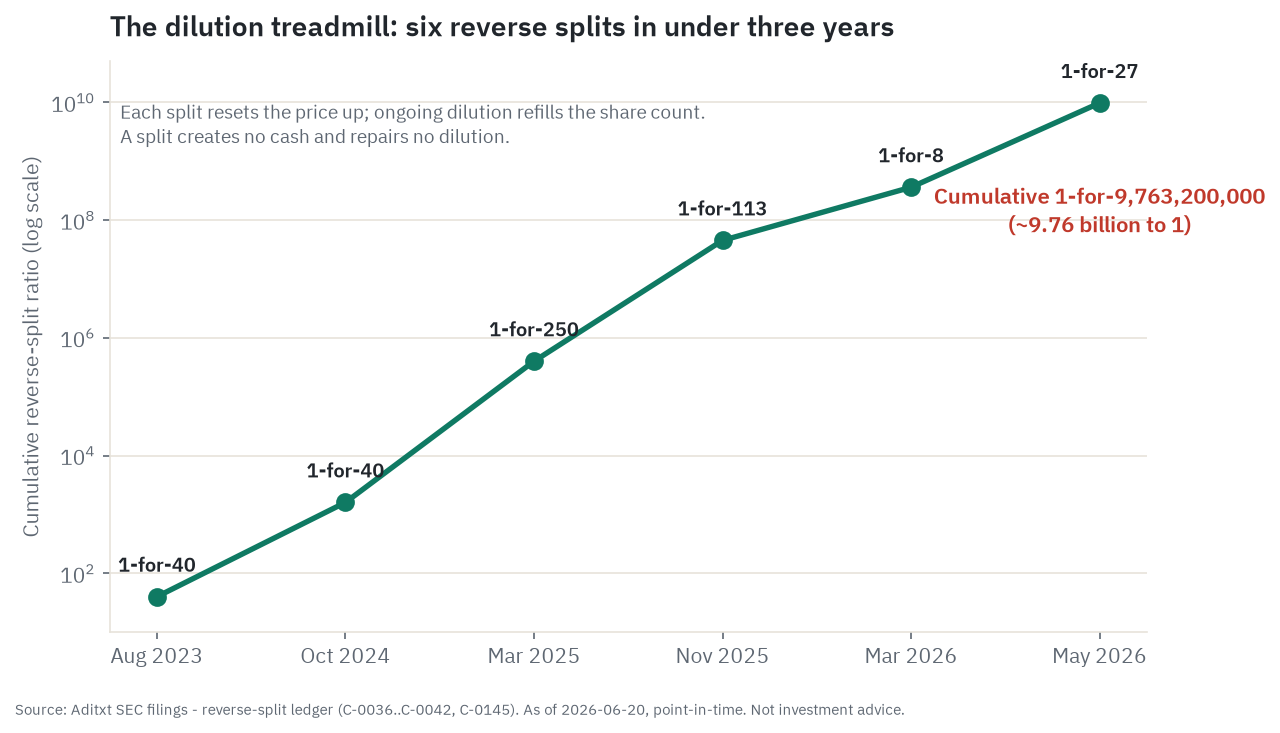
Here is the analogy, and then I will drop it. A reverse split is a down escalator that you keep climbing. Each split lifts the nominal price back up the way climbing a few stairs lifts you, but the escalator (dilution) keeps carrying you back down, so you climb again, and again. Crucially, climbing the escalator gets you nowhere new. A reverse split changes only the units, not the value. If you owned one percent of the company before a 1-for-27 split, you own one percent after it. The split creates no cash and repairs none of the prior dilution; it just resets the nominal share price high enough that the company can issue more shares before it bumps against Nasdaq’s $1.00 minimum again.
Why does Nasdaq’s $1.00 matter so much? Because Nasdaq requires a listed stock to keep a minimum bid price of $1.00. Fall below it for 30 consecutive business days and you are out of compliance. Reverse-splitting is the usual fix. But Aditxt has now reverse-split so many times that, as we will see in the delisting section, Nasdaq told it that it is no longer allowed to use the standard cure period. The escalator has reached the top floor.
There is one shareholder meeting that captures this whole machine in a single afternoon, and it is worth pausing on because it is the sharpest illustration in the entire story. On February 13, 2026, Aditxt held a reconvened special meeting. The headline that traveled was the advisory vote to rename the company “bitXbio, Inc.,” which passed 455,456 votes to 40,462. That is the crypto rebrand. But the same meeting, in the same breath, also approved two of the most dilution-enabling actions on the whole list. It approved proposals under Nasdaq Rule 5635(d) that removed the conversion caps on the Series A-1 and C-1 preferred and on certain warrants, which unlocks the issuance of even more shares from instruments that had been capped. And it granted the board blanket authority to execute a reverse split at any ratio from 1-for-5 up to 1-for-250, at the board’s discretion, without coming back to shareholders. So in one sitting, holders voted for the Bitcoin-flavored new name and, alongside it, pre-loaded the next leg of the dilution-and-split treadmill. The rebrand and the machinery to keep diluting were approved together.
The financing instruments, decoded
The reason the share count keeps climbing is the financing stack. Each tool below is a different spigot on the same tank. The tank is “newly created shares,” and the water level is “what each existing share is worth.” Here is each spigot in plain language, with whether Aditxt uses it.
ATM, or at-the-market offering. A standing arrangement with an investment bank to dribble newly issued shares into the open market at the live price, a few at a time, whenever the company wants cash. It is a tap the company can crack open on any trading day. Each share sold is brand new, so the pie is cut into more slices, and because it sells at market, heavy use pushes the price down. Aditxt uses one, with H.C. Wainwright, authorized up to about $53.4 million, with roughly $21.26 million sold so far. The treadmill is visible in the mechanics: in Q1 2025 the company sold 8 shares at an average of about $572,783 to net $4.58 million; in Q1 2026 it sold 1,857 shares at an average of about $341 to net $633,631. Same kind of money, wildly different share counts, because the reverse splits keep resetting the nominal price so the tap can keep running.
ELOC, or equity line of credit. A pre-negotiated commitment from one investor to buy up to a fixed dollar amount of stock on demand, usually at a small discount to market. It is like a credit line where the company “borrows” by handing over freshly minted shares instead of taking on debt. Aditxt has one, signed May 2, 2024, for up to $150,000,000. It drew zero shares under it in Q1 2026, so it is a loaded spigot rather than a heavily used one, but $150 million of standing dilution capacity against a sub-$1-million cash balance is an enormous overhang.
S-1 and 424B5 shelf registration. The SEC paperwork that makes shares legally sellable to the public. An S-1 registers a block of shares; a 424B5 is the prospectus supplement used to take a shelf offering to market. This is the building permit. The company cannot open the ATM or ELOC spigot until the SEC stamps the registration effective. Aditxt is a serial filer; a resale shelf was declared effective June 30, 2025. The registration itself does not dilute, but it authorizes the dilution.
Warrants. A coupon that lets the holder buy a new share from the company at a set strike price for some years, often bundled “for free” with notes or preferred to sweeten a financing. When exercised, the company prints a new share. The dangerous variant has reset or “full-ratchet” anti-dilution and no floor price: if the stock falls, the strike auto-lowers and the share count auto-grows, so the same warrant converts into more and more shares the lower the price goes. Aditxt has 698,871 warrants outstanding (on a pre-May-split basis), and the filings note that some carry no floor price and reset provisions that lead to a variable number of shares; those are carried as derivative liabilities.
Convertible notes. A loan the lender can convert into stock instead of being repaid in cash. Aditxt’s are short-dated, high-cost OID notes (“original issue discount” means the company receives less cash than the face amount it owes). The March 2026 notes had $3,194,444 of principal, a 10 percent original issue discount, only $2,875,000 actually funded, a 6 percent coupon (12 percent on default), and a 9-month maturity. A separate May 2025 note is in default.
Convertible preferred stock. A senior class of shares that gets paid before common in a wind-up and that converts into common. Aditxt issues it as both acquisition currency and financing currency. The Series A-1, A-2, B-1, B-2, and C-1 preferred total 62,762 shares, which convert to 1,924,734 common-share equivalents, with a liquidation preference of $69,452,730. That preference is the senior claim that sits ahead of common holders, and the $36 million Series A-2 was the currency for the Ignite acquisition.
“Toxic” or “death-spiral” financing. This is my analytical label, not a term the company uses, and it is not an accusation that any counterparty acted in bad faith. It describes a feature rather than an instrument: a conversion or exercise price that floats down with the market with no floor. As the stock falls, each dollar of the instrument converts into more shares, those shares get sold, the price drops further, and the next conversion is bigger. It is a hole in the boat that gets wider the more water the boat takes on. Aditxt’s structure shows the fingerprints (no-floor reset warrants and preferred carried as derivative liabilities, default-rate OID notes) combined with six reverse splits and a live delisting determination. In my analysis, that is a textbook death-spiral capital structure.
The treadmill in one paragraph
Put the pieces together and the loop is mechanical. Aditxt has essentially no product revenue, so it funds itself by issuing stock and stock-linked paper. Every issuance creates new shares, shrinking what each existing share owns and pushing the price down. As the price nears Nasdaq’s $1.00 minimum, the company runs a reverse split, which multiplies the price and divides the share count by the same factor but creates no value. Then it issues more shares and repeats. The tell that value is being destroyed rather than just rearranged is the insider ownership: serial dilution has ground the CEO’s stake to 3 shares and the entire nine-person board and management group to 21 shares combined, with no holder above 5 percent, and stockholders’ equity is negative $35.2 million. A retail holder who bought one split ago and did nothing was diluted straight through the next raise. The split made the screen price look healthier without giving them back a cent.
A live wrinkle to keep straight
The canonical, post-split share count is 815,921 shares outstanding (from the 10-Q cover, as of May 20, 2026, after the 1-for-27 split). Authorized common is 1,000,000,000. The dilution-overhang figures above (the 1,924,734 preferred-equivalents, the 698,871 warrants) are stated on a pre-split basis, so do not mix them with the post-split 815,921 in the same breath. The point survives the bookkeeping either way: the overhang dwarfs the common float.
What the filings say
Now the numbers, all from the filings, all dated. These move fast for a company this distressed, so each carries its stamp.
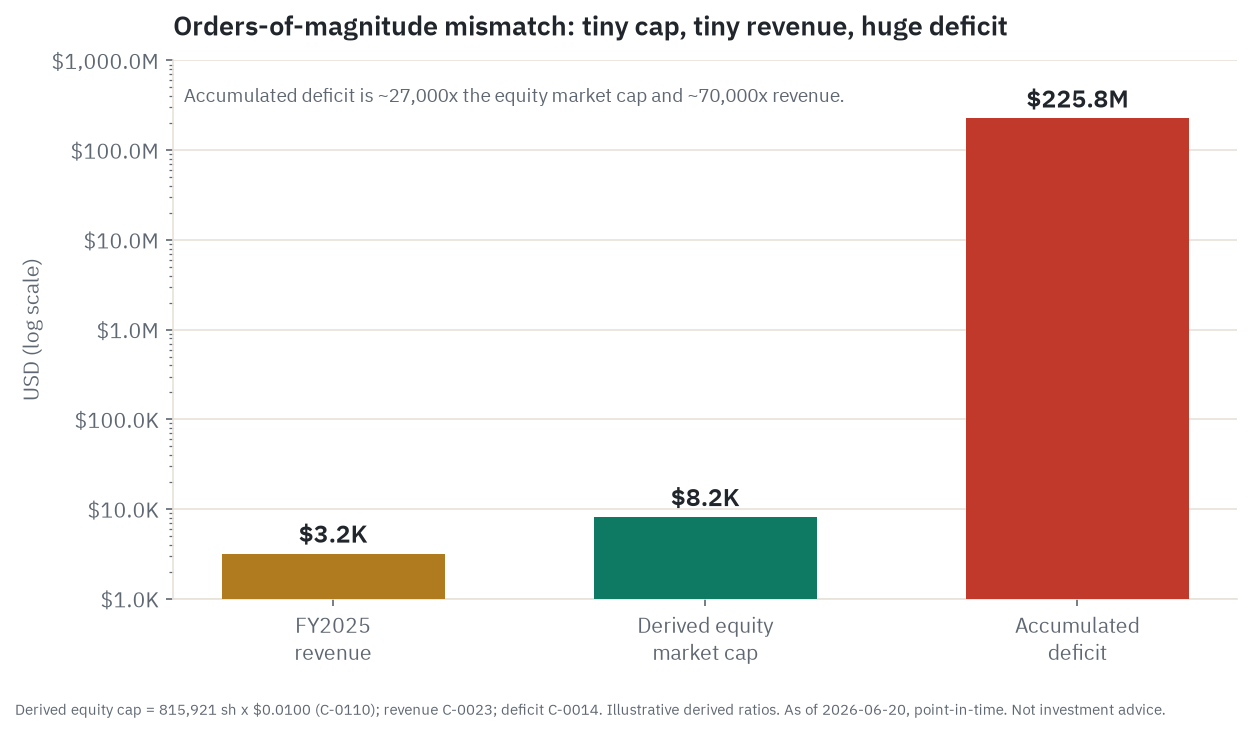
Revenue. Fiscal 2025 total revenue was $3,195 (down from $133,985 in fiscal 2024), with $268 of gross profit. The lone revenue line is the AditxtScore COVID-antibody lab test. Margins are not meaningful because there is essentially no commercial revenue. This is a cash-burning entity, not an operating business.
Cash and burn. Cash was $268,852 as of March 31, 2026, down from $3,198,599 at the end of 2025. Operating cash burn was $4,578,712 in Q1 2026 (about $1.5 million a month, already cut down from $11.7 million in the prior-year quarter), and the full fiscal-2025 burn was $25,688,359.
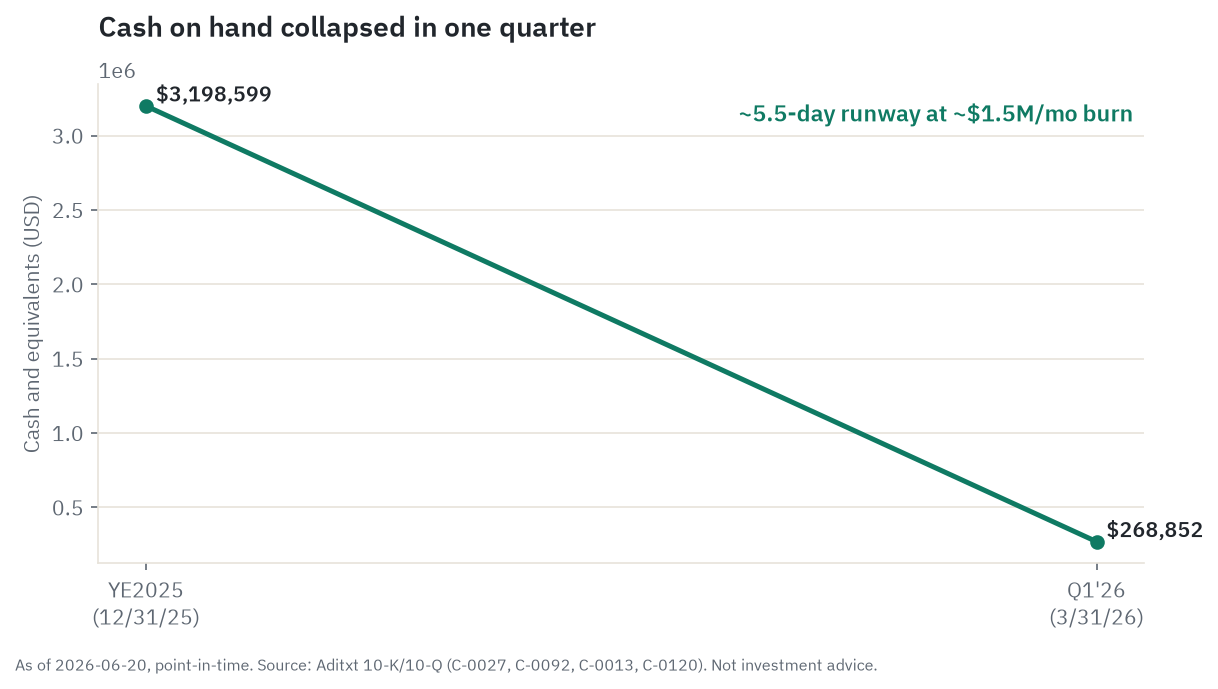
If you do the simple arithmetic, $268,852 divided by about $1.5 million a month is roughly five to six days of cash. That figure is genuinely academic, and it is important to say why immediately, because quoting it without the caveat would be a cheap shot. The cash balance is not what keeps the company alive. Runway here is a function of financing access, not cash on hand. Aditxt funds day-to-day operations directly and continuously from stock sales, not from a reserve. The cash account is a near-empty bucket with a hose running into it. The real question is never “how many days of cash,” it is “can it keep selling shares, and at what price.” At sub-penny prices, each sale raises trivial dollars, which is exactly the dilution loop.
Accumulated deficit. $225,756,495 as of March 31, 2026. That is the running total of every dollar the company has lost since inception. Set it against a derived equity-market value of about $8,000 and fiscal-2025 revenue of $3,195 and the orders-of-magnitude mismatch is the whole story in one picture.
Stockholders’ equity. This is the headline. Total stockholders’ equity was negative $35,174,386 as of March 31, 2026, flipped from a positive $3,953,682 at year-end 2025 in a single quarter. Stockholders’ equity is, roughly, assets minus liabilities, the accounting “book value” left for shareholders. Negative equity means the company owes more than it owns on the books.
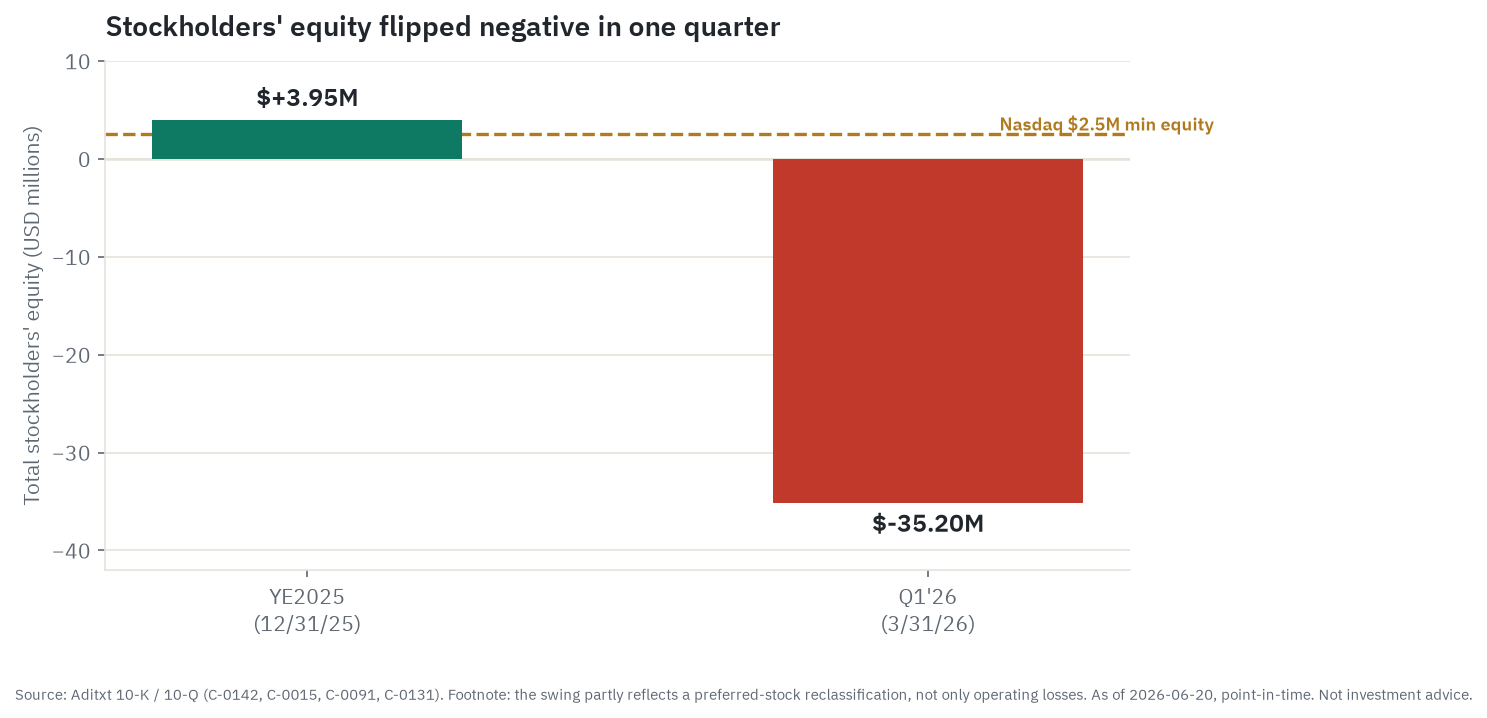
One honest nuance, because it matters and the bears who skip it are overstating their case. That one-quarter swing to negative $35.2 million coincided with the quarter the company issued the $36 million Series A-2 preferred to buy Ignite. That preferred is carried on the balance sheet in a spot between liabilities and equity (accountants call it the “mezzanine”), because it can be required to be redeemed rather than counting as permanent ownership. Parked there instead of in equity, it mechanically drives the equity line negative even though the company received an asset (Ignite) in exchange. So the hole is not purely incinerated cash; part of it is a preferred-classification swing tied to an asset purchase. That does not make Aditxt solvent. The burn and the going concern are independent of the bookkeeping. But “the equity hole is all destroyed cash” would be an over-read.
Liabilities. About $6.6 million of accounts payable, of which roughly $5.8 million is more than 90 days past due. The company states it is over 90 days past due on a significant number of vendor obligations. A May 2025 note is in default. Cash on hand will not fund 12 months.
Capital returns and dilution. There are no buybacks and no dividend. The entire equity story is dilution. Authorized common was raised to 1,000,000,000 from 100,000,000.
Guidance and management framing. No earnings guidance, which is normal for a pre-revenue micro-cap. Management’s 10-Q framing is that it “continues to actively pursue numerous capital raising transactions” for “bridge funding,” and it concedes that remaining funds will not be sufficient to fund operations for the next 12 months.
The going-concern language, verbatim. The auditor, dbbmckennon, wrote in the 10-K filed March 31, 2026: “the Company’s net losses and negative cash flow from operations, raise substantial doubt about its ability to continue as a going concern.” Management echoed it in the 10-Q: “the Company believes that this creates substantial doubt with the Company’s ability to continue as a going concern.” These are the company’s and the auditor’s own words.
FDA status. No FDA clearance or approval, and no recall or enforcement action, for any Aditxt entity. The openFDA databases return no matches for Aditxt, Pearsanta, or Ignite Proteomics. Any claim that Pearsanta or Ignite holds an FDA diagnostic clearance is refuted by the data; their tests, if marketed, operate as CLIA laboratory-developed tests, not FDA-cleared devices.
Insider and institutional signal. Insider ownership has been diluted to near-zero: 3 shares for the CEO and 21 shares for the entire board and management group, with no holder above 5 percent (per the proxy filed April 3, 2026). Heavy Form 4 activity in June 2026, including a Bank of America entity appearing as a reporting owner, reads as financing-warrant and convertible churn (exercise-and-sell mechanics), not conviction buying.
The Nasdaq delisting situation, step by step
This is the single most time-sensitive part of the whole company, so it gets its own section. A lot of coverage of ADTX flattens this into “facing delisting,” which undersells it. There is not one Nasdaq problem here. There are three separate ones, each a standalone reason Nasdaq can throw the stock off the exchange, and all three are now sitting in front of the same panel at the same time. Walking through them in order is the clearest way to understand why this is the master switch for everything else.
First, a one-line primer on how Nasdaq delisting works, because the mechanics matter. Nasdaq sets minimum “continued listing standards.” When a company falls below one, Nasdaq Staff sends a deficiency notice. Usually the company then gets a grace period to fix it, and only if it fails to cure does Staff issue a formal determination to delist. The company can appeal that determination to an independent Hearings Panel, and filing that appeal “stays” the delisting, meaning the stock keeps trading on Nasdaq until the panel rules. Keep that sequence (notice, then grace period, then determination, then appeal-and-stay, then panel decision) in mind, because ADTX is at the appeal-and-stay step on all three problems.
Deficiency one: the minimum bid price (Rule 5550(a)(2), the $1.00 rule). Nasdaq requires a listed stock to keep a closing bid price of at least $1.00. ADTX’s bid closed below $1.00 for 30 consecutive business days, from March 24, 2026 through May 5, 2026, which trips the rule. Here is where ADTX is different from a normal company in this spot, and it is the most important mechanical fact in this section. Normally, a company that breaks the $1.00 rule is handed a 180-day cure period: a roughly six-month grace window in which it can get the price back over $1.00, very often by doing a reverse split. That is the standard escape hatch. ADTX does not get it. In its determination dated May 6, 2026, Nasdaq Staff cited Rule 5810(c)(3)(A)(iv) and stated that ADTX is not eligible for any compliance period, because the company had already done a reverse split in the prior one-year period and its reverse splits over the prior two-year period add up to a cumulative ratio of 250-to-1 or more. In plain terms, the rule exists to stop companies from reverse-splitting over and over to stay listed, and ADTX has tripped exactly that tripwire. It has already used up its reverse-split lifeline. So instead of a six-month grace window, the bid-price problem went straight to a Staff determination to delist. This is the precise mechanism behind the escalator-reaching-the-top-floor image from earlier: the usual fix is off the table by rule.
Deficiency two: stockholders’ equity (Rule 5550(b)(1), the $2.5 million rule). Separately, Nasdaq requires a company on this tier to keep at least $2.5 million of stockholders’ equity (or to qualify under one of two alternatives, a $35 million market value of listed securities or $500,000 of net income, neither of which ADTX meets). Nasdaq first flagged this on December 1, 2025, based on the September 30, 2025 balance sheet, and gave ADTX until mid-January 2026 to submit a compliance plan with a possible extension. The company’s equity then got dramatically worse, not better. On May 27, 2026 Nasdaq sent a letter confirming that, based on the March 31, 2026 figure of negative $35,174,386, ADTX still fails the $2.5 million minimum and meets neither alternative. This equity deficiency is a second, independent basis for delisting. And unlike the bid-price problem, this one cannot be fixed by a reverse split at all, because a split creates no equity. Missing a $2.5 million floor by roughly $37.7 million can only be closed by raising real money or converting debt to equity, which the company does not have the cash to do on its own.
Deficiency three: market value of publicly held shares (Rule 5550(a)(5), the $1.0 million rule). Nasdaq also requires that the shares held by the public (excluding insiders) be worth at least $1.0 million in aggregate. On May 27, 2026 ADTX disclosed that it is also not in compliance with this one, the MVPHS deficiency. That is unsurprising given that the entire company’s equity stub is worth roughly $8,000 on the open market, far below $1.0 million. No separate Staff notice on this point had been received as of the research date, but the company put it on the record itself, and the panel can consider it too.
The dated sequence, in one line each, so it is easy to follow:
- December 1, 2025: first equity-deficiency notice (Rule 5550(b)(1)), disclosed in the 8-K filed December 5, 2025.
- March 24 to May 5, 2026: bid price closes under $1.00 for 30 straight business days, failing the $1.00 rule.
- May 6, 2026: Nasdaq Staff issues a determination to delist on the bid-price failure, and states ADTX is ineligible for the standard cure period under Rule 5810(c)(3)(A)(iv). Disclosed in the 8-K filed May 8, 2026.
- May 27, 2026: Nasdaq confirms the equity deficiency at negative $35.2 million as an additional delisting basis, and ADTX self-discloses the MVPHS shortfall; a Hearings Panel hearing is set. Disclosed in the 8-K filed May 29, 2026.
- June 11, 2026: the Hearings Panel hearing is scheduled, with all three deficiencies before the same panel.
Now the careful part, and I am going to state it precisely and then refuse to go past it. What is established fact: Nasdaq Staff determined to delist ADTX (May 6, 2026); ADTX is ineligible for the standard bid-price cure period; the equity and MVPHS deficiencies are real and on the record; and ADTX timely filed an appeal, which stays the delisting and keeps the stock on Nasdaq through the hearing process. What is not established fact: the outcome. The hearing was scheduled for June 11, 2026, and as of the research date of June 20, 2026 no outcome has been disclosed on EDGAR, there is no post-hearing decision 8-K and no Form 25 (the formal delisting form), and the delisting remained stayed. So the honest status is that the stock was still listed under the stay, with a determination to delist hanging over it and the panel’s decision pending. Nothing in this article states or implies that ADTX has been delisted, and nothing states or implies that it has been saved. That outcome may have changed since the research date.
One more thing the reader needs, because it is what gives the listing question its teeth: what actually happens to a holder if the panel affirms delisting. ADTX would drop from the Nasdaq Capital Market down to the over-the-counter (OTC) markets, and for a sub-penny, thinly documented distressed name, very possibly to the bottom rung of the OTC, the Expert Market. The Expert Market is worth understanding plainly, because it is the mechanism behind the bear case’s “effective zero.” On the Expert Market, public quotes are not displayed: a regular retail investor cannot even see a current bid and ask. Most retail brokerages, as a matter of policy, allow customers to sell positions they already hold but block opening new buys, so the stock becomes sell-only for most of the public. The shares typically lose all margin and collateral value (a broker counts them as worth zero against your account), and the institutional and index bid disappears entirely. Liquidity, already thin, can simply evaporate. And here is the part that ties the listing back to survival: the company’s lifelines, the H.C. Wainwright at-the-market program and the $150 million equity line, are registered facilities that work because the stock trades on Nasdaq. Pushed onto a dark OTC venue or the Expert Market, those registered sales become far harder to execute, which chokes off the one source of cash keeping the company alive. That is why this is the master switch. A delisting is not just a venue change; for ADTX it would simultaneously gut liquidity for holders and threaten to cut the financing line that funds the whole operation.
What the market is paying
Every figure here is a snapshot, and this stock is violent. On June 18, 2026 it traded a $0.0086 to $0.0175 range, a 2x swing in one session. The latest confirmed trading day on or before the research date was June 18. Treat all of this as stale by the next open.
Price. Last close was $0.0100 on June 18, 2026, corroborated across four sources. The previous close was $0.0044; that one-day jump is sub-penny tick noise, not signal. The stock sits at the very bottom of its 52-week range, with a low around $0.0040 to $0.0041 that the data vendors agree on. I am deliberately not printing a 52-week high, because split-adjusting a six-reverse-split chart is genuinely fraught and the vendors disagree wildly (one shows about $53,451, another shows $117.84, a roughly 450x gap). The low is reliable; the high is not.
Derived market cap. About $8,159, calculated as 815,921 shares times the $0.0100 close. I derive it from the canonical post-split share count rather than from an aggregator, because after six splits the aggregator share counts are the single most error-prone input; any site still carrying a pre-split count would overstate the cap by orders of magnitude. Across the day’s range the implied cap was roughly $7,000 to $14,300. This is an eight-thousand-dollar equity stub, smaller than a used car, and it moves intraday.
Valuation multiples. Not meaningful. There are no earnings (fiscal 2025 net loss was $42.8 million), so price-to-earnings is negative and not meaningful. Negative stockholders’ equity makes price-to-book negative and not meaningful. Only price-to-sales even computes, at about 0.57, but on $3,195 of revenue that is a rounding artifact, not a valuation. The honest read is that there is no multiple that fairly values this, because the equity is a near-zero option stub sitting junior to $35.2 million of negative book and a roughly $69 million preferred liquidation stack. Rich versus cheap is the wrong axis. Solvency is the axis. (For the opposite kind of price-versus-fundamentals gap in another small-cap medical name, where the market paid up rather than down, see our Butterfly Network (BFLY) breakdown.)
Liquidity and short interest. This is the paradox: the company is worth about $8,000 but churns real money. June 18 volume was about 5 billion shares; the 20-day average is around 532 million shares, which at a penny is roughly $5 million a day of dollar volume, with June 18 turnover spiking far higher. It is a churning lottery ticket. Short interest was 93,339 shares, about 11.44 percent of shares outstanding and 16.81 percent of float, with days-to-cover negligible given the volume.
Sell-side coverage. None. No mainstream analyst coverage and no price target. One data service carries only an algorithmic “Sell” with no target. For a stock under a live delisting determination, the absence of coverage is itself the finding: the sell side has abandoned it.
The split-then-bleed pattern. The daily history shows a clean, repeating cycle. After the May 15, 2026 1-for-27 split the stock opened around $1.89 and held in the $1.22 to $1.52 range for about five trading days, then closed at $0.51 by May 22, and was sub-penny within a month, printing an all-time low around $0.0041 on June 17, 2026. The prior 1-for-8 split in March showed the same shape. The split resets the nominal price; the dilution bleeds it back down. The pattern is confirmed across at least two consecutive splits.
What the crowd is saying
This section is soft signal: what the crowd appears to believe, not fact. The hard numbers live in the filings. Treat everything here as a read on mood.
The news flow over the past year is dominated by distress mechanics: reverse-split notices, repeated delisting items, and going-concern language. Mainstream aggregator tone is clinical and cooling, framing delisting as the main overhang and the reverse splits as compliance failures rather than fresh starts. Against that grim baseline sit two warming spikes: the bitXbio Bitcoin-rebrand narrative and the Ignite SPAC deal. The baseline narrative is negative; the spikes are promotional and short-lived.
On the retail and social side, the lean is promotional and hope-driven rather than skeptical. On the Ignite bounce, StockTwits flashed “extremely bullish” sentiment with “extremely high” message volume, which is a textbook sub-penny dead-cat-bounce crowd. The representative posts are lottery-ticket wishes and comeback memes, not a coordinated thesis. Recurring themes are the next reverse split, the constant “they keep printing” dilution complaint, the bitXbio pivot, and the SPAC hype. Intensity is spike-and-fade: it rises on a catalyst and collapses during the multi-week bleed. A record losing streak of about 22 sessions preceded a +90 percent premarket pop on June 13, 2026, which is the signature of a news-pop on illiquid paper, not a trend reversal. The clearest internal-momentum read is the leadership exodus, which a distressed shell rarely spins into a turnaround.
Where the crowd story diverges from the filings, the gaps are sharp and worth naming.
The biggest is bitXbio. The crowd treats “bitXbio” as a live Bitcoin treasury pivot. The company’s own 8-K from November 18, 2025 states that it “has not made any investments in digital assets, nor does it presently hold any digital assets.” Every element of the planned digital-asset treasury is “subject to the availability of funds,” the ticker is still ADTX (the name change was advisory only), and the “funding” for any future Bitcoin is the same dilution stack, meaning selling ADTX stock. With $268,852 of cash and zero Bitcoin, bitXbio is a marketing layer over the raise-dilute-split machine. The press release came in July 2025; nothing about bitXbio appeared in an EDGAR filing until November 2025, which is promotional-narrative-first sequencing. And as the dilution section laid out, the February 13, 2026 meeting that approved the bitXbio name bundled it with conversion-cap removals and blanket reverse-split authority, so the crypto story and the dilution machinery were voted in together.
The second gap is the Ignite SPAC. The crowd buys ADTX as a rescue play on the $150 million deal, but structurally the upside flows to Pubco shares at the subsidiary level, not to new ADTX value. The third is the recurring hope that a reverse split is a “reset.” The filings show six splits, a cumulative 9.76 billion to one, insiders ground to 21 shares, and negative $35.2 million equity. The split is cosmetic; the dilution is permanent. And the fourth is institutional Form 4 churn misread as conviction: a market-maker-class entity, HRT Financial, cycled in and out and ended at zero shares after selling 3.13 million shares at $0.013 on June 16, 2026. That is liquidity provision, not accumulation.
A hygiene flag, framed precisely. This is classic thin-float, sub-penny terrain, exactly the profile where a single press release or a coordinated thread can move price violently before fading. I found no verified evidence of bots or a coordinated pump ring, so I am not alleging one. I am flagging the trading environment’s manipulation-risk characteristics, which is a different and milder thing. And do not mistake loud for large: “extremely high” message volume is high relative to a near-dead ticker, and absolute attention is small and collapses between catalysts.
Can it survive its own financing?
Here is the synthesis from the top-down and bottom-up views, and it is genuinely two-sided.
The survival case (this is the “structural bull,” recast, because there is no demand cycle to defend) is that as long as Aditxt stays listed, it retains the financing plumbing (the ATM, the $150 million ELOC, the effective shelf) to keep raising bridge capital. The strategic reset is real: the Ignite SPAC combination plus a new interim CEO could, in principle, inject value, recapitalize equity, and give a Nasdaq panel a credible plan. If rates ease and biotech M&A revives, the speculative-financing window that names like this depend on would widen. The bull’s whole game is time arbitrage: survive long enough for one bet (Ignite closing, Pearsanta filing, ADI clearing pre-IND) to land.
The bear case is that the lifeline is the disease. The listing clock is near-term and binary. The equity hole of negative $35.2 million versus a $2.5 million floor is a capital problem, not a price-per-share problem, and a reverse split cannot fix it because a split creates no equity. Going concern, payables 90-plus days past due, and a note in default mean insolvency risk runs in parallel with delisting risk. And every raise that keeps the lights on resets the reverse-split treadmill and erodes per-share value toward zero. That is the split-then-bleed pattern, in the financials.
The honest read is that the bear is better supported, because it rests almost entirely on audited primary facts while the bull rests on optionality and a negotiated mark. The most likely path is continued dilution-and-reverse-split survival mode while management tries to push Ignite to close, with two forks: a higher-probability fork where listing or financing access fails and the common bleeds toward a vanishing residual, and a lower-probability fork where a deal closes, books a marketable asset, and leaves something for common. There is no realistic branch in which current common holders are made whole without further heavy dilution. The decisive near-term event is the June 11, 2026 hearing, and its outcome was not public as of this writing.
The five-year outlook
Everything in this section is a scenario map, not a forecast. Every forward number is an estimate or illustrative arithmetic, clearly labeled, and never a price target. For a name like this the realistic outcome distribution is bimodal and heavily downside-skewed for the common, and the single most important input (the June 11, 2026 hearing outcome) was not public as of the research date, so I carry both branches and never state which happened.
The driver tree
ADTX’s five-year fate is not decided by revenue, margins, or a market size, because there is essentially no operating business. It is decided by a short chain of survival switches, each gating the next.
(a) Nasdaq listing survival, the master switch. Listing gates everything, because the ATM and the ELOC are effectively Nasdaq-dependent registered facilities; a move to OTC or the Expert Market chokes that plumbing. The May 6, 2026 Staff delisting determination is on the record, under a stay, with a hearing scheduled for June 11, 2026 whose outcome was not disclosed on EDGAR as of the research date and with the delisting still stayed. Critically, Aditxt is ineligible for the standard cure period under Rule 5810(c)(3)(A)(iv) because of its reverse-split history, so it cannot simply reverse-split again to fix the $1 rule.
(b) The ability to keep selling stock at sub-penny prices. Even with a listing, the engine only works if shares fetch meaningful dollars. At about $0.01, the entire roughly 999-million-share authorized headroom raises only about $10 million, less than one year of burn (illustrative). Each at-market sale pushes the price down, so the machine must print ever more shares to net the same cash, which is what forces the splits.
(c) Whether Ignite/Copley closes, and whether value reaches common. The June 2026 Business Combination Agreement marks Ignite at about $150 million (15 million Pubco shares at $10). The nuance that the bear case must concede: Aditxt-as-seller retains that stake at the parent; it does not get nothing. But the stake sits behind the roughly $69.5 million preferred liquidation stack and the negative book, the deal needs at least $15.0 million of trust cash plus $7.5 million of Ignite financing to close by a roughly September 30, 2026 outside date, the parent signed a Side Letter and Guaranty that adds liabilities (guaranteeing Ignite’s debt and expenses), the shares are lock-up-restricted, and Ignite’s standalone revenue is undisclosed. So this driver has two gates: does it close, and does any residual reach common.
(d) The Evofem securities, the hidden asset. After the Evofem merger died, Aditxt did not walk away empty. It holds Evofem Series F-1 convertible preferred with a stated value of about $26.28 million, about $3.73 million of Evofem convertible notes, and a warrant for 149,850,150 Evofem shares. This is distressed, illiquid paper on a sub-penny OTC name (EVFM trades around $0.0085), so face value is not market value, but it is not zero. A re-rate requires Evofem to relist or restructure, which it stated an intent to pursue.
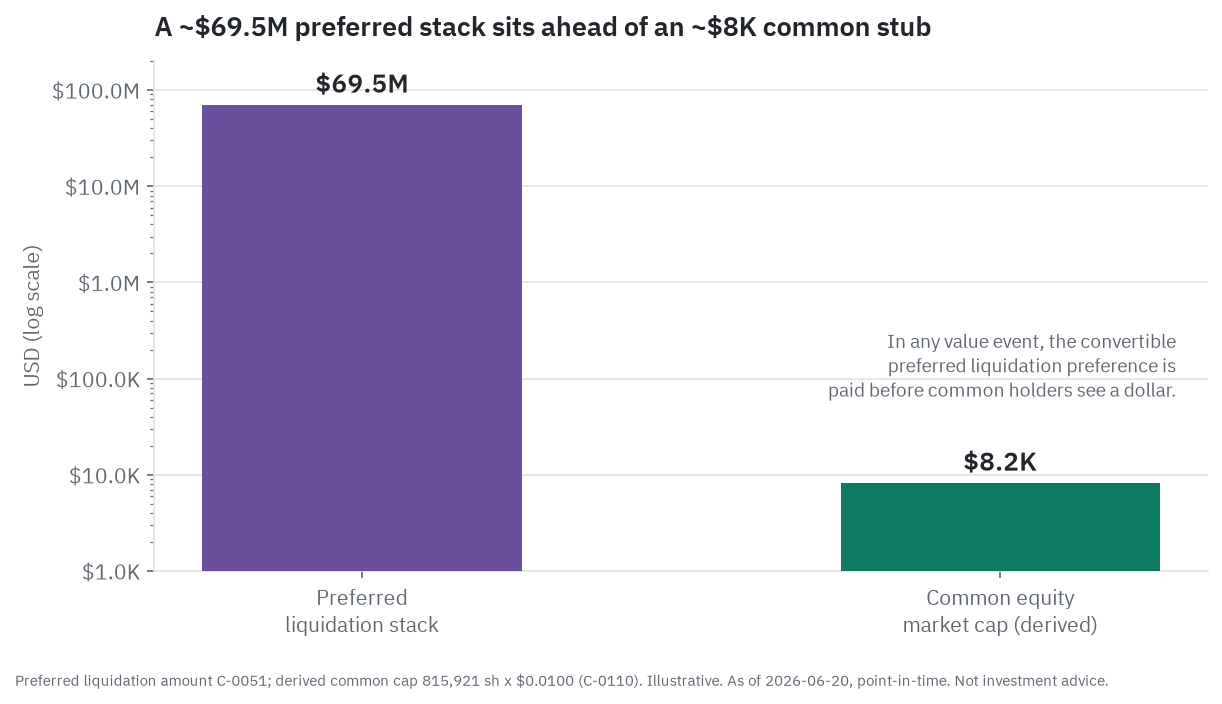
The preferred stack is who gets paid first when the lifeboat is launched. Picture the order people board the lifeboat in a wind-down: the roughly $69.5 million of preferred climbs in ahead of common. Whatever the parent’s assets are worth, the preferred is paid before a single dollar reaches the common holder. That is why even a genuinely valuable asset like a $150 million Pubco stake may leave nothing for common, and it is the crux of this whole analysis.
(e) Any subsidiary clinical or FDA milestone. This is pure optionality. Adimune is 100 percent preclinical with a pre-IND meeting targeted but no IND cleared; Pearsanta has a real lab and IP but no validated test and a never-filed IPO. Each advances only if someone else funds it.
(f) Dilution pace against the billion-share ceiling, which sets the next reverse split. Six splits in under three years; the observed pattern is split, then bleed back sub-$1 within about a week, then sub-penny within a month, then repeat.
How the switches chain: (a) gates (b); (b) and (c) and (d) decide whether the parent has any asset; and even a “yes” on (c) or (d) only reaches common after the preferred and the negative book. The bull needs (a) and (b) and either [(c)-to-common or (d)] to all break favorably; the bear needs any one of (a) or (b) to fail. That asymmetry is why the distribution is downside-skewed.
Bull: listing saved, Ignite closes with residual to common, and a hidden-asset re-rate
Assumptions. The panel grants a conditional exception period, citing the pending Ignite close as a credible recapitalization path, so the listing survives. Financing access stays open long enough to bridge. Ignite/Copley closes near its $150 million mark, the Pubco stake survives redemptions and post-lock-up trading, and after the preferred stack and the guaranty liabilities there is still a positive residual that the parent books as a marketable asset, flipping equity back above the $2.5 million floor. Evofem relists or restructures and the F-1 preferred, notes, and warrant mark up off near-zero. A clean Adimune pre-IND or a Pearsanta filing would be a bonus.
Trajectory. This is not an earnings story (Ignite leaves on close); it is a net-asset-value-reaches-common story. The stub re-rates violently off its floor on the catalyst filings, helped by the thin float and the 11.44 percent short interest as squeeze fuel. Over five years the common could retain a small but non-zero claim on a recapitalized parent.
Illustrative magnitude [estimate]. Method is a net-asset residual to common, not an earnings multiple. If the retained Pubco stake holds near its mark and the Evofem paper marks up, the parent’s gross assets could exceed the roughly $69.5 million preferred stack plus net liabilities, leaving a positive residual to common measured in the millions to low tens of millions, orders of magnitude above the roughly $8,000 stub today. This is illustrative arithmetic on negotiated marks, not cash anyone has paid, it still assumes heavy further dilution on top of the 9.76-billion-to-one already run, and it is not a price target.
What breaks it. This issuer is 0-for-3 on marquee mergers, so the most likely break is that the Pubco mark proves illiquid or shrinks (heavy SPAC redemptions, a small lab dressed for a SPAC, a soft post-lock-up tape) so that after the preferred there is nothing left for common. The deal closes but the value is captured above the common. The secondary break is the panel affirming delisting and starving the bridge before close.
Base: listing limps on via dilution, value accrues to preferred and Pubco, common keeps bleeding
Assumptions. Listing survives for now (a conditional exception or a slow grind), but the un-curable equity hole keeps it perpetually on the edge. The ATM and ELOC keep printing, but at sub-penny prices each raise nets little and dilutes heavily. Ignite/Copley closes or partially closes, but the value routes to Pubco, preferred, and new money, with little to none reaching common after the stack. Evofem paper stays distressed and largely unmarked. At least one or two more reverse splits punctuate the period.
Trajectory. Perpetual survival mode: raise, dilute, hit the ceiling, reverse-split, bleed, repeat. The per-share value of legacy common erodes toward zero even though the entity persists, because the share count repeatedly resets and any asset value sits behind the preferred. The entity is alive; the common is a vanishing residual.
Illustrative magnitude [estimate]. Method is a junior residual after a senior stack absorbs the available value. With about $69.5 million of preferred plus a negative book ahead of common and continuous dilution, the common’s claim trends toward a near-zero option stub; the roughly $8,000-stub character persists or shrinks in real terms across successive splits. Illustrative, not a target.
What breaks it. A financing-access interruption (a lost appeal, an exhausted or lapsed shelf, an ATM or ELOC counterparty stepping away at sub-penny prices) converts the slow base-case bleed into the bear overnight, because there is no operating cash flow to catch the fall.
Bear: listing lost or financing cut, dilution grinds common toward zero
This is anchored on the skeptic’s strongest case, and I mean it. It is a scenario, not a prediction.
Assumptions. The panel affirms delisting (the higher-base-rate outcome for a fact pattern this severe, stated as analysis and not as a panel prediction), or the stay lapses, and ADTX moves to OTC or the Expert Market. Registered ATM and ELOC sales become impractical there, so the one capital source dies. Any subsidiary or Evofem value that exists is captured by Pubco, the preferred stack, and new rescue money, not by legacy common. The treadmill ends not with a split but with a restructuring or insolvency event.
Trajectory. With days of cash runway (academic, since the real runway is financing access), a note in default, and $5.8 million of past-due payables, cutting the financing source breaks the cash bridge quickly. Expert Market mechanics mean many brokers allow liquidations only, not opening buys; spreads blow out; the passive and institutional bid disappears. The common trends to an effective zero for holders even if a reorganized entity or its assets live on elsewhere.
Illustrative magnitude [estimate]. Method is recovery to the most-junior claim in a distressed wind-down. Common sits behind about $69.5 million of preferred, a negative book, a defaulted note, and past-due vendors; in a restructuring or insolvency the recovery to common rounds to zero. Illustrative, not a target.
What saves the bear from being right. A Nasdaq save plus an Ignite close that books a real, marketable parent asset flipping equity above $2.5 million. In that world the bear’s “ruinous dilution” claim survives, but its strongest claim, a structural vector to zero for common, is falsified. That is the scenario I am deliberately leaving open.
Catalysts and timeline
Near term (next few quarters): the June 11, 2026 hearing outcome, the single most load-bearing event, watched via an Item 3.01 8-K granting an exception period versus an affirm-delisting 8-K or a Form 25; a possible separate Staff notice on the market-value-of-publicly-held-shares deficiency; the Ignite/Copley close (conditions include $15.0 million minimum trust cash plus $7.5 million Ignite financing, roughly September 30 outside date, and SPAC deals frequently amend, extend, or terminate); the Adimune pre-IND meeting, targeted for Q2 2026 but unconfirmed; a possible seventh reverse split; ATM, ELOC, and shelf capacity; and the next 10-Q for going-concern and default updates.
Multi-year inflections: whether a recapitalized parent ever holds a marketable asset (a tradeable, unlocked Pubco stake or a marked-up Evofem position); a Pearsanta IPO actually filing; Adimune reaching a registered human trial with a funded partner; an Evofem relisting; and the broader financing window (a rate-easing cycle plus a biotech-M&A revival would widen the speculative window ADTX depends on, and it sits at the most selective end of it).
Companies to watch (bull / base / bear)
Watch ADTX itself plus the deal counterparties and the subsidiary milestones. Every figure here is point-in-time as of June 20, 2026 and moves fast.
Aditxt, Inc. (ADTX, Nasdaq). The name itself; a distressed parent holding company.
- Bull: the retained Ignite/Pubco stake (marked at about $150 million) and the distressed Evofem securities are real off-ramps; if listing survives and a deal books a marketable asset, the stub could re-rate hard.
- Base: listing limps on via dilution; any value routes to preferred and Pubco; common keeps bleeding through more splits.
- Bear: listing lost or financing cut, and dilution grinds the common toward a near-zero residual junior to the preferred stack.
- Watch: the post-June-11 Item 3.01 8-K or Form 25; the next 10-Q balance sheet; the next reverse-split filing.
Evofem Biosciences (EVFM, OTC). The dead-deal counterparty, and the mirror of ADTX’s hidden Evofem asset.
- Bull: Phexxi is a real, revenue-generating product; a debt restructuring or new buyer could re-rate the equity off near-zero and mark up the securities Aditxt holds.
- Base: stays a distressed sub-penny OTC name; the Aditxt securities stay largely unmarked.
- Bear: crushing debt and going concern; stockholders already rejected their best exit (the Aditxt merger), and a restructuring likely wipes common.
- Watch: any Evofem relisting or refinancing 8-K; EVFM price action off sub-penny.
Copley Acquisition Corp (COPL, NYSE). The live SPAC re-floating Ignite.
- Bull: provides a clean NYSE listing and a roughly $150 million mark for Ignite; trades near trust value, so limited downside to trust pre-close.
- Base: a typical pre-close SPAC; the deal closes, amends, or extends.
- Bear: standard SPAC risk: redemptions, registration and shareholder-vote conditions, possible termination before close.
- Watch: the closing 8-K and the S-4 disclosing Ignite’s standalone revenue; the Pubco post-close price versus trust.
IMAC Holdings (BACK, Nasdaq). The distressed seller that conveyed Ignite via a note default. Market cap not independently confirmed here; confirm before citing a figure.
- Bull: shedding the defaulted Ignite notes removes an overhang.
- Base: remains a distressed micro-cap.
- Bear: the default and asset forfeiture signal severe distress; residual value to BACK common unclear.
- Watch: IMAC’s own filings on the note default resolution.
Appili Therapeutics (APLI, TSX Venture). Terminated counterparty; low load-bearing weight. Market cap not independently confirmed here.
- Bull: termination freed it from a serial non-closer and netted a reported break fee.
- Base: a small Canadian biodefense pharma with limited capital-markets access.
- Bear: lost its acquisition exit.
- Watch: its own financing updates.
Risk controls
The honest risks, stated plainly, because for this name the risks are the thesis.
Delisting is live and near-term: a Staff determination to delist exists, the outcome of the appeal hearing was not public as of this writing, and a move to OTC or the Expert Market would gut liquidity and likely choke the financing plumbing. Dilution-to-zero is a real scenario for the common (not a prediction): the structure points that way, and the math is relentless at sub-penny prices. Going concern and insolvency risk are independent of the listing clock: cash is days deep, a note is in default, and vendors are months past due. The company depends on a single point of failure, financing access; if it cannot sell shares at meaningful prices, there is no operating cash flow to fall back on. The stock is a micro-cap with violent intraday swings and an eight-thousand-dollar equity stub, so position size and slippage matter enormously. Deals at this issuer have a documented history of not closing. The crowd narrative is promotional and the float is thin, which is manipulation-risk terrain even without evidence of an actual pump. And the data goes stale within days: every price, cap, share count, and cash figure here will be wrong by some margin by the time you read it.
What would change the read, in either direction: a Nasdaq exception-period grant plus an Ignite close that books a marketable parent asset above $2.5 million, with a residual clearing the preferred stack, would turn the bear bullish. A Form 25 or affirm-delisting, an Ignite termination or close far below mark, an accelerating dilution and another split with no asset booked, or a liquidity or default event would confirm the bear.
The one question a bull must answer, stated plainly: does subsidiary or Pubco or Evofem value actually reach the ADTX common holder, or does it get captured by new money, by the spun-out Pubco entities, and by the roughly $69.5 million preferred liquidation stack ahead of common? On today’s audited evidence the honest answer leans toward the latter, even though a genuinely valuable asset (Ignite) and a real-but-distressed one (the Evofem paper) demonstrably exist at the parent.
Methodology, sourcing, and data-quality flags
This piece was assembled from several parallel research streams: the SEC filings (10-K, 10-Q, and 8-K), market action and valuation, social and OSINT sentiment, the macro listing-and-financing context, the bottom-up dilution and runway economics, the corporate history, the acquisition tracker, the subsidiary science, and a five-year bull/base/bear outlook. Every load-bearing figure is recorded in a claims ledger with a source and a tier.
The source hierarchy: SEC EDGAR filings are primary and override everything (financials, share count, the reverse-split ledger, the going-concern language, the Nasdaq deficiency notices, the deal terms). openFDA is primary for clearance and recall checks (the result here was “no matches” for every entity). Market and sentiment aggregators are press-tier and point-in-time only, used for prices, volume, and crowd mood, never to overrule a filing. Forward scenarios are labeled estimates.
Data-quality flags:
- The single most time-sensitive item is the listing status. As of June 20, 2026 the Nasdaq Staff determination to delist (May 6, 2026, on the bid-price rule) existed alongside two further deficiencies on the record (the stockholders’-equity deficiency confirmed May 27, 2026 and the self-disclosed market-value-of-publicly-held-shares shortfall), all three before one Hearings Panel, and the delisting was stayed pending the June 11, 2026 hearing. The hearing outcome was not public on EDGAR as of the research date (no Form 25, no post-hearing decision 8-K). Nothing here states or implies that ADTX has been delisted or saved. This status may have changed since the research date.
- Prices, market caps, share counts, and cash figures are point-in-time as of June 20, 2026 and move within days. The latest confirmed trading day was June 18, 2026.
- Market cap is derived (815,921 canonical post-split shares times the close), not taken from an aggregator. After six reverse splits, aggregator share counts are the single most error-prone input; any provider still carrying a pre-split count would overstate the cap by orders of magnitude. The pre-split dilution-overhang figures and the post-split outstanding count are on different bases and are not mixed.
- The 52-week high is unreliable and is not printed: vendors disagree by roughly 450x ($53,451 versus $117.84) because of different split-adjustment methods. The 52-week low (around $0.004) is corroborated.
- The Evofem roughly $17 million cash close condition and the Appili roughly $1.0 million break fee are press-tier and single-source (the Appili figure is from Appili’s own release); both are framed as reported, not asserted as Aditxt-confirmed.
- Ignite Proteomics’ standalone revenue is not disclosed in Aditxt’s audited filings; the $150 million is a SPAC-negotiated mark, and the “commercial-stage,” “$2,200 per test,” and market-size figures are issuer or press claims, not audited. No Ignite revenue number is stated as fact.
- The negative $35.2 million equity figure is a filed fact, but part of the one-quarter swing reflects the classification of the $36 million Ignite preferred outside permanent equity, so it is not characterized as entirely destroyed cash.
- The cash runway in days and the dilution arithmetic are illustrative estimates (cash divided by burn, and shares-to-raise-$X at a static price), not forecasts and not price targets.
- Going-concern and delisting base rates from the auditing and academic literature are estimates cited for direction, not measured probabilities for this company.
- Social and StockTwits sentiment is soft, single-platform, moment-in-time signal, reported as crowd belief, not fact. No coordinated-manipulation evidence was found, so none is alleged.
- The “toxic” or “death-spiral” characterization of the capital structure is my analysis based on the no-floor reset features and the split record, not a company term and not an allegation of bad-faith conduct by any party.
- Deal statuses (Evofem terminated, Appili terminated, the Ignite SPAC pending) may have changed since June 20, 2026.
Key sources: Aditxt FY2025 10-K (filed Mar 31, 2026) and Q1 2026 10-Q (filed May 20, 2026); the reverse-split 8-Ks; the Nasdaq Item 3.01 8-Ks (Dec 5, 2025; May 8, 2026; May 29, 2026); the Evofem termination 8-K (Oct 20, 2025); the Appili termination 8-K and Appili’s release; the Ignite acquisition 10-K disclosure and the Ignite/Copley Business Combination Agreement 8-K (Jun 10, 2026); the bitXbio 8-K (Nov 18, 2025); the DEF 14A (Apr 3, 2026); openFDA and ClinicalTrials.gov; and point-in-time market and sentiment aggregators (stockanalysis, Yahoo Finance, Google Finance, investing.com, StockTwits).
OSINT research for educational purposes only - not investment advice, not a recommendation, and not a solicitation. Point-in-time as of June 20, 2026; figures and statuses move fast and may have changed. Distressed sub-penny stocks under active delisting review carry extreme, up-to-total-loss risk and can move violently intraday. The author holds no position in ADTX and has not been compensated by any party mentioned. Do your own due diligence and consult a licensed financial advisor before making any decision.