
Research date: June 19, 2026 | OSINT supply-chain research on Butterfly Network Inc. (NYSE: BFLY), the global point-of-care ultrasound market, and its US-listed comparables. Live prices, stamped hard.
Important disclaimer. This is independent OSINT (open-source intelligence) research compiled for educational and informational purposes only. It is not investment advice, not a recommendation or solicitation to buy, sell, or hold any security, and not a statement that any security is suitable for you. The author is not a financial advisor and has no fiduciary relationship with any reader. All figures are point-in-time (as of the close on June 18, 2026; research date June 19, 2026) and move fast - prices, market caps, short interest, and multiples may be stale by the time you read this. Any bull / base / bear scenarios and “companies to watch” are analytical framings, not price predictions or guarantees. Do your own due diligence and consult a licensed professional before making any financial decision.
Companion tool - jump to the interactive dashboard to sort and filter every company and explore the supply-chain map, leaderboard, and valuation context.
TL;DR
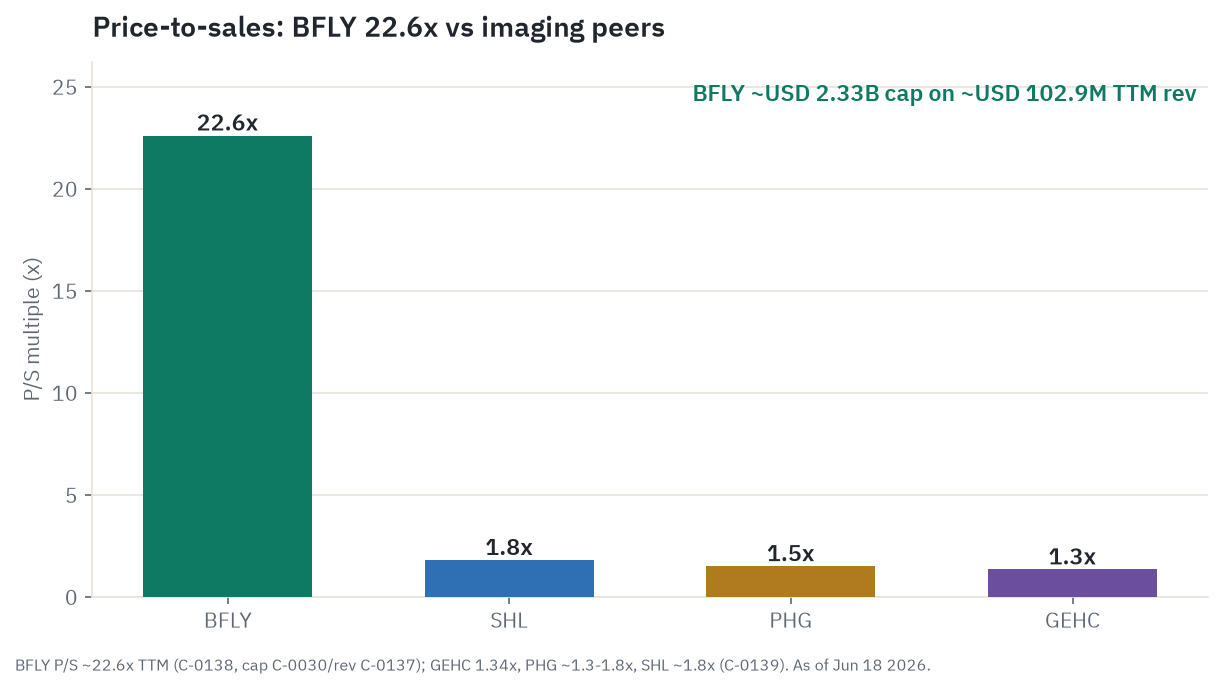
Butterfly Network makes a handheld ultrasound probe that runs on a single semiconductor chip instead of hand-cut crystals, and it sells cloud software on top. On June 18, 2026 the stock closed at $8.90, up 55.87 percent in one day and roughly 61 percent above its June 12 close of $5.54, after the AI image startup Midjourney unveiled a full-body scanner prototype built on 40 Butterfly chips. That move re-rated the company to a market cap around $2.33 billion and a price-to-sales multiple near 22.6x trailing sales, against large imaging peers near 1.5x and an analyst consensus 12-month target around $5.70, which sits below the price. The balance sheet is genuinely clean: $137.954 million in cash at March 31, 2026, zero debt, and FY2025 revenue of $97.610 million up 19 percent, with gross margin climbing from 63.0 percent to 68.9 percent. But the company still loses money, guides FY2026 to a $21 million to $25 million adjusted-EBITDA loss with no stated breakeven date, and the chip-licensing line that drove the spike is one customer, contracted for five years, front-loaded in cash and not a perpetual royalty. The honest verdict: the underlying POCUS business is real and improving, the silicon is a real asset, and the June spike was an event, not a fundamentals re-rating. At 22x sales and 56 percent above where the sell-side values it, the price already discounts an outcome that is not yet a shipping product, not yet recurring, and not yet profitable. All figures below carry a date stamp and move fast. Verify live quotes before acting.
All prices, market caps, short-interest figures, and valuation multiples below are as of the close on June 18, 2026 (the latest full trading day before this research date of June 19, 2026) unless otherwise stamped. BFLY is in an active, high-volatility run-up. These figures move fast and may be materially stale by the time you read this. Verify live quotes before acting.
Explore it yourself: the interactive dashboard
Open the dashboard in a full screen
The dashboard holds the eleven companies in this piece, sortable by market cap, technology, and how they touch the point-of-care ultrasound market, plus the supply-chain and valuation context. Use it to check any single name as you read.
Prefer a spreadsheet? Download the Excel valuation model with the revenue, burn, dilution, and price-to-sales math laid out so you can flex the assumptions yourself.
What Butterfly Network actually is (the 90-second primer)
Start with the thing in your hand at a doctor’s office. A traditional ultrasound machine is a cart full of electronics with a fistful of probes, and each probe contains a strip of piezoelectric crystals. Those are tiny ceramic crystals that flex and “ping” out sound when you apply electricity, and generate a little electricity back when the returning echo pushes on them. They work well. They are also hand-cut, hand-soldered, brittle, and each one is tuned to a narrow frequency, so you need a different probe for the heart, the belly, and a blood vessel. That is the “probe library” a hospital pays for.
Butterfly’s idea was to throw the crystals out and put the whole transducer onto one computer chip. The chip uses CMUTs, capacitive micromachined ultrasonic transducers. Picture a microscopic drum: a flexible membrane stretched over a tiny vacuum gap. Apply voltage and the membrane vibrates and makes sound. When an echo comes back it pushes the membrane and changes the electrical charge, which the chip reads. Butterfly packs roughly 9,000 of these tiny drums in a grid on a single piece of silicon, built directly on top of the ordinary chip-making process (CMOS) that also makes camera sensors and processors. The umbrella name for building tiny moving parts onto a chip this way is MEMS. You do not need to remember the acronyms. The point is this: an entire ultrasound machine’s transducer now lives on one chip, the chip can be told electronically which frequency to use, so one probe covers the whole body, and because the imaging is software-defined, new modes and AI features ship as updates rather than new hardware.
That chip is the company’s actual asset. Everything else hangs off it. The product line went from the original iQ (2018, launched at $1,999) to the iQ+ (now $2,699) to the current best-seller, the iQ3 ($3,899 plus a membership), which runs on Butterfly’s newest chip generation, the P4.3, fabricated by TSMC. On top of the device sits a subscription: individual plans run $299 to $420 a year, and an enterprise platform called Compass adds fleet management, AI image review, and documentation tooling. That software line reached 35.0 percent of total revenue in FY2025, which matters because software dollars are worth far more than hardware dollars (more on that below).
Two things about the stock’s history explain why a 56 percent day was even possible. First, Butterfly went public through a SPAC merger in 2021 at a high valuation, then spent years as a penny-to-low-single-digit name as the cash-burn reality set in. Second, the company added a new business in late 2025: Butterfly Embedded (formerly called Octiv, sometimes written “Octave”), which licenses the chip itself to other companies that build their own devices around it. Embedded is the part the market got excited about in June. It is also the part this piece works hardest to keep honest.
The catalyst: why the stock ran up so hard
Here is the clean price record, sourced to daily closes (the intermediate days between June 12 and June 18 are not all separately sourced, so only the endpoints are stated as facts):
| Date (2026) | Close | Intraday high |
|---|---|---|
| June 12 | $5.54 | $5.97 |
| June 16 | $5.65 | $5.84 |
| June 17 | $5.71 | $6.14 |
| June 18 | $8.90 | $8.94 |
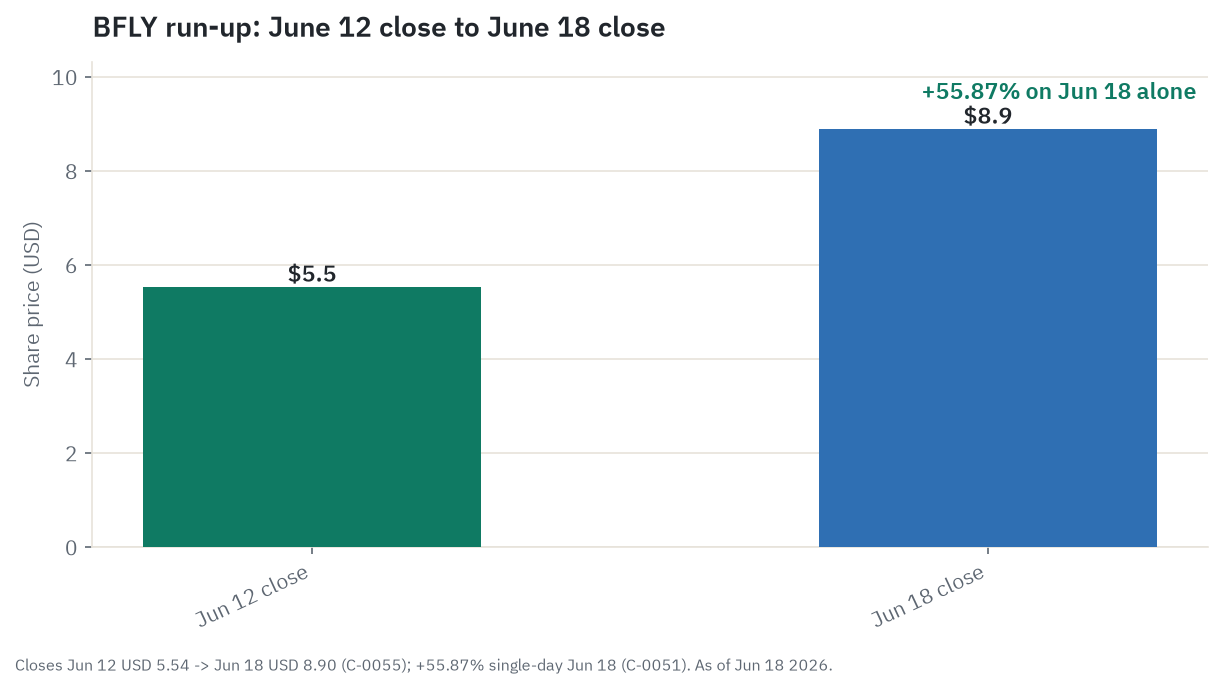
June 18 was a +55.87 percent single day (previous close $5.71 to $8.90), on roughly 59 million shares, which is many times normal volume. From the June 12 close of $5.54, the cumulative move was about +60.6 percent. BFLY was the number-one percentage gainer on the NYSE two days running.
The cause is well sourced and singular. On June 18, Midjourney, the AI image-generation startup, launched a healthcare division called Midjourney Medical and revealed its first hardware product: a full-body ultrasonic scanner. In plain terms, a person is lowered into a water pool ringed by transducers, and a compute cluster reconstructs a picture of the inside of the body. Those transducers are built on Butterfly’s chips. Butterfly’s own June 18 commentary, from CEO Joseph DeVivo, said the current prototype uses “40 Butterfly Ultrasound-on-Chip imaging modules per system,” “about half a million sensors scanning simultaneously,” and “over two petaflops of processing power.” (Trade coverage put the active channel count near 8,960, but that figure is press-only, so treat the 40 modules and the two-petaflops figure as the sourced core and the channel count as color.) Those numbers are also the reason the thing is slow today. Half a million sensors firing at once throw off a flood of raw channel data, and shuttling that volume off the transducers and reconstructing it into a 3D picture is the bottleneck. That data-movement load, not the imaging physics, is why the prototype takes about 20 minutes per scan against a 60-second, MRI-speed goal. The two petaflops is what it takes to chew through one scan, not proof that one scan is fast.
Now the honest framing, because the gap between what was announced and what the market priced is the whole story. The scanner is a research prototype, not a product. It has no FDA clearance disclosed as of June 18, 2026. Per Midjourney’s own framing, the first version launches under a general-wellness label that makes no diagnostic claim, which is the regulatory route that needs no FDA clearance, with diagnostic clearances to be pursued only later (more on that in the Embedded section). The current prototype still takes about 20 minutes per scan against the 60-second goal. The first clinic is targeted for the San Francisco Bay Area around the end of 2027, and the 50,000-unit, 5,000-facility figure you may see quoted is a 2031 aspiration, not contracted volume. Butterfly is the chip licensor here, not the maker or seller of the scanner. No scanner-driven chip revenue is being recognized yet, and the revenue-share and chip-purchase dollars that would make this scale only begin if and when Midjourney actually commercializes. On the day, William Blair’s Andrew Brackmann publicly flagged that the FDA pathway, the reimbursement, and even the clinical usefulness of routine whole-body scanning were unanswered questions, with “no early evidence demonstrating clear utility.”
So what re-priced? The June 18 move reattached the market’s attention to a deal that had been disclosed seven months earlier. On November 17, 2025, Butterfly filed an 8-K disclosing a Co-Development and Licensing Agreement with Midjourney. The terms, taken verbatim from the filing, are: an exclusive, non-transferable license to certain ultrasound-on-chip technology within a specified field of use, a $15 million one-time fee, a $10 million annual license fee paid quarterly, up to $9 million in milestones, plus revenue-sharing on Midjourney hardware that uses Butterfly chips and payments for chip purchases. The term is five years. One nuance the headlines flatten: the widely quoted “up to $74 million over five years” is Butterfly’s own press-release arithmetic ($15 million plus five years of $10 million plus $9 million), not a line in the 8-K. The four component figures are confirmed against the primary filing; the $74 million sum is the company’s framing.
This was a sentiment reaction to a partner’s demo, not a new contract and not an analyst upgrade. The consensus 12-month price target was roughly $5.69 to $5.80 across 11 analysts, which sits below the $8.90 close. There was also mechanical fuel: short interest was about 13 percent of float with 5.5 to 7.2 days to cover, the kind of setup that amplifies a surprise positive catalyst. That short data settled on May 29, 2026, before the spike, so any squeeze is inferred from the setup and the volume, not confirmed by post-event data. A constructive Q1 2026 earnings report in late April (revenue $26.5 million, up 25 percent, gross margin near 69 percent) set the backdrop but did not cause the June move. The spike was an event. The fundamentals did not change in June.
How the money flows
flowchart TD
    DEMAND["End demand: hospitals, clinicians, ~100 countries"]
    SAAS["SaaS / AI subscription -- 35% of FY25 rev (Butterfly)"]
    DEVICE["iQ probe -- finished device (razor)"]
    DIST["Distribution: direct US sales + intl distributors"]
    EMBED["Butterfly Embedded -- chip licensing (Midjourney USD 74M/5yr)"]
    CM["Probe assembly: Benchmark Electronics, Thailand (sole CM)"]
    COMP["Components: transducer module single-sourced (CN/TW/TH)"]
    FAB["TSMC -- single foundry, all CMUT-on-CMOS wafers"]
    IP["Ultrasound-on-Chip IP / design (Butterfly-owned)"]

    DEMAND -->|subscription $| SAAS
    DEMAND -->|hardware $| DIST
    DIST --> DEVICE
    DEVICE --> CM
    CM --> COMP
    COMP --> FAB
    SAAS -.recurring toll-booth.-> DEMAND
    IP --> FAB
    IP -->|license royalty| EMBED
    EMBED -->|wafers only| FAB
    EMBED -.per-module fee.-> DEMAND
Read this top to bottom and the investing point is the shape. Demand starts with people who pay: US hospitals and health systems, clinicians, veterinary and out-of-hospital buyers across roughly 100 countries, plus government and global-health programs. They buy two things that look like one purchase. They buy a handheld probe, which is a one-time hardware sale, and they buy a recurring software subscription, which is the toll booth. Think razor and razor-blade: the probe is the razor, sold at a thinner margin to seed the installed base, and the software is the blade you keep paying for. Be precise about “thinner,” though, because the razor analogy oversells it. The probe’s estimated gross margin is around 45 percent, which is well below software’s 80-percent-plus but is still a healthy positive margin. Butterfly is not selling the device below cost the way a printer maker dumps an inkjet. It is a lower-margin razor that funds a high-margin blade, not a true loss-leader. That subscription line has climbed to 35.0 percent of revenue.
Now trace the hardware dollar downward, because the chain narrows to a single point. Butterfly designs its own chip and owns that IP, but it owns no factory. Every wafer is etched by TSMC, the single foundry, under a Foundry Service Agreement signed in March 2019 that carries monthly minimum-purchase obligations. This is the structural pinch: demand from roughly 100 countries funnels into one Taiwanese fab where Butterfly is a small, non-exclusive customer competing with TSMC’s priority accounts. The wafer then goes to assembly, and Butterfly does not build probes either. Benchmark Electronics in Thailand is the sole contract manufacturer, and all iQ probes are made, tested, shipped, and supported out of one country. Into that assembly flow go components from vendors in China, Taiwan, and Thailand, and the critical custom transducer module is single-sourced, cushioned only by holding heavy safety inventory.
There is a second, parallel chain that skips most of that. Butterfly Embedded licenses the chip itself to a partner like Midjourney, which then builds its own device. Here Butterfly is a pure toll-taker on its silicon. It still depends on TSMC for the wafers, but it bypasses Benchmark, probe assembly, distribution, and end-customer support entirely. That is why Embedded dollars are the fattest dollars in the business, and also why the entire device business has one place it cannot route around: the fab. The reason the fab is unswappable is specific. The CMUT drums are not a separate part bonded onto a finished chip. They are micromachined directly onto TSMC’s particular CMOS process, layer by layer. Moving to another foundry would mean re-validating the whole transducer from the silicon up, not just porting a chip design, so a different fab would in practice be a different sensor. That is what welds Butterfly to one supplier. Hold that thought through the rest of the piece. The shape of this chain is one owned design feeding one foundry, two toll booths bolted on top, and a lot of single points of failure in the middle.
The field guide: probes, software, and the chip-licensing layer
Butterfly sells three different kinds of dollar, and the whole “can it make money” question is about the mix. Here is what one dollar of each is worth, with the segment margins flagged as estimates because the company does not publish them.
| Tier | What it is | FY2025 size | Recurring? | Estimated gross margin | Gross profit per $1 |
|---|---|---|---|---|---|
| Hardware (probes) | iQ / iQ+ / iQ3 handheld, one-time sale | Product $63.4M (65% of rev) | No | ~45% (estimate) | ~$0.45 |
| Software / SaaS | Compass AI, cloud, enterprise subscriptions | part of $34.2M software (35%) | Yes | ~80-85% (estimate) | ~$0.80+ |
| Licensing (Butterfly Embedded) | Chip and IP licensed into partners’ devices | inside the software line | Yes / contracted | ~90-100% (estimate) | ~$0.90-1.00 |
The segment margins (hardware around 45 percent, software and licensing around 85 percent) are modeling assumptions, not filing facts. The logic behind them is simple. A probe re-incurs a real bill of materials every time: the TSMC-made chip, the housing, assembly, freight, warranty, and inventory risk. A licensing dollar re-incurs almost nothing, because the chip design and software were already paid for as sunk cost, so the next dollar of royalty falls almost entirely to gross profit. Software sits in between, because the cloud is built once and serves many seats. This is the picks-and-shovels logic: the maker carries the cyclicality and the thin margin, and the licensor collects a toll on volume it never has to manufacture.
On the software and AI layer specifically, Butterfly’s enterprise platform Compass AI launched November 17, 2025. It includes a documentation agent (ambient voice dictation that the company says cuts charting time up to 25 percent), an AI quality-assurance reviewer, and a compliance dashboard, and the company claims it lifts documentation-compliance capture to as high as 94 percent versus roughly 15 percent conventionally. Those are company-stated metrics, not independently verified. There is also Butterfly Garden, an app marketplace mixing Butterfly’s own tools with third-party apps. On Butterfly’s own FDA-cleared AI clinical tools, the count is three: the Auto 3D Bladder Volume Tool (cleared 2020), the Auto B-line Counter for lung assessment (2023), and the Blind Sweep Gestational Age Tool (2026), the last of which estimates fetal age in under two minutes for minimally trained users and is deployed in Malawi and Uganda under a Gates Foundation grant.
One piece of regulatory history belongs here, because it bears directly on the AI-moat and execution story. In February 2020, per FDA records, Butterfly issued two Class II recalls (Z-1601-2020 for an Auto Ejection Fraction tool and Z-1600-2020 for an Auto Bladder Volume tool), disabling both features. The stated reason was that they had been “distributed without an approved 510(k).” The bladder tool was later cleared properly (K200980, June 2020). This is not an allegation; it is the FDA’s own enforcement record. The relevance is that shipping an AI feature ahead of its clearance is exactly the kind of execution error that matters when a company’s whole pitch is software and AI velocity on top of the chip.
Butterfly Embedded: the catalyst, decoded honestly
The bull case lives or dies on whether Embedded is a real second business or a single-customer option on Midjourney. The research is now precise enough to draw the line.
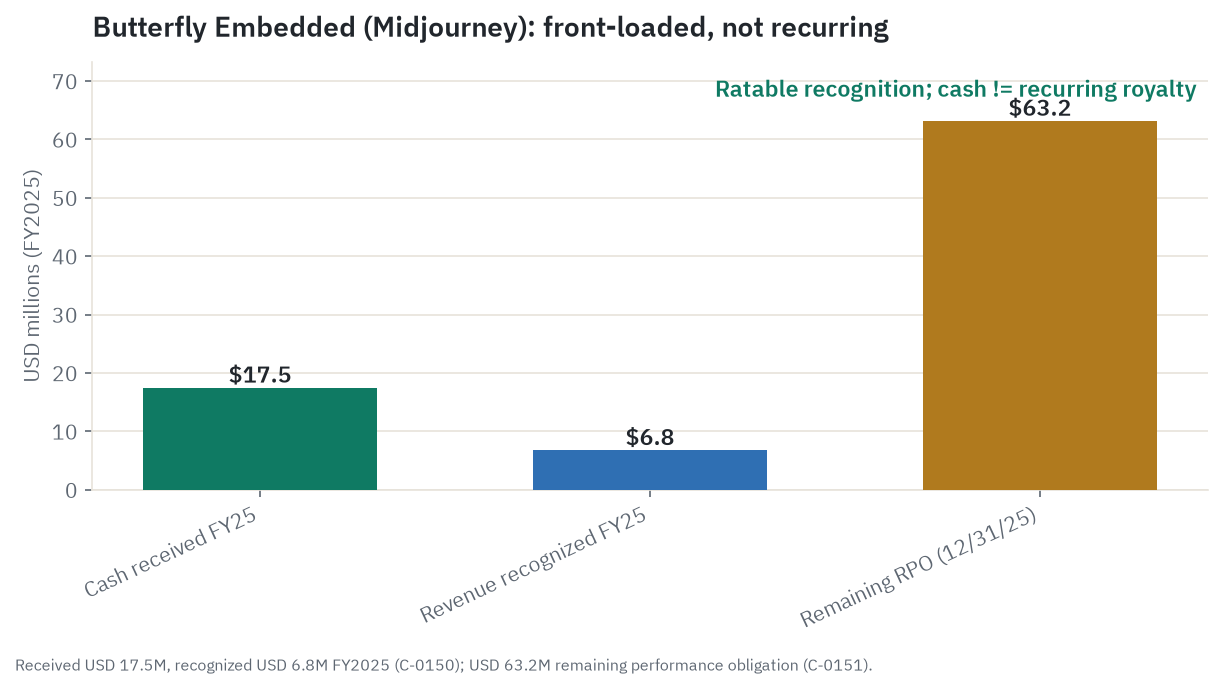
First, the accounting, because it is the crux. The Embedded line is front-loaded cash recognized ratably over time, not a recurring royalty stream. Under standard revenue accounting, Butterfly split the Midjourney deal into two performance obligations. The combined license-plus-co-development obligation (the $15 million upfront, the $10 million a year, and the milestones) is recognized over time as the development work is performed, not booked as a one-time upfront hit. The chip-purchase rights are recognized point-in-time, only when chips actually change hands. The numbers make the front-loading concrete: in FY2025 Butterfly received $17.5 million in cash from Midjourney but recognized only $6.8 million of revenue, deferring the rest. As of December 31, 2025, $63.2 million of remaining performance obligations tied to Midjourney sat on the books, expected to be recognized roughly 56 percent within a year and 44 percent after. That is contracted, multi-year, high-margin revenue. It is more durable than a one-off milestone. It is also capped at a five-year term and is not a perpetual royalty annuity. Do not let anyone tell you this compounds forever.
Second, the customer count. As of this research, the Embedded narrative rests on one customer. There is no second, non-Midjourney Embedded license to point to. The Q1 2026 Embedded line was $5.7 million, up 149 percent year over year, and it is the highest-margin dollar in the company, but it is one partner. Lose or impair Midjourney and the “second business” story is the “single-customer optionality” story. The thesis needs Embedded to become a platform. Today it is a contract.
Third, and this is the part the headlines skip, look hard at who that one customer is, because the dollars that actually scale Butterfly past the fixed license depend on Midjourney executing. The fixed pieces of the deal (the $15 million upfront, the $10 million a year, the milestones) get paid on the contract whether or not the scanner ever ships. The parts that turn Embedded into a real growth engine, the per-chip purchases and the revenue share, only show up if Midjourney builds, clears, and sells scanners at volume. So the relevant question is not “is the contract signed” but “can this particular maker pull it off.” Here is the balanced read.
The encouraging half. Midjourney is, by the reported figures, a serious and unusually well-funded company for a moonshot like this. It is a bootstrapped, profitable AI text-to-image business founded by David Holz and launched in 2022, with reportedly around $200 million of revenue in 2023 and an estimated $500 million of annual recurring revenue by May 2025, all on a small team (reported near 40 people, with the scanner reportedly built by about 9). Because it took little or no outside venture capital, it has its own cash to self-fund a long, slow hardware program without a board of VCs demanding a quick exit. The individual credentials are real too. Holz previously co-founded Leap Motion, an actual hardware company, and the medical-hardware effort is led by Ahmad Abbas, a former Apple Vision Pro hardware engineering manager. So there is money behind this, and there are people on the team who have shipped physical products before. (These financials are press and estimate figures on a private company, so treat them as reported, not audited.)
The discouraging half, which is larger. The Midjourney Scanner is the company’s first-ever hardware product and its first FDA-regulated medical foray. Midjourney has never built a physical product, never run a manufacturing line, and never operated a medical device. A subscription image generator and an FDA-regulated imaging machine share almost no operational muscle. The individual credentials do not fully close that gap either: Leap Motion was a commercial disappointment that eventually sold for about $30 million, and one ex-Apple manager is not a medical-device organization. The plan itself quietly defers the hardest part. The launch ducks FDA diagnostic clearance entirely by shipping as a non-diagnostic general-wellness product, with diagnostic clearances promised “incrementally over time.” The San Francisco clinic by end-2027 and the 50,000 scanners by 2031 are marketing targets, not commitments, and the prototype today runs about 20 minutes per scan against a 60-second goal.
Put plainly, the chip-buy and revenue-share dollars, the only part of this deal that scales Butterfly beyond a fixed five-year license, ride on a cash-rich but completely unproven medical-hardware maker clearing manufacturing, FDA, and reimbursement at the same time, on an imaging modality that does not yet exist as a cleared product. That is the single largest unhedged variable in the entire bull case. The contract is real and the upfront money is real. The growth is a bet on a first-time hardware company.
Unit economics and margins: can it actually make money?
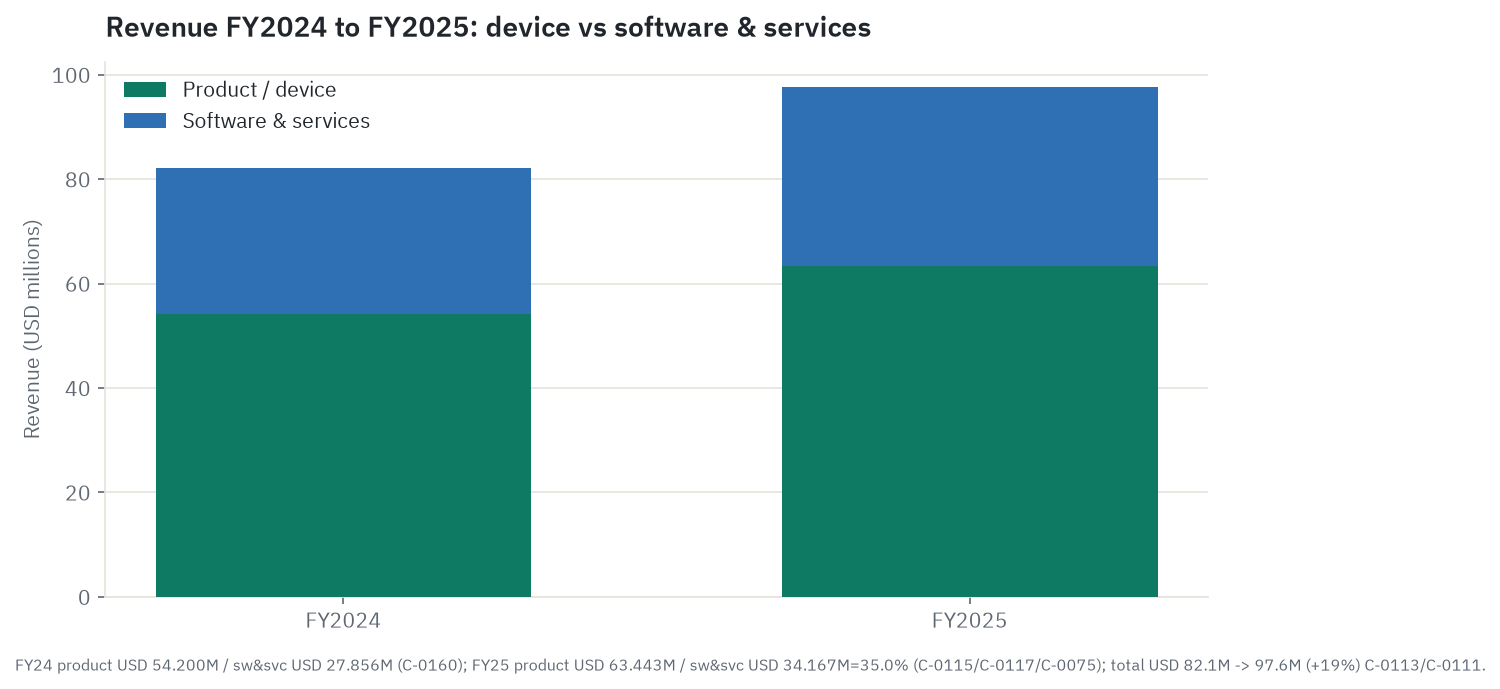
Start with the revenue build. FY2025 revenue was $97.610 million, up 19.0 percent from FY2024’s $82.056 million. The split is product $63.4 million and software and other services $34.2 million, with the software line growing far faster. In Q1 2026, revenue was $26.5 million (up 25 percent), and inside that, software and other services jumped 68.2 percent while product grew only 3.5 percent. The software surge is led by Embedded.
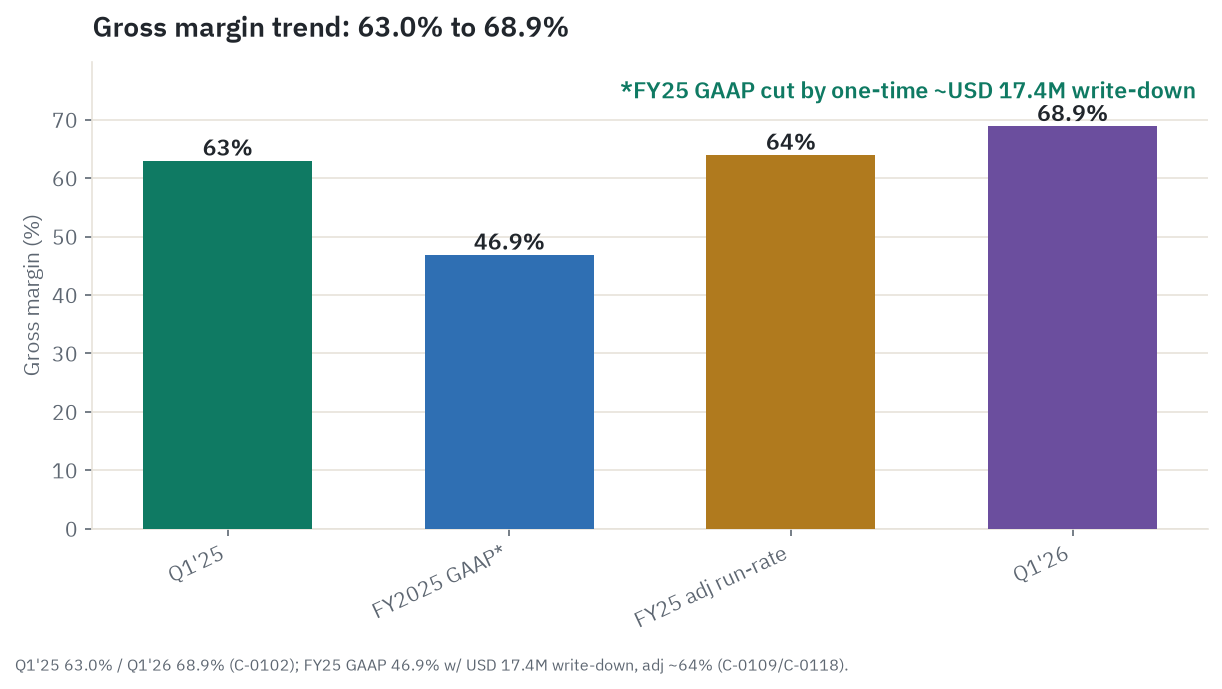
Now the gross margin, which is the heart of the profitability question. It moved from 63.0 percent in Q1 2025 to 68.9 percent in Q1 2026, a 590-basis-point jump. That is a mix story, not a pricing story. Two levers did the work: software and licensing went from roughly 33 percent of revenue to 45 percent, and Embedded, the fattest dollar, kicked in. One caution that is easy to miss: the FY2025 GAAP gross margin reads only 46.9 percent, but that number is distorted by a one-time $17.4 million write-down in Q3 2025 on obsolete prior-generation chips (a $7.975 million inventory write-down plus a $9.621 million vendor-advance write-down). Strip the one-time hits and the underlying margin is around 64 percent. So do not read 46.9 percent as the run-rate, and do not read 68.9 percent as a settled floor either, because it leans partly on a licensing line that is still concentrated in one partner.
The breakeven math is where the company’s own guidance and an honest model both say “not soon.” Management has named no breakeven date and explicitly guides FY2026 to an adjusted-EBITDA loss of $21 million to $25 million on revenue of $117 million to $121 million. Our own model, with opex held flat and gross margin held near the run-rate, puts adjusted-EBITDA breakeven at roughly $136 million to $142 million of revenue and true GAAP operating breakeven at roughly $179 million to $187 million, which is close to double today’s top line. These are estimates, labeled as such, built on flat-opex assumptions that will not hold exactly. The takeaway survives the assumptions, though. Adjusted-EBITDA breakeven is plausibly two to three years out at guided growth, somewhere around 2027 to 2028, if margin holds and cash opex grows slower than revenue. GAAP profitability is much further out, because stock-based compensation runs roughly $31 million a year and that wedge keeps the GAAP loss wide even as the adjusted number flatters. A retail reader should not confuse “adjusted-EBITDA positive” with “actually profitable.” On a generous path (22 percent revenue growth, opex up 8 percent a year), the model does not reach GAAP operating breakeven until past 2030.
The whole profitability case, then, is the mix-shift. With opex near flat, every 100 basis points of gross margin moves breakeven revenue by about $3 million, and the two ways to raise margin both point the same direction: sell more software per probe, and grow Embedded. If Embedded proves to be durable, contracted, high-margin revenue, the margin holds. If it turns out to be front-loaded payments from one partner that fade once the upfront and early milestones lap, the 68.9 percent reverts toward the low-to-mid 60s. The research resolves this partway: Embedded is contracted and ratable, which is good, but it is one customer and term-limited, which caps it.
The balance sheet and the runway
This is the part of the story that is unambiguously strong. At March 31, 2026, Butterfly held $137.954 million in cash and equivalents (about $142 million including $4 million of restricted cash), with no debt at all. The liabilities on the balance sheet are deferred revenue, leases, and payables, not borrowings. For a company that the market just treated like a distressed lottery ticket and then like an AI compounder in the same week, the actual balance sheet is boring in the best way.
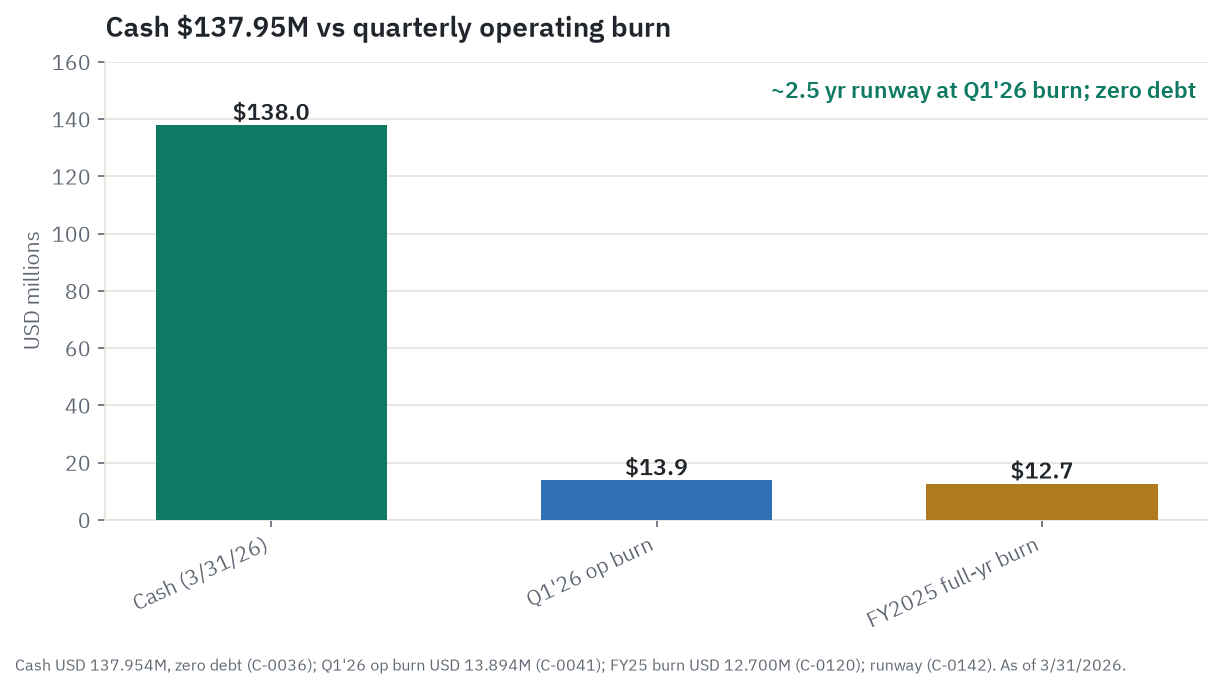
The runway depends entirely on which burn number you use, and the honest answer is a range, not a point. Q1 2026 operating burn was $13.894 million, which annualizes to about $55.6 million and implies roughly 2.5 years of runway. But FY2025 full-year operating burn was only $12.700 million (helped by a favorable working-capital swing), and FY2026 is guided to a $21 million to $25 million adjusted-EBITDA loss, so on a roughly $23 million annual proxy the runway stretches to 5 to 6 years. Management’s own framing is that cash plus operating cash flow is “sufficient for at least the next 12 months.” The safe read: debt-free, around $138 million of cash, comfortably funded near-term, with a runway that is wide but whose headline swings two to three times depending on the burn basis. Do not print a single runway number without stating which burn you used.
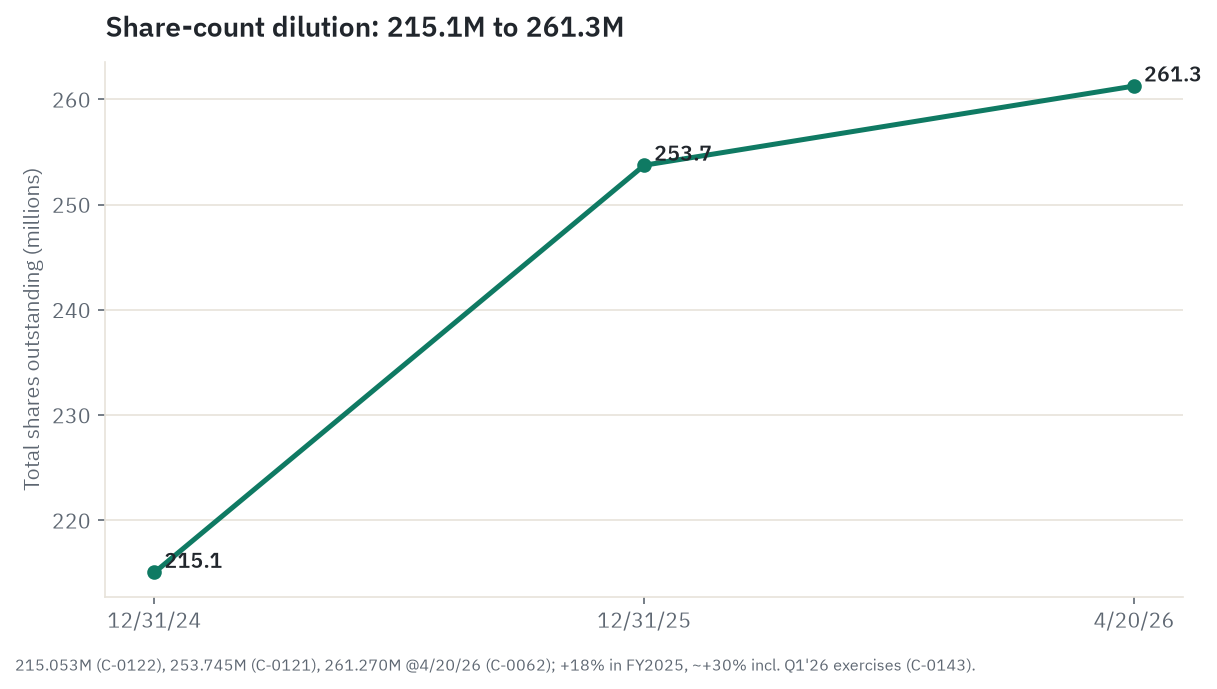
Then there is dilution, which is the cost of all that runway. Total shares (Class A plus a constant 26.4 million Class B) went from 215.1 million at year-end 2024 to 253.7 million at year-end 2025 to 261.3 million by April 20, 2026. That is +18.0 percent in FY2025, driven overwhelmingly by a single registered offering of 27,600,000 shares that raised $81.0 million net, plus routine RSU vesting and option exercises. Q1 2026 had no equity offering. The pattern is the treadmill that every pre-profit cash-burner runs on: issue equity to fund the burn, dilute holders, repeat.
On insiders, the simple “net seller” headline is misleading, and the Form 4 record is worth getting right. Over the trailing 12 months, BFLY insiders were net sellers in aggregate, but that figure is driven entirely by founder-director Jonathan Rothberg, who sold about $20.8 million of stock through his 4C Holdings entities, with every one of those sales filed under a Rule 10b5-1 plan (scheduled, programmatic selling, not a discretionary signal). CEO Joseph DeVivo made no discretionary sales at all; his only dispositions were automatic “sell-to-cover” sales to pay tax on vesting RSUs, and he concurrently received a 1.4-million-share grant. Excluding Rothberg, the insider group was a net buyer of about $5.9 million, led by director Larry Robbins buying roughly $11.5 million in the open market and another director adding about $0.57 million. So the honest line is not “insiders are dumping.” It is “the founder is selling on a schedule, and the rest of the boardroom, including a director writing an eight-figure check, was buying.”
The market and the demand pool
Two market numbers get quoted for Butterfly, and they are about ten times apart, so keep them separate. There is the broad point-of-care ultrasound market, which includes cart and trolley systems, sized around $4 billion to $4.5 billion in 2026 at roughly a 7 percent CAGR (GMInsights and Precedence Research converge there). And there is the narrow handheld-device arena, the probe-only and smartphone-tethered segment where Butterfly actually competes, which Grand View Research sizes at only about $0.3 billion to $0.4 billion. Butterfly’s $97.6 million of FY2025 revenue is roughly 2 percent of the broad market and a low-double-digit slice of the narrow one. Do not blend the two markets to make the opportunity look bigger than it is.
You will also see the “ultrasound becomes as common as the stethoscope for 40 million providers” framing. That is a unit ceiling, not a sized dollar market. The arithmetic gives it away: a fully saturated 40 million providers at even a $2,000 device plus $420-a-year software would be an $80-billion-plus hardware market, larger than any analyst’s entire POCUS estimate. The gap proves the 40-million number is an aspirational ceiling that assumes universal training and credentialing that does not exist today.
Reimbursement is the practical gate, and it is mixed. A POCUS exam is billed under standard diagnostic-ultrasound CPT codes (there is no special POCUS or handheld code), typically worth $50 to $300 per exam, which means a motivated office can recoup a roughly $2,000 device quickly. But to bill legitimately you need medical-necessity documentation, a structured report, and image archiving with five-year retention plus a quality process, and that workflow overhead is the single biggest practical barrier. Crucially, AI adds no incremental payment in 2026 per the emergency-physicians’ guidance: an AI-assisted POCUS study is reimbursed the same as one without AI. Emergency medicine is mature (ED availability rose from about 19 percent in 2014 to 52 percent by 2020). Primary care, the much larger pool, has barely started, gated by training and credentialing rather than by the device. So the demand story is real and structurally insulated from the hospital capital-equipment cycle (these are sub-$10,000 handhelds, below the approval threshold that snags million-dollar MRI machines), but it is a slow, reimbursement-gated adoption curve, not a step-change.
The macro backdrop is a genuine headwind for a stock like this. The Fed held its policy rate at 3.50 to 3.75 percent in June 2026 with a median dot pointing to 3.8 percent at year-end, which signals a possible further hike before any easing, and the 10-year Treasury sits near 4.44 percent. BFLY is the definition of a long-duration equity, because essentially all of its value is in profits years out, and a 4.4-percent-plus discount rate mathematically compresses the present value of those distant cash flows. The rate environment argues against, not for, a premium multiple. The one paradoxical silver lining: a high stock price makes dilution cheaper, so the run-up itself temporarily neutralizes the financing problem, but only while it lasts and only if management actually issues into the strength. That is circular, and a faded narrative reintroduces the dilution problem at a lower price.
Company by company: who’s who in POCUS
A caution before the names. Every public giant below makes a handheld POCUS device, but in each case handheld POCUS is a rounding error in the company’s revenue, so the giant’s market cap is not a clean comparable for Butterfly. You cannot value BFLY off GE HealthCare’s multiple, and you cannot imagine BFLY “catching” GE in this segment, because GE is not really trying. Butterfly is the only pure-play public POCUS-on-chip name. That is the reason the theme is hard to buy cleanly, and it is also part of why a single demo could move the stock 56 percent. All market caps are point-in-time, stamped to June 18, 2026.
The anchor
Butterfly Network (BFLY) - market cap around $2.33 billion. The pure-play. Whole-body handheld probes on a proprietary chip, plus cloud and AI software, plus the new Embedded licensing arm. The only public ultrasound-on-chip name. Bull: the only public pure-play on a defensible silicon design, with genuine Embedded optionality validated (loosely) by the Midjourney deal. Bear: one licensing customer, an undated breakeven, 22x sales against peers near 1.5x and roughly 56 percent above the analyst target, a chip moat that a well-funded rival is already attacking, and a scaling story that depends on that one customer (a first-time hardware maker) clearing manufacturing and the FDA at once.
The giants (POCUS is a rounding error for each)
GE HealthCare (GEHC) - around $28.0 billion. A diversified imaging giant; its handheld is the Vscan Air wireless probe, the best-known legacy handheld brand. GMInsights credited GE with leading POCUS at over 22 percent share in 2025. Bull: a trusted clinical brand with a global salesforce that can bundle handhelds into big enterprise imaging deals. Bear: POCUS is non-strategic inside roughly $19 billion of revenue, so GE will never push hard; but its salesforce and install base can still bury Butterfly in any account it decides to defend. The Vscan is piezoelectric, not chip-integrated, and innovates slowly.
Koninklijke Philips (PHG) - around $25.7 billion. Its handheld is Lumify, a well-regarded app-based probe that plugs into a phone or tablet. Bull: strong imaging heritage and a clinician-trusted, FDA-cleared handheld with broad probe options. Bear: Lumify is a tiny slice of roughly EUR18 billion of revenue, it is piezoelectric and tethered rather than chip-integrated, and POCUS is non-core amid Philips’ broader restructuring.
Siemens Healthineers (SHL on XETRA; SMMNY OTC) - around EUR38.4 billion, roughly $44 billion. Stronger in cart and premium ultrasound than in pocket handhelds; its handheld line is the Acuson Freestyle. Bull: deep ultrasound R&D and enterprise reach to cross-sell handhelds into hospital accounts. Bear: US access is only through a thin OTC ADR, and the handheld line is minor and piezoelectric.
Fujifilm Holdings / Sonosite (FUJIY OTC; 4901 Tokyo) - around $25.1 billion. Sonosite is arguably the most trusted POCUS brand in emergency and critical care, though it skews to rugged portable carts more than pocket handhelds. Bull: deep clinical loyalty in the ED and anesthesia. Bear: US access via OTC ADR, portable-cart rather than chip-handheld focus, and POCUS is non-core to Fujifilm.
Samsung Medison - not separately listed. A subsidiary of Samsung Electronics, delisted from the Korean exchange in 2011, stronger in OB/GYN and portable carts. There is no way to buy it as a pure-play, and the ticker that looks like it (006660.KS) is a different company entirely.
Shenzhen Mindray Bio-Medical (300760.SZ) - around CNY173 billion, roughly $24 billion. A large Chinese device maker whose TE Air wireless handheld targets the value and global-health segment. Bull: aggressive pricing and scale in cost-sensitive and emerging markets. Bear: a Shenzhen A-share that is hard for US retail to access, with a piezoelectric (non-chip) handheld and China and geopolitical risk attached.
The caveat above matters most when you put the multiples side by side. These giants trade near 1.5x sales because POCUS is a sliver of large, profitable businesses. Butterfly, post the June 18 spike, trades near 22.6x.
The private disruptors (where the real tech rivalry sits)
Exo Imaging - private, more than $300 million raised (including a $220 million Series C). This is the name that matters most for the moat argument. Exo’s Iris is also chip-based (a pMUT chip, a different micromachined approach from Butterfly’s CMUT), so it is the closest technical analog and a direct competitor for the same wedge. On the AI layer, the comparison is definitional and should be stated carefully. Exo markets 14 FDA-cleared AI indicators embedded in Iris (its own June 2025 count of individual indicators), while Butterfly holds 3 distinct Butterfly-owned cleared AI tools. By distinct AI-specific 510(k) submissions, Exo’s number is closer to 5 to 8. The two figures count different units, so the honest framing is that Exo is plausibly ahead on the cleared-AI layer, not that it has “undercut the moat” as settled fact. Either way, Exo is the disconfirmation of the “only credible chip POCUS” framing, and it is well capitalized.
Clarius Mobile Health - private, about $27 million raised. High-definition piezoelectric handhelds for specialties like MSK and aesthetics, reportedly profitable as of 2025. Why it matters: Clarius reached profitability on a fraction of Butterfly’s capital using piezo, not a chip, which is direct evidence that you do not need Butterfly’s silicon to make money in POCUS. That cuts against the moat premium.
EchoNous - private, about $194 million raised. Its Kosmos device is AI-guided and piezoelectric, competing more on the software-guidance layer than on silicon.
Vave Health - private, about $6.4 million raised. A low-cost piezoelectric wireless probe aimed at education and global-health access, competing on price at the exact “stethoscope for everyone” end of the market that Butterfly markets to.
One more honesty note that applies across this section: Butterfly is “widely cited” as the handheld unit-volume leader, but the precise share figure is unverified, and so are the POCUS shares attributed to the giants. Treat “number one in handheld” as a claim, not a fact.
Is the upside durable?
Pull the threads together and the durability question splits cleanly, which is usually the honest answer.
What is durable: the chip is a real asset, the device business grows around 20 percent, the balance sheet is clean with no debt, the margin mix is genuinely shifting toward higher-quality dollars, and the Embedded line is contracted and ratable rather than a one-quarter sugar high. None of that is fake, and none of it depends on the June narrative. A patient owner could hold this as a slowly improving medtech with a real installed base and an optionality kicker.
What is fragile: almost every load-bearing word in the bull thesis is a future event or a partner’s event, and worse, it is a partner’s event run by a partner that has never done this before. The Midjourney scanner is a prototype with no FDA clearance, a 20-minute scan, and a 2031 unit aspiration, and the maker behind it is a profitable but first-time hardware company attempting its first FDA-regulated device. Embedded is one customer, and the dollars that would make that customer matter (the chip buys and the revenue share) only arrive if that first-time maker clears manufacturing and the FDA at once. Breakeven is undated and, on GAAP, years out. The multiple is 12 to 17 times the peer group and roughly 56 percent above the analyst target, and it is a multiple borrowed from the AI-hardware sector and laid on a sub-$100-million-revenue medtech whose own fundamentals did not change in June. The chip moat protects a probe, not the market, and a well-funded chip rival (Exo) plus a profitable piezo player (Clarius) both show the segment can be contested without Butterfly’s exact silicon.
So is the boom durable? The business is. The June price is the fragile part. The most likely path is not a collapse and not a moonshot; it is that the squeeze fuel exhausts, the stock drifts back toward the medtech multiple its fundamentals support as the market re-applies a discount rate that argues against AI-hardware pricing, and the durable POCUS business keeps compounding underneath while Embedded stays a single-customer line until a second license appears. The thing to watch is not the next demo. It is the next equity raise (does management issue into strength), the next 10-Q (does the device base re-accelerate or is the licensing pop a one-off), and any second Embedded customer.
Companies to watch (bull / base / bear)
Butterfly Network (BFLY) - the only public POCUS-on-chip pure-play, post a 56 percent day, at roughly 22.6x sales.
- Bull: Embedded becomes a real second business beyond Midjourney as additional licensees sign, the core POCUS business reaches adjusted-EBITDA breakeven around 2027 to 2028, and the margin mix-shift toward software and licensing continues, justifying a premium-to-medtech (though not AI-hardware) multiple.
- Base: steady POCUS growth near 20 percent, Embedded is real but lumpy and front-loaded rather than a royalty annuity, dilution continues at a slower pace funded by a still-clean balance sheet, and breakeven on GAAP stays years out. The stock re-rates partway back toward the analyst target as the spike premium decays.
- Bear: Embedded stays a single, prototype-stage licensing relationship, Midjourney (a first-time hardware maker building its first FDA-regulated device) stumbles on manufacturing, FDA, or reimbursement so the chip-buy and revenue-share dollars never materialize and Butterfly is left with only the fixed five-year license, the 68.9 percent margin drifts back toward the low-60s as the mix sugar-high fades, the stock re-rates from 22x sales toward the high-single-digit multiple its fundamentals support (the consensus target near $5.70 implies roughly a third lower), and dilution resumes at a lower price as the narrative cools. The TSMC and Benchmark single-source fragility and competition from GE, Philips, and Exo sit underneath all of it.
- Watch: the next equity raise (size and price), post-June short-interest settlement (squeeze unwind or new conviction), the next 10-Q’s Embedded and device-base detail, any second Embedded license, and the Midjourney scanner’s FDA and ship-date progress.
Risk controls
Ranked roughly by how likely each is to bite in the near term, here is the honest risk stack.
- Valuation and momentum reversal. At 22.6x trailing sales, roughly 56 percent above the consensus target, on a move that had short-squeeze mechanics and settled short data only from before the spike, the single biggest near-term risk is simply that the narrative premium decays. The fundamentals did not change in June; the price did.
- Single-customer concentration plus maker-execution risk. Embedded is one customer, and that customer is the largest unhedged variable in the whole bull case. The fixed license gets paid regardless, but the dollars that scale Butterfly past it (chip purchases and revenue share) depend on Midjourney actually building and selling scanners. Midjourney is a profitable, cash-rich AI image company, but the scanner is its first-ever hardware product and its first FDA-regulated medical device. A first-time hardware maker has to clear manufacturing, the FDA, and reimbursement at the same time, on a novel imaging modality, for that revenue to appear. That is a lot of unproven execution stacked on one partner.
- Prototype, not product. The scanner has no FDA clearance, runs in about 20 minutes against a 60-second goal, launches first as a non-diagnostic wellness product that defers the hard FDA work, and its first clinic is targeted for late 2027. Treat any forward claim about it with Butterfly’s own forward-looking hedge.
- Dilution. Share count rose 18 percent in FY2025. The runway is wide but the company funds its burn with equity, so a faded narrative means raising at a lower price.
- Single foundry and single contract manufacturer. One fab (TSMC, where Butterfly is a small non-exclusive customer), one assembler (Benchmark, in one country), and a single-sourced transducer module. Any Taiwan-Strait or Thailand disruption hits the device business with no near-term route-around. The $17.4 million Q3 2025 write-down shows the hardware cost and inventory risk is live, not theoretical.
- Competition. Exo is chip-based and arguably ahead on cleared AI; Clarius reached profitability on piezo; the giants can defend any account they choose. The moat protects a probe, not the market.
- Reimbursement and adoption friction. No POCUS-specific CPT code, no incremental AI payment in 2026, and adoption gated by training, credentialing, and archiving workflow rather than by the device. The 40-million-provider TAM is a ceiling, not an addressable market.
- Regulatory and FDA. The 2020 “shipped without a cleared 510(k)” recalls are in the record, and the company’s whole pitch is AI velocity on top of the chip, which is exactly where that kind of execution error recurs.
What would change the thesis, in either direction: a second Embedded customer (bullish), a first contracted chip-buy order above the baseline (bullish), an FDA setback or a clinical-utility verdict against routine whole-body scanning (bearish), or an equity raise that resets the dilution and runway math (depends on price).
Methodology, sourcing, and data-quality flags
This piece was built from eight parallel research streams plus two targeted refills: the run-up catalyst, the supply chain, product and technology, financials and balance sheet, the market and reimbursement landscape, macro backdrop, micro and unit economics, the company comparables, a refill on the Embedded accounting, insider Form 4s, and FDA clearance counts, and a second refill profiling Midjourney itself as the maker behind the scanner. Every load-bearing figure traces to an entry in the run’s claims ledger with a source and a tier. The ledger holds 169 claims. The source hierarchy, in order of weight: primary (SEC filings (the FY2025 10-K, the Q1 2026 10-Q, the November 2025 and Q1 earnings 8-Ks), FDA openFDA enforcement and 510(k) records, Federal Reserve releases) for 98 claims; press (reputable trade and financial coverage) for 47; analyst (third-party market and multiple aggregators) for 10; and estimate (model-computed figures) for 14. By status, 125 claims are verified and 42 are unverified, with 2 still flagged disputed, where “unverified” mostly means a live market figure, a private-company estimate, or a model output rather than a contested fact.
Point-in-time note: every price, market cap, short-interest figure, and valuation multiple is stamped to the June 18, 2026 close ($8.90), the latest full trading day before the June 19 research date. These figures move fast and may be materially stale by the time you read this.
Data-quality flags:
- Live price, market cap, and multiple set (C-0051, C-0086, C-0099, C-0135, C-0138, C-0142, C-0143): press-tier or model-computed and time-sensitive. Market cap sources disagree on timing and share count (roughly $2.0 billion to $2.33 billion); the $2.33 billion figure uses the post-close share count. P/S of about 22.6x is computed on roughly $102.9 million TTM revenue and moves intraday with the price (it was about 14.5x at the pre-spike $5.71).
- The “$74 million over 5 years” Midjourney figure (C-0088): Butterfly’s own press-release aggregation, not a line in the 8-K. The component figures ($15 million one-time, $10 million a year, up to $9 million in milestones, plus revenue-share and chip purchases) are confirmed against the primary filing; the sum and the 50,000-unit / 2031 figures are company targets, not contracted volume.
- Embedded recognition (resolved): the disputed question of whether Embedded is recurring royalty or front-loaded was resolved against the FY2025 10-K. It is contracted, multi-year, front-loaded cash recognized ratably over time (FY2025: $17.5 million received, $6.8 million recognized, $63.2 million remaining performance obligation). It is not a perpetual royalty. The exact upfront-versus-ratable split of the Q1 2026 Embedded line is not separately disclosed.
- Breakeven model (C-0125, C-0126): estimate-tier, opex-flat assumptions. Adjusted-EBITDA breakeven of roughly $136 million to $142 million and GAAP operating breakeven of roughly $179 million to $187 million are modeled, not management figures. Management has committed to no breakeven date and guides FY2026 to a loss.
- Cash runway (C-0142): a computed range (about 2.5 years on Q1 operating burn versus 5 to 6 years on an adjusted-EBITDA proxy), shown alongside management’s “sufficient for at least the next 12 months.” No single “out of cash by” date is implied.
- Short interest (C-0096): about 13 percent of float, 5.5 to 7.2 days to cover, settled May 29, 2026, before the spike. Any squeeze is inferred from the setup and volume, not confirmed by post-event short data.
- Scanner specifics: the prototype is sourced as non-diagnostic, with no FDA clearance disclosed and a roughly 20-minute scan. Two further specifics that circulated (a “scanned about 12 people” count and a “body composition maps only” description) could not be confirmed to a primary source and are not stated here as fact.
- Segment gross margins (C-0127): hardware around 45 percent and software around 85 percent are internal modeling assumptions, not company-disclosed figures.
- Market sizing: estimates vary roughly tenfold by scope and house. The broad POCUS market (around $4 billion to $4.5 billion, GMInsights and Precedence) and the narrow handheld-device market (around $0.3 billion to $0.4 billion, Grand View) are kept separate and never blended.
- Peer P/S (C-0139): GE HealthCare 1.34x, Philips roughly 1.3 to 1.8x, Siemens Healthineers roughly 1.8x, from third-party aggregators (analyst-tier). Note that handheld POCUS is a rounding error in each giant’s revenue, so these are sector multiples, not clean POCUS comparables.
- Insider activity (C-0147 superseded by Form 4 detail): parsed from 38 EDGAR Form 4 filings. Net selling is driven entirely by founder Rothberg’s scheduled 10b5-1 plan; excluding him, insiders were net buyers of about $5.9 million, and the CEO made no discretionary sales.
- Channel-count and “Octave” naming: the roughly 8,960-channel figure is trade-press only and is treated as color, not fact. “Octave”/“Octiv” is the former name of the Embedded licensing unit, not a chip generation.
- Midjourney company profile (C-0161 to C-0168): every figure on the maker (the around $200 million 2023 revenue, the estimated $500 million ARR by May 2025, the profitability, the bootstrapped funding, the team size, and the founder and hardware-lead credentials) is press and estimate tier. Midjourney is a private company that files no financials, so none of these can be raised to a primary, filing-verifiable source; they are reported and attributed, not audited. The “first-ever hardware product / first FDA foray” framing is sourced to press (Engadget, The Next Web) and Midjourney’s own description. The wellness-label launch and the end-2027 clinic, 2031 fleet, and 2028 custom-silicon dates are Midjourney’s stated targets, not commitments. The one primary-tier item in this cluster is the Butterfly-Midjourney deal structure (C-0169), confirmed against Butterfly’s release and the referenced SEC filing.
Key sources: SEC EDGAR (BFLY CIK 0001804176) FY2025 10-K, Q1 2026 10-Q, and the November 17, 2025 and Q1 2026 8-Ks; FDA openFDA enforcement and 510(k) databases; the Federal Reserve June 2026 FOMC statement and SEP; stockanalysis.com, finviz, and MarketBeat for live price, market cap, short interest, and analyst targets; GMInsights, Precedence Research, and Grand View Research for market sizing; POCUS101, AAFP, and ACEP for reimbursement mechanics; Butterfly Network investor materials and product pages; and reputable trade press (TechTimes, MedTech Dive, MobiHealthNews, Benzinga, Investing.com) for the June 18 catalyst and competitor detail; and for the Midjourney maker profile, Contrary Research, Sramana Mitra, PYMNTS, Engadget, The Next Web, and Radiology Business (all press or estimate tier, with the deal terms cross-checked to Butterfly’s BusinessWire release and the referenced 8-K).
This document is OSINT research for educational purposes only and is not investment advice, not a recommendation, and not a solicitation. The author is not a financial advisor. All data is point-in-time as of June 18-19, 2026 and may be outdated; nothing here is guaranteed. Forward-looking statements are estimates or attributed third-party views, not promises. Do your own due diligence.