
Research date: July 2, 2026 | OSINT market research on RTX Corporation (NYSE: RTX), the aerospace-and-defense conglomerate behind Collins Aerospace, Pratt & Whitney, and Raytheon
Important disclaimer. This is OSINT-based research and educational analysis, not investment advice. I am not a financial advisor. Nothing here is a recommendation to buy or sell any security, and the scenarios below are illustrative, not price targets. Aerospace and defense names carry real cyclical, geopolitical, and contract-execution risk that can move a stock sharply in either direction. Market caps, prices, valuation multiples, and market-share figures are point-in-time (July 2, 2026), press-reported where noted, and move fast. Do your own due diligence and consult a licensed advisor.
Where this stock could be in 6 months, 1 year, 3 years, and 5 years
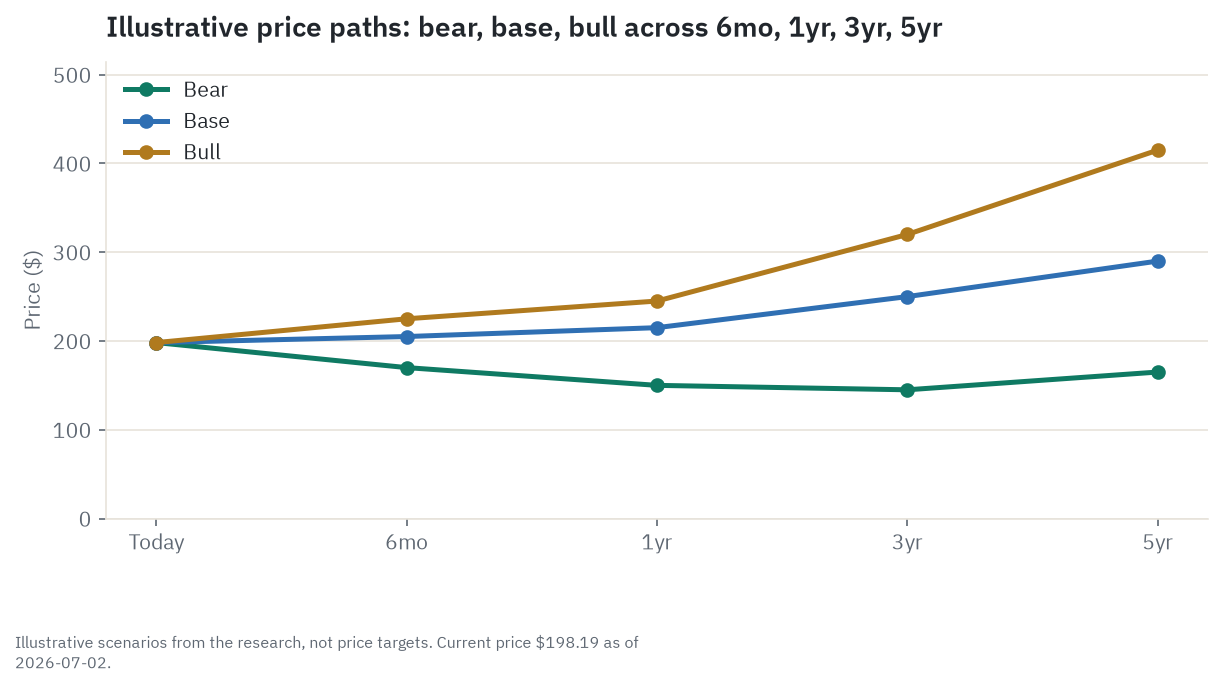
Six months out, the story is almost entirely about the next two earnings prints. RTX has beaten and raised its own guidance every quarter this year, and the question for Q3 and Q4 2026 is simply whether that streak continues, whether the Pratt & Whitney GTF recall’s cash cost stays on its guided path of roughly $0.7 billion for the year, and whether the political fight over how RTX spends its own cash (more on that shortly) stays a war of words rather than touching an actual contract. The bear case here runs to about $170, the base case to about $205, and the bull case to about $225. What flips this window fastest is a surprise, in either direction, on the recall’s cash bill or the capital-allocation dispute.
One year out, the dominant variable becomes whether RTX actually delivers the guidance it just raised (adjusted sales of $92.5 billion to $93.5 billion, adjusted earnings per share of $6.70 to $6.90) and whether Pratt & Whitney’s margin, still the thinnest of the company’s three segments, shows real improvement rather than just a bigger backlog. Bear case around $150, base case around $215, bull case around $245. A confirmed Pratt margin inflection would be the clearest sign the bull case is winning; a fourth straight year of elevated aircraft-on-ground counts would be the clearest sign it isn’t.
Three years out, the structural drivers start to matter more than any single quarter. Has the newer GTF Advantage engine become the production standard, roughly on the 2028 timeline management has pointed to. Has NATO’s pledge to lift defense spending toward 5 percent of GDP by 2035 kept converting into placed orders rather than slipping. Has Raytheon’s growing fixed-price contract book avoided its own version of the cost overrun that hit Northrop Grumman’s B-21 bomber program. Bear case near $145, base case near $250, bull case near $320.
Five years out, the question is durability: does RTX keep compounding on two genuinely different structural tailwinds at once, a decade-long NATO/allied rearmament cycle and a supply-constrained commercial-aerospace aftermarket, or does one of its open problems (the recall, the political overhang, a fixed-price cost blowup) leave a permanent scar on the multiple the market is willing to pay. Bear case around $165, base case around $290, bull case around $415. Every one of these numbers is an estimate built from stated assumptions, not a forecast to bank on.
Where the read lands today. On balance, the read holds at Hold: RTX is a genuinely strong, dual-engine business (defense plus commercial aftermarket) whose backlog and guidance both keep climbing, but the stock has already re-rated to capture most of that good news, and the GTF recall plus a live political dispute with its largest customer are real, unresolved drags, not settled ones. The single thing most likely to flip this read is Pratt & Whitney’s margin actually moving, in either direction.
Companion tool
Jump to the interactive dashboard to sort and filter every company in the piece, or download the Excel model to flex the scenarios yourself.
TL;DR
RTX runs two demand engines under one roof: a defense business (Raytheon, plus Pratt & Whitney’s military engines) riding a genuine, multi-year NATO/allied rearmament cycle with a decade still to run, and a commercial aerospace business (Collins Aerospace, plus Pratt & Whitney’s civil engines) riding the same supply-constrained aftermarket annuity that has made engine makers some of the best businesses in industrials. Both funnel into a record $271 billion backlog that is growing faster than revenue, and management just raised full-year guidance for the second time this year. The catch is that Pratt & Whitney, RTX’s fastest-growing segment, is also by far its thinnest-margin one, still working through the multi-year “Powder Metal Matter” recall on its geared turbofan engine, and in January 2026 the White House publicly named RTX and tied its access to defense contracts to how it spends its own cash, a live and unusual political overhang with no real precedent at this company. At roughly 36 to 37 times trailing earnings, the stock has already caught most of the good news the sell-side sees, which is why this reads as a strong company at a full price rather than a cheap one.
Explore it yourself: the interactive dashboard
Open the dashboard in a full screen
Two demand rivers, one balance sheet
Most companies in this business ride one cycle. RTX rides two, and they rarely move together. Picture two separate rivers feeding the same reservoir. One river is defense appropriations: the US Department of Defense’s budget, plus a fast-growing pool of allied and NATO budgets now explicitly aimed at 5 percent of GDP by 2035, flows through congressional and foreign-government approvals into Raytheon’s missile and air-defense systems and into Pratt & Whitney’s military engines, chiefly the F135 that powers every version of the F-35 fighter. The other river is commercial air travel: airlines and lessors ordering Airbus A320neo-family jets, a meaningful share of which fly on Pratt & Whitney’s geared turbofan engine, plus every jet, whichever engine it carries, needing Collins Aerospace content such as avionics, interiors, and flight controls.
Both rivers feed the same reservoir because RTX’s underlying economics are the same in both cases: sell the hardware near cost to win the placement, then spend the next twenty to thirty years collecting the real profit on spare parts, overhauls, and sustainment contracts. That is the classic razor-and-blade model of the jet-engine business, and RTX’s own backlog makes the point in hard numbers. Of the company’s $268 billion year-end 2025 backlog, Pratt & Whitney alone carried $151 billion, and roughly half of the entire company’s unfulfilled order book is long-term commercial-aerospace maintenance contracts sitting inside that one segment. The segment with today’s thinnest reported profit margin is also the one holding the single largest pool of locked-in future revenue.
A third, newer force now sits above both rivers: in January 2026, the sitting US president publicly named Raytheon as “the least responsive” defense contractor and tied continued Pentagon contract access to how RTX allocates its own capital between shareholders and production capacity. That makes the US government, RTX’s largest single customer at 38 percent of 2025 sales, simultaneously a regulator, a buyer, and now a vocal stakeholder in how the company spends its cash, a genuinely unusual arrangement worth tracking on its own, separate from the ordinary appropriations and program risk every defense contractor carries.
How the money flows
flowchart TD
    DOD["US DoD budget ~$1.0T+ FY2026 + NATO/allied budgets toward 5% GDP by 2035"]
    AIR["Airlines/lessors: Airbus A320neo family orders"]

    DOD --> RAY["Raytheon segment: Patriot, LTAMDS, Standard Missile, AMRAAM, Tomahawk"]
    DOD --> PWMIL["Pratt & Whitney military: F135 sole-source (F-35)"]
    DOD --> COLDEF["Collins Aerospace defense electronics/mission systems"]

    AIR --> ARFRM["Airbus A320neo: GTF vs CFM LEAP-1A duopoly"]
    ARFRM --> PWCOM["Pratt & Whitney commercial: GTF OE sale, thin margin"]
    AIR --> COLCOM["Collins Aerospace commercial: avionics, interiors, mechanical systems"]

    RAY --> BACKLOG["Record backlog $268B FY2025 ($161B commercial/$107B defense)"]
    PWMIL --> BACKLOG
    PWCOM --> BACKLOG
    COLDEF --> BACKLOG
    COLCOM --> BACKLOG

    BACKLOG --> AFTERMKT["Aftermarket annuity: Pratt backlog alone ~$151B, mostly long-term service"]

    AFTERMKT --> CASTINGS["Hot-section castings/forgings: Howmet + Precision Castparts (Berkshire)"]
    CASTINGS --> TITANIUM["Titanium/superalloys: ex-Russia VSMPO, now Howmet/ATI/TIMET/Aubert-Duval"]
    CASTINGS --> STRUCT["Structural castings/isothermal forgings: RTX-flagged ongoing constraint"]

    AFTERMKT --> CASH["RTX cash generation"]
    CASH --> RETURNS["Capital returns: dividend + buybacks"]
    CASH --> CAPEX["2026 capex raised $2.6B to ~$3.1B for missile capacity"]

    POLPRESSURE["Jan 2026: White House pressure on RTX capital allocation"] -.-> CASH
    POLPRESSURE -.-> DOD
Read the diagram top to bottom. Money originates in two places: government defense budgets at the top left, and commercial airline demand at the top right. Both flow down through RTX’s three segments into a single, shared backlog, which is the real chokepoint in this whole picture: once an order is booked, whether it is a Patriot missile contract or a new GTF engine sale, it converts into decades of aftermarket revenue rather than a single transaction. That aftermarket pool then funds a narrow, specialized supplier base underneath it (titanium, superalloys, precision castings and forgings) before the leftover cash flows back out as dividends, buybacks, and now a larger capital-expenditure program aimed at expanding missile production.
The newest wrinkle sits off to the side rather than inside the flow itself: the January 2026 political pressure on RTX’s capital allocation acts less like a supplier or a customer and more like a new set of hands trying to redirect the cash flowing out at the bottom of the diagram, back up toward production capacity instead of shareholders. It is drawn with a dotted line because, as of this research date, it has changed RTX’s stated capex plan but has not been shown to have touched an actual contract award.
The three businesses inside RTX: a field guide
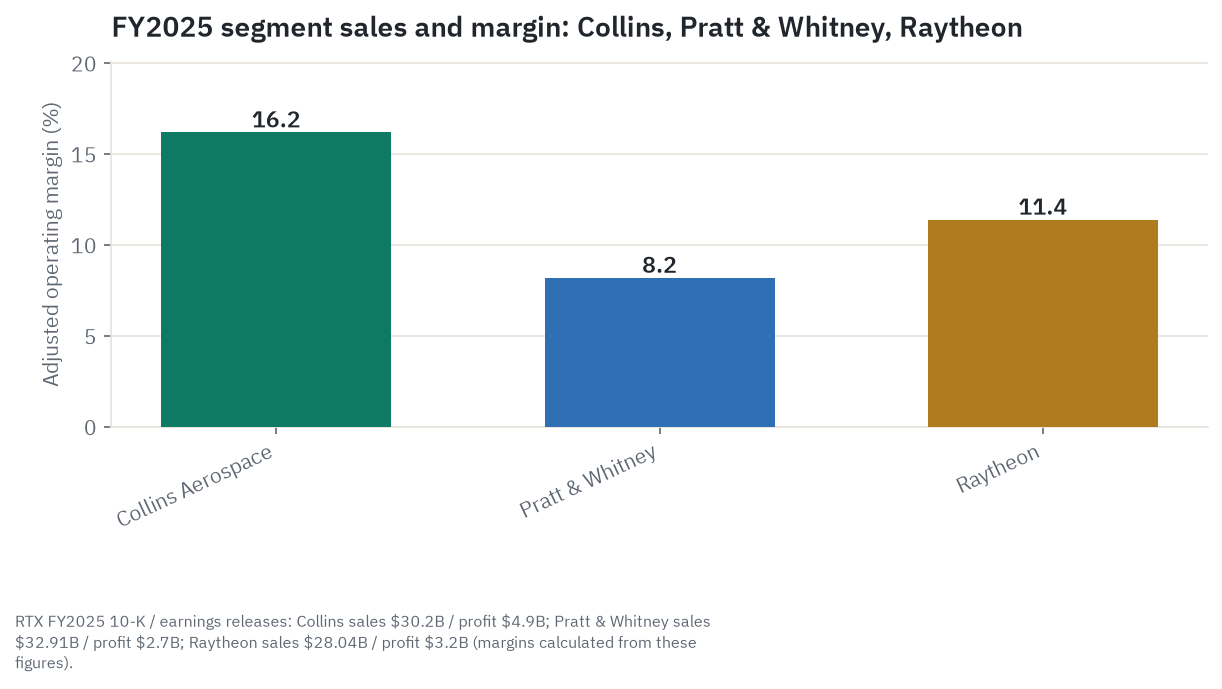
Collins Aerospace makes the parts every aircraft needs regardless of which engine it carries: avionics, environmental control systems, flight controls, engine nacelles, interiors, evacuation systems, and landing systems, sold both as new equipment to Boeing and Airbus and, far more profitably, as decades of aftermarket parts and repairs once the aircraft is flying. It posted FY2025 adjusted sales of $30.2 billion, up 9 percent organically, at roughly a 16 percent operating margin, the highest of RTX’s three segments and the closest thing to a mature, steady-state aftermarket business the company has.
Pratt & Whitney builds the GTF geared turbofan for the Airbus A320neo family and the F135 engine that powers every version of the F-35 fighter. It is RTX’s fastest-growing segment, with FY2025 adjusted sales of $32.9 billion, up 17 percent organically, but also its lowest-margin one at roughly 8 percent, a direct consequence of a multi-year engine recall described below and of the ordinary jet-engine practice of pricing new engines near cost to win the aircraft placement in the first place.
Raytheon makes air-and-missile-defense and precision-strike systems: Patriot, the newer LTAMDS radar, Standard Missile, AMRAAM, and Tomahawk, among others. FY2025 adjusted sales were $28.0 billion, up 6 percent organically, the slowest growth of the three segments but the fastest margin expansion, up 130 basis points to roughly 11.4 percent, even while carrying the most exposure of the three segments to fixed-price development-contract risk.
Layered underneath these three names is the fact that RTX sells to both the US government (38 percent of 2025 net sales) and international customers (47 percent), with Airbus alone at roughly 14 percent of total company net sales, down slightly from 17 percent in 2023. Concentration risk runs in both directions here: RTX depends on a small number of qualified titanium melters and casting/forging houses for the metal that goes into an engine or a missile, and at least one of those suppliers, Howmet Aerospace, depended on RTX for roughly 9 percent of its own third-party sales as of a 2020 disclosure, meaning the dependency is genuinely mutual at that layer of the chain.
Who wins where
Think of this industry in four layers, each with a different claim on the economics. Airlines and lessors carry the highest operating leverage and feel a downturn first, but RTX barely touches this layer directly. Airbus and Boeing capture new-aircraft-sale value but are themselves supply-chain-constrained, meaning RTX is a supplier into their economics, not a participant in them. The engine and systems makers, RTX’s own Collins and Pratt & Whitney, plus their competitors GE, CFM, and Rolls-Royce, capture the most durable value in the commercial half of the chain, because aftermarket revenue is tied to flight hours already flown on an existing fleet, not to new orders, which smooths and lags the swings an airline actually feels. Defense programs of record, Raytheon’s Patriot and missile lines and Pratt’s F135, capture a different but similarly durable kind of value: once a system becomes the program of record, a government’s own switching costs, requalifying an alternate supplier, sunk training investment, and interoperability requirements with allies, function much like an aftermarket moat even though the underlying contract mechanics are completely different from a commercial spare-parts business.
The one genuine asterisk on RTX’s moat is that Pratt & Whitney’s GTF is not sole-source the way Pratt’s own F135 is on the F-35. On the Airbus A320neo, the GTF competes head to head with CFM International’s LEAP-1A (a GE Aerospace and Safran joint venture), and trade-press estimates of the actual order split between the two are genuinely inconsistent, ranging roughly from 55 to 75 percent for LEAP depending on the source and period. The safest way to describe it is a real two-supplier duopoly in which GTF is the minority position, not a Pratt monopoly, which matters because it means Pratt’s slice of the growing narrowbody aftermarket pool depends on continuing to win a healthy share of new orders against a well-funded competitor, not on owning the platform outright.
Company by company: who’s who
RTX Corporation (RTX), the subject of this piece, is the world’s second-largest defense contractor by revenue behind Lockheed Martin, per Defense News reporting (a single-source figure, stated here as a widely-reported rank rather than a precise, independently confirmed dollar amount), and the only name in this peer set with a large, GE-comparable commercial-aerospace aftermarket business layered on top of a defense-prime business. Bull: three legs of demand, commercial aftermarket, elevated global defense spending, and a decade-long backlog, are all growing at once, and the GTF recall’s worst cash impact is fading. Bear: Pratt’s margin is still the thinnest of the three segments post-recall, and the January 2026 political pressure on capital allocation is a live, company-specific risk with no clean precedent.
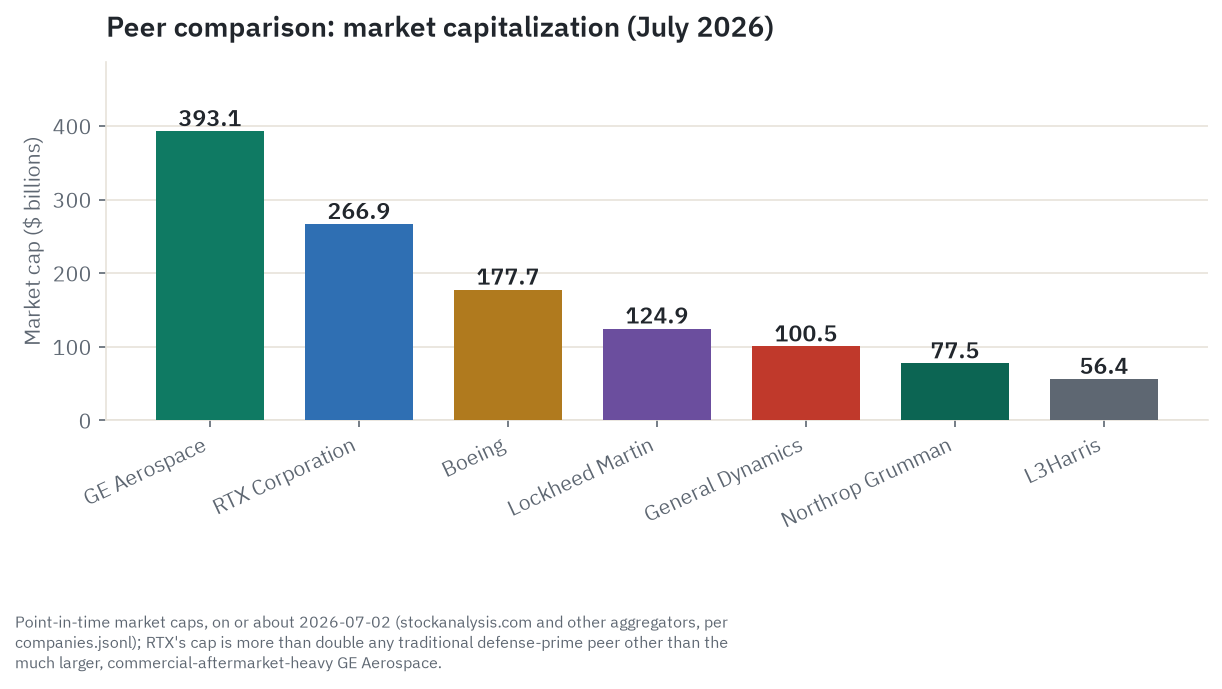
Lockheed Martin (LMT), market cap roughly $124.9 billion, is the world’s largest defense contractor by revenue and RTX’s closest scale peer, sole-source maker of the F-35 airframe that Pratt & Whitney’s F135 engine powers. Q1 2026 revenue was roughly $18.0 billion, about flat, with net earnings of $1.5 billion and earnings per share down to $6.44 from $7.28 a year earlier, on F-16 and C-130 program delays and F-35 deliveries falling to 32 units from 47. Bull: the deepest defense backlog in the group at $186.4 billion and the broadest program-of-record base, riding the same NATO and allied rearmament tailwind RTX does. Bear: the Q1 2026 earnings miss shows execution risk is real even for the largest prime, and softer F-35 deliveries directly affect Pratt & Whitney’s own F135 engine volume.
Northrop Grumman (NOC), market cap roughly $77.5 billion, is the smallest of the traditional Big Five primes by market value but holds the B-21 Raider next-generation stealth bomber program, a rare sole-source strategic asset. Q1 2026 sales rose 4 percent to $9.9 billion and operating margin expanded to 10.0 percent from 6.1 percent, helped by the absence of a prior-year loss charge, though the company still carried roughly $1.0 billion of remaining B-21 loss accrual as of March 2026. Bull: a February 2026 agreement added 25 percent more B-21 program capacity, a multi-decade, high-visibility program moving past its costly early-loss phase. Bear: that same loss accrual is the live, current-quarter proof that fixed-price development contracts can blow through budget in this exact industry, this exact year, a direct read-through risk to Raytheon’s own fixed-price programs.
General Dynamics (GD), market cap roughly $100.5 billion, is the most diversified name in the group, straddling naval shipbuilding (Electric Boat’s Columbia-class and Virginia-class submarines), business aviation via Gulfstream, and land systems. Q1 2026 revenue rose 10.3 percent to $13.5 billion with Electric Boat’s backlog surging 48 percent year over year to a record $131 billion, while Gulfstream delivered a first-quarter-record 38 jets. Bull: the submarine backlog reflects the same allied naval rearmament tailwind RTX rides on the missile side, while Gulfstream gives a business-jet cycle RTX does not have. Bear: Electric Boat’s growth still depends on execution across multiple shipyards inside a notoriously slow, cost-overrun-prone shipbuilding industrial base.
L3Harris Technologies (LHX), market cap roughly $56.4 billion, is the smallest pure-play defense-electronics name in the group but has posted ten consecutive quarters of margin expansion, reaching 15.7 percent in Q1 2026 on revenue of $5.74 billion, up 12 percent. Bull: ten straight quarters of margin expansion is a rare, hard-to-fake operational signal in a peer group where fixed-price cost overruns are a live risk elsewhere. Bear: its smaller scale means less diversification if any single program, or its pending Munitions Acceleration Council order pool, slips or shrinks.
GE Aerospace (GE), market cap roughly $393.1 billion, more than RTX’s entire market value despite being roughly a pure engine-and-services business, is Pratt & Whitney’s direct competitor on the A320neo (LEAP-1A versus GTF) and the dominant engine supplier on Boeing’s 737 MAX, where Pratt has no competing program at all. Q1 2026 revenue rose 25 percent to $12.39 billion with orders up 87 percent and a backlog of $211.3 billion. Bull: a cleaner, higher-margin, pure-play aftermarket story than RTX’s three-segment mix, without RTX’s GTF-recall drag. Bear: GE has its own supply-constrained LEAP delivery ramp and is just as exposed to a Boeing/Airbus production-rate slowdown as Pratt & Whitney is. (See the companion deep dive on GE Aerospace for the full engine-side comparable.)
The Boeing Company (BA), market cap roughly $177.7 billion, is simultaneously a Collins Aerospace customer (Collins content flies on nearly every Boeing jet) and, on other programs, a defense competitor and partner to Raytheon and Lockheed. Q1 2026 commercial deliveries rose 10 percent to 143 aircraft, 114 of them 737 MAX jets, lifting commercial airplane segment revenue 13 percent to $9.2 billion. Bull: a 737 MAX production-rate ramp is a direct demand lever for Collins Aerospace content sales, even without a GTF angle on that specific airframe. Bear: Boeing’s own certification and production delays, including the 787 program and the MAX 7/10 variants slipping into 2027, are a swing factor on Collins Aerospace shipment timing that RTX does not control.
What the filings say
RTX’s FY2025 results, drawn from its Form 10-K and year-end earnings release, show a company whose headline numbers keep improving even as one segment’s profitability lags. Adjusted sales reached $88.6 billion, up 11 percent organically, with adjusted earnings per share of $6.29, up 10 percent. On a GAAP basis, net income attributable to shareowners was $6.73 billion and diluted earnings per share were $4.96, meaningfully below the adjusted figure because of acquisition-accounting amortization and other non-GAAP add-backs typical of RTX’s reporting since the 2020 Raytheon-United Technologies merger. Free cash flow was $7.9 billion, up $3.4 billion year over year.
Q1 2026 kept the momentum going: total sales of $22.1 billion, up 9 percent reported and 10 percent organic, with adjusted earnings per share of $1.78, up 21 percent, and adjusted segment operating profit of $2.9 billion, up 14 percent. By segment, Collins Aerospace posted $7.6 billion in sales (a figure recorded two ways in the sources gathered here, up 5 percent reported versus up 10 percent organic, both plausibly true depending on foreign-exchange and divestiture treatment) and adjusted operating profit of $1.298 billion, up 6 percent. Pratt & Whitney posted $8.173 billion in sales, up 11 percent, and adjusted operating profit of $711 million, up 21 percent. Raytheon posted $6.945 billion in sales, up 10 percent, and adjusted operating profit of $845 million, up 25 percent, the fastest profit growth of the three segments in the quarter.
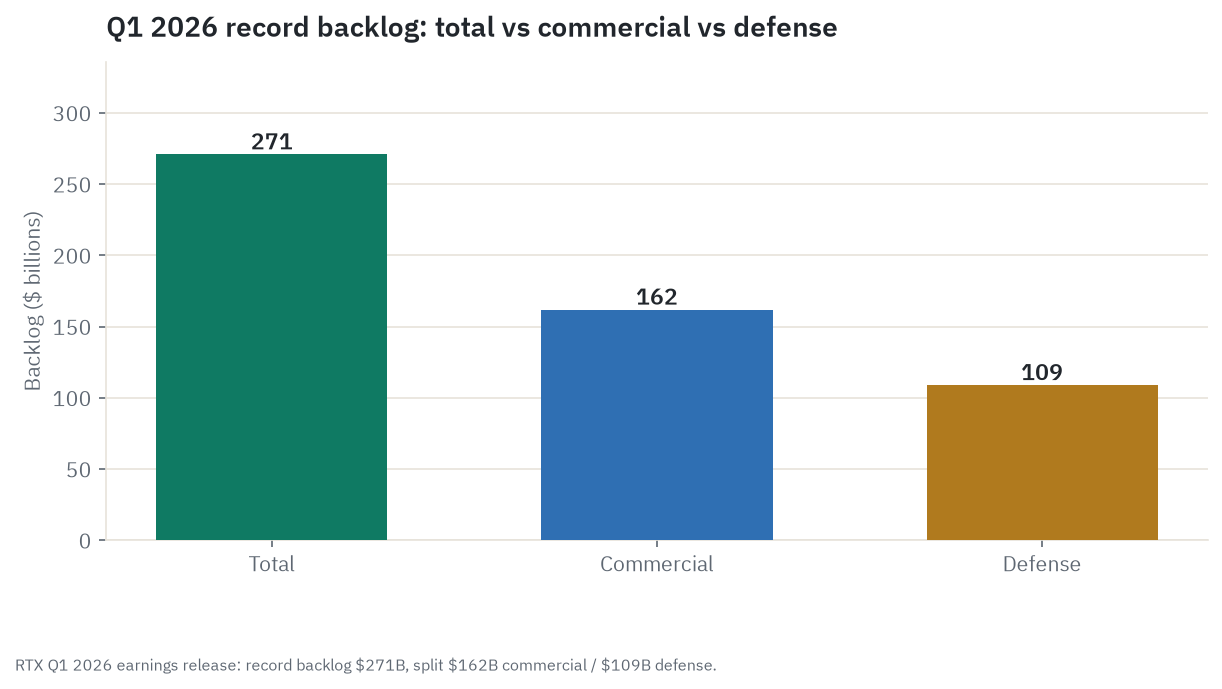
The backlog is the clearest number in the entire filing set. It hit a record $271 billion in Q1 2026, split $162 billion commercial and $109 billion defense, up from $268 billion at year-end 2025 (itself up 23 percent from $218 billion a year earlier), on a FY2025 book-to-bill ratio of 1.56. By segment at year-end 2025: Collins $42 billion, Pratt & Whitney $151 billion, Raytheon $75 billion. Roughly a quarter of the total is expected to convert to revenue within twelve months, and roughly half of the entire company’s backlog sits inside Pratt & Whitney’s long-term commercial maintenance contracts specifically, the clearest single number behind the aftermarket-annuity thesis.
Management raised guidance for the second time this year. Initial FY2026 guidance, given alongside the Q4 2025 results in late January, called for adjusted sales of $92.0 billion to $93.0 billion and adjusted earnings per share of $6.60 to $6.80. After the Q1 2026 beat, management raised that to adjusted sales of $92.5 billion to $93.5 billion and adjusted earnings per share of $6.70 to $6.90, while holding the free-cash-flow range at $8.25 billion to $8.75 billion, a modest, not sweeping, upward revision one quarter into the year.
The balance sheet carries manageable leverage for a company this size. At year-end 2025, total debt was $39.5 billion against cash of $7.4 billion, implying net debt of roughly $32.1 billion against a market capitalization of roughly $267 billion. A secondary source described debt-to-total- capitalization as improving from 2024 to 2025, but that specific percentage trend was not independently cross-checked against the underlying filing in this research pass and is not stated here as a confirmed figure. The board raised the quarterly dividend to $0.73 per share in April 2026, a 7.4 percent increase and the sixth consecutive year of increases, while RTX also raised its planned 2026 capital expenditure from $2.6 billion to roughly $3.1 billion, about a 20 percent increase, to expand production capacity for Standard Missile, AMRAAM, Tomahawk, and Patriot systems, a response to the political pressure described below.
The GTF “Powder Metal Matter” is RTX’s single largest disclosed operational event of the past several years. Disclosed in mid-2023, a rare condition in the powder metal used to manufacture high-pressure turbine and compressor discs in the PW1100G-JM engine required an accelerated inspection and part-replacement program across the fleet. The original charge was roughly $2.9 billion to $3.0 billion in pre-tax operating profit, plus a $5.4 billion reduction to net sales in the same quarter, for a net income impact of about $2.2 billion and a $1.55 hit to that year’s diluted earnings per share. Total gross remediation cost across the whole program has been estimated at $6 billion to $7 billion over several years. Between 600 and 700 engine removals occurred from 2023 through 2026, roughly 27.2 percent of the fleet at the time, with an average of roughly 350 A320neo-family aircraft grounded from 2024 through 2026 and a peak of 600 to 650 aircraft grounded in the first half of 2024. RTX estimates the 2026 cash impact at roughly $0.7 billion from customer credits and partner-recovery timing (a separate, press-reported figure put the 2025 cash impact at $1.1 billion to $1.3 billion, a number this research could not cleanly reconcile against the 2026 estimate, so both are stated here with their own years attached rather than merged into a single trend). RTX continues to guide to elevated aircraft-on-ground levels through 2026. The newer GTF Advantage variant enters service in 2026 and is expected to become the production standard by around 2028.
Disclosed risk factors that matter most: fixed-price development contracts, which RTX’s own filings note cover work “that has not been done before” and carry real cost-overrun exposure (the same mechanism behind Northrop Grumman’s B-21 loss charge); the GTF’s status as one of two engine choices on the A320neo rather than a sole-source position; customer concentration, with Airbus at roughly 14 percent and the US government at 38 percent of 2025 net sales; the ongoing Powder Metal Matter cash and aircraft-on-ground overhang; and the new, RTX-specific political pressure on capital allocation described next. A further, longer-dated risk is that Pratt & Whitney’s F135 sole-source position on the F-35 is durable on today’s fleet but not guaranteed to extend to the next fighter generation, where GE Aerospace holds a competing, similarly funded prototype contract for the Next Generation Adaptive Propulsion engine.
What the market is paying
RTX last traded at $198.19 (July 2, 2026, per one aggregator’s 3:06pm ET read), up 3.34 percent on the day; a separate, earlier-in-the-day read from a second source showed $188.29, up only 0.51 percent. The two reads span the same trading session at different times, and while no single confirmed news catalyst for a move of that size was found in this pass beyond a surge in July $200 call-option activity, the size of the spread is large enough to flag rather than resolve silently. Market capitalization is roughly $266.9 billion on roughly 1.35 billion shares outstanding. The 52-week range is $142.96 to $214.50, meaning the stock sits roughly 87 percent of the way up its own range, well off its high but far above its low.
Precise multi-year total-return figures could not be corroborated across two independent sources in this research pass and are not stated as hard percentages here; directionally, press reporting places the trailing one-year gain above 60 percent even after a reported mid-single-digit pullback earlier in 2026. Measured volatility is unusually low for a large-cap defense-and-industrial name: a five-year beta of roughly 0.30, corroborated identically across two separate data vendors, though a figure low enough relative to typical intuition that a third, ideally terminal-sourced check would be the ideal final word on it. Three-month realized volatility was separately reported around 29.2 percent annualized in late June 2026 from a single press source.
Valuation sits at a premium to the broad market, but at the cheaper end of RTX’s own aerospace-and-engine peer set. Trailing price-to-earnings reads roughly 36 to 37 times (two vendors read 35.98x and 37.19x, a small, ordinary variance rather than a genuine disagreement), forward price-to-earnings roughly 26 to 28 times, and the price-to-earnings-growth ratio roughly 2.5 to 2.7 times, above 1 and therefore not obviously justified by the growth rate alone, though that ratio is a blunt tool for a company with RTX’s mix of cyclical commercial aftermarket and long-duration defense backlog. The dividend yield runs between roughly 1.37 percent and 1.46 percent depending on the exact quote timestamp, consistent with the $0.73 quarterly dividend on a stock trading in the high $190s to low $200s. Against GE Aerospace, the closest thing to a pure commercial-engine comparable to Pratt & Whitney specifically, RTX’s ~36-37x trailing multiple looks comparatively reasonable next to GE’s roughly 46 times, though the two companies are not a clean apples-to-apples comparison given RTX’s much larger defense mix. RTX’s market cap of roughly $267 billion is more than double any traditional defense-prime peer (Lockheed Martin, at roughly $125 billion, is the next-largest), reflecting its unique position as the only name in the group with a GE-comparable commercial aftermarket business layered on top of a defense-prime business.
Liquidity is deep and short interest is low. Average daily volume runs roughly 5.2 million to 5.4 million shares on a roughly 1.35-billion-share float, easily tradable in size, and short interest sits at only roughly 1.4 percent to 1.5 percent of float, consistent with a name the sell-side broadly likes rather than one attracting meaningful bearish positioning. Sell-side consensus is a Buy rating, with price targets clustering between $202 and $216 across sources, implying roughly 6 percent to 9 percent upside from the current quote. Read plainly, the sell-side likes the RTX story and sees modest, single-digit upside from here, a “the market has mostly caught up to the good news” signal rather than a “deeply undervalued” one. A notable spike in July $200 call-option volume, 15,505 contracts traded against just 165 prior open interest on July 2, 2026, implies meaningful short-dated bullish positioning on the stock clearing $200, a speculative signal worth naming but not a fundamental one.
What the crowd is saying
Two narratives are running through 2026 coverage of RTX at the same time, and they pull in opposite directions. The first is straightforwardly bullish: a Q1 2026 beat, raised guidance, and a record $271 billion backlog, built from real, named contracts including a $3.7 billion German-funded Patriot interceptor deal for Ukraine and continued NATO rearmament tied to the 2035 spending target. Trade press treats Raytheon’s missile business as one of the clearest beneficiaries of the post-2022 European rearmament cycle.
The second narrative is a genuinely unusual political story. On January 7, 2026, President Trump posted publicly that Raytheon had been “the least responsive” defense contractor to Pentagon needs and threatened to restrict RTX’s contract access unless the company redirected capital from dividends and buybacks into US manufacturing capacity. RTX shares fell on the news. The company’s response, raising planned 2026 capital expenditure by roughly 20 percent for missile production while stating it remains committed to its dividend, reads as an attempt to satisfy the production-capacity demand without conceding on shareholder returns. No confirmed contract cancellation or enforced buyback suspension had been found as of this research date; this is a live, unresolved situation, and it is the single most idiosyncratic, company-specific sentiment driver in this research pass, distinct from ordinary sector-wide political noise.
The narrative and the fundamentals do not always move together, and that gap is worth naming explicitly. Q1 2026 earnings coverage carried a “beat but stock fell” framing: shares reportedly declined more than 3 percent on an earnings day where revenue and adjusted profit both beat consensus, attributed by several outlets to tariff and geopolitical concerns rather than anything in the results themselves. Separately, a March 2026 skeptic- side piece (Forbes) flagged GTF recall costs, possible longer-term commercial share erosion to CFM’s LEAP, Raytheon fixed-price margin risk, and a current ratio near 1.03x (current assets barely exceeding current liabilities) as reasons for caution, alongside a price-to-earnings figure of roughly 41.9 times that does not match other trackers’ roughly 35.9 times figure from around the same window, a reminder that even seemingly hard valuation numbers vary by source and method for this name.
Retail chatter on Stocktwits has swung between “bullish” and “extremely bullish” with high message volume at various points in 2026, notably spiking around political defense-spending headlines, and one piece explicitly framed both Lockheed Martin and RTX as facing “retail skepticism” ahead of earnings, suggesting sentiment toward the traditional defense names runs more cautious and valuation-conscious than the pure momentum chatter seen around some other 2026 market names. No evidence of coordinated pump-and-dump activity or thin-float hype was found; RTX is a roughly $267 billion, 1.35-billion-share mega-cap, a poor structural fit for that kind of manipulation. On the employee side, RTX rates 3.8 out of 5 on Glassdoor across 7,787 reviews, with 75 percent of employees saying they would recommend the company to a friend, a touch below GE Aerospace’s 4.1 rating found in the companion research on that name, directionally consistent with RTX’s more mixed 2026 news flow.
The sharpest, most durable open question found in this research is not really a market-sentiment question at all: whether the January 2026 political pressure on RTX’s capital allocation resolves quietly, as the capex increase suggests the company is hoping, or escalates into something that actually touches contract awards or the dividend. That is a genuinely unresolved situation as of the research date and deserves its own line in any risk assessment, separate from the more conventional recall and fixed-price risks below.
How durable is this: the structural case, and the real cyclical risk
The structural case for RTX rests on two independent tailwinds that rarely fail at the same time. Global military expenditure rose to a record level in 2025, the eleventh consecutive annual increase, pushing the global military burden to its highest share of world GDP since 2009. European defense spending alone rose 14 percent year over year, and NATO’s own March 2026 report noted that, for the first time, every member Ally met or exceeded the alliance’s 2 percent of GDP target, with European Allies and Canada collectively raising spending 20 percent in a single year. The June 2025 Hague summit commitment to reach 5 percent of GDP by 2035 (3.5 percent core military spending plus 1.5 percent broader security spending) is a real, multilaterally agreed policy shift with a full decade to run and a 2029 formal review checkpoint, not a one-year appropriations bump. Meanwhile, the commercial side rides the same structural logic as any engine-and-aftermarket business: a large, still-growing installed base of flying aircraft generates decades of billable maintenance revenue regardless of how many new aircraft get ordered in any given year, and both GTF and its LEAP competitor are today constrained by Airbus’s own production capacity, not by airline demand.
Think of it like owning both a toll booth on a highway that keeps adding lanes and a subscription business whose customers already signed multi-decade contracts. The toll booth is defense: money keeps arriving as governments widen their own spending commitments over a full decade. The subscription is commercial aftermarket: once an airline buys an engine, the maintenance revenue is contracted in for the life of that engine, regardless of whether that airline orders another new aircraft next year.
The real cyclical case is that neither river is immune to reversal, and RTX layers a company-specific risk on top of both. A recession, a pandemic-scale shock, or a sustained regional conflict cutting flight hours would soften Pratt & Whitney’s and Collins Aerospace’s aftermarket revenue with a lag, exactly as it would for any aftermarket-heavy engine maker. The defense side, while currently strong, is not immune either: the NATO 5 percent target is a pledge, not appropriated money, and a change in the security environment currently driving the buildup, a Ukraine ceasefire, a de-escalation of Middle East tensions, or a shift in Indo-Pacific posture, could slow the pace of actual budget increases well before the 2029 review checkpoint. And RTX carries a bear-case risk its peers largely do not: the January 2026 political pressure on its capital allocation and production pace is an idiosyncratic, company-specific overhang that could, in a worse scenario, actually touch contract flow from RTX’s single largest customer, a risk with no clean historical precedent at this company to size against.
The most likely outcome, on the evidence gathered here, is continued, if uneven, growth across both halves of the business, with the near-term swing factors being how the political dispute resolves and whether the GTF recall’s remaining cost tail fades on the schedule management has guided to. RTX’s defense-side demand looks more structurally durable over a three-to-five-year horizon than its commercial-side demand, because the NATO/allied commitment has a full decade to run and is backed by explicit multilateral targets, while the commercial aftermarket cycle, though real and currently supply-constrained, remains subject to the same eventual air-pocket risk every aviation cycle has faced before.
The scenarios in detail
The driver tree. Four variables decide where RTX actually lands over the next five years: whether Pratt & Whitney’s margin genuinely climbs from today’s roughly 8 percent toward Collins’ mid-teens as the recall fades and GTF Advantage matures; the pace at which NATO and allied members actually convert their 5-percent-of-GDP pledge into placed orders; how the January 2026 political dispute over capital allocation resolves; and how much longer the commercial-aerospace cycle stays supply- rather than demand-constrained.
Bull
Pratt & Whitney’s margin climbs from roughly 8 percent toward the low teens as GTF Advantage becomes the production standard around 2028 and remediation costs finish fading. NATO members keep pace with the 5 percent pledge or come close, next-generation programs like Golden Dome convert from prototype into real production dollars, and the political dispute cools into a routine capex-for-access arrangement rather than escalating. Under these assumptions, adjusted earnings per share compounds at roughly 12 percent a year off the FY2026 base and the market gradually re-rates the stock’s multiple toward the high 20s to low 30s, closer to (though probably still below) GE Aerospace’s premium. Applying that kind of multiple to a compounding earnings base yields the roughly $320 (three-year) and $415 (five-year) levels shown in the chart above, an estimate, not a target. What has to be true: Pratt’s margin has to actually move, not just the backlog. If GTF Advantage’s maturity timeline slips, or CFM’s LEAP keeps winning the clear majority of new A320neo orders, this scenario does not happen on schedule.
Base
The recall’s cash cost keeps fading roughly on RTX’s own guided path, NATO spending grows but with the normal slippage against the pledged pace, the political dispute persists as a background irritant that costs RTX some capital-allocation flexibility without touching actual contract awards, and Raytheon’s fixed-price book avoids a Northrop-style loss charge. Under these assumptions, adjusted earnings per share compounds at roughly 8 percent a year, in line with the FY2026 guidance midpoint’s implied growth and the backlog’s 1.56 book-to-bill, with the multiple holding close to today’s roughly 27 times. That yields the roughly $250 (three-year) and $290 (five-year) levels above, again an estimate. This scenario breaks if either the recall or the political dispute turns from a manageable drag into an acute one.
Bear (anchored on the strongest disconfirming case)
The GTF recall’s cost tail runs longer than guided into a fourth consecutive elevated year, Pratt’s margin stays stuck in the high single digits, a Raytheon fixed-price program overruns its budget the way Northrop Grumman’s B-21 did, and the political dispute escalates enough to genuinely constrain capital allocation or introduce friction in contract awards, while a commercial demand air-pocket softens the aftermarket side at the same time. Under these assumptions, adjusted earnings per share is roughly flat to down for several years while the multiple compresses toward the defense-prime peer set’s lower level, high teens to low 20s, as the premium the market currently pays for RTX’s dual-cycle story unwinds. That yields the roughly $145 (three-year) and $165 (five-year, a modest recovery as the recall eventually resolves even here) levels above. This scenario does not require all four bad outcomes at once, just two or three of them landing together: Pratt’s margin failing to move, the political dispute touching an actual contract, a fixed-price overrun at Raytheon, or a commercial demand shock are each, on their own, sufficient to drive this outcome.
Catalysts and timeline. Near term: Q3 and Q4 2026 earnings, any Federal Register or DoD announcement on the capital-allocation dispute, further Golden Dome prototype-to-production decisions ahead of a 2028 demonstration target, and monthly Airbus/Boeing delivery data for GTF-versus-LEAP order trends. Multi-year: GTF Advantage becoming the production standard around 2028, NATO’s 2029 progress review on the 5-percent pledge, and the F135’s exposure to the Next Generation Adaptive Propulsion competition for whichever fighter eventually succeeds the F-35.
Leading indicators to watch: the quarterly GTF powder-metal cash impact and aircraft-on-ground counts; Pratt & Whitney’s segment operating margin specifically, not just its sales growth; any disclosure that moves the capital-allocation dispute from rhetoric toward, or away from, an actual contract action; NATO member-state defense-budget passage against the 5-percent pace; and monthly Airbus/Boeing narrowbody delivery data for GTF-versus-LEAP order share.
Companies to watch (bull / base / bear)
RTX (RTX) - the subject of this piece. Bull: Pratt’s margin inflects upward as the recall fades and GTF Advantage matures, the political dispute cools, and the backlog keeps converting. Base: steady, mid-single-digit-to-high-single-digit growth continues with the multiple roughly flat. Bear: the recall runs longer than guided, the political dispute escalates, or a fixed-price program overruns at Raytheon. Watch: Pratt & Whitney’s quarterly segment margin.
Lockheed Martin (LMT) - the closest scale peer and the F-35 airframe maker Pratt’s F135 depends on. Bull: F-35 delivery rates recover and the deepest backlog in the group keeps converting. Base: program delays persist but the overall backlog holds. Bear: further airframe delivery softness directly caps F135 engine volume. Watch: monthly F-35 delivery counts.
Northrop Grumman (NOC) - the fixed-price-risk case study. Bull: B-21 production ramps cleanly past its early-loss phase. Base: margins continue recovering toward peer levels. Bear: a new fixed-price program overrun repeats the B-21 pattern. Watch: the remaining B-21 loss accrual.
General Dynamics (GD) - the most diversified name, with a genuine business-jet cycle RTX lacks. Bull: Electric Boat’s submarine backlog and Gulfstream deliveries both keep growing. Base: steady execution across both businesses. Bear: shipyard execution risk slows submarine delivery. Watch: Electric Boat backlog growth.
L3Harris (LHX) - the margin-momentum story. Bull: the margin-expansion streak continues past ten quarters. Base: margins hold near current levels. Bear: smaller scale means a single program slip hits harder. Watch: segment operating margin trend.
GE Aerospace (GE) - the richer-multiple commercial-engine comparable. Bull: a cleaner aftermarket story continues to command a premium. Base: premium holds near current levels. Bear: its own LEAP supply constraints or a Boeing/Airbus slowdown catch up with the multiple. Watch: LEAP delivery rates.
Boeing (BA) - the airframe customer whose production rate feeds Collins. Bull: 737 MAX rate increases lift Collins content sales. Base: deliveries grow steadily. Bear: further certification delays slow Collins shipment timing. Watch: monthly 737 MAX delivery counts.
Risk controls
RTX’s risk profile has three genuinely distinct sources, and a reader tracking this stock should treat them separately rather than as one blended “defense stock” risk. The operational risk is the GTF recall, a multi-year, still-not-fully-resolved cost and reputational drag on RTX’s fastest-growing segment, with no guarantee the 2026-into-2028 fade happens exactly on the schedule management has guided to. The political risk is new and specific to this company: a sitting administration publicly naming RTX and tying contract access to capital-allocation choices is a risk category with no clean historical precedent here, and it deserves its own line item rather than being folded into generic “regulatory risk.” The contract-structure risk is fixed-price development work at Raytheon, proven inside this exact peer group by Northrop Grumman’s live B-21 loss accrual, meaning it is not a theoretical risk but a demonstrated one in 2026 itself.
Layered on top of all three is valuation risk in the ordinary sense: at roughly 36 to 37 times trailing earnings, with sell-side targets implying only single-digit upside, the stock has limited room to absorb a disappointment on any one of the risks above without a real price reaction. A reader who wants exposure to the structural defense-spending and commercial-aftermarket story here should weigh whether they are being paid enough, at today’s price, to hold through the resolution of the recall, the political dispute, and the ordinary cyclicality every aerospace name eventually faces. What would change this picture for the better is a genuine, multi-quarter Pratt & Whitney margin inflection; what would change it for the worse is a confirmed contract action tied to the political dispute, or a fixed-price cost overrun inside Raytheon’s own book.
Methodology, sourcing, and data-quality flags
This research draws on RTX’s FY2025 Form 10-K, its Q4 2025 and Q1 2026 earnings releases, NATO’s own March 2026 Secretary General report, and a mix of aggregator, trade-press, and analyst sources for market data, peer comparisons, and sentiment, cross-checked against each other wherever two independent sources were available. Filings and primary company releases are treated as the highest tier; press reporting corroborated across two or more outlets is treated as reliable but dated; single-sourced figures are named as such and hedged rather than stated as bare fact.
The full five-factor read. On valuation, RTX trades at roughly 36 to 37 times trailing earnings and 26 to 28 times forward earnings, with a price-to-earnings-growth ratio near 2.5 to 2.7, a real premium to the broad market though noticeably smaller than GE Aerospace’s roughly 46 times, the closest commercial-aftermarket comparable; sell-side targets clustering at $202 to $216 against the current quote imply only single-digit upside, reading as a stock that has largely caught up to its own good news. On growth, FY2026 guidance was raised, not just reaffirmed, one quarter into the year, and the backlog hit a record $271 billion in Q1 2026, up from $268 billion at year-end 2025, continuing to grow faster than revenue on a 1.56 book-to-bill, with several concrete, named order drivers (the Ukraine Patriot deal, the F135 production award, the Golden Dome stake) adding to it at once. On quality, the picture is genuinely uneven: Collins Aerospace’s roughly 16 percent margin reads as a mature aftermarket franchise, Raytheon’s roughly 11.4 percent is expanding fastest of the three, and Pratt & Whitney’s roughly 8 percent is still absorbing recall costs, while free cash flow of $7.9 billion in FY2025 and a sixth consecutive year of dividend increases are tempered by a reported current ratio near 1.03x, a real if modest liquidity caution. On risk, the GTF recall’s cash impact is still guided to run through 2026, a live and unresolved political dispute sits between RTX and its single largest customer, fixed-price contract risk is proven inside this exact peer group by Northrop Grumman’s ongoing B-21 accrual, and Pratt’s GTF is a minority position in a genuine duopoly rather than a sole-source moat. On momentum, the stock is up sharply over the trailing year by press accounts, sits roughly 87 percent of the way up its 52-week range, and carries a Buy sell-side consensus and an unusually low, two-source- corroborated beta near 0.30, tempered by at least one clean earnings beat that was met with a same-day share-price decline attributed to macro and political noise rather than the results themselves. Taken together, the read holds at Hold, a strong, dual-engine business whose valuation has largely caught up with its own good news, with real, unresolved risk on both the recall and the political front.
Data-quality flags:
- A same-day price discrepancy ($188.29 versus $198.19 on July 2, 2026) was found across two sources and is stated here rather than silently resolved; the higher, later-timestamped read is used throughout.
- RTX’s own multi-year total-return figures (year-to-date, one-year, three-year, five-year) could not be corroborated across two independent sources and are described only directionally, never as precise percentages.
- The stock’s beta of roughly 0.30 is corroborated across two vendors but is low enough relative to typical intuition for this kind of name that a third, ideally terminal-sourced, check would be the ideal final word.
- Collins Aerospace’s Q1 2026 growth rate is recorded two ways across sources (5 percent reported versus 10 percent organic); both figures are stated rather than one being silently chosen.
- The GTF-versus-LEAP order share on the Airbus A320neo has no single authoritative fleet-data source in this research pass; this piece describes a duopoly with GTF as the minority position rather than asserting a precise percentage split.
- The 2025 (roughly $1.1 billion to $1.3 billion) and 2026 (roughly $0.7 billion) powder-metal cash-impact figures were not reconciled against each other and are stated with their respective years attached.
- RTX’s debt-to-total-capitalization trend, its exact FY2026 US national defense discretionary spending figure, and its precise 2024 defense revenue and industry rank were each single-sourced in this research pass and are described here with that caveat rather than as bare confirmed figures.
- RTX’s precise dollar share of the $3.2 billion multi-company Golden Dome interceptor-prototype pool is not broken out in any source found; this piece describes RTX as one of 12 companies in the combined pool.
Key sources: RTX FY2025 Form 10-K and Q4 2025/Q1 2026 earnings releases (rtx.com, PR Newswire); NATO’s March 2026 Secretary General Annual Report (nato.int); SIPRI 2025 global military expenditure data; stockanalysis.com, finviz.com, and wallstreetzen.com for market data; marketbeat.com for sell-side consensus; Breaking Defense, Defense News, Axios, and Defense One for the political-pressure story and defense-contract reporting; Forbes for skeptic-side framing; Glassdoor for employee sentiment; and peer-company Q1 2026 earnings releases for Lockheed Martin, Northrop Grumman, General Dynamics, L3Harris, GE Aerospace, and Boeing.
Prepared July 2, 2026. Figures are point-in-time and will change. This is research and analysis for educational purposes, not investment advice, not a recommendation, and not a solicitation. Aerospace and defense names carry real cyclical, geopolitical, and contract-execution risk. Verify all figures independently and consult a licensed financial advisor before making any decision.