
Research date: June 30, 2026 | OSINT market research on GE Aerospace (GE, NYSE), the pure-play jet-engine and propulsion company that emerged from the old General Electric conglomerate after the January 2023 spin-off of GE HealthCare and the April 2024 spin-off of GE Vernova. Two reporting segments: Commercial Engines & Services (CES) and Defense & Propulsion Technologies (DPT).
Important disclaimer. This is OSINT-based research and educational analysis, not investment advice. I am not a financial advisor. Nothing here is a recommendation to buy or sell any security, and the scenarios below are illustrative, not price targets. Aerospace is a cyclical, capital-intensive industry exposed to fuel prices, airframer production rates, defense-budget politics, and export-control rules, and GE Aerospace’s own FY2026 guidance explicitly assumes no global recession. Market caps, prices, valuation multiples, and market-share figures are point-in-time (June 30, 2026), press-reported where noted, and move fast. Do your own due diligence and consult a licensed advisor.
Where this stock could be in 6 months, 1 year, 3 years, and 5 years
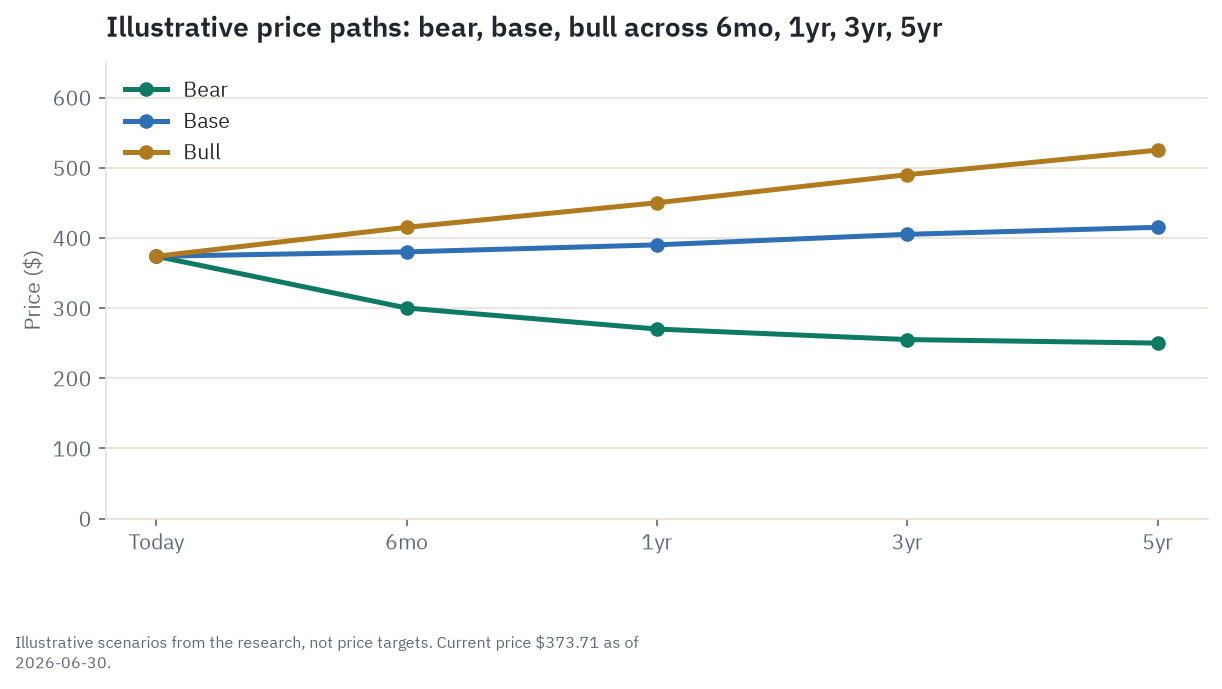
GE closed at $373.71 on June 30, 2026, a fresh all-time high after climbing roughly 96 percent of the way up its own 52-week range of $243.34 to $379.67. All the ranges below are estimates built off the scenario assumptions in the research, never price targets, and every one of them is anchored on that same starting price.
6 months. This window belongs to the Q2 2026 earnings print due July 16 and to how long the mid-2026 jet-fuel shock lasts. The options market is already pricing an above-average move into that print, and the stock is technically stretched: a 14-day RSI near 74.5 and a price sitting 18 to 22 percent above its 50-, 100-, and 200-day moving averages. Management said in April it was “trending toward the high end” of its full-year guide, so the base case (around $380) is close to flat, a good quarter offset by an already-rich starting price. The bull case (around $415) is another clean beat with the full-year guide raised and momentum intact. The bear case (around $300) needs no earnings miss at all, only for the market to stop paying a peak multiple into a visibly softening demand backdrop, a de-rating back toward the cluster of moving averages in the low $310s to low $320s. What flips this window is simple: the Q2 services growth rate, and whether guidance moves at all.
1 year. The dominant question becomes whether a guide that “does not assume a global economic recession,” in management’s own words, actually holds up against a fuel shock still working through airline income statements. The base case (around $390) is continued double-digit services growth with the multiple grinding a little lower, so the price roughly tracks earnings rather than re-rating. The bull case (around $450) is the aftermarket annuity visibly decoupling from the airline cycle, LEAP shop visits ramping on schedule, and the market willing to keep paying up for that. The bear case (around $270, roughly 28 percent below today) is the scenario the research treats as the skeptic’s most credible one: a handful of carriers defer engine shop visits, Boeing and Airbus stay stuck on production, results land at the low end rather than the high end of guidance, and a peak multiple compresses on a story that has quietly gone from “contracted” to “solid but decelerating.” What flips this window: the first downward revision to FY2026 or FY2027 guidance, or a second cut to the industry’s airline-profit forecast.
3 years. Here the structural drivers start to matter more than the news cycle. The base case (around $405) assumes management’s 2028 framework of roughly $11.5 billion in operating profit is broadly hit and that LEAP’s margin inflection is visibly underway, with earnings growth (helped by a shrinking share count) largely offsetting continued multiple normalization. The bull case (around $490) has LEAP tracking toward profit-dollar parity with the older CFM56 engine ahead of schedule, with defense revenue compounding on top. The bear case (around $255) has the 2028 framework slip while the multiple settles at a de-rated 27 to 28 times earnings. What flips this window: the actual reported LEAP services margin against that 2030 parity path, and whether the backlog keeps growing faster than revenue converts it.
5 years. This is really one question dressed up as a stock price: is the aftermarket business a bond-like annuity, or is it still a cyclical stream wearing an annuity’s clothing? The base case (around $415) is a strong franchise compounding around 10 percent a year with the multiple settling near 33 times earnings, a scenario in which five years of real growth is largely offset by that de-rating, so the total return ends up modest, mostly earned back through a lower multiple rather than a higher one. The bull case (around $525) is the annuity proving its durability and holding a premium multiple. The bear case (around $250) is cyclicality reasserting itself and the stock re-rating to a more ordinary aerospace multiple in the mid-20s. What flips this window: whether LEAP’s aftermarket dollars actually reach CFM56-level profitability by 2030 as guided, and whether independent repair shops and aftermarket parts competition start showing up in the dollar value of each shop visit.
Where the read lands today. On balance the read holds at Hold: this is a genuinely excellent franchise trading at a full-to-rich price at an all-time high, roughly 46 to 48 times earnings against a sell-side mean target of $348 to $355, meaning the average analyst already models mild downside from here. Practically, Hold means own it if you already do and do not chase it at this price; it does not mean sell, and it does not mean this is a bad company. What would flip this toward Buy is the kind of 15 to 20 percent pullback or cyclical pause that restores a valuation cushion while the growth story stays intact. What would flip it toward Reduce is the aftermarket annuity actually failing to decouple from the airline cycle, meaning a confirmed guidance cut tied to deferred shop visits rather than a one-quarter wobble.
Companion tool
Jump to the interactive dashboard to sort and filter every company in this piece, or download the Excel model to flex the scenarios yourself.
TL;DR
GE Aerospace makes most of its money the way a razor company makes money on blades: it sells jet engines, mostly through CFM International, its 50/50 revenue-sharing joint venture with France’s Safran, at thin or near-zero margin to win a spot on a Boeing or Airbus airframe, then earns the real profit over the next 20 to 30 years servicing that engine. Services already run about 71 percent of Commercial Engines & Services segment revenue and generated 26.6 percent segment operating margin in FY2025, funding free cash flow that converted at 113 percent of adjusted net income. The backlog, $211.3 billion at the end of the first quarter of 2026, is growing faster than revenue and is roughly 80 percent commercial services, meaning most of it is the deferred annuity the market is actually pricing this stock on rather than new-engine sales. It grows faster than revenue because every engine sold, whether through CFM or directly, locks in a 20-to-30-year service agreement that gets booked into the backlog in full the day it is signed, while the revenue from that same contract is only recognized in thin slices year by year as the engine actually flies and comes in for shop visits; as the installed base itself keeps expanding, new decades-long contracts keep piling into the backlog faster than the older ones can be drawn down into revenue. That is the bull case, and it is real. The tension is that none of this comes cheap: at $373.71 the stock trades at the richest multiple in its peer group, above the sell-side’s own average price target, at a moment when a mid-2026 Middle East fuel shock just cut the global airline industry’s 2026 profit forecast roughly in half and management’s own guidance explicitly assumes no recession. Airbus deliveries fell year over year in the first quarter, LEAP’s own margin ramp is a 2030 forecast rather than an actual, and a competitively priced replacement-parts market keeps some pressure on the aftermarket dollar per shop visit, a pressure that is real but not currently quantified anywhere in the public record. On balance, the lean is Hold: a great business, not a great entry price.
Explore it yourself: the interactive dashboard
Open the dashboard in a full screen
What GE Aerospace actually does now
Forget the old General Electric. The company that carries the GE ticker today is not the sprawling conglomerate that once made lightbulbs, jet engines, credit cards, television networks and power turbines under one roof. That company broke itself into three pieces: GE HealthCare (Nasdaq: GEHC) split off in January 2023, GE Vernova (NYSE: GEV, the power-generation and grid business) split off in April 2024, and what remained, renamed GE Aerospace, is a pure-play propulsion company. If you are picking this stock up expecting exposure to medical scanners or power turbines, you are thinking of the wrong ticker; those are now separately traded companies with their own separate shareholders.
What GE Aerospace actually does is build and, far more importantly, service jet engines. Think of an engine sale the way a coffee-pod machine maker thinks about the machine itself: the hardware is priced to get into the customer’s kitchen, and the money is made for years afterward on the pods. GE Aerospace and its joint-venture partner Safran price new engines aggressively, sometimes near breakeven, to win the exclusive or preferred slot on a new Boeing or Airbus airframe. Once an airline’s fleet is flying on that engine, only GE- or CFM-approved parts, repair data, and shops keep it certified to fly, so nearly every dollar of spare parts, overhauls, and scheduled shop visits for the next two to three decades flows back to GE Aerospace and Safran. That aftermarket stream, not the original engine sale, is the business.
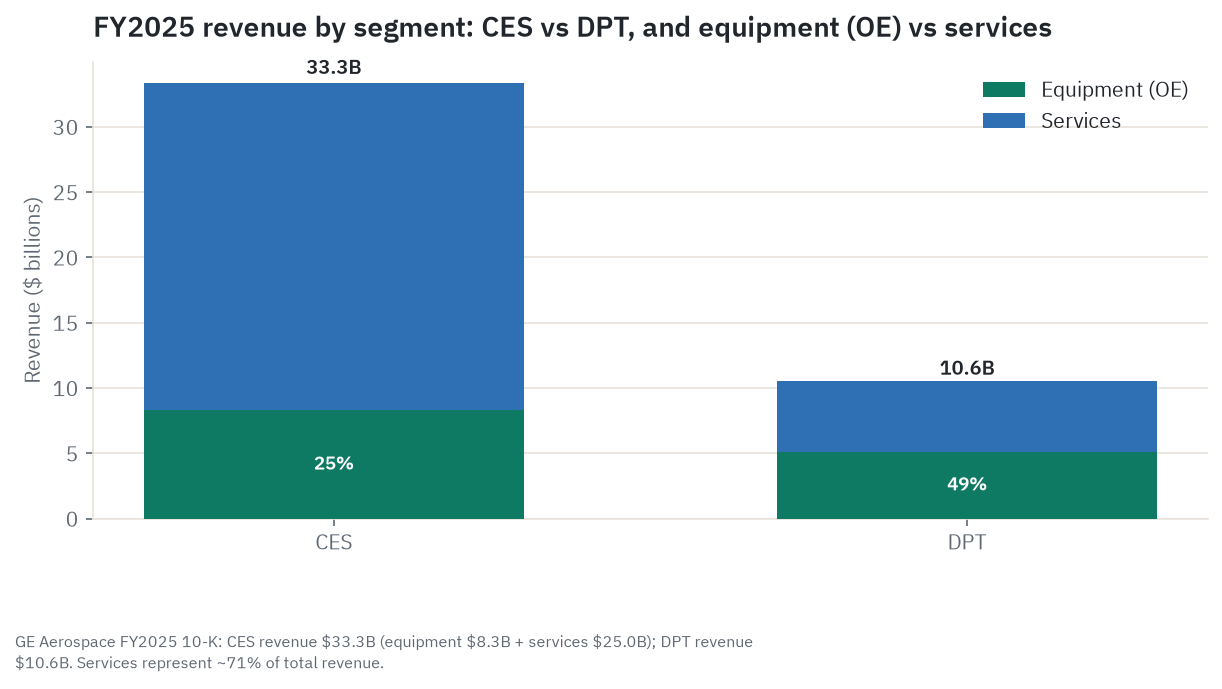
The company organizes itself into two reporting segments. Commercial Engines & Services (CES) is the growth engine and the profit engine at once: FY2025 segment revenue of $33.3 billion, up 24 percent year over year, and segment operating profit of $8.9 billion at a 26.6 percent margin. Within CES, services revenue of $25.0 billion dwarfed new-engine equipment revenue of $8.3 billion, a roughly 75/25 split that tells you where the actual economics sit. Defense & Propulsion Technologies (DPT) is the smaller, steadier sibling: $10.6 billion of FY2025 revenue, up 11 percent, and $1.3 billion of operating profit at a 12.3 percent margin, covering military engines like the F110 (F-15/F-16), F404 and F414 (fighter and trainer aircraft), and T700 (helicopters), plus the Propulsion & Additive Technologies unit. Together, CES generated roughly 87 percent of the company’s combined segment profit in FY2025 on less than triple DPT’s revenue, which is the cleanest single number for showing that this is fundamentally a commercial aftermarket story with a defense business riding alongside it, not the other way around.
A field guide to the engines
CFM56. The legacy workhorse. Built through CFM International, GE Aerospace’s 50/50 joint venture with Safran Aircraft Engines since 1974, it powered the prior generation of Boeing 737 and Airbus A320 narrowbodies. The engineering is long since paid off and the installed base is enormous, so CFM56 is close to pure-profit aftermarket at this point, and shop visits are guided to hold in a range of 2,300 to 2,400 per year through 2028, longer than a simple fleet-retirement model might suggest, likely because airlines are extending older aircraft rather than retiring them given how scarce new aircraft supply currently is.
LEAP. The current-generation replacement for CFM56, also built through the CFM joint venture. It is exclusive on the Boeing 737 MAX and one of two engine choices (alongside Pratt & Whitney’s geared turbofan) on the Airbus A320neo family. LEAP deliveries hit a record 1,802 units in 2025, up 28 percent year over year, and the installed base is on track to more than double by 2030, eventually overtaking CFM56 as the largest engine family in service. LEAP’s early years brought a real durability problem: high-pressure turbine blade wear, especially in hot and dusty operating environments, shortened time between shop visits below original design expectations. CFM developed a fix, a new high-pressure turbine blade, stage-1 nozzle, and forward inner nozzle support, that FAA and EASA certified in December 2024, and CFM has since said LEAP’s time-on-wing is now in line with CFM56’s. That claim comes from CFM itself, echoed by industry trackers rather than an independently audited metric, so treat it as directional, not settled fact. Time-on-wing is the thing that actually decides how profitable an engine is to service: a shorter time-on-wing means the engine comes off the aircraft for an expensive shop visit more often, which raises the airline’s own operating cost and, in the early going, meant GE and Safran were absorbing more frequent, earlier repair cycles than a mature engine like CFM56 would require at the same age. The durability kit is the fix for exactly that problem, stretching LEAP’s interval between shop visits back out toward CFM56’s, which is what management’s own guidance leans on when it talks about LEAP reaching CFM56-level profit dollars by around 2030. The financially important point is that LEAP still runs at thinner margin economics than mature CFM56 today, and that 2030 profit-dollar parity is guidance, management’s own forecast, not a result already booked.
GEnx and GE9X. GE Aerospace’s own widebody engines, sold directly rather than through the CFM joint venture. GEnx powers the Boeing 787 and 747-8. GE9X is exclusive to the Boeing 777X, which has slipped its certification timeline repeatedly; as of mid-2026 Boeing targets type certification in late 2026 and first delivery to launch customer Lufthansa in early 2027, though Cathay Pacific’s own planning assumes end-2027, a real gap between the company’s public timeline and at least one major customer’s more conservative contingency plan. A January 2026 inspection found cracking in the GE9X’s mid seal; GE and Boeing both describe it as not severe enough to affect certification or the delivery timeline, but it remains a live, open engineering item worth watching rather than a closed one.
Defense engines. F110 powers F-15 and F-16 fighters sold under foreign military sales programs; F404 and F414 power lighter fighters and trainers including the U.S. Navy’s F/A-18 family, and export programs in Korea, Turkey, and India; T700 powers military helicopters. These programs run on multi-decade government contracting cycles rather than airline capex cycles, giving GE Aerospace a second, more policy-driven growth lever largely independent of the commercial aviation cycle. Separately, the XA100 adaptive-cycle demonstrator engine was not selected for the F-35 propulsion upgrade in March 2025; the Pentagon instead funded a contract modification to Pratt & Whitney’s existing F135 engine, leaving XA100’s near-term commercial payoff unclear even as testing continues under other funding.
How the money flows
flowchart TD
    TOP["Airlines/lessors + defense budgets: ~$42.3B adj. revenue FY2025, $211B+ backlog"]
    TOP --> BOEING["Boeing 737 MAX / 777X: LEAP-1B & GE9X exclusive"]
    TOP --> AIRBUS["Airbus A320neo: LEAP-1A vs Pratt GTF"]
    TOP --> DEFENSE["Defense primes/DoD: F110, F404, T700"]

    BOEING --> CFM["CFM Intl JV: GE+Safran 50/50 revenue split"]
    AIRBUS --> CFM
    BOEING --> GEDIRECT["GE Aerospace direct: GE9X, GEnx"]

    CFM --> OE["OE engine sale: priced near cost to win placement"]
    GEDIRECT --> OE
    DEFENSE --> DPT["Defense & Propulsion Tech: $10.55B rev / $1.30B profit"]

    OE --> SERVICES["Aftermarket LTSAs/spares/shop visits: $30.2B rev, $170B+ backlog"]

    SERVICES --> CASTINGS["Hot-section castings/forgings: Precision Castparts + Howmet, ~80%+ share"]
    CASTINGS --> TITANIUM["Titanium/alloys: ex-Russia VSMPO, now Howmet/ATI/TIMET/Aubert-Duval"]
    CASTINGS --> RAREEARTH["Rare-earth alloys: China-reliant, 2027 DoD ban looming"]

    SERVICES --> CASH["GE Aerospace cash generation"]
    DPT --> CASH
    CASH --> RETURNS["Capital returns: buybacks + rising dividend FY2025"]
    CASH --> RD["RISE open-fan R&D with Safran"]
Read the diagram top to bottom and it tells the whole story. Money starts with two demand pools: the flying public and freight, funneled through airlines and lessors placing orders with Boeing and Airbus, and defense budgets in Washington and a handful of allied capitals. Boeing and Airbus decide (or let airlines choose) the engine, and on the 737 MAX that decision has already been made for GE Aerospace: LEAP is the only engine option. On the A320neo family, LEAP competes head to head with Pratt & Whitney’s geared turbofan, which is itself a live tailwind for GE right now, since a powder-metal contamination recall grounded a large share of the GTF-powered A320neo fleet in late 2025, versus only a small share of LEAP-powered aircraft grounded for engine-related issues over the same period. Every engine sold through the CFM joint venture splits revenue 50/50 with Safran; every engine sold directly (GEnx, GE9X) keeps the full economics in-house. CFM International is a genuine 50/50 joint venture, not a GE subsidiary GE simply pays a royalty to: LEAP and the legacy CFM56, together the large majority of narrowbody new-engine volume in the world, are designed, sold, and serviced through that JV, and GE’s own financial statements pick up roughly half of the JV’s economics through the equity method rather than consolidating the whole business. GE Aerospace does not separately disclose exactly what share of total company revenue LEAP and CFM56 represent, so the honest statement is qualitative: CFM is the majority of GE’s narrowbody engine volume, and GE’s upside from LEAP’s growth is real, but it is shared evenly with Safran by contract, not a number the company breaks out to the dollar.
The real toll booth sits one layer down: once an engine is flying, the decades of spare parts, repairs, and shop visits that follow are the actual business, and they route almost entirely back to GE Aerospace and Safran because certification, proprietary repair data, and long-term service agreements signed at delivery keep most of that spend inside the OEM ecosystem. That services layer, roughly $30.2 billion of FY2025 revenue against $12.2 billion of new-engine equipment revenue, and roughly $170 billion of the total backlog, is the part of the diagram the market is actually valuing.
Underneath all of it sits a narrow, slow-to-expand supplier base making the parts that can survive inside an engine’s hot section. Precision Castparts (now part of Berkshire Hathaway) and Howmet Aerospace dominate the specialist casting and forging capacity that both CFM and Rolls-Royce depend on, and turbine airfoils alone can run roughly a third of an engine’s raw-material cost. Titanium sourcing carries its own scar: Russia’s VSMPO-AVISMA was historically a major titanium supplier to Western aerospace before GE Aerospace and Boeing suspended Russian titanium purchases after the 2022 invasion of Ukraine, pushing sourcing toward U.S. melters (Howmet, ATI, TIMET) and France’s Aubert & Duval at a higher, less flexible cost structure. A newer chokepoint sits just ahead: U.S. defense procurement rules taking effect in 2027 will ban Chinese-origin rare-earth alloys, and GE Aerospace’s supply base currently leans on Chinese-sourced material for some of those inputs. Cash generated from the services annuity, plus the defense segment’s own profit, then funds buybacks, a rising dividend, and reinvestment in CFM RISE, the open-fan engine architecture GE and Safran are jointly developing as LEAP’s eventual successor.
Who wins where
The commercial narrowbody engine market is effectively a duopoly. CFM International (GE Aerospace and Safran) and Pratt & Whitney (a unit of RTX) split the Airbus A320neo family between LEAP and the geared turbofan, while GE Aerospace holds the entire 737 MAX slot to itself through LEAP. On widebody aircraft, GE Aerospace’s GEnx and GE9X compete with Rolls-Royce’s Trent family and, in some applications, Pratt & Whitney and other RTX engines. That competitive structure means new-engine pricing is set mostly by the airframers, who hold real negotiating power as the platform owners buying at scale, while aftermarket pricing is set mostly by the engine makers, protected by type certificates and proprietary repair data.
Underneath the engine makers sits a much narrower toll-taking layer: the specialist casters and forgers who make the superalloy parts capable of surviving an engine’s hot section. Precision Castparts and Howmet Aerospace dominate that layer for the whole industry, which means their capacity, not GE’s own assembly lines, has historically been the binding constraint on how fast LEAP and other new engines can actually be built. Airlines and lessors, by contrast, are mostly price-takers on both new aircraft (a Boeing/Airbus duopoly) and aftermarket services once locked into a long-term service agreement, a structural reason the engine and engine-services tier of the industry has historically captured more of the profit pool than the airlines that actually fly the planes.
The one competitive check on engine-maker pricing power worth naming honestly: FAA-approved third-party replacement parts, known as PMA parts, typically price 25 to 45 percent below OEM list price with no safety difference the FAA has found. Used serviceable material harvested from retired aircraft is a second substitution channel. Neither shows up anywhere in the public record as a quantified dollar hit to GE Aerospace’s aftermarket margin today, but both are real and slowly growing pressures on the per-shop-visit dollar, and GE management itself has flagged a growing independent LEAP repair network as a factor it is actively managing rather than ignoring.
Company by company: who’s who
GE Aerospace (GE), NYSE, market cap roughly $390 billion as of June 30, 2026. The pure-play propulsion leader since the 2024 breakup, holding the number one or two narrowbody engine position through CFM56 and LEAP. First-quarter 2026 orders jumped 87 percent year over year to $23 billion, including a commitment from American Airlines for more than 300 LEAP-1A engines, while revenue rose 25 percent and adjusted earnings per share beat estimates by roughly 16 percent. Bull: a decades-long aftermarket annuity on an installed base that keeps growing, with a backlog that gives years of revenue visibility. Bear: still supply-chain constrained on new-engine deliveries, sole-source exposed to Boeing on some platforms, and, the point the sourced peer set alone can understate, trading at the richest multiple in the group with no valuation cushion above the sell-side’s own average target.
RTX Corporation (RTX), NYSE, market cap roughly $255.5 billion. Owns Pratt & Whitney (the other half of the narrowbody engine duopoly, via the geared turbofan and the F135 military engine), Collins Aerospace systems, and Raytheon missile and defense electronics. First-quarter 2026 sales rose 9 percent with Pratt & Whitney operating profit up 22 percent on 19 percent commercial-aftermarket growth. Bull: diversified across commercial aftermarket and a fast-growing defense order book amid elevated global defense spending. Bear: the geared turbofan’s recurring durability and inspection issues have dented Pratt & Whitney’s margins and airline relations in past cycles, and, worth stating plainly, a recovery in that program would remove one of the tailwinds currently pushing narrowbody share toward GE and CFM.
Safran SA (Euronext Paris: SAF.PA, thinly traded U.S. OTC ADR: SAFRY), market cap roughly $163.4 billion. GE Aerospace’s co-equal partner in the CFM joint venture, which between LEAP and legacy CFM56 holds roughly 70 percent of the global narrowbody engine market. First-quarter 2026 adjusted revenue rose 19 percent, driven by LEAP deliveries and continued spare-parts and services growth. Bull: shares GE’s narrowbody aftermarket annuity without GE’s defense-program execution risk, while diversifying into landing gear and interiors. Bear: tied to the exact same LEAP supply chain constraints and forged-parts bottlenecks as GE, so it cannot outrun GE’s own delivery problems even if it wanted to.
Rolls-Royce Holdings plc (London Stock Exchange: RR.L, U.S. OTC ADR: RYCEY), market cap roughly £119.2 billion (about $155 billion via the ADR). The widebody engine specialist and the clearest margin-recovery story in the group, having rebuilt from a near-collapse in 2020. Full-year 2025 underlying operating margin reached 17.3 percent, with 2026 guidance raised to £4.0 to 4.2 billion of underlying operating profit, aided by large-engine flying hours running at 115 percent of 2019 levels and a new data-center power tailwind through its Power Systems division. Bull: the fastest margin-recovery story of the group, with wide-body aftermarket strength plus that data-center power angle. Bear: less exposure to the hot narrowbody LEAP/geared-turbofan cycle, and its own turnaround has already re-rated the stock to roughly 20 times earnings against a 10-year historical average nearer 11 times, meaning much of the good news is already priced in.
Honeywell Aerospace (Nasdaq: HONA), market cap roughly $70 to 72 billion. A components and systems supplier, not a mainline engine maker, covering auxiliary power units, avionics, environmental control systems, and business-jet engines. It began independent trading on Nasdaq on June 29, 2026, just one day before this research was dated, after Honeywell (now renamed Honeywell Technologies for the remaining parent) spun off its aerospace unit. Bull: a newly independent pure-play the market can value directly, unlocked from the old industrial conglomerate discount. Bear: less than a week of trading history as of this writing and no standalone multi-quarter track record, so any valuation figure for this name should be treated as early-days and unverified rather than settled.
The Boeing Company (BA), NYSE, market cap roughly $170.6 billion. GE and CFM’s largest single airframe customer, whose own production recovery directly sets GE Aerospace’s near-term delivery cadence. First-quarter 2026 commercial deliveries rose 10 percent to 143 aircraft, and Boeing is targeting a 737 MAX production-rate increase to 47 per month this summer with full-year MAX deliveries guided to 500 to 550, up roughly 40 percent year over year. Bull: a MAX rate ramp is one of the single biggest near-term demand levers for LEAP-1B shipments. Bear: Boeing’s own delays, including 787 delivery slippage and MAX 7/10 certification pushed to 2027, are a direct swing factor on GE and CFM’s own shipment volumes and revenue timing, not a risk that lives only on Boeing’s side of the ledger.
Airbus SE (primary listing Euronext as AIR, thin U.S. OTC ADR: EADSY), market cap roughly $175 billion. CFM and Pratt & Whitney’s other major airframe customer, with the A320neo family the single largest demand driver for both engine programs. First-quarter 2026 deliveries fell 16 percent year over year to 114 aircraft on continued Pratt & Whitney geared-turbofan supply constraints and Chinese delivery administrative delays, even as orders rose 95 percent in the same quarter. Bull: order intake surged even as deliveries slipped, meaning the backlog, and future engine shipments, keeps growing regardless of near-term delivery bumps. Bear: near-term profit and engine-shipment timing are exposed to supplier bottlenecks Airbus does not control, and the year-over-year delivery decline is the clearest concrete evidence that a full backlog does not automatically convert into near-term GE revenue on schedule.
GE Vernova (NYSE: GEV) and GE HealthCare (Nasdaq: GEHC). Both are GE Aerospace’s corporate siblings from the 2023 and 2024 breakup, not aerospace companies, and neither is the subject of this research. GE Vernova (power generation, grid equipment) has re-rated sharply on data-center and grid power demand since its spin-off; GE HealthCare (medical imaging) has seen its market cap decline over the trailing year. They are named here only so a reader does not confuse either company’s separate story with GE Aerospace’s.
What the filings say
Every figure in this section comes from GE Aerospace’s own SEC filings: the FY2025 Form 10-K filed January 29, 2026, the first-quarter 2026 Form 10-Q filed April 21, 2026, and the associated 8-K earnings-release exhibits, cross-checked directly against the filing text rather than an aggregator’s summary. A note on comparability before the numbers: the 2023 and 2024 figures in the FY2025 10-K have been restated to show GE Aerospace on a standalone, continuing-operations basis, excluding the spun-off GE Vernova and GE HealthCare businesses. Do not blend these with the old, pre-split “General Electric Company” conglomerate numbers you might find in an older data source.
Revenue and profit. FY2025 total GAAP revenue was $45,855 million, up 18 percent year over year, made up of $12,159 million of equipment revenue, $30,163 million of services revenue, and $3,533 million of run-off insurance revenue (a legacy of the old GE Capital insurance book, discussed below). Stripping out that shrinking insurance book gives the company’s own preferred “adjusted revenue” measure of roughly $42.3 billion, which actually grew faster, 21 percent, than the GAAP total, because the runoff piece is declining while the core aerospace business accelerates. GAAP net profit was $10.0 billion, a 21.8 percent margin, up 210 basis points year over year; the company’s own non-GAAP operating profit measure was $9,055 million at a 21.4 percent margin. GAAP diluted earnings per share reached $8.05, versus $6.09 in 2024; the company’s own adjusted EPS measure, which strips out one-time items, was $6.37, up 38 percent.
Segments. Commercial Engines & Services generated $33,314 million of FY2025 revenue, up 24 percent, and $8,861 million of segment profit at a 26.6 percent margin. Within CES, services revenue of $25,010 million ran roughly three times new-engine equipment revenue of $8,304 million. Defense & Propulsion Technologies generated $10,554 million of revenue, up 11 percent (Defense & Systems contributing $6,574 million, Propulsion & Additive Technologies $3,980 million), and $1,296 million of segment profit at a 12.3 percent margin, up from 11.2 percent the prior year. Put together, CES generated roughly 87 percent of the company’s combined segment profit on a little more than triple DPT’s revenue base, a clean confirmation that the aftermarket-heavy commercial business, not defense, is what carries this stock. One structural note for anyone modeling forward quarters: effective January 2026, GE restructured its internal reporting so CES absorbs the prior Technology & Operations organization and the Aeroderivative business moves from CES to DPT. The FY2026 guidance table’s own “2025” comparison figures are explicitly labeled by the company as revised and unaudited to reflect that reorganization, so the audited FY2025 10-K numbers above (CES $33,314 million, DPT $10,554 million) are the clean, GAAP-audited baseline, and any FY2026-guidance-table comparison should be read with that caveat in mind.
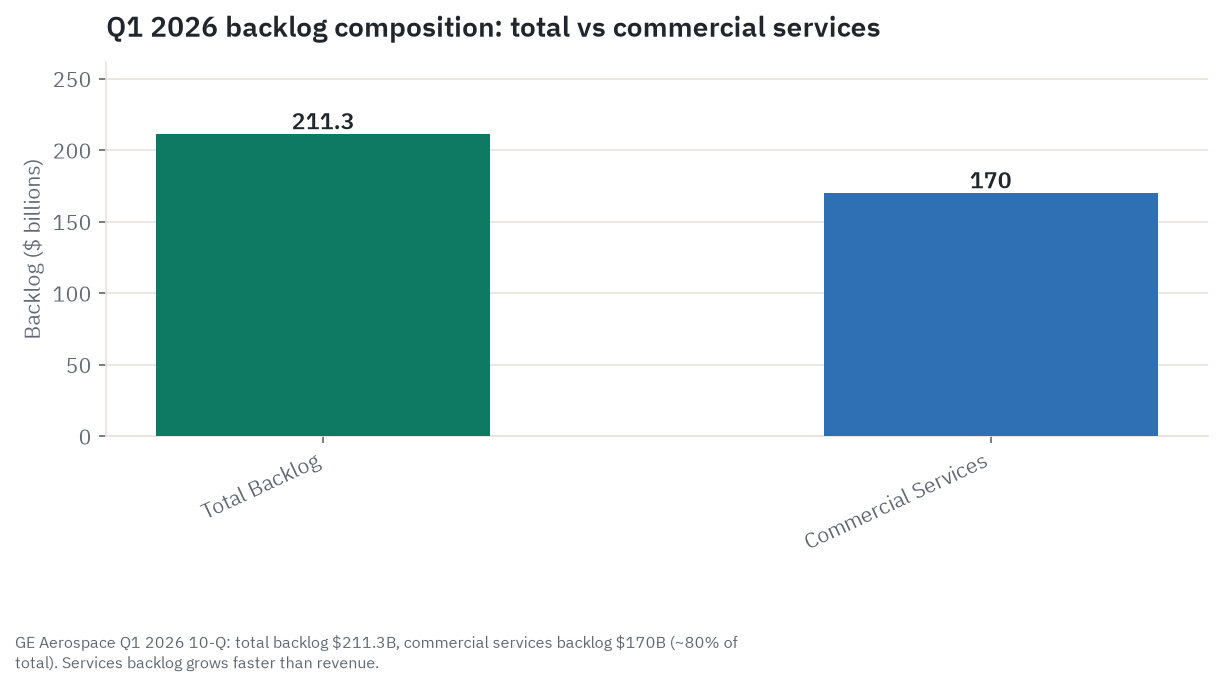
Backlog. Total backlog reached roughly $190 billion at the end of FY2025 and grew to $211.3 billion by the end of the first quarter of 2026, an increase of more than $20 billion in a single quarter, of which the commercial services backlog alone runs roughly $170 billion, or about 80 percent of the total. That backlog is growing faster than revenue, which is the single number the bull case rests hardest on, since it says the deferred aftermarket annuity, not new engine orders, is the pool actually expanding.
Cash flow and the balance sheet. Cash from operating activities reached $8,543 million in FY2025, up 47 percent from $5,817 million in FY2024. GE Aerospace’s own headline free cash flow measure came in at $7,694 million, up 24 percent, representing 113 percent conversion of adjusted net income, meaning the company is turning more cash out the door than the accounting profit alone would suggest, a mark of an asset-light business (capital expenditures ran only about $1.2 billion against $42 billion of adjusted revenue). At year-end 2025 the company held $12.4 billion of total cash and restricted cash against $20.5 billion of consolidated borrowings, up from $19.3 billion the prior year on $2.0 billion of new senior notes issued in July 2025, for an implied net debt of roughly $8.1 billion; by the end of the first quarter of 2026, cash had fallen to $11.0 billion and borrowings to $20.3 billion, implied net debt around $9.3 billion. Moody’s upgraded GE Aerospace’s rating from Baa1 to A3 in February 2025, and S&P upgraded it from BBB+ to A- in March 2025, both moves that happened in 2025, a point worth stating precisely since it is easy to misdate. A $3.0 billion revolving credit facility maturing 2029 sits entirely undrawn.
Two legacy liabilities are worth naming honestly, because a purpose-built aerospace-propulsion peer without GE’s history would not carry either one. First, a pension obligation of $28,484 million against plan assets of $23,052 million, a $5,432 million deficit, though the main plan is 91 percent funded on a U.S. GAAP basis with no required near-term cash contributions expected. Second, $36,894 million of insurance liabilities and annuity benefits, mostly long-term-care reserves of $25,792 million, a legacy of the old GE Capital insurance book that GE Aerospace still carries and reports through its Corporate & Other line. Neither is presented anywhere in the filings as a solvency concern; both are managed, run-off obligations rather than growing exposures, but they are real balance-sheet weight a cleaner-sheet peer simply does not carry.
Capital returns. The board authorized a $15.0 billion buyback in March 2024; GE Aerospace repurchased 29.6 million shares for $7.4 billion in FY2025 on an MD&A commitment basis (or $7,551 million on a cash-flow-statement basis, a difference driven by accelerated-repurchase settlement timing rather than a data error), bringing cumulative repurchases to $12.3 billion as of the 10-K. By the first-quarter 2026 10-Q, cumulative repurchases under that authorization had reached $14.5 billion, essentially exhausting it, after a further $2.2 billion spent in the quarter alone. A new $20 billion authorization approved in December 2025 now sits on top of the largely spent prior one. On the dividend side, GE Aerospace declared $0.36 per share in December 2025, then raised it 30.6 percent to $0.47 per share in February 2026, which annualizes to $1.88 and, at the current price, works out to roughly a 0.5 percent yield, not an income stock by any stretch but a growing one. FY2025’s total dividends declared came to $1.44 per share across the year at the pre-raise rates; FY2026 will run at the new, higher quarterly rate throughout. The diluted weighted-average share count has been shrinking steadily, from 1,099 million in 2023 to 1,068 million in 2025, meaning buybacks are outpacing dilution from stock-based compensation, a real structural tailwind to per-share earnings independent of the underlying business.
Guidance. Management initiated FY2026 guidance alongside fourth-quarter 2025 results on January 22, 2026: adjusted revenue growth in the low double digits off the roughly $42.3 billion FY2025 adjusted-revenue base, operating profit of $9.85 to $10.25 billion, and adjusted earnings per share of $7.10 to $7.40, against $6.37 in 2025. Free cash flow is guided to $8.0 to 8.4 billion at greater than 100 percent conversion. At the segment level, CES total revenue is guided up in the mid-teens percentage range and DPT revenue up mid-to-high single digits. At first-quarter 2026 earnings on April 21, management reaffirmed every one of those ranges and said it was trending toward the high end, citing the growing commercial services backlog and strong first-quarter orders and revenue. Management’s own stated assumptions behind that guidance: Brent crude staying elevated through the third quarter of 2026 before easing, a near-term fuel-availability impact, reduced global GDP estimates, flat-to-low-single-digit growth in flight departures, and, in the company’s own words, an assumption that “does not assume a global economic recession.” Looking further out, a longer-term framework from a July 2025 investor update raised the 2028 target to approximately $11.5 billion of operating profit and $8.5 billion of free cash flow, each roughly $1.5 billion above the company’s prior 2024 investor-day framework, implying management’s own expectation of continued double-digit adjusted-revenue growth through the decade’s back half on the strength of the services ramp. Every one of those 2026 and 2028 numbers is guidance, a company forecast, not an audited result already booked.
Disclosed risks, in the company’s own words. The 10-K names three risks that matter most for this stock specifically. First, single-source and joint-venture dependence: CFM International is a 50/50 non-consolidated joint venture with Safran, and “for some Boeing models, our engines may be the sole source engine for a particular aircraft,” meaning GE Aerospace shares control and economics of its single largest commercial platform by design, not by choice. Second, a supply-constrained new-engine ramp, with the company itself citing supply-chain shortages, inflationary pressure, and skilled-labor shortages as ongoing constraints on the LEAP delivery ramp specifically. Third, commercial aviation cyclicality: “a substantial portion of our business is directly tied to economic conditions in the commercial aviation sector, which has historically been cyclical in nature.” The filings also flag product safety and quality risk in standard boilerplate language, and note that tariffs already caused an unfavorable change in estimated profitability on some long-term service agreements in FY2025, before a late-2025 zero-for-zero aerospace tariff arrangement among the U.S., E.U., U.K., Japan, and Korea.
Recent material events and insider signal. A January 15, 2026 8-K disclosed a CES leadership reorganization: Mohamed Ali named president and CEO of an expanded CES that now absorbs the Technology & Operations organization, with prior CES leader Russell Stokes set to retire in July 2026. A June 11, 2026 8-K added Judson Althoff, chief executive of Microsoft’s commercial business, to the board, with an artificial-intelligence and operational-efficiency rationale cited by CEO Larry Culp. Neither is an adverse surprise; both are leadership and governance moves. Per the 2026 proxy, the largest shareholders are the index-fund trio of Vanguard (8.4 percent), BlackRock (7.9 percent), and Fidelity (6.4 percent), a fairly ordinary large-cap ownership register, and insider holdings are modest: CEO Culp holds 1,612,480 shares, under 1 percent of the company, and all directors and executives together hold under 1 percent as a group. A sample of Form 4 filings from May and June 2026 shows routine option exercises and tax-withholding sales tied to the post-earnings vesting window, nothing that reads as large discretionary insider selling or buying.
What the market is paying
Every figure in this section is a snapshot read on or around June 30, 2026, and, per the brief’s freshness bar, should be treated as a dated read rather than a current fact by the time this is read.
Price and range. GE closed at $373.71 on June 30, 2026, an all-time closing high struck the day before, June 29. The stock’s 52-week range runs from $243.34 (July 8, 2025) to $379.67 (June 25, 2026), putting the current price roughly 96 percent of the way up that range. Market cap sits at roughly $386 to $390 billion depending on which vendor’s share-count vintage you use (both are legitimate, just dated slightly differently), on approximately 1.04 billion shares outstanding.
Volatility and technicals. Vendors disagree meaningfully on beta, one reading 1.35, another 1.10, wide enough that neither should be treated as precise, though both suggest a stock that moves somewhat more than the broad market. Thirty-day realized volatility ran 31.76 percent annualized against a 39.15 percent implied volatility reading heading into the July earnings print, consistent with the options market pricing in more turbulence ahead than has actually shown up recently. On technicals, the stock trades well above all its major moving averages, roughly $315.68 (50-day), $313.98 (100-day), and $308.49 (200-day), 18 to 22 percent above each. A 14-day RSI near 74.5 and a stochastic %K near 88 both sit in overbought territory by the usual convention, and a rising ADX confirms a strong trend rather than signaling an imminent reversal on its own. Read plainly: buyers have been in firm control for months, and support on any pullback would likely first be tested in the high $310s to low $320s rather than anywhere near the current price.
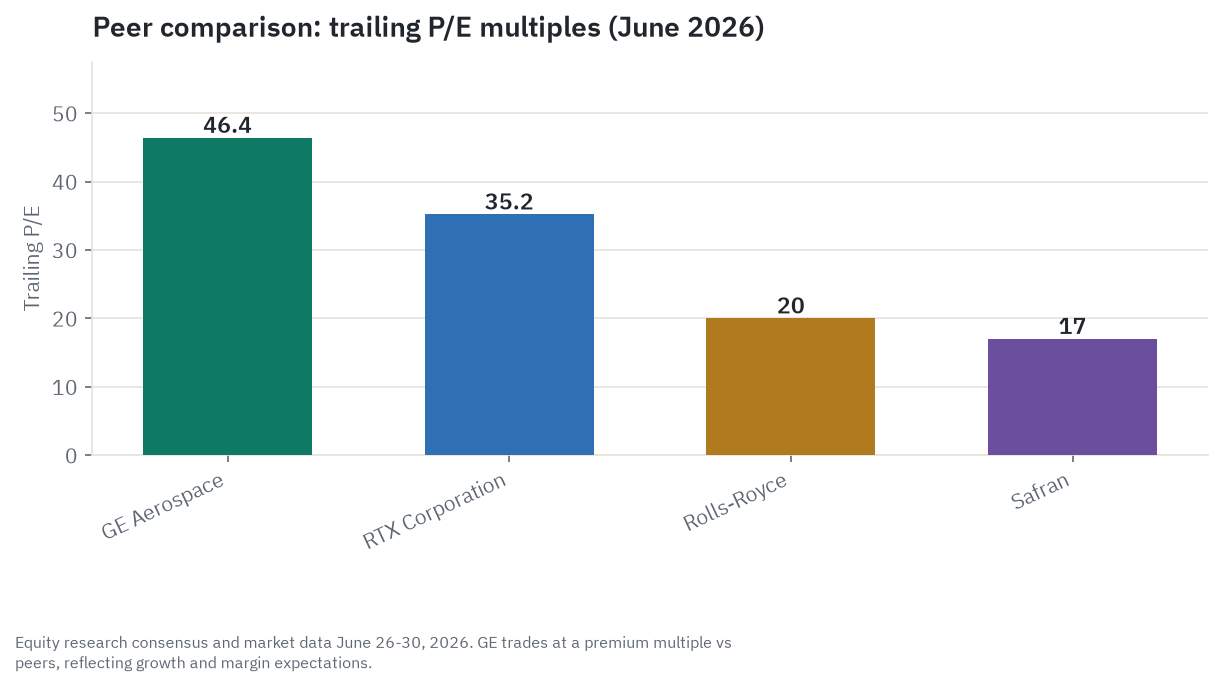
Valuation. This is where GE Aerospace stands out, and not in the direction a value investor would want. Trailing price-to-earnings on GAAP earnings runs approximately 46 times, a figure two separate data vendors converge on closely. A forward price-to-earnings reading of roughly 48 times shows up on one vendor, and it is worth flagging as an anomaly rather than accepting at face value: a forward multiple exceeding the trailing multiple is not the normal pattern for a company guided to grow earnings, and it likely reflects either a lower consensus forward earnings base than management’s own guidance or a data-timing mismatch, so treat it as directional rather than precise. Enterprise value to EBITDA reads roughly 36 times on a trailing basis but closer to 27 times against 2026 estimated EBITDA, a wide spread that matters because which measure you use changes the “is this expensive” conclusion substantially. Price to book, at 21.59 times, is the one multiple every vendor agrees on exactly. The dividend yield of roughly 0.5 percent confirms this is not an income name.
Set against peers, GE Aerospace is unambiguously the most expensive name in its own group. RTX trades at roughly 35 times trailing earnings and 18.5 times EV/EBITDA, itself a discount to the broader aerospace and defense industry’s own EV/EBITDA median. Safran trades near 17 times trailing earnings. Rolls-Royce trades at roughly 20 times earnings, itself a sharp re-rating from a 10-year historical average nearer 11 times, so Rolls has stretched too, just from a much cheaper starting point. GE’s premium is arguably the most defensible of the group’s rich multiples, if the guided free cash flow ramp to $8.0 to 8.4 billion in 2026 and roughly $11.5 billion of 2028 operating profit lands on schedule, but it is also the name with the least room in the group for disappointment.
Liquidity and short interest. Average daily volume runs roughly 4.7 to 5.1 million shares on a 1.04 billion-share float, a highly liquid mega-cap by any measure. Short interest sits at roughly 13.9 million shares, or about 1.3 percent of float, as of early July 2026, actually drifting up modestly from 1.5 percent in February and 1.6 percent in December 2025 even as the stock climbs to new highs, but still well below the roughly 3.5 percent peer-group average. Skepticism exists here, it just is not being expressed heavily through the short book.
Sell-side. Consensus rating is Buy, with two separately sourced reads roughly agreeing: one panel of 22 analysts putting the mean price target at $354.57 (high $426, low $270), another panel of 20 analysts at $348.22 (high $405, low $270, with 16 buy ratings, 1 strong buy, 2 hold, and 1 sell). Both means sit below the current $373.71 price, implying roughly 5 to 7 percent downside to the average target even though the aggregate rating still reads as a net Buy. Read that combination honestly: sell-side analysts like the underlying business, but in aggregate their price targets have not kept pace with the stock’s own run to new highs, and the high end of the target range is the only realistic scenario in which the stock still has meaningful upside against current published targets. None of this is a forecast; it is sell-side opinion, dated to late June 2026.
What the crowd is saying
The dominant news narrative through the first half of 2026 has been an aerospace turnaround story accelerating faster than expected: first-quarter orders up 87 percent, revenue up 25 percent, services revenue up 39 percent, all comfortably ahead of guidance, layered on top of a multi-year narrative around CEO Larry Culp’s operational turnaround and balance-sheet cleanup since the 2024 breakup. Trade press coverage of the LEAP durability fix and the CFM56 legacy fleet’s longer-than-expected life has been warming, and 17 of 19 analysts tracked in one sentiment scan rated the stock a buy through the period, alongside the stock’s all-time closing high on June 29.
Retail and social sentiment tells a more interesting, and genuinely divergent, story. Through February and March 2026, Reddit and StockTwits chatter on GE turned bearish, with one Reddit sentiment gauge dropping into the low 20s to high 20s on a 100-point scale, even as the fundamentals kept beating. The trigger was not a business concern at all: reports that the Iranian Revolutionary Guard Corps had threatened strikes on 18 U.S. technology and defense companies, GE among them, drove a roughly 14 percent stock decline in April tied to that geopolitical scare rather than to anything in the filings. By June, as that overhang faded and the strong first-quarter results sank in, the stock recovered to fresh highs, a clean example of retail sentiment lagging institutional conviction rather than leading it. Separately, at least one StockTwits user pegged fair value at $220 in the February-to-March window, versus a price near $370 today, an explicitly valuation-driven bearish call that, whatever one thinks of the specific number, was directionally the same argument the sell-side’s own below-spot mean target quietly makes today.
Employee sentiment reads strongly positive: a 4.1 out of 5 Glassdoor rating across more than 4,600 reviews, with 84 percent of employees saying they would recommend the company, and a Best Places to Work recognition for 2026, tempered by employee complaints about long hours consistent with the company’s lean-manufacturing operating discipline. Customer sentiment among airlines is a genuinely useful, if soft, signal: GE Aerospace ranked first for aftermarket avionics support and third overall out of 41 OEMs and suppliers in one airline aftermarket satisfaction survey, while separately drawing airline complaints about engine pricing power in late 2025 and early 2026, complaints CEO Culp has pushed back on by pointing to the company’s roughly $3 billion in annual research and development spend and its decades-long service commitment. Airlines paying and grumbling, rather than defecting to a competing engine supplier, reads as evidence of real pricing power rather than weakness, though it is worth being honest that this is exactly the kind of soft signal that can flip if a competitor’s product genuinely closes the gap.
The sharpest divergence worth naming plainly: a valuation-conscious minority of retail investors and at least one social-media voice called this stock expensive well before it hit its most recent highs, and they were, on the numbers, more prescient about the multiple than about the timing, since the fundamentals kept outrunning even a rich starting valuation for months. That is not proof the bears are wrong now; it is proof that “expensive” and “wrong to be short” can both be true of the same stock for a long stretch, which is itself a useful caution for anyone reading this section as a timing signal rather than as a temperature check. No coordinated promotion, pump-and-dump activity, or thin-float hype mechanics were found in this review; the retail skepticism reads as organic, if thin in volume.
Is the aftermarket annuity built to last through a cycle?
The structural case for GE Aerospace is genuinely strong, and it is worth stating plainly before getting to the caveats. Commercial air travel has grown roughly in line with global economic growth for decades, funded overwhelmingly by household discretionary spending on leisure travel rather than corporate budgets, which makes it structurally durable even though it is cyclically volatile. Global full-year 2025 revenue-passenger-kilometer growth came in at 5.3 percent, a continuation of post-pandemic normalization. More importantly for GE Aerospace specifically, the industry is currently capacity-constrained rather than demand-constrained: passenger load factors are forecast to hit a record 83.8 percent in 2026 because Boeing and Airbus cannot build aircraft fast enough to meet ticket demand, which means the order book and shop-visit queue GE Aerospace is sitting on is backed by real, unmet flying demand rather than by airline optimism that could evaporate overnight. Because roughly three-quarters of the commercial engine segment’s revenue is aftermarket services tied to the installed base and flight hours actually flown, not new-aircraft capital spending, GE Aerospace’s revenue is levered more to the act of flying than to airline profitability itself, a meaningfully more durable position than a pure new-engine supplier would have.
The honest cyclical case is just as real, and it is playing out in front of us as this is written. A regional conflict in the Middle East drove a jet-fuel price spike in mid-2026 that cut the global airline industry’s own 2026 net-profit forecast roughly in half, from about $45 billion to about $23 billion, inside a single reporting cycle, concrete proof that a single geopolitical event can reprice the entire demand base GE Aerospace sits on top of almost overnight. Aftermarket revenue is genuinely more insulated than new-engine sales, but insulated is not immune: in a sustained downturn, aircraft already in service keep flying at reduced but non-zero rates and still need scheduled maintenance driven by hard time and cycle limits rather than by airline profitability, so the historical pattern (2001, the 2008-09 financial crisis, and the 2020 pandemic all serve as templates) is that airlines defer and stretch rather than cancel maintenance outright. Deferred revenue is still a real cash-timing hit, just a smaller and slower-arriving one than a pure new-engine order book would take. A second, separate risk cuts the opposite direction: if Boeing and Airbus succeed in normalizing their own production rates faster than underlying flying demand grows, today’s supply-constrained, high-load-factor equilibrium could tip toward a more ordinary supply-and-demand balance, removing the “cannot build them fast enough” tailwind currently supporting new-engine pricing, and potentially accelerating the retirement of older, CFM56-powered aircraft faster than LEAP’s own aftermarket business has matured enough to fully replace that legacy profit pool.
The most likely path, reasoned through both sides honestly, is a split rather than a clean call in either direction. The structural growth in flying itself is real. GE Aerospace’s aftermarket-heavy revenue mix genuinely insulates it more than a pure new-engine or pure-airline story would be insulated. But 2026 is not an early-cycle setup: order books are already full, load factors are already at record highs, and the first live test of whether the aftermarket annuity actually decouples from the broader macro cycle, rather than merely lagging it, is happening in real time via the current fuel shock. The most probable outcome is continued but decelerating aftermarket growth, a bumpy but not collapsing new-engine delivery ramp gated as much by Boeing and Airbus’s own supply chains as by GE’s, and periodic macro scares, fuel shocks, tariff brinkmanship, a financing-cost surprise, that dent sentiment and near-term results without breaking the multi-year installed-base thesis outright.
The scenarios in detail
Four variables decide GE Aerospace’s outcome over the next five years, and every scenario below is just a different setting of these same four knobs.
The aftermarket growth rate. Services already make up roughly 71 percent of CES revenue and CES generates roughly 87 percent of segment profit, so this single variable, driven by global flight hours flown rather than by airline profitability directly, by the LEAP installed base rolling into its own high-margin shop-visit phase, and by the pace at which the legacy CFM56 fleet keeps flying rather than retiring, is the whole thesis in one line. The $211.3 billion backlog, growing faster than revenue, is the forward fuel in the tank.
The margin trajectory. The 26.6 percent blended CES margin reported in FY2025 is a weighted average of a thin-to-negative new-engine margin and a very high services margin. A heavier mix of new LEAP engines mechanically drags the blended figure down in the near term, before reversing as those same engines mature into their own aftermarket tail. The load-bearing swing factor is whether LEAP actually reaches CFM56-level profit dollars by around 2030 as management has guided, a forecast rather than a booked result, with competitively priced replacement parts and a growing independent repair network sitting as a real, if publicly unquantified, offset to that math.
The multiple. At roughly 46 to 48 times earnings, GE Aerospace carries the richest valuation in its peer group and trades above the sell-side’s own mean target. Over a five-year horizon the multiple almost certainly normalizes from today’s level toward a still-premium but lower 28 to 34 times as growth naturally decelerates from its current pace; how fast and how far that normalization runs is what actually separates the bull, base, and bear cases far more than the earnings path itself does.
Capital intensity, capital returns, and the cycle. The business is asset-light, spending only about $1.2 billion of capital expenditure against $42 billion of revenue, converts more than 100 percent of adjusted income to free cash flow, and shrinks its own share count roughly 1.5 to 2 percent a year through the new $20 billion buyback authorization, a structural tailwind to per-share numbers independent of the operating story. Against that sits the cycle itself: the mid-2026 fuel shock already halved the industry’s 2026 airline-profit forecast, management’s own guidance explicitly does not assume a recession, and new-engine throughput is gated by Boeing and Airbus, whose combined first-quarter 2026 deliveries moved backward at Airbus specifically. The legacy pension and insurance liabilities remain managed drags rather than near-term breaks.
Bull case. Services growth stays in the low double digits through the period as the annuity decouples from the airline cycle; LEAP reaches CFM56-level profit dollars on or ahead of the roughly 2030 guided timeline; blended CES margin climbs past the high 20s as the new-engine mix drag reverses; defense compounds on continued rearmament spending and foreign military sales; the buyback shrinks the share count toward roughly 0.94 billion; and the market keeps paying a premium multiple near 36 times for a proven, contracted annuity. Under those assumptions, operating profit compounds past the 2028 framework toward roughly $16 to 17 billion by 2030-31, adjusted earnings per share reaches roughly $14.50, and free cash flow comfortably tops $11 billion. Applying a premium 36 times multiple to that earnings figure produces an illustrative five-year price near $525, an estimate, not a target. What has to be true: the aftermarket really is bond-like through a demand wobble, LEAP’s durability and margin ramp track guidance closely, and Boeing and Airbus’s own production throughput recovers enough to convert the backlog into actual shop visits. What most likely breaks it: a sustained demand air-pocket proving the annuity is deferrable after all, or independent repair-shop and replacement-parts competition capping the per-shop-visit dollar faster than the installed base grows.
Base case. Services growth decelerates from its current roughly 20 percent pace toward high single digits; LEAP’s margin inflects roughly on the guided path; the 2028 operating-profit framework of approximately $11.5 billion is broadly met; the buyback continues; and the multiple normalizes from today’s level toward a still-premium 33 times as growth matures. Operating profit reaches roughly $13.5 to 14 billion by 2030-31, adjusted earnings per share around $12.50, and free cash flow around $10 to 11 billion. At a 33 times multiple that produces an illustrative five-year price near $415, meaning five years of genuinely solid compounding is largely offset by the multiple coming down, so the total return over that period ends up modestly positive, earned back mostly through a lower multiple and a small dividend rather than through a re-rating higher. What has to be true: the order book converts on a bumpy but not broken Boeing and Airbus delivery ramp, with no recession-grade demand break and the legacy insurance and pension obligations staying managed. What most likely breaks it: the multiple compressing faster than earnings grow if the cycle softens further, turning a flat-ish base case into an outright down year.
Bear case, anchored on the strongest sourced version of the skeptic’s argument. The 2026 fuel and margin shock keeps airline profitability roughly halved for longer than hoped, some carriers defer shop visits and stretch time between overhauls, Boeing and Airbus deliveries stay stuck (Airbus already moved backward year over year in the first quarter of 2026), new-engine and near-term aftermarket volumes land at the low end rather than the high end of guidance, and the market simply stops paying a peak multiple for a growth path that has visibly shifted from “contracted and certain” to “solid but decelerating.” Earnings still grow in this case, just more slowly than a roughly 48 times forward multiple requires. Operating profit stalls near $11 to 12 billion by 2030-31 as services growth roughly halves, adjusted earnings per share reaches only about $9.50, and the multiple re-rates to a more ordinary aerospace level near 26 times, producing an illustrative five-year price near $250. What has to be true for this case: cyclicality is not repealed, meaning the aftermarket lags rather than escapes a downturn the way the 2001, 2008-09, and 2020 cycles all show, and today’s record load factors and deferred retirements prove to be cycle-high rather than the new permanent normal. The single point the skeptic case leans on hardest: the sell-side’s own mean target already sits below the current spot price at roughly 46 times earnings, which means this stock does not need a fundamental break to fall 25 to 40 percent, only for the market to stop paying peak sentiment’s price for a story that is still growing, just no longer accelerating.
A numbered downside scenario worth sitting with. Consider a 10 to 15 percent air-pocket in global flight hours, the 2008-style demand shock, not the 2020-style grounding shock, arriving inside 12 to 18 months and combined with a simultaneous multiple re-rate. Because roughly 71 percent of CES revenue is flight-hour-linked services, and airlines defer shop visits and stretch on-wing time hard in a genuine cash crunch, a reasonable estimate is a roughly 10 percent haircut to forward adjusted earnings per share, since services soften with a lag and a dampened amplitude relative to the raw flight-hour cut, but deferred spending is still a real cash hit. That would take FY2026-27 adjusted earnings per share from a roughly $7.25 midpoint toward $6.50 to $6.75. Apply a simultaneous re-rate from roughly 48 times to a still-premium 28 to 30 times, and the arithmetic works out to roughly $191, an estimate, not a forecast, or roughly 49 percent below the current price. Notice how much of that decline comes from the multiple rather than the earnings: a re-rate to 28 to 30 times alone, on otherwise unchanged earnings, accounts for roughly 35 to 40 percentage points of that decline by itself. The $211.3 billion backlog does not rescue the near-term cash line in this scenario either; a record order book you cannot ship, or that customers defer drawing on, converts to revenue later, which cushions the multi-year story while doing very little for the twelve-to-eighteen-month numbers a stock actually trades on in the moment.
Catalysts to watch over the next several quarters: second-quarter 2026 earnings on July 16, where the options market is already pricing an above-average move; the trajectory of jet fuel prices and any resolution or escalation of the Middle East conflict driving the current shock; the outcome of the U.S.-E.U. tariff-truce renewal decision and whether a Federal Register notice finalizes the aerospace zero-for-zero carve-out that has so far shielded the sector from broader metals tariffs; the transition of CES leadership as Russell Stokes retires in July 2026 under new leader Mohamed Ali; and the pace of execution on the new $20 billion buyback authorization. Further out: whether LEAP’s reported services margin actually tracks toward the 2030 CFM56-parity guidance quarter by quarter; the GE9X and 777X entry into service, targeted for late 2026 certification and early 2027 first delivery; the pace of CFM56 shop visits against the 2,300-to-2,400-per-year guided run rate through 2028; and the 2028 operating-profit framework checkpoint itself.
Leading indicators a reader can actually track: the CES services revenue growth rate each quarter, where deceleration below high-single-digit growth would be the first real crack in the annuity thesis; whether the backlog keeps growing faster than revenue, and what share of it is firm versus cancellable; the reported LEAP services margin against the 2030 parity path; Boeing and Airbus’s monthly delivery figures, the throttle that actually converts backlog into new engines and then aftermarket revenue; the monthly IATA airline-profit and load-factor data as the real-time demand read; the multiple itself relative to peers, since a peak-multiple stock typically de-rates before its earnings do; and any commentary on spare-parts delinquency, currently spun as bullish tightness but also a real cap on the very ramp the multiple is paying for.
Companies to watch (bull / base / bear)
GE Aerospace (GE). Role: the subject of this piece, the narrowbody engine duopolist and aftermarket annuity. Bull: the backlog keeps growing faster than revenue and LEAP’s margin ramp tracks the 2030 guide. Base: solid but decelerating growth with the multiple normalizing lower over time. Bear: the fuel shock persists, shop visits get deferred, and a peak, above-target multiple compresses on a story that is merely “still growing” rather than “still accelerating.” Watch: the quarterly services growth rate and any change to FY2026 guidance.
RTX Corporation (RTX). Role: the other half of the narrowbody engine duopoly through Pratt & Whitney, plus a large defense-electronics franchise. Bull: diversified commercial aftermarket and defense growth. Base: the geared turbofan recall backlog normalizes through 2026 as guided. Bear: a faster-than-expected Pratt & Whitney recovery pulls narrowbody engine-selection momentum back from LEAP. Watch: the pace of GTF fleet return-to-service and any narrowbody engine-selection wins against LEAP.
Safran SA (SAF.PA). Role: GE’s co-equal CFM joint-venture partner. Bull: shares GE’s LEAP annuity while diversifying into landing gear and interiors. Base: continues growing roughly in line with GE’s own CES trajectory, since the two companies share the same engine program. Bear: the same supply-chain and forged-parts bottlenecks constraining GE constrain Safran identically. Watch: LEAP delivery volumes, since Safran cannot outperform GE’s own supply constraints.
Rolls-Royce Holdings plc (RR.L). Role: the widebody engine specialist and clearest margin-recovery story. Bull: continued margin expansion plus a data-center power tailwind. Base: the turnaround is largely intact but the easy re-rating gains are mostly behind it. Bear: the stock has already re-rated to roughly 20 times earnings from a historical average near 11 times, leaving less room for further multiple expansion even if the operating turnaround continues. Watch: underlying operating margin progress against the raised 2026 guidance.
Boeing (BA) and Airbus (AIR/EADSY). Role: the two airframe customers whose own production rates set GE and CFM’s near-term delivery cadence. Bull: Boeing’s targeted MAX rate increase and Airbus’s surging order intake both point to future engine demand. Base: deliveries stay bumpy but do not collapse. Bear: continued certification delays (Boeing’s MAX 7/10 pushed to 2027) or supply constraints (Airbus’s own first-quarter 2026 delivery decline) directly cap GE’s own OE and aftermarket-conversion timeline. Watch: monthly delivery figures from both airframers.
Honeywell Aerospace (HONA). Role: a components and avionics supplier, newly independent, and the more literal aerospace-pure-play peer to GE going forward as it develops its own trading and analyst history. Watch, not yet a clean bull/base/bear call: too new to size confidently; treat any valuation figure for this name as unverified until it accumulates a real quarterly track record.
Risk controls
The honest risk picture here is not about solvency; it is about price and timing. GE Aerospace’s balance sheet is genuinely clean by industrial standards, investment-grade and recently upgraded twice, with free cash flow conversion above 100 percent and a shrinking share count. The risks that actually matter to an investor buying at $373.71 are, in order of how directly they hit the stock: first, valuation with no cushion, since the stock trades above the sell-side’s own average target at an all-time high, meaning it does not need a fundamental break to fall meaningfully, only a normalization of sentiment; second, cyclicality that is repricing in real time through the current fuel shock, against a management guide that explicitly assumes no recession; third, concentration risk through the CFM joint venture and sole-source exposure to Boeing on certain platforms, meaning GE Aerospace does not fully control the economics or the production cadence of its own single largest commercial program; fourth, an unquantified but real competitive pressure on aftermarket pricing from independent parts suppliers and repair shops, which the company itself acknowledges as a factor it is actively managing; and fifth, the legacy pension and insurance liabilities, real balance-sheet weight even though neither is currently flagged as a near-term funding concern.
A sensible way to frame position sizing here, in plain terms rather than as advice: this is a stock where the operating business is genuinely strong and the entry price is genuinely rich, which argues for treating any existing position as a hold rather than an add at current levels, and for treating any new entry as something to size conservatively and revisit on a real pullback rather than to chase into strength. What would change the thesis for the worse: two consecutive quarters of decelerating services growth, an actual cut to FY2026 or FY2027 guidance, a second downward revision to the industry’s airline-profit outlook, or clear evidence that airlines are deferring shop visits rather than merely running a soft quarter. What would change it for the better: a 15 to 20 percent multiple reset that restores a real valuation cushion while the growth story stays intact, the aftermarket demonstrably holding up through the current fuel shock rather than merely surviving it, or Boeing and Airbus delivery rates re-accelerating enough to convert the backlog faster than currently modeled.
Methodology, sourcing, and data-quality flags
This research draws on GE Aerospace’s own SEC filings (the FY2025 10-K, the first-quarter 2026 10-Q, and 8-K earnings-release exhibits, each fetched and checked directly against the filing text), the company’s own investor-day and press materials, industry trade press (FlightGlobal, Leeham News, and others covering engine deliveries and durability), IATA industry-wide releases on airline profitability and traffic, market-data aggregators for price, valuation, and sell-side consensus figures (cross-checked across at least two vendors wherever possible), and social and search-sentiment scans framed throughout as soft signal rather than fact.
On valuation, the evidence is unambiguous that this is the expensive end of an already re-rated sector: roughly 46 times trailing and roughly 48 times forward earnings, and roughly 36 times trailing enterprise value to EBITDA, the richest readings in the peer group by a wide margin, with the share price sitting above the sell-side’s own mean target of $348 to $355, meaning the average analyst already models mild downside from here. The read is overvalued, though the premium is arguably the most defensible of the group’s rich multiples if the guided free cash flow ramp lands on schedule. On growth, the read is genuinely strong: FY2025 adjusted revenue grew 21 percent, the $211.3 billion backlog is growing faster than revenue, the installed base is rolling into its high-margin shop-visit phase, a competitor’s engine recall has been pulling narrowbody selection momentum toward LEAP, and defense revenue and profit both grew at a healthy clip in FY2025 as a genuine second growth engine. On quality, this reads as an A-grade franchise: a 26.6 percent CES segment margin, free cash flow conversion above 100 percent, capital-light operations, and two credit-rating upgrades in 2025, lightly tempered by the legacy pension deficit and run-off insurance liabilities a purpose-built aerospace peer would not carry. On risk, the picture is mixed to cautious: aviation cyclicality is repricing in real time through the current fuel shock, management’s own guidance explicitly assumes no recession, the LEAP program is a joint venture with shared control, aftermarket erosion from competitively priced replacement parts is real but not quantified anywhere in the public record, and there is no valuation cushion at an all-time high. On momentum, treated here as a soft, low-weight signal, the trend is powerfully upward, an all-time high and a consensus Buy rating, but stretched by conventional technical measures and running ahead of both sell-side targets and estimate revisions. Taken together, the overall lean is a great franchise at a full-to-rich price heading into a softening demand cycle, a balanced Hold as a labeled research signal, pulled down specifically by valuation rather than by any weakness in the underlying business.
Data-quality flags:
- Prices, market caps, valuation multiples, and the sell-side consensus target are all point-in-time as of June 29-30, 2026, and will be days to weeks stale by the time this is read; treat the live price header on this page as the current figure.
- A handful of early-recorded claims in the underlying research ledger had dollar figures corrupted by a text-processing error during data collection; every affected figure in this article has been independently re-confirmed against the primary filing text before use, and none of the corrupted originals is quoted here.
- The dividend history required a correction during fact-checking: GE Aerospace declared $0.36 per share in December 2025, then raised it 30.6 percent to $0.47 per share in February 2026, not the reverse sequence that appeared in an earlier research pass.
- The Moody’s and S&P credit-rating upgrades both happened in 2025 (February and March, respectively), a date that was initially mis-recorded as 2026 in an earlier research pass and has been corrected here.
- Forward price-to-earnings (roughly 48 times) reads higher than trailing price-to-earnings (roughly 46 times) in the one vendor source available, an unusual pattern for a company guided to grow earnings; treat this specific figure as directional rather than precise.
- A stale price-to-free-cash-flow multiple, sourced to a webpage that returned an access error on re-fetch and only readable via a search-engine cache dated mid-March 2026, has been deliberately excluded from this article rather than stated as a current fact.
- Multi-year total-return figures for GE stock and for a peer aerospace-sector ETF, sourced to a webpage that returned an access error on re-fetch, span the 2023 GE HealthCare and 2024 GE Vernova spinoffs and a 2021 reverse stock split, making a clean multi-year total-return comparison unreliable with the sources available; these figures have been excluded from this article, and the 52-week price range is used instead as the verified return-adjacent data point.
- The claim that LEAP’s time-on-wing performance is “now in line with CFM56” originates with CFM itself, echoed by industry trackers rather than an independently audited metric, and is presented throughout this article as CFM’s own assessment rather than as settled fact.
- Independent parts and repair-shop competition on aftermarket pricing is a real, disclosed risk factor the company itself acknowledges managing, but no dollar figure quantifying its actual impact on GE Aerospace’s margins exists anywhere in the public sources reviewed for this research; it is presented here as an unquantified risk, not assigned an invented number.
- Two legitimate measurement bases exist for FY2025 share buybacks, $7.4 billion on an MD&A commitment basis versus $7.6 billion on a cash-flow-statement basis, owing to accelerated-repurchase settlement timing; this article uses the cash-flow-statement figure and notes the alternate basis.
- The Pratt & Whitney geared-turbofan grounding figures (roughly 38 percent of the global A320neo fleet at one point in late 2025) come from aviation trade press using slightly different denominators across sources (share of the A320neo fleet specifically versus share of the broader geared-turbofan-powered fleet); both readings are directionally consistent but should not be read as a single precise percentage.
Key sources: GE Aerospace FY2025 Form 10-K (filed January 29, 2026) and first-quarter 2026 Form 10-Q (filed April 21, 2026), both filed with the SEC; GE Aerospace fourth-quarter and first-quarter 2026 earnings-release exhibits; GE Aerospace’s 2026 proxy statement (DEF 14A); GE Aerospace’s July 2025 investor-update presentation; IATA industry press releases on 2025 and 2026 airline traffic and profitability; FlightGlobal and Leeham News trade-press coverage of engine deliveries and durability; Safran’s own press materials on the LEAP durability-kit certification; market-data aggregators including stockanalysis.com, wallstreetzen.com, and MarketBeat for price, valuation, and sell-side consensus figures; and company filings and press materials for RTX, Safran, Rolls-Royce, Honeywell Aerospace, Boeing, and Airbus cited in the company-by-company section above.
Prepared June 30, 2026. Figures are point-in-time and will change. This is research and analysis for educational purposes, not investment advice, not a recommendation, and not a solicitation. Aerospace is a cyclical, capital-intensive industry exposed to fuel prices, airframer production rates, defense-budget politics, and export-control rules. Verify all figures independently and consult a licensed financial advisor before making any decision.