
Research date: July 1, 2026 | OSINT market research on Philip Morris International Inc. (NYSE: PM)
Important disclaimer. This is OSINT-based research and educational analysis, not investment advice. I am not a financial advisor. Nothing here is a recommendation to buy or sell any security, and the scenarios below are illustrative, not price targets. Tobacco is a heavily regulated, politically sensitive category, and nicotine products carry health and addiction risks that this piece does not evaluate or endorse; nothing here is health guidance any more than it is investment advice. Market caps, prices, valuation multiples, and market-share figures are point-in-time (July 1-2, 2026), press-reported where noted, and move fast. Do your own due diligence and consult a licensed advisor.
Where this stock could be in 6 months, 1 year, 3 years, and 5 years
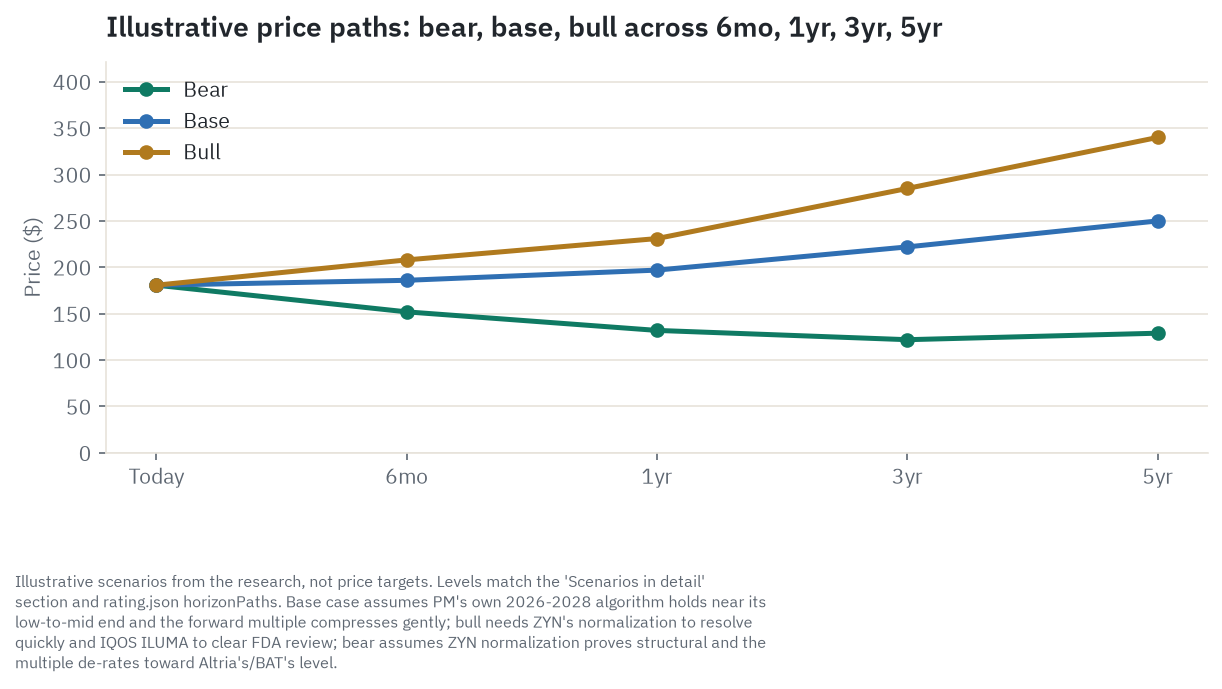
Six months. The next two quarterly reports are the whole story here. Philip Morris just posted a first-quarter US segment revenue decline of 30.8 percent and a 23.5 percent drop in ZYN pouch shipments, which management blames entirely on a distributor-inventory correction rather than any weakening in actual demand, pointing to Nielsen-measured consumer purchases that grew roughly 10 percent the same quarter. Whether the next two prints show shipments catching back up to that underlying demand, or the gap persisting for a third and fourth quarter, is the single most important thing to watch. The base case, around $186, assumes the company’s own framing holds up under one more earnings cycle of scrutiny. The bull case, near $208, needs an early, clean sign that shipments and purchases are converging again. The bear case, near $152, is what happens if the pattern repeats and the market starts treating ZYN as a normal, competitive category rather than one Philip Morris still dominates unchallenged. The single thing most likely to flip this window is the next ZYN US shipment number, read against the offtake figure Philip Morris reports alongside it.
One year. By roughly mid-2027, the ZYN question should largely be resolved one way or the other, and the dominant variable shifts to a very different regulatory clock: IQOS ILUMA, the company’s newest and most competitive heated-tobacco device, has had its US application pending with the FDA since October 2023, more than two and a half years with no decision date disclosed as of this writing. A year from now, either that has moved or it has not. The base case, around $197, assumes ZYN growth stabilizes at a lower but real pace and ILUMA’s status is essentially unchanged. The bull case, near $231, needs both a clean ZYN resolution and real forward motion on ILUMA. The bear case, near $132, is the compounding-disappointment scenario: ZYN stays soft, ILUMA stays stuck, and the market re-prices Philip Morris’s premium down toward its peers. The flip factor is whether the company’s own “channel timing, not demand” explanation for the ZYN numbers turns out to be right.
Three years. By roughly mid-2029, the structural forces take over from any single quarter’s noise. Europe’s flavor-ban and excise patchwork, currently concentrated in France’s outright nicotine-pouch ban starting March 2026 and Denmark’s severe flavor and strength caps from April 2026, with an EU-wide framework still working through transposition toward roughly 2028, either stays contained to those two countries or spreads further across Philip Morris’s second-largest developed region. And by this point, IQOS ILUMA has either turned the US into a real, commercial IQOS market or the application is still sitting in review. The base case, around $222, assumes the smoke-free mix shift keeps grinding higher while the valuation premium normalizes gradually. The bull case, near $285, needs the US IQOS opportunity to be genuinely open and contributing revenue by this point. The bear case, around $122, is a Europe that keeps adding restrictions layered on top of a US IQOS opportunity that still has not materialized, permanently capping the growth rate the current multiple assumes. The flip factor is the trend in European smoke-free volume growth measured against the spreading flavor-ban map.
Five years. By roughly mid-2031, almost everything comes down to the same driver tree compounded over time. Does Philip Morris’s blended profit mix keep improving as smoke-free products climb from 41.5 percent of revenue today toward the company’s own stated ambition of more than two-thirds by 2030, a target management has set for itself rather than a base-case forecast, and one that Morningstar’s independent model treats far more conservatively, at roughly 53 percent by that year? And does the market keep paying a premium multiple for that trajectory, or does Philip Morris eventually trade like the rest of the tobacco group? The base case, around $250, compounds adjusted earnings per share at roughly 9 percent a year, the low-to-mid end of the company’s own stated algorithm, at a still-rich but somewhat lower multiple, plus a dividend that has room to grow as debt keeps working down toward management’s own target. The bull case, near $340, is the scenario where ZYN, IQOS, and ZYN’s newly won Modified Risk marketing claim all compound together and the market keeps paying close to today’s multiple for it. The bear case, near $129, is Philip Morris settling into a normal, mid-teens-multiple tobacco stock, exactly the fate its current premium is supposed to be immune from, with earnings still growing modestly but the multiple never recovering. The flip factor across the full five years is simple to state and genuinely uncertain: does the smoke-free mix shift keep compounding fast enough to earn a premium multiple, or does Philip Morris eventually get priced like everyone else in the group.
Where the read lands today. On balance the read holds at Hold: this is the best smoke-free transition story in tobacco by a real margin, but it is also priced that way, carrying the richest multiple and the thinnest dividend cushion of any major tobacco name at exactly the moment its newest growth engine just showed how fast it can wobble. That combination argues for treating the stock as a name to own through the transition for its differentiated growth rather than one to add to at today’s premium. The lean would move up toward Buy if the next couple of ZYN shipment prints reconverge cleanly with reported consumer demand and IQOS ILUMA shows real regulatory progress, both of which would de-risk the premium the market is already paying. It would move down toward Sell if ZYN normalization drags into 2027, if France- and Denmark-style flavor restrictions spread meaningfully further across Europe, or if ILUMA remains stuck indefinitely. The nearest-term thing to watch is the next quarterly ZYN shipment number, read against the offtake figure the company reports alongside it.
Companion tool
Jump to the interactive dashboard to sort and filter Philip Morris against its global tobacco peers, or download the Excel model to flex the scenario assumptions yourself.
TL;DR
Philip Morris is running two businesses inside one company, on two very different clocks. The legacy one, cigarettes sold in roughly 175 markets outside the United States (Philip Morris sold its US cigarette rights to Altria in a 2008 spin-off and has not sold Marlboro domestically since), is a slow, managed decline that the company offsets with pricing power almost every year, funding everything else the business does. The new one, built on IQOS heated tobacco and the ZYN nicotine pouches acquired with Swedish Match in 2022, is genuinely still growing fast: smoke-free products are now 41.5 percent of net revenue and rising, IQOS is the number-one nicotine brand by volume in the markets where it operates, and ZYN just became the first nicotine pouch in history to win an FDA Modified Risk designation, letting Philip Morris market it with an explicit lower-risk-than-cigarettes claim. The tension the market is actively working through right now is that the newest and highest-multiple piece of that growth story just wobbled hard: US ZYN shipments fell 23.5 percent and the US segment’s revenue fell 30.8 percent in the first quarter of 2026, which the company attributes to a distributor-inventory correction rather than any change in underlying demand, while its own decision to scale back production shifts at its Kentucky ZYN plant suggests capacity had, at minimum, run ahead of near-term sell-through. Layer on top of that a second growth engine, IQOS ILUMA, still stuck in FDA review after two and a half years with no decision date, a spreading European flavor-ban and excise patchwork that has already produced an outright pouch ban in France and severe restrictions in Denmark, and a stock trading at the richest multiple and the lowest dividend yield of any major tobacco name, and the picture that emerges is a genuinely excellent, differentiated transition story priced for a level of certainty the most recent quarter did not fully deliver.
Explore it yourself: the interactive dashboard
Open the dashboard in a full screen
What Philip Morris actually does
Philip Morris International sells nicotine, in three different physical forms, to adult users almost everywhere on earth except the one market most Americans would assume it dominates. The company’s combustible business, Marlboro and roughly two hundred other cigarette brands, is sold in about 175 markets outside the United States. That geographic gap is not an oversight. In 2008 Philip Morris spun off from what is now Altria, and the two companies split the world: Altria kept the US cigarette rights, including domestic Marlboro, and Philip Morris kept every other market on the planet. It is the closest thing corporate history has produced to two siblings splitting a family business by continent, and it means that when people picture Philip Morris as simply “the Marlboro company,” they are picturing the wrong half of a business that has not sold a cigarette on US soil in almost two decades.
Layered on top of that combustible base, and the reason the market values Philip Morris the way it does, are two next-generation products built on genuinely different economics. IQOS is a heated-tobacco system: a reusable device heats a tobacco stick rather than burning it, on the same razor-and-blade logic as an inkjet printer or a coffee-pod machine. The device itself is sold near cost, sometimes subsidized outright in a new market, because the real business is the stick a converted smoker keeps buying, at a gross margin the company says runs comparable to or better than cigarettes once a market matures. ZYN, a tobacco-free nicotine pouch acquired through the 2022 purchase of Sweden’s Swedish Match, works on simpler economics still: there is no device to subsidize, just a tin of pouches with very high manufacturing margins once a plant runs at scale, which is exactly why Philip Morris has poured more than 800 million dollars into new and expanded US pouch manufacturing capacity since 2023.
The revenue math shows how far this shift has already gone. In the first quarter of 2026, smoke-free products, IQOS, ZYN, and the smaller VEEV e-vapor line combined, made up 43 percent of Philip Morris’s total net revenue, up from 41.5 percent for the full year 2025. International Combustibles remains the largest single segment by dollars, 5.7 billion dollars of the quarter’s 10.1 billion in total net revenue, but International Smoke-Free is now unambiguously the fastest-growing piece of the business, up 24.7 percent reported in the quarter against combustibles’ 6.8 percent. The newest and smallest segment by revenue, the US business built almost entirely around ZYN and the smaller VEEV vapor line, is the one investors watch most closely, because it is the newest and highest-multiple part of the smoke-free story and it just delivered the quarter’s most volatile result: a 30.8 percent revenue decline.
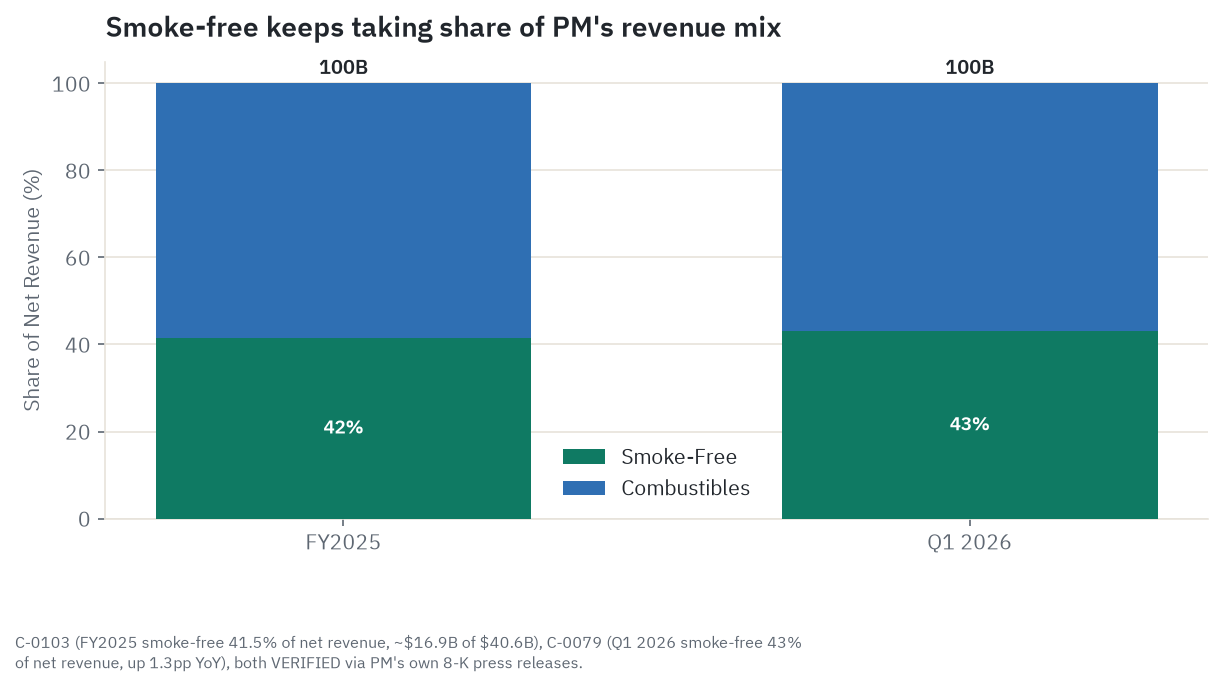
Philip Morris’s own ambition is for smoke-free products to exceed two-thirds of total revenue by 2030. That is worth stating plainly as a company target and not as a consensus forecast: Morningstar’s independent model puts the figure closer to 53 percent by the same year, a real and meaningful gap between what management is promising and what at least one respected outside analyst house expects. IQOS itself has become the clearest proof point either side can point to: the system now holds roughly 76 to 77 percent of the global heated-tobacco category by volume, and in the first quarter of 2026 it actually overtook Marlboro to become the number-one nicotine brand, across every product form, in the markets where Philip Morris operates, reaching 10.9 percent of combined cigarette-and-heated-tobacco industry volume. Japan, Philip Morris’s most mature smoke-free market and the best available preview of what a full transition looks like, offers a genuine proof of concept: heated tobacco passed 50 percent of the country’s total nicotine offtake in December 2025, with IQOS holding close to 70 percent share of that category.
How the money flows
flowchart TD
    LEAF["Tobacco leaf: 30+ countries<br/>Brazil, Malawi, Turkey, US, etc."]
    LEAF --> MERCHANTS["Leaf merchants: Alliance One/Pyxus, Universal Corp<br/>+ PM direct-buy (Brazil ~10% of leaf need)"]

    MERCHANTS --> CIGFACT["Cigarette manufacturing<br/>~50 PM plants ex-US, 800B+ cigs/yr"]
    CIGFACT --> COMBUST["International Combustibles<br/>$5.7B Q1'26 rev, +6.8% reported"]

    MERCHANTS --> HEETSFACT["IQOS stick (HEETS) plants<br/>Bologna Italy (>EUR1B), Papastratos Greece (~EUR300M)"]
    ELECTRONICS["IQOS device electronics<br/>battery/heater/PCB - contract mfrs not publicly named"]
    HEETSFACT --> IQOS["IQOS system<br/>~77% global HNB volume share, #1 nicotine brand in its markets"]
    ELECTRONICS --> IQOS
    IQOS --> SMOKEFREE_INTL["International Smoke-Free<br/>$3.8B Q1'26 rev, +24.7% reported"]

    ZYNFACT["ZYN pouch plants: Owensboro KY (+$232M), Aurora CO (+$600M)<br/>scaled back to 24/5 shifts Apr 2026"]
    ZYNFACT --> USSF["US Smoke-Free (ZYN, VEEV)<br/>$0.6B Q1'26 rev, -30.8% on inventory normalization"]

    COMBUST --> RETAIL["Wholesale/retail distribution<br/>market-by-market excise tax + marketing law"]
    SMOKEFREE_INTL --> IQOSRETAIL["IQOS-branded stores + e-commerce + 3rd-party retail"]
    USSF --> USRETAIL["US retail: gas/convenience, online age-verified"]

    RETAIL --> REG["Regulatory gate<br/>FDA PMTA/MRTP (US), EU TPD3, national excise/flavor law - recurring, not one-time"]
    IQOSRETAIL --> REG
    USRETAIL --> REG

    REG --> REVENUE["PM total net revenue<br/>$10.1B Q1'26 (+9.1% reported), smoke-free = 43% of total"]
    REVENUE --> CASH["Operating cash flow<br/>FY2026 guided ~$13.5B"]
    CASH --> DIV["Dividend - priority 1<br/>~3.24% yield"]
    CASH --> DELEV["Deleveraging - priority 2<br/>net debt/adj. EBITDA 2.61x, targeting ~2.0x by end-2026"]
    CASH --> CAPEX["Smoke-free capex - priority 3<br/>$1.4-1.6B FY2026 guided"]

    DEBT["Swedish Match acquisition debt<br/>~$16B raised 2022 to buy ZYN"] -.->|overhangs| DELEV
    EUFLAVOR["EU flavor bans/excise: France (Mar'26), Denmark (Apr'26), TPD3 (~2028)"] -.->|overhangs| SMOKEFREE_INTL
    ILUMA["IQOS ILUMA US PMTA<br/>filed Oct 2023, still pending, no date"] -.->|overhangs| USSF
Start with roughly thirty-plus countries growing tobacco leaf, the largest volumes coming from Argentina, Brazil, China, India, Italy, Indonesia, Malawi, Mozambique, the Philippines, Turkey, and the United States. Philip Morris buys some of that leaf directly, including from roughly 17,000 contracted farmers in Brazil supplying about 10 percent of its global leaf needs, and the rest through independent merchants including Alliance One, Pyxus International, and Universal Corporation. From there the chain splits three ways. Leaf destined for cigarettes flows into roughly fifty company-owned factories outside the United States, producing more than 800 billion cigarettes a year, an aging, shrinking-volume asset base that Philip Morris and its historic rival British American Tobacco have taken the unusual step of jointly petitioning European regulators to let them cross-manufacture in shared Polish, Croatian, and Portuguese plants, an arrangement that would have been unthinkable between two competitors a decade ago. Leaf destined for IQOS sticks flows into two purpose-built factories, a more than one-billion-euro complex in Bologna, Italy, and a roughly three-hundred-million-euro converted plant in Greece, both feeding the recurring consumable revenue behind IQOS’s razor-and-blade economics. ZYN pouches, which contain no tobacco leaf at all, come out of two American plants, one in Owensboro, Kentucky, inherited and expanded from Swedish Match, and a new six-hundred-million-dollar facility in Aurora, Colorado. Both finished-goods streams then move through their own distribution channel, combustibles through conventional wholesale networks, IQOS through more than eight hundred branded retail stores and e-commerce, and ZYN through age-verified US retail and online sales, before every stream passes through the same recurring chokepoint: a regulatory gate that varies market by market and never fully closes, covering FDA marketing authorization in the United States, the European Union’s evolving Tobacco Products Directive, and national excise and flavor law everywhere else. What comes out the other side funds a clear capital-allocation order: the dividend first, paying out at roughly a 3.24 percent yield, continued deleveraging of the debt raised to buy Swedish Match, and then further smoke-free manufacturing capacity.
The one genuine disclosure gap in this chain sits inside the IQOS device itself. Philip Morris names its tobacco-leaf origin countries, its cigarette factory locations, and its IQOS stick manufacturing sites in detail, but it does not publicly enumerate the contract manufacturers that build the device’s battery, heating element, and circuit board with the same specificity, describing that work only as happening at its own facilities plus unnamed “select contract manufacturers.” That is the one part of Philip Morris’s supply chain that behaves like a consumer-electronics business, sourcing batteries and printed circuit boards rather than tobacco leaf, and it is worth flagging as a real research hole rather than treating the company’s manufacturing disclosure as uniformly complete.
The brand portfolio and the margin math behind it
Marlboro remains the company’s largest single brand and, remarkably for a shrinking category, is still gaining share: it reached a record 11.0 percent of the cigarette category in the fourth quarter of 2025, and Philip Morris’s total international market share across cigarettes and heated tobacco, excluding China and the US, hit 29.2 percent for full-year 2025, up 0.2 points year over year. That is the unglamorous engine funding everything else: a shrinking category where Philip Morris is still winning share from competitors, using price to more than offset the volume decline almost every year.
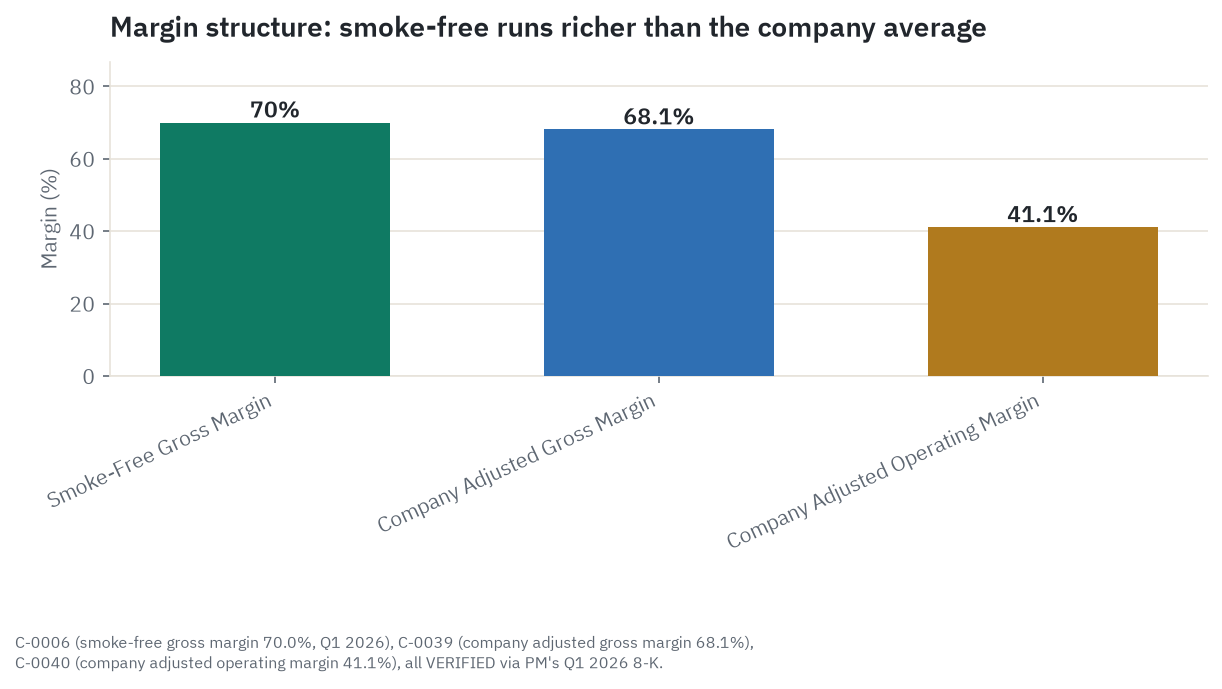
The margin chart above is the cleanest illustration of why the smoke-free shift matters as much as it does. Smoke-free products carry roughly a 70 percent gross margin, comfortably above the company’s overall adjusted gross margin of 68.1 percent in the first quarter of 2026, which itself expanded 0.6 points year over year as the smoke-free mix grew. Company-wide adjusted operating margin ran 41.1 percent in the same quarter. Every percentage point of revenue that shifts from combustibles to smoke-free products pulls the blended margin higher, even before accounting for the pricing power Philip Morris still has on the cigarette side. That is the mechanical reason a modest, single-digit shift in revenue mix can move earnings per share more than the headline revenue growth rate alone would suggest.
IQOS’s regulatory position adds a second layer most competitors cannot quickly replicate. The system holds a Modified Risk Tobacco Product authorization from the FDA, first granted in 2020 and renewed on April 17, 2026 for the IQOS 2.4 and 3.0 systems and their HEETS consumables, letting Philip Morris state in its US marketing that switching completely to IQOS reduces exposure to harmful chemicals compared with continuing to smoke cigarettes. Philip Morris describes itself as the only company to have secured and maintained that authorization for a heated-tobacco product in the United States. On June 30, 2026, ZYN won an even more novel version of the same designation: the FDA authorized twenty ZYN products, across ten flavors and two nicotine strengths, to carry an explicit Modified Risk claim, the first time any nicotine pouch in history has received that status, allowing Philip Morris to state that ZYN carries lower risk than cigarettes for a list of specific health outcomes including mouth cancer, heart disease, and stroke. That claim is an FDA-authorized marketing designation Philip Morris is permitted to make, not an independent health assessment this article is making on its own, and it functions as a real competitive moat: the review process behind it is slow and expensive enough that a fast-follower cannot cheaply copy the claim, only the product.
That moat has also, historically, been a genuine litigation risk rather than a purely hypothetical one. Philip Morris and British American Tobacco fought a multi-year global patent war over heated-tobacco device technology, IQOS’s heating-blade design against BAT’s induction-based glo system, and BAT’s US subsidiary won an International Trade Commission exclusion order against IQOS imports in November 2021 before the two companies settled all the litigation globally and lifted the import threat. It is a useful reminder that Philip Morris’s device intellectual property is a real asset precisely because it has been worth fighting over, not because it has gone unchallenged.
Who wins where
Tracing the chain from raw leaf to finished sale makes clear who actually captures the economics of a Philip Morris product, and the answer shifts depending on which of the three product lines is being discussed.
Tobacco farmers and leaf merchants sit at the base of the chain with the thinnest, most commoditized margins, and carry real reputational risk alongside the financial kind: Philip Morris’s largest-volume leaf-growing regions, including parts of Africa and South Asia, have drawn sustained scrutiny from non-governmental organizations over child labor and farmer debt, which is part of why the company has pushed direct-sourcing programs like its roughly 17,000-farmer Brazilian initiative that give it more traceability than buying blind through merchants.
Combustible cigarette manufacturing is a shrinking, capital-intensive layer that Philip Morris increasingly treats as a cost to be optimized rather than a growth engine, evidenced most starkly by its willingness to cross-manufacture with British American Tobacco, a historic rival, simply to cut excess capacity across both companies’ European plants.
IQOS and ZYN manufacturing sit at the top of the value chain in a genuinely different way: purpose-built, high-margin plants that behave more like consumer-electronics or fast-moving-consumer-goods factories than classic tobacco operations, and they are where nearly all of Philip Morris’s incremental capital investment is now going. That is also where the newest volatility lives, visible in the Owensboro, Kentucky ZYN plant’s shift from around-the-clock production to a reduced schedule in April 2026, direct evidence that capacity built for one growth rate ran ahead of the demand actually showing up at the register in early 2026.
Retailers, whether a convenience store selling cigarettes and ZYN cans or a dedicated IQOS-branded store, have real leverage against most consumer-goods suppliers but comparatively little against Philip Morris specifically in markets where its brands dominate, because no retailer serving adult smokers can credibly skip Marlboro or IQOS from the shelf.
Regulators sit above every other layer in this chain and are, more than in almost any other consumer category, the single biggest swing factor in where value ultimately accrues. The same government that authorized ZYN’s Modified Risk marketing claim in June 2026 is, through individual member states, simultaneously banning nicotine pouches outright in France and capping their flavors and strength in Denmark starting the same year, a reminder that Philip Morris operates in a business where the rules can tighten and loosen in different markets at the same time, sometimes over the very same product.
As a point of consumer-staples comparison for a reader weighing Philip Morris against other high-yield, mature dividend payers, Coca-Cola sits in a structurally different part of the staples universe: a concentrate-and-brand licensing model facing its own volume-growth and health-driven demand questions, but without the outright product bans and category-specific FDA authorization regime that define tobacco’s regulatory picture.
Company by company: who’s who
Philip Morris International Inc. (PM), NYSE, market cap approximately $281.7 billion as of July 2, 2026. The largest international, ex-US tobacco company by revenue and the clear global leader in heated tobacco, with IQOS holding roughly 76 to 77 percent of global heat-not-burn volume, and the number-one nicotine pouch brand in the US via ZYN. First-quarter 2026 results: net revenue up 9.1 percent reported (2.7 percent organic) to $10.1 billion; smoke-free products 43 percent of revenue and up 12.4 percent; adjusted diluted earnings per share of $1.96, up 16.0 percent. IQOS overtook Marlboro as the number-one nicotine brand in its markets during the quarter, while US ZYN shipments fell 23.5 percent on inventory normalization, dragging the US segment down 30.8 percent. Bull: IQOS and ZYN give Philip Morris a genuine multi-year growth story layered on top of a cash-generative legacy cigarette business, with smoke-free products already 43 percent of revenue and rising. Bear: US ZYN demand just showed how fast the newest growth engine can swing on inventory and competitive noise, and the stock’s premium multiple leaves little room for that pattern to repeat across IQOS.
Altria Group, Inc. (MO), NYSE, market cap approximately $120.95 billion. The dominant player in the US cigarette market and Philip Morris’s direct historical sibling from the 2008 spin-off, now a domestic-only, high-yield tobacco name rather than a smoke-free growth story. First-quarter 2026 smokeable-products net revenue rose 2.9 percent to $4.76 billion, revenue net of excise tax rose 5.2 percent to $4.11 billion, reported operating companies income rose 8.3 percent to $2.67 billion, and adjusted diluted earnings per share rose 7.3 percent company-wide; its e-vapor brand NJOY is no longer broken out as its own reportable segment as of the quarter. As a fellow high-yield tobacco name, Altria offers the sharpest available valuation contrast to Philip Morris: a trailing price-to-earnings ratio of roughly 15.0 times against Philip Morris’s 25.0 times, and a dividend yield of 5.85 percent against Philip Morris’s 3.24 percent. Bull: the cheapest multiple and highest yield in the group, with a still-resilient US combustibles base and steady buybacks and eighteen consecutive years of dividend growth. Bear: structurally the most exposed name in the group to secular US cigarette volume decline, with the least next-generation-product momentum now that NJOY has been de-emphasized.
British American Tobacco p.l.c. (BTI), NYSE-listed ADR, market cap approximately $130.16 billion. Philip Morris’s closest global-scale peer and IQOS’s and ZYN’s most direct multi-category competitor, through Vuse in vapor and Velo in modern-oral nicotine pouches. A mid-2026 pre-close trading update showed Velo’s modern-oral volume share in its top markets rising 350 basis points to 29.7 percent, with US modern-oral revenue up 297 percent reported behind the Velo Plus launch, reaching roughly second place in US volume and value share within a year, while Vuse vapor revenue fell 6.4 percent reported under pressure from illicit single-use vapes. Bull: Velo’s US momentum shows British American Tobacco can take real share from ZYN in the exact category Philip Morris is counting on for growth, and it trades at the cheapest multiple in the peer group. Bear: Vuse vapor revenue is shrinking under illicit-product competition, showing next-generation categories are not a uniform one-way win even for a well-capitalized global player.
Japan Tobacco Inc. (JAPAY), OTC American Depositary Receipt, market cap approximately $66.55 billion. The smallest of the four major international peers by market capitalization, but the most levered outside Philip Morris to heated tobacco’s fastest-growing pocket, through its Ploom platform now sold in roughly 25 to 29 markets. First-quarter 2026 revenue rose 15.2 percent to 924.0 billion yen, operating profit rose 24.7 percent to 304.6 billion yen, and reduced-risk-product revenue rose 63.8 percent to 43.5 billion yen, or roughly 278 million dollars, on 44.2 percent volume growth. Bull: the highest dividend yield in the group, at roughly 8.31 percent, alongside genuine Ploom-driven momentum and a dominant home-market position in Japan. Bear: a thinly traded over-the-counter ADR for US investors relative to its primary Tokyo Stock Exchange listing, with reduced-risk-product growth still coming off a much smaller base than IQOS.
Imperial Brands PLC (IMBBY), OTC American Depositary Receipt, market cap approximately $28.29 billion. The smallest of the four global majors, historically viewed as a value and cash-return name rather than a next-generation-product leader. First-half fiscal 2026 revenue reached 14.72 billion pounds versus 14.60 billion pounds a year earlier, with tobacco-and-next-generation-products net revenue up 1.8 percent at constant currency and adjusted earnings per share up 5.3 percent to 127.7 pence, while its blu vapor brand gained 130 basis points of share and held double-digit share in the UK, Spain, and France. Bull: the cheapest trailing price-to-earnings ratio in the group, at roughly 12.3 times, with a reaffirmed transformation plan and steady buybacks. Bear: the smallest next-generation scale of the four majors and the least exposure to the heated-tobacco and modern-oral categories driving Philip Morris’s and British American Tobacco’s growth narratives.
What the filings say
Revenue, margins, and the quality of the growth. First-quarter 2026 total net revenue was $10.1 billion, up 9.1 percent reported and 2.7 percent organic. By product type rather than geography, smoke-free products contributed $4.4 billion, up 12.4 percent and now 43 percent of the total, while combustible products contributed $5.8 billion, up 6.7 percent. By geographic segment, International Combustibles delivered $5.7 billion, up 6.8 percent reported but only 1.0 percent organic; International Smoke-Free delivered $3.8 billion, up 24.7 percent reported and 15.8 percent organic on 11.9 percent volume growth, with gross profit up 28.6 percent reported; and the US segment, built almost entirely around ZYN and the smaller VEEV vapor line, delivered just $0.6 billion, down 30.8 percent reported and 31.6 percent organic, driven by a 21.2 percent decline in US smoke-free shipment volumes and specifically a 23.5 percent drop in ZYN pouch shipments to 2.3 billion pouches, or roughly 155 million cans. Adjusted gross margin was 68.1 percent, up 0.6 points year over year, and gross profit reached $6.9 billion, up 10.1 percent. Operating income margin was 40.7 percent reported and 41.1 percent adjusted. Adjusted diluted earnings per share reached $1.96, up 16.0 percent from $1.69 a year earlier; reported, GAAP diluted earnings per share was $1.56, down 9.3 percent from $1.72, with the entire gap driven by fair-value adjustments on equity investments rather than any deterioration in the operating business, since operating income margin actually expanded year over year.
The single most important nuance in the whole filing sits inside that ZYN number. Management’s explanation is that the shipment decline reflects a distributor and retail-inventory correction, not weakening consumer demand, and it points to Nielsen-measured ZYN offtake, meaning actual purchases by consumers at the register, growing roughly 10 percent in the same quarter. That gap between what Philip Morris ships to distributors and what consumers actually buy has shown up before: full-year 2025 ZYN shipments were 794 million cans, including 196 million cans in the fourth quarter alone, up 19 percent year over year, while Nielsen-estimated fourth-quarter offtake grew an even faster 23 percent. A reader who sees only the negative 23.5 percent headline risks badly misreading the underlying business, but it is worth being precise about whose framing this is: the offtake data Philip Morris cites comes from the company’s own reporting of third-party Nielsen figures, not from an independently pulled dataset, and the company’s own operating decision in April 2026 to scale back the Owensboro, Kentucky plant from around-the-clock to a reduced production schedule is, at minimum, consistent with capacity having run ahead of near-term sell-through, whatever the ultimate cause.
Segments and geography. International Combustibles remains the largest segment by absolute revenue at $5.7 billion in the quarter, or roughly 56 percent of the total, funding the rest of the business even as it grows slowly. International Smoke-Free, at $3.8 billion, is now unambiguously the fastest-growing segment. The US segment is small in absolute dollars, roughly 6 percent of total quarterly revenue, but is the segment investors watch most closely because it is the newest and highest-multiple part of the smoke-free story.
IQOS and VEEV in the numbers. IQOS heated-tobacco-unit shipment volume grew 11.3 percent in the quarter, broadly matching adjusted in-market sales growth of 10.9 percent, meaning the shipment growth looks like real consumer demand rather than channel stuffing. VEEV, the smaller e-vapor line, shipped more than one billion equivalent units in a single quarter for the first time, up 94.8 percent year over year, and now shares the number-one closed-pod position in Europe by Nielsen’s estimate.
Cash flow and the balance sheet. Operating cash flow was seasonally negative in the quarter, at negative $399 million versus negative $350 million a year earlier, a normal pattern for Philip Morris’s first quarter given working-capital and excise-tax timing, though the year-over-year figure did worsen modestly. Net debt to adjusted EBITDA stood at 2.61 times as of March 31, 2026, with management guiding toward a target closer to 2.0 times by the end of 2026. Total debt has been reported elsewhere at approximately $51.9 billion as of the same date, but that figure traces to a secondary summary of the quarterly filing rather than a figure independently confirmed against the primary balance sheet in this research pass, so the net-debt-to-EBITDA ratio, which is directly company-reported, is the more reliable leverage figure to anchor on. The leverage itself is a legacy of the roughly 16 billion dollars of new debt Philip Morris raised in 2022 to fund the Swedish Match acquisition that brought ZYN in-house, and it means the company is more rate-sensitive than a typical staple with a pristine balance sheet, even though an A-rated issuer with predictable, recession-resistant cash flow can service this level of debt through a wide range of rate environments and deleveraging is already underway.
Guidance. Alongside first-quarter results, Philip Morris guided full-year 2026 reported diluted earnings per share to $7.56 to $7.71 and adjusted diluted earnings per share to $8.36 to $8.51, representing growth of 10.9 to 12.9 percent over 2025’s $7.54 adjusted diluted earnings per share. Full-year organic net revenue growth is guided at 5 to 7 percent, and organic operating income growth at 7 to 9 percent, with operating cash flow guided to approximately $13.5 billion and capital expenditures guided to $1.4 to $1.6 billion, predominantly for continued smoke-free manufacturing capacity. Separately, in February 2026, Philip Morris issued a new multi-year growth algorithm for 2026 through 2028: organic net revenue growth of 6 to 8 percent a year, organic operating income growth of 8 to 10 percent a year, and adjusted diluted earnings per share growth, excluding currency effects, of 9 to 11 percent a year, explicitly assuming no share repurchases over the period, meaning the company expects that entire earnings growth rate to come from the operating business itself rather than a shrinking share count.
Disclosed regulatory catalysts. Two live regulatory questions define the next one to two years of the US growth story. IQOS ILUMA, the company’s most advanced current-generation heated-tobacco device, filed its US premarket application in October 2023 and remained undecided as of the first quarter of 2026, more than two and a half years under review with no decision date disclosed; the April 17, 2026 FDA action renewed Modified Risk status only for the older IQOS 2.4 and 3.0 systems, explicitly not ILUMA. Until that clears, Philip Morris’s most competitive current device cannot be sold at scale in the United States. Separately, ZYN Ultra, a stronger nicotine-pouch variant, remains under active FDA review as part of the agency’s nicotine-pouch pilot program, with the company saying only that it is preparing further launches “in the coming months,” with no firm date attached.
Ownership. Philip Morris’s shareholder base is reported to be roughly 81 percent institutional and under 1 percent insider, with Vanguard Group the largest reported holder at approximately 9.3 percent and BlackRock at approximately 6.6 percent, though these figures come from secondary aggregators rather than a primary 13F or 13G filing pulled directly in this research pass, and should be read as directional rather than precise. A 2026 proxy statement was filed with the SEC on March 25, 2026, though its full ownership table was not independently extracted for this piece.
What the market is paying
Price and range. Philip Morris last traded at $180.75 on July 2, 2026, up roughly 1.7 percent on the day, within a 52-week range of $142.11 to roughly $193.05. Vendor sources show a minor, immaterial discrepancy on the exact 52-week-high date, so this piece cites the level without asserting a specific date. Market capitalization was approximately $281.7 billion, with an enterprise value of roughly $323.45 billion on about 1.56 billion shares outstanding.
Returns. This is the weakest data set in the market-action research for this piece, and it deserves real caution rather than a precise figure. Different vendor snapshots at different points in 2026 showed materially inconsistent one-year and year-to-date return figures, so no specific return percentage is stated here as fact. What is consistent across multiple independent sources is the shape of the year: the stock ran to a high near $191 to $193 in February 2026, sold off to a trough near $161 around May and June, roughly coinciding with the period when the ZYN and US inventory story became visible in the first-quarter results, and has since recovered to the low $180s by the July 2026 research date.
Volatility, beta, and short interest. Five-year beta is 0.40, a notably low figure consistent with tobacco’s classic defensive profile, and lower than Altria’s 0.50, though British American Tobacco’s beta is lower still at 0.13. Short interest stood at roughly 16.93 million shares, or 1.09 percent of shares outstanding, a low level suggesting little organized bearish positioning through the short book despite the year’s volatility.
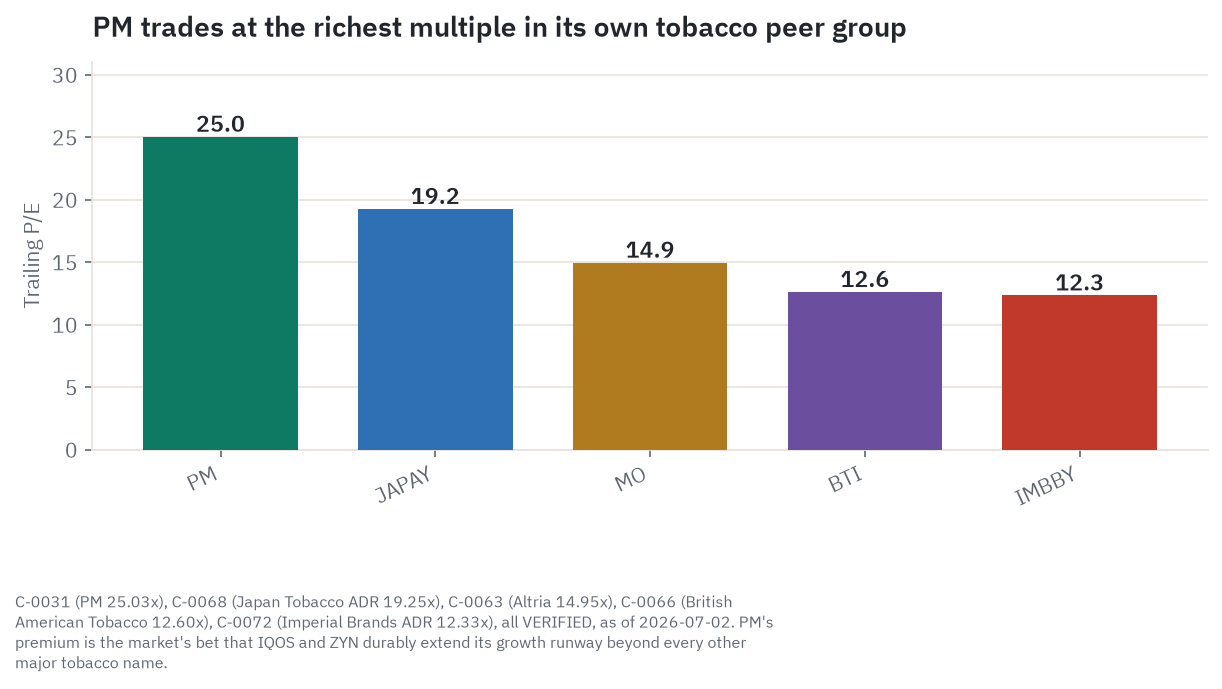
Valuation relative to peers. Philip Morris trades at a clear premium to every other major tobacco name on every metric checked. Trailing price-to-earnings runs approximately 25.03 times, against Japan Tobacco’s 19.25 times, Altria’s 14.95 times, British American Tobacco’s 12.60 times, and Imperial Brands’ 12.33 times. Forward price-to-earnings runs roughly 20.77 times, against Altria’s 12.47 times and British American Tobacco’s 12.56 times. Enterprise value to EBITDA runs approximately 17.40 times, against Altria’s 8.98 times and British American Tobacco’s 10.86 times, meaning Philip Morris trades at close to double Altria’s multiple on this basis. The price-to-earnings-growth ratio sits near 2.05, meaning even adjusted for its faster growth rate the market is not treating Philip Morris as cheap. The single clearest number in this entire section is the dividend yield: Philip Morris pays 3.24 percent, barely more than half of every other major peer’s yield, with Altria at 5.85 percent, British American Tobacco at 5.08 percent, Imperial Brands at 5.79 percent, and Japan Tobacco at 8.31 percent. The honest read is that the market has unambiguously chosen to price Philip Morris as the growth name in a group of income names, which is exactly why it carries the least valuation cushion of any major tobacco stock if the IQOS or ZYN growth story disappoints.
Sell-side. Consensus leans Buy across independently corroborated sources. Stockanalysis.com shows a Buy consensus from 15 analysts with a mean target of $194.86, implying roughly 7.8 percent upside from the price used in that read. Marketbeat.com shows a Moderate Buy consensus from 12 analysts, ten rating it a buy and two a hold, with an average target of $194.63 and a range of $180.00 to $210.00. The two sources converge closely on a mean target near $194 to $195, a reasonably clean corroboration, and that convergence implies sell-side sentiment that is constructively positive but far from euphoric, with the average target sitting only a manageable single-digit percentage above the current price.
What the crowd is saying
News coverage through the first half of 2026 tells a story of a tug-of-war between genuinely strong headline results and mounting worry about ZYN’s US growth trajectory. Coverage warmed sharply on June 30, 2026, when the FDA granted the first-ever Modified Risk designation to a nicotine pouch, prompting a wave of bullish sell-side commentary, including price-target raises from major banks citing both the ZYN designation and progress in the IQOS Japan market. Coverage had cooled earlier in the year around the first-quarter print, where the chief financial officer’s own characterization of ZYN’s 2023-to-2025 profitability as “abnormal,” alongside the slowing US shipment numbers, read to much of the financial press as a signal that the best of the ZYN growth-and-margin story might be behind it, at least for now. The net tone across the year is a company delivering strong headline execution while the market actively re-prices how much of the ZYN growth story was cyclical versus structural.
Retail-investor commentary, as read through financial-media aggregation rather than direct social-platform scraping, characterizes Philip Morris as a quality, dividend-paying compounder rather than a hot momentum name, consistent with its consumer-staples, high-yield profile. The prevailing narrative combines powerful current execution and a real smoke-free moat with genuine concern about ZYN’s deceleration and regulatory noise, rather than settling firmly into either a bullish or bearish consensus. Nothing in the sources reviewed suggests coordinated pump-style chatter, which is expected for a large, heavily analyst-covered, deeply liquid stock rather than a thin-float name.
The clearest divergence between the crowd’s narrative and the underlying fundamentals is in how fast sentiment swung on ZYN relative to how much the actual regulatory picture changed. ZYN’s regulatory position objectively improved over the period in question, moving from FDA marketing authorization in January 2025 to the far stronger Modified Risk designation in June 2026, the best regulatory endorsement any nicotine pouch has ever received, even as the stock and sell-side sentiment wobbled hard on a single quarter of promotional-driven US weakness. That is a case where the market’s short-term narrative moved faster than the underlying regulatory and competitive fundamentals, which if anything strengthened over the same window; the stock’s roughly 10 percent pullback over one recent trailing 90-day stretch suggests the market leaned, at least temporarily, toward pricing in more of the bear case than the hard data at the time clearly supported.
A second, smaller divergence involves a Washington DC Attorney General subpoena into ZYN.com’s compliance with the district’s flavored-tobacco ban, reported by a single trade publication, which generated headlines describing Philip Morris as having “suspended ZYN sales.” The underlying fact is narrower and less alarming than that framing suggests: Philip Morris paused only its own online sales channel nationwide as a precaution while the inquiry proceeds, retail sales continued unaffected, and online sales represent a small share of total ZYN volume by the company’s own characterization. This is worth naming as an example of narrative volume outrunning the underlying financial materiality of an unresolved, investigative matter, not as evidence of any adjudicated wrongdoing.
How durable is the moat, and what would actually break it
The structural bull case for Philip Morris does not require anything new to be invented; it requires the transition already well underway to keep compounding. Smoke-free products carry meaningfully higher gross margins than the legacy cigarette business, IQOS’s regulatory authorizations and device-and-consumable ecosystem are hard for a fast-follower to cheaply replicate, and ZYN’s newly won Modified Risk status is a real, evidence-backed marketing asset that took years and real money to earn. If IQOS keeps taking share from cigarettes across Europe, Japan, and emerging markets, and ZYN holds its US category leadership even as competition intensifies, Philip Morris’s blended margin mix keeps improving even as total nicotine-use prevalence keeps declining globally, a company genuinely growing profit inside a shrinking underlying category by capturing a rising share of it at higher margin per unit. That is a company-specific, structural story rather than a bet that this particular business cycle happens to be different.
The real near-term bear case is not a crash. It is a normalization that runs deeper and lasts longer than the market currently expects, with a specific, plausible mechanism and timeline. Over the next two to four quarters, ZYN’s US shipment numbers stay choppy as channel inventory works itself out against genuinely intensifying promotional competition from Altria’s On! and British American Tobacco’s Velo, the latter already showing 297 percent reported US revenue growth and roughly second-place US share within a year of its relaunch. Even if Philip Morris’s own “channel timing, not demand” framing turns out to be broadly correct, the market may still re-price the category’s overall growth rate down from the 2023-to-2025 land-grab pace to something closer to a normal, competitive consumer category, permanently lower than what justifies today’s multiple. Layer on top of that IQOS ILUMA sitting in FDA review with no decision date, keeping the US IQOS opportunity theoretical rather than commercial for at least the next year or two, and Europe’s flavor-ban and excise patchwork, currently concentrated in France and Denmark but with an EU-wide framework still working through transposition toward roughly 2028, starting to show up as a measurable drag on smoke-free growth in Philip Morris’s second-largest developed region. None of this individually breaks the transition story: IQOS’s device-and-stick economics and ZYN’s underlying US demand both look durable on the evidence available today. Together, though, a slower and lumpier growth path than 2023-to-2025, a US IQOS opportunity that stays gated for longer than hoped, a tightening European regulatory environment, and a balance sheet still working down the debt from the acquisition that bought ZYN in the first place, are exactly the ingredients for the market re-asking why Philip Morris deserves close to double Altria’s multiple and the lowest dividend yield in its own peer group, and compressing that multiple even if the underlying smoke-free transition keeps working, just on a longer and lumpier timeline than the current price assumes.
There is also a structural, sector-wide headwind that sits above both the bull and bear cases and applies to Philip Morris regardless of how well it executes: a meaningful share of institutional capital simply will not own tobacco manufacturers, on principle, under sustainability and ESG mandates common across the asset-management industry. No specific dollar figure for that excluded pool of capital is sourced in this research pass, so none is claimed, but the dynamic itself is real and well documented at the sector level, and it structurally caps the pool of natural buyers for the stock relative to a similarly profitable business in an unrestricted sector. It is one reason tobacco as a group tends to trade at a valuation discount to the broader market even when individual operators, Philip Morris very much included, are executing well, and it is a permanent tax on the multiple rather than a cyclical one that fades with the next good quarter.
The most likely outcome sits between the clean bull and the deep bear, as it usually does with a maturing growth story. ZYN’s US shipment numbers probably do reconverge with reported offtake over the next several quarters, roughly consistent with management’s own framing, but probably settle into a real, meaningfully lower growth rate than 2023-to-2025 rather than resuming that earlier pace. IQOS ILUMA probably does eventually clear FDA review, but on a timeline that extends past what the bull case currently assumes, keeping the full US IQOS opportunity a multi-year story rather than a near-term catalyst. Europe’s flavor-ban patchwork probably continues spreading gradually rather than exploding across the whole region at once, adding real but manageable drag rather than derailing the smoke-free thesis outright. Net effect: smoke-free products keep rising as a share of profit, but the growth rate of that shift, and the multiple the market is willing to pay for it, both likely compress somewhat from the 2023-to-2025 peak, exactly the tension the base-case scenario below tries to capture.
The scenarios in detail
Four variables decide Philip Morris’s outcome over the next five years, and every scenario below is simply a different setting of these same four dials.
Whether ZYN’s US growth resumes at a real, if lower, rate, or keeps normalizing lower. This is the master near-term variable and the one the bull case is quietest about. The first-quarter 2026 US segment revenue decline of 30.8 percent and ZYN shipment decline of 23.5 percent is, by management’s own account, a distributor-inventory correction rather than a demand problem, backed by Nielsen-measured consumer offtake that grew roughly 10 percent the same quarter. But the company’s own decision to scale back the Owensboro, Kentucky plant’s production schedule is, at minimum, consistent with capacity having run ahead of near-term demand. Whether the next two or three quarters show shipments catching back up to offtake, or the gap persisting, is the hinge the near-term price swings on.
Whether IQOS ILUMA clears FDA review and the US IQOS opportunity turns commercial rather than theoretical. Philip Morris’s most advanced current-generation heated-tobacco device has had its US application pending since October 2023, more than two and a half years as of the first quarter of 2026, with no decision date disclosed. The April 2026 FDA action renewed Modified Risk status only for the older IQOS 2.4 and 3.0 systems, explicitly not ILUMA. Until this clears, the single biggest incremental market for IQOS stays closed to Philip Morris’s best device.
Whether Europe’s flavor-ban and excise patchwork stays contained or spreads. France bans nicotine pouches outright starting March 2026, Denmark imposes severe flavor and nicotine-strength caps from April 2026, and the European Union’s TPD3 revision brings pouches into regulatory scope for the first time, with full effect realistically around 2028 after national transposition. Whether this stays a two-country problem or becomes a wider EU-wide drag on smoke-free economics in Philip Morris’s second-largest developed region matters more at the three-to-five-year horizon than the six-month one.
The multiple, and whether the market keeps paying Philip Morris’s premium. Philip Morris trades at the richest multiple of any major tobacco name on every metric checked, roughly double Altria’s on an enterprise-value-to-EBITDA basis, and pays the lowest dividend yield in the group at 3.24 percent. That premium is the market’s bet that IQOS and ZYN durably extend Philip Morris’s growth runway beyond any other major tobacco name. It is also the company’s single biggest valuation risk, because there is no high starting yield underneath the stock to cushion a de-rate the way there is at Altria, British American Tobacco, or Imperial Brands if the growth story disappoints.
Bull case. ZYN’s first-quarter shipment decline proves to be exactly the one-to-two-quarter channel correction management describes, and US shipment growth reconverges with the roughly 10 percent offtake growth the company continues to report. IQOS ILUMA clears FDA review within the next one to two years, opening the US market to Philip Morris’s most competitive device. ZYN’s new Modified Risk status converts into real US share gains against Altria’s On! and British American Tobacco’s Velo rather than remaining just a marketing claim. Europe’s flavor-ban patchwork stays contained to France and Denmark rather than spreading. Adjusted diluted earnings per share compounds at the high end of the company’s own stated 9-to-11-percent algorithm, roughly 11 percent a year, and the forward multiple holds in the 23-to-24-times range throughout, roughly where it trades today, because durability gets proven rather than merely assumed. Earnings per share would grow from $7.54 in fiscal 2025 toward roughly $14.40 by fiscal 2031, implying a price near $340 by roughly mid-2031, an order-of-magnitude trajectory and an estimate, never a price target. What has to be true: ZYN’s normalization resolves quickly and IQOS ILUMA actually clears. What is most likely to break it: ZYN normalization drags past 2026 into a multi-year pattern, or ILUMA stays stuck in FDA review indefinitely.
Base case. ZYN’s US shipment volume stabilizes at a real, if meaningfully lower, growth rate than 2023-to-2025 as channel inventory works itself out over two to three quarters. IQOS ILUMA’s US status remains unresolved through most of the horizon, keeping the US IQOS opportunity real but still mostly ahead of the company rather than behind it. Europe’s flavor-ban and excise patchwork adds real but manageable drag, concentrated in a handful of markets rather than becoming EU-wide before 2028. Adjusted diluted earnings per share compounds at roughly 9 percent a year, the low-to-mid end of the company’s own stated algorithm, while the forward multiple compresses gently from today’s roughly 20.8 times toward the high teens as the market normalizes what is still the fastest-growing major tobacco name into a maturing, rather than land-grab, growth story. Earnings per share would grow from $7.54 toward roughly $13.00 by fiscal 2031, implying a price near $250 by roughly mid-2031, an estimate, alongside a dividend currently yielding 3.24 percent with room to grow as leverage works toward the company’s own 2.0-times target. What has to be true: the smoke-free mix shift keeps grinding higher and no individual regulatory or competitive shock lands. What is most likely to break it: ZYN normalization taking longer than a couple of quarters, pulling the whole timeline right without changing the eventual destination.
Bear case, anchored on the skeptic’s strongest argument. ZYN’s first-quarter shipment decline is not a one-quarter channel-inventory blip but the start of a genuine reset from a supply-constrained land-grab pace to a normal, competitive category, with Altria’s On! and British American Tobacco’s Velo, the latter already at 297 percent reported US revenue growth, continuing to take real share. IQOS ILUMA stays stuck in FDA review through most of the horizon, keeping the US IQOS opportunity theoretical rather than commercial. France’s outright pouch ban and Denmark’s flavor and strength caps prove to be the leading edge of a wider European pattern rather than contained exceptions, and the EU’s TPD3 and excise framework lands harder than expected once fully transposed around 2028. Philip Morris’s still-real leverage, net debt to adjusted EBITDA of 2.61 times as of the first quarter of 2026, working toward but not yet at the company’s own 2.0-times target, limits capital-allocation flexibility if any of the above forces a reinvestment response. Adjusted diluted earnings per share growth slows to roughly 5 percent a year, well below the stated 9-to-11-percent algorithm, and the multiple de-rates from today’s roughly 20.8 times forward toward the low-to-mid teens where Altria and British American Tobacco already trade, as the market decides Philip Morris no longer deserves close to double its cheapest peer’s multiple for a growth rate that no longer clearly justifies it. Earnings per share would crawl from $7.54 toward roughly $10.34 by fiscal 2031, implying a price near $129 by roughly mid-2031, modestly below today’s price on a five-year view, with total return kept only marginally positive by the dividend, an estimate. What has to be true: ZYN’s normalization proves structural rather than transitory, and the European regulatory patchwork spreads meaningfully, and IQOS ILUMA never clears within the horizon. What would rescue the bull case from here: a clean, early ZYN shipment-and-offtake reconvergence paired with real IQOS ILUMA progress.
Catalysts and timeline. In the near term, the second- and third-quarter 2026 earnings reports are the single most important events, the first real test of whether ZYN shipment volume catches back up to reported offtake. The IQOS ILUMA FDA decision could land at any point, with no disclosed timeline, and is a binary swing for the US IQOS opportunity specifically. The ZYN Ultra review, part of the FDA’s nicotine-pouch pilot program, could also produce a decision with no firm date attached. The unresolved Washington DC Attorney General subpoena into ZYN.com’s compliance is a smaller, less financially material item worth tracking for resolution. Over a multi-year horizon: the European Union’s TPD3 framework is expected to be finalized around mid-2026, with roughly a two-year national transposition period after that before it takes full effect; Philip Morris’s own deleveraging path toward its stated 2.0-times net-debt-to-EBITDA target by the end of 2026 bears watching if smoke-free growth disappoints; and the pace at which smoke-free products climb from 41.5 percent of revenue toward the company’s own two-thirds-by-2030 ambition, against Morningstar’s more conservative 53 percent estimate, is the clearest single long-run scorecard.
Leading indicators to watch. ZYN US shipment volume measured against Nielsen-reported offtake is the master near-term indicator: reconvergence within two to three quarters points toward the base or bull case, a persistent or widening gap points toward the bear case. IQOS ILUMA’s FDA status is a binary swing specifically for the US IQOS opportunity. The International Smoke-Free segment’s growth rate relative to International Combustibles is the clearest single read on whether the mix shift the entire multiple rests on is accelerating, holding, or decelerating. The count of European countries imposing France- or Denmark-style flavor and pouch restrictions, beyond the two that have already moved, is a direct read on how fast the European headwind is spreading. Net debt to adjusted EBITDA trending toward the company’s own 2.0-times target confirms whether deleveraging stays on track. And the forward price-to-earnings premium over Altria and British American Tobacco is worth watching directly: whether the roughly two-times gap versus Altria holds, widens, or compresses is the bear signal materializing in real time if it starts to close.
Companies to watch (bull / base / bear)
Philip Morris International (PM), the smoke-free transition leader at the top of the tobacco valuation table. Bull: ZYN’s normalization resolves quickly, IQOS ILUMA clears FDA review, and the smoke-free mix shift keeps compounding at a held premium multiple. Base: ZYN stabilizes at a lower but real growth rate, ILUMA stays pending through most of the horizon, and the premium multiple compresses gently as the market normalizes a maturing growth story. Bear: ZYN normalization proves structural rather than transitory, Europe’s flavor-ban patchwork spreads, ILUMA never clears within the horizon, and Philip Morris re-rates down toward its cheaper peers’ multiples. Watch: the next ZYN US shipment number against reported offtake, and any movement on IQOS ILUMA’s FDA status.
Altria Group (MO), the cheapest multiple and highest-yield name among the US-anchored majors. Bull: a still-resilient US cigarette base, an 18-year buyback-and-dividend-growth streak, and the cheapest valuation in the group continue rewarding patient income investors. Base: secular US cigarette volume decline continues, roughly offset by pricing, with modest overall earnings growth. Bear: structurally the most exposed name in the group to US cigarette volume decline, now with the least next-generation-product momentum after de-emphasizing NJOY. Watch: whether Altria’s own next-generation efforts (on! nicotine pouches specifically) can hold share against ZYN and Velo.
British American Tobacco (BTI), the most direct multi-category competitor to both IQOS and ZYN. Bull: Velo’s 297 percent US revenue growth and roughly second-place share within a year prove British American Tobacco can take real modern-oral share from ZYN, at the cheapest multiple in the peer group. Base: Velo keeps gaining share gradually while Vuse vapor stabilizes as illicit-product pressure eases. Bear: Vuse vapor revenue keeps shrinking under illicit single-use-vape competition, showing next-generation categories are not a uniform win even for a well-capitalized global player. Watch: Velo’s US share trend against ZYN specifically, and any stabilization in Vuse vapor revenue.
Japan Tobacco (JAPAY), the highest-yielding major with genuine Ploom-driven momentum but comparatively thin US-investor liquidity. Bull: Ploom’s expansion across roughly 25 to 29 markets and Japan’s advanced heated-tobacco transition keep reduced-risk-product revenue compounding at a high rate. Base: steady, Japan-anchored growth continues at a slower international pace than IQOS’s. Bear: the thinly traded US ADR remains a poor liquidity proxy for the primary Tokyo Stock Exchange listing, and reduced-risk-product growth stays a smaller share of the total business than at Philip Morris. Watch: Ploom’s market-count expansion and Japan’s heated-tobacco offtake share trend.
Imperial Brands (IMBBY), the smallest and cheapest of the four global majors. Bull: the cheapest trailing multiple in the group, a reaffirmed 2030 transformation plan, and steady buybacks reward a patient value-oriented holder. Base: modest constant-currency growth continues, with blu vapor gradually gaining share in its core European markets. Bear: the smallest next-generation scale of the four majors leaves it least exposed to the fastest-growing categories driving Philip Morris’s and British American Tobacco’s growth narratives. Watch: blu’s share trend in the UK, Spain, and France, its strongest markets.
Risk controls
Philip Morris’s risk profile concentrates in regulation and capital structure rather than in the underlying demand for its products, which remains, on the evidence available, genuinely durable given the physiological dependence component of nicotine use. The clearest, most immediate risk sits inside ZYN’s US shipment-versus-offtake gap: even accepting management’s own “channel timing, not demand” framing at face value, the company’s own decision to scale back production at its Owensboro, Kentucky plant is real evidence that capacity built for one growth rate ran ahead of near-term demand, and a reader should watch the next two to three quarterly prints closely before treating either the bull or bear reading of this pattern as settled. Second, IQOS ILUMA’s pending US authorization, now more than two and a half years in FDA review with no decision date, is a genuine overhang on the US IQOS opportunity that the current premium multiple partly assumes will resolve favorably. Third, Europe’s flavor-ban and excise patchwork, currently concentrated in France and Denmark with a broader EU framework still transposing toward roughly 2028, is a real and plausibly spreading headwind in Philip Morris’s second-largest developed region. Fourth, the company carries real financial leverage, a net debt to adjusted EBITDA ratio of 2.61 times as of the first quarter of 2026, a legacy of the roughly 16 billion dollars borrowed to fund the 2022 Swedish Match acquisition, working toward but not yet at management’s own 2.0-times target. Fifth, and cutting across all of the above, Philip Morris trades at the richest multiple and the thinnest dividend yield of any major tobacco name, meaning it has the least valuation cushion in its own peer group if any of these risks lands harder than currently priced. Sixth, a structural, sector-wide dynamic sits above all of the company-specific risks: tobacco as a category faces reduced access to a meaningful share of institutional capital under sustainability and ESG investment mandates, a permanent, if unquantified, tax on the multiple rather than a cyclical one. Liquidity itself is not a concern: the stock is highly liquid and would not present a position-sizing constraint for an ordinary investor.
What would change this thesis for the worse: two or more consecutive quarters of ZYN US shipment volume failing to reconverge with reported offtake growth; IQOS ILUMA still undecided a year or more from now with no disclosed timeline; France- and Denmark-style flavor restrictions spreading to additional European markets ahead of the EU-wide TPD3 framework; or the forward price-to-earnings premium over Altria and British American Tobacco compressing on a soft print rather than holding. What would change it for the better: a clean, early ZYN shipment-and-offtake reconvergence confirming management’s framing; real IQOS ILUMA progress at the FDA; ZYN’s Modified Risk status converting into measurable US share gains rather than remaining a marketing claim on paper; and Europe’s flavor-ban patchwork staying contained to the two countries that have already moved.
Methodology, sourcing, and data-quality flags
This article draws on Philip Morris’s first-quarter 2026 and full-year 2025 Form 8-K earnings-release exhibits filed with the SEC, the company’s own investor-relations press releases including its June 30, 2026 release quoting the FDA’s Modified Risk order for ZYN verbatim and its April 17, 2026 release on the IQOS Modified Risk reauthorization, a 2026 DEF 14A proxy statement identified on SEC EDGAR, and cross-checked market data from stockanalysis.com and marketbeat.com. Every figure treated as a fact in the sections above traces to a claim recorded and either verified against a primary filing, verified against the FDA’s or WHO’s own published materials, or independently corroborated across at least two data sources; figures that could not be reconciled to a confirmed source are hedged explicitly or presented as ranges rather than as precise point figures.
Four load-bearing figures could not be independently verified to a primary-source standard in this research pass and are treated accordingly throughout this piece rather than stated as precise fact. First, the specific claim that smoke-free products represent roughly 22 percent of shipment volume while delivering roughly 40 percent of net revenue rests on a secondary repackaging of the 10-K; the revenue-side figure is independently confirmed at 41.5 percent for full-year 2025, and this piece anchors on that confirmed number rather than the unconfirmed volume-side percentage. Second, a reported Fitch credit-rating trajectory and a specific March 2025 outlook-change date traces to a single, lower-tier trade blog rather than Fitch’s own release; this piece anchors the leverage discussion instead on Philip Morris’s own company-reported net debt to adjusted EBITDA of 2.61 times as of March 31, 2026. Third, Philip Morris’s exact total debt figure, reported elsewhere at approximately $51.9 billion as of March 31, 2026, traces to a secondary summary of the quarterly filing rather than a figure independently confirmed against the primary balance sheet, since a direct fetch of the underlying filing returned an access error in this research pass; again, the company-reported leverage ratio is used as the load-bearing figure instead. Fourth, a Washington DC Attorney General subpoena into ZYN.com’s compliance with the district’s flavored-tobacco ban traces to a single trade-press report; this piece states it as reported, not as an adjudicated finding, and carries Philip Morris’s own characterization, that online sales were paused nationwide only as a precaution and represent a small share of total ZYN volume, alongside it.
Three additional figures carry genuine cross-source disagreement and are presented as ranges rather than single points. Analyst-house estimates of the global nicotine-pouch total addressable market by 2030 range roughly fourfold, from about 6 billion to about 25 billion dollars, depending on methodology, a dispersion wide enough that this piece treats the disagreement itself as the finding rather than picking a single number. Philip Morris’s own trailing return figures across different time windows returned materially inconsistent numbers across different vendor snapshots taken at different points in 2026, so no specific one-year or year-to-date return percentage is stated as fact anywhere in this piece; the qualitative pattern, a February 2026 high, a May-to-June trough, and a recovery to the low $180s by the research date, is corroborated across multiple independent sources and is used instead. And the exact 52-week-high figure shows an immaterial, roughly one-percent discrepancy across vendors on both the level and the date, so this piece cites the higher, more broadly corroborated figure without asserting a specific date.
A further set of softer, non-load-bearing figures rests on secondary or single-source sourcing and is flagged for completeness: Philip Morris’s global manufacturing footprint of roughly fifty facilities and more than eight hundred billion cigarettes produced annually, its count of more than eight hundred IQOS-branded retail stores, its reported institutional and insider ownership percentages, and the specific stake sizes attributed to Vanguard and BlackRock. None of these figures drives a load-bearing conclusion in this piece; each is used only with an “approximately” or “reported” hedge.
Now, briefly, the full five-factor read that sits behind the Hold rating stated in the lede. On valuation, the evidence points toward overvalued: Philip Morris trades at the richest multiple of any major tobacco name on every metric checked, roughly double Altria’s enterprise-value-to-EBITDA multiple, with a price-to-earnings-growth ratio near 2.05 that says the market is not treating the stock as cheap even adjusted for its own faster growth rate, and a dividend yield barely more than half of every other major peer’s, leaving little income cushion under the premium. On growth, the picture is the clearest strength in the file and genuinely differentiated within tobacco: smoke-free products are 41.5 percent of revenue and rising, IQOS is the number-one nicotine brand by volume where Philip Morris operates, ZYN just won the first-ever FDA Modified Risk status for a nicotine pouch, and the company’s own algorithm targets 9-to-11-percent adjusted earnings-per-share growth, well ahead of every peer’s guided pace, tempered by real near-term execution noise in the ZYN shipment numbers and IQOS ILUMA’s continued regulatory limbo. On quality, the read is good, though not pristine: roughly 70 percent smoke-free gross margin and a regulatory moat around both IQOS and ZYN that few competitors can quickly replicate sit alongside real, if manageable and improving, financial leverage carried over from the acquisition that bought ZYN in the first place. On risk, the read is balanced to negative: a pending IQOS ILUMA authorization, a spreading European flavor-ban and excise patchwork, an unresolved regulatory inquiry into ZYN.com, real M&A-driven leverage, and the structural, sector-wide capital-access headwind tobacco carries regardless of company execution, all clustered in the exact segment the market is pricing the growth premium on. On momentum, the read is genuinely mixed: a volatile year that ran from a February 2026 high to a spring trough and back to the low $180s, a Buy-leaning sell-side consensus implying only modest upside, low beta, and minimal short interest, a market still actively deciding how much of the ZYN story was cyclical rather than structural. Taken together, real growth and quality strengths are offset by a rich valuation and genuine, if not severe, risk concentration, and the overall lean holds at Hold, a labeled research signal built from the evidence above, not a personal recommendation.
Data-quality flags:
- The smoke-free volume-versus-revenue split (roughly 22 percent of volume for roughly 40 percent of revenue) uses an independently confirmed 41.5 percent revenue figure; the specific 22 percent volume figure is unconfirmed and used only qualitatively.
- A Fitch credit-rating trajectory and outlook-change date traces to a single lower-tier source; the article instead anchors on Philip Morris’s own confirmed 2.61 times net-debt-to-EBITDA ratio.
- Philip Morris’s exact total debt figure (~$51.9 billion) traces to a secondary summary of the quarterly filing, not an independently confirmed primary-source read; the confirmed leverage ratio is used instead.
- A Washington DC Attorney General subpoena into ZYN.com compliance traces to a single trade-press report and is stated as reported, not as an adjudicated finding, with the company’s own characterization included.
- Global nicotine-pouch total-addressable-market estimates range roughly fourfold across analyst houses ($6 billion to $25 billion by 2030); presented as a range, not a point figure.
- Philip Morris’s specific trailing return percentages (one-year, year-to-date) were inconsistent across vendor snapshots and are not stated as fact; the qualitative price pattern across 2026 is used instead.
- The exact 52-week-high figure and date show a roughly one-percent, immaterial discrepancy across vendors.
- Philip Morris’s manufacturing-footprint count, IQOS retail-store count, and institutional-ownership percentages rest on secondary or single-source data and are used only with an approximate or reported hedge.
- Philip Morris’s own stated ambition for smoke-free products to exceed two-thirds of revenue by 2030 is company guidance, not a consensus forecast; Morningstar’s independent model is meaningfully more conservative, at roughly 53 percent by the same year.
- Peer market capitalizations for British American Tobacco and Japan Tobacco were pulled from separate secondary trackers at slightly different dates than Philip Morris’s and Altria’s figures; treated as directional, not precise, in any side-by-side comparison.
Key sources: Philip Morris International first-quarter 2026 and full-year 2025 Form 8-K earnings-release exhibits (SEC EDGAR); Philip Morris investor-relations press releases, including the June 30, 2026 ZYN Modified Risk release and the April 17, 2026 IQOS Modified Risk reauthorization release; the FDA’s public announcements on ZYN’s Premarket Tobacco Product Authorization and Modified Risk status; the World Health Organization’s global tobacco-trends reporting; stockanalysis.com; marketbeat.com; company filings and press releases for Altria, British American Tobacco, Japan Tobacco, and Imperial Brands.
Prepared July 1, 2026. Figures are point-in-time and will change. This is research and analysis for educational purposes, not investment advice, not a recommendation, and not a solicitation, and it is not health guidance regarding nicotine or tobacco products. Tobacco is a heavily regulated, litigation-prone category whose valuations move with regulatory and legislative developments as much as with the underlying business. Verify all figures independently and consult a licensed financial advisor before making any decision.