
Research date: July 1, 2026 | OSINT market research on Linde plc (LIN, Nasdaq), the world’s largest industrial gas company by revenue, formed by the 2018 merger of Linde AG and Praxair. The most recent reported numbers are full-year 2025 (released February 5, 2026) and the first quarter of 2026 (released May 1, 2026). Second-quarter 2026 results are expected in late July or August and are not yet out.
Important disclaimer. This is OSINT-based research and educational analysis, not investment advice. I am not a financial advisor. Nothing here is a recommendation to buy or sell any security, and the scenarios below are illustrative, not price targets. Linde is a capital-intensive industrial business whose newest growth legs, clean hydrogen and carbon capture, carry real project-execution risk, as a direct competitor demonstrated with a full-year loss in fiscal 2025, and the stock trades at a premium multiple with almost no valuation cushion if growth or margins disappoint. Market caps, prices, valuation multiples, and market-share figures are point-in-time (July 1, 2026), press-reported where noted, and move fast. Do your own due diligence and consult a licensed advisor.
Where this stock could be in 6 months, 1 year, 3 years, and 5 years
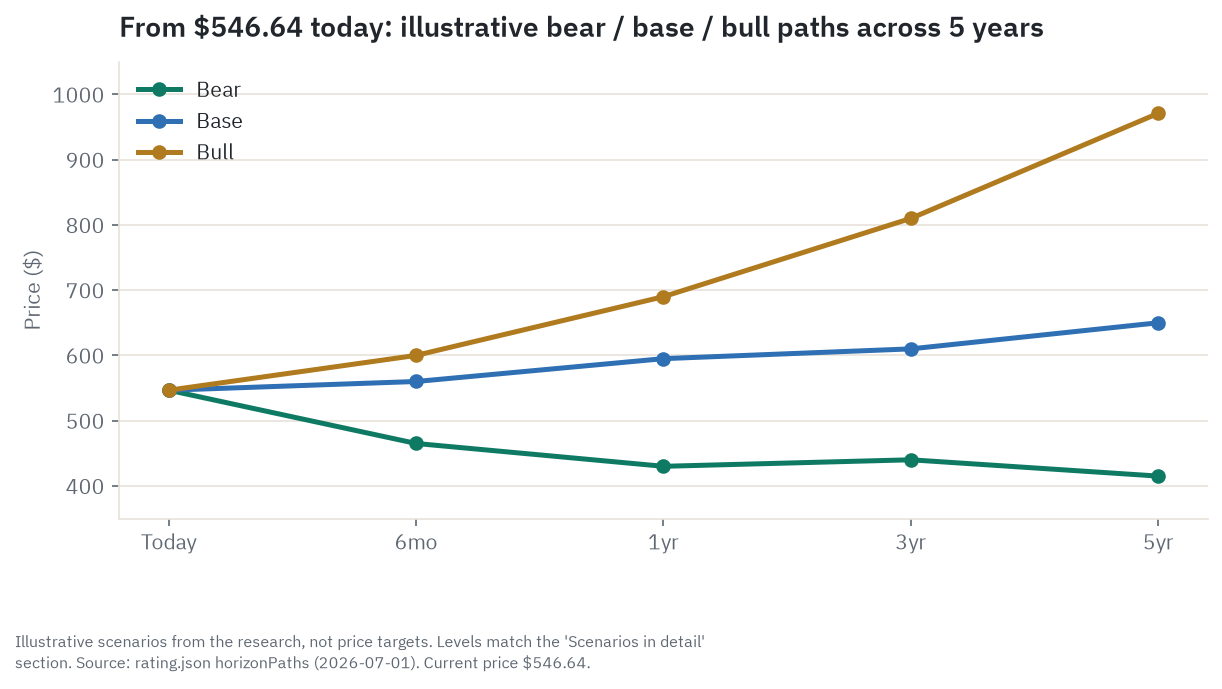
Every dollar range below is built the same way: a stated adjusted-earnings estimate for 2030 multiplied by a stated exit multiple. None of it is a price target, and none of it is a forecast to trade on. The quote above this article is current; treat everything that follows as a range of plausible outcomes, not a prediction.
6 months (into early 2027). This window is a referendum on two quarters of prints, nothing more. Linde just narrowed and nudged up its full-year 2026 adjusted earnings guidance to $17.60-$17.90 a share, and the stock already sits at an all-time high, essentially level with the sell side’s own $543.27 average price target. There is no obvious catalyst for a big move in either direction that is not already visible on the calendar. The base case, near $560, has the next two quarters landing inside guidance and the stock drifting up on earnings alone. The bull case, near $600, needs a beat-and-raise quarter plus a continued currency tailwind to carry the stock toward the top of the analyst range. The bear case, near $465, is what happens if the next print misses, if the volume weakness already visible in Europe spreads, or if the dollar strengthens again and erases the currency boost that flattered this year’s reported growth. Watch whether the next two quarters land inside management’s own guidance range: that alone decides this window.
1 year (mid-2027). The dominant question becomes whether the newly set 2026 guidance holds up over a full year and what management says about 2027 alongside it. The base case, near $595, has 2026 landing close to its guided midpoint, early 2027 estimates building toward roughly $19 a share, and the multiple holding close to today’s level. The bull case, near $690, needs guidance raised again, the way it already was between the fourth quarter of 2025 and the first quarter of 2026, plus a named large electronics or hydrogen contract win, pushing the multiple into the mid-30s. The bear case, near $430, is a guidance cut, whether from a genuine industrial slowdown or a project write-off in the mold of what a competitor already experienced, which would break the “steady grower” story and send the multiple down with it. The single thing to track is the next few quarters of guidance revisions, not just the headline growth number.
3 years (2029). This is where the structural story starts to matter more than any single quarter, and it is the window where a skeptic’s case would bite hardest. If the current wave of new semiconductor fab construction and the pipeline of clean-hydrogen and carbon-capture projects convert into signed, operating contracts roughly on schedule, underlying growth could durably run above its recent 3-to-4 percent pace. If instead one or more large clean-energy projects are written down across the industry, the way Air Products’ balance sheet already absorbed once, while the base industrial cycle also cools, the premium the market currently pays for Linde would come under real pressure. The base case, near $610, has underlying growth holding around 5 to 6 percent and the multiple settling near 28 times earnings. The bull case, near $810, has the new-project pipeline clearly outrunning the base business and the multiple pushing into the low 30s. The bear case, near $440, is a hydrogen-project setback layered onto a broader industrial slowdown, stalling earnings growth and resetting the multiple into the low 20s. The flip point is whether the electronics and hydrogen pipeline is converting into revenue on schedule, or running into the same execution trouble a competitor already hit.
5 years (2030). The pure durability question. In the base case, near $650, Linde compounds adjusted earnings at a high-single-digit rate for five straight years while the multiple gives back a few turns from today’s rich level, and the stock ends meaningfully higher mostly because the earnings grew into a still-generous multiple. The bull case, near $971, has both the electronics and clean-hydrogen growth legs prove out at scale, with the market treating Linde the way it already treats other quality industrial compounders, or better. The bear case, near $415, close to the stock’s own 52-week low, is a genuine multi-year industrial downturn combined with a clean-energy project impairment, resetting the multiple to a traditional industrial-cyclical level. The widest gap in this whole outlook sits here: roughly $415 on the bear side to $971 on the bull side, more than double, which tells you how much of the five-year outcome is riding on whether the market still believes Linde deserves a premium multiple, not on the earnings alone.
Where the read lands today. On balance, the read holds at Buy: this is a genuinely high-quality, diversified industrial compounder with real growth legs and a fortress balance sheet, priced in the same rich band as the market’s other favorite quality names and already sitting essentially at the sell side’s own average target. The quality and execution are strong enough to lean toward owning the business, but there is no bargain built into the price. The single thing most likely to flip the read is a clean-energy project impairment at Linde itself, the same kind that already hit a direct competitor once.
Companion tool
Jump to the interactive dashboard to sort and filter Linde against its industrial-gas and quality-compounder peer set across valuation, growth, quality, risk, and momentum, or download the Excel model to flex the bull, base, and bear scenarios with your own earnings and multiple assumptions.
TL;DR
Linde is the world’s largest industrial gas company, built from the 2018 merger of Germany’s Linde AG and America’s Praxair, and it sells the invisible inputs that heavy industry cannot run without: oxygen for steel mills, nitrogen for food processing and semiconductor fabs, hydrogen for refineries, and medical oxygen for hospitals. It does this alongside two other scaled global players, Air Liquide and Air Products, in a structure close to an oligopoly, and it locks in demand through on-site plants built directly on a customer’s property under contracts that can run up to thirty years. That structure shows up as roughly $64 billion of already-contracted future revenue on the books today. The 2026 story is a modest reacceleration: reported sales grew 8 percent in the first quarter, though roughly five of those eight points were simply a weaker dollar, and full-year adjusted earnings guidance was nudged up to $17.60-$17.90 a share, a 7-to-9-percent increase. Two genuine new growth legs, semiconductor fab gas supply and clean-hydrogen or carbon-capture project contracts, are outgrowing the base business, but a direct competitor, Air Products, just posted a full-year loss after writing down projects in exactly that hydrogen category, which is the industry’s clearest live evidence of how badly a bet on the newest growth leg can go. The stock, at an all-time high and trading around 33 times trailing adjusted earnings, sits fractionally above the sell side’s own average price target, meaning there is essentially no valuation cushion if either the growth or the margin story disappoints. Quality is close to the top of anything in industrials; the price already assumes most of that quality holds.
Explore it yourself: the interactive dashboard
What Linde actually is
Strip away the ticker and Linde is, physically, a company that builds giant refrigerators. Its core plants, air-separation units, chill and compress ordinary air until oxygen, nitrogen, and argon separate out as liquids, the same three gases that make up almost all of what we breathe, just no longer mixed together. A second type of plant, a steam-methane reformer, does something different: it strips hydrogen out of natural gas for refineries, chemical plants, and increasingly for lower-carbon energy uses. Neither process is exotic science. What is hard, and what keeps this a three-company industry worldwide, is doing it at the scale, purity, and reliability that heavy industry and hospitals require, and building the physical plant and pipeline network to deliver it economically.
Linde sells that output three ways, and the split matters because it maps directly to how durable each dollar is. On-site (25 percent of the most recent quarter’s sales) means Linde builds a dedicated plant next to one large customer, a steel mill, a refinery, a chemical complex, under a contract that guarantees a minimum purchase for up to thirty years. Think of it as a thirty-year lease bolted permanently to the customer’s factory floor: once poured, the concrete has no other use, so the arrangement locks in both sides at once. Merchant (29 percent) is bulk liquid gas trucked from a large regional plant to mid-sized customers under shorter, multi-year contracts. Packaged gas (35 percent) is the cylinder business, gas bottles delivered on a route to welding shops, hospitals, and small manufacturers, picked up empty and refilled, which behaves like a local delivery-logistics business more than a heavy-industry contract. The remaining slice is Linde Engineering, which designs and builds gas plants, including for competitors and customers who prefer to buy a turnkey plant outright rather than sign a long-term supply deal.
Reported through four segments, Americas, EMEA, APAC, and Engineering, the business did $34.0 billion in revenue in 2025, up 3 percent, at a 29.8 percent adjusted operating margin. The first quarter of 2026 showed sales of $8.78 billion, up 8 percent, though underlying growth once currency is stripped out was closer to 3 percent, adjusted operating profit of $2.63 billion at a 30.0 percent margin, and adjusted diluted earnings per share of $4.33, up 10 percent. Full-year 2026 adjusted earnings guidance sits at $17.60 to $17.90 a share, 7 to 9 percent above 2025.
How the money flows
flowchart TD
    A["Feedstock: air (free) + natural gas"] --> B["Air separation units / steam-methane reformers (the chokepoint plant)"]
    B --> C1["On-site supply (25% of sales) - dedicated plant, take-or-pay contract up to 30yr"]
    B --> C2["Merchant liquid (29% of sales) - bulk tanker delivery"]
    B --> C3["Packaged gas (35% of sales) - cylinder delivery routes"]
    B --> D["Linde Engineering - builds plants for Linde and third parties (11% of sales)"]
    C1 --> E1["Steel, refining, chemicals, hydrogen users"]
    C2 --> E2["Mid-size manufacturing, food & beverage, healthcare"]
    C3 --> E3["Welding shops, hospitals, labs, small manufacturers"]
    D --> E4["Competitors and customers who buy a turnkey plant"]
    E1 --> F["~$64B of contracted future revenue (remaining performance obligations)"]
    E2 --> F
    E3 --> G["Route-density economics, local competition"]
    F --> H["Linde plc revenue: $34.0B FY2025"]
    G --> H
Two feedstocks go in: free atmospheric air and cheap natural gas. What comes out the other side, oxygen, nitrogen, hydrogen, argon, at a guaranteed purity and pressure, is worth vastly more, because the value Linde sells is not the gas itself, it is the separation and the reliability. The real toll booth in this chain sits at the plant, not at any single sale. Once an on-site plant is poured into concrete on a customer’s land under a decades-long contract, no competitor can undercut Linde there without building an equivalent plant of its own, a process that takes years and typically a nine- or ten-figure capital commitment. That is why $64 billion of already-contracted future revenue is the single most important number in this section: it is proof that the toll booth is built and collecting, not a hope that it will be.
The one part of the chain where a customer has real, near-term leverage is packaged gas, the cylinder-delivery business, where a local independent distributor with a denser route in one city can genuinely compete on price. Everywhere else, the fight happens once, at the moment a brand-new large facility, a semiconductor fab, a chemical complex, a hydrogen hub, chooses its gas supplier for the life of the plant. Win that moment and the revenue is locked in for decades. Lose it and there is no second chance until the next facility gets built somewhere else.
A field guide to Linde’s business lines
- Atmospheric gases (oxygen, nitrogen, argon). The base of the business, produced by air separation and sold across steel, chemicals, food processing, and healthcare. Slow-growing, close to non-discretionary, and the reason Linde’s overall demand does not swing as hard with the economy as a typical industrial name.
- Hydrogen and syngas. Produced mainly by steam-methane reforming for refineries and chemical plants today, and increasingly marketed as “clean,” lower-carbon hydrogen for decarbonizing industrial processes, Linde’s newest and largest growth ambition, and its newest and largest source of project-execution risk.
- Electronics and specialty gases. Ultra-high-purity gases sold to semiconductor fab customers, where the tolerance for impurity is measured in parts per billion and the tolerance for a supply interruption is essentially zero, because a single fab campus can cost tens of billions of dollars. This is the highest-margin, stickiest corner of the business and the direct beneficiary of the current wave of new fab construction across the United States and Asia.
- Linde Engineering. Designs and builds gas-processing plants for Linde itself and for third parties. Had $640 million of new order intake and a $2.8 billion backlog in the most recent quarter. Lumpy, project-driven, and a smaller, higher-margin complement to the core gas-supply business.
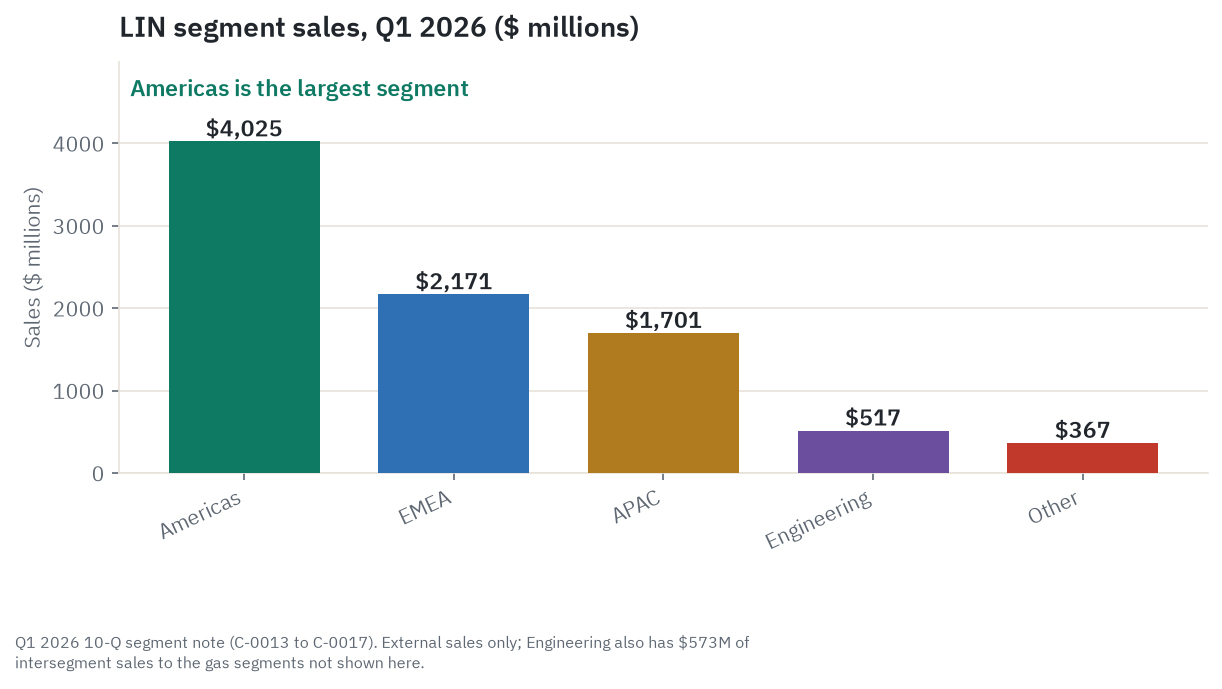
Segment margins tell their own story. EMEA runs the richest margin at 36.1 percent, the most mature and contract-dense region. Americas follows at 31.6 percent. APAC sits lowest among the three gas regions at 28.0 percent, and falling, because new plants there are absorbing start-up costs before their revenue ramps to a mature level, the normal, temporary cost of feeding the growth pipeline.
Who wins where
Three companies, Linde, Air Liquide, and Air Products, dominate global merchant and on-site industrial gas supply, a structure that solidified after the 2018 Linde-Praxair merger forced substantial antitrust divestitures in Europe and China to secure regulatory approval. That regulatory scar tissue is itself part of the moat: it is very hard for a fourth global player to assemble the same scale today. Within that three-player top tier, the real competitive fight is not price, it is who wins the next generation of large facility siting decisions, semiconductor fabs, hydrogen hubs, chemical complexes, each of which locks in a decades- long winner and shuts the door on the losers for the life of that plant.
Below the top tier sit local and regional independent gas distributors, who compete mainly in the packaged cylinder business where route density, not global scale, decides the winner. And running alongside the industrial gas majors is a much wider field of quality industrial and specialty compounders that the market values the same way, Ecolab and Sherwin-Williams among them, companies with nothing to do with gas but everything to do with the same investment case: recurring, contract-protected, pricing-power-rich revenue in a mature industrial category. Linde’s valuation is set as much by comparison to that peer group as to its two direct gas competitors.
Company by company: who’s who
Linde plc (LIN, Nasdaq). The world’s largest industrial gas company by revenue, roughly $252.9 billion in market capitalization. Sells atmospheric gases, hydrogen, and specialty gases through on-site, merchant, and packaged channels, plus plant engineering services, across four reportable segments. First-quarter 2026 sales were $8.78 billion, up 8 percent reported, roughly 3 percent underlying; adjusted operating margin 30.0 percent; adjusted diluted earnings per share $4.33, up 10 percent. Bull: a three-player global oligopoly with $64 billion of already- contracted revenue, a 24 percent return on capital, and a reaccelerating growth algorithm built on semiconductor fab demand and a clean-hydrogen project pipeline. Bear: trades at essentially the same premium multiple as the market’s other favorite quality compounders with no valuation cushion, so any stumble in growth, margin, or a large capital project has nowhere to hide.
Air Products and Chemicals (APD, NYSE). A direct global competitor, roughly $70.0 billion in market capitalization, that has pushed harder than either Linde or Air Liquide into large, first-of-a-kind clean-hydrogen and gasification megaprojects. Fiscal 2025 (ended September 30, 2025) revenue was $12.04 billion, but the company posted a GAAP net loss of $394.5 million, a diluted loss per share of $1.77, driven by disclosed asset impairments and project write-offs in exactly that hydrogen and gasification portfolio. Bull: first-mover positioning in multiple large clean-hydrogen offtake contracts could pay off disproportionately if policy support and buyer demand for low-carbon hydrogen scale up over the next five to ten years. Bear: this is the sector’s clearest live demonstration of what happens when a single large clean-energy bet goes wrong before the concrete has paid for itself, and it is the exact risk category every major in the industry, Linde included, is now chasing.
L’Air Liquide S.A. (Paris: AI; US OTC ADR: AIQUY). Linde’s most direct global-scale peer, with the deepest overall footprint and a large home-healthcare business, oxygen therapy and respiratory equipment for patients, that neither Linde nor Air Products runs at the same scale. Its primary listing is Euronext Paris and its results are reported in euros; a reliable, independently verified US-dollar market capitalization was not available in this research pass, so no specific valuation multiple is stated for it here. The only US-quotable instrument, an unsponsored over-the-counter ADR, traded around $41.13, up roughly 30 percent over five years on that basis. Bull: the broadest global footprint and a genuinely differentiated healthcare-services arm reduce dependence on pure industrial cycles. Bear: US investors face an illiquid, unsponsored ADR with currency translation risk, a real practical disadvantage next to Linde’s Nasdaq liquidity.
Ecolab (ECL, NYSE). Not an industrial gas company, but the market’s other standard example of a wide-moat, service-embedded industrial compounder, worth roughly $79.8 billion. Fiscal 2025 revenue was $16.08 billion, net income $2.08 billion, diluted earnings per share $7.28, a trailing price-to-earnings ratio near 38.9 times. Bull: a sticky, razor-and-blade water-and-hygiene model with genuine pricing power. Bear: trades at a multiple similar to or above Linde’s despite a more mature, lower-growth end-market mix, evidence that the whole quality-compounder category, not just Linde, is priced richly right now.
Sherwin-Williams (SHW, NYSE). The market’s second standard quality-compounder comparison, roughly $86.9 billion in market capitalization. Fiscal 2025 revenue was $23.57 billion, net income $2.57 billion, diluted earnings per share $10.26, a trailing price-to-earnings ratio near 34.4 times. Bull: a company-owned retail store network built over decades is a genuine, slow-to-replicate distribution moat, its version of Linde’s on-site plant network. Bear: housing and construction cyclicality flows straight into paint demand, and the current multiple assumes that cyclicality stays muted.
What the filings say
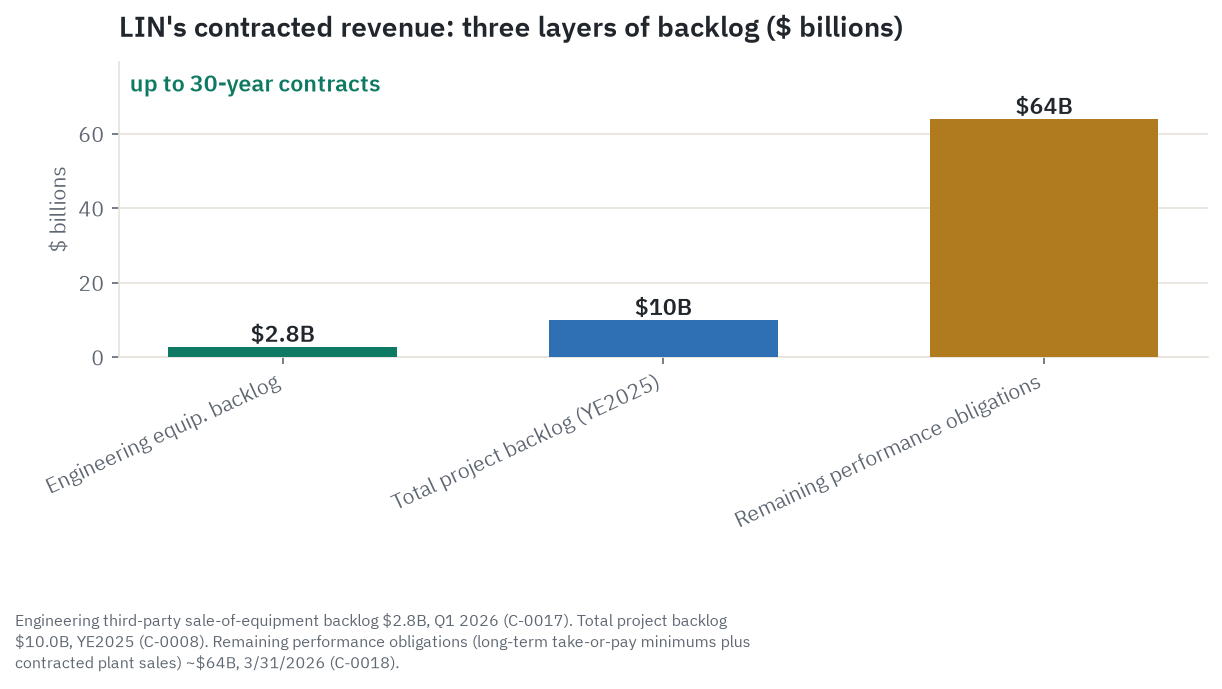
Linde’s remaining performance obligations, the future minimum-purchase revenue already locked in under on-site and Engineering contracts, stood at roughly $64 billion as of March 31, 2026. These supply contracts can run up to thirty years, and management estimates about half of the related revenue will be earned within the next six years. Layer that alongside a total project backlog of $10.0 billion at the end of 2025 (projects already under construction) and Linde Engineering’s own $2.8 billion third-party equipment backlog, and the picture is one of contracted revenue stacked in three overlapping layers, the near-term projects being built now, the medium-term backlog converting to revenue, and the very long tail of already-signed thirty-year minimums.
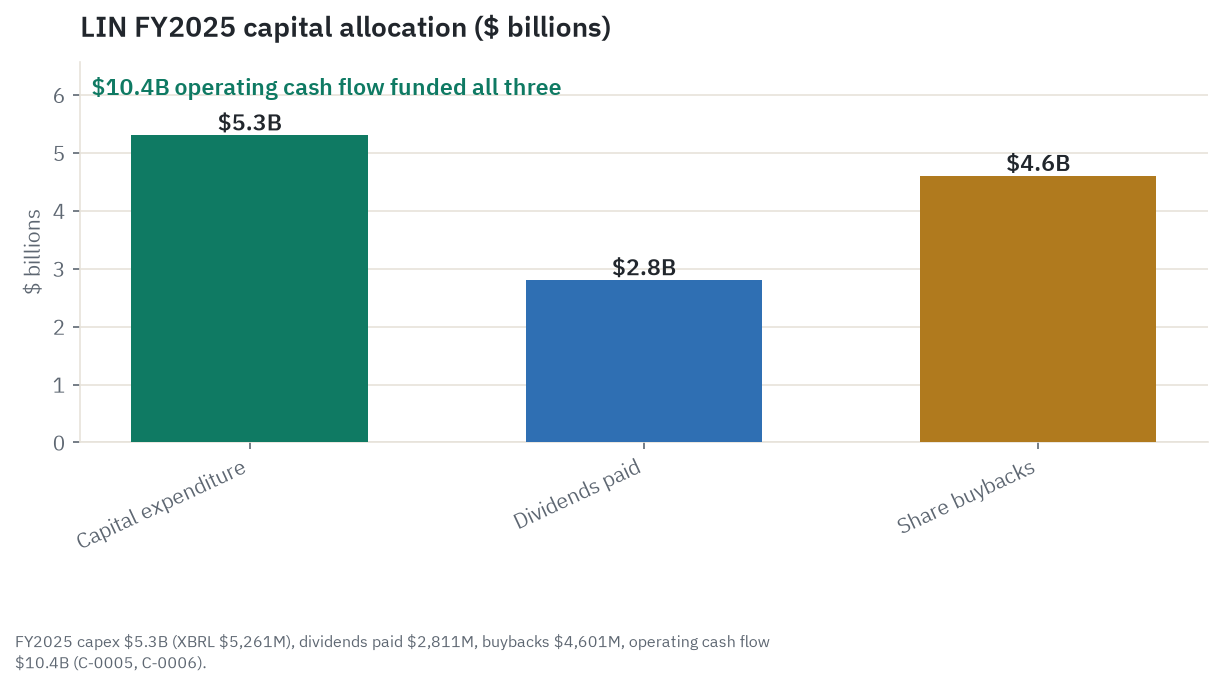
Full-year 2025 results: sales $34.0 billion, up 3 percent; GAAP operating profit $8.92 billion; adjusted operating profit $10.1 billion, a 29.8 percent margin, up 30 basis points; GAAP net income $6.90 billion, diluted earnings per share $14.61; adjusted diluted earnings per share $16.46, up 6 percent. Operating cash flow was $10.4 billion, up 10 percent, against $5.3 billion of capital expenditure, implying roughly $5.1 billion of free cash flow after capex on our own arithmetic (Linde’s release did not restate a single full-year free-cash-flow line the way its quarterly releases do). The company returned $7.4 billion to shareholders through dividends and buybacks in 2025 alone.
The most recent quarter, first-quarter 2026, showed sales of $8.78 billion, up 8 percent reported, but the bridge behind that number matters: 5 points of the increase came from currency translation alone (a weaker dollar against the euro), 2 points from price, 1 point from volume, and 1 point from acquisitions, offset by 1 point of decline in Engineering. Strip out currency and underlying growth was closer to 3 percent, not materially different from the pace of the last few years. Adjusted operating profit was $2.63 billion, a 30.0 percent margin, down 10 basis points year over year even as dollar profit rose 8 percent, evidence that cost inflation is still being fought, not eliminated. Adjusted diluted earnings per share were $4.33, up 10 percent, helped by both higher net income and a shrinking share count, 466.3 million diluted shares versus 476.3 million a year earlier. Free cash flow in the quarter was $898 million after $1.34 billion of capital expenditure, and the company returned $1.55 billion to shareholders in the quarter alone.
Segment detail for the quarter: Americas sales $4.03 billion, up 10 percent reported and 6 percent underlying, operating margin 31.6 percent, up 60 basis points, with electronics and metals-and-mining cited as drivers. EMEA sales $2.17 billion, up 7 percent reported but down 2 percent underlying, as a 1-point pricing gain was more than offset by a 3-point volume decline in chemicals-and-energy and manufacturing demand, operating margin 36.1 percent, up 60 basis points. APAC sales $1.70 billion, up 11 percent reported and 6 percent underlying on volume and new project start-ups, operating margin 28.0 percent, down 130 basis points as those same new projects absorb start-up costs. Engineering sales $517 million, down 8 percent, operating margin 19.5 percent, with $640 million of new order intake and a $2.8 billion backlog.
The balance sheet, as of March 31, 2026: total assets $86.3 billion, total liabilities $46.2 billion, shareholders’ equity $38.6 billion, long-term debt $21.5 billion, cash $4.0 billion. Net debt against trailing annualized adjusted EBITDA of roughly $13.8 billion implies leverage of a little over 1.2 times, conservative for a capital-intensive industrial business, and consistent with the investment-grade credit profile the company has carried since the 2018 merger. Shares outstanding have fallen steadily on continuous buybacks, from 477.5 million in mid-2024 to 462.6 million at the end of the most recent quarter.
Full-year 2026 guidance: adjusted diluted earnings per share of $17.60 to $17.90, a 7-to-9-percent increase, assuming about 1 point of favorable currency; second-quarter 2026 guidance of $4.40 to $4.50; full-year capital expenditure guided to $5.0-5.5 billion, which management explicitly ties to supporting a $7.1 billion contracted sale-of-gas project backlog under construction. That guidance was quietly raised and narrowed between the fourth-quarter 2025 release, which had framed the full-year range at $17.40-$17.90, and the first-quarter 2026 release three months later, a small but real signal the year is tracking at or above management’s own expectations rather than needing to be walked back.
Disclosed risks worth a five-year holder’s attention: cyclical exposure in chemicals-and-energy and manufacturing end markets, visible directly in the EMEA underlying volume decline above; foreign-currency translation risk given that EMEA and APAC together made up about 44 percent of the most recent quarter’s sales; commodity input cost risk on natural gas and electricity, substantially but not entirely passed through under long-term contracts; and, most consequential for a long-term thesis, execution risk on large capital projects in clean hydrogen and carbon capture, the same category that produced Air Products’ full-year loss.
What the market is paying
Linde last traded at $546.64, within a fraction of a percent of its 52-week high of $547.22 and well above its 52-week low of $387.78. The stock is up roughly 28 percent over six months, about 15 percent over the trailing year, and nearly 90 percent over five years. Beta sits at 0.72, meaningfully below 1.0, evidence that Linde’s diversified, largely non-discretionary demand base does not swing with the broad market or the industrial cycle the way a typical heavy-industrial or semiconductor-equipment name would.
Multiplying the current price by the most recently reported share count implies a market capitalization of roughly $252.9 billion, in close agreement with the $252.74 billion an independent data provider reports separately. Trailing GAAP earnings put the price-to-earnings ratio at about 37.4 times; on adjusted earnings it is closer to 33.2 times. On the 2026 guidance midpoint, the forward multiple is roughly 30.8 times.
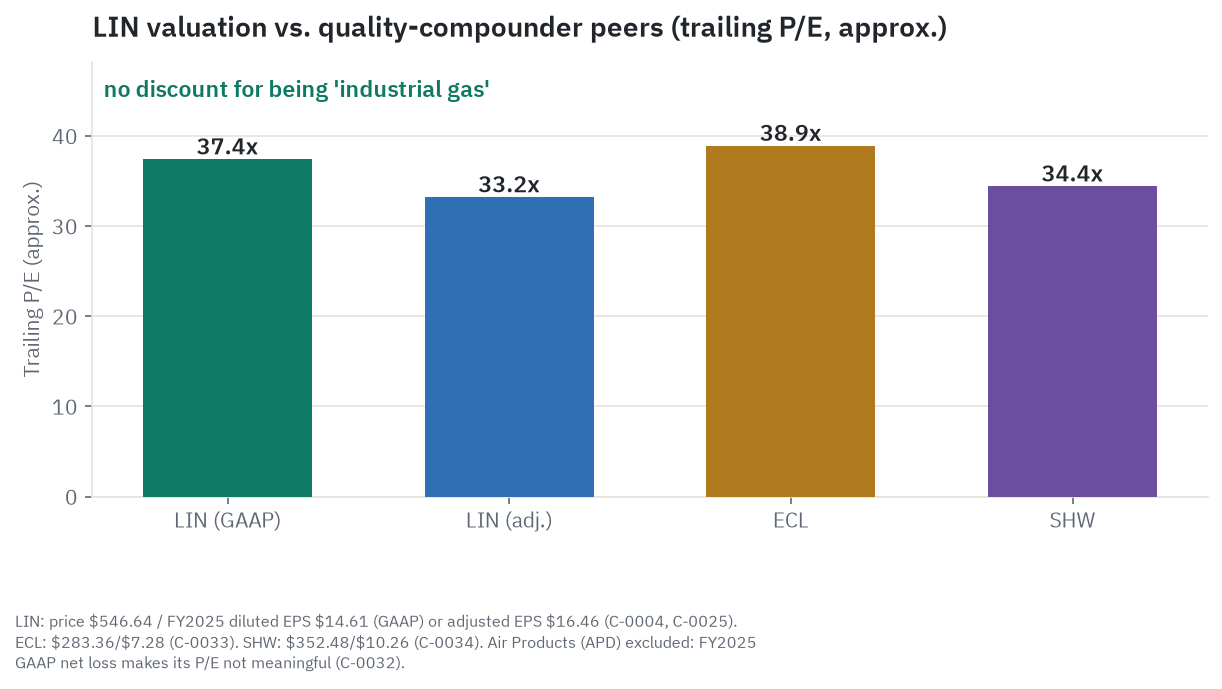
That places Linde squarely alongside Ecolab (about 38.9 times trailing) and Sherwin-Williams (about 34.4 times trailing), the market’s two other favorite examples of a quality industrial compounder, rather than at any kind of discount for being “just” an industrial gas company. Air Products, Linde’s most direct competitor by business model, is not a clean comparison right now: its GAAP net loss mechanically makes its price-to-earnings ratio meaningless, and is itself the clearest evidence in the whole sector of how a large clean-energy project bet can go wrong.
Twelve Wall Street analysts have rated the stock in the trailing twelve months, ten Buy, one Strong Buy, one Hold, a consensus rating of Buy. The average price target is $543.27, against a range of $460 to $600, meaning the current price sits fractionally above the average target already. That combination, a bullish consensus with the price already ahead of the average number attached to it, is worth sitting with: this reads less as “cheap” and more as “own the compounder, do not expect a near-term re-rate.”
Short interest was 7.60 million shares as of June 15, 2026, about 1.65 percent of the public float, up nearly 18 percent from the prior report but still a low absolute level, with a days-to-cover ratio of 3.0. There is no meaningful organized bear thesis expressed through the short market right now. Liquidity is not a constraint either way for a stock this size.
What the crowd is saying
Everything in this section is signal, not fact, a read on what market participants are saying and doing, which is not the same thing as what is true about the underlying business.
The dominant market narrative on Linde has shifted over the past two to three years from “reliable, boring industrial gas compounder” toward a quieter version of two of the market’s favorite current themes: semiconductor and AI-related capital spending, through electronics-gas supply to new fab construction, and clean-energy decarbonization, through hydrogen and carbon-capture project wins. Both threads are real and both showed up directly in management’s own first-quarter 2026 commentary. What is worth separating out is the degree of re-rating the market has already applied around that framing: the stock sits at an all-time high, priced in the same rich band as Ecolab and Sherwin-Williams, even though underlying constant-currency revenue growth in the most recent quarter was still only about 3 percent.
Sell-side tone is overwhelmingly positive, and positioning data backs that up: low short interest, a calm rather than crowded trade in either direction. Securities filings through the first half of 2026 show a normal mix of scheduled equity-award grants and routine executive sales, the kind of pattern typical at a large, mature company, with no unusual cluster of open-market insider buying that would suggest management sees the stock as unusually cheap here.
The clearest divergence between narrative and fundamentals: the market increasingly frames Linde alongside secular AI and clean-energy growth stories that typically command expanding multiples, while the company’s own guided growth algorithm is still, by its own numbers, a high-single-digit adjusted-earnings compounding machine built mostly from low-single-digit organic growth plus continued buybacks, not a step-change acceleration in the underlying business. The newer growth vectors are real and are growing faster than the base business, but they remain a minority of a $34 billion revenue base, and the valuation already reflects a fairly optimistic version of how much bigger they become.
Durability: what has to be true, and what breaks it
The structural case for owning Linde does not depend on any single quarter’s growth number. It depends on three things holding at once: that the toll-booth economics of on-site, take-or-pay contracts keep working (they have, for decades, across multiple economic cycles); that the newer growth legs, semiconductor fab supply and clean hydrogen, keep converting signed contracts into operating, revenue-generating plants roughly on schedule; and that the market keeps paying a compounder-grade multiple for an earnings base that is still, honestly, mostly a diversified industrial business rather than a technology company.
The real cyclical and structural risk is not that customers stop buying industrial gas, there is no substitute for oxygen in a steel furnace or nitrogen in a semiconductor fab. It is narrower and more specific: a customer could build and operate its own plant rather than contract with Linde, though few large industrials want the capital intensity and specialized expertise that requires; a customer’s own facility could close, ending that regional contract’s revenue regardless of its remaining term; and, in the newest part of the business, a customer betting on hydrogen or carbon capture could choose a different decarbonization path entirely, or simply delay, leaving a newly built plant without an offtake buyer. Air Products has already shown, with a full-year GAAP net loss driven by project impairments, exactly what that last risk looks like when it lands.
The most likely outcome, on the evidence gathered here, sits closer to the base case than to either extreme: a company that keeps compounding high-single-digit adjusted earnings growth through pricing, modest volume gains, and buybacks, with the newer growth legs adding a real but gradual lift rather than a step change, and a multiple that gives back a modest amount of today’s premium over five years as growth normalizes toward its historical pattern rather than the market’s more optimistic framing.
The scenarios in detail
The driver tree behind every number in this section has four variables. First, the underlying, constant-currency growth rate, roughly 3 percent in the most recent quarter once currency is stripped out, and whether that holds, accelerates, or fades. Second, the new-project pipeline in electronics and clean hydrogen, which can swing hard in either direction: named contract wins pull the growth algorithm meaningfully above its historical pace, while a stalled or impaired project subtracts a full year’s earnings in one charge, as it already did at a competitor. Third, margin durability, currently a narrow, stable 29.5-to-30.1-percent adjusted band, though new-project start-up costs (visible in APAC’s margin decline) show that stability can wobble as the pipeline converts. Fourth, the multiple itself, currently around 30.8 times forward adjusted earnings, sitting in the same band as the market’s other favorite quality compounders, with the stock already priced essentially at the sell side’s own average target.
Bull case (illustrative, not a target)
Electronics and clean-hydrogen contracts convert into signed, operating plants faster and larger than the base case assumes, adding meaningfully to underlying growth on top of continued price attainment, while margin holds or expands as new projects mature past their start-up drag and buybacks continue at a similar pace. Adjusted diluted earnings per share compound from $16.46 in 2025 through roughly $17.75 in 2026 to about $27.70 by 2030, a five-year growth rate near 11 percent, with the multiple sustained around 34 to 35 times, similar to the market’s richest quality-compounder comps today. That combination implies an illustrative price near $950 to $1,000 by 2030. What has to be true: the electronics and hydrogen pipelines largely avoid the kind of project impairment a competitor already experienced. The single thing most likely to break it is exactly that, a Linde-specific clean-energy project writedown, which would immediately puncture the flawless-execution premise the bull case depends on.
Base case
Underlying growth continues at roughly its recent pace, 3 to 5 percent, built from continued pricing power, modest volume growth, and a steady rather than accelerating contribution from the new-project pipeline, with margin holding in the 29-to-30-percent adjusted band and buybacks continuing at a similar pace. Adjusted diluted earnings per share reach roughly $23.60 by 2030, a five-year growth rate near 7.5 percent, in line with management’s own current guidance simply continuing. On a multiple that normalizes modestly from today’s roughly 30.8 times forward level toward 27 to 28 times, that implies an illustrative price near $620 to $680 by 2030. What has to be true: the business keeps doing roughly what it is doing now, without a major surprise in either direction. Most likely to break it: the multiple compresses faster than earnings grow, a market-wide de-rating of expensive quality compounders, for instance, pulling the base case toward the bear path even if the underlying business performs exactly as guided.
Bear case (anchored on the sell side’s own lack of cushion and the sector’s demonstrated project risk)
A combination of a broader industrial slowdown that widens the underlying volume weakness already visible in Europe to other regions, a clean-energy project impairment at Linde itself echoing what a direct competitor already absorbed, and a reversal of the currency tailwind that has been flattering recent reported growth, together stall underlying growth and compress the premium multiple the stock currently commands. Adjusted diluted earnings per share stall near $18 to $19 by 2030, essentially flat after the 2026 guided step-up, a five-year growth rate of roughly 2 percent. On a multiple resetting to a traditional industrial-cyclical band of 22 to 23 times, roughly consistent with the stock’s own 52-week low of $387.78, that implies an illustrative price near $400 to $440 by 2030. What has to be true: simply that growth and margin disappoint by more than a little while the market simultaneously stops paying a compounder-grade multiple, both plausible outcomes given the sector’s demonstrated execution risk and the stock’s current lack of valuation cushion. Most likely to rescue the bull or base case instead: the electronics and hydrogen pipelines keep converting into signed, operating contracts without a Linde-specific impairment event.
Catalysts and timeline
In the near term: second-quarter 2026 earnings, expected late July or August, the first test of the newly narrowed guidance; ongoing named new on-site contract announcements, especially in electronics and clean hydrogen, the clearest real-time evidence of whether the growth pipeline is converting into actual signed contracts rather than announcements; and third-quarter 2026 earnings around October or November, which will show whether the pattern of upward guidance revisions seen so far in 2026 continues. Further out: the current wave of new semiconductor fab construction across the United States and Asia moves from construction to full operation between roughly 2027 and 2029, the point at which those fabs’ gas-supply contracts convert from capital commitments into actual Linde revenue, and the pace of policy support for clean hydrogen and carbon capture across major economies will materially determine how much of that growth vector converts into signed, operating contracts rather than stalling at the planning stage.
Companies to watch (bull / base / bear)
Linde (LIN). The name itself. Bull: the electronics and hydrogen pipelines convert into signed, operating contracts on schedule with no project impairment, and the market extends or expands the current compounder multiple. Base: growth continues at its recent 3-to-5-percent underlying pace and the multiple gives back a few turns as growth normalizes. Bear: a clean-energy project writedown at Linde itself, paired with a broader industrial slowdown, breaks both the growth and valuation legs of the story at once. Watch: quarterly guidance direction, underlying regional volume trends, and any project impairment disclosure.
Air Products (APD). The read-across on hydrogen project risk. Bull: its clean-hydrogen offtake contracts eventually pay off as policy support and buyer demand for low-carbon hydrogen scale up. Bear: further impairments in its project book would confirm the sector-wide risk and likely pressure sentiment toward Linde’s own, less disclosed, hydrogen project exposure. Watch: whether fiscal 2026 results show a return to GAAP profitability or further project-related charges.
Air Liquide (AI / AIQUY). The global-scale peer, valued in a currency and on an exchange this research could not fully verify in dollar terms. Bull: the broadest global footprint and a genuinely differentiated healthcare-services arm. Bear: US access is limited to a thin, unsponsored ADR carrying currency risk. Watch: whether reported euro-denominated results (not independently verified here) show similar underlying growth and margin trends to Linde’s own.
Ecolab (ECL) and Sherwin-Williams (SHW). The valuation comparison set, not competitors. Bull: both demonstrate that the market is broadly willing to pay a premium multiple for quality industrial compounders right now, supporting Linde’s own multiple. Bear: if either de-rates on a growth disappointment, it would be an early signal that the whole quality- compounder category, Linde included, is due for a valuation reset. Watch: their own quarterly results as a read on whether the category’s premium is holding.
Risk controls
The most important risk for a five-year holder is valuation risk, not business risk: the stock offers essentially no cushion if growth or margin disappoints, because it already trades fractionally above the sell side’s own average target and in the same rich band as the market’s other favorite quality compounders. Layered on top of that is genuine, if moderate, cyclical exposure (visible directly in the European volume weakness in the most recent quarter), currency translation exposure given that roughly 44 percent of sales come from Europe and Asia, and, most specifically, large-project execution risk on the newest, least-proven growth leg, clean hydrogen and carbon capture, where a direct competitor has already shown the downside case with a full-year loss.
A reader managing this risk would want to track, each quarter: the direction of guidance revisions (raised and narrowed, as has happened so far in 2026, versus cut); underlying, constant-currency regional sales growth, separated from the currency-driven headline number, specifically whether the European weakness spreads or reverses; segment operating margin, especially in APAC, to see whether new-project start-up drag resolves as those plants mature; any project impairment disclosure at Linde or at a competitor; and the gap between the stock’s price and the sell side’s own average target, which is itself a read on whether confidence in the compounder framing is strengthening or weakening.
What would change this thesis for the worse: a Linde-specific clean-energy project impairment; a guidance cut rather than a raise; underlying volume weakness spreading beyond Europe; or a sustained currency reversal exposing how much of recent reported growth was translation rather than real demand. What would change it for the better: continued conversion of the electronics and hydrogen pipelines into signed, operating contracts without an impairment event, and a market willing to extend or expand the current compounder-grade multiple as those growth legs prove durable.
Methodology, sourcing, and data-quality flags
This research draws its load-bearing figures from Linde plc’s own SEC filings (the first-quarter 2026 Form 10-Q, the fourth-quarter and full-year 2025 and first-quarter 2026 earnings-release exhibits, and the SEC’s structured XBRL company-facts data), from the equivalent primary filings of Air Products, Ecolab, and Sherwin-Williams, and from Yahoo Finance price history and MarketBeat’s aggregated sell-side consensus, price-target, and short-interest data. Every figure stated as fact in this article traces to a claim recorded and verified against its source; every forward-looking dollar figure is explicitly labeled an estimate and is never a price target.
The five-factor read behind the Buy rating, in plain language: Valuation is the clearest negative, though a moderate one. At roughly 33.2 times trailing adjusted earnings and about 30.8 times on 2026 guidance, trading in the same rich band as Ecolab and Sherwin-Williams and sitting fractionally above the sell side’s own average target, the stock offers essentially no cushion, though it is not egregiously expensive relative to its own peer set. Growth is real but modest: the honest description is high-single-digit adjusted earnings growth built from low-to-mid-single-digit organic growth plus buybacks, not a technology-style growth story, supported by 2026 guidance of 7-to-9-percent adjusted earnings growth and a $64 billion contracted revenue backlog, offset by the same quarter’s European volume decline and an Engineering revenue drop. Quality is excellent: adjusted operating margin has held in a tight band for several quarters, return on capital runs around 24 percent by management’s own account, the balance sheet carries modest leverage, and the business generates ample free cash flow to fund both its growth capital program and its shareholder returns simultaneously. Risk is moderate and real, not severe: a low beta and diversified end markets offset genuine currency, commodity, and large-project execution exposure, the last of which a direct competitor has already shown the downside of. Momentum, weighted lightly and treated as soft signal, is strongly positive: the stock sits at an all-time high with a broad Buy consensus and low short interest, tempered by the fact that this strength has already pushed the price slightly ahead of where the professional consensus sees fair value. On balance, the quality and execution outweigh the lack of valuation cushion enough to keep the overall lean on the constructive side, a research signal that favors owning the business rather than avoiding it, without any built-in margin of safety. This is a labeled, rules-based research signal, not personalized investment advice.
Data-quality flags:
- Air Liquide’s US-quotable instrument is an unsponsored, thinly traded over-the-counter ADR; its primary listing and financial statements are in euros on Euronext Paris, and a verified, independent US-dollar market capitalization or valuation multiple could not be confirmed in this run. Its ADR price trend is reported as a directional signal only.
- Linde’s full-year 2025 free cash flow (roughly $5.1 billion) is this research’s own arithmetic, operating cash flow less capital expenditure, because the company’s full-year release did not restate a single free-cash-flow line the way its quarterly releases explicitly do.
- No third-party total-addressable-market figure for the global hydrogen or clean-energy market is cited anywhere in this article, because no source reviewed could be verified to a primary or analyst tier for a specific, attributable number; estimates for that market vary by an order of magnitude across providers and are widely regarded as unreliable this far out.
- Air Products’ financial detail is drawn from its own SEC filings; its fiscal year ends September 30, so its most recent full fiscal year (2025) is not calendar-aligned with Linde’s, Ecolab’s, or Sherwin-Williams’s December 31 fiscal years.
Key sources: Linde plc SEC filings and earnings releases (10-Q, 8-K exhibits, SEC XBRL company-facts API); Air Products, Ecolab, and Sherwin-Williams SEC 10-K and 10-Q filings; Yahoo Finance price history; MarketBeat sell-side consensus, price-target, and short-interest data.
Prepared July 1, 2026. Figures are point-in-time and will change. This is research and analysis for educational purposes, not investment advice, not a recommendation, and not a solicitation. Linde is a capital-intensive industrial business whose newest growth legs carry real project-execution risk, and the stock trades at a premium multiple with almost no valuation cushion. Verify all figures independently and consult a licensed financial advisor before making any decision.