
Research date: July 2, 2026 | OSINT market research on Alibaba Group Holding Limited (BABA, NYSE ADR; 9988.HK, HKEX dual-primary), the Chinese e-commerce and cloud-computing group whose stock has spent 2026 caught between a genuine AI growth story and a run of headline risk it does not fully control.
Important disclaimer. This is OSINT-based research and educational analysis, not investment advice. I am not a financial advisor. Nothing here is a recommendation to buy or sell any security, and the scenarios below are illustrative, not price targets. Alibaba is a Cayman Islands holding company operating in China through a VIE structure and a US-listed ADR subject to unresolved US-China regulatory, litigation, and delisting-adjacent risk, none of which is fully captured by a standard valuation multiple. Market caps, prices, valuation multiples, and market-share figures are point-in-time (July 2, 2026), press-reported where noted, and move fast. Do your own due diligence and consult a licensed advisor.
Where this stock could be in 6 months, 1 year, 3 years, and 5 years
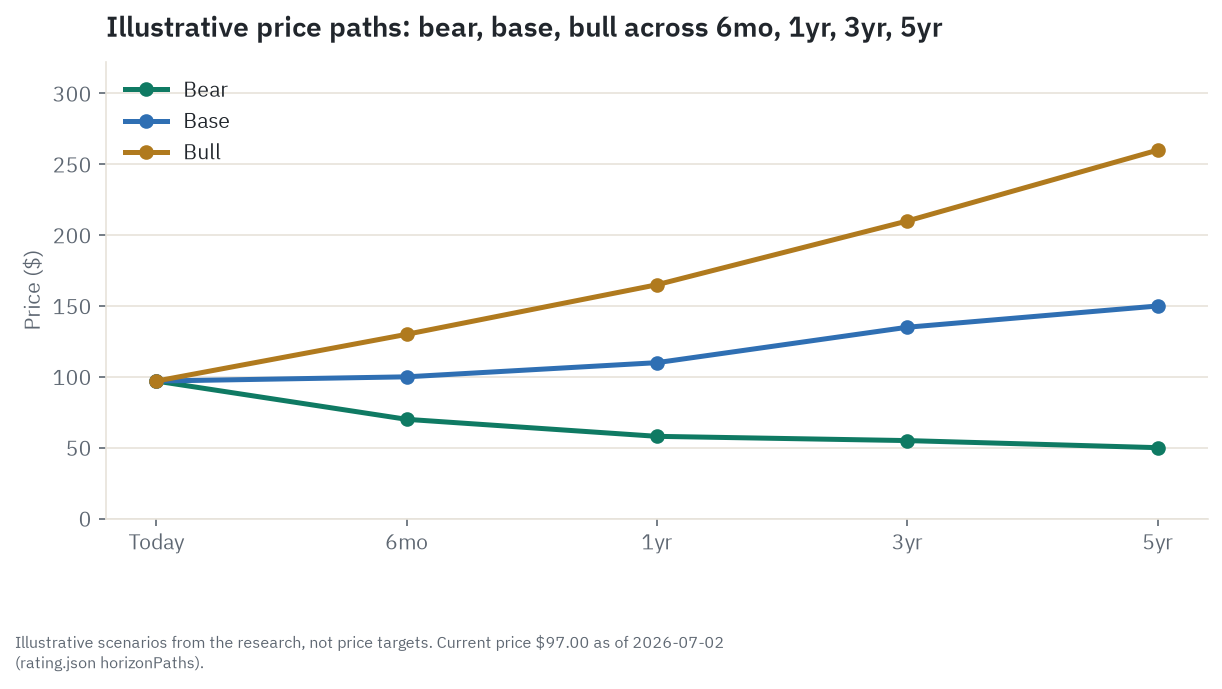
Every range below is an estimate built off the assumptions in the scenarios section further down, never a price target, and all four are anchored on the same $97.00 starting price used throughout this piece.
6 months. This window belongs to headlines, not earnings. The next print that matters is Alibaba’s fiscal first-quarter 2027 results, due around mid-August 2026, but two live legal threads could move the stock before then with no change to the business at all: a federal lawsuit Alibaba filed to overturn its placement on the US Department of Defense’s “Chinese Military Companies” list, and an unproven allegation from Anthropic that actors linked to Alibaba ran a large-scale scraping campaign against its Claude models. The base case (around $100) is close to flat: both disputes stay open but do not escalate, and cloud keeps growing in the 30 to 40 percent range. The bull case (around $130) needs an early favorable signal in either legal matter, which has precedent since Xiaomi and the chipmaker AMEC both won removal from similar Pentagon lists through litigation, plus a clean cloud beat. The bear case (around $70) does not need a bad quarter at all, only a fresh adverse headline in either dispute or a China commerce print showing the price war against local rivals still intensifying.
1 year. The dominant question by mid-2027 is whether the profit engine inside Alibaba’s China commerce business has actually stopped shrinking, since the brutal year-over-year comparisons driving today’s numbers get easier to beat a year out. The base case (around $110) assumes that bottoming happens gradually while cloud profit keeps compounding, a real but unspectacular recovery. The bull case (around $165) needs the domestic price war to visibly cool and at least one of the two legal overhangs to resolve favorably or simply fade. The bear case (around $58, roughly 40 percent below today) is the scenario this research treats as most credible if nothing changes: the subsidy war persists because neither side has an incentive to blink first, free cash flow stays negative, and the Pentagon listing survives the lawsuit.
3 years. By 2029, Alibaba’s three-year, roughly $53 billion AI and cloud infrastructure buildout should be largely deployed, giving the first real read on whether it converted to durable profit or left the company holding depreciating data-center capacity. The base case (around $135) has cloud becoming a materially larger share of group profit while the commerce business settles at a lower, more competitive margin than its mid-2020s peak. The bull case (around $210) is cloud and AI scaling into a genuine second profit engine at a pace comparable to what Amazon Web Services or Google Cloud showed in their own scale-up years. The bear case (around $55) is a capex overbuild: enterprise demand for AI infrastructure disappoints relative to what was spent, China’s property-linked consumption slump persists longer than expected, and a fresh geopolitical shock compounds the damage.
5 years. By 2031 the durability question is answered one way or another: has Alibaba built a cloud and AI business as economically significant as the commerce engine that made the company famous, and has the standing discount for owning a Chinese ADR narrowed at all. The base case (around $150) is a slower-growth, better-margin Alibaba, cloud large and genuinely profitable, commerce holding share at a structurally thinner margin, the geopolitical discount smaller but not gone. The bull case (around $260) is cloud and AI reaching hyperscaler-like scale and margin while commerce’s advertising take rate fully offsets any softness in transaction volume. The bear case (around $50) is the structural-bear outcome: domestic rivals have permanently compressed the core margin, cloud never gets there, and the ownership-structure discount never closes.
Where the read lands today. On balance the read holds at Hold, tilted toward the cheap side: a real operating recovery is visible in the cloud numbers, but too much of the next year depends on two unresolved legal disputes this research cannot handicap, and the company’s own capital-return capacity got measurably worse this year even as the multiple got cheaper. The single thing most likely to flip this toward a clearer buy signal is a dated, favorable resolution to either dispute landing at the same time as a visible stabilization in the commerce business’s profit line.
Companion tool
Jump to the interactive dashboard to sort and filter every company in this piece, or download the Excel model to flex the scenarios yourself.
TL;DR
Alibaba is really two businesses sharing one stock: a mature China e-commerce marketplace that still generated roughly 108 billion yuan of segment profit in the fiscal year ended March 2026, and a fast-scaling cloud and AI arm growing revenue 34 to 40 percent a year that is not yet a large profit contributor. The commerce engine’s profit fell 44 percent in the same year, not because shoppers disappeared but because Alibaba chose to spend heavily defending its market position against Pinduoduo, Douyin, and Meituan in a subsidy war with no announced end date, and that spending, layered onto a roughly 53 billion dollar three-year AI infrastructure buildout, pushed free cash flow negative for the first time in three years and forced a near-total pause in the stock buyback that used to run over 10 billion dollars a year. None of that is priced as a crisis on the multiple: at around 15 times trailing earnings, half its January 2026 high, Alibaba trades at a persistent discount to US hyperscalers, and Wall Street’s own average price target still implies roughly 90 to 100 percent upside. But the multiple has to compensate for more than a cyclical slowdown. Alibaba is a Cayman Islands company whose shareholders hold a contractual claim on the Chinese business rather than direct equity in it, a structure its own regulatory filing says has never been tested in a Chinese court, and it is currently fighting a US Department of Defense blacklist designation in federal court while also facing an unresolved, disputed allegation from the AI lab Anthropic that its affiliates tried to copy a frontier AI model through mass scraping. Both disputes are live as of this writing, and the article treats both exactly as they stand: unresolved, not settled in either direction.
Explore it yourself: the interactive dashboard
Open the dashboard in a full screen
The two Alibabas inside one stock
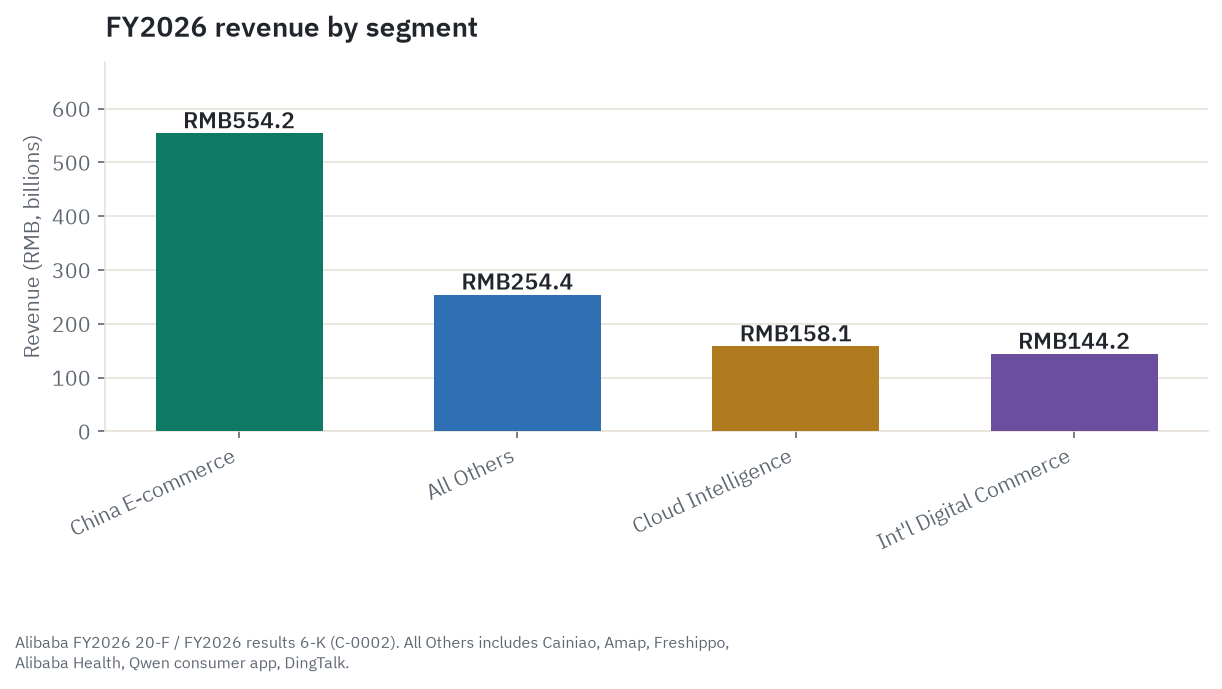
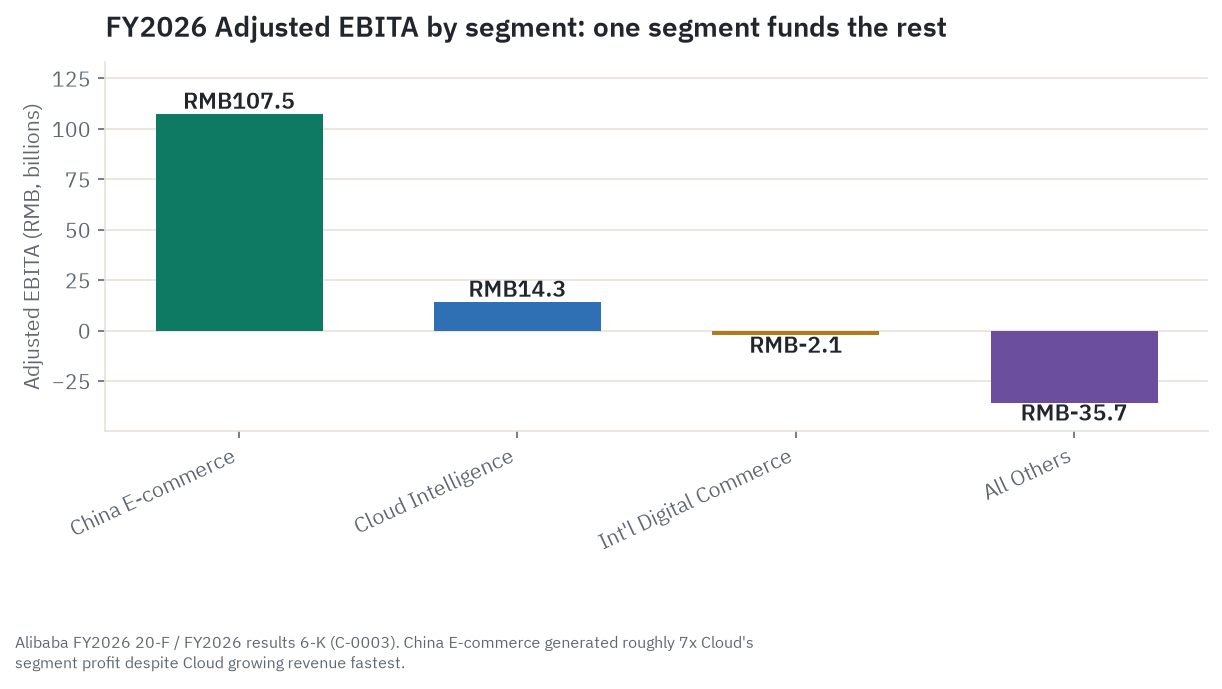
Picture an old, profitable corner shop that still pays most of the household’s bills while the owner’s grown child runs an ambitious new venture in the back room, one that is growing fast but has not yet turned a real profit and keeps asking for more capital to expand. That is roughly the shape of Alibaba today. The corner shop is China Commerce, the Taobao and Tmall marketplaces that generated 554 billion yuan of revenue and 108 billion yuan of segment profit in the fiscal year ended March 2026 (FY2026). The back-room venture is Cloud Intelligence Group, growing revenue 34 percent for the full year and 40 percent in the most recent quarter, with AI-related product revenue notching an eleventh consecutive quarter of triple-digit growth, but contributing only about 14 billion yuan of segment profit in the same period, roughly a seventh of what the shop out front produced.
The tension in the stock is that the shop’s till has gotten thinner this year, on purpose. Facing an aggressive, years-long price war from the discount marketplace Pinduoduo and the short-video-to-commerce platform Douyin, plus a separate subsidy fight against the food-delivery giant Meituan in the newer “instant commerce” category, Alibaba chose to spend to defend share rather than protect margin. China Commerce’s segment profit fell 44 percent year over year even as the underlying advertising and commission take rate, the fee Alibaba charges merchants for visibility and completed sales, kept rising. That is the crucial nuance a passing look at the headline number misses: Alibaba is not losing pricing power, it is choosing to spend the extra revenue that better monetization is generating right back into subsidies and discounts to keep merchants and shoppers from drifting to a cheaper rival. Whether that is smart defense or a fight with no exit is the central disagreement in the market on this stock, and it runs through nearly every section below.
Layered on top of that internal tension is an external one that has nothing to do with commerce economics at all: Alibaba is a Chinese company whose US-listed shares are a bet on both the operating business and on a geopolitical relationship that produced, in the span of six weeks in mid-2026, a Pentagon blacklist designation, an unproven AI-copying allegation from a US competitor, and a $600 million settlement with the US Department of Justice over an unrelated matter. None of the three is fully resolved or fully dismissed as of this writing. That combination, a real business story and a live geopolitical one, is why this stock’s range between its bear and bull outcomes is unusually wide even for a large, liquid, profitable company.
How the money flows
flowchart TD
    A[Chinese consumer spend] --> B[Taobao / Tmall<br/>domestic marketplaces]
    A2[Chinese enterprise / SME spend] --> B3[1688.com / Alibaba.com<br/>China + global wholesale]
    A3[Global cross-border consumer demand<br/>US, EU, SE Asia, Turkey] --> C[AliExpress / Lazada / Trendyol<br/>International Digital Commerce Group]
    A4[Enterprise IT / AI compute demand] --> D[Alibaba Cloud<br/>Cloud Intelligence Group]
    A5[Local on-demand demand<br/>food, groceries, errands] --> E[Ele.me / Taobao Instant Commerce<br/>Quick Commerce]

    B --> F[Merchant ecosystem<br/>brands, SMEs, resellers on Taobao/Tmall]
    B3 --> F2[Merchant ecosystem<br/>China + global wholesale suppliers]
    C --> F3[Merchant ecosystem<br/>cross-border sellers, incl. Lazada/Trendyol local sellers]
    E --> F4[Local merchants + gig-economy riders]

    F --> G[Cainiao<br/>logistics network]
    F3 --> G
    F4 --> H[Local delivery / rider network]

    F --> I[Alipay / Ant Group<br/>payments + escrow, 33% Alibaba equity stake]
    F2 --> I
    F3 --> I
    E --> I
    B --> I

    G --> J[Delivery to consumer / enterprise]
    H --> J
    I --> K[Settlement to merchants<br/>net of payment-processing fees]

    F --> L[Customer management revenue<br/>P4P search ads, display ads, take rate]
    F3 --> L
    B --> L
    D --> M[Cloud subscription + AI/API consumption fees]
    G --> N[Logistics service fees]

    L --> O[Alibaba China E-commerce Group<br/>revenue + Adjusted EBITA]
    M --> P[Cloud Intelligence Group<br/>revenue + Adjusted EBITA]
    N --> O
    F3 --> Q[Alibaba International Digital Commerce Group<br/>revenue + Adjusted EBITA]

    I -.equity income / dividends.-> R[Alibaba consolidated results<br/>via equity-method stake]

    O --> S[Alibaba Group Holding Ltd<br/>consolidated financial statements]
    P --> S
    Q --> S
    R --> S
Demand enters this chain through five doors. Chinese household spending funnels into Taobao, which charges no basic listing fee and monetizes mostly through advertising, and Tmall, a business-to-consumer storefront that charges both commission and advertising. Chinese enterprise and small-business spending funnels into the wholesale marketplaces 1688.com and Alibaba.com. Demand from outside China funnels into AliExpress, Lazada, and Trendyol, together the International Digital Commerce Group. Enterprise IT and, increasingly, AI compute demand funnels into Alibaba Cloud. On-demand local spending, food, groceries, errands, funnels into Ele.me and the newer Taobao Instant Commerce push.
Almost none of this money passes through Alibaba’s own inventory. The dominant model is marketplace, not retail: merchants own the goods and set the price, and Alibaba collects a toll twice, once as a commission on the sale itself (Tmall only; Taobao charges no base commission) and once as an advertising fee merchants pay to be seen at all in a crowded marketplace. That second toll, customer management revenue, is the single largest line inside China Commerce and is the layer where Alibaba still has real pricing power, because a merchant who wants visibility on Taobao or Tmall has few substitutes for that specific audience. The base commission layer has much weaker pricing power, since Pinduoduo undercuts on take rate and Douyin competes on attention. Money then moves to fulfillment through Cainiao, Alibaba’s logistics arm, and settles through Alipay, which is not part of Alibaba at all. Alibaba holds a 33 percent equity stake in Ant Group, Alipay’s parent, but does not consolidate it. That separation matters more than it sounds: the company that moves the money and holds the payment relationship with hundreds of millions of Chinese consumers is a related party, not a subsidiary, and its fortunes (including a stalled initial public offering that was suspended by regulators in 2020 and never revived) can move Alibaba’s own stock without Alibaba controlling any of it.
The one place in this whole chain where Alibaba is building rather than intermediating is cloud. Instead of connecting a merchant to a buyer and taking a toll, Alibaba Cloud sells compute and AI services directly, and Alibaba itself owns the data-center capital that makes that possible. That is also, not coincidentally, the one part of the map generating the capital expenditure that flipped the company’s free cash flow negative this year.
A field guide to what Alibaba actually sells
China E-commerce Group is Taobao and Tmall, plus the food-delivery app Ele.me and the travel app Fliggy, all folded into one reportable segment as of the June 2025 quarter. This is the profit engine: 554 billion yuan of FY2026 revenue, up 9 percent, and 108 billion yuan of Adjusted EBITA, down 44 percent as Alibaba spent to defend share. Inside this segment, customer management revenue, the advertising and commission line, grew a healthier 8 to 10 percent like-for-like even where overall transaction volume growth lagged, evidence that Alibaba’s AI-powered ad tools are extracting more revenue per shopper even without needing shopping volume itself to reaccelerate.
Cloud Intelligence Group is Alibaba Cloud, the company’s public-cloud and AI-infrastructure business, competing domestically against Huawei Cloud and Tencent Cloud and, for AI-specific workloads, against ByteDance’s Volcano Engine. Segment revenue grew 34 percent for FY2026 and an even faster 40 percent for external customers in the most recent quarter, with AI-related product revenue posting an eleventh consecutive quarter of triple-digit growth and reaching an annualized run rate near 5.3 billion dollars. Segment Adjusted EBITA grew even faster than revenue, up 35 percent for the year and 57 percent in the latest quarter, evidence of real operating leverage as fixed infrastructure costs spread across a larger revenue base. Alibaba Cloud’s own Qwen family of AI models has become a genuine global open-source phenomenon, passing roughly 900 million cumulative downloads by March 2026 and capturing more than half of all global open-source AI model downloads, ahead of the combined total of the next eight competitors including Meta’s Llama and DeepSeek, while the consumer-facing Qwen app has grown to roughly 203 million monthly active users, third worldwide behind ChatGPT and ByteDance’s Doubao.
International Digital Commerce Group bundles AliExpress, the Southeast Asian marketplace Lazada, and the Turkish marketplace Trendyol. Revenue grew 9 percent to 144 billion yuan in FY2026, and the segment’s Adjusted EBITA loss narrowed sharply to 2.1 billion yuan from 15.1 billion yuan the year before, approaching breakeven as logistics got more efficient and AliExpress’s curated “Choice” storefront improved monetization. This segment is still a price-taker: it competes directly against Temu and Shein’s aggressive cross-border subsidy models and cannot hold share without matching some of that promotional spending.
All Others is a catch-all now containing Cainiao logistics, the mapping app Amap, the grocery chain Freshippo, Alibaba Health, the Qwen consumer app, and the messaging app DingTalk, among others. It posted a 254 billion yuan revenue and a 36 billion yuan Adjusted EBITA loss in FY2026, reflecting continued subsidy-funded competition in local services against Meituan. Cainiao’s own Hong Kong initial public offering, once targeted at up to a 20 billion dollar valuation, has been shelved indefinitely; Chairman Joe Tsai has said the company is “not in a hurry on the timing.”
Sitting outside all four reportable segments is Alibaba’s 33 percent equity stake in Ant Group, the Alipay parent. Ant’s planned 2020 dual Hong Kong and Shanghai listing, which would have valued the fintech giant near 315 billion dollars, was suspended by Chinese regulators days before it was due to price and has not been revived. Ant has since completed a multi-year restructuring into a regulated financial holding company and, as of early 2026, founder Jack Ma’s voting control over the entities that own Ant shares has been reduced from roughly 53 percent to about 6 percent, removing a regulatory objection that existed for years. There is no confirmed IPO date, and this stake should be read as real option value with no realizable current cash to Alibaba, not as a near-term catalyst.
Who wins where
Alibaba’s China Commerce advertising layer is the most durable toll in the whole map: it requires no inventory and no fulfillment capital, and it scales with merchant competition for visibility rather than with raw transaction growth, which is why it kept growing even as overall segment profit fell. Cloud Intelligence Group is the fastest-improving unit economics in the portfolio, the clearest emerging pricing power (Chinese enterprises increasingly cannot substitute freely to US hyperscaler AI services because of both data-residency rules and constrained Nvidia chip supply), but it carries the largest capital-intensity risk in the business. International Digital Commerce and the local-services piece of All Others sit at the other end: subsidized, share-fighting businesses against Temu, Shein, and Meituan that do not hold value capture through a downturn, they lose more, not less, when a competitor gets aggressive. The Ant Group stake is a separate category entirely, a large but entirely regulatory-gated call option that generates no operating cash flow to Alibaba today.
Zooming out to the wider chain, Alibaba’s closest peers split cleanly by what they actually compete on. JD.com owns its own logistics network and competes as a first-party retailer, a structurally different, more capital-intensive model than Alibaba’s asset-light marketplace. Pinduoduo (parent of both the domestic Pinduoduo app and the international discount marketplace Temu) competes almost entirely on price, and is the platform most directly responsible for compressing Alibaba’s China Commerce margin. Baidu is not a commerce competitor at all but the cleanest read-through for China’s broader AI-cloud demand cycle, and a direct rival to Alibaba Cloud for enterprise AI workloads. Tencent, roughly twice Alibaba’s market capitalization, competes indirectly through WeChat Pay against Alipay and through in-app commerce against Taobao, from a far more diversified and higher-margin base of gaming, advertising, and fintech revenue. Amazon is the standard the market measures Alibaba Cloud against on a growth-rate basis, and the one Alibaba still trails badly on group-level profitability.
Company by company: who’s who
Alibaba Group Holding Limited (BABA / 9988.HK), the subject of this piece. Leader or co-leader in Chinese e-commerce and the number one or two public cloud provider in China. Most recent quarter (fiscal Q4 2026, ended March 2026): total revenue of 243.4 billion yuan, up 3.0 percent year over year and slightly below the roughly 247.1 billion yuan analysts expected, while Cloud Intelligence Group’s external revenue grew 40 percent and AI-related product revenue notched its eleventh consecutive quarter of triple-digit growth. Group Adjusted EBITA fell 84 percent year over year in the same quarter on heavy AI and e-commerce reinvestment. Bull: cloud and AI reacceleration plus a persistent discount to US hyperscalers on the multiple. Bear: profitability is being sacrificed for AI capex with no disclosed return timeline, the once-reliable buyback has shrunk to a fraction of its former size, and the VIE and ADR structure carry a standing tail risk that does not show up in any multiple.
JD.com, Inc. (JD / 9618.HK), Alibaba’s long-standing number-two, a first-party retailer with its own logistics network rather than a pure marketplace. Q1 2026 revenue of 316 billion yuan, up 5 percent, with core JD Retail operating margin expanding to 5.6 percent from 4.9 percent a year earlier even as the newer food-delivery business (competing directly with Meituan and with Alibaba’s own Ele.me) posted a non-GAAP operating loss of 10.4 billion yuan that narrowed sequentially; overall non-GAAP net income still fell 42 percent year over year on delivery-war spending. Bull: core retail margins are expanding even while the company absorbs food-delivery losses, and those losses look to have peaked. Bear: the multi-front subsidy war in food delivery and quick commerce is a persistent drag on group profitability with no clear end date, the same dynamic pressuring Alibaba.
PDD Holdings Inc. (PDD), parent of the domestic discount marketplace Pinduoduo and the international discount marketplace Temu, and the platform most responsible for the price pressure on Alibaba’s China Commerce segment. Q1 2026 revenue of 106.2 billion yuan, up 11 percent but below the roughly 109.4 billion yuan consensus estimate, as Temu is being forced to shift from a fully-managed model (a 30 to 40 percent take rate) to a semi-managed marketplace model (5 to 15 percent) after the United States ended its de minimis duty exemption for small parcels and imposed tariffs as high as 54 percent on direct-mail shipments from China. Bull: still the fastest unit-growth story in Chinese e-commerce, and the shift to a semi-managed model actually reduces PDD’s own capital and inventory risk. Bear: Temu’s original growth engine, duty-free small parcels, has been legislated away, and the resulting take-rate compression is structural, not cyclical, for PDD, while the same low-cost aggression keeps squeezing Alibaba’s own cross-border business.
Baidu, Inc. (BIDU / 9888.HK), China’s dominant search engine and a direct competitor to Alibaba Cloud for enterprise AI workloads, plus operator of the Apollo Go autonomous-driving robotaxi service. Q1 2026 revenue of 4.65 billion dollars, up 4 percent, with AI Cloud infrastructure revenue up 79 percent and GPU cloud revenue up 184 percent; Apollo Go delivered 3.2 million fully driverless rides in the quarter, up 120 percent year over year, with more than 22 million cumulative rides by April 2026. Bull: the robotaxi scale-up and AI cloud growth give Baidu a second growth leg beyond a maturing core advertising business. Bear: core search advertising is under structural pressure from short video and AI-search disintermediation, and robotaxi economics are still unproven at scale.
Tencent Holdings Limited (0700.HK / TCEHY), roughly twice Alibaba’s market capitalization, and the closest Chinese internet-scale peer, competing directly with Alipay through WeChat Pay and with Taobao through in-app commerce inside WeChat’s ecosystem. Q1 2026 revenue of 196.5 billion yuan, up 9 percent, with net profit up 21 percent to 58.1 billion yuan, beating expectations, driven by domestic and international gaming growth plus a 20 percent jump in advertising revenue on AI-driven ad targeting. Bull: a diversified, high-margin franchise across gaming, advertising, and fintech is funding an AI buildout from a much stronger profit base than Alibaba’s thinner e-commerce margins. Bear: Chinese gaming-approval and payments-antitrust regulatory risk persists, and AI capital spending is set to step up sharply in the second half of 2026.
Amazon.com, Inc. (AMZN), the global benchmark Alibaba Cloud’s growth rate is measured against, and Alibaba’s e-commerce economics too, though Amazon competes in essentially no shared geography with Alibaba. Q1 2026 revenue of 181.5 billion dollars, up 17 percent, with operating margin at a company-record 13.1 percent; AWS revenue grew 28 percent to 37.6 billion dollars, its fastest growth in 15 quarters, generating 14.2 billion dollars of operating income. Bull: AWS’s reacceleration alongside record group operating margins shows a hyperscaler monetizing AI capex profitably, the exact comparison Alibaba Cloud is chasing. Bear: at roughly 2.6 trillion dollars of market capitalization, Amazon trades at a large premium to Alibaba on almost every metric, meaning the “cheap China cloud” thesis for Alibaba depends on closing a profitability gap, not just a growth-rate gap, against this benchmark. See our Amazon deep dive for the full AWS picture.
What the filings say
Alibaba is a foreign private issuer, so it files an annual Form 20-F rather than a 10-K, plus Form 6-K current reports that function roughly like an 8-K. Everything below comes from the FY2026 20-F, filed May 20, 2026, and the accompanying fiscal-year results announcement filed May 13, 2026, both covering the fiscal year ended March 31, 2026.
Revenue and the headline-versus-underlying gap. Total revenue was 1,023.7 billion yuan (148.4 billion dollars), up 3 percent as reported from 996.3 billion yuan the year before. That 3 percent headline is misleading on its own: management’s preferred like-for-like framing, which excludes the divested Sun Art hypermarket chain and Intime department stores, shows 11 percent growth, and a reader comparing the two numbers without that context would draw the wrong conclusion about underlying demand.
Margins collapsed, but not because gross margin eroded. Gross margin held essentially flat around 40 percent in both fiscal years. GAAP operating income fell 64 percent to 50.2 billion yuan, or 5 percent of revenue, from 140.9 billion yuan, or 14 percent, the year before. The drop traces to a 56 percent fall in consolidated Adjusted EBITA (mostly the China Commerce spending discussed above) plus a 54 percent jump in goodwill impairment charges, concentrated in the All Others segment, not to any erosion in the underlying cost of doing business.
Net income looks better than the operating story, and that gap is worth flagging. GAAP net income fell 19 percent to 102.1 billion yuan, but this figure is flattered by a large, one-time swing in “interest and investment income, net,” which jumped to 87.5 billion yuan from 20.8 billion yuan the year before, mostly mark-to-market gains on equity holdings and a gain on disposing of the Trendyol consumer-services business. Non-GAAP net income, which strips those swings out, fell much harder, down 62 percent to 60.7 billion yuan, and is the more honest read on operating performance this year. Diluted earnings per share came in at 5.50 yuan, down from 6.70 yuan the year before.
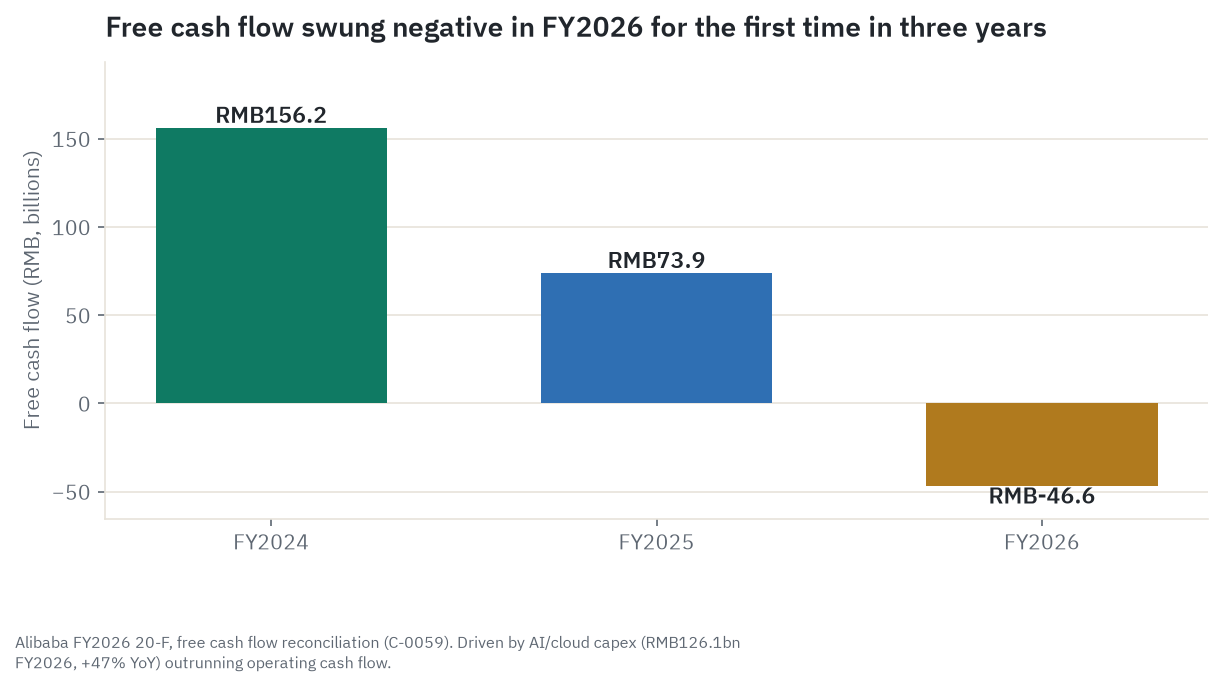
Free cash flow turned negative for the first time in three years, and this is the single most important cash-flow fact in the filing. Free cash flow was negative 46.6 billion yuan (negative 6.8 billion dollars) in FY2026, compared with positive 73.9 billion yuan in FY2025 and positive 156.2 billion yuan in FY2024. Operating cash flow fell 53 percent to 76.2 billion yuan while capital expenditure rose to 122.0 billion yuan from 84.3 billion yuan, and management’s own explanation attributes the decline “mainly” to quick-commerce investment and rising cloud infrastructure spending.
The balance sheet still has room, but the cushion thinned in a single year. Cash and short-term investments totaled roughly 286.8 billion yuan (41.6 billion dollars) as of March 31, 2026, down from about 374.3 billion yuan a year earlier. Total debt was roughly 260 billion yuan (37.7 billion dollars), with no senior notes maturing within the next year and the maturity schedule back-loaded well beyond that. Netting debt against cash and short-term investments, Alibaba is still roughly net-cash, but that cushion is meaningfully thinner than it was twelve months ago.
Capital returns pulled back sharply, in the same year free cash flow went negative. Share buybacks totaled only about 1.0 billion dollars in FY2026 (73 million shares repurchased on the NYSE), down from roughly 12 billion dollars the year before, a reduction on the order of 92 percent. Ordinary shares outstanding actually rose slightly during the year, from about 18.47 billion to about 18.58 billion, the first such increase in recent years, as employee restricted-stock and convertible-note dilution outpaced the now much smaller buyback. The board also declared only the standard annual dividend of 1.05 dollars per ADS for FY2026, dropping the extraordinary dividend that had brought the prior year’s combined payout to 2.00 dollars per ADS. Reduced buybacks, a dropped special dividend, and negative free cash flow all landing in the same twelve months is a coherent, and worth-noting, pattern of capital being redirected toward the AI and cloud buildout.
The risk factors Alibaba discloses about itself are worth reading directly. The 20-F states plainly that the VIE structure through which Alibaba operates its Chinese licenses “has not been tested in a court of law,” and that if Chinese regulators ever found the arrangement non-compliant, Alibaba “could be forced to relinquish control” and stop consolidating those businesses. Separately, the filing notes that the significant volatility and decline in the ADR price in recent years has increased the risk that Alibaba could be treated as a Passive Foreign Investment Company for US tax purposes, an unusual risk factor that is explicitly a function of the stock’s own price decline and would trigger materially worse tax treatment for US individual holders if triggered. On the delisting question, the SEC placed Alibaba on its conclusive “Commission-Identified Issuer” list in August 2022 after the audit regulator PCAOB said it could not inspect Chinese-based auditors; a December 2022 bilateral agreement restored PCAOB’s inspection access, and Alibaba has not been re-identified since. That resolution depends on continuing cooperation between Washington and Beijing, a political relationship rather than a permanent fix, which is exactly why Alibaba converted its Hong Kong listing to dual-primary status in August 2024, a direct, already-executed hedge against a renewed delisting scenario.
Insider and institutional signal is thin by design. As a foreign private issuer, Alibaba is exempt from the US-style continuous insider-transaction reporting that produces a Form-4 tape for domestic companies, so there is no ongoing read on executive buying and selling. The 20-F’s own beneficial-ownership table shows light insider holdings: Chairman Joseph Tsai at 1.5 percent of ordinary shares, CEO Eddie Wu at 0.1 percent. No outside holder is disclosed at the 5 percent-or-more threshold in this filing.
What the market is paying
Alibaba trades on two exchanges as one economic security. The NYSE ADR (BABA), where each ADS represents eight ordinary shares, and the Hong Kong Stock Exchange ordinary shares (9988.HK), which became eligible for mainland Chinese investor access through Stock Connect once Alibaba converted its Hong Kong listing to dual-primary status in August 2024. As of this writing the two lines are tightly arbitraged: 9988.HK traded around HK$94.50, which at prevailing exchange rates and the eight-shares-per-ADS ratio implies an ADS-equivalent price essentially identical to the NYSE line.
The 52-week range tells the drawdown story on its own: 91.99 to 192.67 dollars, meaning the stock sits roughly 49 to 50 percent below a high set as recently as January 2026. The proximate path down was fast, not gradual: the stock fell from around 126.62 dollars on May 27, 2026 to around 94.93 dollars by June 26, 2026, a roughly 25 percent decline in a single month, compounding on top of an earlier April 2026 tariff-driven shock that produced a 36.77 percent intraday drawdown around April 7. Multiple things happened in that same six-week window in late June: the Anthropic distillation allegation became public around June 25, the Department of Defense’s blacklist listing (June 8) and Alibaba’s subsequent lawsuit (June 23) were both live, prominent investors including ARK Invest’s Cathie Wood and Michael Burry’s Scion Asset Management were reported reducing or exiting positions, China’s May retail-sales data showed the first year-over-year contraction since 2023, and the fiscal fourth-quarter results (filed May 13) had already come in below consensus on both revenue and margins. Untangling a single cause from that compressed timeline is not really possible, and this research treats the decline as genuinely multi-causal rather than assigning it to any one headline.
On valuation, Alibaba trades around 15 times trailing earnings and roughly 15 times forward estimates, per aggregator data timestamped for this research date, alongside a dividend yield near 1.1 percent on the reduced annual dividend. That multiple is directionally accurate but should not be treated as reconciled precisely to the audited GAAP earnings in the 20-F. Converting the filing’s GAAP diluted earnings per ordinary share into a per-ADS, US-dollar basis lands in a broadly similar range to the aggregator’s trailing figure, but the two do not match exactly, likely reflecting a blend of trailing-twelve-month periods that straddle the fiscal year boundary and a GAAP-versus-non-GAAP definitional gap. Treat the mid-teens multiple as directionally right, not audited to the decimal. Beta is unusually low for a Chinese ADR, around 0.50 versus the broad US market, which likely reflects that this stock’s volatility is driven by idiosyncratic China and geopolitical news rather than by US macro conditions; a low beta does not mean low volatility, and a roughly 50 percent peak-to-trough move in a single year is large in absolute terms regardless of its correlation to the S&P 500.
Short interest sits low for a mega-cap, in the range of 1.6 to 2.1 percent of float depending on the exact reporting date and provider (this figure is aggregator-sourced rather than an exchange-official biweekly count, so treat it as directional). A sub-3-percent short interest on a stock that fell roughly half from its 52-week high suggests the decline has been driven mostly by long-holder selling and sentiment, not by an aggressive short build, which matters for anyone framing this as a short-squeeze setup: the positioning data does not support that framing.
Sell-side coverage has stayed remarkably bullish through the entire drawdown. Across roughly 40 to 48 analysts depending on the data provider, consensus remains “Strong Buy,” with average 12-month price targets clustering around 187 to 195 dollars, individual targets ranging as high as roughly 220 dollars and as low as 175. At a spot price around 97 dollars, that average target implies on the order of 90 to 100 percent upside, an unusually wide gap between where sell-side analysts think the stock should trade and where it actually trades. Most of these targets, including a wave of increases to 190 to 195 dollars from firms including Morgan Stanley, Mizuho, and Barclays, were set or reaffirmed in May 2026, before the DoD listing, the Anthropic allegation, and the DOJ settlement all landed in the same six-week window. That gap cuts two ways. It is consistent with a genuine mispricing, if the recent selloff really is sentiment-driven noise layered onto an improving operating picture. It is equally consistent with sell-side models simply not having caught up yet to three concurrent, genuinely hard-to-model legal and geopolitical developments. Sell-side price targets are structurally slow to re-rate after a fast, multi-causal selloff, and this research treats the gap as a signal worth watching, not as proof the market is wrong.
What the crowd is saying
Retail and social sentiment on Alibaba splits into an unusually binary debate: either this is a wrongly punished compounder trading at a discount that will not last, or a structurally impaired business carrying a governance and geopolitical discount that never closes. Few commentators hold a moderate middle position, and that binary framing, more than any single data point, is the defining sentiment feature of this stock and of Chinese ADRs generally heading into the second half of 2026.
The bearish camp’s case is built almost entirely on the compressed run of headlines already described: the Anthropic allegation, the DoD blacklist and lawsuit, high-profile investor exits, and a weak China retail-sales print, all inside the same six-week window. Michael Burry’s Scion Asset Management, notably, had already fully exited a BABA position once before, in 2025, after briefly holding it, a round trip retail bears cite as evidence that even sophisticated value investors have struggled to hold this name through China-specific volatility. The bullish camp counters with the same six-month period’s operating numbers, 34 to 40 percent cloud growth and an eleventh straight quarter of triple-digit AI product revenue growth, and points to sell-side coverage that has stayed at “Strong Buy” throughout, arguing the selloff is a liquidity and headline-risk event divorced from the earnings trajectory. Financial media coverage in 2026 has consistently framed BABA as a genuinely contested “deep value or value trap” story rather than settling one way, which is itself informative: both camps largely agree on what the operating numbers show, and the disagreement is almost entirely about what discount rate to apply to headline, governance, and geopolitical risk, an inherently sentiment-driven question rather than a fundamentals one.
Founder Jack Ma’s public visibility is watched by the market as an informal barometer of the company’s, and the broader Chinese private-tech sector’s, political standing, following his 2020 exit from Alibaba’s board and a widely read period of withdrawal from public life after Ant Group’s IPO was suspended. A rare in-person appearance alongside senior Alibaba and Ant executives at a rice-planting event outside Hangzhou, reported June 29, 2026, landed right in the trough of the Anthropic and DoD-driven selloff, and some coverage read the timing as a signal of continued state tolerance for the company’s private leadership, though this is an inference from timing, not a stated fact from any official source.
Retail sentiment toward the whole China-ADR complex, not just Alibaba, is colored by two structural facts that recur in every bear thread regardless of the quarter’s earnings: the VIE structure, under which a US ADR holder owns a contractual claim rather than direct equity in the Chinese operating business, and the delisting mechanism under the Holding Foreign Companies Accountable Act, which depends on a bilateral audit-access agreement either government could revoke. Alibaba’s Hong Kong dual-primary conversion is read by bulls as management being proactively prudent and by bears as management itself treating the delisting scenario as live enough to prepare for. Both readings can be true at once, which is exactly the kind of ambiguity that keeps this stock’s sentiment more volatile than its underlying business fundamentals would suggest on their own.
Is this a cyclical bear market or a structural discount that never closes?
The structural bull case rests on a genuine claim: the growth engine has changed character. Cloud and AI are compounding off a real technology cycle, generative AI enterprise adoption and Qwen model traction, that does not depend on the stressed Chinese consumer at all, and it is scaling with improving unit economics as cloud segment EBITA grows faster than revenue. At the same time, Beijing is now actively subsidizing the consumption side of Alibaba’s legacy business through consumer trade-in bond proceeds and a moderately loose monetary policy, rather than squeezing it the way 2021 to 2023’s regulatory “rectification” phase did, and the AI-driven marketing tools lifting China Commerce take rates show Alibaba extracting more value per transaction without needing shopping volume itself to reaccelerate. The Hong Kong dual-primary listing has already neutralized the worst-case US delisting tail risk for the listing itself. If China’s property market finds any kind of bottom over the next year or two and the AI capex program starts converting to durable cloud profit, both halves of the business could re-rate at once.
The cyclical bear case is real, and it has simply moved to a new axis: geopolitics rather than a classic demand glut. China’s home prices have fallen for roughly four and a half years through 2026, a scale of household wealth destruction comparable to the US experience after 2008, just slower-moving, and while price declines have narrowed, a broader recovery is still probably one to two years out given oversupply. Underneath that, the specific trigger to watch is not a demand collapse but a policy shock: an unfavorable resolution of the DoD blacklist litigation, a fresh escalation in the tariff whipsaw that has already produced two separate declines exceeding 25 percent in 2026 alone, or a breakdown in the PCAOB-China audit-access agreement that reactivates real delisting risk despite the Hong Kong hedge, since US investors holding the NYSE line would still be forced to liquidate or transfer even if the Hong Kong shares remained listed. And the AI capex cycle carries its own overbuild risk: if enterprise AI monetization disappoints relative to the roughly 53 billion dollar three-year commitment, Alibaba would be left holding depreciating data-center capacity on top of a group-level margin profile that is already stressed.
The most likely outcome, on the evidence gathered here, is a nuanced split rather than a clean call in either direction. The property-driven consumption drag probably continues to grind sideways-to-slowly-improving over the next 12 to 24 months rather than snapping back or collapsing further, since state stimulus so far has narrowed price declines without reversing them. Cloud and AI most likely keep compounding at a high double-digit to triple-digit rate on the AI product line specifically, with segment margins continuing to improve, but group-level profitability likely stays depressed for several more quarters as capex depreciation runs ahead of monetization. The geopolitical overhang is probably the single biggest swing factor on how volatile the stock actually feels, even if it does not change the underlying business trajectory much: expect continued sharp, headline-driven drawdowns and rebounds layered on top of a slowly improving operating picture.
The scenarios in detail
The four variables that actually decide where this stock goes over the next five years: whether China Commerce’s Adjusted EBITA keeps falling or has bottomed, whether Cloud Intelligence Group scales into a large enough profit center to offset commerce’s compression, how the DoD lawsuit and the Anthropic dispute resolve, and whether China’s consumption cycle turns. Every dollar figure below is built from an illustrative “normalized earnings per ADS times a forward multiple” framework, not a discounted-cash-flow model, and every one of them is an estimate, never a price target.
Bull. The price war against Pinduoduo and Douyin cools as neither side is willing to keep sacrificing profit indefinitely, letting China Commerce’s take-rate gains flow through to profit again. Cloud Intelligence Group keeps compounding at a 30 to 40 percent revenue clip with profit growing even faster, as it did in the most recent quarter, reaching a scale and margin comparable to a leading US hyperscaler’s regional footprint. In hindsight, the roughly 53 billion dollar AI and cloud capex program is judged to have been well-timed rather than an overbuild. Both the DoD lawsuit and the Anthropic dispute resolve favorably or simply fade, following the precedent set by Xiaomi and AMEC’s successful blacklist removals. China’s property market finds a real bottom within the plausible one-to-two-year window, and Beijing’s stimulus meaningfully lifts household consumption. Under these assumptions, normalized earnings per ADS grow from roughly 6.30 dollars today to roughly 13.50 dollars within five years, and a forward multiple expanding from today’s roughly 15 times toward 18 to 20 times on a larger, more diversified earnings base implies a five-year price around 260 dollars [estimate]. What has to be true: the AI capex program converts to durable, high-margin cloud revenue roughly on management’s signaled timeline, and at least one live legal dispute resolves without a lasting scar. What breaks it: either dispute resolves unfavorably, or cloud monetization disappoints relative to what was already spent.
Base. China Commerce’s profit bottoms over the next 12 to 24 months as the price war plateaus rather than ends outright, still leaving margin below its historical potential. Cloud keeps growing at a strong but decelerating rate as it scales, becoming a meaningfully larger, though not dominant, share of group profit. The AI capex program broadly delivers, neither a clear win nor a clear overbuild. Both legal disputes stay unresolved for a while longer or resolve without a decisive read either way, keeping some geopolitical discount on the multiple. China’s consumption drag continues to grind sideways-to-slowly-improving rather than reversing sharply. Under these assumptions, normalized earnings per ADS grow from roughly 6.30 dollars today to roughly 10.00 dollars within five years, a real but unspectacular recovery, and a forward multiple holding roughly flat near today’s 15 times implies a five-year price around 150 dollars [estimate]. What has to be true: no single driver has to go dramatically right or wrong, this is the muddle-through case. What breaks it toward the bear case: either legal dispute escalating meaningfully, or the price war reintensifying instead of plateauing.
Bear. The price war against Pinduoduo and Douyin persists for years, not quarters, because neither competitor has an incentive to blink first, keeping China Commerce’s profit structurally depressed. Free cash flow stays negative or barely positive as the AI and cloud capex program continues to outrun monetization, an overbuild scenario in which Alibaba is left holding depreciating data-center capacity relative to realized enterprise demand. The DoD blacklist litigation fails, the designation is upheld, keeping Alibaba locked out of Pentagon-adjacent business and reinforcing a narrative that this stock carries uncapped headline risk. The Anthropic dispute escalates rather than fades, adding a reputational overhang to the legal one. China’s consumption drag persists beyond the plausible one-to-two-year window. In the tail version of this case, a breakdown in the PCAOB-China audit-access agreement reactivates real delisting risk for the NYSE line, testing the Hong Kong dual-primary hedge under actual stress rather than as a precaution. Under these assumptions, normalized earnings per ADS grow only modestly, from roughly 6.30 dollars today to roughly 7.50 dollars within five years, essentially treading water as reinvestment and competitive spending consume most of the operating improvement, and a forward multiple compressing from today’s roughly 15 times toward a crisis-level 7 times, as the market treats the geopolitical and structural discount as effectively permanent, implies a five-year price around 50 dollars [estimate]. What has to be true: at least two of the four driver-tree variables go wrong at once. What would confirm this case: repeated quarters of flat-to-declining China Commerce profit alongside no resolution, or an unfavorable resolution, to either the DoD or Anthropic matter.
Catalysts and timeline. In the near term: Alibaba’s fiscal first-quarter 2027 results, due around mid-August 2026; any ruling or scheduling development in the DoD blacklist lawsuit, filed in the Northern District of California; any further public development in the Anthropic dispute; monthly China retail-sales and property-price data; and the pace at which the 2026 consumer trade-in subsidy program is actually deployed. Further out: the 2027 date when the DoD’s indirect, subcontractor-level purchase restrictions take effect; the ongoing status of the PCAOB-China audit-access agreement; whether the roughly 53 billion dollar three-year AI and cloud capex program, concluding around 2028, converts to durable segment profit; and any change in Ant Group’s IPO status.
Leading indicators to watch. China Commerce Adjusted EBITA, quarter over quarter, whether it is still falling, flat, or improving. Cloud Intelligence Group’s Adjusted EBITA margin trend, whether operating leverage keeps improving as capex scales. Any ruling, stay, or scheduling order in the DoD lawsuit. Any further public development, evidence, denial, retraction, or escalation, in the Anthropic dispute. Free cash flow and buyback pace in the next two quarterly reports. China property-price indices and monthly retail-sales prints.
Companies to watch (bull / base / bear)
Alibaba (BABA) - the subject of this piece.
- Bull: the price war cools, cloud scales into a real second profit engine, and at least one legal overhang clears.
- Base: a slow, real operating recovery against a persistent but not widening geopolitical discount.
- Bear: the price war grinds on for years, capex outruns monetization, and the DoD listing is upheld.
- Watch: China Commerce Adjusted EBITA trend and any DoD lawsuit ruling.
JD.com (JD) - the logistics-heavy structural counterpoint to Alibaba’s marketplace model.
- Bull: core retail margin expansion continues while food-delivery losses keep narrowing.
- Base: a slow grind toward food-delivery breakeven with retail margins broadly stable.
- Bear: the subsidy war with Meituan and Alibaba’s Ele.me reintensifies and group profitability stays under pressure with no visible end date.
- Watch: New Business segment loss trend, quarter over quarter.
PDD Holdings (PDD) - the platform applying the most direct price pressure on Alibaba’s core commerce margin.
- Bull: Pinduoduo’s domestic growth stays strong and Temu’s shift to a semi-managed model reduces PDD’s own capital risk without losing much share.
- Base: domestic growth moderates as Temu’s take-rate compression bites, but PDD remains the fastest-growing large platform.
- Bear: Temu’s duty-free growth engine is permanently gone and take-rate compression proves structural rather than a one-time reset.
- Watch: Temu’s take-rate trajectory as the semi-managed transition completes.
Baidu (BIDU) - the cleanest read-through on China AI-cloud demand, competing with Alibaba Cloud for enterprise workloads.
- Bull: Apollo Go’s robotaxi scale-up and AI cloud growth give Baidu a durable second growth leg.
- Base: AI cloud growth continues while core search advertising slowly declines, a rough offset.
- Bear: short-video and AI-search disintermediation erode core advertising faster than the new businesses can replace it.
- Watch: Apollo Go ride volume and AI Cloud Infra revenue growth, quarter over quarter.
Tencent (0700.HK / TCEHY) - the far larger, more diversified peer Alibaba is often compared against on margin quality.
- Bull: gaming, advertising, and fintech keep funding an AI buildout from a much stronger profit base.
- Base: steady, high-single-digit to low-double-digit growth across segments with continued regulatory friction in gaming.
- Bear: a fresh gaming-approval or payments-antitrust regulatory shock disrupts the earnings base.
- Watch: domestic and international gaming revenue growth and any new SAMR or gaming-regulator action.
Amazon (AMZN) - the global-scale benchmark for both Alibaba Cloud’s growth rate and Alibaba’s e-commerce economics.
- Bull: AWS reacceleration alongside record group operating margins keeps demonstrating what a fully monetized AI capex cycle looks like.
- Base: AWS growth normalizes toward the high 20s to low 30s percent range with margins holding near current levels.
- Bear: AI capex intensity across the whole hyperscaler group compresses margins industry-wide, Amazon included.
- Watch: AWS operating margin trend as its own AI infrastructure investment continues. See our Amazon deep dive.
Risk controls
The clearest, most quantifiable risk in this research is capital-allocation deterioration: free cash flow went negative for the first time in three years, the buyback shrank by roughly 92 percent, and the extraordinary dividend was dropped, all in the same fiscal year. If a reader is underwriting the bull case on “Alibaba is cheap and will keep buying back stock,” that specific mechanism has weakened materially and needs re-underwriting, not assuming.
The least quantifiable risk is structural: Alibaba operates through a variable interest entity structure that its own regulatory filing says has never been tested in a Chinese court, and it is a US-listed ADR subject to a delisting mechanism that is currently dormant but not repealed, dependent on a bilateral audit-access agreement either government could revoke. Neither risk shows up in a standard valuation multiple, and neither shrinks even if every operating number in this article improves. A reader sizing a position in this name should treat the standard China-ADR discount as compensation for a real, structural risk, not merely an emotional one, whatever view they take on whether the current discount is large enough.
The two most acute near-term risks are both legally sensitive and both genuinely unresolved as of this research date. Alibaba has been designated by the US Department of Defense as a “Chinese Military Company” and is suing in federal court to reverse that designation; the outcome is pending, and this research does not know, and cannot honestly estimate, which way it will go. Separately, Anthropic has alleged, in a letter to the US Senate Banking Committee, that actors affiliated with Alibaba ran a large-scale scraping campaign against its Claude models; this is an unproven allegation that Alibaba has not admitted and that Chinese state media has publicly disputed, and it should be weighed as exactly that, an open question, not a settled fact in either direction. A third, separate matter, a 600 million dollar settlement with the US Department of Justice, is resolved: Alibaba and an Ant Group payment-processing subsidiary signed non-prosecution agreements and Alibaba admitted that between 2016 and 2024 its marketplaces failed to prevent roughly 80,000 illegal pharmaceutical and controlled-substance sales. No individuals were criminally charged, and this is a non-prosecution agreement, not a conviction, but the admission of the underlying conduct is now a matter of public record.
What would change this thesis: a durable, multi-quarter stabilization in China Commerce’s Adjusted EBITA would be the strongest confirming signal for the bull case. An unfavorable outcome in the DoD lawsuit, or credible public evidence substantiating the Anthropic allegation, would be the strongest disconfirming signal. A second consecutive year of negative free cash flow, without a clear cloud-profit offset, would undercut the “temporary reinvestment” framing this research currently gives the bull case some credit for.
Methodology, sourcing, and data-quality flags
This research draws on Alibaba’s FY2026 Form 20-F (filed May 20, 2026) and fiscal-year results 6-K (filed May 13, 2026), both primary SEC filings, cross-checked against market-data aggregators (stockanalysis.com, TipRanks, MarketBeat), reputable financial press (Bloomberg, Reuters wire copy, Caixin Global, CNBC, SCMP), and a US Department of Justice press release. Every load-bearing figure in this piece traces to a claim in the underlying research ledger, adjudicated by an independent verification pass that checked each one against a second, independently named source before treating it as confirmed.
On valuation. Alibaba’s roughly 15 times trailing earnings multiple reads as cheap against both its own 52-week high and against US hyperscaler comparables, and a still-bullish sell-side consensus implies substantial upside from current levels. That cheapness is real but only a partial signal: GAAP earnings this year were flattered by a large one-time non-operating gain, so the multiple sitting on normalized operating earnings is richer than the headline number suggests, and the discount also has to compensate for structural risks (the VIE arrangement, the dormant delisting mechanism) that a multiple alone cannot price cleanly. On growth. Cloud and AI product revenue are compounding at rates that would be exceptional anywhere in the world, but this pocket remains a minority of group profit, and headline group revenue growth is muted once the like-for-like adjustment for disposed businesses is set aside. On quality. This has genuinely deteriorated over the past year: free cash flow turned negative for the first time in the disclosed three-year run, the buyback shrank roughly 92 percent, and the board dropped the extraordinary dividend, real and quantifiable changes in capital-allocation capacity, not a rough patch that shows up only in a single quarter. On risk. Elevated and largely outside Alibaba’s own control: the VIE structure, the dormant HFCAA mechanism, an active DoD blacklist lawsuit with an uncertain outcome, and an unresolved, disputed allegation from a US AI lab that has already moved the stock materially. On momentum. Negative in the near term, the stock sits roughly half below its January 2026 high on a concentrated run of negative headlines, though low short interest suggests the decline reflects long-holder selling rather than an aggressive short build, and sell-side consensus has stayed bullish throughout, a genuine, if possibly stale, counter-signal. On balance, the five-factor read nets to a Hold that leans toward the inexpensive side: a real operating recovery story sitting underneath real, currently unresolved legal and structural risk that the valuation only partially compensates for.
Data-quality flags:
- Alibaba’s GAAP diluted earnings per share (5.50 yuan per ordinary share, FY2026) does not reconcile exactly to the trailing US-dollar-per-ADS earnings figure aggregators quote for the same period; treat the mid-teens trailing P/E as directionally right, not audited to the decimal.
- China e-commerce transaction-volume shares among Alibaba, JD, and PDD are stale and third-party-estimated across the board; no platform has disclosed official transaction volume since 2020-2021. Treat any specific percentage split as directional, not precise.
- Short interest (roughly 1.6 to 2.1 percent of float) is aggregator-sourced, not an exchange-official biweekly figure; treat as directional.
- Estimates for China’s total cloud-computing market range roughly 60 to 110 billion dollars for 2026 depending on the market-definition scope used by the estimating house; this research does not cite a single point figure for that reason.
- The roughly 53 billion dollar three-year AI and cloud infrastructure commitment is a management-communicated plan reported by press, not a figure the audited 20-F restates verbatim; the filing states only that it has no other detailed future capital-asset plans beyond what was previously announced.
- Two legally sensitive matters discussed in this piece remain genuinely unresolved as of the research date and are framed accordingly throughout: the DoD blacklist lawsuit (designated, suing, outcome pending) and the Anthropic distillation allegation (an unproven allegation Alibaba disputes). A third matter, the DOJ non-prosecution settlement, is resolved and is stated as fact, including Alibaba’s admission of the underlying conduct.
Key sources: Alibaba FY2026 Form 20-F (SEC EDGAR, filed 2026-05-20); Alibaba FY2026 fiscal-year results announcement, Form 6-K (SEC EDGAR, filed 2026-05-13); US Department of Justice Office of Public Affairs press release (2026-07-01); stockanalysis.com; TipRanks; Caixin Global; CNBC; SCMP; Bloomberg.
Prepared July 2, 2026. Figures are point-in-time and will change. This is research and analysis for educational purposes, not investment advice, not a recommendation, and not a solicitation. Alibaba is a Cayman Islands holding company operating in China through a VIE structure and a US-listed ADR subject to unresolved US-China regulatory, litigation, and delisting-adjacent risk. Verify all figures independently and consult a licensed financial advisor before making any decision.