
Research date: July 1-2, 2026 | OSINT market research on Western Digital Corporation (WDC, Nasdaq), a company-mode deep dive for retail investors.
Important disclaimer. This is OSINT-based research and educational analysis, not investment advice. I am not a financial advisor. Nothing here is a recommendation to buy or sell any security, and the scenarios below are illustrative, not price targets. WDC’s stock has moved more than sevenfold over the trailing year and swung double digits in the two trading sessions bracketing this research date alone, so treat every figure below as a snapshot, not a fixed fact. Market caps, prices, valuation multiples, and market-share figures are point-in-time (July 1-2, 2026), press-reported where noted, and move fast. Do your own due diligence and consult a licensed advisor.
Where this stock could be in 6 months, 1 year, 3 years, and 5 years
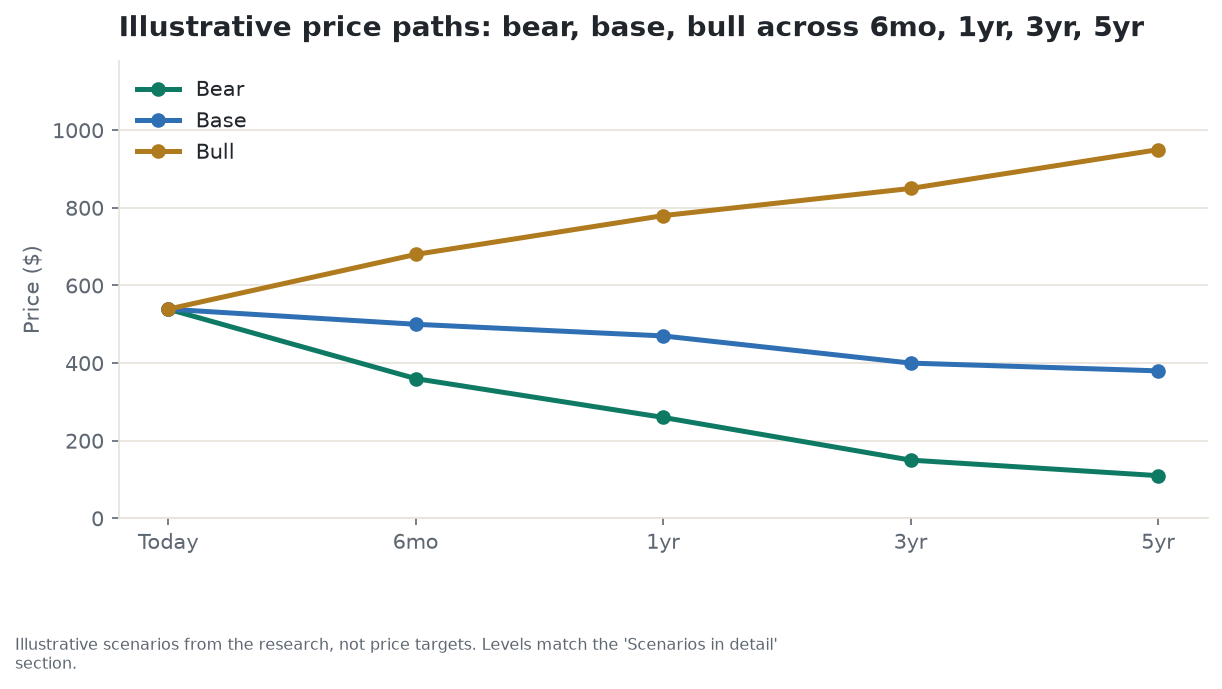
6 months. This window belongs almost entirely to one date: July 29, 2026, when WDC reports fiscal fourth-quarter results and gives its first look at fiscal 2027. Management has already guided to $3.65 billion in revenue and 51 to 52 percent non-GAAP gross margin. A print that lands near that guidance with steady initial commentary on next year points toward the base case, around $500. A beat with confirmation that its next-generation recording technology is progressing on schedule points toward the bull case, near $680. A miss, or a cautious first look at fiscal 2027, layered on top of the sector-wide pullback already underway in the days before this research date, points toward the bear case, near $360. The single number that flips this window is whether non-GAAP gross margin holds in that guided range or slips.
1 year. By mid-2027 the market will be judging a full fiscal year without the one-time accounting item (detailed below) that inflated this year’s headline earnings, and the spread between outcomes widens accordingly: the bear case sits near $260, the base case near $470, the bull case near $780. The base case assumes growth cools from its current extraordinary pace to a still-healthy rate as pricing power normalizes somewhat. The thing most likely to flip this window is concrete evidence of whether WDC’s newest drive technology reaches large customers on a timeline competitive with its only real rival, Seagate, or whether WDC visibly cedes ground in its most valuable product tier.
3 years. This horizon is where the technology race and the industry’s pricing discipline either hold or crack. The base case, near $400, assumes durable but slower growth and a margin structure that settles well above where WDC has historically operated but below today’s peak. The bear case, near $150, assumes a genuine down-cycle, the kind this industry has produced before, arriving as the two suppliers’ combined capacity catches up with demand, compounded by WDC losing further ground on the technology race. The bull case, near $850, assumes WDC closes that technology gap and the two- supplier market keeps choosing margin discipline over a price war.
5 years. By 2031 the question that matters most is structural: does the falling cost of flash memory keep closing the gap with hard drives in the coldest, cheapest storage tier, the one place hard drives still clearly win on economics? If that gap keeps closing, the bear case, near $110, plays out. If hard drives keep their edge in that tier, the outcome lands closer to the base case, near $380, still below today’s price because it assumes the current rich valuation eventually normalizes even if the business itself does fine, or the bull case, near $950, if AI-era data retention permanently enlarges the amount of storage that needs exactly what a hard drive is good at. Nobody can observe that cost-curve race in real time; everybody, this piece included, has to estimate it.
Where the read lands today. On balance, the five-factor read holds at Hold: a genuinely strong hard-drive business riding real AI-datacenter demand, priced at a level that already assumes a good version of that story keeps playing out, on top of a headline earnings number that is flattered by a one-time gain that will not repeat. The single thing most likely to flip it is the July 29 earnings print.
Companion tool
Jump to the interactive dashboard to sort and filter every company in this piece, or download the Excel model to flex the scenarios yourself.
TL;DR
Western Digital used to be two businesses bolted together: hard drives and NAND flash memory. It spun off the flash side as SanDisk in February 2025 and is now a pure-play hard-drive maker, one of exactly two companies on earth (Seagate is the other) that still builds these at scale. That timing turned out to be either brilliant or lucky, because an AI-driven data storage boom hit almost immediately after: hyperscalers need vast, cheap, persistent storage for training data, model checkpoints, and everything AI systems generate, and a spinning hard drive remains the cheapest way to store a terabyte that does not need to be read back in microseconds. Revenue grew 45 percent last quarter, gross margin jumped over 10 percentage points in a year, and the company just raised its dividend 20 percent. The complication: a large share of WDC’s reported net income this year is not from selling hard drives at all, it is a mark-to-market accounting gain on the SanDisk shares WDC kept after the spinoff, and SanDisk’s own stock has gone up roughly sixty-fold since it started trading. Strip that gain out and the stock’s real earnings multiple is considerably richer than the headline number suggests, right as the whole AI-memory trade (WDC included) just had its first real two-day wobble.
Explore it yourself: the interactive dashboard
Open the dashboard in a full screen
What WDC actually does
Western Digital makes one thing: hard disk drives, the spinning-platter storage devices that hold data using magnetized regions on a metal or glass disk. That is a genuinely unusual business to still be in. Twenty years ago dozens of companies made hard drives. Today there are two: WDC and Seagate. Everyone else either went bankrupt, got acquired, or moved entirely to flash memory, the technology inside solid-state drives (SSDs), which has no moving parts and is faster but, gigabyte for gigabyte, still meaningfully more expensive to manufacture at very large capacities.
Think of it like the difference between a filing cabinet and a card catalog drawer. Flash memory is the card catalog drawer: instant to flip through, compact, and increasingly cheap, but you pay a premium for that speed at large scale. A hard drive is the filing cabinet: slower to search, but it holds vastly more paper per dollar, and for records you are not constantly pulling and re-filing, that is exactly the trade-off you want. Datacenters run on both. The card-catalog drawer (flash) handles the files everyone needs right now. The filing cabinet (hard drives) handles the much larger volume of files that need to exist, cheaply, for a long time, without needing instant access.
WDC sells into three end markets. Cloud is by far the largest and fastest growing: high-capacity drives sold to hyperscalers and enterprises for datacenter storage, 89 percent of revenue and growing 48 percent year over year in the most recent quarter. Client is drives designed into PCs and network-attached-storage boxes for OEM customers, a much smaller and slower piece of the business. Consumer is external hard drives and surveillance-camera storage sold through retail, smaller still. The story of this entire article is really the story of that first number: Cloud revenue’s growth is why the stock has moved the way it has, and Cloud revenue’s durability is the question every other section circles back to.
How the money flows
flowchart TD
    DEMAND["End demand<br/>AI training/inference datasets, hyperscaler cold/warm storage, video surveillance, PC/NAS backup"]
    HYPER["Hyperscalers + cloud/enterprise<br/>Cloud end market - 89% of WDC Q3 FY26 revenue"]
    OEM["PC / NAS OEMs<br/>Client end market"]
    RETAIL["Retail / surveillance / DIY<br/>Consumer end market"]
    RD["R&D + component design<br/>Heads, media, motors, controllers, firmware"]
    FAB["WDC's own HDD manufacturing<br/>Thailand, Malaysia, Philippines, Japan"]
    TECH["Recording technology tier<br/>ePMR/UltraSMR shipping today (30-40TB); HAMR in customer qualification (targeting 100TB+)"]
    DUOPOLY["Global nearline/enterprise HDD supply<br/>WDC and Seagate (STX) - a two-company market"]
    WDC_CLOUD["WDC Cloud segment<br/>$2.97B Q3 FY26, +48% YoY"]
    WDC_CLIENT["WDC Client segment<br/>$179M Q3 FY26"]
    WDC_CONS["WDC Consumer segment<br/>$186M Q3 FY26"]
    RETURNS["Shareholder returns<br/>$6B buyback authorized, $0.15/share quarterly dividend"]
    SUBSTITUTE["Competing technology<br/>NAND flash/SSD (SanDisk, Samsung, SK hynix, Micron, Kioxia) - the long-run substitution threat"]

    DEMAND --> HYPER
    DEMAND --> OEM
    DEMAND --> RETAIL
    RD --> FAB
    FAB --> TECH
    TECH --> DUOPOLY
    DUOPOLY --> WDC_CLOUD
    DUOPOLY --> WDC_CLIENT
    DUOPOLY --> WDC_CONS
    HYPER --> WDC_CLOUD
    OEM --> WDC_CLIENT
    RETAIL --> WDC_CONS
    WDC_CLOUD --> RETURNS
    WDC_CLIENT --> RETURNS
    WDC_CONS --> RETURNS
    SUBSTITUTE -.->|cost-per-bit competition, long-run| HYPER
Follow the diagram from the top. Demand starts in three very different places, but 89 cents of every dollar now comes from the same place: hyperscalers and enterprises buying capacity for AI-era datacenter storage. That demand draws on a manufacturing process WDC runs end to end, from component research through its own factories in Thailand, Malaysia, the Philippines, and Japan, which is precisely why the industry has consolidated to two survivors instead of the five or six a typical hardware market supports: building a drive at the cost and reliability hyperscalers demand is not something you can outsource or replicate on short notice.
The technology tier in the middle of the diagram is the real chokepoint. WDC ships today on a recording technology called ePMR, which tops out around 30 terabytes in its standard form and 40 terabytes using a shingled-write technique. The next step up, a laser-assisted technology called HAMR, is what both WDC and Seagate need in order to reach 100 terabytes and beyond, and as of WDC’s own most recent public roadmap update, its customers were still qualifying WDC’s HAMR drives rather than buying them in volume, a step behind Seagate’s own claimed volume production. Once built, output splits back into the three end markets it came from, and the resulting cash funds WDC’s capital return program: a combined $6 billion buyback authorization and a dividend just raised 20 percent.
The dotted line at the bottom is the long-run risk this whole piece keeps returning to. NAND flash, made by SanDisk (WDC’s own former flash division), Samsung, SK hynix, Micron, and Kioxia, competes for the same storage dollar on a falling cost curve, and every year that curve keeps falling is a year the economic case for hard drives in the coldest, cheapest storage tier gets a little harder to make. The toll booth in this chain is not a patent or a brand. It is manufacturing scale in a business only two companies still run, and today that scale is worth more than it has been in years because AI demand is outrunning the industry’s ability to add capacity.
The three segments, in plain terms
Cloud covers high-capacity drives sold to hyperscalers (the large cloud computing operators) and enterprises for datacenter storage. This is where essentially all of WDC’s growth is coming from: $2.97 billion in the most recent quarter, up 48 percent year over year, and 89 percent of total company revenue. These are the drives that hold the “cold” and “warm” tiers of datacenter storage, meaning data that needs to exist and be retrievable but does not need to be read in microseconds the way active AI-model weights or a live database does.
Client covers drives WDC sells to PC makers and network-attached-storage (NAS) box makers to build into their own products. At $179 million in the most recent quarter, this is a small and comparatively slow-growing sliver of the business, riding ordinary PC-refresh cycles rather than the AI buildout.
Consumer covers external hard drives, memory cards, and drives sold into surveillance systems, mostly through retail channels. At $186 million in the most recent quarter, this is the segment an ordinary shopper would actually recognize, and it is the smallest and slowest-growing of the three.
The technology roadmap underneath all three segments. WDC’s shipping technology today is called ePMR (energy-assisted perpendicular magnetic recording), which the company says has reached 30 terabytes in its standard form and 40 terabytes using a shingled-write technique called UltraSMR, the largest drives of this type in the industry as of WDC’s most recent roadmap disclosure. WDC has a stated path to stretch that same technology to 60 terabytes. Beyond that, physics gets in the way: the same properties that let you cram more data onto a disk (smaller magnetic regions) also make those regions less stable at room temperature, a problem engineers call the superparamagnetic limit. The fix, heat-assisted magnetic recording (HAMR), uses a tiny laser to briefly heat exactly the spot being written, making it easier to write there, and lets the drive use a more stable, higher-capacity magnetic material everywhere else. WDC describes its own optimal point for introducing HAMR as 40 terabytes and above, and as of its most recent roadmap update its customers were still qualifying WDC’s HAMR drives, one step behind Seagate’s already-claimed hyperscaler volume production on its own HAMR-based Mozaic line. Industry researchers project that once HAMR is broadly deployed, the pace of capacity growth per drive can return to roughly 20 percent a year, restoring a trajectory that has slowed under conventional recording alone.
Who wins where
The hard-drive industry has consolidated to a genuine duopoly, and the economics sort cleanly around who controls that scarcity.
The duopoly itself. WDC and Seagate are the only two companies left that design and manufacture hard drives at the scale hyperscalers need. That narrow a supplier base is unusual for any hardware category and is the direct reason both companies have been able to raise prices per exabyte at the same time they are shipping more exabytes, a combination that only happens when demand is genuinely outrunning supply.
The technology leader within the duopoly. As of the most recent public disclosures, Seagate appears to be a step ahead of WDC specifically on HAMR, the recording technology both companies need for the next capacity tier. Seagate has reported its Mozaic HAMR drives already in volume production with two hyperscalers, while WDC describes its own HAMR drives as still in customer qualification. That gap, if it persists, is a real mechanism for share to shift within the duopoly, not just a talking point.
The former sibling, now a different kind of competitor. SanDisk, WDC’s own former flash division, is not a hard-drive maker, but it is the clearest face of the long-run substitution threat: every dollar hyperscalers spend helping NAND’s own cost curve fall faster is a dollar working against hard drives’ economic case in the coldest storage tier over time, even though today the two technologies are more complementary than competing (flash for hot data, hard drives for cold data, in the same datacenter).
The scale players one step removed. Micron makes DRAM, NAND, and high-bandwidth memory, and its results are a useful gauge of how far the broader AI-storage-and-memory re-rating has spread beyond any single company’s story. Kioxia, a large NAND maker and SanDisk’s own manufacturing joint-venture partner, is a similar cross-check one step further removed from WDC specifically.
Company by company: who’s who
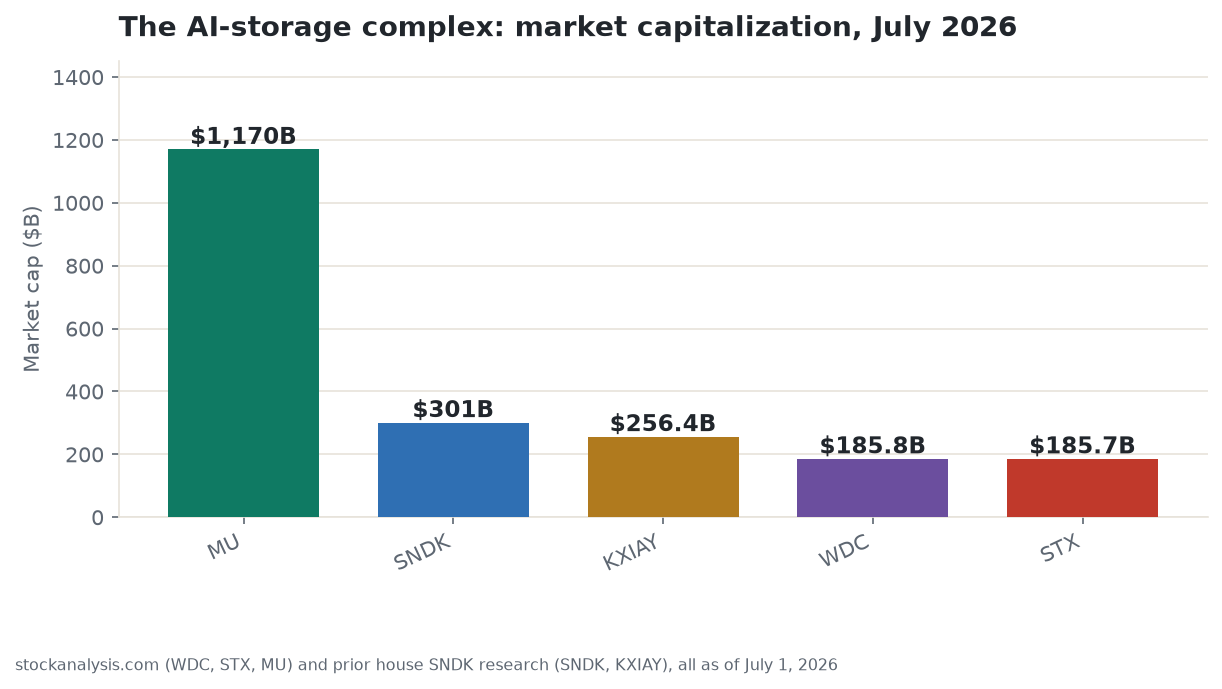
Western Digital Corporation (WDC, Nasdaq). One of exactly two companies in the world that still designs and manufactures hard disk drives at scale, now a pure-play HDD business after spinning off its flash division as SanDisk in February 2025. Market capitalization approximately $185.8 billion as of July 1, 2026. Third-quarter fiscal 2026 revenue was $3.34 billion, up 45 percent year over year, with GAAP gross margin of 50.2 percent, and the Cloud end market, sold to hyperscalers and enterprises, made up 89 percent of revenue and grew 48 percent year over year. Bull: the AI datacenter buildout needs vast, cheap, persistent storage capacity that only two companies on earth can supply at scale, and WDC is one of them, now running a debt-light balance sheet with a growing capital-return program. Bear: hard drives are the slower half of a two-technology storage market that flash has been shrinking on cost-per-bit for two decades, a meaningful share of WDC’s current headline net income is a one-time accounting gain rather than core profit, and WDC’s own roadmap shows it a step behind Seagate on the technology needed for the next capacity tier.
Seagate Technology Holdings (STX, Nasdaq). The other half of the global hard-drive duopoly, and WDC’s only direct, scale competitor. Market capitalization approximately $185.7 billion, essentially tied with WDC’s own, as of July 1, 2026. Trailing-twelve-month revenue was $11.01 billion, up 28.9 percent year over year, with net income of $2.38 billion, up 59.2 percent, and a trailing price-to-earnings ratio of 86.68 times, considerably richer than WDC’s headline multiple. Bull: Seagate’s HAMR-based Mozaic drives are already reported in hyperscaler volume production, giving it a real capacity-per-drive lead in exactly the highest-value part of the market both companies compete in. Bear: priced at a much richer earnings multiple than WDC for a smaller, lower-margin business, leaving less room for the multiple itself to re-rate further if the two companies’ operating results converge.
SanDisk Corporation (SNDK), Nasdaq. WDC’s former flash-memory division, spun off to WDC shareholders on February 21, 2025, and not a hard-drive maker. Market capitalization approximately $301.0 billion as of July 1, 2026, per the house’s own separate SanDisk research, having run up roughly sixtyfold since its spinoff on an AI-driven NAND shortage. WDC still directly matters to this stock and vice versa: WDC retained a stake in SanDisk after the split, currently down to roughly 1.7 million shares (from an initial 28.8 million), which WDC marks to SanDisk’s own share price every quarter and plans to fully monetize by the end of 2026. Bull, for WDC’s own thesis: if hard drives and flash keep behaving as complements rather than substitutes in the AI-datacenter buildout, both WDC and SanDisk can keep growing together. Bear, for WDC’s own thesis: if flash’s falling cost-per-bit keeps closing the gap with hard drives in the coldest storage tier, SanDisk’s success is partly evidence of the very substitution risk that threatens WDC’s own long-run moat.
Micron Technology (MU, Nasdaq). The largest US-headquartered memory maker, spanning DRAM, NAND flash, and high-bandwidth memory for AI accelerators. Market capitalization approximately $1.17 trillion as of July 1, 2026, roughly six times WDC’s own size. Trailing-twelve-month revenue was $90.27 billion, up 167.0 percent year over year, with net income of $50.47 billion, up 710.7 percent, on a trailing price-to-earnings ratio of 23.30 times, the cheapest of the AI-storage-and-memory complex on a trailing basis given how fast its earnings have grown. Bull, as a read-through for WDC: Micron’s results confirm the AI-driven memory and storage re-rating is a broad, multi-company phenomenon, not one stock’s isolated story. Bear, as a read-through for WDC: the same broad memory-cycle risk applies at a much larger scale, meaning a downturn in AI capex would likely hit the entire complex, WDC included, together rather than sparing any one name.
Kioxia Holdings Corporation (285A on the Tokyo Stock Exchange; KXIAY as a thinly traded US OTC ADR). A large NAND flash maker and SanDisk’s own manufacturing joint-venture partner, not a direct WDC competitor but a useful cross-check on the health of the broader flash side of the storage market. Market capitalization approximately $256.4 billion as of July 1, 2026, per the house’s own separate SanDisk research. Trailing-twelve-month revenue was $14.70 billion, up 37.0 percent year over year, with net income of $3.49 billion, up 103.6 percent. Bull, as a read-through for WDC: continued strength here signals the AI-storage complex broadly still has room to run. Bear, as a read-through for WDC: Kioxia was already down roughly a third from its own 2026 peak as of the research date, an early wobble in the flash side of the trade worth watching for what it might say about the storage complex overall, WDC included.
What the filings say
Source: WDC’s Form 10-Q for the quarter ended April 3, 2026 (filed May 1, 2026) and the accompanying earnings release (filed April 30, 2026).
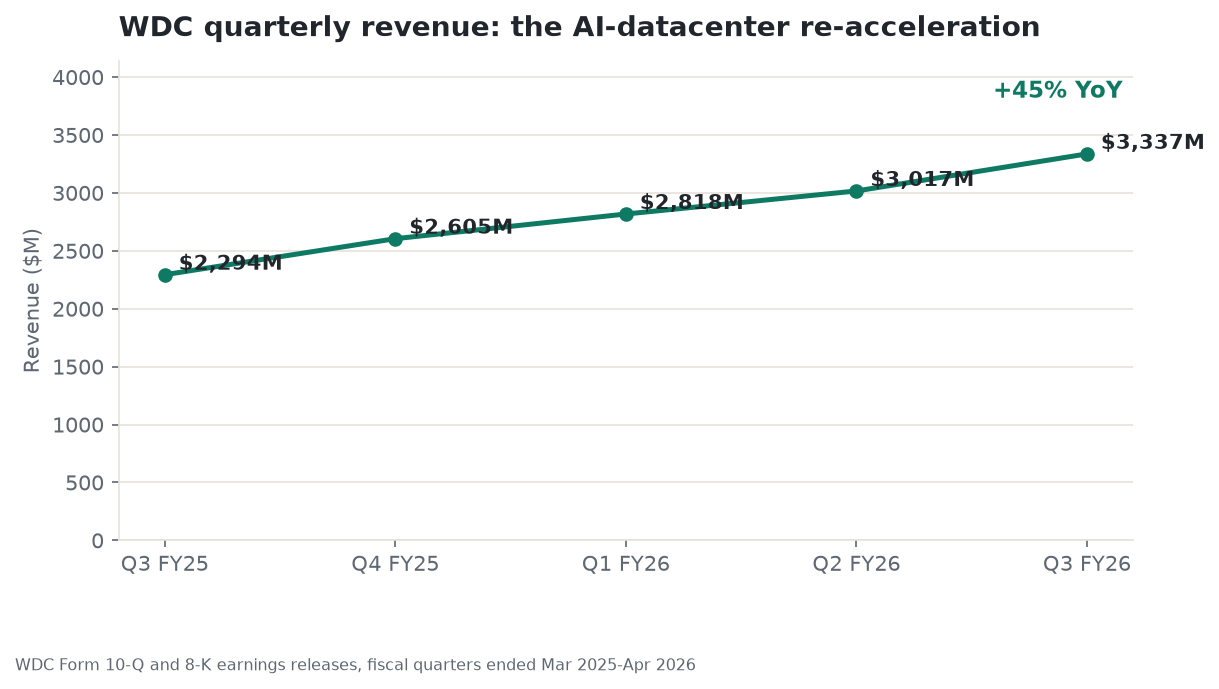
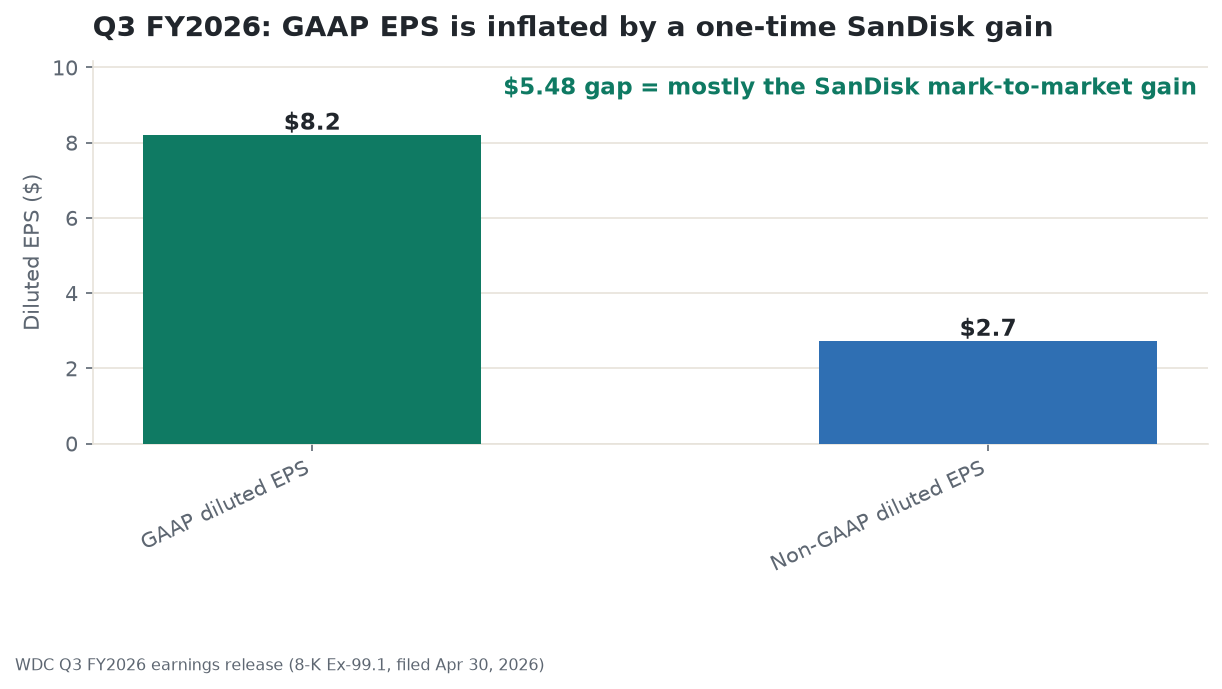
The headline numbers, and the number underneath them. Third-quarter fiscal 2026 revenue was $3,337 million, up 45 percent year over year and up 11 percent from the prior quarter. GAAP gross margin was 50.2 percent (non-GAAP 50.5 percent), up roughly 1,040 basis points from 39.8 percent a year earlier. GAAP operating income was $1,190 million, a 35.7 percent operating margin. Here is where it gets interesting: GAAP diluted earnings per share were $8.20, but non-GAAP diluted earnings per share were $2.72. That $5.48 gap is not a rounding issue or a minor adjustment. It is the single most important nuance in this quarter’s results.
Why the two numbers are so different. When WDC spun off SanDisk in February 2025, it kept a stake in the new company, initially 28.8 million shares. Because WDC no longer controls or significantly influences SanDisk, accounting rules require WDC to carry that stake at fair value every quarter, marking it to SanDisk’s own stock price. SanDisk’s stock has had an extraordinary run of its own, and that shows up directly on WDC’s income statement: a $2.73 billion gain on the retained SanDisk stake in the third quarter alone, and a cumulative $4.45 billion unrealized gain over the first nine months of the fiscal year. WDC has been steadily selling down that stake (it now holds roughly 1.7 million shares, expected to be fully monetized by the end of 2026), but until that process finishes, every swing in SanDisk’s own stock price shows up as a swing in WDC’s reported net income, even though WDC does not operate SanDisk’s business at all. Read WDC’s trailing net income and P/E ratio with that firmly in mind. The underlying hard-drive business earned real money this quarter, roughly $1.05 billion of non-GAAP net income, but the GAAP headline is inflated well beyond that by a stake in a company WDC no longer runs.
Where the growth is actually coming from. WDC’s own filing breaks the revenue growth into two multiplying factors: the total amount of storage capacity shipped (measured in exabytes, or billions of gigabytes) grew 34 percent year over year in the quarter, and the average price WDC got paid per exabyte grew 9 percent at the same time. Both moving in the same direction is the textbook signature of a supplier whose customers need more than it can comfortably provide: in a typical commodity hardware market, selling more units usually means competing harder on price, not getting paid more per unit at the same time.
Segment mix: this is now almost entirely a datacenter story. Cloud revenue was $2,972 million in the quarter (89 percent of total revenue, up 48 percent year over year), Client was $179 million, and Consumer was $186 million. By geography, Americas was $1,499 million, Asia $1,320 million, and Europe/Middle East/Africa $518 million.
Customer concentration. The top 10 customers made up 71 percent of third-quarter revenue and 74 percent of nine-month revenue, up from 73 percent and 68 percent in the prior-year periods. Three individual customers were 17 percent, 15 percent, and 11 percent of quarterly revenue respectively. That concentration is a direct consequence of the Cloud segment’s dominance: a handful of hyperscalers now account for the large majority of what WDC sells, which cuts both ways for pricing power, discussed further in the risk section below.
Balance sheet and capital return. WDC has used this cycle’s cash to delever aggressively. Total debt fell to roughly $1.6 to $1.7 billion (current portion only), with long-term debt down to essentially zero on a trailing basis, versus a net debt position of about $2.6 billion a year earlier; the company is now in a net cash position. The board authorized a $2.0 billion buyback in May 2025 and added another $4.0 billion in February 2026, for a combined $6.0 billion program with no expiration date. WDC repurchased 2.9 million shares for $752 million in the third quarter alone and 13.1 million shares for $1.92 billion over the first nine months. The quarterly dividend was raised 20 percent to $0.15 per share, paid June 17, 2026. Management’s own capital-spending framework targets capex at roughly 4 to 6 percent of revenue, a genuinely capital-light ratio for a company that owns its entire manufacturing base rather than outsourcing it.
Guidance. For fiscal fourth-quarter 2026, management guided (non-GAAP) revenue of $3.65 billion plus or minus $100 million, gross margin of 51 to 52 percent, operating expenses of $385 to $395 million, and diluted earnings per share of $3.25 plus or minus $0.15. CEO Irving Tan framed the demand backdrop directly: “the demand drivers are clear: virtually every AI workload, from training, inference, agentic AI to physical AI, creates data that is stored persistently and cost-efficiently on HDDs.” CFO Kris Sennesael tied the dividend increase to “confidence in the durability of our business.”
Disclosed risks worth taking seriously. The 10-Q states there have been no material changes from the risk factors disclosed in the fiscal 2025 Annual Report, meaning the standing risk set (customer concentration, a limited number of qualified suppliers, execution risk on new recording technology, cyclicality in storage demand, tariff and trade-policy exposure, and reliance on a small number of manufacturing sites in Southeast Asia) remains management’s own framing of what could go wrong. On litigation: SPEX Technologies sued WDC in 2016 alleging patent infringement related to drive-level encryption. An October 2024 jury awarded SPEX $316 million in damages plus $237 million in prejudgment interest. In June 2025, the court’s post-trial ruling found the evidence insufficient to support that award and reduced it to nominal damages of $1. Both sides have appealed, WDC on the underlying infringement finding and SPEX on damages, and WDC has not accrued a liability, stating it believes a loss is not probable. This is disclosed, ongoing litigation with an uncertain outcome in either direction, not a settled fact, and it should be read that way.
How far this business has come. Fiscal 2025 revenue was $9.52 billion, up 50.7 percent, with a 38.78 percent gross margin, already a recovery in progress. Fiscal 2024 and fiscal 2023 revenue, restated to a continuing hard-drive-only basis after the SanDisk separation, were $6.317 billion and $6.255 billion, and both of those fiscal years posted GAAP operating losses, a reminder that the hard-drive industry was in a genuine cyclical trough as recently as two to three years ago, well before the AI-driven surge began.
What the market is paying
All figures point-in-time as of the July 1-2, 2026 research window, sourced from stockanalysis.com. WDC trades on Nasdaq.
A same-day price spread worth naming outright. Two pages of the same data vendor, pulled minutes apart in this research session, showed materially different prices for WDC: one showed a previous close of $598.37 (intraday open $595.50), while another vendor page’s own valuation tables implied a self-consistent price of approximately $539.00 (confirmed three separate ways: dividing the reported market cap by shares outstanding, and backing out the analyst price-target percentage gap). That is roughly an 11 percent spread on the same calendar day. It is not a data error to quietly resolve. News coverage explains it directly: WDC fell roughly 7 percent on July 1 and a further roughly 10 percent on July 2, sliding alongside Micron (down about 8 percent) and SanDisk (down about 10 percent) in a broadly covered “AI-memory stocks pull back” story, so the two snapshots likely straddle that two-day slide. This piece uses the internally self-consistent $539.00 figure as the canonical price throughout and in the frontmatter above the article, with the higher same-day print flagged here rather than silently dropped.
How far this stock has come. The 52-week range is $63.01 to $799.87, and the 52-week price change is roughly +744 percent, meaning WDC traded within a dollar or two of its own 52-week low about a year before this research date. The stock has since pulled back on the order of a third from that 52-week high, while remaining far above its 200-day moving average of $290.56, a pattern consistent with a huge multi-quarter re-rating that has recently cooled rather than reversed. Using WDC’s own fiscal-year-end closing prices as approximate multi-year anchors (fiscal 2023 close $28.66, fiscal 2021 close $53.05), the stock is up on the order of eighteenfold over roughly three years and nine to tenfold over roughly five years, both windows dominated by the same event: a hard-drive industry that spent 2022 through 2024 in a real cyclical trough before the AI-driven surge repriced the whole sector starting in 2025.
Valuation. Trailing price-to-earnings is 32.77, but as explained in the filings section, that denominator includes the SanDisk mark-to-market gain, so it understates WDC’s true earnings multiple on a core-operations basis. Forward price-to-earnings is actually higher, at 37.69, which is the more informative number here: the market itself does not expect trailing earnings to repeat, precisely because this year’s included a one-time item. Other multiples: price-to-sales 15.80 times, price-to-book 21.33 times, EV-to-EBITDA 47.00 times. Set next to Seagate, the gap is notable: Seagate trades at a much richer trailing P/E of 86.68 times on a market cap essentially tied with WDC’s own $185.8 billion, despite smaller revenue and net income, because Seagate’s numbers are not inflated by an equivalent one-time item. That gap narrows considerably, and might even invert, once WDC’s own core, non-GAAP earnings (roughly $1.05 billion in the most recent quarter alone) are used as the comparison instead of the SanDisk-inflated GAAP figure.
Liquidity, short interest, and ownership. Short interest is 26.45 million shares, 7.67 percent of shares outstanding, with 3.94 days to cover at recent volume, a moderate short position for a stock that has moved this much this fast, not a crowded one. Institutional ownership is very high at 97.38 percent of shares, and insiders hold just 0.59 percent.
Sell-side consensus. Twenty-six analysts cover WDC with a consensus rating of Buy and an average 12-month price target of $589.88, implying roughly 9 to 10 percent upside from the canonical price used in this piece. That is a comparatively modest implied upside for a Buy-rated stock that has already gone up more than sevenfold over the trailing year, suggesting the sell side broadly believes the current level already reflects most of the good news even while staying constructive on direction.
Balance-sheet safety. WDC’s Altman Z-Score of 7.6 sits deep in the “safe zone” for bankruptcy risk, consistent with the debt paydown described above.
What the crowd is saying
This section is signal, not fact.
From all-time high to a two-day wobble. News flow on WDC has been genuinely volatile through June and into this research window, and the volatility itself is the clearest sentiment signal here. WDC hit an all-time high in mid-June 2026 after Morgan Stanley raised its price target by a headline-reported roughly 33 percent, and coverage described the stock as “rocketing higher” on the dividend-increase news that followed within days. By late June, at least two separate outlets ran “after a 200 to 290 percent year-to-date surge, is there still upside” pieces within a week of each other, itself a sign the story had become impossible to ignore. Then, in the two trading sessions immediately bracketing this research date, the tone flipped hard: WDC fell roughly 7 percent on July 1 and a further roughly 10 percent on July 2, moving in lockstep with Micron and SanDisk in a broadly covered story about the AI-memory trade pulling back, with at least one outlet describing retail traders as “hopeful for a rebound” in the selloff’s immediate aftermath.
What this arc says. The dominant story about WDC has shifted from “a former hard-drive maker re-rating on AI-datacenter demand” to “one of four correlated AI-memory and AI-storage stocks trading as a basket.” All four names falling together on the same two days for a sector-wide reason, not anything specific to WDC’s own results, suggests a meaningful share of WDC’s recent move has been driven by sentiment and sector-rotation flows layered on top of genuine fundamental improvement, not by company-specific news alone.
The divergence worth naming. It is not between what management says and what the filings show, those broadly agree. It is between the stock’s recent price behavior and the underlying earnings quality: a large share of WDC’s headline year-over-year net income growth traces to the SanDisk mark-to- market gain described above, a fact that has not been prominent in the “AI-storage supercycle” headlines drawing retail attention to the name. A reader reacting to the year-over-year net income growth number without separating out that one-time item is reacting to a considerably rosier picture than the one the core hard-drive business alone is producing.
A data-quality note. A dedicated pull of retail and social chatter (Reddit and X mention volume, options-flow sentiment trackers) was attempted for this piece but blocked by rate limiting on the search tooling available in this session. No specific follower counts, mention volumes, or sentiment scores are reported here as a result, and none should be assumed. What is reported above comes from press headline aggregation and the sell-side consensus data in the market-action section, both treated as point-in-time signal, not confirmed fact about market psychology.
Is the AI storage boom durable, or is this a cyclical peak with better marketing?
The structural case for durability is concrete. AI training runs generate large, growing volumes of data that must be checkpointed to persistent storage repeatedly, and AI inference and agentic systems generate logs, context, and retrieval data that keeps accumulating rather than disappearing. WDC’s own filing puts this plainly: rising demand is “creating accelerated demand for high-capacity drives” and customers are “partnering with us earlier” and “extending the duration of their commercial arrangements,” both real, observable behavior changes from customers, not marketing language. The segment data backs this up: WDC is shipping more total capacity and getting paid more per unit at the same time, which only happens when demand is genuinely outrunning supply.
The cyclical case for caution is just as concrete, and it comes from WDC’s own recent history. This exact industry posted GAAP operating losses as recently as fiscal 2023 and fiscal 2024, only two to three years before this research date. Gross margin swung more than 20 percentage points in the other direction during that stretch. The duopoly’s current pricing discipline, both suppliers choosing to raise prices and extend contracts rather than compete for share, depends on both WDC and Seagate continuing to make that same choice every quarter, in a market with no formal coordination mechanism and a rising individual temptation to chase share the longer prices stay this elevated. And a real technology gap exists today: WDC’s own roadmap disclosure shows customers still qualifying its HAMR drives while Seagate claims hyperscaler volume production already underway, exactly the kind of gap that lets a two-company market’s balance of power shift meaningfully within a single product cycle.
The most likely outcome is a genuine split rather than a clean call in either direction. The AI-datacenter demand leg is real and larger than any prior HDD demand driver, which likely prevents a repeat of the depth of the 2023-2024 trough. But the margin levels and the valuation multiple of mid-2026 are close to a cycle peak by WDC’s own historical standard, and should not simply be extrapolated forward at face value. Some normalization, in both the margin structure and the multiple the market is willing to pay for it, is the more probable path over a multi-year horizon, with the exact timing set by how fast WDC closes the HAMR gap with Seagate and by how fast flash’s own cost curve keeps closing distance on hard drives in the coldest storage tier.
The scenarios in detail
The five-year outcome for WDC comes down to four variables, and the bull, base, and bear cases below are different settings of these four dials.
- AI-datacenter nearline demand. The dominant near-term variable. Cloud segment revenue is 89 percent of total revenue and grew 48 percent year over year on both higher volumes and higher prices at once.
- Duopoly pricing power and contract durability. Whether hyperscalers keep extending contract durations and accepting higher prices, or push back once supply catches up with demand.
- HAMR technology execution versus Seagate. WDC ships today on ePMR (30 terabytes conventional, 40 terabytes shingled) and describes customers as still qualifying its HAMR drives; Seagate already claims hyperscaler volume production on its own HAMR line. Closing or failing to close that gap decides relative share within the duopoly.
- NAND cost-per-bit substitution. The structural, multi-year question: whether flash’s falling cost per bit keeps closing the gap with hard drives in the coldest, highest-capacity storage tier, eventually eroding HDD’s reason to exist in datacenter storage altogether.
Every dollar figure below is an illustrative estimate, built from a stated non-GAAP earnings trajectory and a stated valuation multiple, never from the SanDisk-gain-inflated GAAP earnings base and never a price target. These levels match the lede chart at the top of this piece.
Bull case, “the duopoly wins the decade.” AI-datacenter demand for persistent, cost-efficient storage keeps compounding through the late 2020s. WDC closes the HAMR gap with Seagate within the next one to two product cycles, so neither company loses meaningful share to the other, and both maintain pricing discipline rather than competing the current margin gains away. Revenue grows at a sustained double-digit rate through 2031, non-GAAP gross margin holds in the mid-to-high 40s rather than fully reverting to pre-cycle levels, and non-GAAP earnings per share reaches roughly $27 on a reduced share count near 310 million as the buyback continues. At a 35-times multiple, a premium reflecting sustained conviction that AI has structurally raised the floor under hard-drive demand, that lands near $950. What has to be true: AI datacenter capital spending keeps growing for five straight years, WDC does not fall further behind Seagate on HAMR, and the two-supplier market keeps choosing margin over share. What breaks it fastest: hyperscaler capital spending growth decelerating below the mid-teens annually, or a visible, sustained HAMR share loss to Seagate.
Base case, “a real business, a normalizing multiple.” The AI-driven demand surge continues but decelerates from its current extraordinary pace to a still-healthy high-single to low-double-digit revenue growth rate through 2031. Gross margin settles in the high-30s to low-40s, a genuine structural improvement over WDC’s pre-cycle 28 to 30 percent norm but well below today’s roughly 50 percent cycle peak. HAMR ships in reasonable volume, roughly matching rather than leading or trailing Seagate. Non-GAAP earnings per share reaches roughly $17 on a share count near 320 million. At a 22-times multiple, a still-modest premium to hard drives’ historical single-digit-to-low-teens multiple reflecting the genuine, if moderated, AI tailwind, that lands near $380, notably below today’s price, because today’s price still carries some of the cycle-peak enthusiasm this base case assumes fades. What has to be true: the demand tailwind is real but not permanently accelerating, and the duopoly holds its structure. What would push it toward the bull case: the market deciding the mid-40s gross margin is durable rather than transitional.
Bear case, “the substitution catches up.” NAND flash’s falling cost per bit closes enough of the gap with hard drives in the coldest, highest- capacity storage tier that hyperscalers start allocating a meaningfully larger share of new cold-storage capacity to flash instead. Layered on top, WDC’s HAMR program falls further behind Seagate’s, costing it share in the highest-value part of the Cloud segment, and a genuine cyclical downturn, of the kind this industry has produced before, as recently as fiscal 2023 and 2024, arrives as the two suppliers’ combined capacity additions catch up with a decelerating demand curve. Revenue growth stalls and gross margin reverts most of the way toward WDC’s pre-cycle norm. Non-GAAP earnings per share falls to roughly $8 in a trough year. At a 14-times multiple, a commodity-cycle valuation with no growth or duopoly-discipline premium, that lands near $110, close to WDC’s own 52-week low. This case is anchored on real, disclosed facts, not a tail hypothesis: WDC posted GAAP operating losses as recently as fiscal 2023 and 2024, gross margin has already swung more than 20 percentage points in the other direction within the past two years, and the company’s own roadmap disclosure shows it behind Seagate on HAMR qualification as of the most recent update. What would break the bear case toward the upside: WDC closing the HAMR gap within the next product cycle, or NAND’s cost curve failing to close further ground in the coldest storage tier.
Catalyst timeline. Near term: the July 29, 2026 fiscal fourth-quarter earnings report and initial fiscal 2027 guidance, WDC’s first full read without the SanDisk mark-to-market noise dominating the picture; continued monetization of WDC’s remaining roughly 1.7 million SanDisk shares, expected complete by the end of 2026, which will remove those swings from future quarters entirely; the ongoing cadence of the $6 billion buyback as a signal of management’s own read on valuation; and any concrete update on HAMR qualification progress relative to Seagate’s stated volume-production timeline. Multi-year: WDC’s own roadmap milestone of extending ePMR to 60 terabytes before a full HAMR transition; the pace at which HAMR drives actually reach hyperscaler volume shipment; the SPEX Technologies litigation appeals process, an uncertain-outcome legal risk with no fixed timeline; and, longer-run, the trend in NAND flash cost-per-bit in the coldest storage tier relative to hard drives’ own capacity roadmap.
Leading indicators to watch. WDC’s non-GAAP gross margin at the July 29 print and beyond, specifically whether it holds in the guided 51 to 52 percent range or shows its first sequential decline, the earliest sign a cycle has peaked. Concrete evidence of WDC’s HAMR drives reaching hyperscaler volume production, not just customer qualification, and the timing gap versus Seagate. Customer concentration trend, currently 71 to 74 percent from the top 10 customers. The SPEX Technologies litigation appeal outcome. NAND flash cost-per-bit trend data in cold and archival storage specifically, the clearest read on the long-run substitution threat. And NAND-maker fab utilization rates at Kioxia, Samsung, and SK hynix, already flagged in the house’s separate SanDisk research as running near 50 percent as of mid-2026; a sharp rise toward 70 to 80 percent would signal NAND capacity is about to accelerate its own cost decline, indirectly pressuring hard drives’ cold-storage advantage sooner than the base case assumes.
Companies to watch (bull / base / bear)
Western Digital (WDC). Role: the subject of this piece, one of exactly two companies that still make hard drives at scale. Bull: AI-datacenter demand keeps outrunning combined WDC/Seagate capacity, letting both raise prices and extend contracts. Base: growth decelerates to a still-healthy pace as the current cycle-peak margin normalizes somewhat. Bear: WDC falls further behind Seagate on HAMR while NAND’s cost curve keeps closing the gap in cold storage. Watch: the July 29, 2026 earnings print and whether non-GAAP gross margin holds the guided range.
Seagate (STX). Role: WDC’s only direct, scale competitor, and the other half of the duopoly. Bull: its HAMR lead converts into durable share gains in the highest-value part of the Cloud segment. Base: tracks the same industry cycle as WDC with a similar amplitude. Bear: priced at a much richer earnings multiple than WDC already, leaving less room to re-rate further. Watch: Seagate’s own reported HAMR volume-production progress, the clearest read on whether WDC’s technology gap is closing or widening.
SanDisk (SNDK). Role: WDC’s former flash division and the clearest face of the long-run substitution risk, plus a direct financial tie through WDC’s residual stake. Bull: continued NAND strength signals the broader AI-storage complex still has room to run. Base: tracks its own separately researched cyclical outlook, detailed in the house’s SanDisk piece. Bear: a NAND-specific downturn would remove the “AI storage boom” halo effect currently lifting sentiment on WDC too. Watch: whether WDC’s remaining SanDisk stake gets fully monetized on schedule by the end of 2026, removing the mark-to-market noise from WDC’s own income statement.
Micron (MU). Role: the largest US memory maker and a broad cross-check on the AI-storage-and-memory re-rating. Bull: HBM’s structural margin floor plus broad memory strength confirms this is a sector-wide phenomenon. Base: a wide-amplitude cycle, like the rest of the complex. Bear: the same cyclicality risk as everyone else in this piece, at a much larger scale. Watch: whether Micron’s own results keep confirming AI-driven memory demand or start to show cracks first, given its size and diversification.
Kioxia (285A.T / KXIAY). Role: a large NAND maker one step removed from WDC, useful as an early-warning indicator for the broader storage complex. Bull: continued strength here would support the “this cycle is different” case for the whole complex. Bear: already down roughly a third from its own 2026 peak as of the research date. Watch: whether that pullback deepens or stabilizes, a signal worth tracking even though Kioxia does not compete with WDC directly.
Risk controls
The honest risk paragraph starts with earnings quality, because it changes how every other number in this piece should be read. A meaningful share of WDC’s headline net income and trailing P/E ratio traces to a mark-to-market gain on a stake in a company WDC no longer operates, a gain that has already mostly reversed course in prior periods and will fully stop flowing through the income statement once WDC finishes selling the remaining shares. Anyone using WDC’s trailing GAAP earnings as a valuation anchor without separating out that item is working from a distorted number.
Cyclicality is real and recent, not theoretical: this exact industry posted GAAP operating losses as recently as fiscal 2023 and 2024, and gross margin has already swung more than 20 percentage points in the other direction within the past two years. Customer concentration is high and rising, with the top 10 customers at 71 to 74 percent of recent revenue, meaning a handful of hyperscaler capital-spending decisions matter enormously to WDC’s own results. A real technology gap exists today between WDC and Seagate on HAMR, the recording technology both companies need for the next capacity tier, and if that gap persists it is a mechanism for the duopoly’s balance of power to shift within a single product cycle. There is disclosed, unresolved litigation (the SPEX Technologies patent case) with a legal outcome that cannot be predicted from the information available. And the stock’s own volatility, a beta of 2.17 and a roughly 16 percent two-day drawdown in the days bracketing this research date on no WDC-specific news, means this is not a name where a tight stop functions in any conventional sense; position sizing is the more realistic lever for a reader who chooses to hold it.
What would change this read toward the constructive side: WDC closing the HAMR gap with Seagate and demonstrating hyperscaler volume production on a competitive timeline; non-GAAP gross margin holding or expanding past the 52 percent high end of guidance for two or more consecutive quarters once the SanDisk-gain noise has fully cleared the income statement; or the sell-side consensus price target moving meaningfully above today’s price rather than sitting at a modest single-digit premium to it. What would change it toward the negative: a soft July 29 print or cautious fiscal 2027 guidance showing the core, non-GAAP margin structure eroding even before the SanDisk gain fully rolls off; concrete evidence WDC is losing Cloud-segment share to Seagate; or NAND cost-per-bit data showing the cold-storage substitution threat accelerating faster than the base case assumes.
Methodology, sourcing, and data-quality flags
This is a company-mode deep dive built from parallel research streams covering the value chain and money flow, WDC’s own SEC filings (the Form 10-Q and its accompanying 8-K exhibits), the market action and valuation, OSINT and news-sentiment signal, and the macro and micro economics of the hard-drive cycle. Every load-bearing figure traces to a claim in the run’s ledger with a source and a tier: primary (WDC’s own SEC filings, read directly), press (stockanalysis.com’s derived market data, cross-checked internally for self-consistency, and Google News headline aggregation), or analyst (peer snapshots for Seagate and Micron pulled fresh, and SanDisk and Kioxia snapshots carried from the house’s own separately published SanDisk research for the same July 1, 2026 window, used only for comparative context and not independently re-verified in this run).
On the five-factor read, in plain prose rather than as a score. Valuation nets to overvalued. The trailing P/E of 32.77 looks reasonable next to a stock up more than sevenfold in a year, but that denominator includes a $4.45 billion cumulative unrealized gain on the retained SanDisk stake; on a core, non-GAAP earnings basis, the effective multiple runs considerably richer, and the market’s own forward P/E, already higher than the trailing multiple, is a tacit admission that this year’s earnings will not repeat. The average sell-side price target implies only about 9 to 10 percent upside after a move measured in multiples, not percentages. Growth is genuinely the strongest factor: 45 percent quarterly revenue growth, an 89-percent Cloud-segment mix growing 48 percent year over year, and a demand-outrunning-supply dynamic evidenced by rising volumes and rising prices at the same time. Quality is mixed: core gross and operating margin expansion is real and unrelated to the SanDisk item, free cash flow generation is strong, and the balance sheet moved from net debt to net cash in a year, but customer concentration is high and rising and a large share of headline net income is a one-time item rather than a durable earnings signal. Risk is real and weighs on the read: a beta of 2.17, a two-day roughly 16 percent drawdown right at the research date on no WDC-specific news, disclosed and unresolved litigation, a single-technology business model since the SanDisk spinoff removed any flash-side hedge, and a public roadmap disclosure that puts WDC’s HAMR program behind its only direct competitor’s. Momentum is positive but fragile: a 52-week gain of roughly 744 percent and a Buy consensus across 26 analysts, offset by a fresh, sector-wide two-day selloff right at the research date and a consensus price target implying the sell side does not expect another leg of the kind of move that already happened. Putting those together, the overall lean lands at Hold: a real, fast-growing core business priced for a good outcome that has already mostly happened, with a meaningfully overstated headline earnings base and a risk profile that includes both a real competitive gap to close and a real structural substitution threat to watch.
Data-quality flags:
- WDC’s own price carried an 11 percent same-day spread across two pages of the same data vendor during this research session ($598.37 versus a self-consistent $539.00). Resolved by using the self-consistent figure (confirmed by market cap divided by shares outstanding, and by the analyst price-target percentage gap) throughout, with the discrepancy explained by a genuine two-day AI-memory-sector selloff (roughly -7 percent July 1, roughly -9.9 percent July 2) confirmed via separate news-headline research, not treated as an unexplained data error.
- Sentiment and news-flow claims in this piece are sourced from headline aggregation, not full article text. The Morgan Stanley price-target percentage figure and the exact daily stock-move percentages come from Google News RSS headlines; several underlying articles could not be resolved past Google’s JavaScript-based redirect in this research session. These are marked press-tier and hedged as “headline-reported” rather than stated as precisely confirmed figures.
- Peer snapshots for SanDisk and Kioxia were carried from the house’s own prior SanDisk research, not independently re-pulled in this run. They are used only for comparative scale and context (market cap, growth rates, multiples), never as claims about WDC itself.
- A dedicated social/retail-sentiment pull (Reddit, X mention volume, options-flow trackers) could not be completed due to search-tool rate limiting during this session. No specific follower counts, mention volumes, or sentiment scores are reported as a result; the sentiment section relies on news-headline aggregation and sell-side consensus data instead, both flagged as softer signal, never as fact.
- The SPEX Technologies litigation is disclosed exactly as WDC’s own 10-Q states it, with the original jury verdict, the post-trial reduction to nominal damages, and both sides’ pending appeals. No outcome is predicted or implied.
Key sources: WDC’s Form 10-Q for the quarter ended April 3, 2026 (SEC EDGAR, primary) and the accompanying Q3 FY2026 earnings release (8-K Exhibit 99.1, primary); WDC’s own investor-facing technology blog on its HAMR roadmap (company source, press tier); stockanalysis.com for price, valuation, and statistics data on WDC, Seagate, and Micron (press, point-in-time); Google News RSS headline aggregation for recent sentiment and price-move context (press, headline-level); the house’s own separately published SanDisk research for SanDisk and Kioxia peer context (analyst tier, not independently re-verified in this run). Full per-figure provenance is in the run’s claims ledger.
FAQs: six-month to five-year outlook
Q: What is the 6-month outlook for WDC? A: The July 29, 2026 fiscal fourth-quarter earnings report and initial fiscal 2027 guidance are the deciding event. An in-line print near the guided $3.65 billion revenue and 51-52 percent non-GAAP gross margin points to the base case near $500. A beat with on-schedule technology progress points toward $680. A miss or cautious guidance points toward $360.
Q: What is the 1-year forecast for WDC? A: By mid-2027 the market judges a full fiscal year without the SanDisk mark-to-market noise. The base case sits near $470 as growth cools to a still-healthy pace. The bear case, near $260, assumes WDC loses ground to Seagate on next-generation drive technology. The bull case, near $780, assumes that gap closes and demand keeps accelerating.
Q: What is the 3-year outlook for WDC? A: This is where the technology race with Seagate and the industry’s pricing discipline either hold or crack. Base case near $400 assumes durable but slower growth. Bear case near $150 assumes a real down-cycle plus continued technology share loss. Bull case near $850 assumes WDC closes the gap and duopoly discipline holds.
Q: What is the 5-year forecast for WDC? A: By 2031 the deciding question is structural: does flash memory’s falling cost keep closing the gap with hard drives in the cheapest storage tier? Bear case near $110 if it does. Base case near $380, still below today’s price because it assumes today’s rich multiple normalizes even if the business performs fine. Bull case near $950 if AI-era data retention permanently enlarges hard drives’ addressable market faster than flash can close the gap.
Q: What’s the biggest risk to owning WDC right now? A: Earnings quality. A large share of WDC’s headline net income and its trailing P/E ratio comes from a mark-to-market gain on retained SanDisk shares, not from selling hard drives. On a core, non-GAAP earnings basis the stock is considerably more expensive than the headline multiple suggests, and that one-time item stops flowing through the income statement once WDC finishes selling its remaining stake.
Prepared July 1-2, 2026. Figures are point-in-time and will change. This is research and analysis for educational purposes, not investment advice, not a recommendation, and not a solicitation. WDC’s stock has moved more than sevenfold over the trailing year and swung double digits in the two trading sessions bracketing this research date alone. Verify all figures independently and consult a licensed financial advisor before making any decision.