
Research date: June 13, 2026 | OSINT supply-chain research on the public companies powering the electricity behind the AI build-out
Important disclaimer. This is OSINT-based research and educational analysis, not investment advice. I am not a financial advisor. Nothing here is a recommendation to buy or sell any security. The power and electrical equipment business is deeply cyclical, and several of these stocks have already run hundreds of percent; market caps, prices, backlogs, and lead times are point-in-time (mid-June 2026), press-reported where noted, and move fast. Do your own due diligence and consult a licensed advisor.
Companion tool - jump to the interactive dashboard to sort and filter all 27 companies by tier and explore the supply-chain map, the leaderboard, and the analysis.
TL;DR
For two years the AI story was a chip story. In 2026 it became a power story. A modern AI campus does not run out of compute first, it runs out of electricity, and the grid can no longer say yes fast enough: a large new load energizing in 2025 waited an average of more than seven years for power, and the single piece of equipment that moves that power, the large transformer, is quoted at two-and-a-half to three years out and costs about 77 percent more than it did in 2019. That bottleneck has handed real, shortage-backed pricing power to a narrow set of suppliers - the grid and electrical equipment makers (GE Vernova, Eaton, Schneider, ABB, Siemens Energy), the in-the-building power train (Vertiv), the three gas-turbine makers whose 2030 slots are already sold, and the engineering firms that install all of it. The cleaner way to play the theme has tended to be these picks-and-shovels rather than the volatile independent power producers or the pre-revenue small modular reactor names. The single biggest risk is the calendar in reverse: the demand is funded by about five hyperscalers whose AI returns are unproven, and the equipment shortage that created the pricing power is set to ease in 2028 to 2030 as capacity finally catches up.
Explore it yourself: the interactive dashboard
Here is the whole roster in one place. Use the dashboard to sort and filter all 27 companies by tier, search by name or ticker, and read each one’s position with a one-line bull and bear, without leaving this page.
Open the dashboard in a full screen
Prefer a spreadsheet? Download the Excel scoring model with the full company table.
AI ran out of power, not chips
Picture a city that learns to build skyscrapers overnight. The cranes go up, the steel arrives, the floors stack faster than anyone thought possible. Then the first tenants flip the lights on and nothing happens, because nobody built the substations, ran the cables, or sited the power plants to feed a skyline that appeared in eighteen months. The buildings are finished. The power is not. That is the AI data center in 2026. The chips exist, the capital exists, the buildings are going up across Northern Virginia, Texas, and the desert Southwest, and the thing standing in the way is the least glamorous part of the whole enterprise: getting enough electrons to the rack.
The numbers explain why this snuck up on everyone. A traditional data center hall ran its servers at something like 10 kilowatts per rack. An NVIDIA GB200 rack draws around 130 kilowatts, and the roadmap points toward roughly a megawatt per rack by 2027. Multiply that across a campus and a single site now asks the grid for the kind of load that used to belong to a small city or an aluminum smelter. S&P Global has US power going to data centers rising from roughly 62 gigawatts in 2025 toward about 134 gigawatts by 2030, and the International Energy Agency sees global data-center electricity roughly doubling to around 945 terawatt-hours by 2030, near 3 percent of all the power in the world. Goldman Sachs put a price on the grid build that this implies: on the order of 720 billion dollars of global grid investment needed through 2030.
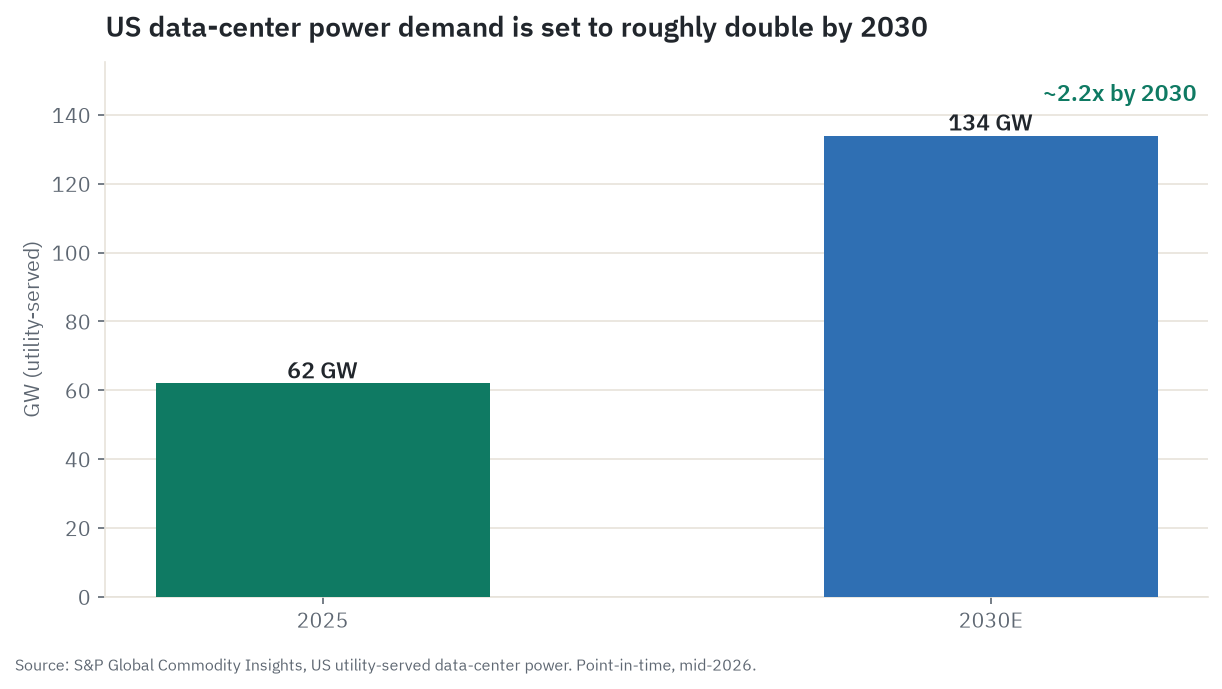
The forecasts disagree on the exact figure, and they should, because they measure different things. Gigawatts of capacity, terawatt-hours of energy, and share of total grid load are three different numbers, and a Goldman global figure cannot be stacked on a US-only one. What does not disagree is the direction. Every major house has revised its estimate up, more than once. When the entire range only moves one way, the range itself is the signal.
How the money flows
flowchart TD
    DEMAND["AI data-center demand: US ~62 to 134 GW by 2030"]

    DEMAND --> GRID["Grid + utilities + IPPs: nuclear PPAs, gated queue"]
    DEMAND --> ONSITE["On-site generation: build-your-own behind the meter"]

    GRID --> INTERCON{{"CHOKEPOINT: interconnection ~57 GW stalled, FERC rules Dec-2025"}}
    ONSITE --> TURB{{"CHOKEPOINT: gas-turbine slots, top-3 ~2/3 share, GEV ~100GW to 2030"}}
    ONSITE --> GENSET["Gensets + fuel cells: Caterpillar, Cummins, Bloom"]

    INTERCON --> EQUIP["Grid equipment: transformers + switchgear"]
    TURB --> EQUIP
    GENSET --> EQUIP

    EQUIP --> XFMR{{"CHOKEPOINT: power transformers, ~128-144 wk lead time"}}
    XFMR --> POWERTRAIN["TOLLBOOTH: in-DC power train UPS/PDU/busway, Vertiv/Schneider/Eaton"]

    POWERTRAIN --> EPC["TOLLBOOTH: EPC + electrical install, Quanta ~$36B backlog"]

    EPC --> COPPER["COMMODITY: copper ~27-33 t/MW, structural deficit"]
    EPC --> GOES["COMMODITY: grain-oriented steel, 1 US plant Cleveland-Cliffs"]
Follow the money from the top. The source of every dollar is the hyperscaler decision to plug in a few more gigawatts. That demand splits immediately at the first fork, because the grid cannot absorb it fast enough. Some of it goes down the grid path, to the utilities and the independent power producers who own generation and the rights to connect, and increasingly to the nuclear fleet operators selling long-dated power straight to Microsoft, Amazon, and Meta. The rest goes down the build-your-own path, to gas turbines and engine gensets that let a campus power itself behind the meter while it waits for, or instead of, a grid connection.
Whichever path the electrons take, the cash then converges on the electrical equipment makers, and this is where the chain narrows hardest. To move power you need transformers and switchgear. To generate it on site you need a turbine slot. Both are sold out. The money then flows inside the building to the power train - the uninterruptible power supplies, the distribution units, the busways - where a tight group of suppliers takes a toll on every megawatt, and to the engineering and electrical-contracting firms that physically install it and are now monetizing a labor shortage stacked on top of an equipment shortage. Underneath all of it sit the raw inputs: copper at roughly 27 to 33 tonnes per megawatt, and the special magnetic steel that goes inside every transformer core, a material so concentrated that exactly one plant still makes it in the United States.
The shape is the whole investing point. Enormous demand, funneling through two or three genuine chokepoints, into a handful of suppliers who cannot be bypassed. That is what creates pricing power, and it is why the safest exposure has often been the companies that sell to everyone building, rather than the ones placing the biggest bets.
A field guide to the power chain
The power chain is not one thing, and most of it is invisible to the people who talk about AI for a living. Here is the plain-language tour, in the order the electrons travel.
The interconnection queue is where a new data center asks the grid for permission to connect, and it is the first wall. Across the United States, thousands of gigawatts of projects sit in study queues, and even the load that clears the study, roughly 57 gigawatts in the PJM market that covers the data-center heartland of Northern Virginia, often still cannot build because the wires and the equipment are not there. The federal regulator only ordered PJM to write rules for large data-center loads in December 2025. The practical result is the defining fact of the whole theme: a large new load that started the process and energized in 2025 waited, on average, more than seven years, and Amazon has cited grid-connection waits of up to seven years in parts of Europe. The industry has a phrase for the new scarce resource. It is not compute. It is “speed to power.”
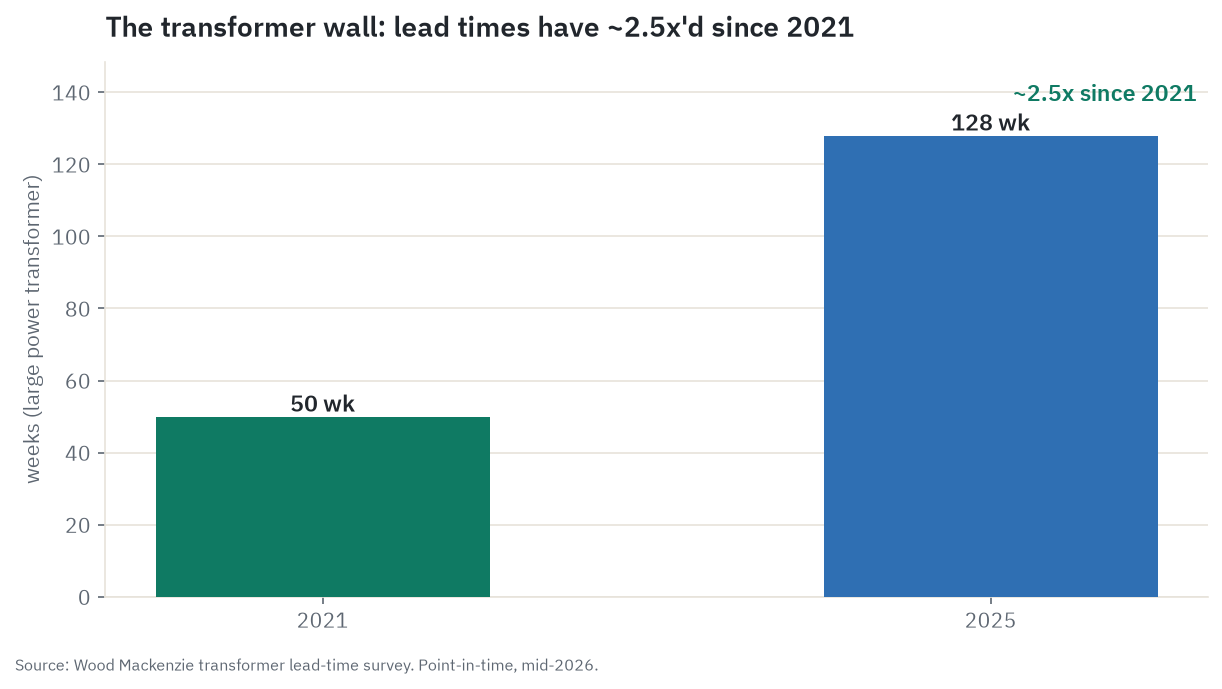
The large power transformer is the single most important box you have never thought about. It steps voltage up and down so power can travel long distances and then be used safely, and nothing energizes without one. It has also become the binding physical constraint of the entire build-out. Lead times have blown out to roughly 128 weeks for a substation transformer and about 144 weeks for the generator step-up units that connect a power plant, up from something like 50 weeks in 2021, with specialized units quoted at three to four years. Prices are up about 77 percent since 2019. And the United States imports roughly 82 percent of its large power transformers, according to the Department of Energy, because domestic capacity is tiny. The reason you cannot simply add that capacity is the bottleneck behind the bottleneck. The magnetic heart of every transformer is a special material called grain-oriented electrical steel, and to build more transformers you have to make more of it, but only a handful of mills on earth make the premium grades and exactly one plant still makes it in the United States. So you cannot buy your way to the front of this line, and you cannot quickly build a second line either, because the line itself depends on a steel almost nobody knows how to make.
Switchgear and the in-building power train are everything between the transformer and the chip. Switchgear protects and routes the power. Then, inside the hall, the uninterruptible power supplies ride through outages, the power distribution units and busways carry electricity to the racks, and a new medium-voltage architecture is arriving to feed racks that now draw what a small building used to. As rack density climbs, the dollar value of all this electrical content per megawatt climbs with it. This is the toll booth: the supplier takes a cut of every megawatt installed, and the cut is getting bigger.
Two pieces of jargon are worth knowing, because they are where a lot of the new spending goes. HVDC, or high-voltage direct current, is a way to move large amounts of power over long distances with lower losses than the ordinary alternating current the grid runs on, and it is increasingly how remote generation reaches a data-center hub. 800-volt direct current is the newer shift happening inside the hall: as a rack approaches a megawatt, delivering its power at a much higher DC voltage cuts the energy lost in conversion and, just as important, sharply reduces the amount of copper each rack needs. That last point resolves an apparent contradiction in the copper story. The build-out needs staggering quantities of copper in total, for the wiring, the busways, and the grid itself, even as each individual high-density rack is being engineered to use less of it. The aggregate demand wins, which is why copper still sits under the whole chain as a constraint.
One more place the per-megawatt money goes is cooling, because a dense AI rack turns almost all the power it draws into heat that has to be removed. Liquid cooling and the equipment around it, where Vertiv and nVent also compete, is a large and fast-growing slice of the same electrical build, and enough of a story to deserve its own treatment another day.
The gas turbine is the fastest way to add real, large-scale generation, and its order book is the clearest tell in the market. Three companies - GE Vernova, Siemens Energy, and Mitsubishi Power - build about two-thirds of the heavy-duty turbines for gas plants under construction, and their slots are sold out for years. GE Vernova alone is sitting on a backlog and slot-reservation book of roughly 100 gigawatts stretching toward 2030. Mitsubishi has quoted lead times as long as seven years. When three suppliers control the only fast path to a gigawatt of power and none of them can deliver before 2028, that is pricing power you can measure.
The engine genset and the fuel cell are the bridge. A reciprocating-engine genset from Caterpillar or Cummins, or a solid-oxide fuel cell from Bloom Energy, can be deployed in months rather than years, which is exactly why behind-the-meter generation exists as a parallel money path. “Behind the meter” simply means the campus makes its own power on site, on its own side of the utility’s meter, so it can run with little or no help from the grid connection it is still waiting on. That power is not free of constraints either: an on-site gas turbine or engine needs a firm natural-gas pipeline supply and an air-emissions permit to run, and in the tightest markets the gas hookup and the permit become their own queue, which caps how fast the build-your-own path can scale and is a real bear point for the genset names. Bloom says its fuel cells can be standing up power in about 90 days against twelve to twenty-four months for engine gensets, and it has signed offtake frameworks with Oracle and others. These are the tools a campus reaches for when the grid says “2032.”
On-site and new nuclear is the long-dated answer. The cleanest version is not a new reactor at all, it is an old one brought back or uprated: Constellation is restarting the 835-megawatt Three Mile Island Unit 1 under a twenty-year Microsoft contract, targeting 2027. The most speculative version is the small modular reactor, where no commercial unit is online anywhere in the country and the credible dates start around 2030.
Copper and electrical steel sit at the bottom. Copper is the wiring and the busbar, at roughly 27 to 33 tonnes per megawatt, and S&P projects a structural deficit of around 10 million tonnes a year by 2040. Grain-oriented electrical steel is the magnetic core inside every transformer, and it is the bottleneck behind the bottleneck: a handful of mills worldwide make the premium grades, and in the United States exactly one plant, Cleveland-Cliffs’ Butler Works in Pennsylvania, still makes it at all.
Who wins where
The competitive map sorts into a few clean tiers, and the tier you own matters more than the individual name.
The grid and electrical equipment makers are the core of the theme, because they sit on the transformer and switchgear chokepoint and sell to every project regardless of who wins the AI race. GE Vernova is the bellwether, the only pure-play that spans both turbines and grid equipment. Eaton, Schneider Electric, and ABB are the broad electrical-content names, each taking a larger dollar share of every megawatt as density rises. Siemens Energy pairs grid and HVDC equipment with one of the three turbine franchises. Then a set of more focused names: Hubbell and Powell Industries in heavy switchgear and grid hardware, Hammond Power in custom transformers, and nVent bridging into liquid cooling and high-density power distribution.
The generation tier is where the on-site build-your-own demand lands: the turbine oligopoly above, plus Caterpillar and Cummins in engine gensets and Bloom Energy in fuel cells.
The in-data-center power train is dominated by Vertiv, the purest large-cap pick-and-shovel on the white space inside the building, with Schneider, Eaton, and ABB all competing for the same per-megawatt content.
The utilities and independent power producers are the grid-path beneficiaries, led by the nuclear fleet operators - Constellation, Vistra, and Talen - selling firm clean power to hyperscalers, with the small modular reactor developers NuScale and Oklo as the speculative call option on the 2030s.
The engineering and construction tier is the labor toll booth that every project must pass through: Quanta Services, EMCOR, Comfort Systems, MYR Group, and MasTec.
The materials chokepoints sit underneath: Cleveland-Cliffs as the single domestic source of transformer-core steel, and Freeport-McMoRan as the cleanest large-cap proxy on copper.
Company by company: who’s who in the AI power build-out
The map above is the territory’s shape. This is the territory. All figures are mid-2026, point-in-time, and move fast.
Grid and electrical equipment - the chokepoint core
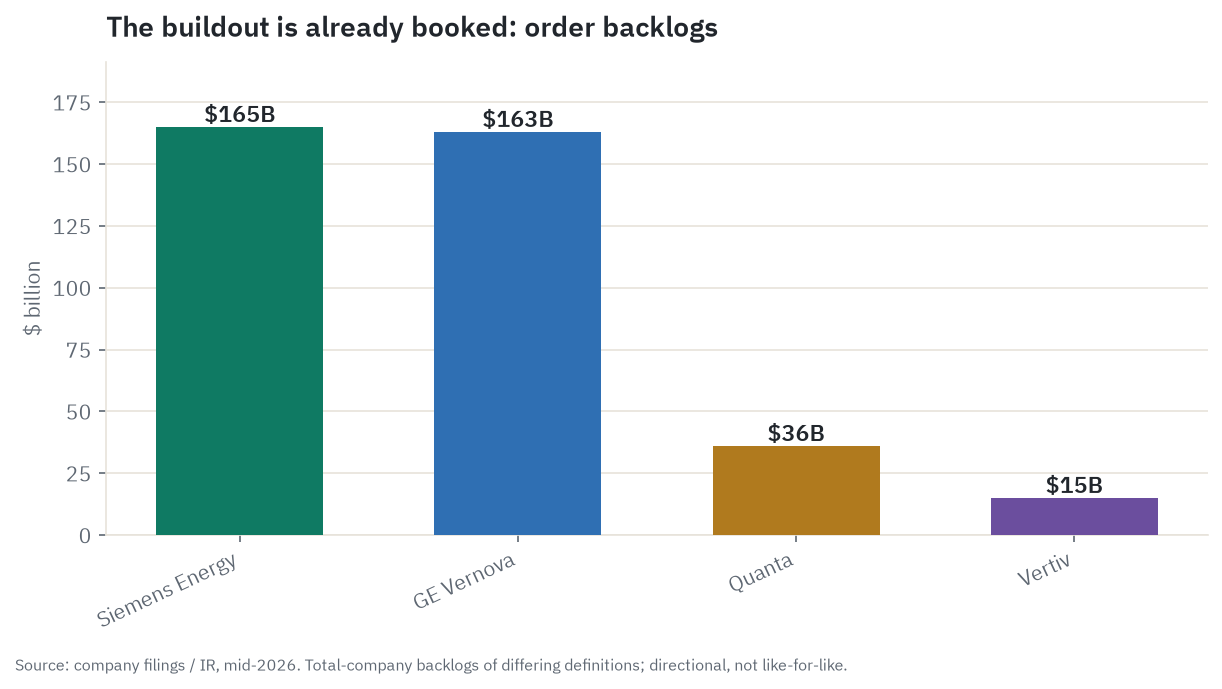
GE Vernova (GEV) is the company this cycle made. Spun out of GE in 2024, it is the only listed pure-play that sits on two chokepoints at once: the gas turbine and the grid transformer. Its total backlog is around 163 billion dollars, its Electrification orders are running at a book-to-bill near 2.5 times, and it has guided 2026 power-equipment pricing 10 to 20 percent above late-2025 levels, which is the rare hard evidence of a supplier raising price into a shortage. Bull: two chokepoints, multi-year visibility, demonstrated pricing power. Bear: the valuation is the catch, a forward price-to-earnings ratio around 55 to 60 against industry medians of 17 to 20 and a stock up roughly fivefold since the spin, and with more than 90 percent of turbine capacity through 2030 already contracted, orders can no longer surprise. The risk is a sentiment-driven de-rating even if the business keeps executing.
Eaton (ETN) is one of the broadest electrical-content plays per megawatt, with both grid-side and inside-the-hall product. It posted record first-quarter revenue of 7.5 billion dollars, total backlog up 44 percent, and data-center orders up roughly 240 percent year on year, and it tracks a US data-center pipeline it pegs at around 228 gigawatts. Bull: diversified across data center, electrification, reshoring, and aerospace, with strong margins. Bear: already a mega-cap, so this is more compounder than re-rating, and that 228-gigawatt figure is a tracked pipeline, not a contracted book.
Schneider Electric (SU.PA / SBGSY) holds the largest single share of the data-center uninterruptible-power-supply market, around 24 percent, and data centers are roughly 30 percent of group revenue. ABB (ABBN.SW / ABBNY) is a top-five data-center power supplier that calls data centers its single strongest end-market, with record first-quarter orders and a 23.5 percent operating margin. Siemens Energy (ENR.DE / SMNEY) carries an all-time-high backlog around 154 billion euros and twin exposure to turbines and grid. All three are excellent businesses with one shared catch for US investors: the primary listing is in Paris, Zurich, or Frankfurt, and the US over-the-counter lines are thinner and carry currency risk. Siemens AG (SIE.DE / SIEGY) is a different company from Siemens Energy, and the two are easy to confuse. Siemens Energy was spun out of Siemens in 2020 and took the turbines and grid equipment; Siemens AG kept the industrial conglomerate, where the data-center-relevant arm is its Smart Infrastructure segment of switchgear, busway, and building and data-center electrification. That arm is growing fast, with data-center revenue up around 45 percent in the first half of fiscal 2026. Bull: a quality, defensive conglomerate with a fast-growing data-center electrification business. Bear: most of its market cap is automation, mobility, and healthcare, so the power exposure is only a slice, and like its peers it trades primarily in Frankfurt with a thinner US over-the-counter line.
Then the more focused names. Hubbell (HUBB) plays both grid hardening and data-center electrical solutions, with data-center growth around 40 percent. Powell Industries (POWL) is a mid-cap switchgear specialist that won a single data-center order worth more than 400 million dollars, the largest in its history, and carries a backlog up 33 percent with visibility into fiscal 2028. Hammond Power Solutions (HPS.A) is a Canadian custom-transformer specialist with backlog up nearly 95 percent, a direct play on the transformer shortage, though it trades primarily in Toronto and only thinly in the US. nVent Electric (NVT) entered 2026 with backlog roughly triple the prior year on hyperscale liquid-cooling and power-distribution orders. The focused names offer the most torque and the most risk: small, lumpy, and richly valued after enormous runs.
Generation - the build-your-own tier
Mitsubishi Heavy Industries (7011.T / MHVYF) is the third of the three gas-turbine makers that together build about two-thirds of the heavy-duty turbines for plants under construction, and it is the one US investors most often overlook, because its primary listing is in Tokyo. Its turbine order book runs through 2028 to 2030 with lead times quoted as long as seven years, and it is roughly doubling its turbine manufacturing capacity to chase the demand. Bull: direct exposure to the sold-out turbine oligopoly, plus a diversified industrial and defense base. Bear: turbines are one part of a sprawling conglomerate, the US over-the-counter lines are very thin, and the cleanest access is the Tokyo-listed shares with their currency exposure.
Caterpillar (CAT) is the workhorse of behind-the-meter power, and its order book shows it: a record company-wide backlog of 63 billion dollars in the first quarter, large reciprocating-engine backlog up more than 3.5 times since early 2024, and power-generation sales up 48 percent. Gensets deploy far faster than a grid connection, which makes Caterpillar a direct beneficiary of the speed-to-power gap. The catch is that the backlog spans construction and mining too, so data centers are a slice, not the whole. Cummins (CMI) has real, profitable data-center backup-power demand in its Power Systems segment, at a more reasonable valuation, though data centers are a minority of a cyclical engine business. Bloom Energy (BE) is the high-beta on-site play, with revenue up around 130 percent and marquee offtake announcements, but it has run from roughly 21 dollars to over 300 in a year, carries a history of cash burn, and some of its headline deals are framed as non-binding frameworks. Treat it as a speculative option on fast-deploy power, not a steady compounder.
In-data-center power - the per-megawatt toll booth
Vertiv (VRT) is the purest large-cap pick-and-shovel on the electrical white space inside the building. Its fourth-quarter 2025 backlog hit 15 billion dollars, up 109 percent, on a book-to-bill near 2.9 times and organic orders up 252 percent, and it is launching an 800-volt direct-current power portfolio ahead of NVIDIA’s next-generation racks, which raises its content per megawatt. Bull: best-in-class order momentum tied directly to rack density. Bear: the valuation prices years of hyper-growth, revenue concentrates in a few hyperscaler customers, and the stock is whippy, already off about 25 percent from its May high.
Nuclear and independent power producers - the firm-power trade
Constellation Energy (CEG) is the marquee nuclear-to-data-center name, restarting Three Mile Island Unit 1 under a twenty-year Microsoft contract, signing a second twenty-year deal with Meta at its Clinton plant, and absorbing Calpine to reach a roughly 60-gigawatt combined fleet. Talen Energy (TLN) pioneered the trade, expanding its Amazon contract to as much as 1,920 megawatts from the Susquehanna nuclear plant, worth roughly 1.4 billion dollars a year at full ramp. Vistra (VST) signed a twenty-year 1,200-megawatt contract from its Comanche Peak nuclear plant. The bull case is that firm, around-the-clock clean power is exactly what hyperscalers will pay a premium for, and that restarting an existing reactor is far lower risk than building a new one. The bear case is twofold: these stocks have re-rated to growth multiples unusual for power producers, and the regulator is a live wire. In November 2024 the federal energy regulator rejected Talen’s original behind-the-meter arrangement with Amazon, the canonical example of the gap between an announcement and a delivery.
NuScale Power (SMR) and Oklo (OKLO) are the small modular reactor developers, and they are the speculative edge of the theme. NuScale has the only design approved by the US regulator but no plant operating and a 2030 target. Oklo, linked to Sam Altman, carries a roughly 11.6 billion dollar market cap on a pipeline of non-binding letters of intent, no license application yet approved, and no revenue. Size them as call options, not investments.
Engineering and construction - the labor toll booth
Someone has to build all of this, and the electrical-construction firms own the labor-scarce installation that every project passes through. Quanta Services (PWR) is the largest pure-play grid and electrical engineering firm, with a record backlog around 36 billion dollars and a move upstream into transformer and breaker manufacturing. EMCOR (EME) carries a record 15.6 billion dollar backlog driven by data-center work, Comfort Systems USA (FIX) has grown technology projects to about 45 percent of revenue with backlog roughly doubled, and MYR Group (MYRG) and MasTec (MTZ) round out the group with smaller, earlier-stage data-center exposure. The bull case is a backlog the size of which the market has rarely seen. The bear case is that these are labor-intensive, fixed-price businesses where margins, not orders, are the swing factor.
Materials - the chokepoint behind the chokepoint
Cleveland-Cliffs (CLF) owns the single domestic source of grain-oriented electrical steel, which is around a quarter of a large transformer’s production cost, and its Butler Works expansion is on track for 2028. Freeport-McMoRan (FCX) is the cleanest large-cap copper proxy, with management explicitly tying its portfolio to data-center and grid demand as copper traded near record highs, around 12,000 dollars a tonne in 2026. Both are real exposure to the theme’s raw inputs, and both are first and foremost commodity-cyclical businesses whose earnings track steel and copper prices, not data-center orders.
Is the boom durable?
This is the question that decides everything, and the honest answer has two layers: a structural floor that is real, and a cyclical spike on top of it that is not guaranteed.
The structural-bull case is that the power demand is not only about AI. Even if every AI project paused tomorrow, the grid would still need a generational replacement of aging transformers and substations, the shift to electric vehicles would still pull on the same equipment, and the reshoring of manufacturing would still add industrial load. Those demands backstop the equipment makers no matter what happens to AI specifically. On top of that floor, the AI build-out is genuinely supply-constrained in a way that is hard to fake: you cannot manufacture a transformer backlog or a turbine slot reservation out of thin air, and the multi-year lead times mean today’s orders translate into years of visible revenue. The shortage is real, the pricing power is real, and the order books are real.
The cyclical-bear case is sharper than the bulls admit, and it has three parts. First, the demand is the discretionary capital spending of about five companies. The hyperscalers are on track to spend somewhere around 660 to 690 billion dollars in 2026, against AI revenue that remains a fraction of that, and at least one prominent venture investor has put the resulting “revenue gap” at 500 to 600 billion dollars a year and widening. Some of that demand is visibly circular. The same handful of chip, model, and cloud companies are widely reported to be financing each other’s commitments, the loop running between Nvidia, OpenAI, Oracle, and CoreWeave being the most-cited example, where one company’s investment becomes another’s revenue becomes another’s order. Critics argue this can manufacture the appearance of demand; defenders call it ordinary vendor financing for a real build-out. Either way, at least one major AI model company is reported to be on track to lose well over ten billion dollars in 2026, and a capex guidance cut from even one hyperscaler would hit equipment order growth before it ever showed up in revenue. Second, there is the efficiency counter-argument that the build-out’s boosters tend to skip. If a model architecture arrives that does far more compute per watt, the way one Chinese lab’s release rattled the market in early 2025, the demand curve everyone is extrapolating could reprice downward fast. Third, and most concrete, the shortage is the cycle, and the cure is dated. Turbine makers are roughly tripling capacity toward the end of the decade, one estimate has original-equipment turbine capacity rising from around 19 gigawatts to 49 and then 76 by 2030, and transformer lead times are expected to start easing from 2027. The scarcity rent that is powering the equipment makers’ pricing today is exactly what their own capacity expansions compete away tomorrow.
The most likely outcome is not a clean answer but a split one. Own the floor, rent the spike. The structural demand for grid and electrical equipment is durable and broad, which favors the diversified equipment names that sell into utilities, electrification, and reshoring as well as AI. The cyclical AI spike is real today but on a clock, which argues for treating the highest-torque names, the small switchgear specialists, the speculative reactors, and the merchant power producers, as positions to size like options rather than core holdings. The base case includes at least one capex scare between 2026 and 2028 that hits sentiment and book-to-bill before it ever shows up in delivered revenue.
A simple way to sort the names follows from that. The durable core is the diversified equipment oligopolies with real pricing power and broad end-markets, GE Vernova, Eaton, Schneider, ABB, and Vertiv, the kind of business you can hold through the cycle because utilities and electrification keep buying even if AI pauses. The rented exposure is the names whose pricing power is real but dated to the 2028 to 2030 capacity cure, the pure turbine and transformer plays and the merchant power producers, where the question is whether you get out before the scarcity rent competes away. And the options are the price-takers and story stocks where the outcome is binary, the small modular reactors and the highest-beta fuel-cell and switchgear names, which belong in a portfolio only at a size you can afford to be wrong about. The single distinction that runs through all three is pricing power versus price-taking: a supplier that can raise price into the shortage keeps the economics, and a supplier that merely sells more units at the market price does not.
Companies to watch (bull / base / bear)
GE Vernova (GEV) - the two-chokepoint bellwether
- Bull: turbine slots and grid equipment both sold out, pricing power demonstrated, guidance raised.
- Base: it executes a long backlog while the stock digests a huge multiple.
- Bear: with capacity pre-sold through 2030, orders cannot surprise, and a forward multiple near 55 to 60 leaves room for a 30 to 50 percent de-rating on sentiment alone.
- Watch: turbine pricing, Electrification book-to-bill, any hyperscaler capex guidance change.
Vertiv (VRT) - the per-megawatt power-train toll booth
- Bull: orders and backlog momentum tied directly to rising rack density, with content per megawatt climbing on the 800-volt transition.
- Base: strong growth that the valuation already largely reflects.
- Bear: customer concentration and a whippy, richly valued stock that falls hard on any capex wobble.
- Watch: book-to-bill, the 800-volt ramp, hyperscaler order commentary.
Eaton (ETN) - the diversified electrical compounder
- Bull: broad exposure to data center, electrification, reshoring, and aerospace, with a long backlog and strong margins.
- Base: mid-teens earnings growth as a quality industrial.
- Bear: mega-cap law of large numbers, plus the 228-gigawatt pipeline is not a contracted book.
- Watch: data-center order growth, Electrical Americas margins, organic guidance.
Constellation Energy (CEG) - the firm-power nuclear trade
- Bull: existing-reactor restarts and uprates sell premium 24/7 clean power that hyperscalers want.
- Base: a re-rated utility delivering decades-long contracts that earn in slowly.
- Bear: a growth multiple on a power producer, with behind-the-meter regulation a live overhang.
- Watch: the Three Mile Island restart timeline, new hyperscaler contracts, federal co-location rulings.
The speculative edge (Oklo, NuScale, Bloom Energy) - the call options
- Why it matters: these are story-driven, pre-revenue or high-beta names where a single announcement moves the stock. They express the most optimistic version of the theme and carry the most timeline and execution risk. Size accordingly.
Risk controls
The power cycle turns like every other, and several of these names have already run 200 to 600 percent, so today’s order books should be treated as cycle-strong, not run-rate. The clearest structural threat is the one hiding inside the bull case: the equipment shortage that created the pricing power is set to ease from 2028 to 2030 as turbine and transformer capacity comes online, which competes the scarcity rent away. The demand leans on about five hyperscalers spending more than a trillion dollars a year between them on infrastructure whose returns are not yet self-sustaining, so a capex pause or an efficiency breakthrough would hit the equipment makers’ orders first. Many of the best pure plays are richly valued, so a sentiment-driven de-rating is a real risk even for companies that keep executing. Several of the strongest businesses, Schneider, ABB, Siemens Energy, Mitsubishi, and Hammond, are listed in Paris, Zurich, Frankfurt, Tokyo, or Toronto with thin US over-the-counter access, so confirm the tradable line and the currency exposure before sizing anything. And the small modular reactor names have no operating plant and no revenue, so an investment there is a bet on a 2030s timeline, not a 2026 business.
Methodology, sourcing, and data-quality flags
This report synthesizes live web research (June 2026) across six streams - the power-demand and grid-bottleneck picture, the grid and electrical equipment makers, on-site and new generation, the in-data-center power train, the materials and policy chokepoints, and the macro and micro economics - and a full company roster, prioritizing company filings and earnings, the IEA, EPRI, the US Department of Energy and EIA, the federal energy regulator, and analyst houses such as Goldman Sachs, BNEF, Wood Mackenzie, and Jefferies, with credible trade press for corroboration. Load-bearing figures were re-checked against an independent source where possible; the headline spine of the piece is independently corroborated.
Data-quality flags:
- Demand figures are forecasts that bounce by house and by metric. Gigawatts of capacity, terawatt-hours of energy, and share of grid load are not interchangeable, and a US-only figure cannot be stacked on a global one. The honest framing is the attributed range, never a single point. The consistent upward revision across houses is the durable signal, not any one number.
- Announcement is not delivery. The nuclear power-purchase agreements are all for existing reactors being restarted or uprated, phased in over 2027 to 2032, not power flowing today. No small modular reactor is online in the United States as of mid-2026; the NuScale and Oklo dates are developer targets and Oklo’s order book is non-binding. On the demand side, federal lab research finds only a minority of projects that enter interconnection queues ever energize, so queue figures overstate what gets built.
- Shortage figures are a scarcity snapshot, not a permanent moat. The transformer and turbine lead-time and pricing figures come largely from point-in-time industry surveys, and the same analysts forecast relief as capacity comes online from 2027 to 2030.
- Backlogs differ in firmness. A contracted backlog (GE Vernova’s gas orders are part firm, part cancellable slot reservations; Eaton’s 228-gigawatt figure is a tracked pipeline, not a signed book) is not the same as recognized revenue. The order-backlog chart in this piece compares total-company backlogs of differing definitions and scales, and is directional, not like-for-like.
- Market caps, prices, and backlogs are point-in-time (mid-June 2026) and were checked as current, not stale. One transcription error was caught and corrected during verification: the Goldman grid-investment figure is roughly 720 billion dollars, not the figure first recorded.
- Foreign-listed names (Schneider, ABB, Siemens Energy, Siemens, Mitsubishi, Hammond) trade primarily outside the US; the US over-the-counter lines are thinner and carry currency risk.
Key sources: IEA, EPRI, US DOE (Large Power Transformer Resilience Report) and EIA, FERC, LBNL (interconnection queue research), Goldman Sachs, BNEF, Wood Mackenzie, Jefferies, and company filings and investor materials from GE Vernova, Eaton, Schneider Electric, ABB, Siemens Energy, Vertiv, Caterpillar, Cummins, Bloom Energy, Constellation, Talen, Vistra, Quanta, EMCOR, Comfort Systems, Cleveland-Cliffs, and Freeport-McMoRan, plus reporting from Reuters, Bloomberg, Utility Dive, and Data Center Dynamics.
Prepared June 13, 2026. Figures are point-in-time and will change. This is research and analysis for educational purposes - not investment advice, not a recommendation, and not a solicitation. The power and electrical equipment business is highly cyclical and several of these stocks carry rich valuations after large runs, which involves real risk of loss. Verify all figures independently and consult a licensed financial advisor before making any decision.